The Everlasting Listicle

84 57

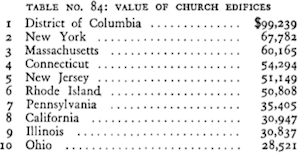
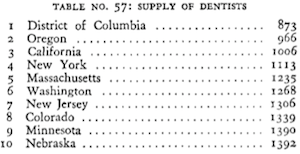
As Emily Badger notes, magazines have been ranking places to live for more than 80 years:

[C]onsider a three-part series by H.L. Mencken that ran in The American Mercury in 1931: It was succinctly headlined, “THE WORST AMERICAN STATE.” In the impressive tome, which covered some 47 pages across three issues of the magazine, Mencken and Charles Angoff methodically ranked the states (at the time, there were only 48 plus the District of Columbia) on everything from farm electrification to literacy rates to the salaries of teachers to the number of natives in Who’s Who in America. (*Blush*: They also included the local circulation per thousand people of The Atlantic Monthly). 

Matt Carmichael, editor of the website Livability.com, dug up this gem (“on microfiche!”) while working on a much more modern ranking of America’s 100 best small and mid-sized cities to live in, which he’s published today. … Mencken’s list, Carmichael notes, included some metrics we would never measure today, like the prevalence of lynchings (surprise leader: Wyoming) or death rates from typhoid fever (sorry again, Mississippi).

In preparing his own ranking, Carmichael became interested in how ideas about quality of life evolve, and not just with respect to rising living standards. “What would you have measured if you were doing a ‘best places to live’ list in 1965?” he asks. “Would it have been mall density? Or cul-de-sacs per capita?”

Amazon’s Porn Dilemma

Meghan Neal outlines the latest controversy in the e-publishing world:

Kernel magazine published an exposé last week detailing the dark corner of Amazon’s Kindle store that features [self-published] adult novels about truly repulsive topics like incest rape, pedophilia, and sexual abuse. Understandably, an uproar ensued, and retailers scrambled to take down the offending titles. But some people are worried that retails are overreacting, or that the take-downs will set a dangerous precedent for squashing free speech. Yesterday, the British bookseller WH Smith went so far as to shut down its entire website in response to the article. The site is still down as of this writing – with a landing page and apology up in its place.

The exposé notes that Amazon already has “strict guidelines for amateur authors who wish to self-publish with the Kindle Direct Publishing service”:

“We don’t accept pornography or offensive depictions of graphic sexual acts,” say the guidelines. “What we deem offensive is probably about what you would expect.” But the authors of these works are setting up fake publishing houses for themselves, which can be as simple as paying $200 for a set of ISBN prefixes, bypassing such restrictions.

PJ Vogt wishes Amazon had kept the smut on the digital shelves:

We outlaw snuff films, child porn and, increasingly, revenge porn, because actual people are harmed during their production.

Erotic fiction concerns fake characters who don’t exist in real life. You could argue that entertainment that caters to people’s darkest fantasies makes them more likely to enact them, but the science wouldn’t support you.

As for the idea that these books are just in bad taste, well, absolutely. They’re the worst. But you won’t find these books unless you’re looking for them. They don’t show up in Amazon search results, you have to go directly to their link. They’re hidden away in the digital equivalent of the video store’s curtain-covered backroom.

Meanwhile, Laura Hazard Owen wonders what a cleaner e-book marketplace would look like:

If e-book retailers truly want no porn to be sold through their sites, they’ll have to spend much more time and money than they do now implementing both automatic and human filters. They’ll also have to clarify exactly what they mean by porn, and in doing so they’ll risk alienating many authors and readers. The book industry reaped massive profits from the bestselling erotic trilogy. If that’s okay, but other porn isn’t – if, for instance, child rape porn is unacceptable – retailers will have to be much more explicit in publicly declaring what is and isn’t acceptable.

Loving Israel Before It Existed

Robert W. Nicholson surveys the long history of evangelical support for Zionism, insisting it “bears no resemblance to the portrait of cardboard-cutout Jesus freaks itching for the annihilation of the Jews and using them as pawns in their apocalyptic game”:

Part of God’s covenant with the Jewish people involved bringing them back from exile and doc_42setting them once again in their own land. Since the 16th century, and despite the sheer improbability of the idea, Protestant writers spoke of a Jewish ingathering and sometimes actively promoted it. When the Zionist movement proper began in the late 19th century, and especially after the Jewish state was founded in 1948, this unlikely prophecy seemed to many to be coming true before their very eyes. Although not all Christians embraced the new state, the vast majority of evangelicals became immediate supporters; one of them was President Harry Truman, a Baptist.

In brief, evangelicals love Israel because God loves Israel.

But there is also another way of putting it. For evangelicals, Israel’s mistakes are representative of their own mistakes as imperfect individuals in need of God’s grace. They are comforted by the fact that God remains faithful to Israel; it means that God remains faithful to them.

He notes that this alliance may not last forever, as sympathy for the Palestinians rises among younger and more progressive evangelicals. While reviewing two recent books about the Bible’s place in American political rhetoric, Robert E. Brown also tracks the decline of Israel as a potent symbol of our national aspirations. Why it was attractive in the first place:

[E]arly Americans — beginning with the Puritans — were accustomed to thinking of themselves as the new Israel, bound by covenant to honor God in their public life. This mindset helps to explain why the Exodus and other biblical events were so rhetorically compelling during the Revolution, why the patriots naturally identified with the Israelites struggling under the bondage and tyranny of the Egyptians.

That didn’t last:

[T]he controversy over slavery radically undermined the moral authority — and so the mythic power — of the Old Testament. Pro-slavery apologists repeatedly trumpeted that the Old Testament sanctioned slavery, and abolitionists responded by fashioning interpretive methods that privileged the moral vision of the New Testament at the expense of the Old. The mythology of an ideal Hebrew polity that could be held out for modern emulation was substantially eroded. The Civil War dealt a final, crushing blow to American self-identity as a renewed Israel.

But the resonances remain.

(Image via Temple Emanu-El)

An Inn For Outsiders

Nathaniel Rich reviews the history of the Chelsea Hotel, which, before closing to guests in 2011, was a famous hangout for artists:

[I]n 1905 … the Chelsea was converted to a luxury hotel, which was visited regularly by guests such as Mark Twain, William Dean Howells, and the painter John Sloan. After World War II, as the hotel declined and room prices fell, it attracted Jackson Pollock, James T. Farrell, Virgil Thomson, Larry Rivers, Kenneth Tynan, James Schuyler, and Dylan Thomas, whose death in 1953 further enhanced the hotel’s legend. (“I’ve had 18 straight whiskies,” said Thomas, after polishing off a bottle of Old Grandad on the last day of his life. “I think that’s the record.”) Arthur Miller moved into #614 after his divorce from Marilyn Monroe. Bob Dylan wrote “Sara” in #211 … Sid Vicious stabbed Nancy Spungen to death in #100. Arthur C. Clarke wrote 2001: A Space Odyssey at the Chelsea, William Burroughs wrote The Third Mind, and Jack Kerouac had a one-night stand with Gore Vidal. In 1966 Andy Warhol shot parts of Chelsea Girls at the hotel. In 1992, Madonna, a former resident, returned to shoot photographs for her Sex book.

Excerpts from an oral history of the hotel:

MILOS FORMAN (Film director): Once I was going up in the elevator to my room on the eighth floor. On the fifth floor the door opened, and a totally naked girl, in a panic, ran into the elevator.

I was so taken aback that I just stared at her. Finally I asked what room she was in. But then the elevator stopped and she ran away. I never saw her again. And I remember in the floor above me there was a man who had in his room a small alligator, two monkeys, and a snake. …

R. CRUMB (Artist): A bunch of really crazy people hung around the Chelsea. You could tell that people were going there just because of its reputation—poseurs with artistic pretentions or European eccentrics with money. There’d be poseurs sitting around the lobby. The lobby was really annoying.

I only started staying there about 10 years ago. It was always when somebody else paid for it. I never could afford to stay there—even 10 years ago, it was too expensive. Except for the old residents who clung desperately to their rooms and by some law were not allowed to be kicked out, the guests there were all arty-farty pretentious people with money who wanted to stay there because Sid and Nancy lived there. That was my impression, anyway. The whole thing seemed extremely self-conscious to me.

For more, here’s Part One of a 1981 BBC documentary about the hotel:

The rest is here. Update from a reader:

I enjoy reading the Dish, but I feel compelled to write you about a minor outrage. Why is there an article about a BBC movie about the Chelsea Hotel, when local indie director Abel Ferrara has made his own documentary about it, also featuring Milos Forman among others?

The trailer for Ferrara’s Chelsea on the Rocks:

The Utter Disaster Of Healthcare.gov, Ctd

Certain state health exchanges, such as New York’s, appear to be functional. But Healthcare.gov, the federal exchange that covers 34 states, continues to have problems. Suderman has no idea when it will be fixed:

It is clear now that, despite occasional suggestions of light at the end of the tunnel, the administration does not know how long the exchange problems will take to fix. At this point, then, it is necessary to at least consider the possibility that the federal exchanges, and perhaps a few of the state-run counterparts as well, are simply not going to work, at least not in the relatively short time the administration has to get the system on track.

Given how little information is available to outsiders, it’s hard to judge with great certainty. It is of course possible that the problems could be resolved in a few days or a few weeks. But the administration’s obfuscations, as well the repeated assurances both before and after the opening of the exchanges that they had everything under control, don’t inspire confidence that meaningful fixes are on the way. Already there are signals that the exchange problems could be deep and long-lasting.

Ezra explains the possible consequences of these glitches:

Short-term problems can become long-term problems. Take the difficulties accessing the federal exchanges. If those persist much longer, it could change the mix of people who ultimately sign up.

The people who really need insurance — so, sicker folks — will keep coming back until they get through. But younger, healthier people will give up after a try and decide to simply pay the fine, at least in year one. That would tilt the risk pool in states with federal exchanges towards older, sicker people, which would mean those states will see much higher premiums in year two, which will further dissuade healthier applicants from signing up, and so on. So that’s a case where a short-term problem could become a long-term one.

Additionally, this does not inspire confidence:

The deadline to apply to enroll in health coverage and not pay a penalty next year is not the same deadline as the end of the open enrollment period, March 31. It’s actually February 15. Which means that while you can still enroll after February 15, you’ll have to pay the penalty for going uninsured if you finish your application after that date. What’s terrifying isn’t the earlier date itself, but the facepalm-worthy fact that the administration, including the Internal Revenue Service, seems not have known about the earlier date until very recently when it was pointed out to them.

Go Big, Mr President

President Obama Delivers A Statement

Tomasky is highly skeptical that new negotations over the budget can result in any different outcome next time:

The position of the chaos caucus is going to be: Okay Obama, you give us entitlement cuts, and we’ll give you…uh, what? No revenues. They’re inflexible on that point. No programs (outside maybe of defense, and even that’s a maybe) funded at levels above sequestration. So actually, they’ll give nothing.

Beutler’s view:

[T]here’s a high likelihood that these negotiations will end the same way as all the others that preceded them did: no agreement. An agreement is only compatible with the GOP’s anti-tax absolutism if Democrats drop their demand for tax parity and agree to pay down sequestration with other spending cuts. Possible, but unlikely.

One way out of this would be for Obama to go big, to propose in these new talks a Bowles-Simpson-style deal in which major tax reform and entitlement cuts are exchanged for much higher revenues. If the GOP were a genuinely conservative party, actually interested in long-term government solvency and reform within our current system of government, they would jump at this. They could claim to have reduced tax rates, even if the net result were higher taxes. And the brutal fact is that, given simply our demographics, higher taxes are going to be necessary if we are to avoid gutting our commitments to the seniors of tomorrow. They could concede that and climb down from this impossibly long limb they have constructed for themselves.

I’ve long favored a Grand Bargain, but recognize its huge political liabilities without the leadership of both parties genuinely wanting to get there. But for Obama, it seems to me, re-stating such a possibility and embracing it more than he has ever done, is a win-win.

He may alienate Democrats – but after his cold-steel resistance to Tea Party blackmail, he has surely won some chips to his left. With independents and moderate Republicans, now reeling from the last month’s brinksmanship, it would signal centrist leadership that could bolster his political standing, even if the GOP turns him down. If his political standing improves, then the chances for a Democratic wave in 2014 increase.

But it means taking a real risk now. And this president has shown in his second term a much greater propensity to risk than in his first.

Think of the boldness of his response to Assad’s chemical weapons attack and agility in roping in Putin to deal with it (so far successfully). Think of his steadfast refusal to budge right up against the threat of default. He has earned new cred and could bolster it some more with a new, bold reach for the political center he can still represent. I believe it would be the most politically effective domestic policy agenda the president can plausibly move forward, if the GOP maintains its rigidity against immigration reform past the next Congressional elections. It would also help bring back the core coalition that gave him such a huge victory in 2008. It would mean the president has not given up on the long-term fiscal health of the country. And it is vital that no president gives up on that, especially one elected on the principle of hope as well as change.

Resignation to gridlock is perfectly rational. But changing that dynamic is never impossible. It’s what we elect presidents to do. And this one still could, if he swiftly exploits the opening this near-catastrophe has presented to him.

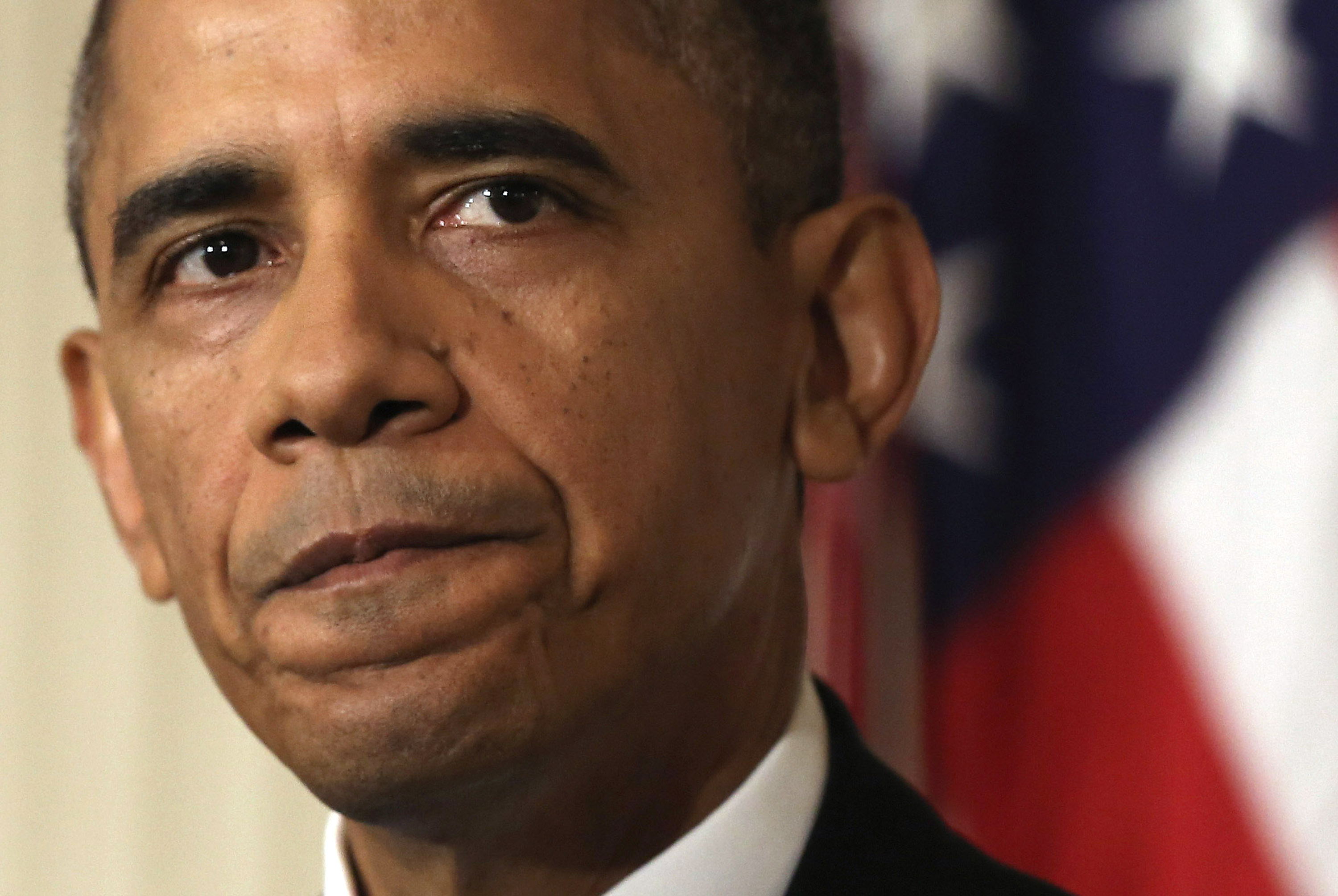
(Photo: U.S. President Barack Obama makes a statement at the State Dining Room of the White House October 17, 2013 in Washington, DC. Obama said the American people are completely fed up with Washington and called on cooperation to work things out. By Alex Wong/Getty Images.)

A Breakthrough With Iran?

This week’s talks in Geneva have been unusually productive:

In a rare joint statement, the nations called the discussions “substantive and forward-looking” and formalized the next round of negotiations in Geneva on November 7 and 8. The United States and the European Union depicted the talks as “substantive,”“very important,” and “positive.” One senior Obama administration official beamed with excitement. “I’ve been doing this now for about two years, and I have never had such intense, detailed, straightforward, candid conversations with the Iranian delegation before,” said the official. “I would say we really are beginning that type of negotiation where one could imagine that you could possible have an agreement.”

Kaplan is similarly hopeful:

First, the chances for a truly historic breakthrough are pretty good – which, at this stage in talks of such magnitude, is astonishing. Second, the Iranians’ main demands—at least what we know of them – are pretty reasonable. … Not only that, but after the first day of meetings, the U.S. and Iranian delegations broke away for an hourlong bilateral session, which American officials described as “useful” in clearing up ambiguities.

After the second day, another meeting was set for November 7 – 8. Some said it would be at the “ministerial” level, which, if true, would mean Secretary of State John Kerry would head the American delegation. A U.S. secretary of state doesn’t usually become so visibly involved until much closer to the end of a negotiation, suggesting that maybe we’re closer to the end than anyone could have imagined.

This is remarkably fast work for any set of nations negotiating any issue—much less for nations that haven’t had diplomatic relations in 34 years, and on an issue that ranks among the globe’s most perilous and contentious.

Cole is cautiously optimistic:

Can a breakthrough be had? I believe so. The sticking points will be the extremists on both sides. In Iran, the Revolutionary Guards and Leader Ali Khamenei think the negotiations are another imperialist US trick, and getting them to sign on the dotted line of an agreement won’t be easy. On the US side, the Israel lobbies and Israel itself will accept nothing less than the mothballing of the whole Iranian enrichment program, which is highly unlikely to happen. A settlement would therefore have to be one that could be accomplished by Presidents Rouhani and Obama despite the carping of the right wings of their countries.

Colin H. Kahl and Alireza Nader wants the US to be realistic:

Instead of pushing for an impossible goal, the United States and other world powers should push for a possible one: an agreement that caps Iranian enrichment at the 5 percent level (sufficient for civilian power plants but far away from bomb-grade) under stringent conditions designed to preclude Tehran’s ability to rapidly produce nuclear weapons, including restrictions on Iran’s stockpile of low enriched uranium, limitations on centrifuges, intrusive inspections, and halting the construction of a plutonium reactor that could open an alternative pathway to nuclear weapons. Such an accord would allow Khamenei and Rouhani to claim Iran’s “rights” had been respected, giving them a face-saving way out of the current nuclear crisis. Even this might be difficult for the Iranian regime to stomach. But if paired with meaningful sanctions relief, it has a much better chance of success than insisting on the complete dismantling of Iran’s program.

Walt agrees:

Iran had zero centrifuges in operation in 2000 and only a handful in 2005, the last time the Iranians offered to freeze their program. The United States rejected all these previous offers, and now Iran has some 19,000 centrifuges, a plutonium program, and a larger stockpile of uranium that could in theory be enriched to make a bomb if Iran ever decides it wants one. In short, the hard-line position of issuing threats, imposing sanctions, and insisting that Iran give in to all our demands has backfired and put us in a worse position today.

Which is why I support engagement of exactly the kind we’re now doing and believe it is the sanest way to achieve peace and stability in the Middle East – and, ultimately, democracy for the people of Iran. Getting Iran more fully into the international economy, rewarding the reformists, increasing bilateral contact and communication all reinforce each other. We have a chance for a virtuous cycle rather than a vicious one. As Reagan ended the first cold war by engaging moderates, so Obama can end the Iranian version by rewarding Rouhani. Because, like Gorbachev, he’s the best hope we’ve got now that sanctions have almost achieved their goal.

The Benefits Of Quiet Diplomacy

SWITZERLAND-IRAN-NUCLEAR-POLITICS-DIPLOMACY

Joshua Keating is, like me, grateful the shutdown has been drowning out coverage of our negotiations with Iran:

Thanks to the government shutdown and the looming default, the news cycle this week has skewed heavily domestic, and understandably so. Somewhat lost in all this has been what is actually a pretty big foreign-policy story, the restarted Iran nuclear talks in Geneva. It’s still early to say, but while nobody’s been paying attention, the talks have been going surprisingly well. Those two things may be connected.

[Neither lifting sanctions or allowing some uranium enrichment on Iranian soil is] popular on Capitol Hill. And as Yochi Dreazen and John Hudson of Foreign Policy report, some members of Congress – some Democrats, in particular – are already signaling opposition to a deal involving lifting sanctions. But Congress has also had its attention elsewhere this week. As Rep. David Price told FP, “We’re in such a weird situation on the Hill with the shutdown and all the oxygen is pretty much going to that fight.”

It’s easy to imagine an alternative-universe scenario in which the government is not shut down, the Iran talks are front-page news, and this is a major focus of attention from Capitol Hill. It still may be tough to the White House to sell Congress on lifting sanctions, but it has to have helped lead negotiator Wendy Sherman that Congress hasn’t been setting the terms of this debate before she even sat down with the Iranians.

And as I noted last night, the talks have been remarkably cordial so far. A distracted Congress and relative quiet about the Israel-Palestine peace process is also helpful, as the invaluable Roger Cohen notes today:

For almost three months now Israelis and Palestinians have been negotiating peace in U.S.-brokered talks. They have been doing so in such quiet that the previous sentence may seem startling. Nobody is leaking. Because expectations are low, spoilers are quiescent. There is a feeling nobody opposed to a resolution need lift a finger because the talks will fail all on their own. This is good. Absent discretion, diplomacy dies.

I think we’re going to get a deal that precludes a war against Iran and begins a period of constructive engagement and detente with the theocracy in Tehran. There’s still a lot to get nailed down and verified, and there are powerful forces in both countries determined to prevent a deal (the Revolutionary Guards, AIPAC and religious fanatics in Iran’s and America’s reddest states among them) but both recently elected governments in Washington and Tehran have a huge amount riding on success.

Avoiding another war in the Middle East – and the wave of murderous Jihadism and polarization that would provoke – is, to my mind, the most important foreign policy goal of the next three years. The second most important? A two-state solution in Israel/Palestine. Domestic drama – and a new constellation of forces in the Middle East, as Cohen explains – may help Obama secure both.

Am I delusional? Maybe. But the coalition of countries behind the negotiations with Iran, combined with the unexpectedly successful chemical weapons suppression and destruction in Syria, has isolated Netanyahu even more acutely in the world, as his political position at home remains tenuous.

You know who he reminds me of – threatening to upend global peace and break the US-Israel alliance by a unilateral attack? Ted Cruz.

(Photo: US Under Secretary for Political Affairs Wendy Sherman (right) smiles at the start of two days of closed-door nuclear talks in Geneva October 15. By Fabrice Coffrini/AFP/Getty Images)

The Wave On The Horizon?

3875705476_f5a3b5ef7e_b

Republican Congressman Charles Boustany worried recently that actions by House Republicans “could trigger a wave of discontent that could wash out our Republican majority in the House if we’re not careful.” Nate Cohn continues to insist that the Republican majority is safe:

[E]ven if public outrage with the GOP persists at today’s levels, there good reasons to question whether the wave will endure through November 2014. Unlike real waves, electoral waves shrink as they approach the shore. Political scientists have found that the generic ballot overestimates the president’s party this far from an election. That’s part of why Alan Abramowitz estimates that Democrats need a 13 point Democratic edge on September 1 to win the 17 seats necessary to retake the chamber in November.

Enten disagrees and argues that “Abramowitz’s forecast is a good starting-point for understanding how uphill is the Democrats’ task in taking back the House, but it is far from perfect.” Furthermore:

The thing is that expert ratings (like most polling) are not all that predictive a year out from an election. At this point in the 2006 cycle, there were 17 Republican seats in the lean or tossup categories (pdf). That’s well short of the 30 seats that Democrats would ultimately take from Republicans. At this point in the 2010 cycle, there were 28 Democratic seats in the lean or tossup category. Republicans, of course, went onto gain 63 seats in 2010.

It’s not until later in the cycle when individual seat rankings become quite useful. That’s when potential challengers and incumbents read the national environment and decide to run or not. Chances are that if the 4-5pt Democratic lead holds, the individual seat rankings will reflect that edge. For now, individual seat ratings probably aren’t all that helpful to understanding which way and how hard the wind is blowing.

My view, for what it’s worth, is that this event has the potential to deeply shape public attitudes about the GOP’s fitness for public office and change the shape of the next Congress decisively. I mean, here’s Ross today:

However you slice and dice the history, the strategery, and the underlying issues, the decision to live with a government shutdown for an extended period of time — inflicting modest-but-real harm on the economy, needlessly disrupting the lives and paychecks of many thousands of hardworking people, and further tarnishing the Republican Party’s already not-exactly-shiny image — in pursuit of obviously, obviously unattainable goals was not a normal political blunder by a normally-functioning political party. It was an irresponsible, dysfunctional and deeply pointless act, carried out by a party that on the evidence of the last few weeks shouldn’t be trusted with the management of a banana stand, let alone the House of Representatives.

And the key thing for responsible actors in the next year is to remind voters again and again about what this crew voted for: a second great depression to appease their ideological purity. They nearly got away with it. The lesson should not be relief and moving on; it should be continued outrage at this vandalism and brinksmanship and a demand for accountability. That means voting Democrat next year even if you disagree about many aspects of their policy proposals. Because this is not about mere policy. It’s about a party threatening to break apart the country if they do not get the rest of us to bend to their minority will and their apocalyptic vision.

If that message can sink in with independents and moderate Republicans, then of course the Democrats can regain the House – and finish the job of the Obama presidency.

I don’t like partisanship. But if it is an indispensable means to ending this level of blackmail of the entire system, then it is a necessary, short-term price to pay.

(Photo by Miguel Teixeira)

The Sabotage Of American Democracy

Negotiations Continue On Capitol Hill One Day Before Debt Limit Deadline

I suppose I shouldn’t in any way be shocked by the extraordinarily vehement attitude of Tea Party Republicans after they nearly destroyed the US and global economy. And yet I am somewhat grateful I can still be shocked by a column on Fox News’ website. Here’s how it starts:

American taxpayers have once again been trampled by establishment Republicans – a thundering herd of chicken-hearted Republicans in Name Only (RINOs) galloping to the Left. The debt ceiling deal struck between Senate Majority Leader Harry Reid and Senate Minority Leader Mitch McConnell is a victory for President Obama and Democrats. ObamaCare is still the law of the land. The government is still spending money it does not have. And thousands of government workers just got a two-week vacation courtesy of the taxpayers.

Let’s take the last three disappointments/wishes from the non-chicken-hearted.

“ObamaCare is still the law of the land.”

Yes, it is. But that’s because the president who proposed it and the Senate that voted for it were re-elected in 2012. That’s how our system works. Is it possible Todd Starnes doesn’t know this? No, it isn’t. So it is fair, I think, to infer that he believes that because his party regards this centrist, private-sector-dependent reform as an “abomination”, the federal government should be shut down permanently and the country’s credit destroyed, prompting a global depression. And that’s why this episode has been so disturbing. It is not that the GOP doesn’t have a perfect right to vote against Obamacare a zillion times; it’s that they responded to their electoral loss in 2012 by threatening to destroy the entire polity and economy. That is not a tactic or a strategy; it’s a declaration of war against the system of American government.

“The government is still spending money it does not have.”

Yes, it is. But almost all the current debt is a function of massive tax cuts in 2001 that were never paid for (by the GOP), two bank-breaking wars that were never paid for (by the GOP), a big new entitlement for seniors, Medicare D, that was never paid for (by the GOP), and the usgs_line.phprevenue sinkhole provided by the worst recession since the 1930s (begun before Obama took office.). The scale of the debt thus acquired is vast. I think Starnes is absolutely right to make its reduction a priority. The question is a pragmatic one – how do we cut entitlement and defense spending along with raising revenues to get there?
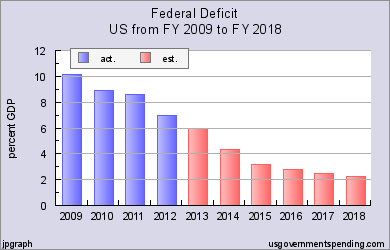
One side is prepared to consider cuts in entitlement programs it cherishes; the other side is resolutely opposed to any net revenue increases at all. One side could begin to negotiate a debt deal that was 2-1 spending cuts to tax hikes; the other side refuses to negotiate even a 10-1 deal. What, for example, does the GOP offer the Democrats on fiscal matters right now? I see nothing. If one side is prepared to give nothing, no deal can be done. And if the Tea Party is right about the urgency of cutting the debt, no deal is very bad fiscal news.

And part of the pragmatic solution is recognizing that immediately ending the government’s current deficit by spending cuts alone would so vitiate economic growth that it would be counter-productive. Starnes is therefore not actually serious about the debt, and neither is the Tea Party.

Their proposal for an immediate balancing of the budget would deepen the debt; and their absolute refusal to countenance any net new revenues to the federal government means they will never get an actual compromise that would actually cut the debt in a meaningful long-term way. In other words, their absolutism on taxes essentially destroys their debt-reduction position … as long as we remain in a constitutional democracy with two parties trying to represent all the people. If the president were saying that he does not care about the debt at all, it would be one thing. But, this president, on current trends, will have brought the deficit down from more than 10 percent of GDP when he took office to around 3 percent when he leaves, during a still tepid recovery (see graph above). What more can these people demand – except, of course, his resignation?

And again, that’s why this episode should not be regarded as anything but a deeply serious political and constitutional crisis. One party is refusing to accept that the other one exists, that not all of America agrees with them, and that democratic norms require compromise in that context.

“Thousands of government workers just got a two-week vacation courtesy of the taxpayers.”

This demonization of government itself, and generalized slur against all those who work for it (and who are also tax-payers) is not just an insult added to injury.

It is another attack on the entire system. As we found out in the fiasco, even Ted Cruz likes government sometimes. For him, it is about keeping monuments open. For other Republicans, it is about scientific research.  And the broader point is that government is the point of politics. There has to be a governing authority that commands universal assent in any functioning democracy. Yes, it should be solvent and run surpluses in peacetime. But it must exist. And conservatism in its proper sense is about governing firmly, securing the rule of law, and sustaining the legitimacy of the democratic system.

What the Tea Party represents, in stark contrast to conservatism, is a radical attack on the very framework of our governing system. It is not right or left within our democratic system. It is a form of secession from it and a de facto abandonment of the notion of one country under one rule of law. It is about sabotage rather than opposition. It is bad enough when one party will seek to sabotage the law of the land – by attempting to rally the public to spurn the new healthcare law, in the hopes of causing it to collapse. But when the dominant faction of one party is bent on sabotaging our democracy, it must not simply be tolerated or appeased the way John Boehner shamefully did. It must be defeated. Anything less is a form of appeasement of forces and ideas that are truly antithetical to the democratic way of life and to constitutional governance.

Yes, in my view, the situation is that grim. If the Republican right’s fanaticism still blinds them to the error of their ways after they nearly destroyed the global economy (and brutally damaged the American one), it becomes clear that only a total collapse of the American government and economy could truly teach them the futility of their deluded aspirations. The rest of us cannot and must not tolerate that. We must draw a line. That line, for those who still believe in the regular order of our democracy, is November 2014.

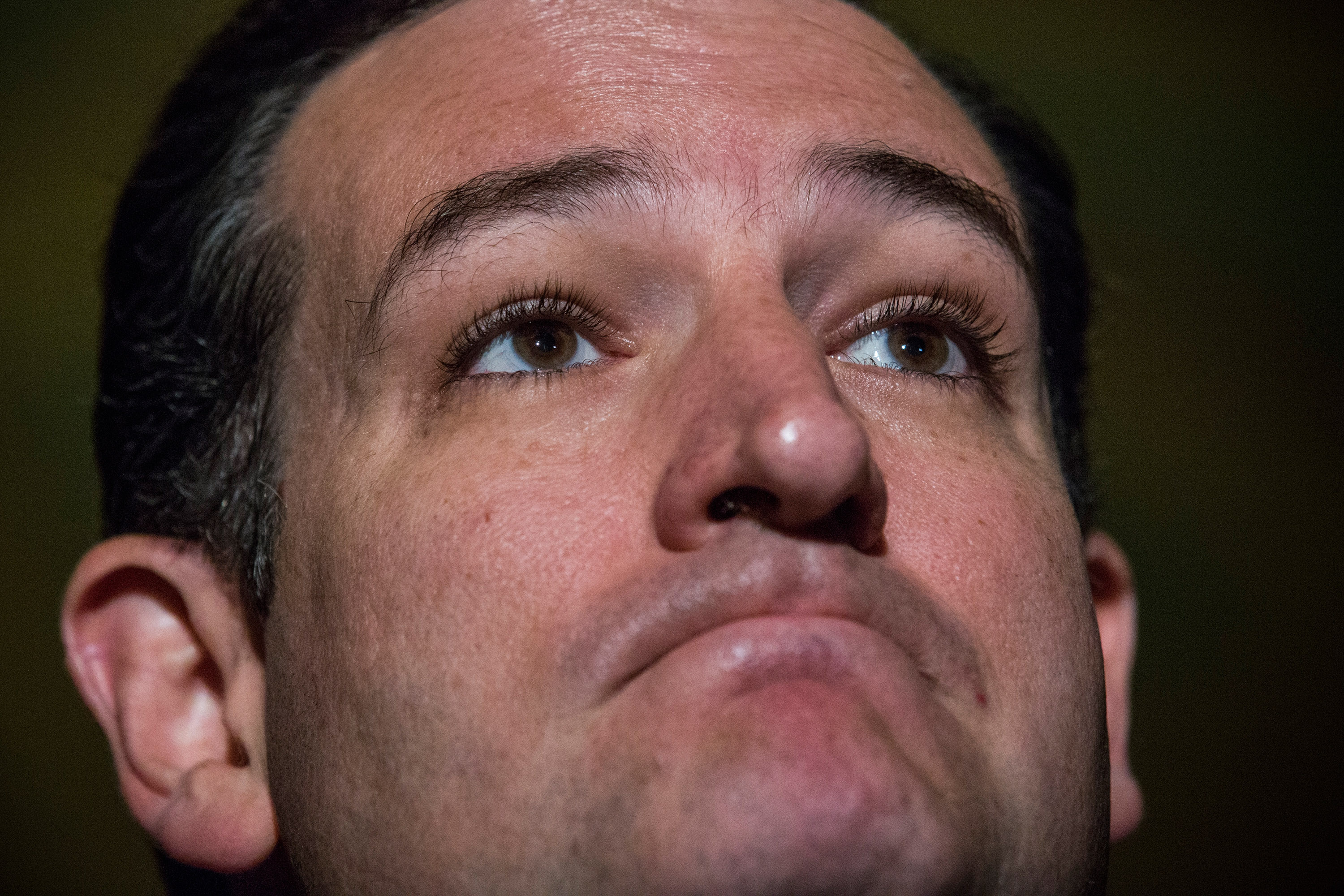
(Photo: U.S. Sen. Ted Cruz (R-TX) answers questions from the media after meeting with Republican senators regarding a bipartisan solution for the pending budget and debt limit impasse at the U.S. Capitol October 16, 2013 in Washington, DC. By Andrew Burton/Getty.)