Yglesias Award Nominee

“[The Obamacare defunders] hurt the conservative movement, they hurt people’s health care, they hurt the country’s economic situation and they hurt the Republican party … These are the people who said, ‘Plan: Step One, Invade Iraq. Step Two, It turns into Kansas,’ Could I ask if there’s anything in between Step One and Step Two? ‘Oh ye of little faith,’” – Grover Norquist.

Update from a reader:

Just wanted to point out that Norquist didn’t have much criticism for the Republicans during the shutdown.  Here are some of his tweets:

Which make his quote today all the more remarkable. (Award glossary here, for new readers.)

The Utter Disaster Of Healthcare.gov, Ctd

A reader writes:

I’ve gotta push back a little against all the howling about how bad the online insurance exchanges are.  I just signed up yesterday in New York and had no prob whatsoever.  Took me about 20 minutes.  Smooth sailing, no hanging, no repeat entries, and pretty simple to use from a UI standpoint.  I even called customer service and was on hold for maybe a minute.  Ask me how long I’m on hold for Verizon, Dell, etc, whenever I call them.  My cousin also signed up yesterday – same experience, and I have two friends who enrolled last week, more or less same.

Furthermore, the fact that a lot of “lookers” aren’t “buyers” yet is fairly irrelevant, in my opinion.  Every time I’ve had to change my insurance I’m used to seeing a very small number of plans I can afford and must compare.  New York showed me 124 (?!).  For people who aren’t used to making financial comparisons, I’m sure there’s gonna be a lag time between info gathering and pulling the trigger.

On a more substantive note:

I’ve worked for myself for about 15 years and insurance shopping has always been a nightmare.  Last time I had to change my plan was a few years ago and I had about five options – all wildly expensive, most fairly sucky.  I ended up with an okay plan for my wife and me which, with double-digit annual increases, is now $1400/mo (not a typo).  That’s $16,800/year, or roughly 22% of my usual income, and I can’t write it off.  Yesterday, the exchange listed 124 plans, the great majority of which were less expensive than I have now.  I got literally exactly the same plan as I have now, from the same carrier, for ~ $1000/mo, and with the subsidy, I’ll be down to ~ $700/mo.  This is a life changer for us.

I know people’s mileage may vary, and I’m sure some of the exchanges have problems, but that’s my story.  I have direct firsthand knowledge of four people’s forays onto the exchange and all of them were good.

Update from a reader:

You posted a response from a reader noting that New York’s exchange is working well and gave them 124 options to choose from. New York is a state that created its own exchange, along with California, Kentucky, Connecticut, Rhode Island, and a few others. The states that created their own are performing fairly well, so your reader’s story is not surprising. What we haven’t heard yet are any success stories from the 36 states that relied on the federal government to build its website. The exchanges built by the Feds continue to appear to be an utter failure.

Another writes:

When judging Obamacare, you have to remember the following: 1. Each “application” can/probably does represent more than one person; 2. You have to count all of the “up to 26 year olds” that can stay on their parents insurance plan; 3. You have to count all of the people who got insurance through the expansion of Medicaid (e.g., California alone added 600,000+). In other words, you have to count ALL of the people who now have or soon will have healthcare because of Obamacare.

Another:

Please don’t forget the people who are getting their insurance greatly improved under the ACA. Not everyone needs subsidies. We have a small family business and purchase our own health insurance. Under the ACA, we will pay the same amount but get a much better policy with no underwriting and no chance of losing insurance if we actually use it. Unfortunately, there is no current benchmark to gauge how many people are getting this benefit, but it should also be included in the discussion.

One more:

Because so many Americans live paycheck to paycheck, most people aren’t going to want to part with hundreds of dollars until they need to, which in this case would be December. As for those who tried to get insurance and failed, it’s not like a news site being down where people can just get their news from somewhere else. In this case, they can’t get it anywhere else – that’s why the ACA exists! – so most people will return once the site is fully functional.
The Republican Radicals Won’t Be Driven Out

That’s the thesis of Frank Rich’s latest:

Some Democrats … cling to the hope that electoral Armageddon will purge the GOP of its radicals, a wish that is far less likely to be fulfilled now than it was after Goldwater’s landslide defeat, when liberalism was still enjoying the last sunny days of its postwar idyll. This was also the liberal hope after Gingrich’s political demise of 1998. But his revolution, whatever its embarrassments, hypocrisies, and failures, did nudge the country toward the right: It’s what pushed Clinton to announce in his 1996 State of the Union address that “the era of big government is over” and to adopt policy modulations that tamped down New Deal–Great Society liberalism. The right has only gained strength within the GOP ever since. Roughly half of the party’s current House population was first elected in 2010 or 2012, in the crucible of the tea-party revolt. While it’s Beltway conventional wisdom that these Republicans don’t know how to govern, the real issue is that they don’t want to govern. That’s their whole point, and they are sticking to it.

He dumps on the idea that “Chris Christie will parlay his popularity in the blue state of New Jersey into leading the national party back to sanity and perhaps even into the White House”:

To believe this you not only have to believe in miracles, but you also have to talk yourself into buying the prevailing bipartisan canard, endorsed by King and Obama alike, that the radicals are just a rump within the GOP (“one faction of one party in one house of Congress,” in the president’s reckoning). In reality, the one third of the Republican House caucus in rebel hands and the electorate it represents are no more likely to surrender at this point than the third of the states that seceded from the Union for much the same ideological reasons in 1860–61. Unless and until the other two thirds of the GOP summons the guts to actually fight and win the civil war that is raging in its own camp, the rest of us, and the health of our democracy, will continue to be held hostage.

The Utter Disaster Of Healthcare.gov

Robert Laszewski explains what the insurers are experiencing:

The insurance industry is literally receiving a handful of new enrollments from the 36 Obama administration-run exchanges. It’s really 20 or 30 or 40 each day through last week. And a good share of those enrollments are problematic. One insurance company told me, “we got an enrollment from John Doe. Then five minutes later we got a message from CMS disenrolling him. Then we got another message re-enrolling him.” On and on, up to 10 times. So insurers aren’t really sure if the enrollments they’ve got are enrollments they should have.

The administration had planned on 500,000 sign-ups in October. But Garance digs into the dismal rate of enrollment:

[It] so far is low enough that if you extrapolate it out it, the health-insurance exchanges would see only 2.76 million people enrolled at the end of the six month open-enrollment period. That number falls well short of the 7 million the administration has announced as its first-year enrollment goal and reflects the lack of enrollment reported through the federally-run exchanges, which cover 34 states, as well as troubles at the state exchanges.

That’s right: Even as the disaster of Healthcare.gov has gotten a fair bit of attention, it turns out that a substantial fraction of the state-run exchanges also have been plagued by moderate to severe technical issues that have hampered enrollment. The verdict from trade publication MedCity News after the first day of state exchange enrollment was that six of the 16 state exchanges were failing. Two weeks after launch, several of the exchanges—including the ones serving Oregon, Vermont and Hawaii—remain hamstrung by technical problems, according to news coverage in the states.

Of course it didn’t have to be this way:

[I]n the small alternate universe of states where enrollment has not been thwarted by technical issues at the state or federal level, the data suggests what must be a welcome proof of concept for the exchanges. The demand is there and people are completing applications through the marketplaces at a solid clip where it’s possible for them to do so.

Straining to see a silver lining, Sarah Kliff finds some evidence of progress on the site.

How The House Spent Its Day

Berating the director of the National Park Services, Jonathan Jarvis:

Nora Caplan-Bricker puts this piece of political theater in perspective:

Whether or not the parks service did a flawless job implementing the shutdown (after furloughing over 20,000 of its roughly 23,000 employees), only in a funhouse-mirror version of reality should members of Congress be debating the functions of an agency that accounts for .0006 percent of the federal budget on the day before we may default on our national debt.

Tim Murphy also covered the hearing:

Republican congressmen had a handy point of comparison for the closures on the National Mall: Occupy DC set up camp on the NPS-maintained McPherson Square for 100 days in 2011 without harassment from park police. “Do you consider it an exercise of your First Amendment right to walk to a monument that you helped build,” Rep. Trey Gowdy (R-S.C.) asked Jarvis, “or is it only just smoking pot at McPherson Square?”

Rep. John Mica (R-Fla.) seized on a quote, provided anonymously from a NPS ranger to aWashington Times columnist, that “we’ve been told to make life as difficult for the people as we can.” Over the last two weeks, conservatives have cited this as evidence the White House may have orchestrated the monument closures. Jarvis insisted that it was strictly an NPS decision. He denied any such order to make life difficult and said the quote—which after all appeared in a newspaper that regularly publishes Ted Nugent—was “hearsay.” “It may be hearsay,” Mica said, but he was sticking to it.

Can The GOP Recover?

First Read remains hopeful:

Almost a year removed from the Obama-Romney presidential election, 2013 has been a lost year for the Republican Party. Has it improved upon its image problem? Nope. Has it fixed its shortcomings with women and minority voters? Nope. Is it in a stronger place than it was in Oct. 2012? No way. Perhaps more than anything else, the GOP remains blinded by the health-care law — and by President Obama himself (who will never run for office again). Indeed, in some ways, you could see this entire shutdown/debt ceiling debate over the president’s health-care law as a replay of the House GOP’s impeachment of Bill Clinton in 1998 — a last-ditch fight against the term-limited incumbent. The good news for the Republican Party is that the Clinton impeachment is a reminder that its problems can be fixed. After all, the GOP won the White House just after Clinton’s impeachment.

Felix, on the other hand, compares the Tea Party to a pack of zombies:

Yes, the President has won an important battle against the zombies. But while it’s possible to win a zombie battle, it’s never possible to win a zombie war. No matter how many individual zombies you dispatch, there will always be ten more where they came from. The Tea Party doesn’t take legislative defeat as a signal that it’s doing something wrong: it takes it as a signal that nothing has really changed in Washington and that they therefore need to redouble their nihilistic efforts. Take it from me: come February, or March, or whenever we end up having to have this idiotic debt-ceiling fight all over again, the Tea Party will still be there, and will still be as crazy as ever. A bruised zombie, ultimately, is just a scarier zombie.

Chait differs:

[W]ill Republicans continue to hold the debt ceiling hostage indefinitely (or, at least, until a Republican occupies the White House)? I doubt it. The debt-ceiling fight was not brought on by Ted Cruz and his baying hordes. It was actually the preferred strategy of mainstream Republicans, especially Paul Ryan. The Ryanites opposed shutting the government down because they wanted to extort Obama with default. The crazies who favored the shutdown were actually willing to lift the debt ceiling so they could keep the shutdown going.

The Democrats Have Finally Grown A Spine

Ezra looks at what it has gotten them:

Democrats managed to get the budget conference they’ve been pursuing for six months. They got a CR of the length they wanted and ending before the next sequestration cuts rather than six-month CR that Sen. Susan Collins proposed. They got a debt-ceiling increase all the way into February. This is far beyond what Democrats thought possible on Sept. 30.

But the strategy Ted Cruz managed to force on the GOP was so suicidal that Democrats felt comfortable forcing Republicans to cave completely. They were so confident that they managed to reject a deal proposed by Sen. Susan Collins and supported by many Senate Democrats because it funded the government for longer than the Democratic leadership preferred. That’s a level of control over the outcome that Democrats never expected to have.

Going forward, not only will Republicans be afraid to shut down the government or threaten the debt ceiling again during this Congress, but if Republicans somehow end up doing it anyway, Democrats will be unafraid of the fight.

Josh Marshall gives Obama credit for standing strong:

Many Republicans knew this was going to be a disaster going in. But just as many totally misread Obama. Just days before the shutdown numerous high profile Republicans insisted there was no way Obama wouldn’t negotiate. But probably the key driver of this drama has been President Obama’s refusal to negotiate over raising the debt ceiling. Yes, there’s been some back and forth here at the end, but as begging like this suggests, it’s mainly been to sort of out terms of surrender. But that refusal has defined the entire standoff.

A Party That Can’t Be Trusted

Dreher has had enough with the GOP:

I cannot believe I’m saying this, but I hope the House flips to the Democrats in 2014, so we can be rid of these nuts. Let Ted Cruz sit in the Senate stewing in his precious bodily fluids, and let Washington get back to the business of governing.

A-fucking-men. Larison nods:

After watching the display of the last few weeks, it is hard to argue that Republicans should have control over any part of the government. It is even harder to believe that they should increase what control they have.

Millman isn’t particularly “pessimistic about the GOP’s chances in the next couple of elections as a consequence of their manifest insanity”:

The electorate is fickle, after all. For that very reason, though, I’m quite pessimistic about the quality of governance in this country going forward.

The Game Cruz Is Playing

Here he is announcing that he won’t delay the Senate bill:

Barro has his number:

Nothing has changed today to make delay and destruction any more futile than it was yesterday, back when Cruz was in favor of delay and destruction.

The only thing that has changed, I think, is that Ted Cruz has more to lose than to gain by continuing to wreak havoc. He made his point and drastically increased his national profile. He built an army of deluded conservative supporters who adore him. Taking another grandstanding opportunity and pushing this Senate vote back by a day or two won’t raise his profile very much, and it will make his Republican colleagues even more furious with him than they already are.

But in the future, when wreaking havoc is once again in Cruz’s political interest, you can expect him to do so.

Allahpundit unpacks Cruz’s strategy:

[H]e already positioned himself as “the purest conservative in the 2016 field” after all this? The policy goal of defunding O-Care was always quixotic but the political benefits of pounding the table against the law, staging a 21-hour speech against it, and backing the first major government shutdown in nearly 20 years to protest it are obvious. Whether he’s now the “purest” conservative in the field, he’s certainly the most famously populist conservative. Which, I think, was his main goal on the political side of this.

Weigel adds:

Cruz was never going to jam the House by delaying a deal and absorbing all the blame for the consequences. That the media thought so reveals that his image has changed radically since getting to the Senate. He’s no longer viewed as the GOP’s answer to Barack Obama. The media views him as the Sarah Palin of the Senate.

The Political Price Of Epistemic Closure, Ctd

Debt Ceiling Denailism

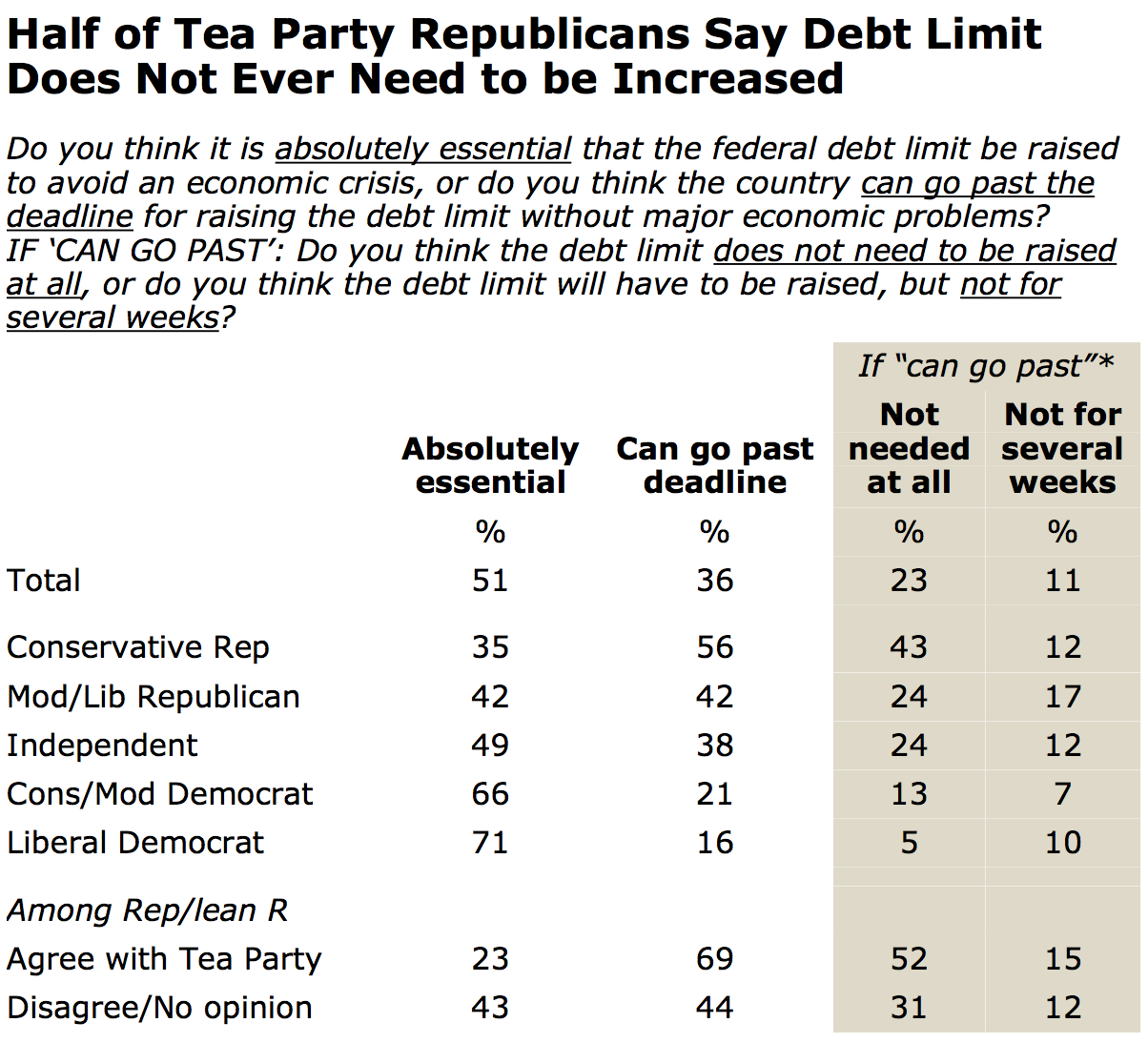
Plumer flags the numbers above from Pew:

[A] majority of Republicans say that the United States can blow past the Oct. 17 debt ceiling deadline without “major economic problems,” Pew finds. But what’s striking is that 52 percent of tea party Republicans don’t think we ever need to raise the ceiling.

Maybe this is the moment we discuss the Dunning-Kruger Effect, defined thus:

The Dunning–Kruger effect is a cognitive bias in which unskilled individuals suffer from illusory superiority, mistakenly rating their ability much higher than average. This bias is attributed to a metacognitive inability of the unskilled to recognize their mistakes.

Of course, understanding that the debt ceiling is not permission to raise spending further but merely to pay the bills already agreed to is counter-intuitive. It takes some explanation. People aren’t stupid for grasping this, just understandably ill-informed. But that’s where elites are necessary, from within a political coalition. And those elites are missing or compromised. John McCain can complain all he likes about wacko-birds. But who was it who put a Class A wacko-bird on his own national ticket? McCain empowered Palinism as much as anyone. A reader adds:

First, thanks for your continuing coverage and commentary regarding the debt limit and government shutdown battle. My thought is this: where is the courage of the leaders of the Republicans?  Where is the Bush family?  Where are the so-called moderates, like Chris Christie?

Where are the business leaders? They should be hammering the GOP to extend the debt limit. They have much at stake, far more than any favors the GOP can do for them. Why are the more sane thought leaders and influencers of the Republican party either silent, or at the very least very reserved?  Are they all afraid of the bullies in the Tea Party and conservative media? My feeling is that if anyone stood up to the bullies, they would find that bullies usually back down when confronted and are not that tough.

The national and world economies hang in the balance.  Our leadership in the world hangs in the balance. Make no mistake, if the US defaults this country will never be the world leader it is today again.  There is so much at stake that you think some on the GOP and their allies in the corporate community would rise up to tame the radicals in the party.

The Tea Party is like crack to the Republican party.  It has produced some highs, but it is also a poison that destroys.  Someone in the GOP needs to get the party to break its addiction.

But intelligent, educated Republicans, like Charles Krauthammer and George Will have defected to the loonies. The Bush family? They’ve made some sane comments – but not at a critical moment like this past week, when one would have thought their simple patriotism would have demanded some kind of intervention. And so the epistemic closure tightens and out polity’s dysfunction intensifies still more.