The Tea Party As A Religion

Mitt Romney Attends Tea Party Rally In New Hampshire

Dishheads know I believe that you cannot understand the current GOP without also grasping how bewildered so many people are by the dizzying onset of modernity. The 21st Century has brought Islamist war to America, the worst recession since the 1930s, a debt-ridden federal government, a majority-minority future, gay marriage, universal healthcare and legal weed. If you were still seething from the eruption of the 1960s, and thought that Reagan had ended all that, then the resilience of a pluralistic, multi-racial, fast-miscegenating, post-gay America, whose president looks like the future, not the past, you would indeed, at this point, be in a world-class, meshugganah, cultural panic.

When you add in the fact that the American dream stopped working for most working-class folks at some point in the mid 1970s, and when you see the national debt soaring from the Reagan years onward, made much worse by the Bush-Cheney years, and then exploded by the recession Bush bequeathed, you have a combustible mixture. It’s very easy to lump all this together into a paranoid fantasy of an American apocalypse that must somehow be stopped at all cost. In trying to understand the far-right mindset – which accounts for around a quarter of the country – I think you have to zoom out and see all of this in context.

Many of us found in Barack Obama a very post-ideological president, a pragmatist, a Christian, and a traditional family man, and naively NEGATIVE# josephm 210524--SLUG-ME-VA-AG-1-DATE--11/03/2009--LOCAbelieved that he could both repair the enormous damage done by the Bush-Cheney administration and simultaneously reach out to the red states as well. I refuse to say the failure is his. Because he tried. For years, he was lambasted by the left for being far too accommodating, far too reasonable, aloof, not scrappy enough, weak … you know the drill by now. In fact, he was just trying to bring as much of the country along as he could in tackling the huge recession and massive debt he inherited at one and the same time, and in unwinding the 9/11 emergency, and in ending two wars and the morally and legally crippling legacy of torture (about which the GOP is simply in rigid denial).

Obama got zero votes from House Republicans for a desperately needed stimulus in his first weeks in office. So I cannot believe he could have maintained any sort of detente with the Republican right, dominated by the legacy of Palin, rather than McCain. But the healthcare reform clearly ended any sort of possibility of coexistence – and the cold civil war took off again. The first black president could, perhaps, clean up some of the mess of his predecessor, but as soon as he moved on an actual substantive change that he wanted and campaigned on, he was deemed illegitimate. Even though that change was, by any standards, a moderate one, catering to private interests, such as drug and insurance companies; even though it had no public option; even though its outline was the same as the GOP’s 2012 nominee’s in GOP Candidates Rick Perry And Michelle Bachmann Appear At Columbia, SC Veterans Day ParadeMassachusetts, this inching toward a more liberal America was the casus belli. It still is – which is why it looms so large for the Republican right in ways that can easily befuddle the rest of us.

But it is emphatically not the real reason for the revolt. It is the symptom, not the cause. My rule of thumb is pretty simple: whenever you hear a quote about Obamacare, it’s more illuminating to remove the “care” part. And Obama is a symbol of change people cannot understand, are frightened by, and seek refuge from.

That desperate need for certainty and security is what I focused on in my book about all this, The Conservative Soul. What the understandably beleaguered citizens of this new modern order want is a pristine variety of America that feels like the one they grew up in. They want truths that ring without any timbre of doubt. They want root-and-branch reform – to the days of the American Revolution. And they want all of this as a pre-packaged ideology, preferably aligned with re-written American history, and reiterated as a theater of comfort and nostalgia. They want their presidents white and their budget balanced now. That balancing it now would tip the whole world into a second depression sounds like elite cant to them; that America is, as a matter of fact, a coffee-colored country – and stronger for it – does not remove their desire for it not to be so; indeed it intensifies their futile effort to stop immigration reform. And given the apocalyptic nature of their view of what is going on, it is only natural that they would seek a totalist, radical, revolutionary halt to all of it, even if it creates economic chaos, even if it destroys millions of jobs, even though it keeps millions in immigration limbo, even if it means an unprecedented default on the debt.

This is a religion – but a particularly modern, extreme and unthinking fundamentalist religion. And such a form of religion is the antithesis of the mainline Protestantism that once dominated the Republican party as well, to a lesser extent, the Democratic party.

It also brooks no distinction between religion and politics, seeing them as fused in the same cultural and religious battle. Much of the GOP hails from that new purist, apocalyptic sect right now – and certainly no one else is attacking that kind of religious organization. But it will do to institutional political parties what entrepreneurial fundamentalism does to mainline churches: its appeal to absolute truth, total rectitude and simplicity of worldview instantly trumps tradition, reason, moderation, compromise.

Francis Wilkinson has studied the scholarship of Roger Finke and Rodney Stark, authors of The Churching of America 1776-1990. He wrote a passage yesterday that resonated with me:

An important thesis of the book is that as religious organizations grow powerful and complacent, and their adherents do likewise, they make themselves vulnerable to challenges from upstart sects that “impose significant costs in terms of sacrifice and even stigma upon their members.” For insurgent groups, fervor and discipline are their own rewards.

Right now, the Republican Party is an object of contempt to many on the far right, whose adamant convictions threaten what they perceive as Republican complacency. The Tea Party is akin to a rowdy evangelical storefront beckoning down the road from the staid Episcopal cathedral. Writing of insurgent congregations, Finke and Stark said that “sectarian members are either in or out; they must follow the demands of the group or withdraw. The ‘seductive middle ground’ is lost.”

In other words, this is not just a cold civil war. It is also a religious war – between fundamentalism and faith, between totalism and tradition, between certainty and reasoned doubt. It may need to burn itself out – with all the social and economic and human damage that entails. Or it can be defeated, as Lincoln reluctantly did to his fanatical enemies, or absorbed and coopted, as Elizabeth I did hers over decades. But it will take time. The question is what will be left of America once it subsides, and how great a cost it will have imposed.

(Photos: from a Tea Party rally, Ken Cucinnelli, far right candidate for governor of Virginia, and Michele Bachmann, apocalyptic prophet, by Getty Images.)


It Will Only Get Worse

Tomasky crouches:

This is the worst it’s ever been in modern America. But it is going to get worse. They aren’t going to stop hating Obama and Obamacare. They aren’t suddenly going to decide to make their peace with him or it. They sure aren’t going to decide that gee, using default as leverage is naughty. A big chunk of them want the United States to default on Obama’s watch, so they can then blame him for what they themselves caused, say, “The black guy wrecked the economy. Couldn’t you have predicted it?” New horrors await us that you and I, being normal people, can’t begin to dream up. But rest assured, they will.

I loved this quote from Congresswoman Jacqueline Speier:

This is like a pre school that’s gone awry. I’ve been in public office for 30 years, and I’ve never seen anything like it.

I’d say that’s putting it mildly. But here’s Brit Hume last night rationalizing the Tea Party’s dead-end strategy at the expense of the nation and the world:

In conventional terms, it seems inexplicable, but Senator Cruz and his adherents do not view things in conventional terms. They look back over the past half-century, including the supposedly golden era of Ronald Reagan, and see the uninterrupted forward march of the American left. Entitlement spending never stopped growing. The regulatory state continued to expand. The national debt grew and grew and finally in the Obama years, exploded. They see an American population becoming unrecognizable from the free and self-reliant people they thought they knew.

And they see the Republican Party as having utterly failed to stop the drift toward an unfree nation supervised by an overweening and bloated bureaucracy. They are not interested in Republican policies that merely slow the growth of this leviathan. They want to stop it and reverse it. And they want to show their supporters they’ll try anything to bring that about. And if some of those things turn out to be reckless and doomed, well so be it.”

On cue, Eric Erickson calls for an even more extreme Republican party:

We only need a few good small businessmen and women to stand up and challenge these Republicans who are caving. If they refuse to fight for us, we must fight them. It is the only way we will finally be able to fight against Obamacare. I am tired of funding Republicans who campaign against Obamacare then refuse to fight. It’s time to find a new batch of Republicans to actually practice what the current crop preaches.

And the beat goes on.

Will Cruz Put Up A Fight?

Beutler doubted it. Josh Green isn’t so sure:

In my talks with Cruz allies over the past couple of days, a clear theme emerged: Republicans were losing because those RINOs in the Senate wouldn’t man up and fight. To pin this defeat on others, Cruz will have to do everything he can to heighten this distinction.

In all likelihood, there’s no reason to panic if Cruz decided to keep tilting at windmills. According to the Congressional Budget Office, the U.S. wouldn’t risk missing a payment until sometime between Oct. 22 and Oct. 31 if the debt ceiling isn’t lifted, and Cruz couldn’t possibly stall for that long. So any delaying tactic would be a make-believe effort to force default in the same way that Cruz’s 21-hour talkathon before the shutdown was a make-believe filibuster. Afterward, he could declare another make-believe victory, while the rest of us got on with our lives.

The Speaker’s Job Is – Amazingly – Safe

US-POLITICS-ECONOMY

Or so it would appear:

Despite the aborted coup that momentarily threatened Boehner’s re-election as Speaker in January, House hardliners have described the past few months as Boehner’s finest. And why not? He gives them every opportunity to take the stands they need to secure re-election, while ultimately cushioning them from the consequences of economic catastrophe. Moreover, there are few credible candidates waiting in the wings—the threat posed by the ambitious Majority Leader Eric Cantor, which hung over the 2011 debt ceiling negotiations, has receded—and even fewer who would actually want the job.

Bernstein thinks “it’s extremely likely that most House Republicans blame the radicals, Ted Cruz, and Jim DeMint a lot more than they blame John Boehner.” Again, I have to keep scratching my head. I understand Bernstein’s narrow point about the Congressional GOP, but from the country’s point of view, Boehner has been unable to get even his own caucus to any kind of majority consensus, rendering the House effectively neutered, apart from its ability, now possibly weakened, to blow the whole system and economy apart. Since when does a Speaker who cannot even do that get to carry on in his job?

From the country’s point of view, that means total stalemate for another year, as immigration reform languishes, infrastructure crumbles, and future entitlements and taxes remain untouched. More to the point, Boehner has been exposed as lacking any core convictions himself. He’s not a leader; he’s a rag-doll tossed around by roiling factionalism in his own ranks. He commands no wide public support; and his entire job is essentially keeping his own job. To my mind, that is unacceptable and after this disaster, he should quit, if he has any self-respect.

Jon Cohn is on my side:

[Boehner] may not command the power of his predecessors, who were able to parcel out earmark spending projects. He may have an unusually petulant and impractical caucus on his hands. But he still has some power to push back—to challenge his critics, to rally his own supporters, and to appeal to the public at large. Standing up to his party’s right wing would have meant risking ouster, but sometimes that’s what leaders do—they take controversial stands and dare their followers to undermine them. Boehner didn’t do that. Instead, he accommodated the Tea Party and waited until the very last minute before defying them, in the hopes they would understand he had no choice.

The gambit will probably work for Boehner, just as it has before: He’ll get to keep his job. But the rest of the country is paying a price.

And this is not leadership. It’s simply pathetic.

(Photo: Saul Loeb/Getty)

The Sabotage Has Already Happened

public-sector-jobs

Ezra wants recognition of the less obvious damage being done to America:

Spectacular crises aren’t the only way a political system can fail. A Congress that can’t avoid own-goals like sequestration, that can’t routinely legislate to address problems like aging infrastructure, and that misses opportunities like immigration reform will, over time, meaningfully harm the country’s growth prospects. And it will do so in a way that’s hard to notice, and thus hard to fix: People don’t much miss the three-tenths of a percentage point worth of growth they didn’t have that quarter. But compounded over time, it’s a disaster.

The shutdown has also impacted the mortgage and the home construction markets negatively. And the result of the default psycho-drama – by which I mean a drama badly choreographed by psychos – remains tight controls on discretionary spending via the sequester and still no long-term debt relief through any sort of coherent bipartisan bargain on taxes, defense and entitlements. Added to this has been the massive loss of public sector jobs, largely by Republican governors, that prolonged the recession and made Obama’s re-election less likely (see above from Calculated Risk). Beinart makes the point rather tightly:

In early September, a “clean” CR—including sequester cuts—that funded the government into 2014 was considered a Republican victory by both the Republican House Majority Leader and Washington’s most prominent Democratic think tank. Now, just over a month later, the media is describing the exact same deal as Republican “surrender.”

Drum highlights a Macroecomic Advisors report that details the economic consequences of recent US fiscal policy. Drum’s bottom line:

[T]he combined effect of past budget deals + sequester + fiscal cliff + debt ceiling crisis is probably a reduction of about half in our economic growth rate this year.

And one suspects that for some Republicans, that’s the point. Pure, spiteful sabotage of a presidency because they have no viable alternative to offer that could begin to command a majority of Americans.

Has The Right Learned Its Lesson?

Senate Holds Confirmation Hearing For Chuck Hagel For Secretary Of Defense

Despite the continued denialism of Goldberg and Hewitt, there are some glimmers of hope. The Houston Chronicle, for example, has recanted its endorsement of Ted Cruz over Kay Bailey Hutchison [see reader clarification below]. Money quote:

When we endorsed Ted Cruz in last November’s general election, we did so with many reservations and at least one specific recommendation – that he follow Hutchison’s example in his conduct as a senator. Obviously, he has not done so. Cruz has been part of the problem in specific situations where Hutchison would have been part of the solution. We feel certain she would have worked shoulder to shoulder with Sen. Susan Collins, R-Maine, in crafting a workable solution that likely would have avoided the government shutdown altogether.

I remain skeptical that a party in this deep an ideological hole – with so many forces still arguing for more digging even up against a national default – is able to climb even slowly out. But this horrible political disaster for them must surely have some impact on purely political animals. Rarely has such a radical move been so definitively quashed (even if at the last minute) – and abhorred so broadly by the American people. That’s why Chait thinks we are making progress:

We can’t be certain Republicans will never hold the debt ceiling hostage again; but Obama has now held firm twice in a row, and if he hasn’t completely crushed the Republican expectation that they can extract a ransom, he has badly damaged it. Threatening to breach the debt ceiling and failing to win a prize is costly behavior for Congress — you anger business and lose face with your supporters when you capitulate. As soon as Republicans come to believe they can’t win, they’ll stop playing.

Allahpundit’s view:

If the point of all this from Democrats’ perspective was to teach the GOP a lesson about not using shutdowns and the debt ceiling as leverage for policy concessions, I’m … pretty sure that that lesson has now been learned.

It might have been learned in different ways — e.g., tea partiers may conclude that what they need is a change of Speaker, not a change of tactics — but right now the thought of another round of brinksmanship and RINO/tea party recriminations makes me feel like Alex in “A Clockwork Orange” hearing Beethoven after the Ludovico technique. That is to say, I don’t think Reid needs to worry about sending the wrong message if he accepts a token GOP concession or two in exchange for raising the debt ceiling. Everyone knows who lost. Boehner won’t try this again soon.

But Weigel doubts the base will recognize its mistake:

[Y]ou can already see how the conservative base will remember this episode. It won’t be a story of Republicans making a huge strategic error and bumbling into an Obamacare-defunding fight without the votes to ever win. It will be a story of wimpy party leaders selling out. The shutdown would have been winnable if they hadn’t sold out.

I think Weigel has the better grasp of the fundamentalist denialism of the GOP base. And one has to wonder: if this fiasco does not deter them from their fanatical purism, what would? And if that is the case, and they continue to determine the future of the GOP, should the majority of the country not unite to consign that toxic faction to electoral oblivion?

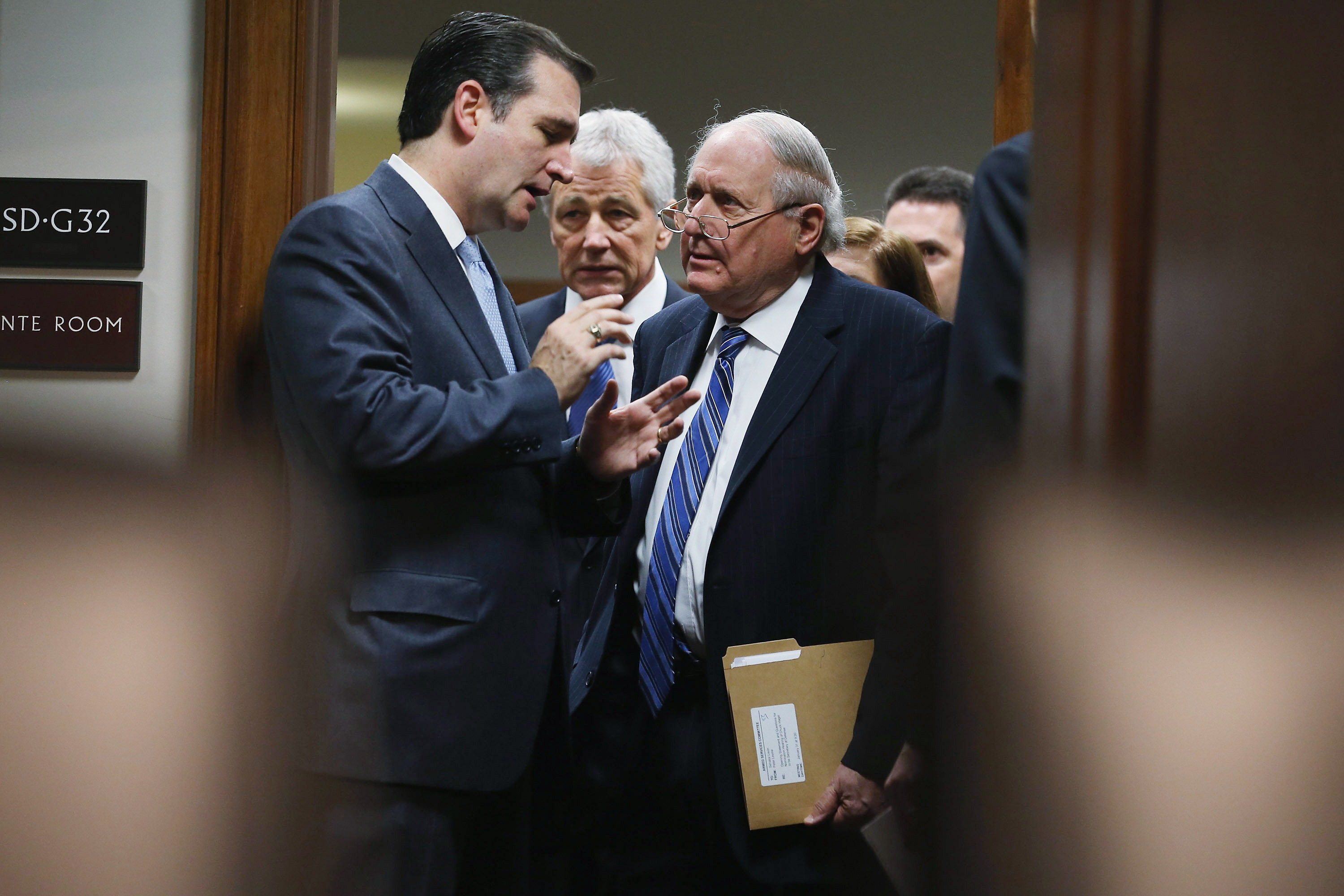
(Photo: Ted Cruz lecturing a bewildered Carl Levin, as Chuck Hagel looks on, last January. By Chip Somodevilla/Getty Images.) Update from a reader:

The Houston Chronicle did not endorse Cruz OVER Hutchinson.  They endorsed him over Paul Sadler, a Democratic state representative, about whom the Chronicle had good things to say. Hutchinson was retiring from the Senate and Cruz had run against Lt. Gov. David Dewhurst in the Republican primary.  In that race, the Chronicle endorsed Dewhurst over Cruz. Yesterday’s editorial is a paean to Hutchinson, expressing a wish that she had kept her seat. It is not retro-active endorsement of Sadler who was not mentioned.

What Moderate Republicans? Ctd

A Surabaya Zoo health worker checks the

After last night’s Republican implosion, it will surely be time soon for introspection among the so-called conservatives about where they have taken their party and this country. In lashing out at the sudden appearance of anti-Cruzniks, Josh Barro nails it:

Roughly one-third of this caucus thinks hitting the debt ceiling and shutting down the government are great strategies to try to stop Obamacare. The other two-thirds of the party has realized all along that this strategy sucks, but they could not find any way to stop their party from implementing it — even though these “reasonable” Republicans outnumber the crazies.

Rep. Devin Nunes (R-Calif.) was on CNN today saying that his party’s strategy for the last month has been lunacy. Well why the hell didn’t he do anything to stop it? Why didn’t he join with Rep. Peter King (R-N.Y.) and stop the shutdown in its tracks on Sept. 30? Where is his sense of responsibility?

Because the operating principle in the GOP is: no enemies to the right. This has been the case for years now – as prescient moderate Republicans, from Specter and Smith to Lugar, were purged, and conservative dissidents like yours truly, Bruce Bartlett, David Frum et al. were ostracized. One might think this means the GOP has hit bottom, like an addict hooked on extremism finally recognizing it no longer exists as a viable party of government. But check out one of the key cowards and enablers and panderers out there, Jonah Goldberg of National Review. After nearly bringing the American and global economy to a standstill, and failing to achieve anything of substance, Goldberg’s advise to the GOP is, verbatim, “Move On Everybody, It Just Doesn’t Matter.” I kid you not:

I would bet that the shutdown plays a relatively minor role in the 2014 and 2016 elections. But even if the shutdown plays a big role, that would be all the more reason for Republicans to find the best and most unifying way to talk about it. Endless internecine screaming about what went wrong is exactly what Obama wanted out of this. Why give it to him if it won’t produce anything worthwhile? As an intellectual or historical question, I think it’s a great thing to debate. As a political touchstone, it’s poisonous.

Goldberg is responding – civilly! – to the hardcore Stalinist of the right, Hugh Hewitt, who still regards Ted Cruz as the future of what’s left of his party. He even tries to spin this fiasco as some kind of possible political win. What is out of bounds is a real, honest, brutal debate about what has happened to Republicanism, how to reverse it, and what lessons to learn. And so it will get worse. Until someone somewhere with some actual clout begins the raw debate that is essential if we are to return to two-party government. Until then, voting Democrat is the only option. I’m not one, but I’m also not insane. No one with any sense of collective responsibility can vote this shambolic crew of vandals into any form of office any time soon. Roll on, 2014.

(Photo: Getty Images)

Will A Deal Get Done In Time?

Beutler suspects so:

The truth is, there are decent reasons to think that even someone as dug in as Cruz won’t assume the risk of delaying whatever deal Reid and McConnell ink. An individual senator or group of senators that held up the plan would own the ensuing market reaction forever. It’s hard to win the presidency if you’re responsible for the Cruz Crash. It’s hard to finance a re-election campaign if the public thinks you destroyed its wealth and institutional donors know how reckless you are.

Thus, despite the time crunch, there are promising signs that Congress will avert disaster by the end of the week, and reopen the government, too. How Republicans react to such a punishing defeat, what conservatives do, and what comes next for John Boehner, will be big stories in the weeks ahead.

Scheiber sees yesterday’s antics in the House as “the final spasm of a still-fresh corpse, the corpse being the GOP’s legitimacy as a political entity”:

In the end, I’m rather relieved that this all happened Tuesday—still relatively early in the process as these things go. A few savvy congressional reporters lamented that we’d lost an entire day while Boehner took a final lap around the mental institution he runs, possibly pushing the resolution of the showdown beyond Thursday. But if you size up the situation from a bit of a distance, you see that Boehner’s final farcical move almost certainly sped things up. Given that the House GOP almost always lurches away from the eventual solution at least once before swallowing its pride and allowing it to pass, far better to get it out of their system Tuesday rather than waiting till Thursday night, with only a few hours to go before D-Day.

Better yet, the fact that it happened before Reid and McConnell had finished their negotiation—with McConnell having suspended the negotiation to give Boehner a chance to embarrass himself further—strengthens Reid’s hand at the margin and allows him to strike a slightly more favorable deal.

Yglesias also expects deal:

This isn’t dispositive, but I do think it’s telling that financial markets remain calm. Playing this drama out until the 11th hour has been damaging, but that’s priced in. The expectation is still that this will end, and the pieces are in place for that to happen.

Suderman notes that, should the Senate deal go through, “shutdown will be over, and the Republicans who pushed for it hardest will have gotten essentially nothing for it.”

Chart Of The Day

Anti Incumbency Mood

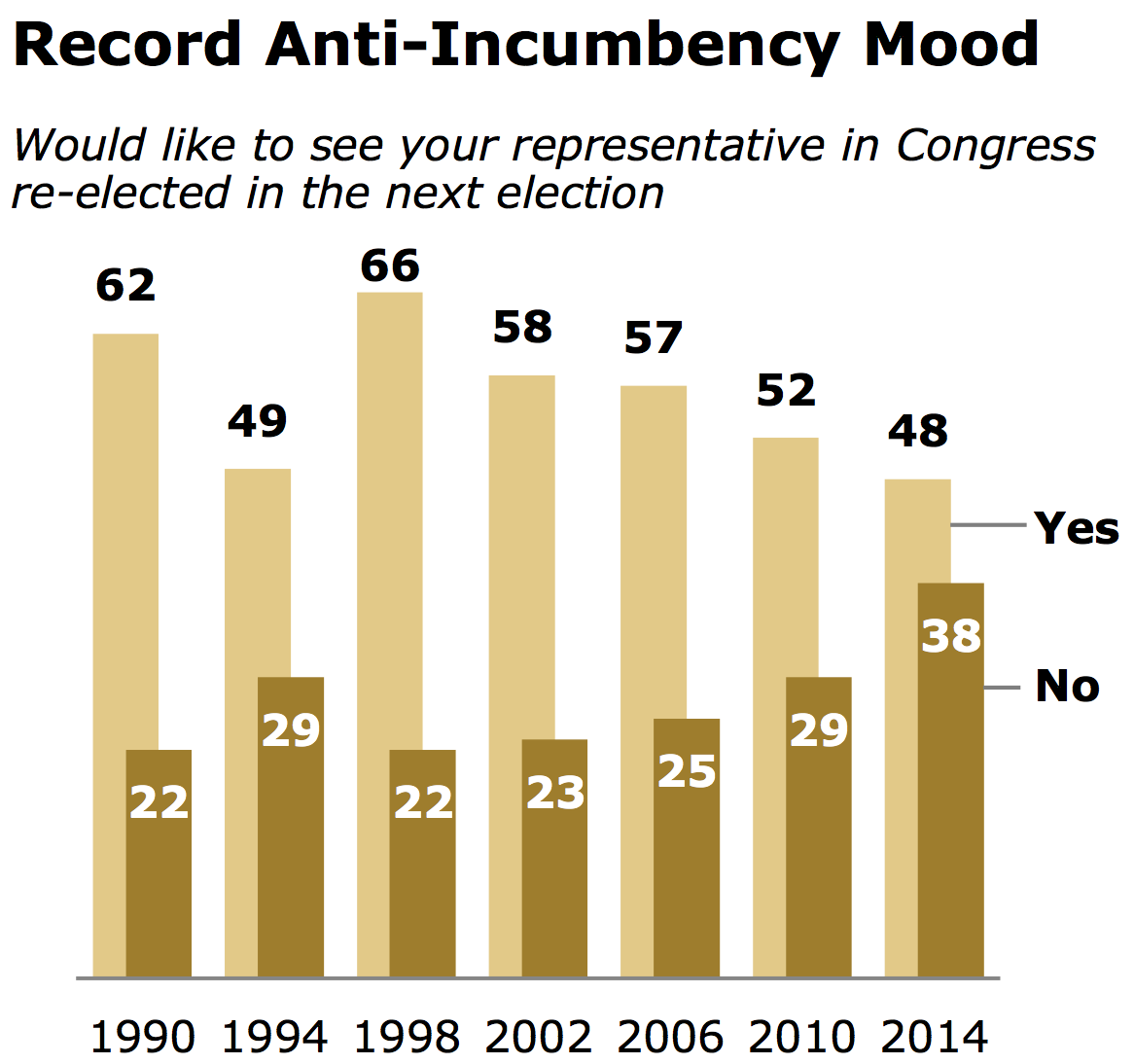
Cillizza suggests that Congress pay attention to some startling new data:

[T]here’s a new number in a national Pew poll that should give incumbents who assume that people hating Congress will exempt them in the next election some pause.  That number? Thirty eight percent — as in 38 percent of people who say they do not want to see their own Member of Congress re-elected in 2014. While that number is far lower than the 74 percent who say they would like to see most Members of Congress lose, it’s still the highest percentage wanting to get rid of their own member in more than two decades of Pew polling.

That stat has to be — or at least should be — concerning to incumbents in both parties particularly given, as Pew notes, that at this time in the 2010 election — when 58 incumbents lost — just 29 percent of respondents said they wanted to replace their own Member of Congress.  Things might return to “normal” — hate Congress, love your Member — well before the 2014 midterms. But, we are currently in the midst of historically poor ratings for Congress, meaning that depending on “how things have always been” could be a major miscalculation.

The Rape Double-Standard, Ctd

Several readers take issue with the reader in this post update:

While it seems clearly wrong to state that you’re an “unbelievable pussy” and it’s not technically “rape” if a woman forces you as a man to have sex without putting a gun to your head, there is a middle ground here.  It’s that while it may have been “against his will” in a technical sense for the story writer to say he was forced to have sex, he ultimately could have avoided it and chose not to.  So was he “forced” to have sex?  Clearly he thought he had to, but again he could have pushed her off and walked away and he ultimately chose not to.  It was not the perpetrator who controlled whether or not the victim was going to have sex.  This seems critically important.  So while the technical non-consent of “forced” rape is there, the complete helplessness and the extreme violation seems likely not.  Which is probably why he stated/questioned that he was “technically raped”? But not traumatized.  It seems to me that whatever the technical legal definition, it’s the helplessness and trauma that are the horrendous and lasting parts of it.

Another is much more critical:

OMG! Is this person in your update serious? Or is your reader Todd Akin? He (assuming this is a man writing) never had an erection when looking at an attractive woman even when he didn’t want to? Sometimes women have physiological responses to rape that are associated with sexual arousal (wetness, orgasm). This does not mean she hasn’t been raped. Ditto a man. Your reader needs to do some research. Here’s an easy-to-read start.

That linked-to article triggered a short thread this summer called “When Rape Triggers An Orgasm”. Another reader on this thread:

If your “update” reader knew anything about rape of any kind – including the most conventional male-against-female rape – he’d know that conflicted feelings about what’s going on are at the heart of any rape. Talking to my female friends who’ve been raped (I’m male, for what it’s worth), one of the worst things about rape is that because of the basics of physiology, there is some pleasure involved. If your girlfriend is stroking you in the middle of the night when you’re half-asleep, you’re going to get hard. That doesn’t mean you want to have sex with her.

Which leads us to the next point.

Rape can be most traumatizing when the perpetrator effectively forces the victim’s own body to respond sexually when the rational and emotional mind are not in agreement. You know how many raped women experience self-loathing and turn to self-harm? Think it might have something to do with feeling betrayed by their own bodies?

To get back to the discussion that doesn’t involve troglodytic assholes, I am extremely glad this discussion is happening. We have made sexual assault and sexual abuse far too tidy when it only consists of a big bad man forcibly holding down a helpless woman and penetrating her. By anything close to conventional definition, I have neither been raped nor raped anyone, but I have been sexually manipulated to the point of causing me a moderate amount of emotional trauma, and I have in the past cajoled someone beyond their comfort level in sexual activity to the point that it destroyed our relationship and leaves me with guilt to this day. In the current context, it’s nearly impossible to talk about either of these things without hanging the “rapist” or “rape victim” sign over my head where it doesn’t really fit with anyones concept of those things, but they clearly belongs in the same larger conversation.

I discussed this extensively with a friend of mine who does extensive work with a rape crisis center. She of course can’t tell me more, but she said the number of men who’ve come to her saying, “this wasn’t really rape, but something happened years ago that I can’t get past” is far higher than anyone would believe.

Another something that happened years ago:

The reader who wrote to call a possible rape victim “simply an unbelievable pussy” is a pretty abhorrent specimen, but his anger seems to be directed at the victim’s claim of being “forced” by a mere girl. Well, let me throw the following story into the mix …

I was in a relationship of three years and it had hit a rough patch. I went out with a female friend for drinks and ended up back at her place. In my innocence, I had foreseen light snogging and then driving home – but she became surprisingly ambitious. Within minutes I was on my back, my pants were down, and (sorry to be so porny) fellatio was underway.

However, as I neared the finish, I was struck by sudden regret. I should not be here, I thought; this is wrong. I’m in a committed relationship and I should either work that out or end it honestly. So, summoning all the willpower I had, I told my friend to stop, it was a mistake, and I tried to lift her away. I was urgent and clear.

At this point, she locked her arms firmly around me and doubled down. (I’m being oblique – I’m sure you can picture what I mean.) Obviously, at some point you don’t stand a chance physiologically, and that point had been just seconds away when I said stop. So the choice I had made quickly became irrelevant. I finished, involuntarily. And then she let me go.

Now, when I attended college in the 1990s, we were taught in no uncertain terms that if the girl says “no” at any point – even if you are already in the midst of sex that she initially consented to – that’s it. She changed her mind. Show’s over. Past the point of “no”, a sex act becomes rape, end of story.

So was it rape in my case or not?

And your angry reader should keep in mind there was literally no way I could have fought my way out, not without punching my friend as hard as I could in the side of her head – and look where her teeth were. Would that really have been smart?

For the record, I was deeply annoyed at my friend, but probably not traumatized. I broke up with the girlfriend a few weeks later and ended up dating the friend for a year. It was the year of dating (with an incredible sex life, btw) that destroyed our friendship, not that night. And I’m not mad at her for that night; I’m mad at myself for staying with the girlfriend too long, for taking our monogamy so seriously when it had clearly become pointless, and at “society” for not having a realistic way to discuss these things.

I dunno, we’re people, and it’s all gray in ways the law and social justice have a hard time with.