Tidal Warming, Ctd

A reader provides a much different take on oceans heating up:

I’ve been long bothered about how climate scientists and pundits have been stretching the truth a bit on the effects of global warming, and in trying to “win” the news cycle. The latest is the narrative about 2014 being the warmest on record. Now, I’m not going to harp about whether statistically speaking it’s the warmest or not, because to be honest, I think it’s somewhat irrelevant. Let me be clear: the Earth is warming. It is going to be a problem someday. We have good reasons to decarbonize our economy even if that weren’t the case.

However, some of the things being said just drive me nuts. First off, I should mention that I’m a meteorologist. I’m a weather forecaster. I’m not a climate scientist, so I’m not an expert on this. But I have been interested in the subject for over 15 years.

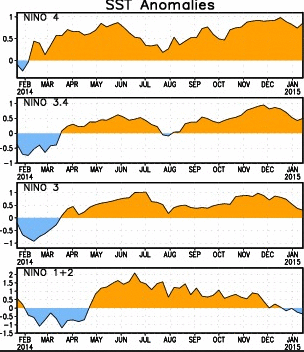
First, regarding that this is an El Niño neutral year. This is true. By a technicality. For NOAA to call an El Niño, it requires the temperature in a certain section (the Niño 3.4 region) of the tropical Pacific to be greater than 0.5 degrees Celsius more than average, for a period of 5 months. Here’s what we’ve had:

unnamed (9)

You can see that the Niño 3.4 region was warm … nearly El Niño criteria for much of the first half of the year, and near or above the criteria over the last several months. But not quite breaking it. Further west, in the Niño 4 region, it was quite a bit warmer. So yes, technically not an El Nino year, but almost.

In addition, that assumes that we’re looking at classical El Niño. Recently there’s been research on a 2nd flavor of El Niño, called El Niño Modoki, which has the warm water focused on the central Pacific, rather than the “classical” eastern Pacific. The interesting thing is that El Niño Modoki has actually been the dominant type of El Niño since the early ’90s, and there’s research that indicates that global warming may be the reason for that. I don’t have access to a current El Niño Modoki index, but eyeballing it, plus given that the weather patterns we’re experiencing are typical of an El Niño Modoki, make me thing that we could be seeing one.

But my point here is that the narrative that the record-breaking temperature was not enhanced by an El Niño is wrong. It’s only because it just barely missed the criteria. Several people, including Phil Plait, have used this record to state that there is no pause in global warming. They’re wrong. But just because there is a pause doesn’t mean that global warming has stopped.

Now, many people like to use 1998 as the start of the pause. I don’t. Because it’s cherry picking, as has been pointed out before. It’s taking an unusual spike in temperatures and using that as a start point. If you pretend that 1998 didn’t happen, you can see that temperatures continued to rise for several years afterwards.

unnamed (31)

However, “warmists” are completely discounting that there are natural variations in climate. The IPCC acknowledges the existence of the pause. There are climate patterns that have periods on the order of 30-60 years. One is called the Pacific Decadal Oscillation (PDO), which is a pattern of sea surface temperature anomalies in the North Pacific. Recent shifts in this oscillation occurred in 1946, 1977, and 2006.

unnamed (32)

A second is the Atlantic Multidecadal Oscillation (AMO), which is something similar but for the Atlantic Ocean:

unnamed (10)

The interesting thing is how these patterns correspond to changes in global average temperature.

unnamed (33)

Global average temperature has periods where there is rapid rise, and then a plateau. We have the first rise, from roughly 1910 to the mid 1940s. This corresponds to the time where the PDO was neutral for a good chunk of time, but it then turned to the “warm” phase near the end. The AMO bottomed out in the early 1910s and then rose until peaking around 1950.

Then we have a bit of a drop and then a plateau in temperatures in the mid ’40s until the late ’70s. During this period the PDO had flipped to the “cold” phase, and the AMO was dropping.

Then in the late ’70s we get the rapid rise until the mid 2000s. The PDO had flipped to the “warm” phase, and the AMO was rising.

Finally we get to the start of our pause. The PDO flipped to the “cold” phase in 2006, and the AMO hit a plateau. Some people are denying that we’re in a pause. All I can say to them is look at that graph above. Would you be happy if your 401K had a chart that looked like that if you started in 2000?

It’s as if the contributions to global average temperature are roughly half and half between long natural cycles and man-made global warming, such that during periods when the natural cycles are warming, we get quick, alarming warming. But then during periods when those natural cycles are cooling, it’s enough to pretty much balance out the warming from CO2.

Now, yes, it’s only been 10 years for my definition of the pause. But my definition is based on actual physical processes, and not by cherry-picking a year. It is completely consistent with previous pauses and sudden rises. And even if we’re going to continue warming, the warming isn’t going to be anywhere near what it was like in the 1977-2006 period.

So what does this mean going ahead? Here’s what I think is going to happen.

The AMO will start to decrease in the next five years, and will probably bottom out in about 20 years. The PDO isn’t expected to switch until sometime in the 2030s. So I think that the pause (which still may result in slight warming) will continue until then. This prediction will be considered falsified if the increase in global average temperature over the next 5 years is greater than 0.10 C per decade.

I also think we’ve seen the bottoming out of the Arctic ice loss. We’ve started to see a recovery and I think it will continue. I’m not completely sure on that because the AMO hasn’t started to drop yet though. So I will consider this prediction falsified if we have two or more new minimums in Arctic ice in the next five years.

And then watch out, because our temps are going to start to spike and I suspect at a greater rate than the 1977-2006 period.

The bottom line is this: just because some of us think that a pause is in place doesn’t mean we’re deniers. It doesn’t mean that we don’t think it’s a problem. I do think we need better climate models that can handle these natural variations, but I think that’s coming. The longer the pause goes, the more scientists are going to realize the need for taking these natural variations into account.
Regarding the reader’s claim that “we’ve started to see a recovery” in Arctic ice, here’s his foil, Phil Plait, last September:

This time, in Sunday’s Mail Online, [David Rose] writes that Arctic sea ice, which hit a major record low in 2012, “has expanded for the second year in succession.” This claim is a humdinger, and typical denial double-speak. It’s technically true, but also really wrong. It’s like examining someone who has a 106° fever and saying it’s really made their skin glow. But what do you expect from an article that has this breathless headline:

Myth of arctic meltdown: Stunning satellite images show summer ice cap is thicker and covers 1.7million square kilometres MORE than 2 years ago…despite Al Gore’s prediction it would be ICE-FREE by now

“Myth of arctic meltdown” is enough to tell you just how slanted and wrong the conclusions of this article will be … and the inclusion of Al Gore’s name brings it home. Mentioning Gore is at best a distraction, red meat to the deniers. Gore isn’t a climate scientist, and as we well know actual climate scientists overwhelmingly agree that the world is warming. One of the outcomes of this is the decline of Arctic sea ice.

Briefly: Arctic sea ice reaches a minimum in late September every year. The overall trend for the amount of ice at that time is decreasing; in other words, there is less ice all the time. Some years there is more than others, some less. But the trend is down, down, down.

In 2012, a mix of unusual causes created conditions where the minimum reached a record low, far below normal. The next year, in 2013, the ice didn’t reach quite so low a minimum extent, and this year looks very much the same as 2013. But saying the ice is “recovering” is, to put it delicately, what comes out the south end of a north-facing bull. You can’t compare two years with a record low the year before that was due to unusual circumstances; you have to look at the average over time.

Of course, if you do, your claims that global warming isn’t real melt away. I’m happy to provide that information. Here’s the Arctic ice extent graphed by the National Snow and Ice Data Center:

arcticice_aug2014.jpg.CROP.original-original

The black line is the average for 1981–2010. The gray region shows the ±2 standard deviation extent for that average; statistically speaking it’s an expected range of extent (it’s actually more subtle than that, but that’s enough to understand what’s going on here). The dashed line shows the 2012 ice extent, and is clearly very low, well outside the expected range. The brown line is 2013, and the light green line is this year, 2014, up to late August. Notice 2014 follows the year before pretty closely.

Note also they are well below average, near the bottom of the expected range. If you look at any recent year’s ice it’s below average; you have to go back to 2001 to find an ice extent near the average.

So the claim that the ice is “recovering” is made based on the wrong comparison. Compare the past two years to the overall trend and they fit in pretty well with overall decline.


Can A Netflix For Magazines Catch On?

Derek Thompson is one of many considering the question:

Next Issue Media was born in 2011, with some of the largest magazine publishers onboard. Charging $15 per month for access to about 140 magazines via phone or tablet, it’s built an audience of a couple hundred thousand subscribers, Joshua Brustein reports in Bloomberg Businessweek. Brustein notes that this week Magzter, another newsstand of digital apps, is launching a similar service with access to “2,000 magazines—including Maxim, ESPN the Magazine, and Fast Company—although not to any of the 25 most popular magazines at U.S. newsstands.” But as Brustein writes, a Netflix for magazines remains the impossible dream of the industry.

What Next Issue and Magzter are principally offering is a Netflix for something far less popular than magazines: magazine apps.

Many magazines still have print circulations well into the millions—National Geographic, Sports Illustrated, Cosmopolitan, and Time all top 3 million—with monthly online audiences in the tens of millions. But far fewer people are paying extra for the apps. Take out Game Informer Magazine, which offers discounts along with its digital subscription, and there is no magazine in the country with more than 300,000 app subscribers.  The print-magazine industry is struggling, and yet the magazine-app industry is, to a title, between 10 and 100 times smaller. There is not much here to re-bundle.

Derek adds, “and the Internet is already Netflix enough for most news and entertainment consumers.” Matthew Ingram also mehs over Magzter and its competitors:

I don’t share this enthusiasm [for] a number of reasons: One of them is the user interface that is offered by most of these services — which tends to employ a somewhat tired “bookshelf” or “newsstand” metaphor that can be difficult to navigate. Meanwhile, the magazines themselves tend to be bloated PDF-style formats that are effectively giant photographs of existing print pages. They take forever to download they are cumbersome to navigate through.

magzter-bookshelf

But the biggest problem with such services is the problem of discovery: One of the main reasons why people like to use Spotify and Rdio and Netflix and similar services is that they make it easy to find new content, whether it’s by sharing playlists or by using algorithm-driven recommendation engines. Netflix, in fact, has what is probably one of the most powerful recommendation algorithms on the web today, and it has spent hundreds of millions of dollars developing it and fine-tuning it so that it works for people. There is nothing similar in most of the NextIssue-style services, and so they essentially force you back into old-fashioned behavior — namely, browsing through magazines, flipping virtual pages.

Magzter is trying to master that “discovery problem” with its own algorithm, but Ingram isn’t impressed. Joshua Brustein notes that the newcomer is also trying the competitive edge of “offering a larger selection of more obscure titles and by selling subscriptions internationally.” But he joins the skeptics:

Netflix-like subscriptions for reading material are still in their early days. In addition to the magazine experiments, there are several similar services for books run by Amazon.com and startups Oyster and Scribd. In all these cases, it’s not clear that anyone but the most voracious readers will save money by signing up for an unlimited multimagazine subscription. For about three-quarters of Next Issue’s $180 annual fee, a reader could get separate digital subscriptions to The New Yorker ($60), Bloomberg Businessweek ($30), Rolling Stone ($20), and National Geographic ($20). The average Next Issue user spends about two hours per week engaged with the app, so it’s fair to ask whether people need much more than that.

Especially if you read the Dish a lot. If so, subscribe here for as little as $19.99 a year!

Judging The Beards Of Believers

The SCOTUS just ruled in Holt v. Hobbs. Amy Howe sums up the unanimous ruling:

The Court easily agreed with inmate Gregory Holt that the Arkansas policy prevents him from exercising his 20150124_usp505religion. Put simply, the prison will not allow him to follow the tenets of his religion and grow a beard. And it didn’t matter, the Court explained, that he could practice his religion in other ways, such as by observing Muslim holidays and having a prayer rug.

The Court was also unconvinced by the state’s justifications for the ban. For example, the Court did not agree that the ban was necessary to prevent inmates from hiding things like razor blades, needles, drugs, or cellphone SIM cards (which could be used to run drug rings from prison) in their beards. That particular argument, the Court suggested, was “hard to take seriously” because most things would be too big to hide in the half-inch beard that Holt is seeking permission to grow, and anything that was small enough to hide would probably fall out anyway. But in any event, if this were actually a problem, it could easily be eliminated simply by making an inmate run a comb through his beard.

Michael Bobelian goes into more detail:

The similarity between the [Religious Land Use and Institutionalized Persons Act] and “its sister statute” enacted the same year, the Religious Freedom Restoration Act, made this a straightforward case for the Court.

“Congress enacted RFRA in order to provide greater protection for religious exercise than is available under the First Amendment,” Justice Samuel Alito wrote, citing Hobby Lobby. “RLUIPA thus allows prisoners ‘to seek religious accommodations pursuant to the same standard as set forth in RFRA,’” Alito explained, in explaining the close relationship between the two statutes. Both acts rely on a balancing test to determine whether a government action potentially infringing on a person’s religious exercise is valid. Any restriction on an individual’s religious exercise must both further a “compelling governmental interest” and be “the least restrictive means of furthering that compelling governmental interest.”

Carrie Severino has more on the degree of burden allowed on a person’s religious practice:

[This ruling] emphasizes that it is the religiously-motivated view of an action, not the unbelieving bystander’s judgment of its importance, that determines whether a burden is substantial.  That is particularly important where, as here, courts are dealing with a minority or unpopular religion.

The Court also clarified some key points respecting substantial burdens.  First, it noted that permission to engage in many other aspects of religions exercise – here, praying daily, keeping a prayer rug, corresponding with religious advisors, keeping a halal diet, and observing religious holidays – does not cancel out the effect of denying Holt the ability to carry out his simultaneous religious obligation to grow a beard.  Additionally, the Court corrected a misunderstanding below that only “compelled” religious practices could be substantially burdened or that disagreements within the Muslim community about the necessity of growing a beard meant curtailing that ability was not a substantial burden.  After all, courts have no business making a judgment call about the fundamentally theological questions of how much religious practice is “enough” or which view of a certain religion is correct.

Justice Ginsberg sought to differentiate her vote from her dissent against the Hobby Lobby ruling, writing that “accommodating petitioner’s religious belief in this case would not detrimentally affect others who do not share petitioner’s belief.” Steven Mazie unpacks her words:

The distinction Justice Ginsburg wishes to push, then, is this: part of the court’s investigation in considering whether to grant religious exemptions from generally applicable laws, as in Hobby Lobby, or from prison grooming regulations, as in Holt, is whether and in what way the accommodation will impact the lives of third parties. No one suffers when Mr Holt lets his stubble grow a bit. But when a corporation with 23,000 employees refuses to provide a benefit available under federal law, thousands of women are directly impacted. They have to buy their own birth control pills, for example, or shell out $1,000 for their own IUDs.

But he wades into some complexity:

While there are clear cases like Hobby Lobby and Holt where an accommodation either does or doesn’t entail harm on third parties, there are other cases that are more difficult to classify. You could say, for example, that no one is harmed when a Seventh Day Adventist gets her unemployment check after being fired for refusing to work on Saturday. But taxpayers foot that bill; they are an impacted third party. And you could say that when an Amish family gets to keep its children on the farm rather than sending them to high school, nobody outside the Amish world is negatively affected. But what about the children who are denied an education that could give them choices and expose them to possibilities outside the Old Order Amish Church?

Looking ahead, Eugene Volokh believes there will be more decisions like Holt‘s:

Now that the Court has a trio of recent cases accepting religious exemption claims, and no cases rejecting such claims, I think this will lead judges to take such claims much more seriously — and will embolden litigators to bring such claims. (It should also help the Becket Fund for Religious Liberty, which won both this case and Hobby Lobby, raise funds for such litigation.) And while RFRA only affects federal laws, RLUIPA affects state prisons and state zoning decisions, and over half the states have either state RFRA-like statutes or state constitutional regimes that are similar to RFRA.

So I think Holt, together with the other two cases, will create ripples far outside prison cases. And that’s especially so given its analysis [of] how a statute’s underinclusiveness can show that exemptions should be granted, how a statute’s unusualness can do the same, and how demanding the “least restrictive means” test is.

Indeed, an anxious Noah Feldman sees a creep in the conservative Court:

Step by step, the justices are expanding the logic of religious exemptions from otherwise neutral laws. Over time, this is leading to a de facto reversal of the Supreme Court’s doctrine that ordinarily denies religious exemptions under the Constitution. This is a good thing when there’s no counteracting compelling interest in applying the law. But it can also go too far, as it did in June’s Burwell v. Hobby Lobby decision.

But in another post, Volokh points to history:

Historically, statute-by-statute religious exemptions have been common in American history. Liberal Justices and advocacy groups pushed, especially starting with the 1960s, for a broader regime of presumptive exemptions for religious objectors, and they got it. Conservative Justices pushed back, and eventually overturned this regime.

Then the movement became bipartisan, as Congress tried to re-enact a broad presumptive exemption regime with RFRA and RLUIPA. And only in recent years has the opposition to religious exemptions — not just individual exemptions in individual cases, but to having RFRA-like regimes altogether — become somewhat more a liberal matter than a conservative one.

Obama’s Tax On College Savings

Ryan Ellis is alarmed by the president’s proposal to make 529 plans, which are basically IRAs for college savings, much less attractive:

Already, it’s difficult for middle class families to find discretionary after tax income for college savings plans. Besides paying the bills and staying out of high interest debt, there are better uses of savings for most families–notably retirement and a down payment for a home. Raising taxes on 529 plans would probably deal a death blow to their widespread use, a kind of anti-savings tipping point.

Karen Weise isn’t so worried:

Obama pairs these reductions with expanding the remaining education incentive, the American Opportunity Tax Credit, which is set to expire in 2017.

Obama signed the AOTC into law in 2009 as part of the federal stimulus program, and it gives up to $2,500 in credits to families with incomes as high as $180,000. The AOTC does share some of the regressive nature of the tax programs—about a quarter of familiesthat claim the credit make more than $100,000—so Obama’s new proposal would make the AOTC permanent and take steps to boost how the AOTC helps lower-income families.

Jordan Weissmann supports Obama’s plan:

Obama wants to tax college savers. But, by and large, they’re wealthy college savers. When the Government Accountability Office looked at 529 plans and their less popular cousins, Coverdell accounts, it found that 47 percent of families that had them earned more than $150,000 per year. (Depending on who’s measuring, that puts them in at least the top 10 percent of U.S. households.) By comparison, it noted, the median income of families with a student in college is $47,747. I don’t know about you, but I generally don’t think that our higher education policy should be geared toward helping families that earned $150,000 or more send their kid to the most expensive possible school.

Reihan is open to the idea for different reasons:

I’m all for helping families, including well-off families, save and build wealth. The reason I’m sympathetic to paring back the benefits associated with 529 plans is that tuition tax breaks appear to be an extremely ineffective way of making higher education more affordable — indeed, one scholar I trust, Andrew Gillen of Education Sector, has actually suggested that they might contribute to tuition increases.

How, you ask? All kinds of financial aid, from direct grants to low-income students to tuition tax credits that benefit all students, including high-income students, increase demand for higher education. It is important, however, that while direct grants to low-income students only increase demand for low-income students, who are less likely to go to college than more affluent students in the first place, tuition tax credits increase demand for all students, including those who are already willing and able to spend large sums on higher education. Colleges can respond to increased demand by increasing supply (e.g., admitting more students), by becoming more selective, or by charging higher prices to capture more of the aid.

Lending Money To Loved Ones

A reader dissents over how we framed this letter:

I don’t see what is so “horrible” in what Ayn Rand wrote to her niece. First, the niece didn’t ask for $25 as a gift; she asked to borrow it.  If you read the letter, Rand gives TWO examples of where a similar request was made, and the money was NOT used to accomplish the stated goal, nor was it paid back.  Second, Rand didn’t insist on charging interest, merely getting the principle back.  Third, she simply insisted the niece be honest and A) spend it on what she said, and B) pay the loan back when she had the chance instead of spending on something else.

Or if you don’t want to be horrible like her, I too could use some new clothes to improve my employment opportunities, and a $250 (inflation adjusted from 1949) Amazon gift credit in reply would help. And you shouldn’t be horrible about insisting that I really use it for clothes, or that I pay it back, much less according to some terms.  If you did insist, you would be “horrible” just like her.

This is the one thing often missed in Ayn Rand’s works: the heroes keep their promises, and pay what they owe “to the last dime”, often at great cost.

Another reader notes:

It would be nice if all of the sites bringing up this letter would put it into context.

1) Rand had previously had a misunderstanding with one of the niece’s two older sisters regarding money she’d loaned her. 2) The niece took the letter in good spirits. Rand liked her response and the girl not only got the money, but began a correspondence with Rand in which Rand was surprisingly maternal and affectionate towards her. 3) The niece’s oldest sister was one of Rand’s best friends until Rand’s death. 4) The niece the letter was sent to and her middle sister, after the misunderstanding about the loan had been cleared up, had cordial relations with Rand for years.

Another broadens the conversation:

I’m a bit miffed at how ill treated this letter is in your post. What an invaluable lesson this is about debt!  If you read the whole letter – ahem, you cut the most important part after she offers terms, which are quite reasonable, in which she warns that once you start earning money you will want to spend it on other things besides the money you owe.  This is quite right!  We all love to slap it on the credit card, and then when faced with the option to buy a new kitchen appliance, fancy meal, or pair of shoes or pay down our debt, how many of us choose the latter?  Not enough.

Most people in the US think nothing about taking on a new credit card – or a fancy new degree – and the mountain of “irresponsibly” laid down debt literally destroys their lives.  It destroys their entrepreneurial spirit; it destroys their educational, relational, and employment opportunities; it destroys their quality of life and entrenches mild- to severe poverty; and it degrades them psychologically and virtually eliminates any taste for risk taking and enterprise, locking them into “getting by” employment to constantly service the debt.

Would that they had someone as wise as Rand cautioning them to think reeeeealy hard before taking on $40,000 for that BS Degree or $10,000 for a late-model car when they could be driving around a reliable beater.  Think of the suffering that could have been alleviated if such lessons were taught to the entire generation of then-17 year old millennials who are currently groaning under their debt.

And let’s look at the massive handicap our national debt has on this same generation and their children.  Would that anyone in Congress had had an aunt as shrewd as Ms. Rand!  Look at the Greek debt or historic Latin American debt.  How “horrible” would it have been to have a tut-tutting aunt make people painfully aware of the potential repercussions of their decisions before undertaking them?  How much global suffering could have been avoided with a little more tough love from a wiry, stick-in-the-mud Aunty like Ayn Rand?

Sure, she moralizes with the girl (“I hate irresponsible people”) and makes it more personal than perhaps it needs to be.  But it is her money, and she is certainly entitled to do what she wants with it.  And why does she owe an open ended, never-to-be-paid-back line of credit to her relatives?  If all of us lent to all our relatives whenever they came a-begging, we’d be as broke as they are!

Russia And Ukraine Are Still At War

Clashes with pro-Russian separatists in Donetsk

New fighting is underway in Eastern Ukraine, breaking a months-long ceasefire. Alexander Motyl assesses the scene:

The war in eastern Ukraine will go on, despite the best efforts of the West and Kyiv to reach a negotiated settlement. For one thing, Putin’s proxies in eastern Ukraine are out-of-control warlords for whom war has become their only raison d’être. For another, Putin will want no permanent peace, as that would only stabilize Ukraine. A large-scale military assault aimed at capturing all of Ukraine, or even establishing a corridor from Russia to the Crimea, is probably out of the question, as the Ukrainian armed forces are strong enough to deter it. But low-level fighting of the kind that has characterized the Donbas for the last few months seems a sure bet. Equally likely is a continuation of terrorist attacks within Ukraine, which Ukraine will survive while Putin’s reputation as an exporter of terrorism will only grow.

Ukraine will continue to insist that the Russian-occupied territories are occupied only “temporarily,” and Russia will continue to insist that its war against Ukraine is really only an internal Ukrainian squabble, but the end result of Russia’s continued occupation of both the Donbas enclave and the Crimea will be the continued, if uneven, consolidation of Russian rule. Faced with tough economic circumstances at home, Kyiv will continue to reduce its economic relations with, and financial subsidy of, the occupied territories. The burden of supporting the increasingly desperate inhabitants will fall on Russia, which will have to decide whether it prefers to make hay from a humanitarian catastrophe of its own making or actually to help save the victims of its imperialist policies. My guess is that Putin the great humanitarian will opt for catastrophe.

Leonid Bershidsky sees no end in sight:

Regardless of the international reaction, Russia will crush Ukraine’s military hopes every time they arise, simply because it has a stronger, better-trained army. It is wishful thinking to believe the balance of forces has changed since September, when Ukrainians crumbled in the face of what were, by all accounts, just a few thousand crack Russian troops. …

[If Poroshenko] is counting on Russia to succumb to Western pressure and low oil prices and give up, he has to intensify fighting in a war he cannot win. That is an extremely risky bet, since Russia can take an inordinate amount of pain as long as its people continue to believe Putin’s cause is just. Poroshenko’s success is also predicated on Western nations’ acquiescence in being dragged deeper into the conflict, because for Ukraine to hold out even a few months, it needs better weaponry. Yet, like Putin, the Ukrainian president can’t afford to give in: He would be swept away in a tide of protest, led by fighters returning from the front lines.

In the meantime, Ukraine is teetering on the economic edge:

Ukraine faces an acute economic crisis that represents no less a threat to its survival than Russia does. Kyiv has come to rely on assistance from the International Monetary Fund and Western donors to survive; yet the Western commitment to support Ukraine financially is limited. Indeed, Moody’s has recently warned that Ukrainian default is very likely, pointing out that the country’s current bailout package provided by the IMF, EU and other donors is not sufficient to cover $10bln external debt repayments that come due this year. The Economist suggests that Ukraine needs an additional bailout of $20bln, noting that despite chatter about a “donors conference,” no government seems willing to put up the money.

Larison isn’t surprised:

All of the obstacles to bailing out Ukraine remain. Western institutions won’t lend Ukraine the money it needs without imposing strict conditions, and the Ukrainian government cannot meet those conditions without wrecking itself politically. If the money were “found” to give to Ukraine in the absence of significant reforms, most of it would likely be lost to corruption or sent on to Russia to pay Ukraine’s debts. That would be a waste of funds, and even when there are strings attached there is not much interest in Western capitals to provide a lot of aid. Western governments decided over the last year that Ukraine wasn’t worth very much to them, and under the circumstances it’s hard to fault them for reaching that decision.

Regardless, the Bloomberg Editors insist that the West keep the sanctions going:

On at least two occasions, [the sanctions] have caused Putin to scale back aggression in Ukraine — in May, when a threat to broaden sanctions pressured Russia to drop opposition to Ukraine’s presidential election, and again last fall, when a Russian military buildup and rebel plans to take three Ukrainian cities evaporated.

Just as important is that exacting a price from Russia for its military aggression unites the EU behind the vital security interests of at least four members — Poland and the three Baltic states. The measures also serve as a financial disincentive for Putin to embark on military adventures beyond Ukraine, and they erode support for him among neighbors such as Belarus and Kazakhstan, now alarmed about what Putin may intend for them.

(Photo: Buildings are destroyed during the clashes between Ukrainian security forces and pro-Russian separatists on January 20, 2015 near the airport in Donetsk, eastern Ukraine. By Alexander Ermochenko/Anadolu Agency/Getty Images)

Soaking The One Percent

The capital gains tax hikes Obama proposed last night are aimed squarely at them:

One Percent

Mark Whitehouse spells out how the richest benefit from our current tax system:

Taken together, the capital-gains and inheritance-tax breaks were worth more than $200 billion in 2013, the Congressional Budget Office estimated. The benefits accrued almost entirely to the rich: They boosted the after-tax income of the top 1 percent by more than 6 percent, and had an almost negligible effect on the lowest-earning 40 percent of U.S. households.

Andrew Flowers provides more background on capital gains:

According to the Congressional Budget Office, as of 2011, the top 1 percent of income earners in the U.S. get more than a third of their income from capital gains. For context, the typical annual income for those in the top 1 percent is about $1.4 million.

In earning so much from the sale of investments, the wealthiest 1 percent are an outlier: 36 percent of their income comes from capital gains. Those with incomes in the 96th to 99th percentile — who earn about $300,000 per year — only earn about 10 percent of their income from investments. That share is even lower for those below the 90th percentile.

Annie Lowry looks at how Obama’s proposals would impact the Romneys:

Taken together, these proposals and others would not just take aim at the wealthiest earners in America. It would take aim at dynastic wealth – the accumulation of investment assets and their light-tax passage to the next generation. It is a timely concern, one thrust into the spotlight last year by Thomas Piketty and his surprise bestseller on inequality, Capital in the Twenty-First Century. Right now, American wealth inequality is primarily driven by American income inequality. Big earners purchase houses, stocks, businesses, and other assets that swell in value over time. Inheritances don’t actually figure much into the equation. In fact, wealth transfers as a proportion of overall net worth have fallen from 29 percent in 1989 to 19 percent in 2007. But in the future, inherited wealth stands to become a bigger and bigger deal, as all those corporate executives like Mitt pass away and pass their money on. Accenture, the consulting firm, anticipates a wave of transfers totaling more than $10 trillion coming in the next decades.

That means Obama’s proposal would not just tax Romney more heavily today, it would limit his ability to create dynastic wealth for his heirs. Robin Hood, I think, would approve.

The Reality Of Theocracy

It can throw men off a high roof for being gay:

1421438213011.cached

All the grotesque punishments for men and women are because of violations of extreme Islamic purity. More images of Jihadist barbarism via The Daily Beast via Twitter, seen below:

1421755547985.cached

And a scene from the Bible, of a woman being stoned to death. This is a culture that, far from reconciling itself with modernity, is going to try to recreate its own fantasy of the 7th Century in the 21st. I fear it will have to implode or be destroyed by other Muslim powers and forces before it retreats into the dustbin of history. Our task is to preserve what’s left of civilization and hope we can outlast it, without becoming something more like it.


What The Hell Is Happening In Yemen?

Houthis take control of al-Udayn district in Ibb, Yemen

It looks like the government may soon be overthrown, as US-backed President Abed Rabbo Mansour Hadi is reportedly being held “captive” in his home by Shiite Houthis rebels. Hakim Almasmari and Martin Chulov put the development in context:

The influence of the Houthis has expanded drastically since they stormed into Sana’a last September, rattling a nascent new order that was trying to find its feet three years after a revolt ousted veteran leader Ali Abdullah Saleh. In the five months since, Hadi had struggled to impose his government’s will. Besieged and unable to control key sections of Yemen’s military, he now seems to have few options and officials in Sana’a were on Tuesday speculating that military rule could soon be imposed across the country. The Houthi push was a death knell to a 2011 political transition backed by the Gulf states, which had removed Saleh from power after 40 years. A key selling point of the change had been to introduce broad social reforms that would transform the poorest state in the Arab world. Instead, Yemen remained beset by poverty and political torpor.

The chaos isn’t exactly new:

[T]he government and aligned tribes have been battling the Houthis in the north on-and-off for more than a decade; [al Qaeda in the Arabian Peninsula] is active in Yemen’s south, provoking regular US drone strikes; a southern secessionist movement has been gaining strength … According to the UN Office for Coordination of Humanitarian Affairs (OCHA), close to 16 million people in Yemen – more than half the population – will need humanitarian aid in 2015, of whom eight million are children. More than 330,000 Yemenis are already displaced within the country due to pockets of conflict in both the north and south.

Adam Taylor notes that US policy in the country, which Obama has heralded in the past, will now surely have to change. He points out that “if the broader U.S. policy goal in Yemen is stability, it doesn’t look like a success at all right now”:

It’s important to note that it’s not [AQAP] that is posing the threat to Hadi right now. Instead, it’s members of the Houthi rebel faction, who are believed to be backed by Shiite regional power Iran and who argue that they are oppressed by Yemen’s Sunni majority. It’s also unclear whether the Houthis want to actually force Hadi out, or just use their military success to pressure the government.

The fight against AQAP seems likely to take a hit, however: While the Houthis have battled against al-Qaeda forces before, wider chaos in the country could well help AQAP. The Houthis are also unlikely to be a willing partner for the United States, which they have accused of meddling in Yemen’s affairs in the past.

Mark Thompson reviews our track record:

Christopher Swift, a Yemen expert at Georgetown University, says U.S. efforts in Yemen have been lackluster. “Our relationships, whether they’re political or military, don’t extend beyond the capital,” he says. “The bad guys are out in the field, far away from the national capital, and to the extent we claim to have relationships out in the bush, they’re based on third-party sources or overhead surveillance.”

U.S. goals in Yemen have always been tempered. “We’ve been playing for very limited, very modest objectives in Yemen,” Swift says. “Yemen is still a place where people who want inspiration, or training, or a place to hide can go. AQAP isn’t going away. The Yemenis are not in a position to make it go away, and we’re not willing to help them defeat AQAP decisively.” Between 2011 and 2014, the U.S. pumped $343 million into Yemen, largely to fight AQAP. The U.S. is slated to provide Yemen with $125 million in arms and military training in 2015, in addition to $75 million in humanitarian aid, according to the nonprofit Security Assistance Monitor website.

Jamie Dettmer warns of a coming backlash from the Sunnis, who view the Houthis as an Iranian proxy:

At the weekend, Sunni leaders from southern provinces reacted angrily to the seizing by Houthis of the president’s chief of staff, Ahmed Awad bin Mubarak, giving them 24 hours to free him and warning they would turn off oil pumps unless he was released. Instead, the fighting escalated. Even before this de facto coup the sectarian power struggle was playing havoc with the government’s battle against AQAP, which is more in the spotlight than ever following the group’s claim of responsibility for the January 7 terror attack in Paris on the French satirical newspaper Charlie Hebdo. On Tuesday, as the presidential palace was being stormed, al Qaeda fighters came close to assassinating a top Yemen Army commander in the south, killing five of his guards in the attack, military officials said.

The extremists are issuing new threats against the West as well, and Bruce Riedel adds that a Houthis victory will further strengthen AQAP’s hand by positioning it as the protector of Sunni rights:

Yemen doesn’t feature often in American foreign policy discussions so it’s no surprise that President Obama didn’t mention it in his State of the Union speech. This is all the more true when one realizes we have very little leverage to influence the outcome in Yemen. Hadi was our best bet. But it is indicative of the complex challenges America faces in the Islamic world and the urgent need for a smarter strategy to deal with it.

The president rightly said America needs a smarter strategy to fight terror that avoids drawing us into quagmires like Iraq. He is right to say we need local partners to fight extremism. He’s right to say sending lots of American boots into civil wars is a mistake. Yemen was supposed to be a role model for this smarter approach of building local capacity and getting our allies to do more. It’s a sobering reality that it’s not working.

(Photo: The militants of a Shiite Ansarullah group, known as Houthis, settle in al-Udayn district of Ibb governorate in Yemen after taking control of the city following clashes with Ansar al-Sharia, an alias for Al-Qaeda in Yemen, on November 07, 2014. By Stringer/Anadolu Agency/Getty Images)

The Foreign Policy In Obama’s Speech

Beinart was struck by how little of it there was:

It’s easy to understand why Obama blew by the subject so quickly. For seven years, his State of the Union speeches have portrayed a nation moving from danger to safety, war to peace. And now, in his final year in office, he’s not only stopped telling Americans they are safer. He’s declaring war.

It’s not surprising that Obama devoted so much of the foreign-policy section of his speech to Cuba. He clearly hoped that by this point in his presidency he’d be taking a victory lap not only for the recession he overcame but for the wars he brought to a close. Now, instead of ending hot wars, he has to be content ending a cold one.

Fred Kaplan delivers a reality check:

It’s true, as he proclaimed, that American leadership and air power are “stopping” the advances of ISIS jihadists in Iraq and Syria, and that’s no small achievement. But his ultimate aim in those countries (“the broader strategy” that he said he’s pursuing “for a safer, more prosperous world”) is baffling.

Again, this is no surprise: He’s battling the extremists of ISIS, while advocating the ouster of Syrian President Bashar al-Assad, who’s also battling ISIS; he also says he’s “supporting a moderate opposition in Syria,” while standing by as Assad mows down its fledgling fighters. There is no clear strategy here, only a holding action. And his “broad coalition, including Arab nations,” is faltering because the interests of some of those Arab nations differ so markedly from our own.

Larison’s biggest complaint:

Obama had the gall to say this: “The American people expect us to only go to war as a last resort, and I intend to stay true to that wisdom.” The trouble I have with this is that it is very clearly not how Obama has governed so far. I assume that he won’t launch a preventive war against Iran at this point, but Obama’s record hardly inspires confidence on this score. The U.S. didn’t go to war in Libya as a last resort. Nor has the war against ISIS been waged as a last resort. Nor would airstrikes on Syria in 2013 have been launched as a last resort.

I think Obama’s pragmatism obscures his real failures on unilateral, executive branch war-making (with disastrous consequences), on basic accountability for war crimes, on closing GTMO, and empowering JSOC and the CIA to new heights of power and independence. He can’t admit that the war on ISIL was indeed a war of choice that once again inserted the US into a sectarian civil war best left to those directly threatened.