The Abatement Of Cruelty

Matthew Scully has written a powerful, emotional and, to my mind, largely persuasive piece about the moral necessity of changing our collective treatment of farm animals. It is framed – somewhat relentlessly – as an argument designed to make pro-life conservatives look afresh pigs.jpgat the moral question of animal cruelty, which is, perhaps, a good thing if he wants to break through the noise. But it can alienate readers who may not share Matthew’s pro-life passion – which is a shame because the argument is worth a hearing in its own right – an urgent hearing about an urgent moral atrocity that many of us enable every day of our lives without even realizing it fully.

What I love about Matthew’s essay is that it refuses to let the reader off the hook. It made me deeply uncomfortable about my own eating habits, which I recognize are simply morally unacceptable. Some screeds are so screechy they make you more comfortable in your own position. This screed – though unnecessarily abrasive at times – doesn’t.

The great thing about the essay – apart from its splendid demolition of that preposterous bore, Anthony Bourdain – is its simplicity. What we do to pigs in factory farms is so morally wrong, so violating of even basic moral norms, that we have to stop it.

This week, we found new evidence that the brains of dogs, when examined under MRIs, react very similarly to human brains in terms of emotion, feeling, and suffering. Every dog owner knows this already, but the excuses that we cannot fully, scientifically, know that these animals are capable of feeling have now run completely dry:

Although we are just beginning to answer basic questions about the canine brain, we cannot ignore the striking similarity between dogs and humans in both the structure and function of a key brain region: the caudate nucleus. … In dogs, we found that activity in the caudate increased in response to hand signals indicating food. The caudate also activated to the smells of familiar humans. And in preliminary tests, it activated to the return of an owner who had momentarily stepped out of view. Do these findings prove that dogs love us? Not quite. But many of the same things that activate the human caudate, which are associated with positive emotions, also activate the dog caudate. Neuroscientists call this a functional homology, and it may be an indication of canine emotions.

The ability to experience positive emotions, like love and attachment, would mean that dogs have a level of sentience comparable to that of a human child.

Our deep familiarity with dogs makes this unsurprising. It is one reason we find dog-fighting or cruelty or mistreatment so abhorrent. But the brain structure of dogs is very similar to pigs, whose intelligence is close to identical. Which is why Matthew’s strongest paragraphs seem to me to be these:

Why is it right or fair to pamper dogs (the lucky ones) and torture pigs? In some corners of the world they torture and eat both, and by what coherent standard can we tell those savage people that they’ve got it wrong? In the underground meat markets of Thailand, Vietnam, and South Korea, as CNN reports, “a common belief is that stress and fear releases hormones that improve the taste of the meat, so the dogs are placed in stress cages that restrict their movement,” among many sufferings that end only when they “have their throats cut in front of other dogs who are awaiting the same fate.” If such practices are morally out of bounds, that’s news to American agribusiness.

It’s all just cultural preference, habit, and custom, as Asian connoisseurs of meat from dogs (or horses, monkeys, dolphins, whales, and on and on) will be quick to tell you. Morally, the differences between pigs and dogs, and between our treatment of them, are purely conventional, the technical term for meaningless. Appeals to convention may be well and good in matters of taste or social etiquette — there is no One True Way to greet guests or prepare party favors. But if we are being morally rigorous, then citing “custom” is just a tautology: We do it because we do it. In this case, you could switch the picture here in our own country all around — dogs to the abattoir, pigs on the couch — and convention and custom would be just as defensible. Or, more to the point, just as indefensible. We can be consistently kind or consistently cruel, but anything in between has the whiff of moral relativism, right and wrong decided by whim.

The main force against this, of course, is market capitalism. What Scully wants would mean much lower profits for Big Ag, a constituency well-tended to by the GOP, even as they slash food stamps for the poor (yeah, they really are compassionate, these conservatives, aren’t they?). And his argument is, at root, a moral and properly conservative critique of capitalism.

That’s why, by his account, Karl Rove simply gave him an arched eye-brow for bringing up the subject as something that might be included in a GOP platform some day. No party that would love Sarah Palin is ever going to sacrifice profits for animal welfare.

But I wish him well, even though I think he alienates liberals and pro-choice independents unnecessarily in his tone in parts. Perhaps given the raw partisanship that courses through what’s left of the right, it’s the most effective strategy for persuasion among Republicans. But what we are talking about here is an enlargement of human empathy – and slash and burn partisan rhetoric is not too helpful in that difficult endeavor.

He’s also rightly very, very defensive about working for a vice-presidential candidate, Sarah Palin, who has openly declaimed her utter contempt for animal welfare on multiple occasions and fought to kill wolves from helicopters leaving them to die excruciating, long deaths (Scully excuses her because of the pro-life testimony of the birth of Trig, the fantastic story of which he seems to take at face value). One obvious, glaring, unbelievable part of his essay is also his remaining inability to condemn the torture program of his former political masters – even to the point of citing torture advocate Andrew McCarthy in his defense. I’m sorry, Matthew. But no ringing condemnation of private sector cruelty against animals can stand without also acknowledging the horrifying treatment of humans that the Republican party still endorses, and even finds a subject worthy of foul, chuckling humor.

His recommendation – veganism – also seems to me a bit de trop. Yes, we can live without meat. But our species evolved as meat-eaters and we were once capable of husbanding animals humanely on traditional farms. It does not seem to me to be wrong to eat meat as such, but rather wrong to eat meat produced in the way almost all of it now is. Going vegan is an admirable choice in this context, but there are less drastic moves: to seek out meat from humane farmers as well as eating less of it. There are also types of meat. I think we can make distinctions of degree between, say, the emotional experience of a chicken and a pig. But the commodification of living beings is what troubles Scully, and it should trouble any Christian, and certainly any Catholic in a church headed by a man by the name of Francis.

In the larger sense, though, we are in Scully’s debt. His prose erupts at times with the righteous fury of the prophet. Because this is a great moral evil amidst us – and he is a true Prophet about that.

Update: This post prompted a reader thread.
This Isn’t 1996 All Over Again

shutdown blame

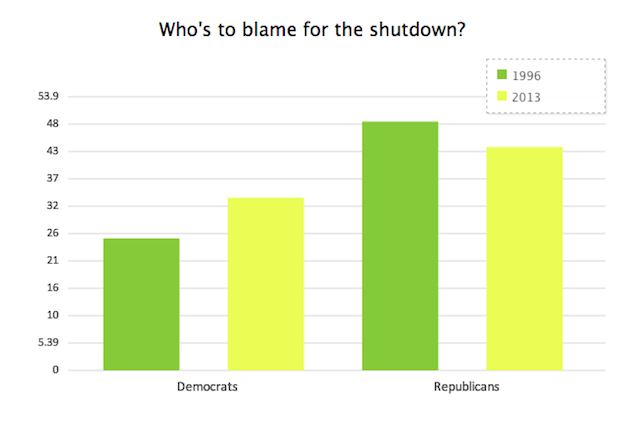
Republicans are weathering this shutdown better than they did the last one:

At left, the proportion of people who blame Democrats for the shutdown: It’s bigger now than it was then. At right, the number who blame Republicans: It’s smaller! With all the talk about how John Boehner’s blunderous perpetuation of the crisis might jeopardize the GOP’s congressional majority, these numbers add a few additional grains to the mound of salt Nate has already thrown on the idea of a congressional upheaval.

Nevertheless, Gross expects the current shutdown to do more damage than the one in 1996:

When you look back over the past 18 years, one of the unavoidable conclusions is that, for a variety of reasons, the federal government is much more involved in the economy than it was. What’s more, the economy is now more dependent on certain sectors that can’t operate at their fullest capacity without the government being entirely open.

As this chart shows, the federal government has become a larger part of the economy over time. In 1995, federal spending accounted for about 19 percent of GDP. Now, it accounts for about 22 percent of GDP. Entitlements like Medicare and Social Security, which have yet to be affected, account for a big chunk of this rise. But the fact remains that federal government spending accounts for a significantly larger chunk of GDP than it did 18 years ago. So if you slam the brakes on that spending, it will have a bigger direct impact than it did 18 years ago, for example in the effect the furloughs of defense contractors is having on the private sector.

How The GOP Defines Surrender

Chait rips into Boehner’s recent debt-ceiling comments:

Boehner dismissed the notion of lifting the debt ceiling and then negotiating the budget as “unconditional surrender.” How it could be unconditional surrender when he publicly favors lifting the debt ceiling, Boehner did not say. Obama and Boehner disagree on a wide array of budget policies. They agree that the debt ceiling needs to be lifted. Doing the thing both parties agree upon is a bizarre definition of unconditional surrender. If Boehner was an actual debt-ceiling truther, who argued that lifting the debt ceiling somehow worsens the fiscal position of the U.S. government, then lifting the debt ceiling would be surrender. But he isn’t. He agrees with Obama on the merits of the debt ceiling. Unconditional surrender is when one party agrees to do something it opposes but the other party wants — say, delaying Obamacare, as Boehner is proposing.

Douthat partially blames Republican unreasonableness on sequester spin:

One of the underappreciated dynamics making the current mess worse is the fact that both left and right, for somewhat different reasons, have embraced the idea that the outcome of the last debt ceiling deal  — sequestration, with its butcher-knife cuts to domestic programs and defense — was a straightforward win for Republicans, and a huge concession by the Democrats.

For liberals, this idea has fed into the widespread “never again” attitude where debt ceiling negotiations are concerned. (“We can’t get blackmailed like that a second time!”) For conservatives, it’s encouraged deeply implausible ideas about what they can expect the White House to offer them this time. (“We basically won outright in 2011, so why not try to go for Obamacare repeal this time around?”)

The reality, though, is that sequestration really was a genuine, almost old-fashioned sort of compromise — one that bit deeply into a lot of Republican interests and constituencies, and left the liberal ringwall around entitlements unbreached.

At this point, Cassidy is hoping for a stock-market crash:

Once the markets started tanking, investors, the banks, and the media would besiege Congress for action. The political environment would change drastically. Refusing to acknowledge reality, including the reality that every country has to pay its creditors or face ruin, would no longer be an option. Within days, or even hours, the two sides would come up with some face-saving device to calm the markets. (Finding a more lasting solution would still be a big struggle.)

To sum up, Congress needs adult supervision. Since the President can’t provide it and the Republican leadership won’t, the market might well have to step in and do the job. Such a resolution wouldn’t be pretty, but history suggests it would be reasonably effective. And once the immediate crisis was resolved, the market would probably [recover] pretty sharply.

Why The President Can’t Save Us By Fiat

Sean Wilentz claimed yesterday that Obama has the power to unilaterally raise the debt ceiling and avoid default. Balkin pushes back:

Wilentz assumes that Obama could stabilize the crisis by acting on his own. But there is good reason to believe that the opposite would occur.  If Obama is impeached, then the issue will shift from the constitutionality of what the House has done (using the validity of the debt as hostage) to the legality of what Obama has done. He will lose the higher ground in the debate, and the country’s focus will be taken over by an impeachment trial for months, as the economy spirals ever downward.  In the meantime, the validity of debt issued by the President will be repeatedly attacked in the courts by allies of the Republicans–who could purchase the new bonds and then demand a refund in order to create standing for a lawsuit.

Obama made similar points in his presser yesterday. Balkin’s argument makes me queasier, even as default, which is the likeliest alternative, remains unthinkable. The key section from the transcript:

 I know there’s been some discussion, for example, about my powers under the 14th Amendment to go ahead and ignore the debt ceiling law. Setting aside the legal analysis, what matters is — is that if you start having a situation in which there — there’s legal controversy about the U.S. Treasury’s authority to issue debt, the damage will have been done even if that were constitutional, because people wouldn’t be sure. It’d be tied up in litigation for a long time. That’s going to make people nervous.

So — so a lot of the strategies that people have talked about — well, the president can roll out a big coin and — or, you know, he can — he can resort to some other constitutional measure — what people ignore is that ultimately what matters is, what do the people who are buying Treasury bills think? And again, I’ll — I’ll just boil it down in very personal terms.

If you’re buying a house, and you’re not sure whether the seller has title to the house, you’re going to be pretty nervous about buying it. And at minimum, you’d want a much cheaper price to buy that house because you wouldn’t be sure whether or not you’re going to own it at the end. Most of us would just walk away because no matter how much we like the house, we’d say to ourselves the last thing I want is to find out after I’ve bought it that I don’t actually own it.

Well, the same thing is true if I’m buying Treasury bills from the U.S. government, and here I am sitting here — you know, what if there’s a Supreme Court case deciding that these aren’t valid, that these aren’t, you know, valid legal instruments obligating the U.S. government to pay me? I’m going to be stressed, which means I may not purchase. And if I do purchase them, I’m going to ask for a big premium.

So there are no magic bullets here.

When Will The US Run Out Of Money?

Debt Limit Estimate

Barro looks at the best estimates we have:

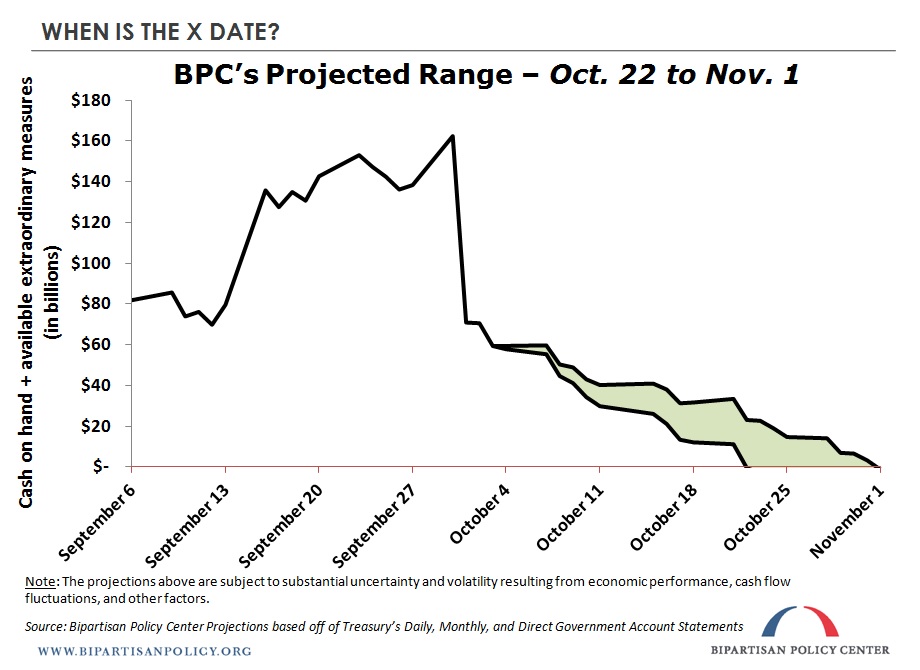
People have been talking a lot about Oct. 17. That’s the day the Treasury Department expects to exhaust ”extraordinary measures” that allow the government to finance itself without issuing Treasury bonds, such as borrowing from various government trust funds. But even when that happens, the federal government will have about $30 billion in cash left on hand, and every day it will collect more revenue. That means it will be able to go a few more days, or possibly as long as two weeks, without missing payments. The Bipartisan Policy Center has projected daily cash inflows and outflows and has narrowed the possible range for the “X date” — the first day the government can’t make all its payments due — as Oct. 22 to Nov. 1.

Matthew O’Brien also examines the government’s balance sheet and uses it to argue that debt prioritization won’t work:

[E]ven if the government is completely competent, the Treasury could still miss a debt payment. Why? Well, payments and revenues are lumpy. We owe more on some days, and we have more cash come in on some days. More importantly, we owe bondholders more on some days. So the question is whether there could ever be a particular day when we owe more in interest than we have in cash on hand. And there is.

Larison adds:

So the Republican members of Congress telling the public that they don’t need to worry about the danger of default if the debt ceiling isn’t raised are simply wrong. They are misinformed, and they are misinforming the public. They need to stop, but unfortunately many of the sources that they rely on for their news and analysis are recycling the same bad information.

When The Elephant Went Rogue

A Surabaya Zoo health worker checks the

Bernstein blames laziness for the current Republican madness:

The truth is that Republicans can pretty much say whatever they want, no matter what the bizarre logic and no matter what connection it has to what they were saying five minutes ago, and Fox News will totally accept it and blast it for hours or days. The result? Republicans have become incredibly lazy. After all, why bother constructing a coherent argument if you don’t need one.

So why is it a problem? Well, for one thing, it means that it’s easy for Republican politicians to fall deep within an information feedback loop, not even realizing that what everyone within that loop is excited about is unpopular, or perhaps just irrelevant, to the other 80 percent or so of the nation. Or to put it another way: Benghazi!

That’s potentially bad for Republicans if they lose a bit of popularity that way, but it’s worse for the system as a whole, because the system depends on parties and their politicians trying to do things that appeal to voters. The problem here is that Republican politicians deep enough in the loop might not even realize that they are espousing unpopular or irrelevant ideas.

Frum lists other factors that have crippled the party. Republicans’ rage at Obama is a big one of course:

Barack Obama was never likely to be popular with the Republican base. It’s not just that he’s black. He’s first president in 76 years with a foreign parent—and unlike Hulda Hoover, Barack Obama Sr. never even naturalized. While Obama is not the first president to hold two degrees from elite universities—Bill Clinton and George W. Bush did as well—his Ivy predecessors at least disguised their education with a down-home style of speech. Join this cultural inheritance to liberal politics, and of course you have a formula for conflict. But effective parties make conflict work for them. Hate leads to rage, and rage makes you stupid. Republicans have convinced themselves both that President Obama is a revolutionary radical hell-bent upon destroying America as we know it and that he’s so feckless and weak-willed that he’ll always yield to pressure. It’s that contradictory, angry assessment that has brought the GOP to a place where it must either abjectly surrender or force a national default. Calmer analysis would have achieved better results.

(Photo from Getty Images)

Francis Happy To Talk To Gay Catholics?

At least that’s what I think this report from the Italian media says. Could a reader translate and I’ll post the whole thing? Update:

Gay Catholics amazed at the Pope: “He answered our letter”

The Kairos group: “We wrote to him, and he blessed us.” Even Don Santoro will write to Bergoglio: “I want to ask him what he thinks of our condemnation”

by Maria Cristina Carratu

Pen and paper. Among the many revolutions of Pope Bergoglio – in addition to phone calls to the homes of everyday people (recently there was news of a family in Galluzzo telephoned by Francis, who, after inviting them to Assisi, asked if he could bless them and invited them to bring “the greetings and blessings of the Pope” to the parish) – there is also the “mail effect”. He receives a mountain of letters every day at his residence in Santa Marta, sent to him directly by those hoping to reach him by bypassing the “obstacles” of the Curia. And now there are those who think it may have been one of those “messages in a bottle” to inspire Bergoglio’s transformation on the subject of gays. A letter was sent last June to the Pope from several Italian Catholic homosexuals, many of whose signatures were collected by the Kairos group in Florence, which is very active in this area. In the letter, gays and lesbians asked Francis to be recognized as people and not as a “category”, asking for openness and dialogue from the Church, and reminding him that closure “always feeds homophobia”.

This was not the first of its kind to be sent to a pontiff, but one which “no one had ever given even a hint of an answer”, said one of the Kairos leaders, Innocenzo Pontillo. This time, instead, the answer arrived. Along with another letter from the Vatican Secretary of State (the contents of both letters are private, and it was only decided recently to make the exchange public), in which, Pontillo explained, Pope Francis wrote that “he appreciated very much what we had written to him, calling it a gesture of “spontaneous confidence”, as well as “the way in which we had written it.”

But not just that. “The Pope also assured us of his benedictory greeting.” “None of us could have imagined anything like this,” stated the Kairos representative, highlighting how, by contrast, the Archbishop of Florence, Giuseppe Betori, “always refused to even meet with us, claiming that if he did we would be legitimized as homosexuals.” Now Pope Francis actually sends us his benediction, and who knows whether his subsequent remarks about homosexuals (“Who am I to judge gays?” uttered on a plane coming back from Rio de Janeiro, and then the explosive words to Civiltà Cattolica [Catholic Civilization, a Roman Jesuit periodical]: “When God looks at a homosexual person, does he approve of his existence with affection, or does he reject him and condemn him? The person must always be considered”) might not actually be due to this exchange of letters.

In the meantime, the prisoners at Sollicciano [a Florentine prison] wrote a letter to Bergoglio (delivered directly to him in the final days of the prison chaplain don Vincenzo Russo), in which they described the ordeals of prison life and invited him to visit them, possibly on the occasion of the National Church Convention of the CEI [Italian Episcopal Conference], to be held in Florence in 2015 and where the pontiff’s presence is expected.

Now, even the Community of Piagge is addressing the Pope: “The climate has changed, and now those who want something different for the Church must stay with the Pope,” recognizes don Alessandro Santoro. “As a Community,” he explains, “we feel liberated from the many doctrinal snares of the past, and Pope Francis demonstrates how it is possible to go from mere doctrinal obedience to faith in the life of people.” Which “doesn’t mean that the Church can’t have its doctrine, provided that man with his suffering is at the center, as the Gospel says.” From this came the idea (on the occasion of the fourth anniversary, on October 27, of the celebration of the religious marriage of a man to a woman who had been born a man, which cost Santoro his job in Piagge), to write to the Pope “to talk to him about our Community, about what we are doing and why we are doing it, and to ask him what he thinks of the disapproval and blame we have suffered” (in addition to marriage, communion is also offered to gays and remarried divorcees).

Mugged For Your Mugshot

David Segal recently reported (NYT) on sleazy mugshot websites:

The ostensible point of these sites is to give the public a quick way to glean the unsavory history of a neighbor, a potential date or anyone else. That sounds civic-minded, until you consider one way most of these sites make money: by charging a fee to remove the image. That fee can be anywhere from $30 to $400, or even higher. Pay up, in other words, and the picture is deleted, at least from the site that was paid.

Mark Kleiman wants more protections for those being blackmailed by such websites:

The Fifth Amendment forbids the deprivation of life, liberty, or property without due process of law. That innocent people should sometimes be arrested is inevitable unless we can equip police with powers of omniscience. But the existence of an arrest record, even without a conviction, has many bad consequences. By maintaining arrest databases and making them available to others, the state in effect continues to punish someone for a crime of which that person was not convicted by due process of law. Why shouldn’t that be ruled unconstitutional?

Mike Riggs adds:

If the best argument for keeping mugshots in the “public information” category is that they’ve always been in that category, or that they help people instantaneously vet their dates and children’s baseball coaches, then open records advocates (of which I’m one 99 percent of the time) need to rethink this issue. Mugshots are a tool that allow police and crime victims to identify and track suspects through the criminal justice system. Making them publicly available turns an investigative tool into a lifelong punishment.

Google is already working to limit the harm these websites inflict:

Google has now found that these sites apparently do not comply with a certain guideline, and has taken action to demote them since Thursday, rolling out an amendment to its algorithms that has led to mugshots being pushed back and listed beyond the first page.

Credit card companies also took action:

“We looked at the activity and found it repugnant,” MasterCard General Counsel Noah Hanft told Times reporter David Segal of the websites offering to remove mug shots for fees. In the course of reporting the article, Segal brought the websites to the attention of MasterCard, American Express, Discover, and PayPal, all of which subsequently decided they would sever their relationships with the sites, effectively crippling their business model.

The Nobel Albatross

Physicist Mark Jackson suggests that the prize can hasten the end of a productive research career:

Ironically, receiving the prize that recognizes a great accomplishment is often accompanied with a decline in scientific accomplishment. This is most likely due to the deluge of social demands placed upon the laureates, who are perceived not just as great scientists but also sages. French biochemist André Lwoff, winner of the 1965 physiology or medicine prize, speaking on behalf of his colleagues, observed, “We have gone from zero to the condition of movie stars. … When you have organized your life for your work and then such a thing happens to you, you discover that you are faced with fantastic new responsibilities, new duties.”

The most bizarre post-Nobel career is undoubtedly that of Brian Josephson, who shared the 1973 physics prize for devising the eponymous solid-state junction. Afterwards Josephson became a follower of the Maharishi Mahesh Yogi and attempted to reconcile quantum physics with transcendental meditation. He is now director of the Mind-Matter Unification Project at Cambridge University, working hard to keep Britain at the “forefront of research” on telepathy.

The Best Of The Dish Today

duluth-MN-12pm

It was another grueling, dispiriting day in Washington. What truly terrifies me is the almost Egypt-level of mutual incomprehension that is being displayed. I take it for granted, for example, that the deficit is falling fast, that the current continuing resolution that is now in suspension affirmed the sequester levels of spending that are far lower than most Democrats would like, that Obamacare is settled law that can only be repealed by the usual democratic process, and that no sane government would default on its debts. But none of this seems to be accepted by the spokespeople of the Republican “party”.

They argue that we are facing a Greece-like implosion because of the current levels of debt (and not because they have shut down the government and are refusing to pay our bills until they stop Obamacare), that the deficit is growing (according to Speaker Boehner this week), that Obamacare is such a destruction of the entire American economy that it must be stopped or delayed at even the cost of a default, that a default is impossible anyway, and that even if we defaulted it would be no big deal.

That’s where we are. We cannot agree upon basic empirical fact in order to have a conversation, let alone a negotiation. If we were for a moment to step outside this cognitive abyss, I’d simply defer to the view of almost every single expert on the subject that even thinking about a default could be a catastrophic event not just for the American but for the entire global economy. Whatever your view of the budget or healthcare reform or the debt, surely no responsible government leader would want that to happen. And yet one party seems openly prepared to threaten it, even to save face among their increasingly radicalized followers.

The Republicans, alas, have two advantages that stem from their radicalism (yes, in a classic piece of total projection, they are the real Alinskyites and Obama is the real conservative). To any neutral observer – say, anyone outside the US – they are easily the crazier ones.

And they are holding a gun to the head of the American government and the economy. Do I believe they would happily explode this country’s credit and economy rather than have to go through the difficult task of building an actual majority in the country for their agenda? Yes, I’m afraid I do. I’ve been waiting to see some scintilla of resistance to ever further radicalization, and I see none whatsoever.

More to the point, most of the public’s eyes glaze over when you explain that the budget – with sequester-level austerity – has already been agreed to and that we are discussing now whether the Congress, having set such a budgetary path, will keep the federal government open and pay the country’s bills. Instead, the GOP can simply switch the subject, claim we are in a perilous debt crisis already and that the debt ceiling is the last stand before we end up like Greece. There is no evidence for this, so far as I can see. But that doesn’t matter if you really live in your own mental universe. In that universe, when the default occurs and the economy crashes, and the stock market collapses, and the dollar sinks like a stone, you can simply state that it was all Obama’s fault. And there are enough true-believers out there who’ll actually buy it. Worse, an economic collapse will inevitably make Obama less popular.

So there are two choices, it seems to me. Obama can invoke emergency executive authority to protect the unquestionable credit of the United States and dare the Courts to over-rule him and the Congress to impeach him. Or Obama can give in to what is an unbelievably outrageous tactic – and try to salvage some kind of interim budget deal that will raise the debt ceiling in return for some kind of Republican trophy. That would be a surrender of profound implications for future presidents – yes, Republican ones too – and fundamentally alter our political system to reward the kind of blackmail we’re now witnessing. But it would end the immediate emergency and remove the blackmail – for a while, until the GOP insists that, even though they lost the last election, they have a right to run the country permanently, regardless of electoral outcomes.

Better perhaps for the president to act to save the economy and the world in a truly perilous self-induced crisis than to allow this rogue faction to concoct a Lehman-style collapse to the power of 10 and then blame him for it. It remains staggering and outrageous that this is where we are. But if one faction of one party controls the House, and it goes completely rogue, as it has, then what can a sane president do? Juan Linz, as Chait as noted, was onto something.

All I can offer at this point is some relief: my favorite post of the day – on the genius of octopus brains –; a jumping greyhound; an all-too relevant clip from a fantastic stoner apocalypse movie; a truly WTF tourism commercial; a really tough Window View contest; and for pure camp value, Michele Bachmann making me shit myself.

The most popular post? Still my take on the GOP’s core, evolving, contradictory, hysterical bargaining position: “There Is No There There”. The second? “What Moderate Republicans?”

See you in the morning, if I can get out from under the covers.

Window view: Duluth, Minnesota, 12 pm.