Accountability Watch: Syria

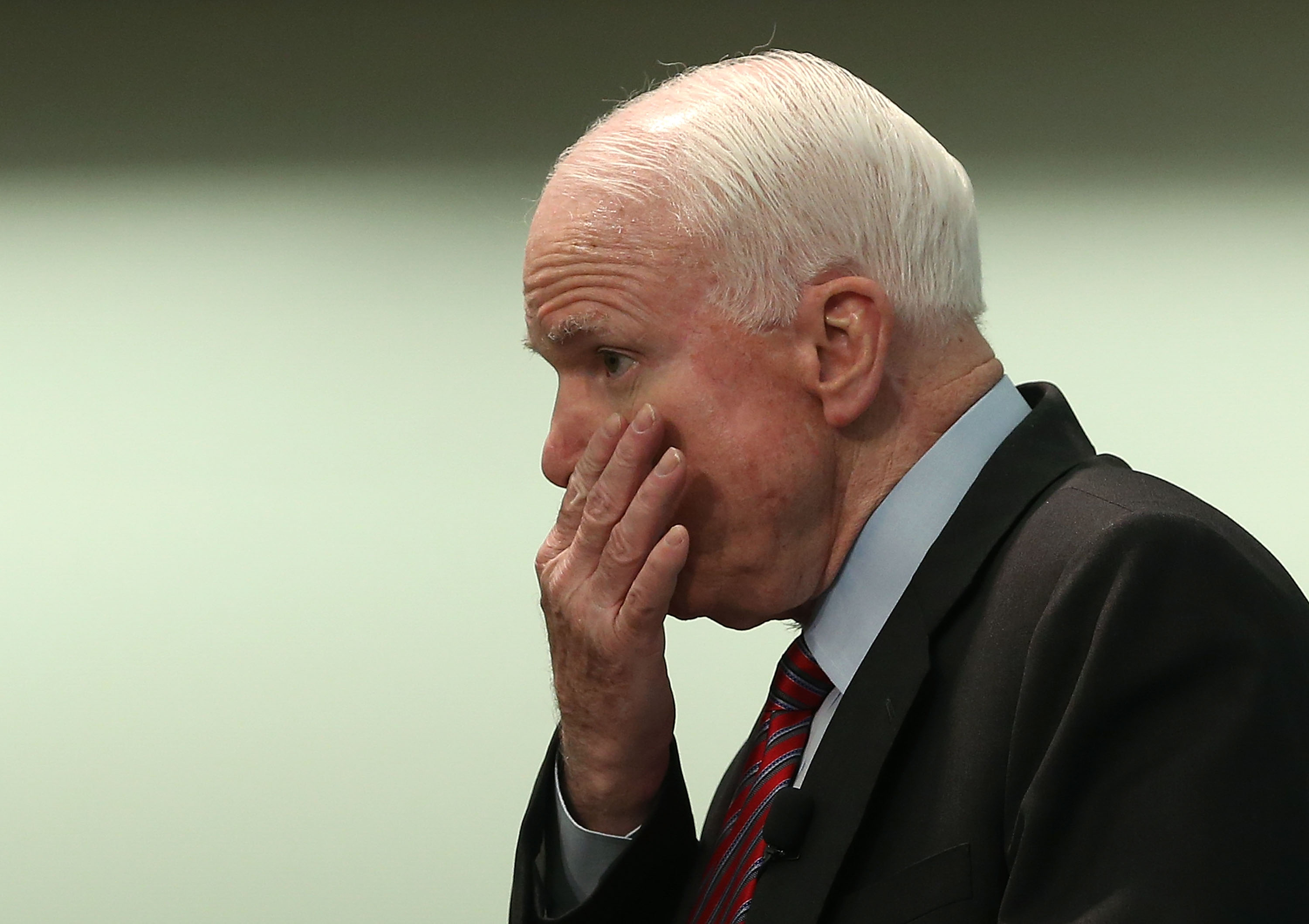
Sen. McCain Speaks On Developments In Syria At The Council On Foreign Relations

You may recall, even though it feels like a couple of centuries ago now, that there was quite some debate about the decision to hand over responsibility for Syria’s chemical weapons program to the UN, headed up by the Russians. Here is Mike Doran, who was on AC360 Later with me on Sep. 10:

It wouldn’t surprise me if, weeks from now, President Obama were attending the United Nations General Assembly while still holding meetings about a U.N. resolution to compel Assad to give up his chemical weapons. I guarantee you that as we speak, Assad’s chemical weapons team is frantically pouring bottles of Chanel No. 5, which Hezbollah stole from Lebanon, into missile shells that it will deliver to the U.N. in an elaborate demonstration of compliance with the agreement. We will take one whiff, call it perfume, and cry foul.

Surprise!

Russian officials and Secretary of State John Kerry have lauded the Syrian government for its cooperation with the preliminary work of the experts, sent by the Organization for the Prohibition of Chemical Weapons, a group based in The Hague that ensures compliance with the treaty banning them. Syria’s government joined that treaty last month after having spent decades amassing an enormous stockpile of the munitions and refusing to acknowledge it possessed them.

Syrian state television released a brief video on Tuesday showing the organization’s experts at work. The experts oversaw the first destruction of components on Sunday, with the goal of rendering inoperable all of Syria’s production, mixing and filling equipment by Nov. 1.

Perhaps Doran still believes this is all a “Potemkin disarmament effort,” as he once tweeted. I’d like to see him defend that posture against the current facts on the ground. Speaking of people who know nothing and never get called on it, here’s a statement about the UN agreement from Senator John McCain and Butters from less than a month ago:

We cannot imagine a worse signal to send to Iran as it continues its push for a nuclear weapon. Without a U.N. Security Council Resolution under Chapter 7 authority, which threatens the use of force for non-compliance by the Assad regime, this framework agreement is meaningless. Assad will use the months and months afforded to him to delay and deceive the world using every trick in Saddam Hussein’s playbook. It requires a willful suspension of disbelief to see this agreement as anything other than the start of a diplomatic blind alley, and the Obama Administration is being led into it by Bashar Assad and Vladimir Putin.

And yet what we learn today is that by November 1, “all of Syria’s production, mixing and filling equipment” will be inoperable. Will this buffoon ever concede this? Of course not. The same statement accuses Assad of deceiving the world like Saddam. But Saddam’s ultimate deception was leaving the impression that he had WMDs, when he didn’t. It appears McCain has yet to absorb the most basic fact of the last war he successfully lobbied for (he’s unsuccessfully lobbied for a few dozen since, if memory serves).

Here’s Jeffrey Goldberg who knows so much about the complexities of the Middle East:

This plan probably won’t work. Assad is a lying, murdering terrorist, and lying, murdering terrorists aren’t, generally speaking, reliable partners, except for other lying, murdering terrorists.

Wrong again! More neocon wrongness from Jon Tobin at the magazine that roasts war criminals, Commentary:

[T]he Russian-sponsored process to get rid of Assad’s chemical weapons is an invitation for the Syrian tyrant to delay and obstruct any efforts to actually remove the toxic material and lock the U.S. into a partnership with a man that even United Nations Secretary-General Ban Ki-moon labeled as a criminal.

So why are the UN, the US, and Russia so happy with how things have worked out thus far? Now, of course, this is still an early stage, and we may have to wait a much longer time to see the real truth. But I seriously doubt any of these alleged hard-nosed foreign policy experts would have predicted the thoroughness of the Syrian cooperation so far, do you? I doubt it just as much as the idea that they will ever concede error, even when it is staring them, like newly-charred bodies in Baghdad, in the face.

(Photo: U.S. Sen. John McCain (R-AZ) speaks about recent developments in Syria September 17, 2013 in Washington, DC. The senator was speaking during a forum at the Council on Foreign Relations. By Mark Wilson/Getty Images.)

A Republican-Friendly Deal Republicans Won’t Accept

Yesterday, Paul Ryan suggested a smaller ransom for opening up the government and avoiding default. Cohn rejects the deal:

Ryan in the op-ed doesn’t simply call for negotiations over fiscal policy. He also sketches out what a deal should look like. And it would involve major concessions from Democrats—cuts to Social Security benefits and more means-testing of Medicare, plus tax reform that, presumably, would not raise revenue. In exchange, Republicans would offer some relief from the budget cuts taking place from budget sequestration. But this isn’t much of a concession. Just as Democrats are unhappy about sequestration’s cuts to domestic spending, Republicans are unhappy with sequestration’s cuts to defense spending. It’s hard to see how Republicans could get such a deal in a routine negotiation.

Pareene doubts other Republicans would support Ryan’s plan:

Ryan knows he has to demand concessions that border on unreasonable in order to get conservatives on board with any end to this crisis. The problem, as ever, is that any concessions Republicans can realistically extract from Democrats and the president run the risk of being seen as insufficient specifically because they are achievable, and trolls like Cruz and his enabling organizations will be happy to make that case. Republicans are a few steps away from using a government shutdown to get a Democratic president to cut Social Security and Medicare, and Republicans are the only people standing in their way.

Chait is on the same page:

The single most implausible element of the House leadership’s “let’s negotiate” gambit is the premise that a bipartisan budget deal would satisfy the Republican base. Any bipartisan deal, even one heavily slanted to the Republican side, would enrage conservatives. Even the tiniest concession — easing sequestration, closing a couple of token tax loopholes — would be received on the right as a betrayal. Loss aversion is a strong human emotion, and especially strong among movement conservatives. Concessions given away will dwarf any winnings in their mind. Boehner, Ryan, and Cantor have spent months regaling conservatives with promises of rich ransoms to come. Coming back with an actual negotiated settlement would enrage the right.

What’s Ailing Healthcare.gov? Ctd

Obamacare Chart

Timothy B. Lee passes along the above chart illustrating how complicated the Obamacare system is:

If the exchanges were just insurance marketplaces, getting them to work might have been a lot easier. Much of the complexity comes from the fact that the exchanges are used to administer the complex system of subsidies the Affordable Care Act provides to low-income consumers. Figuring out whether a customer is eligible for a subsidy, and if so how much, requires data from a lot of federal and state agencies.

A reader argues – persuasively to me – that the system could have been much simpler:

David Auerbach does a good job describing the poor execution of the federal exchange, and I’m sure there’s more of this kind of investigation to come.  But the federal government also made an infinite number of policy decisions, and one of those is, perhaps, the original sin of the design. They decided, very intentionally, not to allow window-shopping.

The administration knew that letting consumers shop anonymously and look at what is available, including the general price ranges, was an important factor.  However, they also knew that the federal subsidies reducing those ultimate prices would be a vital enticement.  They decided that letting consumers know about the subsidies was the more important policy.  But to make that happen, the site would have to require people to actually sign into a formal account, provide financial and other information, and only then proceed to the products available to them.  That is a very intensive technological process, particularly in light of privacy concerns, and is a considerable part of the problem most consumers are having to suffer through.  The benefit is that once through the application stage, they will know not only what products are available, and at what price, but also that they will get a subsidy if the information they’ve provided qualifies them for one.

Placing the subsidy as the primary policy goal came at the expense of allowing people to enter a few basic pieces of information anonymously (age, family structure, zip code, say) and simply explore the options and general prices.  If they see something attractive, they can then either go into the application process at that point, or come back to it at a more convenient time (since no one needs to sign up immediately for coverage that won’t begin until January 1 at the earliest). That would have virtually eliminated the front-heavy technology that was enormously hard to manage, and was predictably glitch-prone.  Anonymous shopping is far easier to design and implement, makes for a better consumer experience, and allows people more time to gather the necessary (and necessarily complicated) information they must have when they are finally ready to actually buy health insurance.

The problems in execution are blameworthy, but it is more than fair to hold the administration’s feet to the fire over their policy decision to prioritize subsidies over shopping.  State-based exchanges had the same options available to them, and many chose shopping as the priority.  Score one more for the wise decision in the ACA to let states take the lead in health care reform, and one more shake of the head at the states who chose to let the federal government do the job rather than doing it themselves.

When is Kathleen Sebelius going to be fired?

What’s The Endgame?

US-POLITICS-ECONOMY

Ambers runs through various possibilities:

The most likely scenario is one where Boehner folds but pretends he didn’t, and Obama negotiates, but only in words. Privately, Boehner would prefer this solution because it would not actually concede any significant ground to the Tea Party, and if the optics are right, he could emerge from this fracas with roughly the same amount of power as before it started. What would this look like? A play, consisting of three acts. Act 1: Republicans promise to pass a clean CR and debt ceiling increase in exchange for specific words from Obama that he can be held to; Act 2: Obama proclaims publicly that he has said all along that he has been willing to negotiate with Republicans, and then says something like, “and I look forward to talking to them right after the the government opens on subjects ranging from tax reform to reducing the burden of entitlements.” Act 3: Boehner seizes on that sentence and tries to sell it to his conference. An unofficial whip count confirms this, but he says publicly that he will do the honorable thing and not allow the nation to go into default SO THAT Republicans can hold Obama accountable on his promise. Finale: the votes pass.

Waldman considers the situation from Boehner’s point of view:

[T]here is not a single factor that over time is making a GOP victory more likely. My guess is that Boehner knows this but is hoping that the fight itself will win him enough breathing space with the conservatives to keep his job when its over. He’ll lose, but he’ll show them that he was willing to inflict some harm on the country in the process, which will deplete their rage just enough.

Think about that for a moment. The only way the Speaker can keep his job is to inflict serious economic damage on the country. That’s the measure of his mettle. We can get lost in the tick-tock of this, and forget to step back and realize that this remains one of the most reckless, nihilist gambits by any political party in my adult lifetime – up there with impeaching Clinton, which, at least, wouldn’t have plunged the entire world into a second depression.

The more extremist they get, the more dangerous they become. If we can survive this self-induced fiasco, we have surely one overwhelming imperative – to get as much constructive things done in the next year and then launch a huge effort to rid the House of these fanatics in 2014. It won’t be easy, but it’s getting urgent.

(Photo: US Speaker of the House John Boehner leaves after speaking at the US Capitol in Washington, DC, October 8, 2013. By Saul Loeb/Getty.)

Kafka The Creeper

Richard Marshall reviews a new biography, Kafka: The Years Of Insight:

KafkaHe was popular, smart, good looking enough to attract women, a joker and a writer with enough fame to feed the ego whilst not so much that would distract from the business. He was capable of acts of kindness but his erotic escapades were pretty dismal. Kafka was a creepy womanizer – at thirty he was stalking with the help of Max Brod some sixteen year old he saw one time at Goethe’s house and he built himself an impervious persona who was cruel, calculating and decisively self-serving when dealing with his never-ending erotic interests. …

Kafka writes letters and diaries that make clear that he has only one subject and that is himself as literature. ‘I have no literary interests; I am made of literature. I am nothing else and cannot be anything else.’ Decisive in this identity, Kafka frees himself from ties that bind those with merely an ‘artistic bent.’

John Banville considers another new volume, Franz Kafka: The Poet of Shame and Guilt, and how the man’s enigmatic sexuality probably informed his fiction:

[Author Saul] Friedländer follows the Kafka scholar Mark Anderson in thinking it “highly improbable that Kafka ever considered the possibility of homosexual relations.” Nor does he for a moment seek to suggest that the “imagined sexual possibilities” Kafka may have entertained are a key to unlock the enigmas at the heart of the Kafka canon. All the same, once this particular genie is out of the bottle there is no forcing it back inside. Repressed homosexual yearnings certainly would account for some of the more striking of Kafka’s darker preoccupations, including the disgust toward women that he so frequently displays, his fascination with torture and evisceration, and most of all, perhaps, his lifelong obsession with his father, or better say, with the Father—the eternal masculine.

(Image via Wikimedia Commons)

The Anti-Sitcom

Joseph Winkler praises It’s Always Sunny as the fun, nasty antidote to the bright sincerity of most other shows, such as “Parks and Recreation, Modern Family, Raising Hope, and even 30 Rock”:

[If] any sin can be said to exist in the amoral world of It’s Always Sunny in Philadelphia, it is the sin of boredom, which is perhaps its most scathing satire and commentary in the world of sitcoms. A sitcom essentially takes life situations and makes them less boring through unlikely, quirky, and slightly absurd twists. Something always happens in a sitcom — someone gets sick, or a miscommunication causes problems — but there is always a resolution, and in hindsight, the conflict was wholly innocuous. Sitcoms often try to depict TV life as a considerably less boring version of our lives, but that their reach is so limited often makes the shows boring in of themselves. (A county fair gone awry, Tracy Jordan is acting up again!). That our sitcoms, embroidered versions of our lives, start to feel boring is a testament to the prevalent sterility and innocuousness of our daily lives (Wake up, go to work, come home, family time, watch TV, et cetera). It’s Always Sunny in Philadelphia, if only for a mere twenty-two minutes a week, gives us a chance to enter a world without stakes; their idle schemes are the elixir for our idle generation.

Who Is Janet Yellen?

Justin Wolfers introduces us to Obama’s Fed chair nominee:

Many will be keen to characterize Yellen’s appointment in the usual hawk-dove spectrum, with most analysts suggesting that she’s more concerned about reaching full employment than controlling inflation, making her a dove. This framing misses something important: While it’s true that Yellen has forcefully advocated for more monetary stimulus in recent years, what’s more notable is that she has gotten the big calls right. Those who argued for tighter monetary policy have been proven wrong. Inflation rates that have been persistently below target, and unemployment has been too high.

Dylan Matthews argues that Yellen is less dovish than she is made out to be:

As Evan Soltas and Matt O’Brien have noted, Yellen is plenty hawkish when the situation requires it. In the mid-1990s, when she served on the Fed Board of Governors, she made it clear that she thought unemployment was dangerously low, low enough that employers have to hike wages, which in turn leads to higher prices, i.e. inflation. “We have an economy operating at a level where we need to be nervous about rising inflation,” she said at one meeting. “We can’t dismiss the possibility that compensation growth will drift upward, raising core inflation and in turn inflationary expectations. This is a major risk. Obviously, we need to be vigilant in scrutinizing the data for signs of rising wages and salaries.”

So inflation hawks, take heart — if and when it’s actually worth worrying about inflation, Yellen will be ready to handle it.

Noam Scheiber hopes that Yellen will be tough on Wall Street:

Yellen’s social circle … consists mostly of tweedy professors and government officials. She strikes me as sufficiently devoid of attachments to bankers and money managers that she can imagine them having some truly terrible ideas—even the smart, witty, seemingly upstanding ones. This is in fact more true of her than the average senior Fed official in New York or Washington. Much of her tenure at the Fed was in San Francisco, thousands of miles away from Wall Street special pleaders.

Neil Irwin notes that “the Fed Yellen inherits is even more complicated than those led by Bernanke and Greenspan, so too will be her challenges”:

What unpredictable ripple effects is the multi-trillion Fed balance sheet having for the global economy, and how much should Fed leaders account for those in their policymaking? What is the interplay between the Fed’s low interest rate policies and excessive risk-taking in different corners of the financial world that could create new bubbles? How do you apply the lessons of the crisis to regulate banks and other institutions more effectively, implementing the immensely complicated Dodd-Frank Act? Does the very transparency that Bernanke has spent his chairmanship pushing create problems of its own, markets hear so much information about what the Fed is thinking and doing that there is unnecessary volatility?

Yellen has made her greatest mark as a thinker about employment and monetary. But as chairman, it will now be her problem to come up with answers to this full gamut of questions.

Yglesias sees Yellen’s nomination as a victory for women:

She’ll be the most important woman in economic policy in American history: It’s probably no coincidence that it took someone so super-duper-duper-qualified to break this particular glass ceiling. No woman has ever chaired the Federal Reserve. Nor has any woman ever chaired any of the other major central banks. We’ve never had a woman run the Treasury Department or the National Economic Council.

Hanna Rosin predicts that the focus on her gender will fade:

If all goes as planned, we will soon forget about the fact that she is a woman. Stories about the first female head of a major central bank will die down. Instead, much as happened with Madeleine Albright, Condoleezza Rice, and Hillary Clinton as Secretaries of State, we will start debating her policies, her interest rate decisions, her inflation targets, her easy money programs. We will move one step closer to not having to discuss or even think much about the fact that the person deciding our monetary policy wears lipstick sometimes.

Shutting Down The Safety Net

Adam Serwer worries about the shutdown’s effects on food aid:

If the shutdown lasts into November, Americans reliant on SNAP could find themselves without aid, depending on the fiscal health of the state or the priorities of state leadership. A spokesperson for the Indiana Family and Social Services Administration told MSNBC that “If the shutdown continues beyond October, the State of Indiana will assess its resources and consider its options for continuing to provide SNAP benefits.” Similarly, a spokesperson for Mississippi’s Department of Human Services said they would look to the USDA for guidance.

Sasha Abramsky considers the mental toll this takes on the poor:

We don’t know how long the shutdown will last, and that uncertainty, too, is harder on the poor. The stress of not knowing what tomorrow will bring can be debilitating.

If you’re on food stamps, the fact that the Department of Agriculture believes that it can fund the program through the end of October is better than nothing—but the prospect of not being able to pay for food in November is anxiety-provoking in a way that puts even more pressure on families that already have their fair share of it.

When I was reporting my book “The American Way of Poverty,” several people talked to me about the impact that the stress associated with poverty had on them: on their ability to focus, on their mood, on their blood pressure, on their energy level. In late 2011, an ex-accountant who had lost her job at the start of the recession and spiraled downward spoke of losing weight due to her worries. A man who had lost the business he had owned talked of how his plight made him feel “worthless.” A hungry teen-ager in a suburb east of Los Angeles told me that he cried daily.

Does Fact-Checking Deter Politicians?

New evidence points to yes:

During last year’s election, [Brendan] Nyhan and [Jason] Reifler picked nearly 1,200 state legislators in states with active affiliates of PolitiFact, the nonpartisan website based in Florida that seeks to evaluate politicians’ claims and rate their validity. To one-third of the lawmakers, chosen at random, Nyhan and Reifler sent a vaguely threatening letter. It alerted the lawmakers that PolitiFact was monitoring them and speculated about the potential consequences to their careers. … Another one-third of the legislators got a “placebo” letter: It told them they were part of a political-science experiment “studying the accuracy of the political statements made by legislators,” but no more. The final one-third got no letter.

At the end of the election, the researchers looked at the politicians’ record. How many had been called out for lying, either by their state’s PolitiFact affiliate or in a news story? The results were impressive: The politicians who didn’t get reminder letters were more than twice as likely to be criticized for inaccuracy than those who did. “Our results indicate that state legislators who were sent letters about the threat posed by fact-checkers were less likely to have their claims questioned as misleading or inaccurate during the fall campaign—a promising sign for journalistic monitoring in democratic societies,” the researchers concluded.

Shutting Down Government Won’t Shrink It

Daniel McCarthy believes that the shutdown is doing serious damage to the cause of small government:

Reducing and restructuring government is going to take time and careful planning, but what we see from the Republicans—abetted by certain activist groups and entertainers who feed off over-emotional listeners, viewers, and donors—is a party whose leadership and record in power is big government and whose committed small-government faction is crippling rather than augmenting its appeal to the country as a whole. This is a recipe for defeat of the small-government faction in future presidential nominating contests—where the Republican Party has shown a longstanding preference for candidates who seem like they can win over centrist voters—and that means even if a Republican can win the White House again in the near future, he’s more likely to be a Republican in the Bush mold.

Larison nods:

Toying around with default threatens to impose greater costs on American taxpayers rather than reduce them. It is the perfect example of striking a symbolic blow against fiscal irresponsibility while adding to the country’s fiscal problems. If one seriously wants to control and reduce government debt, raising the debt ceiling ought to be the last thing that one worries about, since refusing to raise it simply makes paying off the debt that has already been incurred more expensive. Making useless “stands” of this kind not only make small-government conservative ideas unappealing to many other Americans and provoke backlashes against them, but they make even those that agree with many of those ideas conclude that their representatives are ill-suited to governing.