Heckuva Job, Kathleen!

Ezra is admirably candid about Healthcare.gov’s failures:

The public is giving Obamacare’s roll-out low marks:

Just 7 percent of Americans believe that the rollout of President Obama’s health care law has gone very well, according to an Associated Press-GfK poll.

But, as the Dish noted last night, support for Obamacare has gone up since its launch. Ezra thanks the GOP for throwing Obamacare a lifeline:

Republicans have chosen such a wildly unpopular strategy to oppose it that they’ve helped both Obamacare and its author in the polls. This could’ve been a week when Republicans crystallized the case against Obamacare. Instead it’s been a week in which they’ve crystallized the case against themselves.

Yep, it was, in retrospect, an even worse gambit than it seemed at the time for the GOP not to wait and see how Obamacare was rolled out before their mass hostage-taking of America’s collective credit. But I’m still aghast at the rank incompetence at the White House as well as the lack of accountability.

Where, for example, is Valerie Jarrett, who purportedly had a key role in over-seeing this massive project? What does she have to say for herself? Why does Kathleen Sebelius still have her job? If this were a private company and she were responsible for rolling out a critical new product and came up with this nightmare, she wouldn’t last the week. If you want to persuade us that government can help people, then why give us a case-study in incompetence and then risible accountability? It is not good enough to say the GOP saved them. They should not have needed to be saved.

Meanwhile, Allahpundit asks if Ted Cruz will ever admit he was wrong:

I’m tempted to say that it’s just one poll, but on the ObamaCare question, it’s actually not.

John McCormack of the Standard pointed out to me this afternoon that Rasmussen also spotted a small rise in O-Care’s popularity from the beginning of September, when it was at 41/52, to October 4-5, when it blipped up to 45/49. …  The Cruz strategy for defunding (or delaying) ObamaCare was, as I understood it, to stand firm even if it meant a shutdown and then wait for public opposition to the law to build to the point where O would have no choice but to cave. The only two major polls about the health-care law that have been taken after the shutdown, though, show its unpopularity decreasing. Where’s the populist groundswell that’s supposedly going to make Obama blink? Would five polls prove that the strategy wasn’t working? Ten? We know how this theory of populist revolt could be confirmed, but how could it be falsified?

And this while the roll-out has been about as disastrous as I could have imagined. Call me crazy (and they do), but perhaps the simple idea of actually being able to get affordable health insurance is popular! Amazing idea, I know. Even if the initial roll-out should confirm every Tea Partier’s paranoid conviction that the federal government is a useless, unresponsive, money-sucking pile of mediocrity.

Well, in this case, under Obama, it has been.

Ideas That Kill

George Packer deconstructs September’s spate of Islamist violence:

American wars in Muslim countries created some extremists and inflamed many more, while producing a security vacuum that allowed them to wreak mayhem. But the origins of the slaughter are overwhelmingly internal—sectarian, tribal, political, economic. At its source, the violence flows from ideas, terrible ideas, about the meaning of Islam, the character of non-Muslims, and the duties of Muslims. These ideas are promulgated in mosques and coffee shops and schools, and on satellite TV and the Internet, with the aid of conspiracy theories, half-truths, deceptive editing, and lies. They are remarkably impervious to the ebb and flow of U.S. foreign policy.

He covers a new effort to combat these ideas:

At the end of September, the State Department announced the creation of a joint U.S.-Turkish fund to combat Islamist extremism, called the Global Fund for Community Engagement and Resilience. The goal is to raise two hundred million dollars over ten years, from governments and private donors, and to identify and finance grassroots groups around the Muslim world that will do the difficult work of opposing extremist ideas at home. These groups would take on the Islamists where they live, in mosques and community centers, in chat rooms and on social media. The American role would be very much in the background; citizens, organizations, and governments of key Islamic countries, such as Saudi Arabia and Pakistan, would take the lead.

A Two-Tiered Voting System? What Could Go Wrong?

Kansas and Arizona now require proof of citizenship to vote in state and local – as opposed to national – elections:

The dual methods are in response to a U.S. Supreme Court ruling in June that bars Arizona from rejecting federal voter-registration forms that don’t include proof of citizenship, which is required by both states. To comply, both plan to provide those voters with ballots listing just federal races. … State officials say they have little choice: the high court didn’t invalidate the statutes that require proof of citizenship to vote in state and local races. Critics say the mandates are designed to impede ballot access for minorities, the poor and older residents who may not have the needed documentation, such as a passport or a birth certificate.

One of those critics is Emily Badger:

This idea will have two obvious and unfortunate consequences:

It will create mass confusion (TPM writes that Kansas is envisioning four different registration scenarios involving two different registration forms, with some people left ineligible to vote in any election). And by creating greater barriers to registration specifically in non-federal elections, the idea threatens to particularly impact elections for offices like mayor, city council, and state representative. We already know that turnout in local elections tends to be dramatically lower than in national ones, with direct implications for who gets elected.

Benen warns, “The Republican war on voting didn’t end in 2012; it metastasized.”

If You See Something, Text Something

4312589663_fcf0181aea_o

Engrossed by their smartphones, passengers on a San Francisco Muni train didn’t notice a man on board brandishing a pistol until he had shot and killed a student. City authorities have expressed concern about the passengers’ “collective inattention to imminent danger.” Will Oremus elaborates:

San Francisco District Attorney George Gascon told the Chronicle he worries that technology is exacerbating the problem. “These weren’t concealed movements,” he said. “The gun is very clear. These people are in very close proximity with him, and nobody sees this. They’re just so engrossed, texting and reading and whatnot.” Authorities have been warning for years that people’s texting, browsing, and gaming habits make them more vulnerable to phone-snatchings, not to mention being beaned with a basketball by Baron Davis. But Gascon is among the first to suggest that smartphone users are putting their neighbors at risk as well when they block out the world and lose themselves in Candy Crush.

But Lex Berko charges that smartphones have become a scapegoat:

From personal experience, I know I’m just as unaware, perhaps even more so, when involved in an intricate fictional plot as I am when I’m trying to win a game of Dots. If each passenger had been reading instead of playing Candy Crush, answering text messages, or whatever else they were doing (quite frankly, they could’ve been reading an e-book), how would that change our perception of this crime or other similar situations? … We would never hear officially sanctioned statements about balancing our love affair with books in order to minimize crime. We love books, we read books in public, and sometimes reading books in public means not noticing other things going on. But replace books with phones and it’s a different tale entirely.

And Joe Eskenazi makes an uncomfortable point:

Authorities are preaching vigilance, which is probably a smarter thing to do than play Angry Birds. But left unsaid is just what the hell a train full of vigilant people were supposed to do if they noticed a man waving about a pistol – a man, specifically, in search of a random passenger to murder. What then?

(Photo of texting Muni passengers by Flickr user ejbSF)

The Farce Of Food Inspection

Amid fears that the shutdown will compromise food safety, Ritchie King and David Yanofsky look into the two major organizations that inspect food for the federal government:

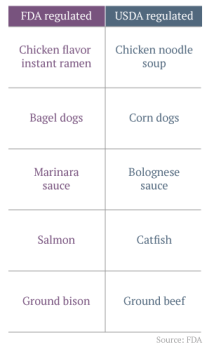
Screen Shot 2013-10-10 at 11.42.10 AMA disproportionate number of the furloughed inspectors work at the Food and Drug Administration—one of the two US government organizations that inspects farms and production facilities—rather than the US Department of Agriculture, where 87% of the food safety staff is still going to work.

So what’s getting inspected, and what isn’t? The answer is far from straightforward. Each agency is responsible for different foods: the USDA generally covers meat, poultry, and products made with egg, while the FDA covers everything else…kind of. As it turns out, their jurisdictions are divided in a way that seems totally arbitrary in some cases. In others, it’s downright farcical.

Take eggs:

The chickens that lay them are monitored by the USDA, as is the facility that they lay them in. The processing plant that washes, sorts, and packages the eggs is regulated by the FDA, and so is the carton that they’re sold in. Once that egg is cracked, the USDA is back in charge whether the contents are dried, frozen, or still in liquid form. That is, unless they are used in eggnog mix, french toast, or egg sandwiches; those items are in FDA territory.

The good news: the USDA, which conducts inspections more frequently than the FDA, hasn’t been hit as hard by the shutdown.

Why Would You Put Your Balls To The Wall?

I guess I should ask Tina Brown, who was inordinately fond of the expression. Maybe it was my balls she was putting “to” the wall? Anyway, it probably doesn’t matter what she meant. From a short history of idioms:

Many figurative expressions have literal origins, but few people stop to think about what they are. For example, the saying “it’s raining cats and dogs” apparently comes from a time when cats and dogs liked to hide in thatched roofs for warmth; when heavy rains fell, the animals would either fall through the roof or jump down in masses, according to etymologist and author Michael Quinion. It’s doubtful that Marvin Gaye knew the roots of his own lyrics, “I heard it through the grapevine”—a term that caught on in the mid-19th century in reference to the twisted vine-like wires of the telegraph and the jumbled messages that would result.

To be fair, it’s hard to believe there was once literal meaning to most phrases. It all seems so violent:

we’d be shooting ourselves in the foot, cutting off our noses, breaking each other’s legs for good luck, shooting messengers, and stabbing friends in the back. We’d be too hurt to dig our own literal graves. We’d be killing birds with stones, breaking camels’ backs, and beating dead horses. Dogs would be eating other dogs, cats would be getting skinned, and Mr Biden would be strangling Republicans. Maybe people would somehow lose their shit, but not before it hits the fan.

Alas, sometimes we think we know the root of a term but we are wrong. “Balls to the wall”, for example, is a term that refers to military pilots accelerating rapidly, thrusting the ball-shaped grip of the throttle lever to the panel firewall, thus gaining full speed. (Naturally Mr Borg was perplexed over this expression as well. “[Putting my balls on the wall] does not help me to do anything, except smell the wall,” he observed.

Another observation from Borg above.

Is The Immediate Crisis Over?

Tim Alberta reported last night that the “particulars of this short-term [debt-ceiling] proposal are in flux, as there are ongoing discussions within the conference regarding which provisions — if any — should be attached.” Cohn is waiting to see the House’s bill:

[I]t’s hard to judge Boehner’s proposal without knowing more details. In particluar, will it actually stipulate that fiscal negotiations take place—and, if so, will it put restrictions on what the outcome of those talks can be? These are critical questions. While Obama and the Democrats have signaled that they would reluctantly accept a short-term increase in the debt ceiling—notwithstanding the political perils that my colleague Noam Scheiber recently identified—they have been adamant that legislation increasing the limit not come with strings attached. It’s not clear whether the bill Boehner described would satisfy those criteria.

Jonathan Bernstein’s perspective:

Democrats have no choice but to accept a clean debt-limit extension (or government funding bill, if that’s available) of any length at all … Where it gets fuzzier is if Republicans propose something that isn’t exactly “clean.”

If the add-ons are cosmetic, Democrats probably (again, depending on details) should accept it. If it includes Republican policy gains or Republican-favoring procedural gains, then Democrats should reject it. But if it’s just some meaningless mumbo-jumbo tossed in so that Republicans can claim a victory (or at least pretend there was no defeat), then Democrats should accept it.

Alex Altman is unsure how many Republicans will support the plan:

It is still uncertain whether the restive House Republican conference broadly supports the plan. While members described the meeting as positive and cordial, others said both more moderate and more conservative members expressed reservation. Some centrist Republicans are concerned about leaving the government shuttered. While several of the Tea Party Republicans who forced the shutdown in an effort to change elements of Obamacare said they would support the plan if Obama signed on, others withheld their support.

Chris Cillizza has similar questions:

Can a clean debt limit bill win a majority of the majority?  This is perhaps the most basic question in all of this. Boehner, as we have noted previously in this space, has already passed three pieces of legislation — the fiscal cliff bill, Hurricane Sandy relief funding and the re-authorization of the Violence Against Women Act — with a minority of Republicans supporting them this year. Does he want to do it again on something as high profile as the debt ceiling?

My favorite quote of the day on all this is from a “senior Democratic aide“:

“Republicans may let one hostage go, but they are keeping a gun to the head of the other, while reserving the right to kidnap the first one again in a few weeks.”

And the beat goes on. Earlier Dish on Boehner’s latest, desperate gambit here.

The Football Fan’s Dilemma

After watching a screener of the new documentary League of Denial: The NFL’s Concussion Crisis, Dan Amira winced his way through Monday Night Football:

Like many football fans, I’ve always cringed a little during those big, loud helmet-to-helmet hits, the ones you can almost feel in your own neck as you watch them. But now, even during the mundane plays, I couldn’t shake the thought that men were mortgaging their futures away, and perhaps shortening their lives significantly, for my entertainment.

Andrew Sharp applauds the film for making the facts of the matter – and thus the moral quandary – “as clear and undeniable as possible”:

Nothing in the documentary is breaking news, but if nothing else, it gives us a definitive document of all the NFL’s hypocrisy and ignorance that’s defined this battle from day one. … I love football, and I hate talking about concussions, but everything we know about football makes it impossible to choose between the two without being just as reprehensible as an NFL doctor.

Eric Levenson describes football fans one of the “losers” of the documentary:

After watching, it’s hard not to feel conflicted about the sport, particularly after hearing about Pittsburgh Steelers lineman “Iron Mike” Webster, whose football-caused head injuries led to an early death. The documentary showed parts of his autopsy and it wasn’t pretty for fans to see: cracked feet, disfigured legs, and a brain filled with tangled tau protein, the tell-tale signs of Chronic Traumatic Encephalopathy, the degenerative condition most associated with damaged football players. And as a fan, it’s hard not to feel a little responsible for that.

Fantasy football enthusiast Greg Pollock wonders what responsibility fans like him bear for transforming NFL players “from real people into collections of stats”:

To succeed in a game, the player must distinguish information that serves his goal from information that does not. Becoming a better player means doing more of that automatically, without thinking, before thinking. For serious fantasy players—and it is hard not to play fantasy without becoming serious about it – that means automating the process by which we ignore information that does not affect points earned. This warps the way we watch football – Frank Gore blocked so Vernon Davis could get the touchdown? What a useless idiot!—but also the way we think about the league as a broader institution.

Meanwhile, Evin Demirel asks if the film could mark a turning point for the NFL:

[A]fter you’re through with the film, you can’t help but feel that the league’s days of dominance are numbered, even if League isn’t what ultimately destroys it. It’s not that football is too violent; it’s that we now know too much about that violence’s effects. A tipping point of mothers who find the sport dangerous will inevitably be reached, and football will become yet another relic of America’s past, one of those things it’s embarrassing we used to love.

Previous Dish on League of Denial here. To read our extensive thread on head injuries in professional sports, go here.

The Abatement Of Cruelty, Ctd

A reader writes:

Your acceptance of the “simply morally unacceptable” eating habits that you currently follow leads you to the “eat less meat, or eat better-raised meat” solution. That seems like an obvious, and perfectly reasonable, reaction when one views the evidence surrounding factory farming. But would that actually satisfy one’s moral compass? While eating less meat by definition reduces the number of animals killed, it implicitly gives sanction to eating some meat. I don’t think society generally accepts that sort of logic when approaching other acts that are morally frowned upon.  It would not be acceptable for the US to waterboard fewer prisoners, a rapist to target fewer victims, or an abusive father to beat his children less often, and claim to be acting in a morally upright manner.

And the option of only eating more humanely raised/killed meat is simply not a realistic option.  While specialty stores may stock meat that purports to be miraculously free of animal suffering, it is often little more than a marketing ploy.  The overwhelming majority of meat sold (in order to be economically competitive) comes from factory farms.  The same applies to the egg and dairy industries.

Eating less meat, or eating better-raised meat, as a morally-sound solution is simply a lie that many of us tell ourselves to feel better about our current habits.

I’m trying to be realistic here. Another vegan is less rigid and has some very helpful tips on cruelty-reduction:

You correctly state that people can still make big differences through their food choices in ways that suit their needs and desires. I would like to offer some guidance on that. No deep thoughts, just some practical advice. (Yes, some advice on eating animals from a vegan. Anything to reduce suffering!)

To begin with, if you want to reduce suffering as much as possible and still include animal products in your diet, reduce anything from pigs or birds.

These are by far the most abused animals in farming today because they can both be raised indoors in tight confinement. They have body parts hacked off to minimize the problems of living in such confinement, among other reasons. Pigs and birds are both very intelligent and social (crows are one of the five most intelligent non-human animals on earth). I believe you are totally wrong when you suggest that chickens have a low level of emotional experience – that describes clams, mussels, and oysters (but likely not most fish). Further, a single chicken yields far less meat than a single cow, so chickens are tortured in vast numbers.

First reduce or eliminate eggs, chicken, and turkey; and pork, ham, and bacon. Next on the reduce/eliminate priority list is dairy. Buy delicious nut milk cheeses and coconut milk/almond milk/soy milk/rice milk yogurt and ice cream.

Beef and lamb are much better choices, as they must live at least some of their lives out in pasture. “Grass fed” is good but deceptive, as they do end up in CAFOs eating grain. Grass-fed and grass-finished beef is better, as they don’t end up in feedlots – this is probably the closest to the “one bad day” school of agricultural animal welfare.

Be very suspicious of feel-good labeling, as most of it is highly deceptive. Terms like “cage free”; “free range”; “natural”; “humane” etc. are mostly used on products from atrocious factory farms. Do not believe them! Look for stores or products that use the labeling system from the Global Animal Partnership, as Whole Foods does, and try to stay in within the green labels. If you feel you must use eggs, make sure they are “pasture raised” or “pastured” – these still surely have their problems but are vastly better than anything without some form of the word “pasture” on them, when that word is used honestly.

Try ideas like Vegan Before Six, Meatless Mondays, meat as a small part of dishes, only on weekends or for special occasions, or any such approach that works for you. Buy vegetarian/vegan cookbooks. Read Jonathan Safran Foer’s book Eating Animals. Watch the documentary Earthlings (narrated by Joaquin Phoenix; music by Moby).

Of course if you add the environmental concerns to the cruelty concerns, then that may bring you closer to vegan … maybe, someday. Either way, everyone can help reduce suffering.

What Does The GOP Have To Show For Itself?

Douthat asks:

From RedState to Heritage to all the various pro-shutdown voices in the House, nobody-but-nobody has sketched out a remotely plausible scenario in which a continued government shutdown leads to any meaningful, worth-the-fighting-for concessions on Obamacare — or to anything, really, save gradually-building pain for the few House Republicans who actually have to fight to win re-election in 2014, and the ratification of the public’s pre-existing sense that the G.O.P. can’t really be trusted with the reins of government.

Sure, the polling could be worse. Sure, assuming cooler heads ultimately prevail, it’s not likely to be an irrecoverable disaster. But something can be less than a disaster and still not make a lick of sense. And that’s what we have here: A case study, for the right’s populists, in how all the good ideas and sound impulses in the world don’t matter if you decide to fight on ground where you simply cannot win.

Friedersdorf largely blames right-wing media for encouraging short-term thinking:

Watch Sean Hannity. Listen to Rush Limbaugh.

With few exceptions, the focus is winning whatever fight happens to be dominating the current news cycle. Each fight is treated as if it is as maximally significant as any other, and that is no coincidence. If you’re driven by partisan tribalism more than ideology, if getting in rhetorical digs at liberals thrills you more than persuading adversaries or achieving policy victories, it makes sense that you would fight substantively inconsequential battles with no more or less vigor than any other.

Galupo imagines what a functional GOP might have achieved:

There is a deal to be had now that Obamacare is again on the backburner and a short-term debt ceiling increase is apparently in play. The mismatch of demands and leverage points is coming back into balance. And so we’re left to wonder what House Republicans could have accomplished had they retained a sense of proportion and sought reasonable concessions without attempting to seize the highest-value hostage. A repeal of the medical device tax, plus sequester-level budget caps? The Keystone pipeline? More?

I have to say that after all this huffing and puffing and threatening to blow our house down, the idea of repealing a medical device tax as the final denouement has a certain element of bathos to it, don’t you think? You nearly destroyed the entire world economy for lower taxes on stethoscopes? Alrighty then …