“Twitterature”

In Alena Smith’s view, “a great Twitter writer is one who, like a parkourist in an urban space, plays with and quite possibly subverts the limits or expectations imposed by authorities.”  She highlights some writers worth following:

There is the tragicomic clowning of @RealCarrotFacts, by Late Night With Jimmy Fallon writer John Wyatt Haskell. There is the broken poetry of the “Weird Twitter” crew, notably including non-Internet-based poet Patricia Lockwood. There is the brilliant social satire of the hydra-headed Kaplan accounts, which mostly skewer [Jonathan] Franzen’s own New York publishing world, and their bitchy, hilarious Hollywood counterpart, Jarrad Paul (@JarradPaul). There is the visually fascinating, concrete-poetry-esque glitch art of accounts like @Glitchr_, @Newmoticons, and @l_i_i_l. There are established literary novelists who have effectively used Twitter for political provocations, such as in Teju Cole’s recent series of wryly incongruous tweets about bombing the U.K. And there are the peculiar pleasures to be found when the work of old-world writers is wittily transplanted to the 21st century Twitterscape, as in the case of Samuel Pepys (@samuelpepys: “Went to bed without prayers, my house being every where foul above stairs”) or Emily Dickinson, whose tight-knit, unnerving wordings are remarkably Twitter-ready and have spawned any number of homage accounts.

Meanwhile, An Xiao considers the revival of traditional Japanese poetry on Twitter:

[T]raditional Japanese poetic forms like haiku (17 syllables) and tanka (31 syllables) are ideally suited for Twitter’s brevity. Additionally, these poems were intended as creative dialogues, making the social aspect of Twitter relevant as well. In can be easy to read Twitter’s rapid fire nature as contra the meditative quality of poetry, but that feature couldn’t be more relevant.

The Abatement Of Cruelty, Ctd

A reader writes:

I think one of your readers missed the point completely.  Their example was: “It would not be acceptable for the US to waterboard fewer prisoners, a rapist to target fewer victims, or an abusive father to beat his children less often, and claim to be acting in a morally upright manner.” But we’re not talking about “fewer”; we’re talking about different.  So interrogations with a waterboard are unacceptable, but other forms of interrogation are fine.  Physically beating a child because they’ve misbehaved is unacceptable but disciplining them is fine.

Now if you have an absolutist view that we can not harm animals for our own needs, all of those absolute examples make sense.  Any harm to any animal is unacceptable.  If your view is that eating meat is a perfectly normal thing for a human to do, and what you wish is to do is spare animals unnecessary cruelty during their lives, then the “Sully Approach ™” is pitch perfect.

Another quotes the other vegan reader:

“First reduce or eliminate eggs, chicken, and turkey; and pork, ham, and bacon.” A healthy hen can produce 300-400 eggs in a lifetime, but only 3-4 servings of meat. So it would seem that removing chicken meat is 100x more effective in reducing the number of chickens affected by your consumption than eliminating eggs.

One of many more readers:

Eggs are actually the easiest to procure outside of the factory system. The backyard chicken coop used to be a staple of urban households; it really is not that hard to do.

Plus, besides eggs, chickens provide a good way to recycle kitchen waste, producing valuable fertilizer for the tomato plant. And a chicken is no more of a neighborhood nuisance than the average dog. It isn’t all roses and sunshine: there is still the problem of disposing of excess roosters and old, no-longer-productive hens … you can eat them, but to do that you still have to kill them. But raising chickens does put you in position to make your own moral decisions.

Another:

Don’t forget farmers’ markets whenever possible. We’re able to raise our own chickens and lambs and we barter with others for beef and pork. All of them are humanely (and even lovingly) raised and slaughtered. Those not so lucky should shop at local farmers’ markets and also talk to them about how they raise and dispatch their animals.  Even in NYC, humanely raised protein is all around. Just don’t buy it at the supermarkets or in restaurants – especially fast food!

Another:

As a non-vegan, I would only add that more of us should be familiar with the Cornucopia Institute, which audits and rates dairy and egg producers on a wide range of ethical standards. They go far beyond “free range” or “organic” labeling and identify producers that really do avoid some of the worst practices, such as the debeaking of egg-laying hens. It was through them that I learned about Vital Farms, a genuinely sustainable (and national) egg brand that really does make an effort to ensure their hens live a good life. Their eggs are expensive as a result (about twice the going rate compared to typical organic), but I think it’s well worth the price.

Another:

I strongly second your moderate vegan reader’s recommendations on reducing the cruelty footprint of your diet. And whether you want to go vegan or just make reducing your meat consumption easier and tastier, I cannot recommend any vegan chef more highly than Isa Chandra Moskowitz. Her Veganomicon is my bible.

More recommendations:

As background, I have historically been someone who was very health focused, and I have tried various types of diets, including meat-centered ones such as the Paleo Diet. I have also toyed with vegetarianism in the past (mainly for health reasons), and I have read some other books on the broad topic (including Four Fish by Paul Greenberg and In Defense of Food by Michael Pollan, both excellent). But Jonathan Safran Foer’s book Eating Animals had a significant emotional effect on me that the others did not. It gave me the same sense of epiphany on the topic of vegetarianism that I received on the topic of religion from reading The God Delusion, and I felt that I could no longer consciously deny that eating meat led to a moral wrong.

Falling Out Of Love With Art

Marilyn Diptych 1962 by Andy Warhol 1928-1987

Francine Prose considers the reasons we lose interest or appreciation in the art we once cherished:

We may also lose our early love for works that we only later realize are so marred by clichés, populated by stereotypes, and repulsively bigoted that we can no longer enjoy them, even if we make allowances for the attitudes of the period in which they were created.

Not long ago, I watched the 1943 film version of Somerset Maugham’s The Moon and Sixpence, a novel based loosely on the life of Paul Gauguin. As a child I’d loved the cinematic depiction of the painter’s romantic flight to—and tragic death in—the South Seas; I think it may have been one of the things that made me want to become an artist. But this time I noticed that the tag line on the cover of the DVD was “Women are strange little beasts,” and that the movie suggests that these little beasts need to be kept in line and properly subservient by whatever means necessary. Once our hero arrives in Tahiti, the depiction of the islanders and of the girl who is given to him as a wife is appalling.

I’m reminded of the fact that my enthusiasm for Gauguin crested around the same time as my affection for Magritte, while my admiration for Gauguin’s housemate, Van Gogh, has grown steadily over the years. For reasons I cannot explain—it’s the mystery of art—Van Gogh’s work seems to me more inspired, more beautiful and moving each time I see one of his canvases.

For related reading, check out the popular Dish thread “When Childhood Classics Aren’t Innocent.”

(Image: Warhol’s Marilyn Diptych, 1962)

Yes We Cannabis

Drug Harms

The Economist is debating legalization. From Ethan Nadelmann’s closing argument in favor of it:

Legalisation may … result in more adults using marijuana, but the negative consequences of any increase in use are likely to be modest given its relative safetycompared with most other psychoactive plants and substancesLegal regulation offers the promise of safer use, with consumers able to purchase their marijuana from licensed outlets and to know the type and potency of their purchases—and to have peace of mind that such purchases will be free from contamination. Legalisation will also accelerate the transition from smoking marijuana in joints and pipes to consuming it in edible and vaporised forms, with significant health benefits for heavy consumers.

Hundreds of millions of people worldwide use marijuana not just “for fun” but because they find it useful for many of the same reasons that people drink alcohol or take pharmaceutical drugs. It’s akin to the beer, glass of wine, or cocktail at the end of the work day, or the prescribed drug to alleviate depression or anxiety, or the sleeping pill, or the aid to sexual function and pleasure. A decade ago, a subsidiary of The Lancet, Britain’s leading medical journal, speculated whether marijuana might soon emerge as the “aspirin of the 21st century“, providing a wide array of medical benefits at low cost to diverse populations. That prediction appears ever more prescient as scientists employed by both universities and pharmaceutical companies explore marijuana’s potential.

Mark Perry digs up the above chart illustrating the relative harms of various drugs. You will note the drug-specific mortality of marijuana: zero. Notice also how relatively safe steroids and mushrooms are. This debate is all but over.

Perry also flags a fascinating 2010 interview with neuropsychopharmacologist David Nutt about the dangers of various drugs, seen below:

The Shutdown’s Smallest Victims

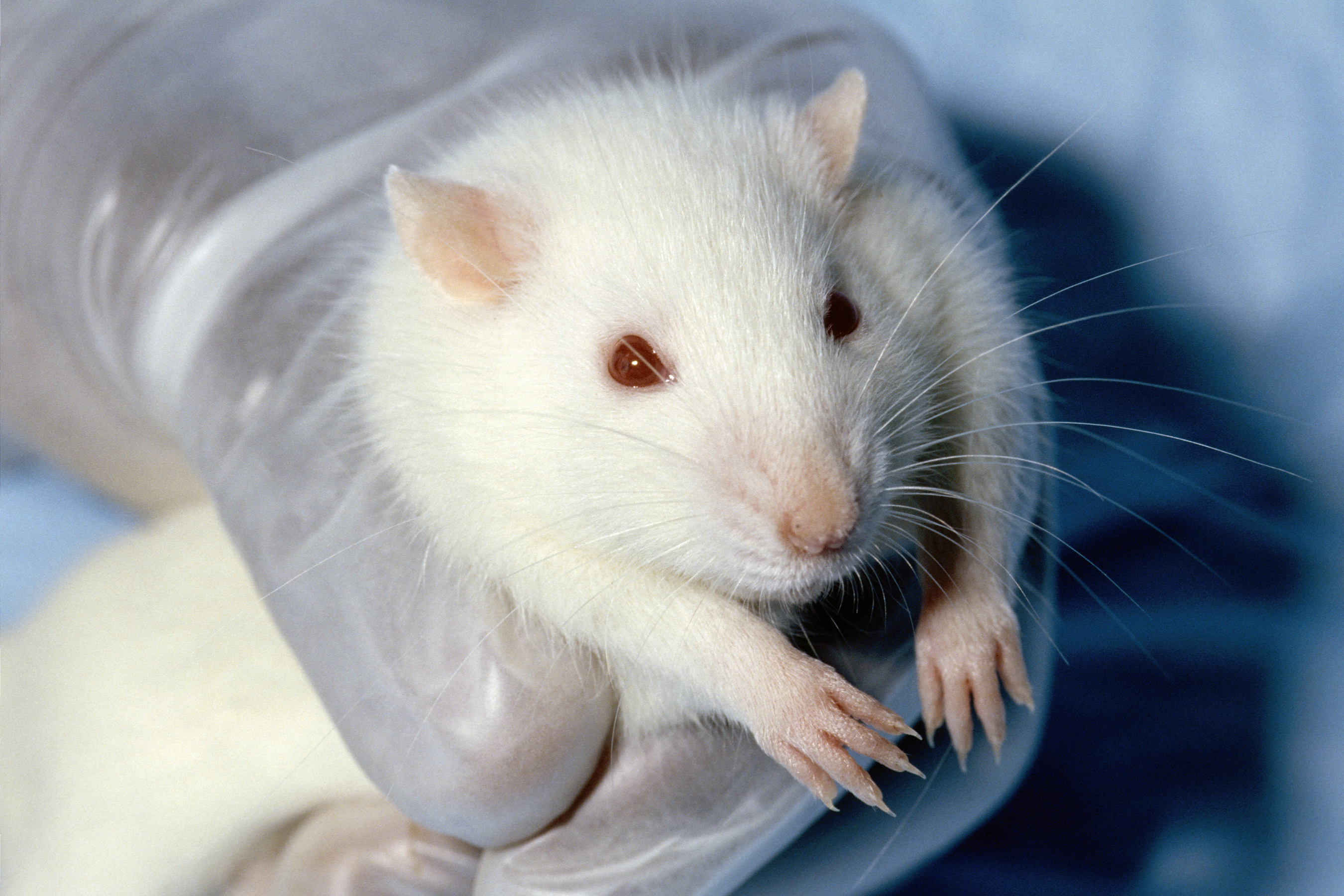
Wistar_rat

Lab animals:

The government shutdown is likely to mean an early death for thousands of mice used in research on diseases such as diabetes, cancer and Alzheimer’s. Federal research centers including the National Institutes of Health will have to kill some mice to avoid overcrowding, researchers say. Others will die because it is impossible to maintain certain lines of genetically altered mice without constant monitoring by scientists. And most federal scientists have been banned from their own labs since Oct. 1.

Fallows isn’t pleased:

Under shutdown rules, the animals still get food and water and are kept alive. But because most researchers are forbidden to work with them, the crucial moments for tests and measurements may pass; experimental conditions may change; and in other ways projects that had been months or years in preparing may be interrupted or completely ruined.

Yes, I realize that lab animals’ situation is precarious in the best of circumstances. But their lives and deaths have more purpose as part of biomedical discovery than in their current pointless captivity.

A government scientist, interviewed anonymously in Wired, reports that euthanasia is inevitable:

It’s not a matter of feeding the animals and cleaning their cages. These animals used for research are used in intricate experiments, involving treatments and collection of data performed by hundreds of individual scientists with each project. An animal caretaker can’t continue that.

Given that, you can imagine what has to happen. You cannot maintain colonies for no reason. It’s very expensive — and if they’re useless for research, what are you going to do? And mice and rats breed like crazy. An exponential expansion of the population that will rapidly fill all the cages. Every lab I know already works to maximum capacity. You can’t leave animals for somebody to feed and water.

The researcher adds:

We only take the life of an animal if it’s justified to provide new insight that will lead to basic understandings in science, or new treatments in human disease. We understand and appreciate that. We don’t do it lightly. We do it deliberately. There’s a difference between using an animal to obtain knowledge of human disease, and just having to engage in a mercy killing for no outcome, and with an enormous loss to science and to resources. It’s a waste of money, a waste of time, a waste of people, a waste of animals.

(Photo: Janet Stephens/National Cancer Institute)

A Deal That K Street Would Love

Walter Russell Mead notes that “one possible ACA-related compromise continues to get play in the media: the repeal of the medical device tax”:

As the shutdown as dragged on, a repeal emerged as both something that the GOP could claim as a victory as well as something that the Democrats could live with. And although the debt limit conversation is now shifting away from Obamacare toward other deals, the industry is still pushing hard for repeal.

Cohn pulls back the curtain on the lobbying effort to get the tax repealed:

[R]epealing the device tax would look like a favor to a special interest. And, notwithstanding arguments for or against the tax, appearances in this case are probably correct.

It’s highly unlikely that Senate bill got 72 votes because so many lawmakers, including about half the Democratic caucus, are worked up about the device tax on principle. No, the most likely explanation is that the device industry has a ton of influence, particularly in states where they have large operations. Among those who have endorsed repeal (though not explicitly as part of a debt ceiling or shutdown negotiation) are two liberal icons in the Senate, Al Franken and Elizabeth Warren. Both say they oppose the tax on the merits. Both also represent states with influential device makers. Medtronic, the nation’s fourth largest device maker, is in Minneapolis. Boston Scientific and Coviden, the eighth and ninth largest, have U.S. headquarters in Massachusetts. My colleague Alec MacGillis wrote about Warren and the device industry a year ago—it’s worth a read if you want to understand what’s going on behind the scenes in Congress right now. Or you can just consider the fact that senator-turned-lobbyist Evan Bayh has adopted device tax repeal as one of his causes. That’s usually a pretty good clue about how much special interest money is behind a campaign.

Maybe The Shutdown Won’t Be A Turning Point

Nate Silver entertains the possibility:

Most political stories have a fairly short half-life and won’t turn out to be as consequential as they seem at the time. … None of this applies if the United States actually does default on its debt this time around, or if the U.S. shutdown persists for as long as Belgium’s. But if the current round of negotiations is resolved within the next week or so, they might turn out to have a relatively minor impact by November 2014.

He goes on to argue that, even “if the shutdown were to have a moderate political impact — and one that favored the Democrats in races for Congress — it might not be enough for them to regain control of the U.S. House”:

First, there are extremely few swing districts — only one-half to one-third as many as when the last government shutdown occurred in 1996. Some of this is because of partisan gerrymandering, but more of it is because of increasingly sharp ideological divides along geographic lines: between urban and rural areas, between the North and the South, and between the coasts and the interior of the United States.

So even if Democrats make significant gains in the number of votes they receive for the House, they would flip relatively few seats because of the way those votes are distributed. Most of the additional votes would come in districts that Democrats were already assured of winning, or where they were too far behind to catch up.

Nate Cohn agrees:

[I]f Democrats do as well in 2014 as they did in 2006, they’ll gain far fewer seats, simply because the best pick-up opportunities are already held by Democrats. Or put differently: without 8 or 9 pick-ups in lean-Democratic districts, a 2006-esque wave would only barely get the Democrats over the 17 seat threshold they need to take back the House in 2014.

All of this ignores, I think, a central factor. Will this experience traumatize enough Republicans to begin to inch back from the precipice of far right Southern nullification politics they now favor? We have to wait and see. My fear is that their cultural alienation and economic vulnerability and religious fundamentalism has gone too far to be turned back any time soon. Maybe a presidential candidate who runs against the Tea Party could do it. But the climate of fear is hard to pierce; and the epistemic closure is close to hermetic at this point.

Heckuva Job, Kathleen! Ctd

Screen Shot 2013-10-11 at 1.06.19 PM

A reader quotes me:

Why does Kathleen Sebelius still have her job? If this were a private company and she were responsible for rolling out a critical new product and came up with this nightmare, she wouldn’t last the week.

I have been an IT consultant for private companies that ranged in size from startups to Fortune-100 since 1998, and a smart private company would not fire someone within a week.  When there is a bad product launch (and the errors I’ve seen in the CA Obamacare site are just embarrassing), the company goes into crisis mode trying to deal with major issues.  When you’re in that mode, you don’t rock the boat unnecessarily. Why fire your leader and add one more complication to an already-complicated situation?  I guarantee you that behind the scenes everyone is scrambling to get the exchanges to an acceptable level of functionality, and once there is a chance to take a breath, people will be held accountable.  But unless Sebelius is somehow making things worse by being there, why would you fire her at this time and make a chaotic situation even worse?

Another adds:

Suppose she was let go, would her replacement not have to go through Congressional hearings before taking the position? How long is that going to take, and what would the effect be on HHS to be without leadership, especially NOW, for an extended time?

Another reader who takes issue with my quote:

Really? The exchanges were contracted out to private companies, CGI Group and Quality Software Services. As far as I know neither of their CEOs have resigned or been fired. Having worked in IT project management for a long time, the Obamacare glitches look pretty routine for such a complicated undertaking.

One of many more readers:

I would like to point out two parallel failures in private business that mirror the launch failure of healthcare.gov.

Last year’s Sim City 2013 and the Diablo 3 launches are great examples of digital products released to mass demand exposing deficient servers and buggy products. While these events are in the sphere of gaming culture and thus might not be “serious” enough for critical discussion both multi-million dollar products had awful launches which serve a good parallel. The individuals in charge of each of these products were not fired, in contrast to your view that private business would hold such incompetence immediately accountable. While both games ended up being disappointments, their directors were allowed to fix the problems before being shuttled off to the side.

If anything, the Obama administration is acting like a business by not removing someone who failed with a product launch, thus creating a larger PR problem, and allowing that person to remain until the problem is fixed.

The myths that surround “how business is done” and the empirical real-world examples are one of my pet peeves. Even the disastrous Apple Maps launch didn’t result in an immediate firing. It took two months and an internal power struggle to remove Scott Forstall and Richard Williamson.

Another example:

Fifteen years ago I was in management at the US headquarters of a Global 500 IT company. The president wanted to roll out an new (but internal) intergalactic system for managing distribution, networks, sales forecasts, revenues, and other operations. He believed his Accenture consulting cronies when they assured him that the turn-up would go smoothly. Seamlessly! (SAP was a co-conspirator.) Little testing was done, at load or otherwise. The integrity of data went unchecked.

The company was unable to take inventory, track sales, or recognize revenue, except by hand, for over a month. Dozens of worker bees had to be flown in from the home country to count the beans. Needless to say, no one was fired.

Another:

Um, I just want to point out that all new systems have their gliches and burps and crashes. Take the iPhone 5s; it’s crashing like crazy: “iOS apps are twice as likely to crash on the new iPhone 5s as they are when running on the iPhone 5 and 5c” – so would you put this in the category of massive failure? You say “And this while the roll-out has been about as disastrous as I could have imagined…” Really? The ACA is a brand new system that’s never been done before and it crashes and you say disaster? I realize this kind of talk is not just coming from you, but really, the drama, THE DRAMA! Nobody steps back and looks at the big picture.

Another steps back:

I’m all for accountability and no fan of Kathleen Sebelius. But you’re a bit harsh in criticizing what is perhaps the most ambitious online system roll-out in the history of the internet. As I understand it, this is an enormously complex system because of all the different agencies – with their own codes, protocols, and security measures – that need to “talk to one another” through the healthcare.gov portal. And isn’t the IRS partially shutdown – I would guess that affects the portal’s ability to verify all the data it needs to check people’s subsidization levels.

In any case, this is a site with high variables, high traffic, and very scary internet security possibilities. To top it off, it was never supposed to be run mostly by the federal government! The plan was that the states would run their own exchanges, right? But too many of them decided that they didn’t actually want “states’ rights” in this instance because rights entail responsibilities, and responsibilities are hard.

And I’ll repeat what many others have said: the comparison here should not be to other quotidian online transactions, but to the previously existing open market for individual health insurance plans. Even dealing with COBRA is a huge hassle – and that was the easiest way to have individual health insurance before the Affordable Care Act.

It was reported that more people tried to sign up for this in 24 hours than in Twitter’s first 24 months.  So, maybe, just maybe, take that Mental Health Break a bit early today and chill out?

Another steps back even more:

First, I want to say that I agree with you, Ezra Klein, and all the others who have been enormously critical of Healthcare.gov’s lack of functionality. I do information technology for a large healthcare nonprofit in Chicago and it has caused me and the people who actually need it nothing but problems. So I am not only disappointed but genuinely incensed at such an important program lacking such basic functionality.

I am also not surprised.

I fully believe that those in the Obama administration who were responsible for the rollout should actually live up to that responsibility. But I don’t think we should stop there. I think this speaks volumes about the process of awarding government contracts. The process to simply find a firm that is willing to do it is rough enough. Then you add in that the government usually chooses the lowest bidder, not the most qualified, which already won’t get the best results. But before you can choose the best of the lowest bids, you have to make sure that the engineers in the firm meet a myriad of federal requirements. I’m not a total anti-regulation nut (despite how it ties my hands, I still am mostly in favor of HIPAA and HITECH) but there are regulations that prohibit the best quality, especially in cases like this. And when it comes to something like a massive new healthcare initiative for the entire nation, how could you want anything but the best?

I’m sure you’ve received a bunch of emails like this one, so thanks for taking the time to read it! And keep up the good work on the blog; it’s still one of the best sites on the Internet – and it had a solid launch!


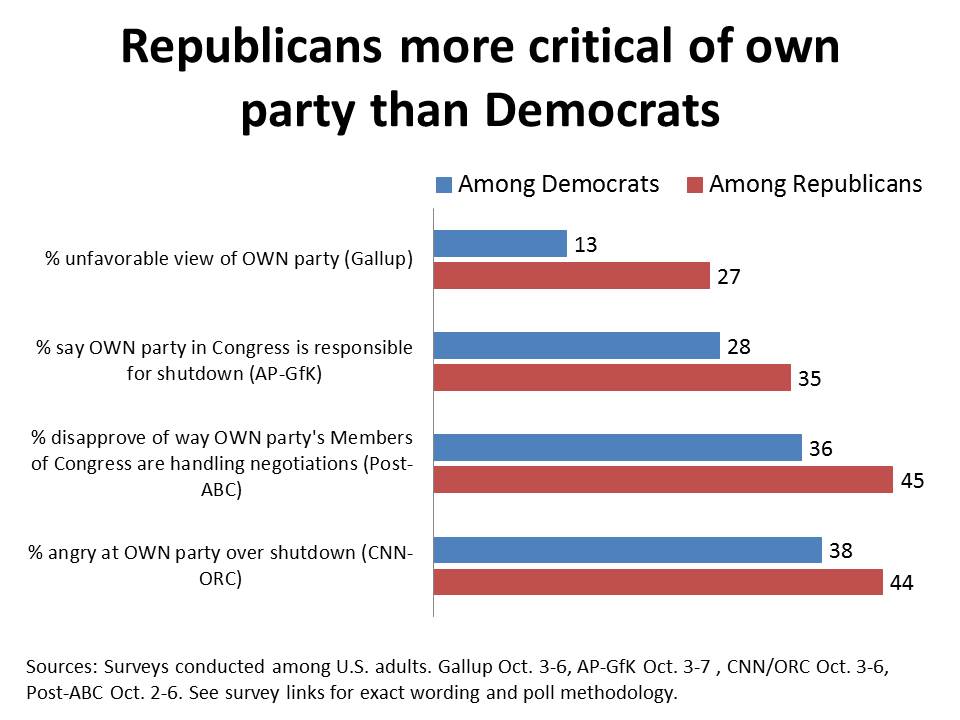
The GOP Hates Itself

Republican Dissaproval

The Fix highlights the above chart:

The last thing the GOP needs as it seeks to unify, expand its reach and attract new voters is anger directed inward. But that’s the reality of what it’s dealing with.

The trouble is: I don’t think this is primarily moderate Republicans, if they actually exist, blaming Tea Party hostage-taking for their party’s fate. I think it’s base Republicans hating on their leadership’s alleged moderation! As someone who has read, edited or written countless “Republicans’ Coming Crackup” pieces, it might just be true this time that it’s happening. As so often, Obama is causing his enemies to self-destruct. How else to interpret a public statement like this one from the head of the National Federation of Independent Businesses:

There clearly are people in the Republican Party at the moment for whom the business community and the interests of the business community — the jobs and members they represent — don’t seem to be their top priority.

McCain (see below) and now Peter King have emerged from the shadows again. This is King on Cruz:

How did a guy eight months in the Senate be able to dominate the House Republicans, Senate Republicans, tie up the country, and bring the government to a halt with no end game, no strategy, and then now just sort of walk away, as if he’s done his job?

Meanwhile, a study finds that the government shut-down is hurting the red states most of all. Much of which prompts the usually sober John Judis to declare that the current GOP is pining for the fjords:

What is happening in the Republican Party today is reminiscent of what happened to the Democrats in the late 1960s and early 1970s.

At that time, the Democrats in Washington were faced by a grassroots revolt from the new left over the war in Vietnam and from the white South over the party’s support for civil rights. It took the Democrats over two decades to do undo the damage—to create a party coalition that united the leadership in Washington with the base and that was capable of winning national elections. The Republicans could be facing a similar split between their base and their Washington leadership, and it could cripple them not just in the 2014 and 2016 elections, but for decades to come.

Seth Masket doubts that we are in the middle of a realignment:

Obviously, it’s hard to know how the current rift will play out. There seems to be a consensus emerging that the current Tea Party-inspired crisis over health reform, the shutdown, and the debt ceiling has been an unmitigated disaster for the Republican Party, costing it in terms of policy and popularity. If that is the dominant interpretation a few weeks and months from now (especially among Republicans), Tea Party affiliates will get much of the blame, and this may represent an opportunity for the more traditional establishment types to reassert themselves and to ignore Tea Party demands in the future.

What more traditional establishment-types? Name one in the House with any clout or on Fox News with any regularity.

Heckuva Job, Kathleen, Ctd

Stay calm. Here’s what we paid for the Obamacare site:

[T]he fact that Healthcare.gov can’t do the one job it was built to do isn’t the most infuriating part of this debacle – it’s that we, the taxpayers, seem to have forked up more than $500 million of the federal purse to build the digital equivalent of a rock.

Update from a reader:

The Digital Trends piece on the cost of Healthcare.gov mis-read the government contract award documents and has walked back their “Healthcare.gov cost half a billion dollars” claim. Their post has been updated (rather mendaciously, I think). Here’s one blogger’s explanation of how they may have misread the contract costs.

Mike Masnick blames the way government hands out contracts:

[I]t appears that the federal government basically handed this project over to the same crew of giant government contractors, who have a long history of screwed up giant IT projects, and almost no sense of the “internet native” world.

The Sunlight Foundation (link above) figured out the list of contractors who worked on the site, and noted that the big ones not only are well-known DC power-player insiders, but they’re also big on the lobbying and political contributions side of things. You’ve got companies like… Booz Allen Hamilton, famous for promoting cyberwar hype and employing Ed Snowden. There’s defense contracting giant Northrup Grumman. Then there’s SAIC — which I can’t believe can still get government business. This is the same firm that famously was given a $380 million contract to revamp the FBI system, on which it went $220 million over budget, and then saw the entire system scrapped after it (literally) brought some users to tears, and the FBI realized it was useless in fighting terrorism. SAIC is also the company that NYC Mayor Bloomberg demanded return $600 million after a city computer project (budgeted at $68 million) actually cost $740 million. SAIC has a long list of similar spectacular failures on government IT projects.

Here’s what I don’t believe. I don’t believe the Obama campaign would have entrusted their polling and GOTV apparatus to these companies. So why do they take government less seriously than they do their own campaign? This is not the change we can believe in. And it better get fixed fast.