How We Depend On Our Descendents

Philosopher Samuel Scheffler argues that, regardless of our individual views about a personal afterlife, we all have a stake in believing that others will live on after we’ve passed:

One thing that happens when you start to think about how you would feel if you knew that life would end shortly after your own death, lots of the things that you now do might come to seem pointless. Like, if you’re a cancer researcher, will you still find it meaningful or valuable to pursue cancer research? Quite likely not. I think we implicitly take it for granted that our activities belong to an ongoing temporal chain of human lives and generations, and that if we imagined that, you know, a giant asteroid were going to destroy the earth so there was no future for humanity, suddenly lots of what we now regard as valuable would seem pointless. …

Many people who believe in the afterlife as traditionally understood think that if there isn’t such an afterlife then the value or purpose or meaning of what we do here and now is diminished, or perhaps lost altogether.

I’m suggesting that if there isn’t an afterlife in my sense, that really would diminish the point and value and meaning of what we’re doing. The nice thing about my kind of afterlife is that we’re actually in a position to take steps to make it more likely that human beings will survive long into the future — or, unfortunately, less likely. …

I think we don’t take sufficiently seriously the importance of insuring that human life continues. And, you know, some people are trying to change that, but often they do it by appealing to some sense of moral obligation — “we owe it to our descendents.” I’m suggesting that it’s not just that they’re dependent on us — there’s also a sense in which we depend on them. Without them, if there are no future generations, the value of what we’re doing here and now is threatened.

The Eastern Way Of Worship

Richard Madsen notices that, according to a recent Gallup poll, 47% of the Chinese population claims to be atheist – yet other surveys demonstrate that nearly 85% of the country “carry out rituals to honor ancestors, seek out good fortune, ward off evil, celebrate festivals, and accumulate merit for a good afterlife.” So what gives?

An answer is to be found in the social nature of indigenous Chinese religion—it is more about belonging than belief. The collapse of the commune and state industrial work unit systems has made the search for forms of community not controlled by the state more pressing than ever. These alternative forms are typically established through myth and ritual, which meaningfully anchor persons to families and communities. But participants in the myth-telling and ritual performance might understand them in very diverse ways, including skepticism about the truth of the myths that they tell and the efficacy of the rituals in which they engage. However, in order to remain members of the wider community, they practice them despite their doubts. If among the middle classes of the West it is now common for religion to take the form of “belief without belonging,” in China it may just as commonly take the form of belonging without belief.

If we see Chinese religion as a matter of community belonging rather than one of spiritual belief, we might gain a clearer perspective on how and why religion in China has been growing and transforming. Old forms of community are dying and new forms are yet to be born—a liminal situation reflected in the kaleidoscopic interplay of old and new forms of religion.


Relatedly, the Chinese Communist Party may be moving on from its longstanding treatment of religion as purely a threat to stability:


The view that religion represents a positive force in civil society is gaining ground, not only among religious believers, but also within the Communist Party itself, in part thanks to the patient and often courageous work of the epistemic community of Chinese scholars who have studied closely and objectively religious life and its evolutions, and who have focused in particular on the philanthropic activities of religious associations during the Republican period and among overseas Chinese communities.

The government’s facilitation of growing involvement on the part of religious organizations in philanthropy and disaster relief, including health care and poverty alleviation, indicates that the Party has listened to these scholars and understood the significance for society of religious adherents’ beliefs and values, and as a result has changed its approach to religion’s place in contemporary China. The Party increasingly looks at it as a resource not incompatible with progress and capable of contributing to social stability. Local government support for the rebuilding of Buddhist temples and for the expansion of the latter’s charities stand as a good example of this new appreciation. The newfound appraisal of traditional rituals known as popular beliefs represent another instance of this change of perspective in the state’s relationship with religion: dismissed until the 1970s as “feudal superstitions,” they are embraced today as a “national heritage” worthy of support.

The Muslim community in particular is making gains:

As one of China’s five official religions, Islam has gained much vigor in the three decades since the reform. In the process of urbanization, for example, rural Muslim migrants reenergized existing Muslim communities in cities like Guangzhou. New Muslim communities in urban centers have also grown at an unprecedented rate. The growing ties between Chinese Muslims and the heartland of the Islamic world are deemed useful within the framework of “building the religious/cultural stage to sing the economic opera” (文化搭台,经济唱戏). Hui Muslims, as the largest Muslim ethnic minority, have particularly benefited from the tide of religious revival and have played an important role in micro-level business activities in the China-Middle East trade because of their religious affinity and knowledge of Arabic.

The Road To Becoming A Relic

München

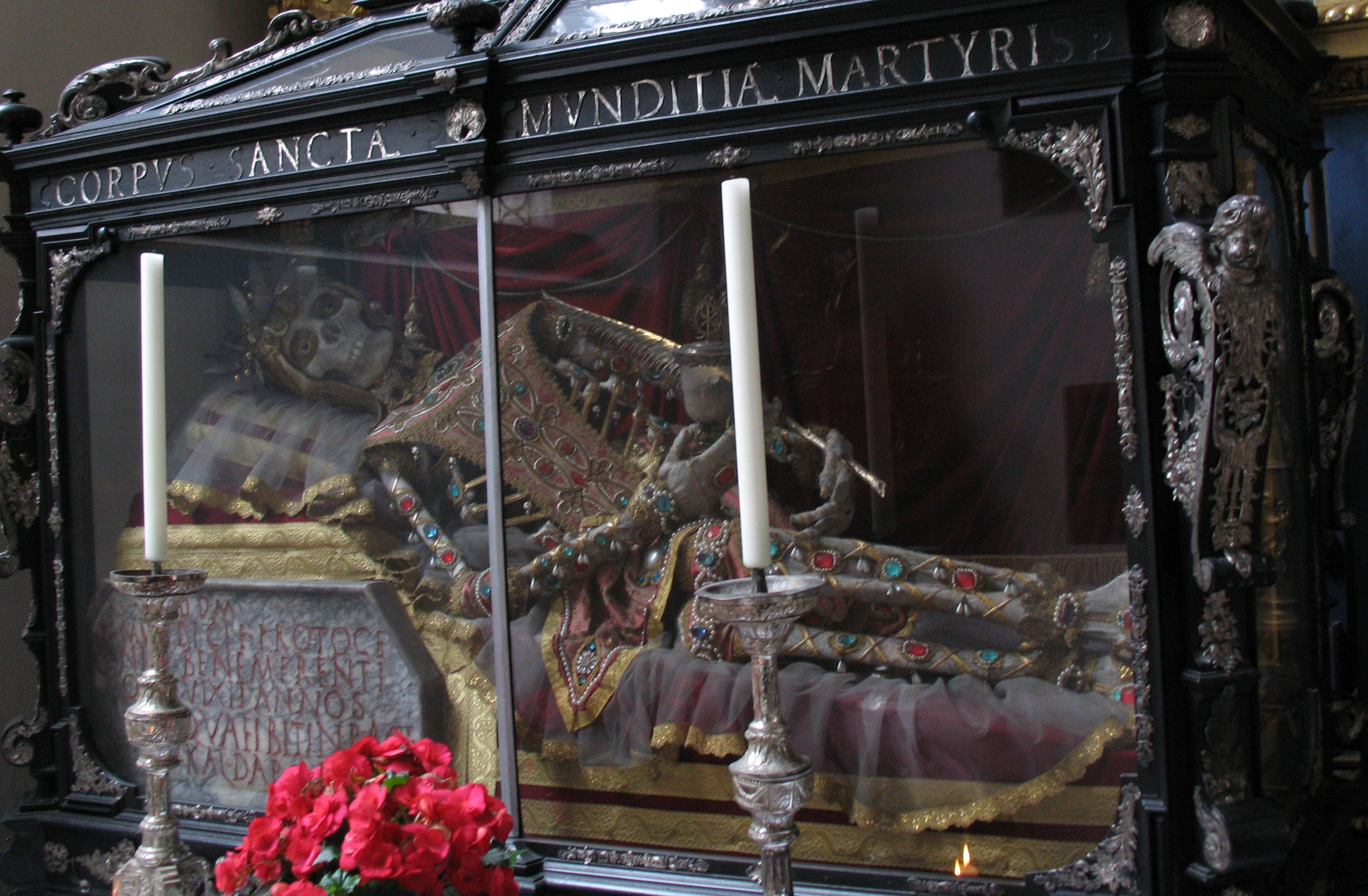
Rachel Nuwer describes the work of art historian Paul Koudounaris, whose book, Heavenly Bodies, documents how the bones of Christian martyrs in Roman catacombs were transformed into bejeweled relics, which were displayed in churches throughout Europe. How Vatican investigators determined which remains belonged to a departed saint:

[T]he process of ascertaining which of the thousands of skeletons belonged to a martyr was a nebulous one. If they found “M.” engraved next to a corpse, they took it to stand for “martyr,” ignoring the fact that the initial could also stand for “Marcus,” one of the most popular names in ancient Rome. If any vials of dehydrated sediment turned up with the bones, they assumed it must be a martyr’s blood rather than perfume, which the Romans often left on graves in the way we leave flowers today. The Church also believed that the bones of martyrs cast off a golden glow and a faintly sweet smell, and teams of psychics would journey through the corporeal tunnels, slip into a trance and point out skeletons from which they perceived a telling aura. After identifying a skeleton as holy, the Vatican then decided who was who and issued the title of martyr.

Once a skeleton was selected, highly-skilled monks and nuns would prepare it for presentation to a congregation, a process that could take up to three years:

Each convent would develop its own flair for enshrouding the bones in gold, gems and fine fabrics. The women and men who decorated the skeletons did so anonymously, for the most part. But as Koudounaris studied more and more bodies, he began recognizing the handiwork of particular convents or individuals. “Even if I couldn’t come up with the name of a specific decorator, I could look at certain relics and tie them stylistically to her handiwork,” he says.

Nuns were often renowned for their achievements in clothmaking. They spun fine mesh gauze, which they used to delicately wrap each bone. This prevented dust from settling on the fragile material and created a medium for attaching decorations. Local nobles often donated personal garments, which the nuns would lovingly slip onto the corpse and then cut out peepholes so people could see the bones beneath. Likewise, jewels and gold were often donated or paid for by a private enterprise. To add a personal touch, some sisters slipped their own rings onto a skeleton’s fingers.

Read the recent Dish thread on relics, “Saints on Display,” here.

(Photo of Saint Munditia’s relics, found in St. Peter’s Church in Munich, Germany, via Wikimedia Commons)

“The Promised Land For Christian Fundamentalism”

Andrew O’Hehir watched God Loves Uganda:

[Murdered Ugandan LGBT activist] David Kato and other victimized and persecuted LGBT people in Uganda and other heavily evangelized African nations seem to be paying the price for the fact that [preacher] Lou Engle and people like him are gradually losing the culture wars at home. Uganda is their biggest success so far, but the long-term vision involves a wave of Christian revival that will sweep out of Africa into the first world, driving back the apparently victorious forces of secularism. But even Engle and his movement, although they strongly oppose gay-rights legislation, did not propose the death penalty for homosexuals. Credit for that belongs in large part to Scott Lively, an unhinged American “ex-gay” leader whose extended rants about how gays had caused the Nazi holocaust (exactly how I do not know) and now sought the destruction of traditional African family life found an enormous audience among Ugandan officials, politicians and teachers.

In May, John G. Stackhouse, Jr. criticized this argument:

From first to last, the anti-homosexuality campaign in Uganda is attributed to the imposition of Western values. But anti-homosexuality is clearly not a distinctive Western value. It is rife in tribal cultures in Africa and already in the outlook of Ugandans when the recent wave of American evangelical extremists arrived. Only such facts can explain the receptivity given to such people as Scott Lively (who apparently spoke for five hours with the Ugandan Parliament) and the resulting widespread and violent anti-homosexuality in government and popular media. By comparison, when evangelicals did dominate North American societies in the nineteenth century, sodomy was illegal, but was not punished by anything approaching life imprisonment, let alone the death penalty. So the tired trope of imperialistic foreigners corrupting the noble savages rears its head again and must once again be dispatched by a little careful thought.

In an interview earlier this year with Queerty, Williams discussed what inspired him to make the film:

I have a strong religious background, and grew up singing in the choir of my family church.  I have always been interested in the power of religion as a force for both good and evil.  My last film [Music by Prudence] took place in Zimbabwe and, while I was shooting there, I was struck by how popular conservative Christianity is in sub-Saharan Africa. After I read about Uganda’s now famous “Kill the Gays” bill, I wanted to explore the religious forces behind it.  I’m not interested in films that preach to the converted— I always wanted to make a film that starts a dialogue within the religious community.

Previous Dish coverage of gay persecution in Uganda here, here and here.

How To Diagnose A Sex Deviant?

In an excerpt from his new book Perv, Jesse Bering illustrates the ongoing debate over sexual deviancy’s relation to mental illness:

[T]here was the tale of Armin Meiwes. That name might dimly light up in your frontal lobes as a distant headliner best forgotten, but to remind you—and apologies for doing so—Meiwes, a computer repairman by trade, was the German cannibalistic sexual sadist who, in the spring of 2001, found a willingly edible sexual masochist for himself named Bernd Jürgen Brandes. “Looking for a well-built 18- to 30-year-old to be slaughtered and then consumed,” read Meiwes’s personal ad on the Cannibal Café website (which, you’ll probably be glad to know, is a website no more). And Brandes, it seems, was looking to be thoroughly digested. That old psychopath Cupid couldn’t have arranged for a more tragic crossing of these lovers’ paths. … From the video footage—the whole awful thing was taped from start to finish—it’s apparent that Meiwes (the eater) didn’t coerce Brandes (the eatee) at all. If anything, the coercion was done by the masochist, not the sadist. Brandes even begged a hesitating Meiwes to bite off his penis. …

I’m by no means suggesting that both the S and the M parts of this equation weren’t disturbed men. You don’t need to be a mental health expert to see that. Yet when we try to apply the ”DSM- 5’s” criteria of pain and non-consent, there’s some tension here, since Meiwes had explicitly sought out a consenting adult partner. And when you combine consent with a masochist’s apparent death wish, well, you can see how a forensic psychiatrist’s job can be daunting.

Bering discusses what he learned from writing his book:

Over the 18 long months in which it was in production, Perv … evolved from being a light scientific treatment of weird sex to a book with an actual moral message. And that message turned out to be embarrassingly obvious, really. As a society, we’ve been dawdling over the irrelevant questions of what’s “normal” and “natural” for far too long. To make any real moral traction, we must abandon the rhetoric of righteousness and instead turn our efforts to clarifying, using science rather than scripture, laws, or even (and especially) our own gut feelings, how a sexual act or orientation is harmful to those involved. In my book, at least, doing harm is the only thing that makes a person a pervert.

Last year he answered a bunch of Ask Anything questions surrounding his previous book, Why is the Penis Shaped Like That? Meanwhile, on the video seen above:

Zoo is a 2007 documentary film based on the life and death of Kenneth Pinyan, an American man who died of peritonitis due to perforation of the colon after engaging in receptive anal sex with a horse. The film’s public debut was at the Sundance Film Festival in January 2007, where it was one of 16 winners out of 856 candidates. Following Sundance, it was selected as one of the top five American films to be presented at the prestigious Directors Fortnight sidebar at the 2007 Cannes Film Festival.

The film was made with co-operation of the two men who took Pinyan to the hospital, as well as other friends of his, in the attempt to explore the life and death of the man, as well as those who came to the farm near Enumclaw for similar reasons, beyond the public understanding of the media. It does contain explicit material of sexual activities, but only in the view of video footage shown on a small television screen.

Part one is above. The rest is here.

When The Force Wasn’t So Strong

The original teaser trailer for Star Wars was recently rereleased:

But the groundbreaking film almost never saw theatrical release, “after it had gone considerably over budget ($13 million finally) and driven Lucas to the point of nervous collapse”. More from an excerpt from David Thompson’s new book, The Big Screen: The Story of the Movies:

Universal had given Lucas a two-picture contract, for American Graffiti and something called Star Wars. No matter the success of the first film, the bosses at Universal could not envisage what Star Wars would be, as Lucas struggled to write it and to work out the array of special effects that would be required. The project was hanging in the balance, even if it was about to reshape the art and the business. Universal faltered, but Twentieth Century–Fox said it would take on the venture. It was scared of science fiction and wary of Lucas and his taciturn demeanor, so it agreed only to a development deal, with step payments that exposed Lucas personally to his debts from THX 1138. …

Lucas had been dismayed in his deal with Fox to learn that the studio was closing down its special-effects department. Yet he envisaged countless scenes such as no one had ever seen before. He assigned John Dykstra (an assistant on 2001) to begin experimenting in Van Nuys, but this was only the prelude to a new culture in which photographic methods would be increasingly harnessed to the computer. In 1975, while working on the film, Lucasfilm founded a new operation, Industrial Light and Magic, which would soon move to Marin, north of San Francisco, at what would be called Skywalker Ranch, begun in 1978 at a cost of $100 million.

Somali Pirates On The Silver Screen

Richard Corliss praises Paul Greengrass’s new thriller Captain Phillips, based on the 2009 hostage situation:

Richard Phillips’ calm, tough demeanor and the flinty resolve he displayed in protecting his crew make him a good fit for [Tom] Hanks, who in many films (including his own astronaut gig, Apollo 13) has played the competent, ordinary guy whom dire circumstances force into extraordinary valor. He was stranded offshore before, too, in the 2000 Cast Away. But that trauma was a stroll on the beach next to his face-off with Muse (Barkhad Abdi), the Somali pirate who commandeers the Alabama, points a gun in Phillips’ face and says, “I’m the captain now.”

The interplay between Phillips and Muse duplicates the elemental tension of any western confrontation: peaceful hero vs. armed villain. … Many of the pirates had been fishermen, and some Somalis have insisted that foreign ships poisoned the fish by dumping toxic waste in the water. Poverty and revenge may have given incentive to the young men, whom Abdi and the other excellent Somali actors portray as teens driven less by greed than desperate bravado.

In a less favorable review, Andrew O’Hehir sees a current of jingoism:

There’s a racial or cultural subtext to this film that’s right on the boundary of consciousness, and cannot entirely be ascribed to verisimilitude.

Hanks’ Phillips – the only fully realized character in the entire film – remains a calm and rational actor until he is pushed to the limit of human endurance. The Navy officers, SEAL team members and other military personnel are competent, emotionless automata, seen mostly in shadows or illuminated by their electronic gizmos. But the Somalis behave like unmedicated hyperactive children with guns – they’re wild-eyed and hot-tempered, vacillating from murderous rage to companionable good humor and back again every few seconds. “Captain Phillips” is less an adventure yarn about the daring rescue of a captured American than a celebration of a huge and expensive machine that crushes disorder.

Joshua Keating bemoans the lack of historical context:

For instance: In the film, Muse briefly mentions foreign vessels coming to take away the fish off the Somali coast. Viewers new to the subject may not know what to make of these remarks, but they refer to what many observers believe was a precipitating cause of the uptick in Somali piracy roughly 20 years ago. When the regime of longtime Somali dictator Siad Barre collapsed in 1991, the country was plunged into ongoing violence between rival armed groups and left without a central government capable of defending the country’s economic interests—including the “exclusive economic zone” off the Somali coast. Fleets from Europe and Asia quickly moved in, depleting the supply of fish.

As an African Development Bank report from 2011 put it, “Fishermen, dismayed at the inability of the central government to protect their country’s EEZ, and at the number of foreign fishing vessels illegally exploiting their traditional fisheries, took matters into their own hands. Initially arming themselves to chase off the illegal foreign fishing vessels, they quickly realized that robbing the vessels was a lucrative way to make up for lost income.

Ryan Kearney lauds the film from a purely cinematic perspective:

Captain Phillips, like all of Greengrass’s films, is an immersive experience: My eyes became one with the camera, and the soundtrack became background music. I might have had misgivings about Hanks’ accent or the stilted officialese, and I might have cringed at the lazy humanization of secondary characters. But those were fleeting moments in a barrage of shouting and sweating and crying and swearing and scowling and shooting. It is a film critic’s worst nightmare, really: a film with many flaws that doesn’t grant a moment to consider said flaws. And before this critic knew it, all of my nails were a quarter-inch shorter, the camera was rising from the sea and panning out to the horizon, strings were swelling, and this 134-minute action film was over in a flash.

The Shape Of Things To Come?

Dave Eggers’s new novel The Circle follows a young woman named Mae who works for “The Circle,” a massive social-media conglomerate:

Though The Circle’s just four years old, 90 percent of all searches on earth go through it. The company owns 92 percent of all text messaging and controls 88 percent of the world’s free-mail (think Gmail) market. But the killer app that secured The Circle’s fortunes is TruYou, the online identity that is required of everyone who wants to use any of The Circle’s array of indispensable Internet tools. Give just a smidgen of personal information — your real name, which is then tied to your bank accounts, your credit cards, your email accounts, and all of your social media profiles — and “anytime you wanted to see anything, use anything, comment on anything or buy anything, it was one button, one account, everything tied together and trackable…”

Edward Docx hails the novel “a work so germane to our times that it may well come to be considered as the most on-the-money satirical commentary on the early internet age”:

There is much to admire. The pages are full of clever, plausible, unnerving ideas that I suspect are being developed right now. “SeeChange” is one such: millions of cheap, lollipop-sized “everything-proof” high-resolution cameras with a two-year battery life that can be taped up anywhere so that the video streams can be accessed by all. “This is the ultimate transparency. No filter. See everything. Always.”

Jason Diamond finds the novel “very real, and very necessary.” Lydia Kiesling remarks that “a lot of it feels farcical, but when you invoke 1984, the implications are deadly serious”:

Orwell wrote 1984 from a knowledgeable position, as a person who had invested himself corporeally in the political system that he was later moved to skewer in his writing. Eggers, meanwhile, has been very open about his position vis–à–vis the facts of tech culture, a position that might be stated as IGNORANCE IS STRENGTH. There is some merit to the idea that the public perceptions of a company, particularly the storied, insular, tech giants, are as good as reality, but we wonder if Eggers is the right person to explain the specifics of why technology is scary. …

There’s are noble impulses behind this novel–to prophesy, to warn, and to entertain–and it basically delivers on these fronts. But The Circle boldly asks us to reckon it alongside one or more of the most, to use the odious word, impactful, novels of the 20th century, and it’s not bold enough to carry that weight. It seems to hedge its bets, so that it is just a little bit sad, a little bit funny, a little bit scary, and a little bit thin. A little bit beta, if you will.

Hillary Kelly fails to see the appeal of The Circle, writing, “Paging George Orwell: Someone’s gone and made a mockery of your masterpiece”:

The premise is terrifying; the execution is absurd. Eggers’s vision is so clouded by righteousness that he fails to provide his characters with any sense of humanity; instead, he’s created cardboard cutouts representative of Our Scary Internet Future. Mae, The Circle’s protagonist, is mealymouthed and naive. Other Circle employees wander about the page in raptures, gleeful about their Elysian employment. One has a hard time imagining why they’d be hired in the first place—their vision and intelligence is sorely limited. And the more knowledge-hungry The Circle grows, and the more the company exposes its dastardly plans, the more comical the novel feels.

But the most galling aspect of Eggers’s unsubtle pen is the disservice it does to the very real threat that digital conglomerates pose. Eggers’s monster is a lumbering Godzilla, easily seen for miles. The real invasions to our privacy are small, creeping, and slipped into our bloodstreams with a series of small pinpricks.

Recent Dish on the book here.
The Chekhov Of Ontario, Ctd

Appreciations for the work of newly-Nobel’d Alice Munro continue to pour forth. From David Lynn:

For many writers, the short story remains a genre of apprenticeship.  It is cultivated in workshops because it is, well, short. … Most writers are eager to graduate to novels (or screenplays) where the hope of glory and even rare lucre flutters ever bright. How different to read and savor the stories of Alice Munro.  Like Anton Chekhov or Frank O’Connor, Peter Taylor or Flannery O’Connor, they reveal vast spaces within a small sphere, deep resonances in a few deft images, sweeping lines.  Think of many of the greatest authors, generally known for their novels, whose short stories are, in fact, often superior.  D. H. Lawrence an obvious case in point.

All of this simply by way of a shout of joy.  This is splendid news indeed.

Sasha Weiss agrees:

It’s often said of Munro that her stories are so packed with emotion and incident that they are like novels—generations playing out their compulsions and longings across a few pages. Other writers study her work with devotion, trying to figure out how so much can happen in so little space. With Munro, it’s easy to pick out examples of miraculous economy: there are many, many stories and most of them are perfect.

James Wood says the news came as a surprise:

The announcement that this year’s Nobel Prize in Literature has been awarded to Alice Munro probably strikes many readers and writers as deliriously incredible. Few contemporary writers are more admired, and with good reason. Everyone gets called “our Chekhov.” All you have to do nowadays is write a few half-decent stories and you are “our Chekhov.” But Alice Munro really is our Chekhov—which is to say, the English language’s Chekhov.

(In Munro’s great story, “The Beggar Maid,” an ambitious man sees that a friend of the woman he is courting “mispronounced Metternich,” and says indignantly to her: “How can you be friends with people like that?” I’m put in mind of Chekhov’s story “The Russian Master,” which has a character who repeatedly torments a young teacher by asking him why he has “never read Lessing.”)

Yet many of Munro’s readers had sadly concluded that she was not, somehow, the kind of writer that the Nobel committee seemed to like; I had decided that she would join the list of noble non-Nobelists, a distinguished category that includes Tolstoy, Nabokov, Borges, Hrabal, Sebald, Bernhard, Ingmar Bergman—and Chekhov, as it happens.

Many more Munro appreciations are here. In a 1994 interview, the writer shared the sources of her inspiration:

Reading was my life really until I was thirty. I was living in books. The writers of the American South were the first writers who really moved me because they showed me that you could write about small towns, rural people, and that kind of life I knew very well. But the thing about the Southern writers that interested me, without my being really aware of it, was that all the Southern writers whom I really loved were women. I didn’t really like Faulkner that much. I loved Eudora Welty, Flannery O’Connor, Katherine Ann Porter, Carson McCullers. There was a feeling that women could write about the freakish, the marginal.

For the uninitiated, C. Max Magee recommendsA Beginner’s Guide to Alice Munro.” The New Yorker‘s archives have many of her stories to explore. Previous Dish on Munro here. You can purchase a few of her collections here and here.

Inside The Room

Reviewing the new book Disaster Artist – a behind-the-scenes account of bizarre cult hit The Room and its auteur, Tommy Wisaeu – Adam Rosen asks whether the film should be considered “outsider art”:

For most viewers, little in The Room bears even remote resemblance to real life. One of the film’s most cherished lines, judging by YouTube views, is when Mark exhorts a nosy friend to “leave your stupid comments in your pocket!” For Wiseau, however, this expression made some kind of strange sense. So much so, in fact, he “wasn’t going to let any of us move on until he had this ridiculous line of dialogue in the can,” [co-star Greg] Sestero writes. What else made sense? A scene with four men, each in tuxedos, tossing a football around while standing only a few feet apart. And, the idea that a stockbroker with a randy stay-home woman is the apex of American achievement. The Room may be a non-native’s laughable, even grotesque caricature of modern American life, but it’s an incredibly sincere one.

Given this context, it might be useful to think of Wiseau as something of an outsider artist. Outsider art—also known as visionary art, or art brut— “describes the work of untrained, self-taught people who make art,” says Charles Russell, author of the book Groundwaters: A Century of Art by Self-Taught and Outsider Artists. Marginalized from society, or at least the art world, due to disability, isolation, or lack of artistic training, outsider artists “are basically following their own personal vision,” Russell says. The label has traditionally applied to painters and sculptors—Sarah Boxer gave an overview of the genre in a recent issue of The Atlantic—but it’s hard to see why it couldn’t also refer to Wiseau or any other thwarted, un-self-aware filmmaker.

The book reveals a lot about the chaotic film production but never cracks the enigma of Wiseau:

What we find out is that Tommy escaped a Soviet Bloc country, unnamed in the book, to Strasbourg, France, in the 1950s. He worked there for a while in a restaurant, eventually moved to Paris, and then on to the New Orleans area. He ended up in Chalmette, a town just east of New Orleans’ Lower Ninth Ward, where he worked at a grocery store for an undisclosed period of time. A Greyhound bus brought him to San Francisco, where he supposedly built a successful street vending business, Street Fashions, selling yo-yos and pleather jackets. There’s little information about how he funded this business, let alone a multimillion-dollar film. Sestero and Bissell insinuate that Wiseau may have been affiliated with local mobsters in San Francisco, but there’s little concrete information to support that.

Previous Dish on Wiseau and his bat-shit brilliance here and here.