What Would The NRA Say About Tombstone?

Lisa Hix highlights a key part of the violent history of guns in the American Old West:

“The gunfight at the O.K. Corral, which is a very well-known event, was something that had social, political, cultural ramifications,” [museum curator Jeffrey] Richardson says. “You had two sides. One was Northern Republicans; one was Southern Democrats. They had conflicting mining interest, and there was a love triangle. All of these things led up to the gunfight at the O.K. Corral. The actual shootout, which lasted 30 seconds, was ostensibly over gun control: The Earp faction, which was representing law and order, asked the cowboys to disarm as they were making their way into town at Tombstone. Well, the cowboys did not do so, and that ostensibly led to the fight.”

That’s right, the West had gun control. In the early days, the West was largely populated with rowdy young men working as miners or cowboys. But as more families flooded into the West, people started to be concerned about safety. Starting in the 1880s, many Westerners towns started to post gun-control ordinances that required anyone coming into town to check their guns at the local law-enforcement office or the hotel. “As they became civilized and people brought their wives and families out, they didn’t want a lot of gunplay,” [True West editor Bob Boze] Bell says.

Did Our Ancestors Have ADHD?

In Back to Normal, psychologist Enrico Gnaulati considers the over-diagnosis of conditions like ADHD, biopolar disorder, and autism spectrum disorders. Amanda Schaffer finds some of his arguments “compelling” but sees in Gnaulati “a tendency to reach beyond the evidence”:

In particular, he resurrects an old evolutionary claim, popularized in the 1990s. The idea is that “A.D.H.D. traits such as distractibility, impulsivity and aggressiveness,” which today can be maladaptive, helped our hunter-gatherer ancestors to survive. “Restlessness, constant visual scanning, and being amped up for quick and aggressive action happen to be attributes of fine hunters,” Gnaulati writes. “If Ritalin had been around 150,000 years ago and taken in mass quantities, our survival as a species might have been uncertain.”

Well, maybe. Speculating about what life might have been like for our ancestors, what traits aided their survival and whether the genetic underpinnings of those traits remain in tact today is a dicey proposition.

Gnaulati does cite one study of Kenyan men, some of whom have a particular genetic variant associated with A.D.H.D. Among the men who were nomadic, having this variant was linked to being “more physically nourished.” Among the men who were recently settled, the reverse was true, which Gnaulati interprets to mean: “A.D.H.D. actuality gives you a leg up under nomadic conditions when you have to forage and hunt but acts as a hindrance when you have to slow down and plow the soil.” The gene variant in question, however, is only weakly linked to A.D.H.D. In fact, most people with this variant do not have the disorder, according to Joel Nigg of Oregon Health and Science University. That makes it tough to generalize about A.D.H.D. based on these men.

Also, as far as common sense goes, doesn’t hunting actually require patience, planning and self-control? Would you trust the survival of the species to an A.D.H.D. kid armed with a spear?

The Advantages Of Growing Old In America

elderly

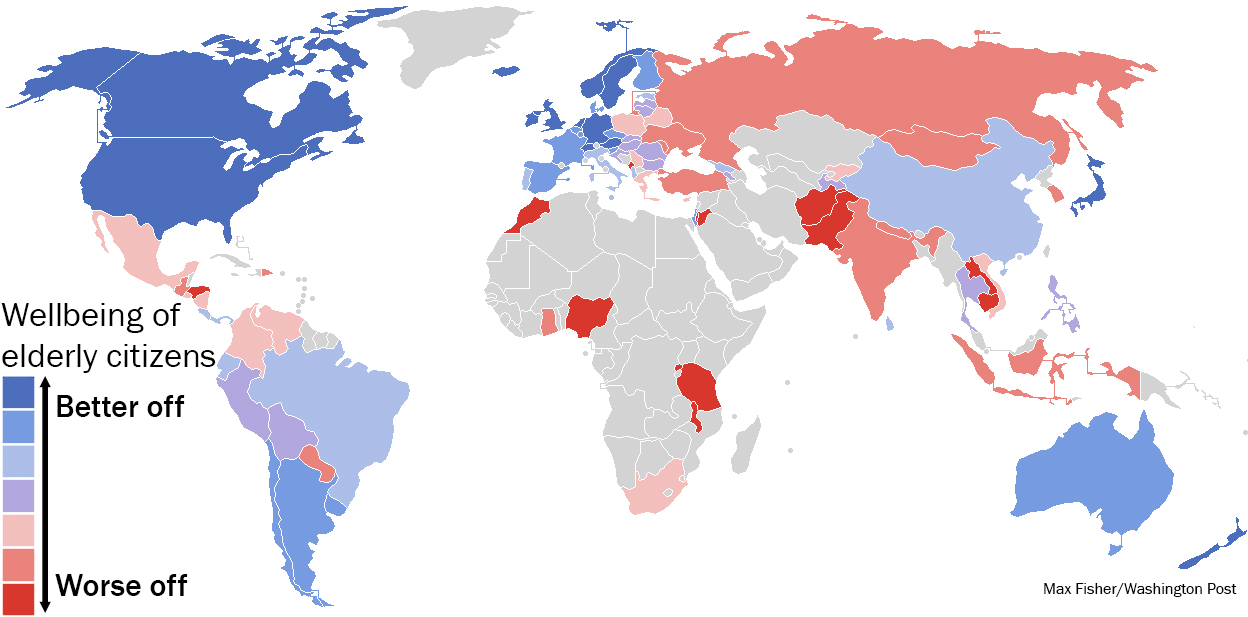
Fisher flags a new study that ranks America “eighth in the world for the wellbeing of the elderly.” Why America scores so high:

[E]ducation and employment opportunities for elderly Americans are some of the best in the world. Actually, second-best, behind only Norway. As the report explains, “Older people value their capacity to work” because they “wish to maintain social contacts and self-worth” as well as remain self-sufficient. In most countries, people start getting locked out of the labor market once they get older. The United States is unusual in that the elderly face less age discrimination and have an easier time getting the education and skills to remain competent members of the workforce. That’s not just good because it means they can work if they want to, but because it allows them to be active and self-sufficient, which go a long way toward promoting health and happiness.

Paradoxically, this may also partly be a product of the United States’s relatively weak social safety net; the report finds that elderly in the United States have “the lowest levels of dependency on public transfers” of wealth in the world.

This Revolutionary Pope

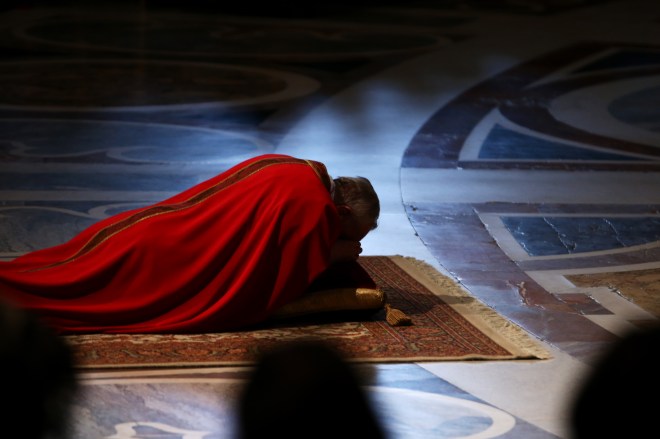
Pope Francis Attends Celebration Of The Lord's Passion in the Vatican Basilica

Last week, as the House Republicans held a gun to the country’s head, I failed to address yet another remarkable interview by Pope Francis, this time to the Italian journalist Eugenio Scalfari, who is an atheist, in La Repubblica. Like his America interview, I urge you to read it, whether you are an atheist, an agnostic, a believer or anything in between. I tried to absorb it all this weekend, and found it difficult. Difficult because it was so overwhelming in its power, and because I need time to pray and think some more about what he said. I mean, what can one say immediately about a Pope who can say:

Proselytism is solemn nonsense, it makes no sense. We need to get to know each other, listen to each other and improve our knowledge of the world around us.

Or this:

Heads of the Church have often been narcissists, flattered and thrilled by their courtiers. The court is the leprosy of the papacy.

Or this:

A religion without mystics is a philosophy.

Or this:

I say that politics is the most important of the civil activities and has its own field of action, which is not that of religion. Political institutions are secular by definition and operate in independent spheres.

It is as if the Catholicism that has been forming and re-forming in my own mind and soul for years suddenly became clearer, calmer, simpler. This Catholicism, like Saint Francis’, is about abandoning power and all the trappings of power; it is about leaving politics alone in an independent sphere, in stark contrast to Christianism which is primarily politics and ultimately about power; it is a faith rooted in mystery and mystics; about love and mercy; about the core teachings of Jesus again – made fresh.

I would say that it is a miracle. Francis’ emergence as Francis is a miracle. Literally:

Before I accepted I asked if I could spend a few minutes in the room next to the one with the balcony overlooking the square. My head was completely empty and I was seized by a great anxiety. To make it go way and relax I closed my eyes and made every thought disappear, even the thought of refusing to accept the position, as the liturgical procedure allows. I closed my eyes and I no longer had any anxiety or emotion. At a certain point I was filled with a great light. It lasted a moment, but to me it seemed very long. Then the light faded, I got up suddenly and walked into the room where the cardinals were waiting and the table on which was the act of acceptance. I signed it, the Cardinal Camerlengo countersigned it and then on the balcony there was the ‘”Habemus Papam”.

Made every thought disappear. And what appears when thought has been left aside? Light!

God is the light that illuminates the darkness, even if it does not dissolve it, and a spark of divine light is within each of us. In the letter I wrote to you, you will remember I said that our species will end but the light of God will not end and at that point it will invade all souls and it will all be in everyone… Transcendence remains because that light, all in everything, transcends the universe and the species it inhabits at that stage.

This is a Pope speaking to an atheist as an equal and in love. Which is where the church must begin again. It’s sad to me that so many orthodox Christians in America cannot yet see this.  Here’s Dreher, in an otherwise positive response to the interview, finding the remarks “incoherent from a Christian perspective”:

I don’t get the universalism behind encouraging people to “move towards what they think is Good.” What the Wahhabist thinks is Good is not the same thing as what the secular materialist thinks is Good, and is not the same thing as what the Amish farm woman thinks is Good. I mean, obviously there will be some overlap, but if the Pope believes there is no reason to insist on Christian particularity, if Jesus is true for him, but not for everyone, then why evangelize at all?

Was Rod reading? “Proselytism is solemn nonsense.” No wonder Russell Moore, a conservative Southern Baptist, calls the interview “a theological wreck. No wonder, at First Things, Mark Movsesian argues that

Some things he said in the interview are a frankly a little shocking.

He told the interviewer, Eugenio Scalfari, “Proselytism is solemn nonsense.” That’s a rather dismissive way to treat millennia of Christian apologetics. The pope’s views on conscience were also odd, from a Christian perspective. “Everyone has his own idea of good and evil and must choose to follow the good and fight evil as he conceives them,” the pope said. “That would be enough to make the world a better place.” With respect, “do what you think is right” is not the Christian view of conscience. That sounds more like Anthony Kennedy than St. Paul. And would the world really be a better place if everyone did what he thought was right? How about jihadis?

Always with the Jihadis, those lost, damaged souls. K-Lo, of all people, defends what Francis said about conscience:

This isn’t “anything goes,” but it’s an exercise in mercy and justice.

What it is is an exercise in engagement, rather than power. This was Saint Francis’ genius, and Paul’s and Augustine’s. They were in their world as well as not of it. Pascal-Emmanuel Gobry has the best take:

[W]hen the Pope says “Everyone has his own idea of good and evil and must choose to follow the good and fight evil as he conceives them”, that could be interpreted as a brief for moral relativism. Of course, the only problem with that interpretation would be that it would be arrant nonsense. Because, you know, he’s the Pope, and also an orthodox Catholic, as he has demonstrated on countless occasions…

The problem here, as always, is pride. We think like politicians. We parse words for whether they help the Republican Party of the Church or the Democratic Party of the Church, whereas we should be humbly receiving the teachings of the Vicar of Christ. When those teachings seem shocking to us, common sense alone dictates that, instead of rending our garments, we should, with humility and charity, check ourselves to see what we can learn.

That’s what I’m still doing. But what leaps out of the interview is a scoop, as John Allen noted and few others did. The scoop is that this Pope has undergone a mystical spiritual awakening – after that great silence and great light before he accepted the papacy. Allen remembers interviewing the new pope’s sister in April, who said “that something was different about her brother since he took over the church’s top job.” He continues:

Recently, I spoke to one of the cardinals who elected Francis (not an American, by the way), who had been received by the pope in a private audience. The cardinal told me he had said point-blank to Francis, “You’re not the same guy I knew in Argentina.”

According to this cardinal, the pope’s reply was more or less the following: “When I was elected, a great sense of inner peace and freedom came over me, and it’s never left me.”

In other words, Francis had a sort of mystical experience upon his election to the papacy that’s apparently freed him up to be far more spontaneous, candid and bold than at any previous point in his career.

One should never doubt the mystical imprint upon the contours of a papacy.

Isn’t it interesting that this story got largely ignored, while a sentence or two that allows Christianists to complain about “relativism” got so much attention? Why not simply examine, and take to heart, what Francis said about his namesake? Here’s what he said:

[Francis] is great because he is everything. He is a man who wants to do things, wants to build, he founded an order and its rules, he is an itinerant and a missionary, a poet and a prophet, he is mystical. He found evil in himself and rooted it out. He loved nature, animals, the blade of grass on the lawn and the birds flying in the sky. But above all he loved people, children, old people, women. He is the most shining example of that agape we talked about earlier…

Francis wanted a mendicant order and an itinerant one. Missionaries who wanted to meet, listen, talk, help, to spread faith and love. Especially love. And he dreamed of a poor Church that would take care of others, receive material aid and use it to support others, with no concern for itself. 800 years have passed since then and times have changed, but the ideal of a missionary, poor Church is still more than valid. This is still the Church that Jesus and his disciples preached about.

This is still the church we can rebuild today.

Read the recent Dish thread on Pope Francis here.
Trading Obsessions For Rituals

Matt Bieber describes how adopting Buddhism helped him overcome his obsessive-compulsive disorder:

OCD often feels like a Choose Your Own Adventure novel, except that all the choices suck and all the adventures hurt. However, as I’ve begun to learn through Buddhist study and ritual, those ‘choices’ are illusory, and there’s no one being hurt. In fact, there’s no one there at all. The attempt to attain pleasure or avoid pain, to stay consistent with a storyline, to ensure some kind of outcome, to be somebody — this is what causes so much suffering.

That’s a hard message to hear, in part because our culture places such a heavy emphasis on the construction of an integrated self with a coherent story in life.  We believe that deep down, there is some kind of solid, stable bedrock to our identity, some unshakable foundation that provides us with the capacity to control significant portions of our experience: to be who we really are, to be true to ourselves. Much religious ritual is designed to reinforce this view — to convince us that it’s possible to keep ourselves together, and to provide a method that promises to help us do so. And while there are important differences, OCD and its rituals are built on a similar worldview.

But that worldview isn’t true. It isn’t possible to keep ourselves together, because we aren’t one coherent thing. Instead, we are a kind of flux, a series of patterns and surprises, inextricably interwoven into the larger field of phenomena that we call reality.

Sagan As Seer

Lynda Walsh views Carl Sagan as an oracle for the Scientific Age:

I would argue Sagan benefited from a sort of bully pulpit that was cemented into place by 3,000 years of civic practice in the West. That bully pulpit, ironically, used to belong to the prophet. … Sagan claimed in Demon-Haunted World, “Science is not only compatible with spirituality; it is a profound source of spirituality.” This argument echoed throughout the narrative of Cosmos, which Sagan navigated in his chapel-like “Ship of the Imagination,” complete with a glowing altar and a hymnal by Vangelis.

But Sagan’s public rhetoric was more than vaguely religious; it was specifically prophetic.

Sagan boasted in Demon-Haunted World, “Not every branch of science can foretell the future – paleontology can’t – but many can and with stunning accuracy. If you want to know when the next eclipse of the Sun will be, you might try magicians or mystics, but you’ll do much better with scientists.” The final episode of Cosmos opens with Sagan reading from the book of Deuteronomy: “I have set before you life and death, blessing and cursing: therefore choose life, that both thou and thy seed may live…”(30:15). In Sagan’s bible, death was nuclear winter, a cause he pushed on- and off-screen with the zeal of Jeremiah.

Walsh concludes:

The fact remains that as long as our public crises turn on technological, medical, or environmental issues (as nearly all of them do), we will turn to science for answers; and as long as science is our dominant channel to civic truth, scientists will remain our prophets.

Previous Dish on Sagan and faith herehere, and here.

Pioneers Of Sexology

Emily Nussbaum calls Showtime’s new series Masters of Sex, based on the lives of sex researchers William H. Masters and Virginia Johnson, a “serious turn-on”:

[T]he show makes the case, beneath its cinematic lacquer, that [sex] is not something merely exciting or trivial but a deep human necessity. Deprived of intimacy and true release, people shrivel up. “Once you’ve seen Oz, who wants to go back to Kansas?” one heartbroken character asks. In this way, “Masters of Sex” reminded me not of a few other Showtime series, with their mood of anomie and disdain, but of “Orange Is the New Black,” the Netflix series that, for all its comic bounce, takes sex seriously, as pleasure, power, and escape. These stories are humanistic, not cynical, and although they go in for a level of prurience, the nudity isn’t simply there to jump the needle on the viewer’s electrocardiogram. “Masters of Sex” may not be revolutionary TV, but it’s got something just as useful: good chemistry.

Ashley Fetters appreciates that the show “limits its sex to where sex is an important component of the story.” Laura Bennett calls it “the best new fall drama on TV”:

“Masters of Sex” captures the atmosphere of its era better than all of “Mad Men”’s exquisite costumes and scrupulous sets: the sense of being on the brink of a seismic shift in the zeitgeist, as well as the particular courage required to be a sexually liberated woman in the baffling, buttoned-up years after Alfred Kinsey’s ground-breaking studies but before the sexual revolution. And the show does so without condescension, but rather with a winking understanding that times have changed less than we think. “The truth is nobody understands sex,” Masters says wearily. Given that a show set in the ’50s feels like the freshest take on sexual relations in awhile, it’s easy to agree.

But Neil Drumming isn’t feeling the chemistry, and neither is John Powers:

Nowhere is Masters of Sex worse than in its unmasterful vision of sex. Rather than treating it maturely, the show exemplifies much of what remains retrograde about premium cable and American pop culture in general — the gratuitous nudity, the squirmingly unsexy lovemaking scenes, the reflexive jokiness that reminds us that sex still makes people very, very nervous. At one point, the show actually cuts from a couple having sex in a car to a shot of a neon sign with a hot dog in a bun.

Maybe such a gag will crack up the 12-year-old boys watching at home, but it’s faintly depressing that half a century after Masters and Johnson helped liberate human sexuality, a TV show about their lives should so often reduce the conversation about it to the ignorant sniggering from which they were trying to set us free.

Uncovering Swingers

Tracy Clark-Flory says that Daniel Stern’s Swingland “at moments … reads like a self-discovery memoir à la “Eat, Pray, Love,” only with super-graphic group-sex scenes”:

The most satisfying bits of “Swingland” are also the most fleeting: Stern’s description of an elderly orgy-goer who boasts of a new hip replacement and osteoporosis medication; the Russian husband who leaves a Sylvester Stallone movie playing on TV throughout Stern’s carnal encounter with his wife; the anxious home improvement chatter that inevitably happens between men before everyone’s taken their clothes off; and the deaf swinger who responds to a woman’s loud moans with, “Even I could hear that!” Behind the absurdity and occasional braggadocio, there is a sweetness hidden at the center of the book, encapsulated in Stern’s revelation toward the end: ”I’d escaped that tonnage of performance-hindering anxiety and understood sex for what it was: fun.”

From TCF’s interview with Stern:

What kind of people did you meet in the lifestyle? What are they like in their everyday lives? What cross-section of America are we talking about?

They really run the gamut, everything from people in the police force to teachers to administrative assistants to people you would recognize from being on television. Age-wise, everyone from early 20s to octogenarians. The vast majority of swingers that I’ve met are middle-aged. My theory to explain that is they live long enough to have enough normal experiences when it comes to sex that they seek out something that is different. They’ve been in a marriage or relationship long enough that they want to get a bit of spice.

The Great American TV Show

Rich Bellis compares Breaking Bad to great works of literature, from Sophocles to Shakespeare. Todd Hasak-Lowy considers the show as a “symptom and cause” of actual literature’s increased marginalization:

[W]hat happens when we convince ourselves and others that Breaking Bad is, artistically speaking, on the level of, say, not just “Midnight Cowboy” and “The French Connection,” but Morrison’s Beloved or Roth’s American Pastoral or Delillo’s White Noise as well? How much better do we feel about regularly watching two or three Good TV shows (i.e. devoting three to six hours of our already too short week to TV) if we believe (and get others to agree with us) that we are participating in the best our culture has to offer? …

We watch Breaking Bad not merely because it is good, but because everyone’s talking about it. Who the hell talks about books anymore? I teach creative writing in an MFA program, and half the time it’s easier to talk about TV than books with my colleagues and students there. Not because no one’s reading there, not at all, it’s just nearly impossible these days for any particular book to become a Thing Of Consequence Happening Right Now In Our Culture.

Tackling A Giant Of Social Sciences

Christopher F. Chabris pans Malcolm Gladwell’s new book, David and Goliath, writing that the author “excels at telling just-so stories and cherry-picking science to back them”:

One thing “David and Goliath” shows is that Mr. Gladwell has not changed his own strategy, despite serious criticism of his prior work. What he presents are mostly just intriguing possibilities and musings about human behavior, but what his publisher sells them as, and what his readers may incorrectly take them for, are lawful, causal rules that explain how the world really works. Mr. Gladwell should acknowledge when he is speculating or working with thin evidentiary soup. Yet far from abandoning his hand or even standing pat, Mr. Gladwell has doubled down. This will surely bring more success to a Goliath of nonfiction writing, but not to his readers.

Michael Bourne agrees:

[D]espite his classical essay structure and all the charts and graphs and interviews with eminent scientists, Gladwell isn’t interested in science. He isn’t interested in facts. He’s interested in stories. Gladwell’s books shouldn’t be read as arguments based in evidence, but as parables based in neo-liberal orthodoxy. … Stories are easy. Facts are hard. I want facts.

In an interview with Gaby Wood, Gladwell explains his intentions, saying his books are “gateway drugs — they lead you to the hard stuff”:

“[A]s I’ve written more books I’ve realised there are certain things that writers and critics prize, and readers don’t. So we’re obsessed with things like coherence, consistency, neatness of argument. Readers are indifferent to those things. My books have contradictions, all the time – and people are fine with that.

“They understand that you can simultaneously hold two positions. Blink was the same way: we have this faculty – it’s good sometimes, it’s bad sometimes. That’s what the book was about.” He chuckles boyishly. “But it’s still really interesting! It’s just, I can’t resolve it – what am I, Sigmund Freud?”

Gladwell further emphasizes his position in an interview with Oliver Burkeman:

“If you’re in the business of translating ideas in the academic realm to a general audience, you have to simplify … If my books appear to a reader to be oversimplified, then you shouldn’t read them: you’re not the audience!”

Tyler Cowen recommends the book:

Quite possibly it is Gladwell’s best book.  His writing is better yet and also more consistently philosophical.  For all the talk of “cherry picking,” the main thesis is that many qualities which usually appear positive are in fact non-monotonic in value and can sometimes turn negative.  If you consider Gladwell’s specific citations of non-monotonicities to be cherry-picking, you’re not understanding the hypothesis being tested.  Take the book’s central message to be “here’s how to think more deeply about what you are seeing.”  To be sure, this is not a book for econometricians, but it so unambiguously improves the quality of the usual public debates, in addition to entertaining and inspiring and informing us, I am very happy to recommend it to anyone who might be tempted.

An extract from David and Goliath is here.  Previous Dish on Gladwell here, here, and here.