King vs Kubrick

As Stephen King releases a sequel to The Shining, entitled Doctor Sleep, Laura Miller defends the longstanding grudge that King and his fans hold against Kubrick’s adaptation:

A key difference between the two versions is the prominence of alcohol, which is more or less incidental in the film. In King’s novel, booze is the key that unlocks the monster inside a regular guy, and the beast’s first victim is the regular guy himself. The most significant thing about any character in King’s fiction is how he or she responds to such monsters, whether they come from within or without. That’s surely the chief reason why he detests Kubrick’s portrayal of Wendy as a gibbering victim; King’s Wendy chooses to be a heroine.

King is, essentially, a novelist of morality. The decisions his characters make — whether it’s to confront a pack of vampires or to break 10 years of sobriety — are what matter to him. But in Kubrick’s “The Shining,” the characters are largely in the grip of forces beyond their control. It’s a film in which domestic violence occurs, while King’s novel is about domestic violence as a choice certain men make when they refuse to abandon a delusional, defensive entitlement. As King sees it, Kubrick treats his characters like “insects” because the director doesn’t really consider them capable of shaping their own fates.

Jason Bailey, taking on King’s criticisms in the above video, emphasizes the creative differences between film and print:

[I]n defending King, Salon’s Miller accidentally makes the more interesting point: “The two men represent diametrically opposed approaches to creating narrative art. One is an aesthete and the other is a humanist. Kubrick was a consummate and famously meticulous stylist; King’s prose is workmanly and his novels can have a shambolic bagginess.”

King’s great novels work because they put us into the heads of his characters, because they convey psychological as well as external struggles, because their inner monologues can pour forth out of his prose. It’s part of what makes him a great writer. It’s also why there have been so many lousy films based on Stephen King books — because all of that is lost in the translation. And Kubrick would have been a lousy novelist, his meticulous detachment resulting in, we could presume, so pretty turgid and lifeless writing. But luckily, he was a filmmaker, and his gifts as an aesthete are what made him such a singularly fine one.

Previous Dish on the gulf between the book and the film adaptation here.

Hijacking The Bard?

Matthew Reis covers the ever-raging debate between scholars over whether to leave Shakespeare in his time or harness his plays for the ideologies of today:

Shakespeare is such a vast cultural icon in the English-speaking world that every new school of critical analysis and jargon soon gets applied to him, so we’ve had lots of Christian and Marxist Shakespeares, psychoanalytic, deconstructed and postmodern Shakespeares, and postcolonial and queer Shakespeares. At the same time, more traditional scholars continue to bring to bear Elizabethan or Jacobean social history on the plays, which can run the risk of turning Shakespeare into something antiquarian, requiring prior knowledge of the rhetorical handbooks, property law or theological disputes of his times. …

“What I am bothered about”, [scholar Brian Vickers] explains, “is looking at a historical phenomenon through a present-day lens. The lens is a distorting glass focusing in on some issues in a particular play and totally excluding others. The plot of Othello is set in motion by the jealous and resentful Iago, who hates Othello and sets out to destroy him using Desdemona as the tool. The first generation of feminist critics seized on the play as an instance of Shakespeare’s misogyny and started with Act Three. That seems to me a partial, distorting reading of the play: if you can’t register the presence of Iago, who creates all the destruction and ends up destroying everybody, including himself, you are not reading, you’re imposing a particular scheme, only interested in the harm that men do to women – not who causes it, not the anguish and agony Othello goes through.”

The Sound Of Crowdsourced Scholarship

English professor David Mikics links the rise of Wikipedia to a decline in student writing:

Wikipedia, which is against style on principle, crushes the individuality of student voice. For the kids in my class, this is what knowledge sounds like: balanced and bland, never indignant or provocative or committed—the voice of the crowd, the everyman. Student essays still occasionally contain remarks that sound jaunty, or freewheeling, or tragic, or ironic. But there are far fewer of these liberated moments than there were before Jimmy Wales gave us Wikipedia’s pasteurized version of scholarship.

But other academics are considering ways to improve the free encyclopedia. This year, the University of California, San Francisco will offer a class that gives credit to fourth-year medical students for editing Wikipedia articles. Dr. Amin Azzam, who will teach the course, explains:

When you look at [the quality of the articles], the fraction of high-quality information on Wikipedia in the medicine-related topics is significantly lower than other domains of Wikipedia. I think a large part of that is because we in the medicine community have not been embracing this model of democratized information. But when you realize that this is where all the world goes for information first, I think we’re missing an opportunity. Why don’t we contribute to improving the quality of information that the public has access to, and that the public goes to? So that’s why I became passionate about this model. I started realizing that this was a much bigger way to make a much bigger impact on public health.

The Classical Music Shutdown

As the New York City Opera heads toward financial ruin, Russell Platt takes stock of the industry’s troubles. Greg Sandow focuses on orchestras and their ever-older audiences:

[N]ow we see what a systemic crisis means.  Because from the aging and shrinking of the audience follows every other problem that we’re having. Declining ticket sales. Declining funding. Performing arts centers (as the New York Times reported back at the start of the 1990s) booking fewer classical music events, because the audience for them was starting to fall. …

Maybe the current orchestra crisis shows us this danger starting to be real, meaning that it’s hitting now, and isn’t just something we project into the future. So many managements arguing with their musicians, over dividing a shrinking financial pie, the result (no matter how it plays out in each situation) of an overall drop in demand, and drop in funding (which of course is tied to the drop in demand), while expenses continue to rise.

Previous Dish on the struggling classical music industry here.

Why Hasn’t Big Business Stopped The Shutdown?

Josh Green examines the rift between the GOP and the U.S. Chamber of Commerce, a major GOP donor:

On Oct. 1, House Republicans ignored the Chamber’s pleas to keep the government running. The shutdown is costing the U.S. economy $300 million a day, according to IHS (IHS), a global market-research firm, and it’s only the latest sign suggesting that the old adage, “Republicans are the party of business,” no longer holds true. From the austerity imposed by sequestration to the refusal to reform immigration laws to the shutdown and now, as appears likely, another debt-ceiling showdown when U.S. borrowing authority expires on Oct. 17, the GOP’s actions have put a strain on one of its most valuable partners: the business community.

Drezner asks, “given the Chamber of Commerce’s tilt, why aren’t GOP representatives listening more closely?” Larison’s answer:

Because the Chamber of Commerce leans so heavily towards the GOP, Republican politicians may conclude that they can ignore some of its complaints without provoking the group to shift more of its support to the other party. Consistently and overwhelmingly favoring one party over another signals to party leaders that your group’s concerns can be dismissed more easily when the leaders have other priorities. The Chamber’s support for Republicans is being taken for granted because that support is so lopsided in the GOP’s favor, and as a result it sometimes has much less influence with what the party does in Congress than one would expect.

Street View Goes Off-Roading

Street view

And into CERN, the international physics laboratory:

Putting together a Street View tour of one of the largest and most expensive science projects in history wasn’t a particularly easy task; the mammoth detectors and tunnels of the collider took two full weeks to photograph. “Every three meters, they took a six-sided panorama of the tunnel,” CERN photographer Max Brice told Symmetry Breaking. “Then we had to figure out the coordinates of every image. It came out to 6000 points for us to track.” This was in 2011; stitching everything together into the finished product took an additional two years.

Luke Westaway takes in the views:

The ATLAS particle detector experiment can be explored, as well as the tunnel that makes up the Large Hadron Collider, plus CERN’s ALICE, CMS, and LHCb experiments. Virtually traversing the dense labs is an atmospheric experience – cramped Half Life-esque tunnels and metal walkways abound, as well as ominous signs that warn of radiation and dangerous magnetic fields.

(Photo: The Compact Muon Solenoid (CMS), a general-purpose detector designed to investigate a wide range of physics. Via Google.)

Who’s Blamin’ Who?

Shutdown Obstacle

YouGov’s latest:

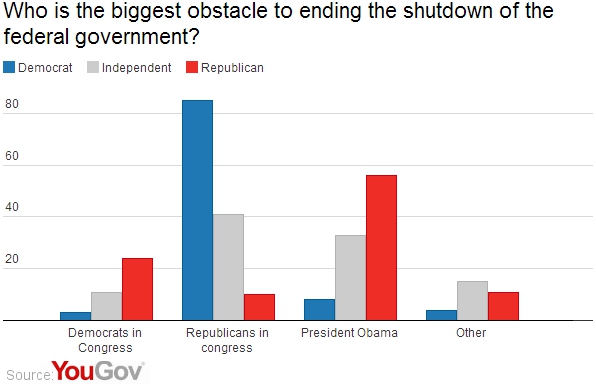
The latest research from YouGov, conducted in the first two days of the shutdown, shows that half (50%) of Americans blame Republicans in Congress for the continuing shutdown. 11% blame Democrats in Congress while 29% blame President Obama for not ending the shutdown. This divides along partisan lines, with Democrats tending to blame Republicans and Republicans tending to blame the President or Democrats. Independents, however, are largely split, with 41% blaming Republicans in Congress and 33% blaming the President.

I’d find the narrow split among Independents unnerving, if I were the president. 33 percent blame the president for the shutdown and impasse? Given that he has already conceded sequester-level spending, and has cut the deficit in the last three years by the swiftest amount since the end of the Second World War, what else do they want him to do? If he were to abandon his signature domestic achievement after re-election, because of blackmail, we might as well give up on elections and representative government altogether. All round, this does not seem to me as a battle either side will “win” as such. Right now, as Harry Enten notes in a review of the polls, “no side is winning, one side is just losing by less”:

More Americans disapprove than approve of the job being done by all three actors in the dispute over the federal budget. President Obama comes out “ahead” in the ABC News/Washington Post poll with a -9pt approval rating. Both parties in Congress are much lower. Democrats in Congress manage to maintain a net approval of -22pt, while Republicans in Congress fall to a -37pt approval rating. These are all awful. …

A new CNN/ORC poll puts the net favorability rating of the Democratic party at -9pt: its lowest since CNN started asking the question in 2006. Republicans, too, are at their lowest level since 2006 as well, with -30pt favorability. A large portion of the difference between the parties’ favorability is that Tea Party supporters are less likely to hold a favorable view of Republicans than Tea Party opponents are of Democrats.

Meanwhile, Weigel highlights a Fox News poll with some bad numbers for Republicans. This one – compared with the last Fox News poll – stood out to me:

A tumble in the GOP’s favorable rating to 35–59, with 59 percent unfavorable marking the highest level in the history of the poll.

Of course that just might be the Tea Partiers frustrated that the GOP isn’t being radical enough in bringing the government and the economy into collapse.

Losing Judaism, Staying Jewish

Marc Tracy parses a new study that suggests that, despite popular belief, Jewish life in America is not in decline:

[A]s Jews increasingly tolerate intermarriage and focus on other signifiers—pride, religious participation, and above all child-rearing—some good news appears. Ninety-four percent of U.S. Jews are proud to be Jewish, says Pew, and three-quarters feel a “strong sense of belonging to the Jewish people.” Seventy percent attended a Passover Seder, and more than half fasted during Yom Kippur. Fewer than 20 percent are not raising their children Jewish to at least some extent; 59 percent are raising them Jewish by religion, although, again, this number is insanely divergent depending on whether the marriage is all-Jewish (96 percent) or interfaith (20 percent).

“The most important finding is that contrary to the lachrymose narrative of a declining, disappearing, vanishing Jewish population, there are many more people who say that they are Jewish, claim Jewish identity, and the vast majority [who] say it is their religion,” Leonard Saxe, a Brandeis professor and prominent Jewish-American demographics expert who consulted on the Pew survey, told me Tuesday.

Jessica Grose takes a different interpretation of the study, stressing that actual religious observance has dropped significantly:

[A]s we get further and further away from virulent anti-Semitism (according to the Pew Survey, 15 percent of American Jews say they have been called offensive names or snubbed in a social setting because they are Jewish, and Jews think other groups, like gays and Muslims, face more discrimination than they do), perhaps it is not surprising that fewer Jews are religious. Other people do let us forget who we are. Plus we don’t have to believe to be Jewish: Judaism, unlike Christianity, is passed down through blood. It’s also difficult to convert to Judaism, and we welcome questioning. Not exactly a recipe for creating generations of faithful devotees.

Gabriel Roth doesn’t despair:

For my grandchildren, the fact that some of their ancestors were Jewish will have no more significance than the fact that others were Welsh. That will be a real loss. But we should be realistic about what’s being lost and what isn’t. Here are some of the things I cherish about Jewishness:

unsnobbish intellectualism, sympathy for the disadvantaged, psychoanalytic insight, rueful comedy, smoked fish. Those things have been thoroughly incorporated into American upper-middlebrow culture. Philip Roth and Bob Dylan and Woody Allen no longer read as “Jewish” artists but as emblematic Americans; their influence is as palpable in the work of young gentiles as young Jews.

The loss of Jewishness as a meaningful identity in America is the kind of loss that occurs when individuals are free to engage in the pursuit of happiness. It’s the loss of something that has great meaning to many people and an important place in history but that is, essentially, tribal.

To that point, Douglas Rushkoff suggests  that “if we want to promote Judaism and its practices, we might need to transcend our rather primitive misconception of Judaism as a race”:

It was Pharaoh who first called the Jews a “people”. The notion of a Jewish bloodline didn’t emerge until the Inquisition as a justification for executing even those Jews who had converted. And it was Hitler (repurposing a bit of Jung) who called the Jews a race.

As I look at history and the Torah, Judaism isn’t really a religion at all, but a path beyond religion. It was developed by the equivalent of recovering cult members, as a way beyond the idolatry and death worship of Ancient Egypt. Instead of “believing” things, a disparate amalgam of tribes (those mythic sons of Jacob), developed a living myth together – as well as a system of law that could be amended as civilization evolved. Everything from the Sabbath to the US Constitution came out of these insights and this continuous process of revision and renewal.

By applying the techniques of the census taker to the Jewish people (a practice actually forbidden in Talmud – we’re not allowed to count ourselves) the would-be protectors of Judaism are practicing a dangerous game with diminishing returns.

When Being An Amateur Is An Advantage

In our final video from Martha Shane and Lana Wilson, they recall how their perceived inexperience ended up being an asset in the filming of After Tiller:

The documentary, which features the four remaining doctors who still perform third-trimester abortions in the wake of George Tiller’s assassination, opens today in Los Angeles and Toronto. It will continue to play in New York until October 8 and then open in many more cities across the country. Trailer here. Martha and Lana’s previous Dish videos are here. Our “It’s So Personal” series, in which readers share their experiences with late-term abortion, is here. Another reader writes:

I worked on a response to your abortion dissent, but a followup reader said it so much better than I ever could:

Is abortion ever immoral? This pro-choice advocate says: Of course it is. But there are many immoral things that are not illegal, and imposing the blunt instrument of the law on a complex moral decision is not going to help people make better choices. The sooner pro-life activists take legal bans off the table, the sooner we can have productive talks about effective programs to help people make better moral choices about abortion and reproductive issues generally.

I have a story to go with that comment.

Many years ago I lived in a house with multiple roommates. We selected a seemingly charming, successful graduate student to fill a vacancy, but within months it was clear she was seriously disturbed.  Any number of things (e.g., polite requests to clean up weeks worth of dirty dishes or to allow someone else to watch TV) triggered abusive, screaming diatribes and implied threats of violence.  We were so freaked out we all decided to move until one brave soul convinced us to band together and boot her out.  She smashed holes in the walls the day she left. If it happened today, I’d worry that she’d return with a gun.

During the year this woman lived with us, she had two abortions.  She also told us she was sloppy with contraception and had had several abortions in the past. It’s easy to argue that these abortions were immoral, but should that translate into law?  Do we want to force a woman like this (who might be unwilling to give up a child) to bear unwanted children at risk for serious abuse?  I’m uncomfortable when the left discusses abortion in terms of rights and when the right discusses it in terms of morality. It’s so much more complicated than that.

Why They’ll Die On This Hill

The Democratic group headed up by Stan Greenberg and James Carville has just put out a report on their recent focus group discussions with Republican voters. It’s a sobering read (pdf) – and definitely helps explain the primal scream now threatening to take down the entire American system of elective government.

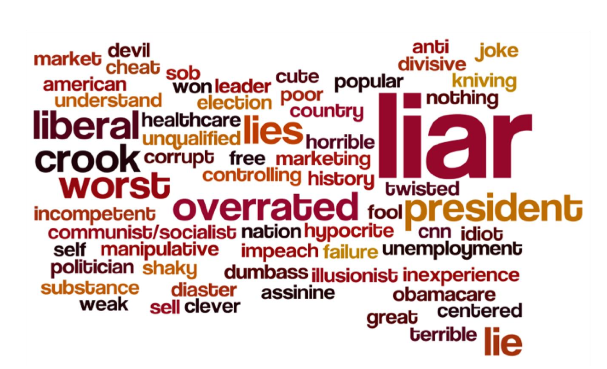
Here, for starters, is the word cloud for what these voters say when talking in like-minded focus groups about president Obama:

Screen Shot 2013-10-04 at 11.30.54 AM

The base Republican voters in these focus groups view themselves as besieged by minorities seeking free benefits, and see Obama as the Pied Piper of those hoping to abuse the system. They are not explicitly racist about the president or about the beneficiaries of the new goodies (though they had no such qualms during Bush’s Medicare D entitlement). But they believe they are losing an America that a Roanoke evangelical describes like this:

Everybody is above average. Everybody is happy. Everybody is white. Everybody is middle class, whether or not they really are. Everybody looks that way. Everybody goes to the same pool. Everybody goes – there’s one library, one post office. Very homogeneous.

This is the America they believe is being taken away from them. Some money quotes:

“The government’s giving in to a minority, to push an agenda, as far as getting the votes for the next time”. (Evangelical man, Roanoke)

“There’s so much of the electorate in those groups that Democrats are going to take every time because they’ve been on the rolls of the government their entire lives. They don’t know better.” (Tea Party man, Raleigh)

But this is the core conclusion of the study and why it helps us understand our current predicament – nothing represents their sense of loss and anger more powerfully than Obamacare:

When Evangelicals talk about what is wrong in the country, Obamacare is first on their list and they see it as the embodiment of what is wrong in both the economy and American politics. In fact, when asked what she talks about most, one woman in Colorado replied, “Obamacare, hands down, around our house.” In Roanoke, it was the first thing mentioned when asked “what’s the hot topic in your world?”

To participants in these groups, Obamacare “just looks like a wave’s coming, that we’re all going to get screwed very soon. ” (Evangelical woman, Colorado Springs)

“Obamacare’s just another intrusion on the Constitution … And I just – I’m appalled. I’m appalled by what’s going on in our country.”(Evangelical man, Roanoke)

“It’s putting us at the mercy of the government again.” (Tea Party woman, Roanoke)

“[Our rights] are slowly being taken away… like health care.” (Tea Party woman, Roanoke)

I’ve long argued that you have to see the bigger cultural and religious picture when analyzing what has happened to American conservatism these past two decades or so.

The bewildering economic and social and demographic changes have created a cultural and existential panic among those most heavily concentrated in those districts whose members are threatening to tear down the global economy as revenge for losing two presidential elections in a row. They feel they have already lost and have nothing to gain from any constructive engagement with a president they regard as pretty close to the anti-Christ of parasitic minorities. They feel isolated in a more multi-cultural country. They feel spied upon and condescended to. They have shut out any news sources apart from Fox. It does not occur to them, for example, that Obamacare might actually help them. And you get no actual specifics on policies they like or dislike. It is all abstractions based on impressions.

More to the point, the bulk of these Republicans no longer believe in the Republican party. They identify more strongly with the Tea Party or Evangelical groups or Fox News than the GOP. On social issues, the defining issue is homosexuality – not abortion. That intransigence will alienate them them even further from the future mainstream. Their next big issue: denying climate change. Right now, I see no way to integrate these groups and people into the broader body politic or conversation. Their alienation is so deep it is close to unbridgeable. And further defeats will make their isolation worse, not better, their anger more, not less, intense.

This is the deeper crisis we face – and without strong economic growth, it is hard to see how it can be ameliorated in the near future. Perhaps if moderate Republicans – a mere quarter of the whole – jumped ship to the Democrats, then the electoral losses would be so great as to demand some kind of reform. But the center is not holding. And I fear it will get even worse than this until it gets better.

Except it’s hard to imagine political dysfunction getting worse than risking the first ever default by the Treasury of the United States because a key minority feels “disrespected.”