No One Deserves Cancer

Charlotte Huff laments the blame game that is so often associated with cancer diagnoses:

After Linnea Duff learned at age 45 that she had developed lung cancer, she practically encouraged people to ask if she had ever smoked. But in the eight years since, her feelings have soured considerably on the too-frequent question, and she’s developed an acute sense of solidarity with fellow patients: smokers, former smokers, and never-smokers alike.

“It’s just so inappropriate,” says Duff, who believes that people with other serious illnesses don’t field so many intrusive queries. “Would you ask someone, ‘Did you eat too much?’ or ‘Did you have too much sex?’”

Why this line of inquiry persists:

Judgments about behavior not only unsettle and stigmatize the patient, but reflect the interrogator’s own insecurities. Frequently, those disease detectives are attempting to regain a sense of control amid the inherently random and sometimes unjust world that we all reside in, according to researchers who have studied stigma. Psychologists refer to this as the “just-world hypothesis,” a bias in thinking and perception that was first described by psychologist Melvin Lerner and colleagues more than four decades ago, and which has since been documented in numerous books and articles.

The Tree Of Liberty Had Non-American Roots

Reviewing Charles Murray’s new ebook, American Exceptionalism: An Experiment in History, Richard Gamble finds fault with his understanding of the Founding. The critique is a useful reminder that Charles is not a conservative in the sense of someone who sees everything embedded in the intimations of the past as they relate to the future:

Murray’s preoccupation with innovation ignores more than a century of colonial America’s prior experience in self-government and constitutionalism and its acknowledged debt to ancient, European, and most of all English political theory and practice. It is hard to recognize historical reality in Murray’s depiction of America’s past. America was not sui generis; it was a variation on themes reaching back thousands of years. The republic did not emerge de novo in the New World; it altered—to use the word the Declaration of Independence chose—an existing form of government while announcing the more general right of a people to abolish their government.

Murray complains at one point about “both liberals and conservatives quoting snippets of [the Founders’] writings” to endorse their own views. But Murray’s own snippets are vulnerable to the same charge.

He uses an 1825 letter from Thomas Jefferson to Henry Lee, for instance, to show that after 50 years of reflection Jefferson called the rights language of the Declaration “an expression of the American mind.” If this is true, it comports nicely with Murray’s claim that America transformed an ideology of natural rights into an enduring political creed. But Jefferson’s letter never makes this connection. In fact, the full text of Jefferson’s letter makes a hash out of Murray’s insistence on an America made “from scratch.” The “object of the Declaration of Independence,” Jefferson told Lee, was “not to find new principles, or new arguments, never before thought of, not merely to say things which had never been said before; but to place before mankind the common sense of the subject.” He continued: “Neither aiming at originality of principle or sentiment, nor yet copied from any particular and previous writing, it was intended to be an expression of the American mind.” And he then cited “Aristotle, Cicero, Locke, Sidney, &c.” This letter may not prove a counter-argument against Murray’s claims, but it certainly doesn’t support them.

Larison complements the critique:

This is familiar territory for Prof. Gamble. He wrote a TAC article on the same subject last year, and wrote In Search of the City on a Hill: the Making and Unmaking of an American Myth to investigate the origins and uses of the “city on a hill” rhetoric that now regularly crops up in appeals to American exceptionalism. As he wrote in his article last year, there are two competing traditions of American exceptionalism:

The old exceptionalism was consistent with the ethos of American constitutional democracy; the new is not. The old was an expression of and a means to sustain the habits of a self-governing people; the new is an expression of and a means to sustain a nationalist and imperialist people. The old exceptionalism suited a limited foreign policy; the new suits a messianic adventurism out to remake the world.

As we have seen once again in the last few weeks, Americans have no appetite for such adventurism.

Allowing Anyone To Be An Instant Sharpshooter

Or “democratizing accuracy,” a euphemistic phrase used by the CEO of TrackingPoint Solutions:

Brian Anderson tested out the company’s precision guided firearm (PGF):

The art of sniping has traditionally been one of complex ballistics. A long-distance shot must be aimed above a target due to the bullet’s drop (gravity) and a slew of other ambient factors that play with projectiles—wind, incline, cant, humidity, temperature, the coriolis effect. TrackingPoint’s system does the exact same real-time ballistics calculation, only it does it for you. …

They call it TTX, short for Tag, Track, Xact. Put very simply, when you tag a target down range the PGFs laser-range finder beams there and back 54 times per second, illuminating the target and measuring the time delay “reflected by the target, providing range measurement accuracy within one meter,” according to the PGF white paper. From here, the system’s on-board ballistic computer realigns your reticle, seen through the PGF’s unique heads-up display, to account for said ambient factors. Squeeze and hold the trigger, and only when your pip perfectly aligns with the reticle will the system’s electronic trigger reset, firing the gun.

How much more lazy could a hunter get? And of course it raises the specter of hunting humans more accurately. The full 20-minute documentary is after the jump:

One, Two, Three-State Solution?

Yousef Munayyer insists that unification of Israel and the Palestinian Territories into one state has become inevitable:

Everything about the Israeli state’s actual behavior suggests it has no intention of ever leaving the West Bank.

Recognizing that we have a “one-state problem” is the key to peace. The first step is ending discrimination in the law based on ethnicity or religion throughout the entirety of the territory. Palestinians must be part of shaping any future state they will live in, and they can do so only on equal footing with their Jewish counterparts before the law, not under military occupation. For the next steps, numerous historic examples of multi-ethnic democracies exist, including those that made transitions from parallel situations. South Africa is one. It is important to note that while each case is different, and no analogy is perfect, lessons learned from those experiences and examples can inform the path forward for Israelis and Palestinians, even as they simultaneously take into consideration the uniqueness of this case.

Bernard Avishai, on the other hand, claims the proponents of one state are chasing an illusion:

They speak, often sincerely, about Judaism as a religion that could continue to be practiced in a secular state that looks like some idealized Palestine before Zionism spoiled things, with no Hebrew, no history, no literature, no Yehuda Amichai poetry, no Yehudit Ravitz songs—none of that national culture that Quebecers learned long ago requires a state apparatus to protect, and which the provinces shrewdly kept within their jurisdictions. As Peter Beinart says eloquently in the current New York Review of Books, one can also find any number of Jews who deny that Palestinians constitute a nation, and who expect them graciously to disappear from the Land of Israel and assimilate into Jordan, Syria, and the Arab world in general.

In fact, advocates of a two-state solution are not a bunch of naïfs unwilling to see how badly the peace process is doing. They are terrified citizens, trying, against hope, to avoid Bosnia—that is, a terrible, engulfing violence in which memories of the fighting of 1948 will be eclipsed by much greater atrocities, which will leave us with exactly the same problem we had at the start: namely, Canada’s problem. How do you reconcile the fierce desire for national distinction—and the fear of national extinction—with civil rights for all?

Assaf David revisits the possibility of the third and usually unpopular option, a Jordan-West Bank merger:

It seems that all the parties involved might, under some circumstances and preconditions, entertain it. The most important of these for Jordan and the Palestinians is that the confederation would not be the dream scenario of the Israeli right wing: unilateral annexation of parts of the West Bank to Israel and de facto presumption that Jordan will be drawn into managing the remaining Palestinian territory to preserve order. That scenario would make both Jordan and the Palestinians Israel’s worst enemy—something Israel’s leaders don’t really want, either.

A confederation would not be an easy way out for any of the three parties. To get Jordan in, Israel would likely have to agree to something close to the 1967 borders, potentially with a land swap on a one-to-one basis, which would mean evacuating Jewish settlers from the West Bank and giving up on East Jerusalem. However, the confederation might be easier for all the parties to accept at this point than any of the various scenarios involving an independent Palestine.
Is War Innate?

No, according to evolutionary biologist David Barash. First he distinguishes between violence and war:

Violence is widespread and, sadly, deeply human, just as the adaptation for violence under certain circumstances is similarly ingrained in many other species. But war is something else. It is a capacity, and involves group-oriented lethal violence. Thus it deserves to be distinguished from rivalry, anger, ‘crimes of passion’ or revenge, or other forms of homicide. …

In his justly admired book The Better Angels of our Nature (2011), the evolutionary psychologist Steven Pinker made a powerful case that human violence — interpersonal as well as warring — has diminished substantially in recent times. But in his eagerness to emphasise the ameliorating effects of historically recent social norms, Pinker exaggerated our pre-existing ‘natural’ level of war-proneness, claiming that ‘chronic raiding and feuding characterised life in a state of nature’.

The truth is otherwise. As recent studies by the anthropologist Douglas Fry and others have shown, the overwhelmingly predominant way of life for most of our evolutionary history — in fact, pretty much the only one prior to the Neolithic revolution — was that of nomadic hunter-gatherers. And although such people engage in their share of interpersonal violence, warfare in the sense of group-based lethal violence directed at other groups is almost non-existent, having emerged only with early agricultural surpluses and the elaboration of larger-scale, tribal organisation, complete with a warrior ethos and proto-military leadership.

A roundup of Dish posts on the debate over Pinker’s Better Angels here. On a related note, Michael Kazin describes how the current war-weariness over Syria “keeps faith with American tradition”:

The Democrats focused their 1900 campaign on opposition to the ongoing war of conquest in the Philippines. In early 1917, the public’s desire to stay out of World War I was so widespread that peace activists demanded a popular referendum on the question which they thought they had a decent chance to win.  Until Charles Lindbergh started accusing Jews of seeking to pull the U.S. into World War II, his America First Committee was an ideologically diverse group with some 800,000 paid members. The throngs which railed against the wars in Indochina and forced an end to the draft belonged to the most successful of all the peace movements. If hundreds of thousands of protesters had not flocked to the Mall starting in 1965, Lyndon Johnson would likely have been elected to a second term, and Richard Nixon might never have had a first one.

The only wars Americans have almost universally supported have been those which began with an attack on the nation: Pearl Harbor and 9/11. And by the time Obama’s “surge” in Afghanistan ended in mid-2012, half the public wanted him to accelerate the withdrawal of U.S. troops. Even brief offensives like the Army’s “punitive expedition” in Mexico that Woodrow Wilson ordered in 1916 and Ronald Reagan’s proxy wars in Central America in the 1980s stirred mass demonstrations and outrage in Congress.

The Great Horse_eBooks Hoax

Susan Orlean revealed on Tuesday that @horse_ebooks, a Twitter feed passing itself off as a self-tweeting algorithm, is actually operated by humans:

[Jacob Bakkila and Thomas Bender] have been working on the project for almost four years, keeping their identities secret from just about everyone, including their colleagues at BuzzFeed, where Bakkila is a creative director, and Howcast, where Bender, until about a year ago, was the vice-president of product development.

Russell Brandom interviewed Bakkila, who defends the project as a work of art:

For starters, Bakkila says he never scheduled a tweet. That meant late nights and fitful posting hours, but for Bakkila, the hardship was part of the art. He modeled the project off of the performance art pieces of Marina Abramovic and Tehching Hsieh, in which the artist’s endurance becomes a central focus of the art. “The point was to never automate it,” Bakkila says. “Part of the installation was performing with no breaks for two years. You begin to see things differently.”

Jason Farago scoffs:

If we were really to believe that @horse_ebooks was art, we would have to find some meaning or importance in its central conceit. Yet the indistinct border between human and machine is about as clichéd as it gets these days, and the hoodwinking of hundreds of thousands of Twitter followers is not a sign of some digital sprezzatura, but of the meaninglessness of the distinction in the first place.

Natalie Kane’s perspective:

The interesting thing is that, in being announced as human-controlled performance art, Horse_eBooks loses most of its power. Knowing that each post wasn’t algorithmically generated, but individually, manually created, tells us differently to what we thought we knew about the technologies that use this technique, less about data and scripts, and more about our need to emulate machines, so as to prove our own supposed authenticity.

Above is the most popular Horse_eBooks tweet, according to FavStar.

The Wrong Way To Run For President

Pareene doubts Ted Cruz will mount a successful bid for president:

[T]he trick is to try to be an insurgent conservative that the donor class is still comfortable with. Cruz is not bothering to make alliances with people whose support he would actually need if he decided to run for president. As a trio of BuzzFeed political reporters show, Cruz has already alienated the donor class.

Waldman also discounts Cruz’s chances:

[B]arring a run by the reanimated corpse of John C. Calhoun, Cruz is going to be the most conservative Republican running. And for all the talk of the power of the base, when was the last time the GOP nomination was won by the most conservative candidate in the race? You have to go all the way back to 1980 and Ronald Reagan. Ever since, Republican primary voters have ultimately gone with somebody who was conservative enough—not the most doctrinaire, not the most confrontational, but the one who assured them he’d be with them when it counted, but also assured them he could win. Ted Cruz will not be that candidate.

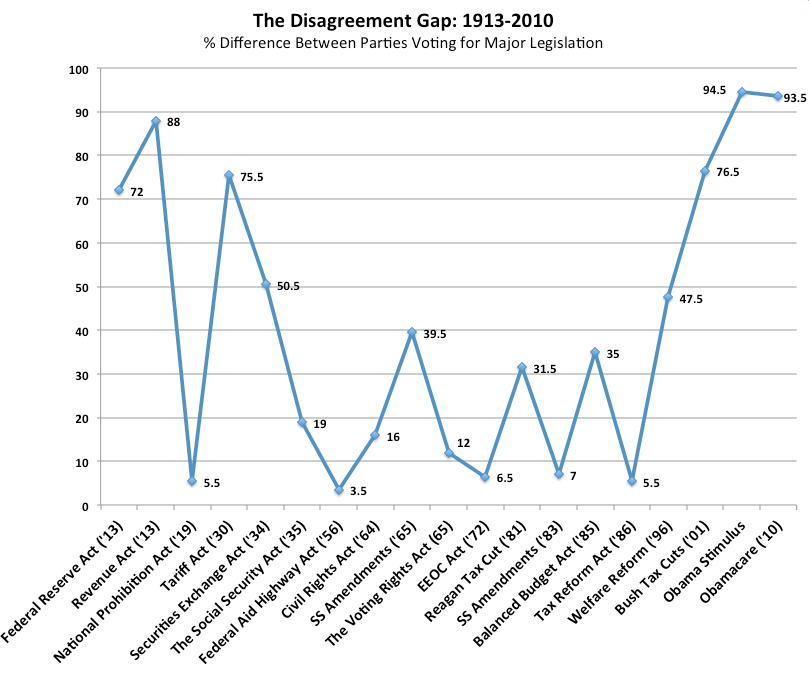
The Disagreement Gap

Disagreement Gap

Derek Thompson uses the above chart to argue that Obamacare and the stimulus are “the most divisive legislation in modern history”:

How do you measure most divisive? [Michael Cembalest, chairman of market and investment strategy at JP Morgan,] constructed a table … of the century’s major legislation and the percent difference in voting between the two parties. For example, in 1956, 98 percent of House Republicans and 93 percent of House Democrats voted for the Federal Aid Highway Act, which built the interstate highway system. That’s a “difference gap” of 5 percent. In the Senate, 100 percent of Republicans and 98 percent of Democrats voted for the bill — a “difference gap” of just 2 percent.

Seth Masket counters that just ” because something isn’t partisan doesn’t mean it’s not divisive”:

Obamacare gets an astounding 93.5% score — almost every Democrat supported it, and no Republicans did so. But it’s possible to be divisive without having such a partisan split.

For example, let’s look at the Civil Rights Act of 1964. According to Thompson’s graph, there’s only a “disagreement gap” of 16% — the model of comity. But that tells us little about the bill and a great deal about what the mid-20th century parties looked like. Both parties contained liberals and conservatives. Little separated the two parties, but a great deal divided them internally — particularly civil rights. Look at the roll call vote. Nearly every Representative from every former Confederate state voted no, while virtually every member from a non-Confederate state voted aye. That’s really divisive! It’s just not partisan, given how the parties of the day were organized.

The Brotherhood After The Ban

In the wake of the Muslim Brotherhood’s official ban by a Cairo court, Eric Trager reviews the group’s options. A worrying scenario:

Muslim Brothers may abandon the Brotherhood and turn to other Islamist movements, including violent ones. After all, younger Muslim Brothers tend to be more radical than their strategically conservative leaders, and they may now act on that radicalism.  Moreover, rank-and-file Muslim Brothers have used violence as a political tool in the recent past—most notably last December, when Brotherhood cadres attacked, tortured, and killed protesters outside the presidential palace in northern Cairo. And history is rich with examples of Muslim Brothers who turned towards jihadi activities during periods of state repression.

Dalibor Rohac expects the ban to backfire:

The Brotherhood was banned during Nasser’s presidency. In Syria, Brotherhood membership was a capital offence between 1980 and 2011. If anything, these and similar bans strengthened the organization’s narrative of victimhood and enabled it to reemerge strengthened and relying on broader popular support. In a recent paper, I show that the electoral success of the Muslim Brotherhood in the aftermath of Arab Spring was foreseeable and resulted from the fact that the group had been actively involved in the provision of social services, particularly to poorer segments of the Egyptian population, and possessed a well-recognized brand name. Over time, this electoral advantage would have dissipated, particularly as the Brethren proved to be rather inept policymakers.

Alas, with the crackdown on the organization, the current leadership of the country seems to be determined to drive the organization underground and to radicalize it.

Joshua Hersh wonders whether the waning revolution has come to an end:

The ruling was breathtaking in scope: it applied not only to the Brotherhood’s political wings but to its social-services activities, and even to any personal declarations of membership individuals might be brazen enough to make—all were declared illegal. The intent was clear: to cast out the Brotherhood from any future role, not just in politics but in Egyptian society altogether. “The plan is to drain the sources of funding, break the joints of the group, and dismantle the podiums from which they deliver their message,” an Egyptian official told the Associated Press.

But if the future of a democratic Egypt is bleak, it is not simply because of sweeping court rulings like Monday’s. Indeed, the question that consumed Egypt for much of July and August —was it a coup?— was always the wrong one. Of course it was a coup. The real question is whether any of the lofty aims of the revolution (the dreams of a popular, democratic government, with civilian control of the military, and a thriving free press), or even the more basic ones (an end to wanton police abuses and outright political corruption) still stand a chance amid the backlash.

Wiping Ahmadi Off The Map

Trita Parsi explains how Rouhani’s recent Rosh Hashanah outreach was definitely a tweet in the right direction:

In his UN speech yesterday, the new Iranian president continued to differentiate himself from Ahmadinejad:

Intriguingly, Rouhani did not mention, even once, the word that so infamously was associated with his predecessor: Israel (or, as Iranian leaders prefer, “the Zionist regime”). At the end of his speech, he recited a verse from the Qu’ran that talked about the Jewish holy book, the Torah. Those two choices should have pleased the sole Iranian Jewish MP accompanying Rouhani in his UN visit to New York.

Then during an interview last night with Christiane Amanpour, Rouhani had this to say about the Holocaust:

“I have said before that I am not a historian, and that when it comes to speaking of the dimensions of the Holocaust it is the historians that should reflect on it,” Rouhani told Amanpour. “But in general I can tell you that any crime that happens in history against humanity, including the crime the Nazis committed towards the Jews, as well as non-Jewish people, was reprehensible and condemnable as far as we are concerned.”