Praying On Their Feet

Justin Hawkins finds constructive Christian engagement with the world to be at the heart of Ronald H. Stone’s new intellectual biography of Reinhold Niehbur and Paul Tillich, who “were far from the bespectacled, portly library-dwellers one might suspect”:

[T]he fact that Christian theology has much to say to the practical affairs of the world is an unmistakable facet of Stone’s narrative.

And though one might reasonably disagree with the substance of either Niebuhr or Tillich’s theological systems, they knew quite acutely that the exigencies of their day required them to plumb the resources of the Christian faith in response. Even more impressively, they did not make religion subservient to previously-determined political convictions, a charge which might legitimately be leveled against many political activists today. As an example, Niebuhr, when convinced that the pacifism required by his Christian socialist party membership was neither wise nor Christian, resigned his membership and his prominent standing there.

Niebuhr and Tillich knew the Christian faith was more than merely a private affair; indeed, one might perhaps even say that they overemphasized the communal, social aspect of the faith (one anecdote hold that H. Richard Niebuhr once had to remind his brother that “Individuals are sinful too, Reinhold!”). But the notion that religion is what one does when alone in one’s room was beyond their comprehension, and that for good reason. If Christ is involved in “making all things new,” then good, faithful Christians might disagree about the substance of that revivification of creation (as Tillich and Niebuhr occasionally did), but they cannot hold that God’s redemption of the world necessarily excludes certain portions of society.

The GOP’s Declaration Of Total War On Our System Of Government, Ctd

In a post earlier today, I quoted the eminently quotable Jon Chait with this question:

Is there an example in American history of a losing party issuing threats to force the majority party to implement its rejected agenda?

I answered no – at least not on this almighty scale. (Caveats here.) Readers beg to differ:

There is an obvious example: the election and subsequent secession crisis of 1860. The southern Democrats were quite clear with their threats to secede from the Union should Lincoln be elected.

Seeing the Obama presidency as a Cold Civil War of the South against a Northern president does help explain the splenetic rage, and the obvious belief in the illegitimacy of the elected president because of the policies he ran on and won with. Another reader elaborates:

The Southern Strategy, which began as a tactical gambit, now accounts for substantially all Republican rhetoric and policy. So the other party is just that — The Other. The point of making demands is making demands. The point of the resentment is the resentment. The point of not compromising is the emotion and the show of not compromising.

The demands over the debt ceiling don’t even involve debt.

More to the point, there didn’t appear to be all too much Republican anti-government resentment during the George W. Bush Bush presidency, as the GOP pushed for Medicare Part D, No Child Left Behind, the executive’s asserted power to wiretap and to detain & torture US citizens without charges or a warrant, surpluses turned into deficits, the right in Raich v Gonzales to imprison folks for activity legal under state law, and the invasion for bogus reasons & failed occupation of an arbitrarily selected Middle Eastern country.

But, President Bush was One of Us. The Kenyan anti-colonial secret Muslim? Less so. Hence, insane demands, in the service of taking Our country back from Them.

The GOP’s Declaration Of Total War On Our System Of Government

crashing-elephant-thumb

Ezra rattles off the demands the GOP is making if they are not to destroy the US and global economy:

In return for a one-year suspension of the debt ceiling, House Republicans are demanding a yearlong delay of Obamacare, Rep. Paul Ryan’s tax reform plan, the Keystone XL pipeline, more offshore oil drilling, more drilling on federally protected lands, rewriting of ash coal regulations, a suspension of the Environmental Protection Agency’s efforts to regulate carbon emissions, more power over the regulatory process in general, reform of the federal employee retirement program, an overhaul of the Dodd-Frank financial regulations, more power over the Consumer Financial Protection Bureau’s budget, repeal of the Social Services Block Grant, more means-testing in Medicare, repeal of the Public Health trust fund, and more.

Why not demand president Obama’s resignation while they’re at it?

What the sheer gob-smacking scale of these demands means is that the GOP effectively wants to nullify the last election entirely (except of course for their gerry-mandered, no-popular vote House majority). The staggering thing about this party as it now exists is that it views the governance of the other party as always effectively illegitimate. Elections do not matter. Only their agenda matters. No compromise is possible, even when this kind of catastrophic default is hanging over our heads. In fact, the danger of catastrophic default is something they relish in order to undo the basic principles of democratic government.

This is not a bargaining position; they already voted for the budget that requires us to raise the debt ceiling. It is a bald attempt to reverse elections as the mark of a democracy and replace them with endless blackmail until they get their way. This isn’t conservatism. It’s pure constitutional vandalism. Derek Thompson’s jaw drops:

Give us everything we want or else we’ll destroy the country! is the sort of demand that only a broken party inside a broken system could possibly hope to make.

The debt ceiling should not exist and the rules of the Senate and House shouldn’t allow a minority to repeatedly extort the majority, but, well, you go to debtmageddon with the government you got. Republicans, inching away from shutdown, are all in on an apocalyptic strategy to trade the full faith and credit of the country for their agenda.

Barro chimes in:

America’s constitutional system only works if the divided branches of government are willing to work together to make consensual agreements about running the government. Republicans are showing themselves to be too irresponsible to make the American constitutional system work.

And Chait searches for a historical precedent:

The fact that a major party could even propose anything like this is a display of astonishing contempt for democratic norms. Republicans ran on this plan and lost by 5 million votes. They also lost the Senate and received a million fewer votes in the House but held control owing to favorable district lines. Is there an example in American history of a losing party issuing threats to force the majority party to implement its rejected agenda?

Not on this massive scale, no.

(Photo by Tony Karumba/AFP/Getty Images)

The Reasons For Traditional Worship

orthodox worship

Will McDavid finds this passage from Andre Dubus’s short story, “A Father’s Story,” to get at the heart of liturgical worship:

Each morning [at Mass] I try, each morning I fail, and know that always I will be a creature who, looking at Father Paul and the altar, and uttering prayers, will be distracted by scrambled eggs, horses, the weather, and memories and daydreams that have nothing to do with the sacrament I am about to receive. I can receive, though: the Eucharist, and also, at Mass and at other times, moments and even minutes of contemplation. But I cannot achieve contemplation, as some can; and so, having to face and forgive my own failures, I have learned from them both the necessity and wonder of ritual. For ritual allows those who cannot will themselves out of the secular to perform the spiritual, as dancing allows the tongue-tied man a ceremony of love.

Frederica Mathewes-Green makes related points on behalf of un-trendy, liturgically-oriented worship:

[Worship] was aimed at God, in adoration and supplication, not at attracting non-believers, or even at giving fellow-worshippers a good worship experience. This focus on God was the case until very recently; now our immersion in a consumer economy has led us to think of everything in terms of appealing to potential customers. We are so mentally saturated in advertising that we have come to think of ourselves and our faith as products that need to be persuasively sold.

That’s how worship gets redirected from the Lord to outsiders, who have no ability yet to understand or respect Him. The church becomes an organization that is primarily occupied with planning a billboard, because the most important goal is to capture non-believers’ attention. When someone responds to a billboard and becomes a member of the community, he discovers that he has joined an organization that — is planning a billboard. The main goal of members of a church is to attract more members to the church. It’s like Ponzi scheme.

Dreher remembers his first experiences at Orthodox worship services – and appreciates that what he found there was strange to him:

When I first started attending an Orthodox church, I thought, OK, this is really beautiful, insanely beautiful, like no other Christian worship I’ve attended … but I don’t understand what’s going on. People were really friendly, but they didn’t try to dumb the worship down for my sake, or any seeker’s sake. They just did what they always do. The beauty and integrity of it drew me in.

(Photo by Flickr user bobosh_t)

What The Obamacare Skeptics Are Saying

Suderman puts a negative spin on the Obamacare premium numbers:

The White House is happily declaring that the premiums are “lower than expected.” And multiple news reports on the numbers are following suit, running headlines on the “lower than expected” premiums coming under Obamacare.

But “lower than expected” is, of course, not the same as lower than they are currently. That’s not the comparison the administration wants to make. “Because of the Affordable Care Act, the health insurance that people will be buying will actually cover them in the case of them getting sick. It doesn’t make sense to compare just the number the person was paying, you have to compare the value people are getting,” HHS official Cohen told the Journal. Accordingly, there are no comparisons in the report to current premiums. All that lower than expected really means, then, is that premiums won’t go up as much as the Congressional Budget Office initially estimated.

But surely today’s bare-bones health insurance premiums give an individual far, far less care than even a bronze-level Obamacare policy. It really is apples-to-oranges. And, of course, that’s counting those young people who already have bare-bones insurance, while so many have none at all. And aren’t the subsidies going to make them affordable? Avik Roy claims not:

Remember that nearly two-thirds of the uninsured are under the age of 40. And that young and healthy people are essential to Obamacare; unless these individuals are willing to pay more for health insurance to subsidize everyone else, the exchanges will not serve the goal of providing coverage to the uninsured.

Ramesh adds:

Costs are lower than expected — not lower than they were. They’re way higher than Obama promised: Families were supposed to save $2,500 in premiums, you may recall.

The White House’s response to these types of complaints:

White House spokesman Jay Carney said [yesterday] that contrasting insurance premiums before and after Obamacare is not an “apples-to-apples” comparison. Why? Because “it’s an apple full of worms compared to an apple that’s fresh and delicious,” he said, referring to the mandated benefits and guarantees attached to post-Obamacare plans.

Methinks he needs a better analogy. And the Obama administration needs much better messaging, or the Party of Sabotage will strike again to prevent any attempt at universal coverage at all.

Rouhani’s Holocaust Bullshit

What the Iranian president said in his interview with Amanpour:

“I have said before that I am not a historian, and that when it comes to speaking of the dimensions of the Holocaust it is the historians that should reflect on it … But in general I can tell you that any crime that happens in history against humanity, including the crime the Nazis committed towards the Jews, as well as non-Jewish people, was reprehensible and condemnable as far as we are concerned.”

Fisher analyzes:

For some in the West, Rouhani’s condemnation of the Holocaust was a remarkable step forward from 10 years of Ahmadinejad, and a significant gesture from a president who still has to answer to the hard-line supreme leader, Ali Khamenei, no friend of Israel and ultimately Rouhani’s boss. For others, though, his apparent deferral to Holocaust revisionists was a sad reminder of the degree of hostility toward not just Israel but Jews entrenched in the Iranian political system – and a sign that Rouhani is still of that system.

Marc Tracy accuses Rouhani of perpetuating Holocaust denial:

Imagine that a company or some other kind of organization with a history of believing that the world is flat appoints a new CEO who is more open to alternative beliefs about the shape of the world. “The world is not flat,” he says. But he doesn’t then say: “In fact, the world is a globe with a circumference of 24,901 miles.” He says: “I don’t know whether it is a globe. Maybe it is. Or maybe it is curved. Maybe it is jagged, like one of its many mountain ranges. Maybe it dips, like a crater. Maybe it is a series of steps hurtling through the cosmos. I am not qualified to judge.” Would you say that this person has come to hold the mainstream view on the shape of the world?

But again, obviously the remark is embedded in the difficult task Rouhani has in both getting a deal with the West, while not provoking insurrection from his more reactionary, hateful colleagues in the Iranian political system. Moynihan’s view:

It’s important to remember that the skilled Holocaust denier parses, dissects, and molests language, quibbling with the word “denial”—they typically acknowledge that many Jews died, but were victims of various typhus epidemics—and wondering why shadowy forces are hamstringing dissenting historians.

Jonathan Tobin piles on:

That these stands are calculated to convince Western elites that Rouhani is a decent person while still giving him cover at home is a tribute to the cleverness of the Iranian tactic. After all, contrary to some other statements uttered during the charm offensive, there is more to Iranian anti-Semitism than just Ahmadinejad’s personal obsessions. Iranian TV often broadcasts material that merges the two topics by claiming that Jews have exaggerated the extent of the Holocaust in order to “steal” Palestine from the Arabs and hoodwink the United States out of money. Rouhani’s mention of the doubts about how many Jews died is a signal to Iranians and other Islamists that he is very much on the same page as Ahmadinejad but knows how to talk to Westerners.

How do we know that it isn’t the opposite: a signal to the West that he is very much on the same page as indisputable, mainstream history, but knows how to handle Iranian domestic factions? It seems to me that this is a more plausible explanation.

All this debate on these principles is well and good, but it’s important to remember that the test, right now, is not whether Iran’s theocracy will suddenly become like the West, but whether we can do business with them on their nuclear ambitions – and whether Rouhani can effectively deliver his far right the way Obama will have to deliver the AIPAC-influenced Congress.

The Sabotage Party

crashing-elephant-thumb

Derek Thompson worries about hitting the debt ceiling:

Besides Denmark, no other country I know of asks legislators to vote to pay for something they’ve already voted to pay for. The debt ceiling should not exist. But now that it does exist, it must be said again and again that it does not create new laws. It just affirms that we will pay for old laws. It’s not a smart scalpel for shaving the deficit, it’s a guillotine hanging over the head of the head of the country.

Even when the blade doesn’t fall, it can still have consequences. The Summer 2011 showdown that nearly resulted in default cost taxpayers $19 billion this decade in elevated interest rates as investor panic began to build. That’s the price of playing with the full faith and credit of the United States.

Just imagine what the “largest self-imposed financial disaster in history” would cost us.

Of course, I agree. Unlike today’s GOP, I actually think that fiscal conservatism means adjusting taxes and spending to lower the deficit and debt in the usual budgetary process. Unlike today’s GOP, I believe a fiscal conservative also pays the bills on loans he has already decided to spend. Call me crazy, but that’s where I am. And I sure don’t think that’s somehow not conservative.

Nonetheless, we shouldn’t get carried away and argue that the debt ceiling has never been used as political blackmail. In fact, the Democrats were the first to play this game:

In 1973, when Richard Nixon was president, Democrats in the Senate, including Sen. Edward Kennedy (D-Mass.) and Sen. Walter Mondale (D-Minn.), sought to attach a campaign finance reform bill to the debt ceiling after the Watergate-era revelations about Nixon’s fundraising during the 1972 election. Their efforts were defeated by a filibuster, but it took days of debate and the lawmakers were criticized by commentators (and fellow lawmakers) for using “shotgun” tactics to try to hitch their pet cause to emergency must-pass legislation … [Subsequently], major changes in Social Security were attached to the debt bill; another controversial amendment sought to end the bombing in Cambodia. [Political Scientists] Kowalcky and LeLoup list 25 nongermane amendments (pdf) that were attached to debt-limit bills between 1978 and 1987, including allowing voluntary school prayer, banning busing to achieve integration and proposing a nuclear freeze.

Of course, the brinksmanship now, in a still sluggish economy and with the deficit already falling fast, is playing with economic catastrophe, as Ezra notes:

Let’s say the Obama administration couldn’t get around the debt ceiling and the U.S. government could suddenly only spend as much as it received in taxes. Then outlays would have to fall immediately by 32 percent in October. That would be a huge, sudden shot of austerity and could put a big dent in the economy.

It’s also unclear what would happen if the U.S. government defaulted on a bond payment. Back in January, Michael Feroli, the chief economist of JP Morgan, told me that this scenario ”would be like the financial market equivalent of that Hieronymus Bosch painting of hell.” The global financial markets are structured around the notion that U.S. Treasuries are the safest asset in the world. If that assumption were ever called into question, havoc would ensue.

Barro isn’t sweating the debt ceiling:

Boehner knows that hitting the debt ceiling is a political disaster for Republicans. That’s why he backed down on his debt ceiling demands the last time, and the underlying political dynamic hasn’t changed.

Sometimes, Boehner is forced by his caucus’s unreasonableness to court disaster. But most House Republicans will be grateful if Boehner saves them from a debt ceiling crisis, so his speakership won’t be in danger for averting one—even if House Republicans feign outrage over his cutting a deal with Minority Leader Nancy Pelosi to do so.

Drum suspects that Obama will act unilaterally, if need be:

[I]f the debt ceiling showdown lasts more than a couple of weeks, it’s likely that President Obama will simply order the Treasury to start auctioning bonds regardless. Maybe under the authority of the 14th Amendment, maybe under his authority as commander-in-chief. Maybe he’ll declare a state of emergency of some kind. Who knows? But eventually this is how things will work out, with Obama acting because he has to, and because he knows that courts will be loathe to intervene in a political dispute between the executive and legislative branches.

(Photo by Tony Karumba/AFP/Getty Images)
Who Will Control Afghanistan in 2014?

Christian Neef reports that although NATO “claims it will be leaving behind a pacified Afghanistan when it withdraws its troops next year, there are already increasing signs that the former mujahedeen are reactivating their militias”:

The mujahedeen feel the Afghan army is incapable of providing security in the country after NATO’s withdrawal. Despite the West’s efforts to nurture this fledgling military force, over the past three years one out of every three soldiers has deserted – a total of 63,000 men. Even leading politicians in Kabul – including Vice President Mohammed Fahim, who is himself a former warlord – are predicting that the mujahedeen will make a comeback in 2014. Ahmed Zia Massoud, the brother of legendary mujahedeen commander Ahmad Shah Massoud, publicly proclaims that his supporters are in the process of rearming themselves.

Where Paul Is Promising

Senators Discuss Balanced Budget Amendment

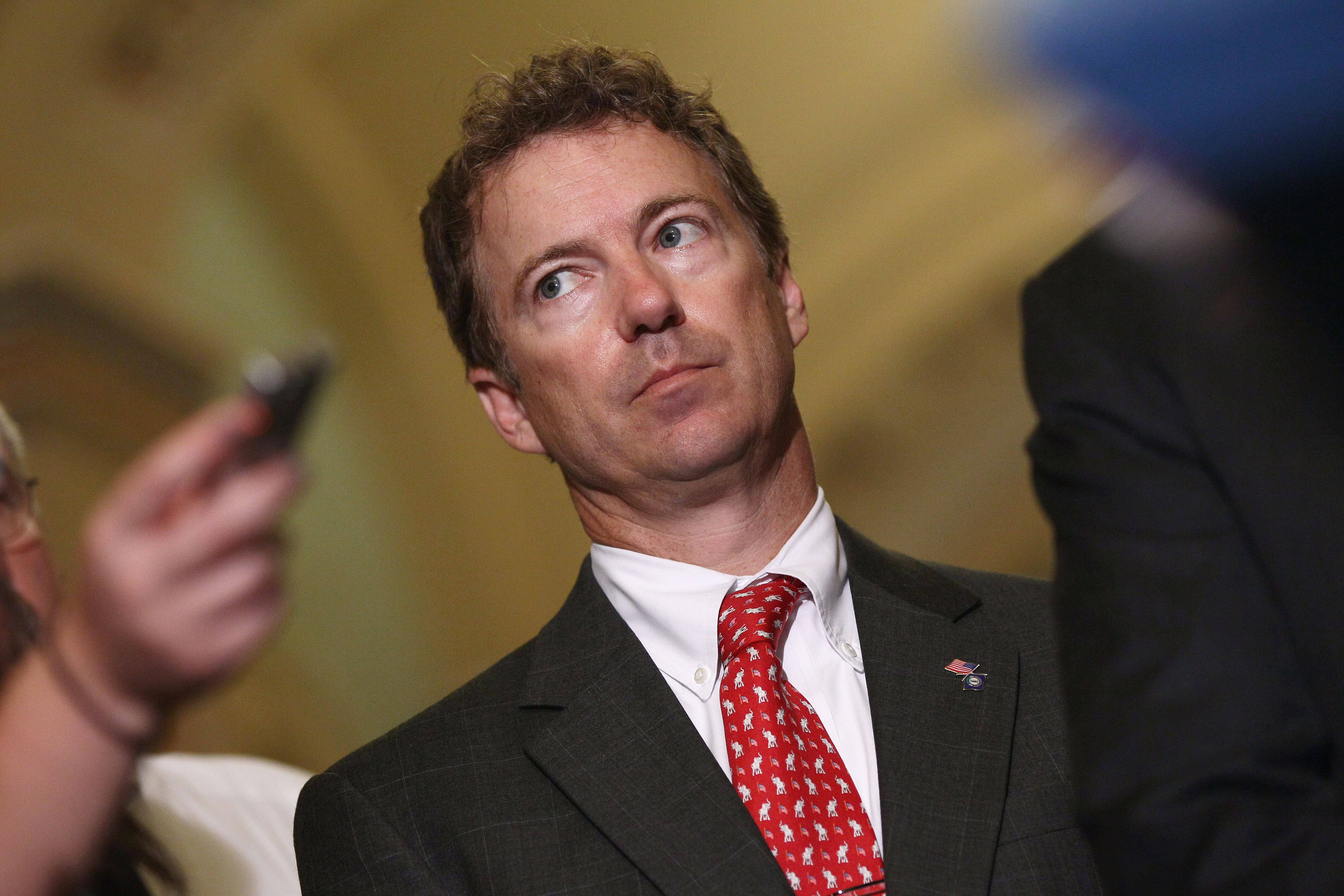
Frank Rich believes that a Rand Paul presidency “would be a misfortune for the majority of Americans who would be devastated by his regime of minimalist government.” That, of course, presupposes that Paul’s domestic radicalism would get past a Congress, which I seriously doubt. Even the current House couldn’t actually live up to its much more modest cuts in discretionary spending, and cutting entitlements – the real and sanest money-saver – is extremely hard.

The real promise of a Paul presidency, as Rich argues, would be in foreign affairs.

Look: I don’t support the extreme version of non-interventionism Paul backs. But I do believe, on Eisenhower lines, that the military-industrial complex is out of control, that our military spending has less to do with defense than with sustaining a global hegemony that has proven itself more of a burden than an asset, and that it is simply more politically realistic that Americans will back cuts in defense over healthcare. If you want a return to fiscal balance, cutting defense is essential and I see no figure on right or left more capable of doing so than Paul.

Of course, he’ll be opposed by the Congress as well. But in foreign policy, a president can do a lot on his own to shift direction. Obama has been a small-c conservative on this, gently nudging us back toward a more balanced role in the world – with the Syria deal the recent high-point. But we need to do more on this front, if we are to keep the lobbyists and the McCainiacs at bay.

After all, no faction in foreign policy has been more destructive of American interests in the 21st century than neoconservatism. And only if the GOP can rid itself of that hubristic faux expertise will we be able to bring down the long-term debt and more accurately connect America’s ends and means. On this surely Frank Rich is right:

The complacent neocon Establishment has been utterly blindsided. Just ask Bill Kristol, who had predicted that only five Republican Senators would join Paul in opposing military action in Syria—a vote count off by more than 400 percent. And just ask Christie, who attacked Paul’s national-security views this summer from what he no doubt thought was the unassailable political and intellectual high ground—only to find out he had missed the shift in his own party’s internal debate. …

Paul’s opposition to Bush-administration policies is essentially the same as Obama’s when he rode to his victories over Hillary Clinton and McCain. An Ur-text for Paul’s argument against Syrian intervention can be found in Obama’s formulation of 2007: “The president does not have the power under the Constitution to unilaterally authorize a military attack in a situation that does not involve stopping an actual or imminent threat to the nation.” Like Obama the candidate, Paul was in favor of the post-9/11 war in Afghanistan, against the war in Iraq, skeptical about the legal rationale for Guantánamo, and opposed to the Patriot Act. That’s more or less the American center now.

Why should Paul not occupy it? Hillary sure won’t. It takes nerve to face down the CIA and the NSA. Obama has been more co-opted than many of us hoped for. Paul isn’t the co-optable sort.

(Photo: Win McNamee/Getty.)

A Happy Rise In Unemployment

child-labour-hazardous-work-percent-of-children-in-child-labor_chartbuilder-2

Tim Fernholz notes that child labor has fallen substantially around the world since 2000:

Wondering how 168 million child laborers could be a positive thing? Well, the number represents about a third fewer workers aged 5 to 17 than there were in 2000. The fastest decrease in child laborers has come in last four years, even though child advocates had feared an increase because of the global recession. … The [International Labour Organization] points to two major reasons for the recent decrease: The poorer nations where child labor is concentrated recovered more quickly from the global recession, which meant fewer children were forced by impoverishment into child labor. Also, reduced labor demand meant that older children weren’t able to enter the workforce as quickly.

But Harriet Grant stresses that the number is still too high, especially with many working children hidden in the less formal pockets of the economy:

[ILO child labor expert Yoshie] Noguchi said that because the family-based model of working was so common, it remained difficult to tackle child labor through a model of transparency in supply chains. “Consumers can indirectly give a signal to business that they do not want [child labor] and then the supply chains might give a signal to suppliers, but the supply chain is very long now,” she said. “It’s not easy for enterprises to say no, because people can sub-contract down to even a family-based level that nobody comes to inspect. Child labor exists more in that kind of setting than anywhere else.”