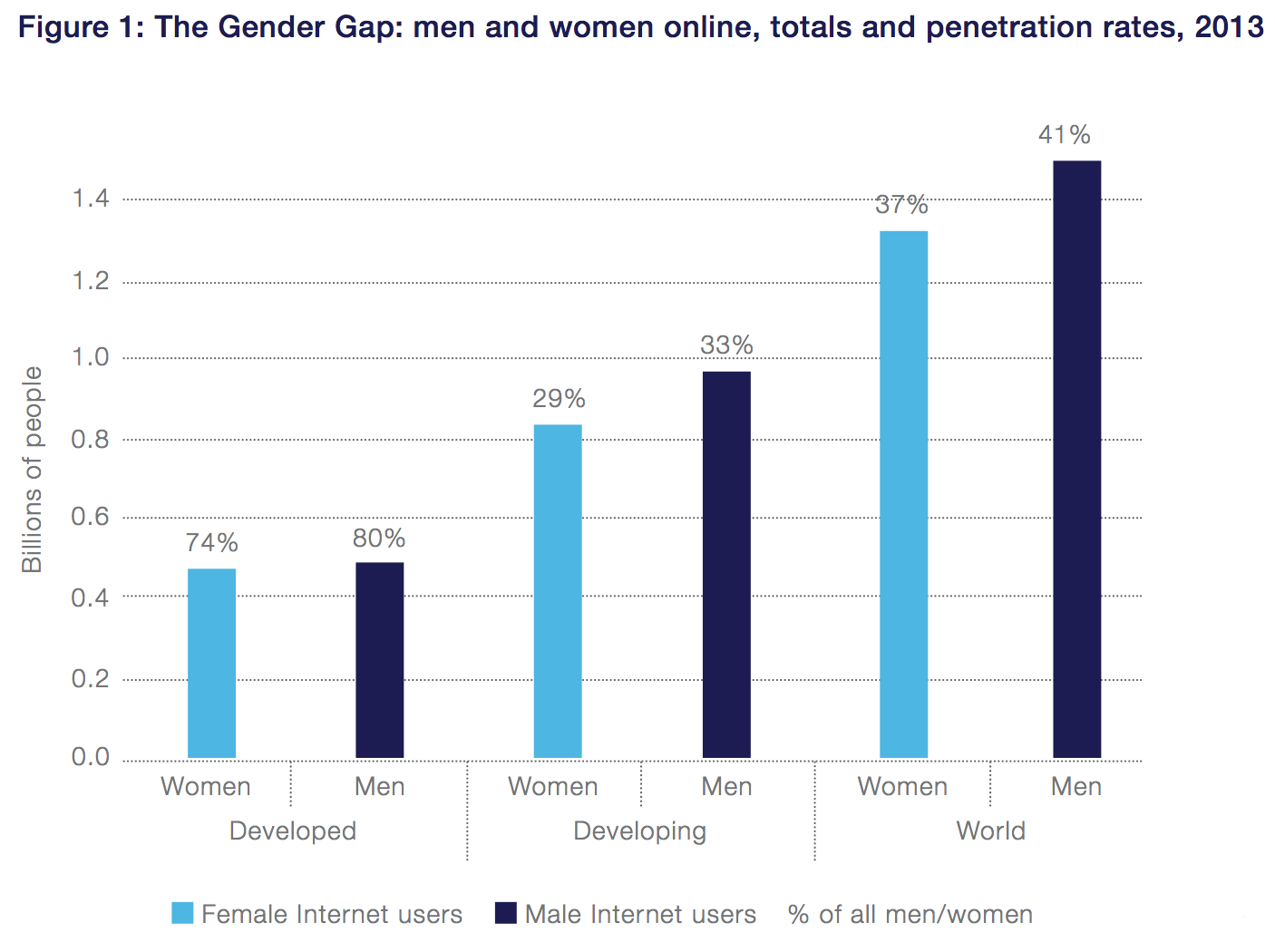
Meghan Neal points to a new UN-backed report indicating “there’s a major online gender gap that needs closing, quick”:
Worldwide, 200 million fewer women have access to the internet than men, and that’s expected to widen to 350 million if nothing’s done to change it. In today’s information economy, that puts women at a socioeconomic disadvantage right out the digital gate – not to mention it creates an unbalanced economy that’s not doing society any favors. In fact, according to the report, if the world were to add 600 million female internet users, it would boost the global GDP by up to $18 billion.
In some regions extremely hostile gender politics are what keep women offline. In certain Arab countries, women are discouraged or outright banned from online activities, leading to the biggest gender imbalances in countries where Internet is relatively accessible. In Saudi Arabia for instance, nearly two-thirds of men with Internet access were engaging in e-commerce, compared to less than 50 percent of female Web users. Similarly, smartphone usage in that country has a 4:1 male to female ratio.
But even in the Western world there is a gender gap, albeit a smaller one. In this instance, the gap is blamed on more subtle hostility toward female Internet users. “[T]he U.S. access gap is entirely the product of socioeconomic differences between men and women, while the use gap is the product of both socioeconomic differences and underlying, gender-specific effects,” the report states.
The House proposal (at least as originally conceived) is a grab bag of GOP goodies, most of which were bullet points in Mitt Romney’s presidential campaign platform. But it lacks the most controversial elements of the GOP agenda — Medicare privatization, Medicaid devolution — and as such doesn’t cut enough spending for some of the most hardline conservatives in the House Republican conference. It also doesn’t include any abortion restrictions.
As such, Boehner and his leadership team can’t whip up 217 Republicans (the current threshold for passage) to back it, and since zero Democrats will support their crazy plan, it’s dead. At least as currently written.
Chait thinks that there is a perverse logic to this turn of events:
Why would the most conservative Republicans settle for forcing Obama to implement Mitt Romney’s platform? They thought Romney’s platform was too timid in the first place! They were willing to vote for figures like Rick Santorum and Newt Gingrich, not to mention Herman Cain and Michele Bachmann, as an expression of their dismay with Romney.
Now, it may seem a little silly to insist that Obama accept an agenda that was too extreme to prevail in a Republican primary. But if you’re already insisting that Obama accede to an agenda that was too right wing to win a general election last November, at this point, what’s the difference?
The line between Syria’s moderate and extremist rebels is becoming increasingly blurry. Rania Abouzeid digests the news:
Western and Arab capitals are all looking for friends among the so-called moderate elements. And yet the Free Syrian Army command is only as strong as its international backers allow it to be. Within the rebellion, strength comes from receiving weapons and ammunition that can be distributed to the men on the ground, to build credibility and leverage. But the current situation has emerged because the supplies either never came or were inconsistent and small, prompting fighters to buy weapons inside Syria, smuggle them from abroad, or manufacture their own.
They also turned to more hardcore Islamist elements, who—with their superior funding, supplies, and discipline—have been pivotal in securing many rebel victories. This contributed to a vicious circle: the United States has long expressed fears that any weapons it might send to Syria’s rebels will end up in the hands of extremists; the lack of weapons shipments has made the extremists stronger.
Fisher wonders whether arming Syrian moderates is now futile:
One line you often read, in stories articulating the United States’s many unattractive options in Syria, is that there may or may not have been a window for a Libya-style intervention early on in the conflict, but that we’ll never really know. We may now be at a similar point with the window for championing a branch of the opposition.
Because the U.S. won’t and indeed legally cannot arm members of this “Islamist Alliance” on account of the involvement of Jabhat al-Nusra, that leaves the administration with the option of arming the weakest part of the weaker side in a civil war. That would seem to serve no purpose except to add more weapons to the mix, and there is no guarantee that any U.S.-provided weapons would not be lost to other groups that the U.S. has no wish to arm. That has always been true, but now it is impossible for anyone to miss.
Nonetheless, we shouldn’t get carried away and argue that the debt ceiling has never been used as political blackmail. In fact, the Democrats were the first to play this game against against Nixon.
I strongly disagree with that statement. I don’t know if you are missing the point of today’s showdown or are intentionally trying to make a limited, although irrelevant, point that past debt ceiling fights have occurred. But nothing like what Republicans are proposing now has ever happened before, and it is dangerous for folks to try to equivocate and obscure this new, extremely dangerous threat.
Yes, there have been isolated examples where an opposing party that controlled both houses of Congress have attempted to actually pass and attach bills to a debt ceiling increase to pressure a president not to veto such legislation (like the Nixon example or another example involving gasoline taxes under Carter), or where a majority Congressional party tried to rein in future spending as a condition of increasing the debt ceiling (such as Republicans refusing to provide the votes needed to raise the debt ceiling under Republican Eisenhower).
While I don’t agree with those past examples of using the debt ceiling as leverage, they do at least involve an inter-branch power struggle between the Legislative branch (both House and Senate) and the Executive branch on a limited issue, and where the recalcitrant Congressional party had the votes to pass its demand through Congress.
What Republicans propose now differs wildly in kind, not degree.
Republicans today cannot attach to a debt ceiling increase a bill that passed both the House and Senate. Indeed, Republicans have not even shown that most of their demands could even pass the Republican House. And Republicans can’t claim that their votes alone are necessary to pass a debt ceiling bill. Rather, absent a Republican Senate filibuster and a faux Republican “majority of the majority” House rule, a clean debt ceiling would pass easily.
Instead, what we have here today is a new concept that a rump minority – using pure obstruction alone – can force enactment of its own agenda through a threat of catastrophic economic retaliation. Also, with a $16 trillion debt, this would be an annual extortion threat that far surpasses the value of majority electoral success. As Matt Yglesias aptly puts it: “Republicans are essentially asking for an end to constitutional government in the United States and its replacement by a wholly novel system.”
In short, contrary to your statement, we have never before seen a minority party openly and aggressively threatening to destroy the full faith and credit of the U.S. unless its agenda was enacted – much less right after that specific agenda was defeated in a national election.
this is a tumblr with a simple premise: send me your dick pics, & i’ll critique them with love.
‘with love’ is an important addendum. i’m never going to shame you about the size of your dick or what it looks like; i’m not about that life. i will, however, be ruthlessly honest when it comes to things like angles, lighting & general tone. i’m trying to help you improve, because in all likelihood your dick pics are artless & dull.
We really are in the age of the selfie. After just two days in existence, there’s a backlog of eight weeks’ worth of dicks. Anthony Weiner was just an early adopter. For future politicians and public figures, acknowledging their youthful selfies will, I suspect, be a little like boomers admitting they once smoked pot. My fave critique of a somewhat ambitious dude:
it’s clear that you had one goal in mind when taking this picture and that was to demonstrate that your dick is roughly the size of an empty v bottle. congratulations, i guess, because you achieved that. you achieved very little else.
From the critique of a submitter who labeled his own pic “Lol real small”:
i like the fact that you are holding your dick in this picture. too often dick pics are clinical affairs with the sole aim of showcasing size, and this comes at the expense of eroticism. when you hold your dick in your picture, you do two things:
you obscure some of it, which is sexy; and
you remind me that your dick is a sexual organ, and that touching it makes you feel good.
i’m also feeling the fact that you’ve left your boxer shorts on in this pic; it adds a bit of subtlety and dick pics could always use that.
thank you for being the inaugural dick pic of critiquemydickpic.tumblr.com. your dick pic gets a B.
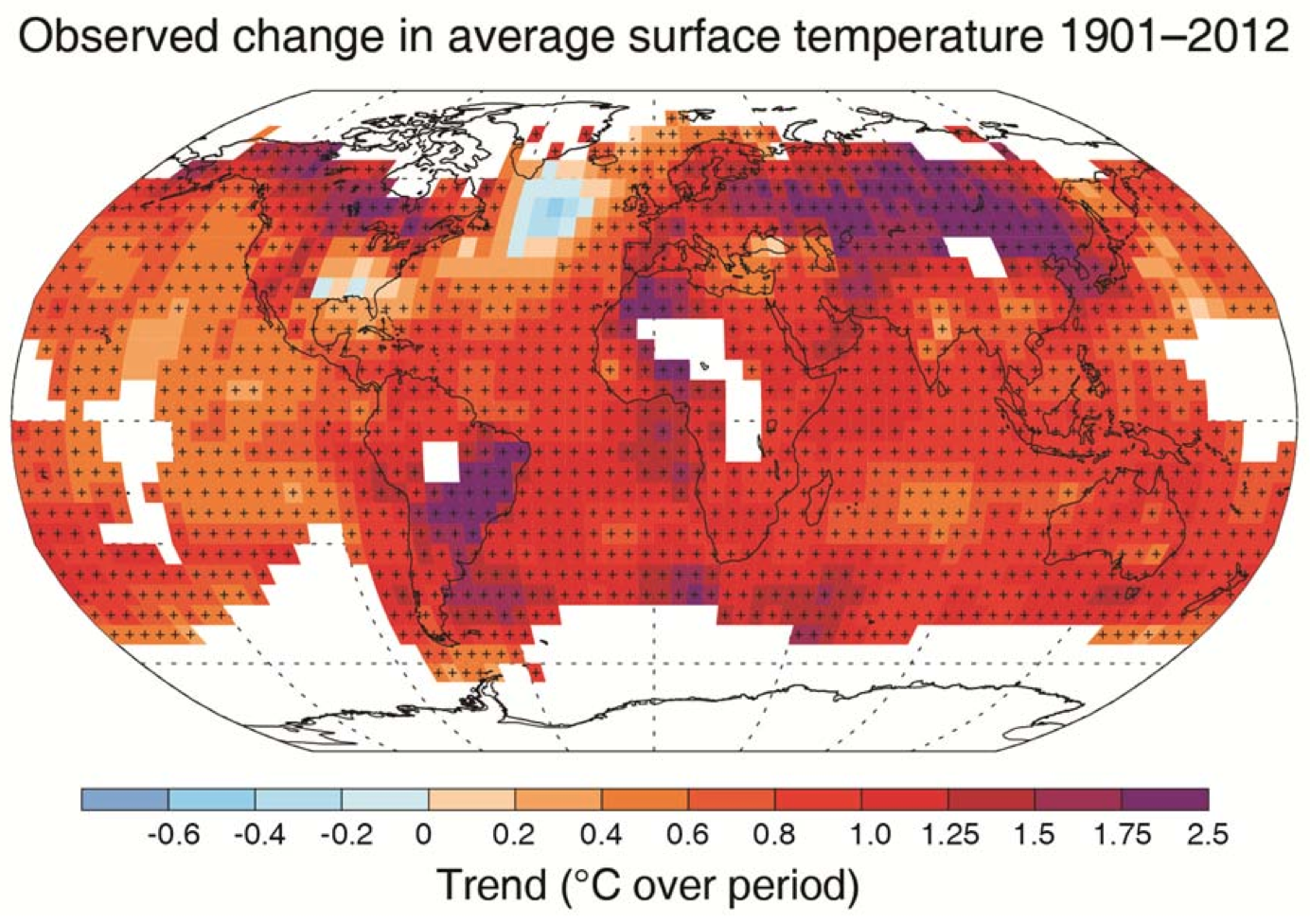
The summary for the new Intergovernmental Panel on Climate Change (IPCC) report can be read here (pdf). Richard Schiffman asked various experts for a headline that captures the new report:
Ted Scambos, a glaciologist and head scientist of the National Snow and Ice Data Center (NSIDC) based in Boulder would lead with:“IPCC 2013, Similar Forecasts, Better Certainty.” While the report, which is issued every six to seven years, offers no radically new or alarming news, Scambos told me, it puts an exclamation point on what we already know, and refines our evolving understanding of global warming. …
Eric Holtaus explains why the IPCC report is significant:
What makes the IPCC so important is simple: They are required to agree. Last night, the group pulled an all-nighter to ensure that representatives from all 195 member countries agreed on every single word of the 36-page “summary for policymakers” (pdf). That instantly makes the report the world’s scientific and political authority on what is happening to the climate, what will happen in the future, and what needs to be done to avoid the worst impacts.
The IPCC has added considerable clarification to the most controversial part of the report, where it notes that the rate of surface temperature increase over the last 15 years ago is somewhat less than it had been previously. After an earlier draft of the report leaked in August, this section was widely cited by climate skeptics to cast doubt on global warming. Now, the IPCC clarifies that short-term trends of this kind “are very sensitive to the beginning and end dates and do not in general reflect long-term climate trends.” The report says the recent reduction in the rate of warming is caused, in roughly equal parts, by natural climate variability (possibly including heat going deeper into the oceans) and a temporary decline of solar radiation reaching the planet, thanks to volcanic eruptions and the solar cycle itself.
Scott K. Johnson examines the emissions estimates:
In order to keep warming below the oft-referenced target of 2°C above pre-industrial temperatures, the total amount of carbon humans have emitted cannot exceed about 800 gigatons, the report says. As of 2011, about 531 gigatons had been emitted. The two middle scenarios involve the emission of 595-1250 gigatons between now and the end of the century.
The report also emphasizes the need to consider the long-term ramifications of carbon dioxide emissions. “Depending on the scenario, about 15 to 40 percent of emitted CO2 will remain in the atmosphere longer than 1,000 years.”
Brad Plumer, meanwhile, thinks it’s time the IPCC begins rethinking its mission:
[M]any experts have begun urging the IPCC to rethink its whole mission. Do we really need hundreds and thousands of scientists devoting years of their lives to an encyclopedic synthesis that is getting a bit repetitive? Would it be more useful for the IPCC to produce more frequent, nimble reports on important sub-topics, as it did in 2012 when it released a smaller “special report” on extreme weather?
It’s a topic the IPCC has even begun asking itself.
I was pleasantly surprised to see your post on Stolperstein. Two years ago my family flew out to Berlin to see the unveiling of two Stolpersteins bearing the names of great-grandparents outside of their apartment. My grandfather, who was raised in the house until he was ferried off to hide in France at age 11 and never got to see his parents again, led a brief but beautiful ceremony standing standing outside on the quiet and peaceful Neukolln street. For me, the Stolpersteins are an unassuming, simple and devastatingly powerful reminder of the personal toll of the monstrosities of the Holocaust. It’s one thing to try to visualize 6,000,000, and it’s another thing to try to imagine the family that once lived right where you happen to be standing.
But for my grandfather, they were something else. As he walked us down his childhood streets, each Stolperstein would bring up memories of this gossiping neighbor, or this childhood friend, or this guy who ran the shop down the street. Whereas we could only see each as a tragedy, he could see them as memories as well.
[Above] is a particularly powerful video that was sent to us of a child living in the same building as my grandfather grew up in, seeing and learning about the Stolperstein for the first time.
If any German-speaking Dishheads would be willing to send us a translation, we will update. (Update below.) Another reader points to a different memorial:
The reader who shared his experiences in Bad Godesberg struck a chord with me. He wrote: “Finding out a few years ago that it had been owned by a prominent Jewish Family that had to flee was dumbfounding to me; I had never thought of that possibility while sneaking in and playing on its grounds.” I, too, had an experience like that.
My father was stationed in Bad Tölz during the 1980s, and I spent four years playing in the (now closed) US Special Forces base there – the Flint Kaserne. After college, in 2000, I returned to Germany for the first time since I was ten years old. While in Munich, I paid a visit to the Dachau concentration camp. They had a map of all the satellite camps and stations where prisoners would be sent to work as slave laborers, and there in big bold letters was “Bad Tölz.”
In that instant I knew (and later confirmed) that my old swimming pool, bowling alley, t-ball fields, playgrounds, Dad’s office, soccer fields, basketball courts, trick-or-treating streets, and cafeterias – practically my whole existence for four of the best years of my life … all of it was on the satellite camp.
It’s been 13 years since I made that discovery, and I still feel conflicted about the Flint Kaserne. I had a wonderful childhood there, and yet I think of all the elderly German neighbors, who would have been adults during WWII, and I can’t help but want to yell at them: “You knew! All this time you knew!” Sadly, my experience is hardly unique.
Update from a reader:
It is hard to understand some parts, and in fact they say nothing extremely moving (very German). It goes as the following:
woman: i am not sure if this has an educational value
young man steps out of the door: whose roses are these?
he reads: 1942, two years before the end of the war, what happened at this point?
old man: they lived here
young man: ok
woman: that was a jewish family that lived here
young man: and they survived the holocaust?
woman: no they were killed, in belgium
young man: they lived in this flat, in this house?
woman: yes, they lived in this house, we put these small “stolpersteine” everywhere, because these people have no …
young man reads the names: ok they were married
woman: we put these stones in the pavement all over berlin
young man: a horrible time
woman: because nobody cares about them any longer are we putting these stones in the ground, they were gassed and because of that there is nobody left
young man: i hope they rest in peace
I am a young German (18), living in Trondheim in Norway and I was amazed to see that even here there are a number of Stolpersteine. This is a great project, and if you live in a bigger German city, chances are good that you walk over some of these stones every day. They remind one in a very careful way of those who were killed because our ancestors supported or cowardly accepted the Nazis.
Having won the big battles for legalization, activists in Colorado and Washington are aiming at new obstacles:
Top of the list is access to financial services. Most banks and credit-card companies will not deal with dispensaries for fear of violating federal money-laundering laws. This forces many to operate as cash-only businesses, with all the attendant hassle and security problems. One frustrated dispensary owner says the payroll accountant must spend a day a week sorting employees’ wages into piles of cash: “It’s so old-school I feel like she should be wearing a monocle.”
Grilled at a congressional hearing last week, [deputy Attorney General James] Cole said the justice department was reviewing the issue with banking regulators. Tax reform, dispensary owners’ other big worry, will be trickier. … Jaime Lewis, a Denver-based dispensary operator, says she pays an effective tax rate of 67 percent; about twice as much, she reckons, as comparably sized companies in other sectors.
Meanwhile, Mike Riggs insists that investors would be pouring money into Colorado’s cannabis industry if not for the state’s unreasonable residency requirement:
The rule, which Colorado residents did not vote for when they approved Amendment 64, requires a person to have been a Colorado resident for two years before they can apply for a marijuana business license, and three years before they can invest in a marijuana grower or retailer. It also has to be the investor’s primary residence. For comparison, Washington state has a three month residency requirement, and it doesn’t have to be the investor’s primary residence.
But financiers are getting creative:
The silver lining for investors is that growing and selling marijuana aren’t the only investment opportunities. “There’s obviously the industry itself, but there’s also the ancillary market,” says Mason Tvert of the Marijuana Policy Project, the group that led Colorado’s legalization campaign (and which did not push for a residency requirement). Paraphernalia, like vaporizers and vape pens, are an obvious opportunity, but the list doesn’t end there. Tvert points to Uber’s disruption of the taxi industry, and suggests that a similar app could be developed for marijuana. He also wouldn’t be surprised to see interest grow in specialized gardening products and classes on cultivation, thanks largely to the provision in Colorado’s law that allows adults to grow marijuana in their homes.
Tvert touches on the banking obstacle in the above video. Previous Dish on the business of bud here and here.
Beutler thinks the Republicans’ demands are designed to produce “a bunch of campaign fodder”:
What’s missing [from the GOP’s demands] are the big ticket items they don’t actually want to vote for in a real legislative negotiation. Medicare privatization. Chained CPI. Those didn’t make the cut. Instead, it’s all stuff they want and stuff they know some Democrats have a hard time opposing. If they send a bill like this over to the Senate — there’s reason to believe this bill won’t clear the House — it looks an awful lot like Dems will be able to strip all of the riders using the same majoritarian process they’re currently employing to hive Obamacare defunding off of the government spending bill. That will require asking vulnerable Dems to vote against things that might cause them problems in their states.
Steinglass asks why Republicans taking the economy hostage is more acceptable than Democrats doing so:
If either party can take advantage of this sort of doomsday threat, it should be clear that neither can. To underline that fact, Mr Obama ought to counter the Republican threat not to raise the debt ceiling, with a threat of his own to veto a raise in the debt ceiling. Republicans may demand the postponement of Obamacare in exchange for a debt-ceiling hike. Mr Obama can demand passage of an immigration-reform bill including a path to citizenship in exchange for a debt-ceiling hike. … [T]he whole idea that Mr Obama would threaten to tank America’s credit rating and the global economy in order to achieve his legislative agenda is just nuts. Whereas Republicans, well, you just have to expect them to pull that sort of stunt, because…because why again?
Playing hardball in politics is not unhealthy. Hardball is often necessary and important, and many who complain about it should pay more attention to getting better at it. Madison’s framework does not require or desire that individuals should all be moderates. But to valorize hardball for its own sake is unhealthy, and even more unhealthy is to veto a compromise simply because it is a compromise. There is no contradiction between compromise and political principle, or at least no necessary contradiction. Nor is compromise at odds with constitutional principle. Just the reverse: Compromise is the most essential principle of our constitutional system. Those who hammer out painful deals perform the hardest and, often, highest work of politics; they deserve, in general, respect for their willingness to constructively advance their ideals, not condemnation for treachery.
No one is saying, of course, that anyone should support anything only because it is a compromise, any more than that he should oppose something only because it is a compromise. The point, rather, is that compromise is a republican virtue. It endows the constitutional order with stability and dynamism. It not only tempers the worst in us; it often brings out the best. It is patriotic, not pathetic, and it deserves to be trumpeted as such.
A reminder of a president the Tea Party would despise if he were currently in office:
The enactment of Reagan’s monumental tax cuts in 1981 caused huge deficits, forcing both parties to scramble to hold them in check. The next year Democratic and Republican negotiators from Congress and the White House reduced deficits by cutting spending and increasing revenue. Democrats urged Reagan to allow a three-month delay in a tax cut scheduled for 1983 as the price of them agreeing to spending cuts. He accepted that, but refused a demand that he reduce the cut from 10% to 5%. Reagan said, “you may make me crap a pineapple, but you won’t make me crap a cactus.”
The final deal was a carefully balanced package of provisions that one side or the other detested. The essence of compromise is giving up something you care about to gain something else more important. Reagan understood this, but he realized that his supporters would understand that in compromising he had not turned his back on his ideals.
(Photo via Wiki: “Referred to as the second of the two “Reagan tax cuts” (the Kemp-Roth Tax Cut of 1981 being the first), the Tax Reform Act of 1986 was also officially sponsored by Democrats, Richard Gephardt of Missouri in the House of Representatives and Bill Bradley of New Jersey in the Senate.)