Taking The Back Door Into The Ivy League

Theodore Johnson asks if enrolling in Harvard’s distance-learning program counts as attending Harvard:

I often felt [as if] I’d snuck into one of the world’s premier institutions for higher learning. There is little chance that my slightly-above-average undergraduate GPA and an extra-curricular résumé that only consisted of a part-time job at a music store would’ve secured a spot for me in one of Harvard’s ultra-competitive graduate schools. Yet, with no admission letter in hand and exactly zero hours spent preparing for graduate admissions tests, I became a Harvard student. And I was not alone. The Extension School  Harvard’s degree-granting continuing education school  has a student population of more than 13,000.

Johnson, who was one of the .2 percent of Harvard Extension School students to graduate with a degree, asks, “Did I really go to Harvard?” Daniel Luzer says no  but it doesn’t matter anyway:

The truth is that Harvard, like other colleges, runs a lot of programs that aren’t really Harvard.

Harvard Business School runs the Executive Education Program, in which “those enrolled attend one three-week session, which … cost $33,000 a pop, per year for three years.” Enrollees don’t earn an MBA but they “still receive alumnus status.” High school students can attend Harvard Summer School and spend $7,000 to live in Harvard dorms and take a class on the Harvard campus. In the unlikely event that one is subsequently admitted to Harvard College, however, such classes cannot be applied to a Harvard degree.

Harvard Extension is not quite the same thing, of course. While it’s arguably not really Harvard, it’s not “fake Harvard,” either. It’s not a scam. It’s not an attempt to earn extra cash by selling the Harvard brand. Indeed, at $1,020 to $2,000 per four-credit course, it’s actually donating the Harvard brand.

Unequal Justice Under International Law

ICC

Eric Posner considers the growing irrelevance of the International Criminal Court (ICC), especially in light of how it hasn’t gone after Assad:

The countries that signed on were mostly peaceful democracies and poor countries embroiled in endless conflicts that could not be addressed with regular law enforcement. Because the ICC treaty specifically limits ICC involvement to cases where national legal institutions fall short, the ICC focused its attention on the latter group, which unfortunately were mostly African.

In some cases, the African countries invited ICC participation, but in others it was thrust upon them. For example, the Security Council authorized the ICC to investigate Sudan, whose president Omar al-Bashir was indicted for his role in ethnic killings in Darfur. (He has refused to appear for trial.) Even a country like Uganda, which invited ICC participation, later found that as a result it could not offer an amnesty to insurgents in order to establish peace. As the ICC increasingly interfered in their affairs, African countries took the view that the court, in the words of Ugandan President Yoweri Museveni, is now being used by Western powers “to install leaders of their choice in Africa and eliminate the ones they do not like.” Meanwhile, the ICC—with an annual budget of more than $140 million and staff of about 700—has been able to convict only one person (the Congolese warlord Thomas Lubanga) in more than a decade.

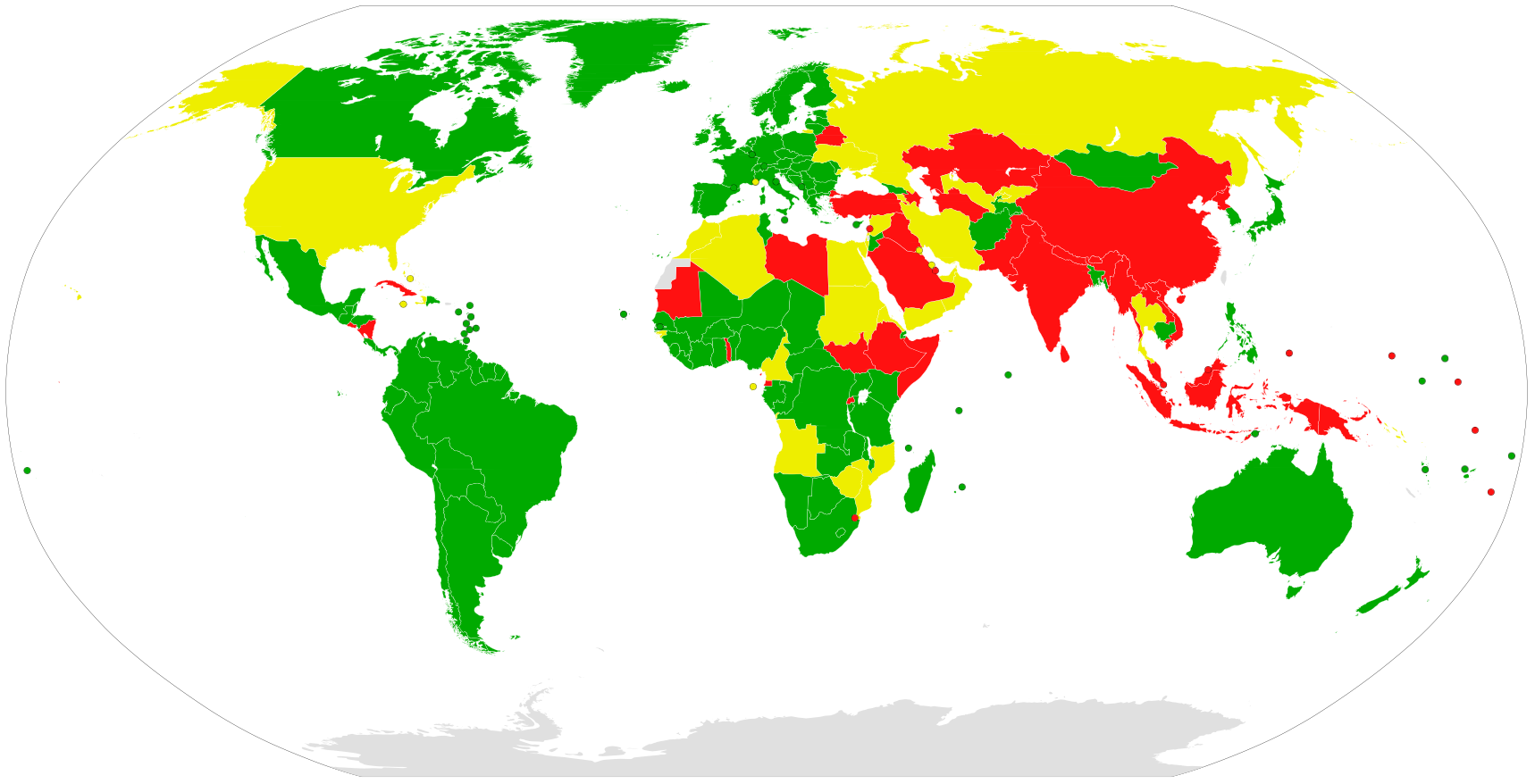
The map seen above, from Wikipedia, shows countries belonging to the ICC (green), countries that have signed but not ratified (yellow), and countries that have not signed (red).

Is English Undermining The EU?

Robert Lane Greene suggests so. He feels all schoolchildren in the European Union should learn two foreign languages:

Why not let the [English] spread to every corner of Europe – and, indeed, the rest of the world? This would certainly seem more practical than teaching every European child two more languages. But mandating English might also serve to undermine loyalty to the EU. There are too many Europeans who would rather not have English dominate political affairs. The continent has more native German-speakers, including four countries where German is an official language. French has as many native-speakers in Europe, too, and is official in three countries (not to mention Europe’s de facto capital, Brussels). Native English-speakers make up less than a fifth of the EU’s population. And, awkwardly, English is the official language of the one country that will soon hold a referendum on whether to quit the EU entirely.

But the real reason not to adopt a “mainly English” language policy involves the EU’s promise to its members, under the official motto “united in diversity.” No country joined the union in order to be crushed under a homogenizing wheel.

The Heartless Blogger

Leon Wieseltier – news alert – thinks I’m a callous bastard:

In the name of “nation-building at home,” we are learning to be unmoved by evil. I will give an example. On Anderson Cooper’s show last week, there appeared a man named Zaidoun Al Zoabi, an academic in Damascus and a prominent anti-Assad activist, who was kidnapped by the Syrian secret police and held in one of Assad’s most notorious prisons. He was pleading for American action to stop Assad’s savagery. “Is the diplomatic path now only about chemical weapons?” Al Zoabi asked, with a look on his face composed in equal measure of dignity and desperation. “What about [Assad’s] massacring us for the past two years?”

At which point Andrew Sullivan, who was a panelist on the show, folded his arms, turned away, and sneered: “Chemical weapons is all you’re going to get right now!” Go back to your disgusting little country and die. The blogger giveth and the blogger taketh away. Is this “war-weariness”? It is certainly a disrespect for suffering.

A couple of points. Zoabi has opposed military intervention by the West for the last two years. Anne-Marie Slaughter noted this on the show:

SLAUGHTER: Last week when we talked you did not support military strikes. You did not think…

ZOABI: I do not support until now.

So how heartless was Zoabi for the last two years? More to the point, a clear majority of Syrians still oppose military intervention by the US. From a recent YouGov poll:

More opponents of the regime strongly disapprove of a U.S. military strike than favor it. 81 percent of government supporters, as well as 56 percent of those who prefer not to say. There’s little evidence that ordinary Syrians favor an attack.

In fact, distrust of America is nearly unanimous among Syrian poll-takers. Only 7 percent of those interviewed thought that the U.S. government was “a friend of the Syrian people.” There wasn’t much disagreement on this point among supporters and opponents of Assad. 79 percent of supporters, 61 percent of opponents and 57 percent of non-aligned said the U.S. was “an enemy of the Syrian people.”

If the Syrian people themselves remain at best ambivalent, is it really solely a mark of “heartlessness” to be skeptical that military intervention would do any good either for the future of Syria or for the current cessation of chemical attacks.  Leon describes what I said with respect to chemical weapons thus:

“Chemical weapons is all you’re going to get right now!”

The transcript reads:

ZOABI: Let me just say one thing. Is the diplomatic path now only about chemical weapons? What about massacring us for the past two years?

SULLIVAN: Chemical weapons right now.

As for my moral callousness – expressed by Wieseltier, putting words into my mouth, as “Go back to your disgusting little country and die!” – here’s a part of the transcript when I was asked directly about the horror of August 21 – and countless other occasions Assad used these vile weapons. I said:

It is absolutely fair and important for us to observe this horrifying thing.

We should. I’m not saying we shouldn’t. I think we should feel it, see it, absorb it, think about it, and face up to it. But statecraft is not about emotional, visceral responses. Statecraft requires someone to see the world as it is but then to make serious judgments about our interests, the future, unintended consequences.

You cannot run foreign policy by emotional spasms. And my fear is that that emotional spasm threw Obama off his essential trajectory of keeping out of this.

These are difficult, tough choices to make in a fallen world. I do not envy the job of the president. Nor do I doubt the sincerity of Wieseltier’s anguish in the face of such horror. If I have at times seemed too indifferent to the suffering in that country in making realist points, I apologize. But I differ in judgment about the right course of action. It seems to me we should be able to acknowledge that, without imputing inhuman callousness.

You Can’t Predict “Crazy” Crime

Garance is uncomfortable with creating a registry of the mentally ill:

More than half of Americans experience one or more mental illnesses over the course of their lives, and around 26 percent of Americans over age 18 each year experience at least one, primarily anxiety disorders and mood disorders like depression. The overwhelming majority of them are no danger to anyone at all. But with so substantial a portion of the country going through bouts of one thing or another over the course of their lives, the idea that any federal database could capture enough information to encompass every one who might one day be a threat anywhere is akin to hoping for a government staff of precogs.

And that’s not even getting into the highly problematic question of whether the government should mark millions of people who will never hurt anyone for a carve-out from the Second Amendment, and the privacy and stigmatization issues involved in cataloging harmless people who suffer from common mental illnesses in order to label them as potential threats in a federal government database. The idea of creating a mental health database instead of pursuing policies that involve direct regulation of guns is one put forward, not surprisingly, by the gun lobby, which knows that it’s easier to blame gun violence on out-of-control crazies than on abundant access to deadly weapons by disturbed individuals with evil intent bent on mayhem and murder.

Ambinder has similar worries:

I am pretty certain that there is no reliable matrix to predict, with anything close to reasonable certainty, that a person with “X” traits and “Y” life experiences will perpetrate a mass shooting, or otherwise brutalize people. So I believe that a mental health surveillance system, hastily constructed, would be a significant and worrisome expansion of the state, and an ineffective one, at that.

Honoring Shepard With The Truth

In today’s video from Jimenez, he addresses the criticism he faced after working on the 20/20 piece that first introduced the thesis of The Book Of Matt to the world in 2004:

Sure enough, Media Matters has already published a take-down of Jimenez’s book before it’s even released. And this is how the Matthew Shepard Foundation has responded thus far:

Attempts now to rewrite the story of this hate crime appear to be based on untrustworthy sources, factual errors, rumors and innuendo rather than the actual evidence gathered by law enforcement and presented in a court of law. We do not respond to innuendo, rumor or conspiracy theories. Instead we recommit ourselves to honoring Matthew’s memory, and refuse to be intimidated by those who seek to tarnish it. We owe that to the tens of thousands of donors, activists, volunteers, and allies to the cause of equality who have made our work possible.

The Book Of Matt: Hidden Truths About the Murder of Matthew Shepard comes out next week. Steve’s previous videos in the series are here. A reader reflects on it:

What made Matthew’s story a story is not the facts of his death, but the reaction after his death. Whatever happened, Jimenez adds new information to the context, but the actual events are trapped on a hillside 15 years ago.

When the first reports of what happened in Laramie became publicized, I was a closeted guy living in a mostly rural, conservative Midwestern town.  I felt Matthew’s death because of the coverage and the story. It provided a realization of my fears leftover from being assaulted in my early teens by two classmates suspicious that I was a faggot.

They rammed me up against a locker in a late morning break between classes and punched and kicked me a few times. They then pinned me into a corner and poured an entire bottle of cheap perfume over my head – an event that had helped keep me in the closet for the next 25 years.

Nearly five years after Matthew’s death, I was returning home after a one-year leave.  Just as I finished the overseas leave, I was part of an incident wherein another man and I intervened in the hate-based assault of a 19-year-old man by four men shouting homophobic slurs. The assailants had been alternating holding him and hitting him and throwing his possessions into the busy street.  The other guy who intervened also got injuries, including an apparent concussion, but I was mostly okay. We slowed it down enough until some bouncers at a nearby gay bar came over and ended it.  When we tried to report it, the police did not want to file a report and told us that they thought it was just a fight and should not be reported for its context.

The reality is that the extra fear caused by hate crimes deserves more thought than you give it.  I have been robbed and assaulted in another context that had not to do with being gay.  It was a more serious incident in terms of potential risk to my life, but the incident that I remember, that I can smell, hear and see to this very day is the assault of a young man named David on Oxford Street in Sydney, Australia.  The incident wherein the next day the police said, “Mate, they’re kids, so nothing will happen if we file the crime report.”  They said it happens all the time and there is nothing they can do about it.  It took two hours of me being an asshole in the police station before they agreed to write a crime report.  Matthew Shepard was with me that entire time.

A week later, after arriving back in the states, I was driving cross-country from San Francisco with a friend back to the Midwest.  We stayed one of the nights in Laramie, as it made the most sense for the trip.  That evening, I took a solo walk through town and looked up at the hillside where I know from the reports he spent his last hours.  Whatever the reason and true circumstances from the night he died, I knew that one of me, another imperfect gay soul, died alone on that hillside.  The reaction and story, however factual, is, like many American stories, a defining moment.

The next morning, when we drove out of Laramie (I didn’t sleep much that night), I knew that I was not going back in the closet.  I knew that I was moving into a new phase of my life.  Not four years later I was testifying in the Indiana legislature against a marriage amendment.  I don’t need the story of Matt to be perfect, but we cannot change the impact of his story still has on many of us.

Francis And Wagner

It was a fascinating detour in the Pope’s gob-smacking interview yesterday: he is a fan of Wagner, specifically the Furtwängler La Scala Ring and the 1962 Knappertsbusch Parsifal. The peerless music critic for the New Yorker, Alex Ross, has some thoughts:

If I’m not mistaken, Pope Francis is comparing “decadent Thomist commentaries” to Klingsor’s magic garden — a seductive illusion covering a wasteland. Could the Pope’s emergent philosophy of unadorned compassion have been influenced in some small way by Parsifal, that attempted renovation of religious thought through musical ritual? “Through pity, knowing”? “Redemption to the Redeemer”? Possibly, but there are limits to his aestheticism: “Our life is not given to us like an opera libretto, in which all is written down; but it means going, walking, doing, searching, seeing.” This is a remarkable man.

And also a remarkable mind. We were constantly reminded of Benedict’s intellect, and it was and is impressive. But it was also a desiccated variety, crammed with fear, obsessed with order and precision, closed at times to the surprises of life and of God in its attempt to dot every i and cross every t. Francis? A profound intellect, yet also a living, breathing, open-ended one.

What Signal Does Not Striking Syria Send?

Fisher claims that it “boosts the credibility of [Obama’s] stated position that he isn’t seeking Iran’s destruction and that he will seek detente with Iran if it first meets his long-held demands on uranium enrichment”:

Here’s where the parallel with Syria is really important: Iranian leaders distrust the United States deeply and fear that Obama would betray them by not holding up his end of the bargain. That’s been a major hurdle to any U.S.-Iran nuclear deal. But seeing Assad’s deal with Obama work out (so far) sends the message to Iran that it can trust the United States. It also sends the message that making concessions to the United States can pay off. Iran’s supreme leader has been talking a lot lately about flexibility and diplomacy toward the West. So it’s an ideal moment for Obama to be demonstrating flexibility and diplomacy toward the Middle East.

Scoblete thinks Fisher goes to far:

[I]t’s going to be very difficult for Iran to accept the idea that the Syrian deal shows the Obama administration isn’t seeking Iran’s destruction when the Pentagon talks openly about arming Syria’s opposition even with a chemical weapons deal in place. That sends exactly the opposite message to Iran, who need only look to Libya to understand the consequences of accepting a Western disarmament deal.

Larison adds:

Iran can’t help but notice that states that agree to disarmament don’t buy themselves security from attack or foreign support for their domestic opponents. The fact that the U.S. continues to threaten Iran with attack in the name of “prevention” must mean more to Tehran than the U.S. decision not to attack Syria. The recent conciliatory gestures from Rouhani are an encouraging sign that tensions between the U.S. and Iran can be reduced, but there has to be some effort on Washington’s part to reciprocate or the chance will quickly be lost. Avoiding an attack on Syria should make diplomacy with Iran more productive, but whether it produces an agreement will depend on the willingness of the U.S. to make the concessions necessary to reach one.

This Extraordinary Pope: Your Thoughts

This embed is invalid


A reader refers to the above segment from last night’s AC360 Later:

I am an elderly Catholic Chaplain of 30 years, long a gay rights activist, serving prisons, hospitals and communities as advocate, counselor, and helper-as-able. I was beyond delighted to see you with Anderson Cooper, speaking with such passion about our new Pope. I had not known you were gay, or Catholic. I need to tell you how proud I felt of you, and that I just love you for using that talent; for hanging in there with the Catholic Church; for being you.

Another reader:

Wow! I wondered if Pope Francis could possibly be for real.  He seems the absolute embodiment of what I always thought the Catholic Church was supposed to be about – promoting the ideas and teachings of Jesus, not running a corrupt organization without a shred of mercy, divine or otherwise.  Pope Francis is having a tremendous pull on me.  I rejected the Church long ago, but I’m drawn to this man and what he has to say.  I hear a voice inside me that says “yes”.

Another:

I have been moved, as you have been, by the amazing grace of the Holy Father. What a revelation, indeed. I was recently baptized Episcopalian – it was the only denomination I could find that matched my social values. This Pope is the first Catholic leader in my lifetime (42 years) I remember reacting to in this way. In reading a book about my church, this passage struck me: “As Episcopalians, we are not called to be Christians, we are called to be Christ on earth.” Pope Francis, from everything I have seen, is embodying Christ on earth. What a blessing. I’m proud to take the liberty of the Anglican stretch and call him my Pope too.

Another:

Damon Linker is wrong.  Words matter and so do his actions.  Of course Francis didn’t come out and say “homosexual acts are morally permissible.”  That statement would completely take away from his greater point: God is love.  People would be frothing instead of focusing on who is important: Jesus Christ and his ultimate sacrifice because of his Father’s love for all of us.  As a liberal woman, I don’t need him to make a grand statement about women and the priesthood. The actions of washing young women’s feet on Holy Thursday was deeply profound.  Love for everyone is what he’s projecting.

Of course there will be liberals that will never be happy, and there will be conservatives that twist his words to suit their agenda, but the rest of us will just push away the noise and listen.

Another:

To Linker and Stanley:  “Meepus, meepus.”

Another:

I am amazed at those who poo-poo the words of Pope Francis because they do not change church doctrine. They might not. But they do seem to change an attitude towards those who disagree with doctrine. And that is no small thing. For example, my wife (a Catholic) and I (a Jew) have taken our 14-year-old daughter to church regularly for her entire life. We send her to Catholic school. Yet she chose not to be confirmed. Why? The church’s dogmatic approach to homosexuality for her entire life. But now the Pontiff has told her, “You think we are wrong? Feel free. You can still be Catholic.” That’s a big deal. That might someday make her comfortable coming to the church.

Another:

I’m an atheist, but if anything I’m more enthusiastic about Pope Francis than you are. I think the best of Christianity is a combination of the messages from Jesus about helping the poor and downtrodden; that love is the only solution to the puzzle of humanity; and that forgiveness holds a power much greater than revenge. This pope really seems to get it. If his words can stir emotions in an old non-believer like me, think of what he might do with lapsed Catholics.

Another atheist:

It feels strange, being a nonbeliever, to find myself so avidly following the Pope Francis’s pronouncements these days. A few months ago I felt cheered by his hints of a possible shift in the Catholic Church’s attitude towards homosexuality. Then, a few weeks back, I was struck by his succinct but powerful tweet on the Syrian conflict:

It’s almost poetic in its rhythmic, palindrome-like structure. And today I was stirred, as you were, by the elegant and intelligent answers he gave on the nature of his Christian faith in this interview. I think you are right to suggest that the example of someone (anyone, but especially someone in a position of power) who devotes himself to values of loving, openness, generosity, giving is appealing to many people – even those who, like me, see religion as folly.

And yet. I want to share with you the whole of my experience. Just as I feel myself swept away (I confess: I tend to feel things strongly, like you), I find that my admiration for Pope Francis crashes into an obstacle. The effect is as a wave hitting an unseen reef – it comes as a surprise even to me.

I find myself suddenly remembering that he is devoted to a process of arriving at his values that is diametrically opposed to my own (just as he remarks in his interview, when he speaks of looking for more than mere “evidence” to confirm God’s presence). Where I look for evidence, he looks to an unprovable “faith”. And this has the effect of making me feel sad.

It is, I imagine, the way you would feel if you encountered a loving, kind, wise person, say at an airport, while sitting at the gate, waiting to board your plane. Let’s say this person, who seemed to hold some position of authority, spoke with great clarity about his values, and they seemed very close to your own. You even saw him care for a fellow passenger, who had fallen ill. And then, a little while later, seated next to you on the plane by coincidence, he began to speak about … the many elves that live in the woods. How he knows that they are in ALL the woods, for EVERYBODY, even among the Eucalyptus trees in Australia … the birch trees in Siberia … the rubber trees in …

What would you feel? This is a serious question, Andrew! (My intent is not to mock religion; I am sharing with you a point of view.) Try to imagine. Would your admiration for the evident personal qualities of this individual overcome your embarrassment and disappointment? Imagine then, that you learn, from other passengers, that he is the leader of an organization that has a history of divisiveness in many countries, that has subjected many to feelings of unworthiness, that has even refused to bring to light, in the past, the sexual abuse of some of the most vulnerable of its members. The man is still the same – an impressively loving and kind individual, taken as an individual. Your opinion on that is unchanged. But the context would pull you up short of admiration, wouldn’t it?

In the end, for this atheist at least, my bursts of admiration for the individual man who is Pope Francis make me sad, not happy.

Another is happier:

“Be not afraid” was a central message of JPII. Here we finally have a Pope who gets it in a transformative sense … a real, human sense. I’m an atheist, a former Catholic seminarian. I can never return to Christianity because it is, in a phenomenological sense, meaningless. But so what?

I’ve also been a volunteer EMT and hospice volunteer, along with being in NY after 9/11 with the Coast Guard and the Red Cross. As an atheist, I care for people regardless of who they are.  And this is a pope who gets it. He’s a leader in a very human sense.

When I read his words, even as an atheist, I see a mature, considerate human being who is not afraid of being human. It’s apparent he’s seen poverty and suffering. He’s seen and comforted the dying. He’s been with people worried about their next meal and shoes for their children. Those are concerns that dwarf who you’re having sex with, or whether you use contraception. Those are real, human issues. To watch someone die, to see loneliness in those last moments is to see a kind of suffering that penetrates and breaks one’s idea of love and humanity. And he’s seen it.

While I can never again be a Christian, at least I can see Christianity in a different light – one that says Christians live a message and a life that is intensely human. We will never agree on many things. But this man is not my enemy and I am not his. And that’s something.

Free Willies!

A boy shouts as he under goes circumcisi

Joseph Stern rants against the anti-circumcision movement, going so far as to compare it to vaccine denialism. It’s an enjoyable piece of hysteria and affront but he fails to address the core point of those, like me, who oppose circumcision. The basic question is a very simple one: Why not leave infant boys alone? The foreskin is the result of aeons of human evolution, and only desert religions, like Judaism and Islam, have embraced it as a way to mark their own particular relationship with their deities. The question, really, is why all infant boys should be subjected to this mutilation at all? The vast majority of the world’s male population is not genitally mutilated – and they have not, over history, shown any serious defect.

What Stern has to address – and, despite fulminations and aspersions and disparagement of those seeking to leave infants alone, he never does – is why on earth are we even talking about this? What could possibly justify a horrible, traumatic procedure removing part of an infant boy’s body? Those who favor doing something seem to me to be the ones who need to make the case. The default doesn’t need to be defended. What has to be defended is such an intervention – which is irreversible and which is done without the consent of the infant. If you are concerned about future health hazards, why not remove the tonsils or the appendix after birth? The only reason this barbaric practice endures is religious fundamentalism.

As it is, more and more American parents are joining those around the rest of the world in choosing not to subject infants to the excruciating pain of mutilation. The following data are from Wikipedia.

Brazil, for example, has a circumcision rate of only 7 percent; Canada 32 percent; China less than 1 percent; Germany 11 percent; Spain 2 percent; in Britain, medical authorities are trying to reduce circumcision rates to below 2 percent.

To read Stern’s rant would require one to believe that somehow, all these countries, representing a huge majority of the world population, are somehow leaving boys open to all sorts of risks that Americans are free from. It’s a preposterous argument – and Americans increasingly see it as such. The genital mutilation rate for American-born boys has been slowly declining for a while, and Medicaid increasingly doesn’t cover it in many states. In the 1970s, 90 percent of infant boys were mutilated. That rate is now, mercifully, 54.7 percent. In the West, the rate is now mercifully down to 25 percent. Let’s hope it keeps declining and more and more boys can grow up with their bodies intact.

(Photo: A boy shouts as he under goes circumcision in Kajang outside Kuala Lumpur on November 20, 2011. By Mohd Rasfan/AFP/Getty Images)