Economic Growth Is Good For The Environment?

The Economist makes the case:

[A]s people get richer, their interests begin to extend beyond necessities towards luxuries: for some people that means expensive shoes, for others a day’s bird-watching. Green pressure groups start leaning on government, and governments pass laws to constrain companies from damaging the environment. In the West, a posse of pressure groups such as Greenpeace and the Environmental Defence Fund started up in the 1960s and helped bring about legislation in the 1970s and 1980s.

Growth also has indirect benefits for biodiversity.

People clean up their environment in ways that help other species: through building sewage-treatment plants, for instance, and banning factories from pouring effluent into rivers. Prosperity and peace tend to go together, and conflict hurts other creatures as well as man, as the wars in the Congo have shown. Richer countries generally have better governments, and conservation cannot work without an effective state. Agricultural yields rise, allowing more food to be produced on less land. Population growth rates fall: in East Asia, fertility has dropped from 5.3 children per woman in the 1960s to 1.6 now.

Another Economist article notes that this process isn’t quick:

In its early stages economic growth often causes people to multiply faster as death rates come down but birth rates stay high, as is happening in Africa now. That intensifies competition for resources between humans and other species. But when countries become richer, more women get educated and take jobs, more people move away from farms and into cities and birth rates start falling.

A Pre-Tenderized Meal, Ctd

A reader writes:

Reading your roadkill thread, I’m surprised you haven’t had any Aussies write in. You haven’t really experienced roadkill until you’ve driven Down Under. Wombats regularly take out the OLYMPUS DIGITAL CAMERAundercarriages of cars and leave ugly skid marks and chunks down the road. But it’s really kangaroos that cause the biggest problems. With an estimated 20 million Big Reds – which easily grow to six feet tall in the vast Outback – and several million Eastern Greys that grow almost as big along the Pacific coast, driving Down Under can be downright dangerous. The PBS series Nature actually aired an episode titled Kangaroo Mob (available to watch here) about the dangers of kangaroo overpopulation around the city of Canberra, including driving hazards and the controversial practice of culling.

Rural citizens have what some call “roo-guards” on the fronts of vehicles (see attached photo), but that only offers minimal protection if they hit a big one. My friend who lives in Bathurst, NSW, showed me a photo of the front end of his family sized car after hitting an adult male grey and I was shocked that it looked like he had hit a telephone pole! Kangaroos go farther than just freezing in headlights, my Bathurst friend claims; they charge the lights, making for an especially frightening driving experience. His kids were in the back seat screaming as the animal charged and exploded on impact.

Because of such animal road obstacles, I’ve avoided driving at night in Australia and learned that many rural Aussies only do so when absolutely necessary. I opted for a bus to Uluru (Ayers Rock) in the summer of 2012 because we wouldn’t be returning to Alice Springs until midnight. Shortly after sunset I was attempting to doze when I was startled by my traveling companion letting out a blood-curdling scream that I had never heard before, immediately followed by THWACK-THUMP with the bus tires pitching up like they hit a large speed bump. My friend was frozen in place as I asked “Did we hit a roo?!” … all he could do was stare forward and nod in the affirmative while shaking like he had seen a ghost.

In the headlights I could see the road ahead was thick with roos hopping in all directions, many coming very close to suffering the same grizzly fate as their mangled comrade, but luckily they started to thin out and we didn’t have any other incidents. The roo-guard on the bus took most of the impact but the animal was in mid-hop when it hit so the head slapped the glass. But the only damage done was to my friend’s psyche. At a rest stop, the driver pointed out the dents on the side of the bus from other impacts, where we could see head and tail indentations. He bragged that he only brakes for cattle and camels. Comforting.

I’ve probably caused you to wonder if Aussies eat roadkill. Yes, they do, but only about as uncommonly as rural North Americans would butcher roadkill deer. I’ve eaten kangaroo that was properly marinated to remove the gaminess and it tasted like some beef I’ve had, but my Bathurst friend joked that roo meat is not very popular, since half the population considers them vermin and the other half feels guilty about eating the national animal.

Update from a reader:

G’day Andrew. Mate, it’s a roo bar, not a roo guard. And it’s an emblem of a culture. No doubt while in Australia, the reader followed the tried and tested methods for effectively roo bar piedeterring Thylarctos plummetus (drop bear) attacks – placing forks in the hair, having Vegemite or toothpaste spread behind the ears or in the armpits, urinating on yourself, and only speaking English in an Australian accent.  In a dangerous land of colourful story tellers, you don’t want to be a few sangers short of picnic, eh?

Roo-bar pie, anyone?

Another:

Just a quick note for warning for people thinking of “car-harvesting” next time they hit a deer but also don’t know how to butcher a deer themselves. My dad owned a small locker store when I was growing up. One day a guy who had hit a pretty decent sized deer brought it in to be butchered. After we had processed it, my dad got a call from the guy’s insurance company. They wanted to know the value of the deer meat because they planned to deduct it from what they paid out for the damage to the vehicle. Seriously.

How Not To Friend And Influence People

Ann Friedman casts a critical eye on LinkedIn:

[I]t’s always been a little tough to figure out what LinkedIn is for. The site’s initial appeal was as a sort of self-updating Rolodex—a way to keep track of ex-coworkers and friends-of-friends you met at networking happy hours. There’s the appearance of openness—you can “connect” with anyone!—but when users try to add a professional contact from whom they’re more than one degree removed, a warning pops up. “Connecting to someone on LinkedIn implies that you know them well,” the site chides, as though you’re a stalker in the making. …

You can try to lie your way through this firewall by indicating you’ve worked with someone when you haven’t—the equivalent of name-dropping someone you’ve only read about in management magazines. But odds are, you’ll be found out.

I’d been confused, for instance, about numerous LinkedIn requests from publicists saying we’d “worked together” at a particular magazine. But when I clicked through to their profiles, I realized why they’d confidently asserted this professional alliance into being: the way to get to the next rung is to pretend you’re already there. If you don’t already know the person you’re trying to meet, you’re pretty much out of luck.

This frenetic networking-by-vague-association has bred a mordant skepticism among some users of the site. Scott Monty, head of social media for the Ford Motor Company, includes a disclaimer in the first line of his LinkedIn bio that, in any other context, would be a hilarious redundancy: “Note: I make connections only with people whom I have met.” It’s an Escher staircase masquerading as a career ladder.

Meanwhile, a Dish reader flags a new development from the networking site:

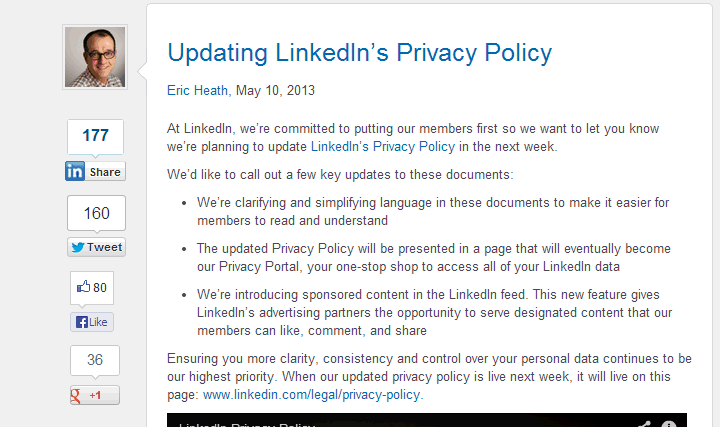
I’ve really enjoyed your ongoing coverage of the spread of sponsored content throughout online media. Well here’s a screen shot from new updates to the LinkedIn Privacy Policy / User Agreement:

1C038680

The third bullet point reads:

We’re introducing sponsored content in the LinkedIn feed. This new feature gives LinkedIn’s advertising partners the opportunity to serve designated content that our members can like, comment, and share.

And just when I thought the LinkedIn feed articles couldn’t get any worse …

The Rebirth Of Catholicism, Ctd

VATICAN-POPE-AUDIENCE

A reader responds to the incredible interview with Pope Francis released today:

After reading the Pope’s remarkable interview, I noticed that James Martin, an editor at America and himself a Jesuit priest, had a short companion piece about preparing the interview for publication. This comment jumped out at me:

Our review process was somewhere between editing and spiritual reading.  One editor said that it was the first time she ever found herself in tears over a galley.

What a testament to the power of the Pope’s words – “in tears over a galley.” I felt much the same way reading it, disarmed from the very start by the sincerity of his own declaration of sinfulness, and moved by how clearly he feels the mercy of Jesus in his own life. You can tell this was not a perfunctory concession, like saying, well, nobody is perfect. His humility, his hesitation to judge, his approach to the life of the Church – all stem from the posture established in the first question: “Who is Jorge Mario Bergoglio?” His reply? “I am a sinner whom the Lord has looked upon.”

There is so much to say about this interview – who knew he loves Dostoevsky and Hopkins? – but this passage in particular struck me as worth noting:

“I see clearly … that the thing the church needs most today is the ability to heal wounds and to warm the hearts of the faithful; it needs nearness, proximity. I see the church as a field hospital after battle. It is useless to ask a seriously injured person if he has high cholesterol and about the level of his blood sugars! You have to heal his wounds. Then we can talk about everything else. Heal the wounds, heal the wounds…. And you have to start from the ground up.

“The church sometimes has locked itself up in small things, in small-minded rules. The most important thing is the first proclamation: Jesus Christ has saved you. And the ministers of the church must be ministers of mercy above all.

There is so much suffering in the world, so much pain – not just because of war and poverty, but through depression and loneliness, broken homes and strained families. The message of forgiveness and mercy brought by Jesus, the simple words, “God is Love,” seem more needed, more fresh and powerful, than ever. The pain I feel at seeing the Church, and Christianity more broadly, turned into an adjacency of the culture wars and mainly understood as the purveyor of backwards, spite-filled moralizing, is because, as Francis argues, the Church should be “a field hospital after battle.” The Church should be a refuge, a place for the walking wounded to stumble into and receive love and mercy and care, without preconditions or expectations. As he puts it, you heal wounds, then you can talk about everything else. You lead with love, not legalism. I imagine Francis, smiling as he does, holding his arms open and saying, “Jesus has saved you, you are loved, come join us!” People need to know that when they walk through church doors, they are loved unconditionally. That it is a safe place, a place where there only is grace, where they are met exactly where they are, joined not by their moral superiors, but by fellow sufferers and sinners – people as much the casualty of the battled called life as they are.

The world needs Christianity, the message of Jesus, more than ever. You can see and feel it everywhere – people, young people especially, are hungry for meaning, are desperate for kindness in a world of strife. I’m amazed at how Pope Francis has met this moment, has felt and responded to this need. I don’t know when, or if, the Church will shift its position on, say, homosexuality. I think the Church will change, and I think Francis knows you can’t change your rhetoric about the issue this drastically without eventually changing substance, too — the cognitive dissonance is just too great. But that, really, is a secondary issue. “We can talk about everything else.” Or, as Francis said, “You have to start from the ground up.” What is that ground? Jesus himself, Love incarnate, friend to the sinner and outcast. That is the real story of Francis – his recognition that first things must be put first, that if the Church becomes a hospital for the wounded, a place of love and healing, then everything else will come in time. How Francis beautifully puts it:

I dream of a church that is a mother and shepherdess. The church’s ministers must be merciful, take responsibility for the people and accompany them like the good Samaritan, who washes, cleans and raises up his neighbor. This is pure Gospel. God is greater than sin. The structural and organizational reforms are secondary—that is, they come afterward. The first reform must be the attitude. The ministers of the Gospel must be people who can warm the hearts of the people, who walk through the dark night with them, who know how to dialogue and to descend themselves into their people’s night, into the darkness, but without getting lost.

This is a man with his priorities straight – and the powerful response to that so far shows us, I think, just how much the message of Jesus, the “pure Gospel,” continues to fascinate and resonate, meeting human beings at the places of their deepest longings, needs, and hopes.

(Photo: Pope Francis smiles after his weekly general audience in St Peter’s square at the Vatican on June 12, 2013. By Alberto Pizzoli/AFP/Getty Images)

The Rebirth Of Catholicism

K43692CARAVAG 1

I am, I must confess, still reeling from Pope Francis’ new, lengthy and remarkable interview. I can barely believe that these words – so redolent of Jesus’ – are coming from the new Bishop of Rome, after so long an absence. Although the Pope is unfailingly respectful of his predecessor, let no one doubt the sharpness of Francis’ turn away from the dead end of Benedict. His message is as different as the context. Where Benedict, draped in ornate vestments, spoke from the grand edifice of the Vatican, Francis is in the same simple hostel in which he was ensconced during the Papal Conclave. Why?

Community. I was always looking for a community. I did not see myself as a priest on my own. I need a community. And you can tell this by the fact that I am here in Santa Marta. At the time of the conclave I lived in Room 207. (The rooms were assigned by drawing lots.) This room where we are now was a guest room. I chose to live here, in Room 201, because when I took possession of the papal apartment, inside myself I distinctly heard a ‘no.’ The papal apartment in the Apostolic Palace is not luxurious. It is old, tastefully decorated and large, but not luxurious. But in the end it is like an inverted funnel. It is big and spacious, but the entrance is really tight. People can come only in dribs and drabs, and I cannot live without people. I need to live my life with others.

An inverted funnel, which he now wants open to the world and to his fellow human beings. And there is throughout a premise of humility, doubt, mystery, openness to new things. How many times have you heard a Pope be as self-critical in retrospect as this:

My authoritarian and quick manner of making decisions led me to have serious problems and to be accused of being ultraconservative. I lived a time of great interior crisis when I was in Cordova. To be sure, I have never been like Blessed Imelda [a goody-goody], but I have never been a right-winger. It was my authoritarian way of making decisions that created problems.

And when at the outset of the interviews he is asked simply who he is, he replies

I am a sinner. This is the most accurate definition. It is not a figure of speech, a literary genre. I am a sinner.

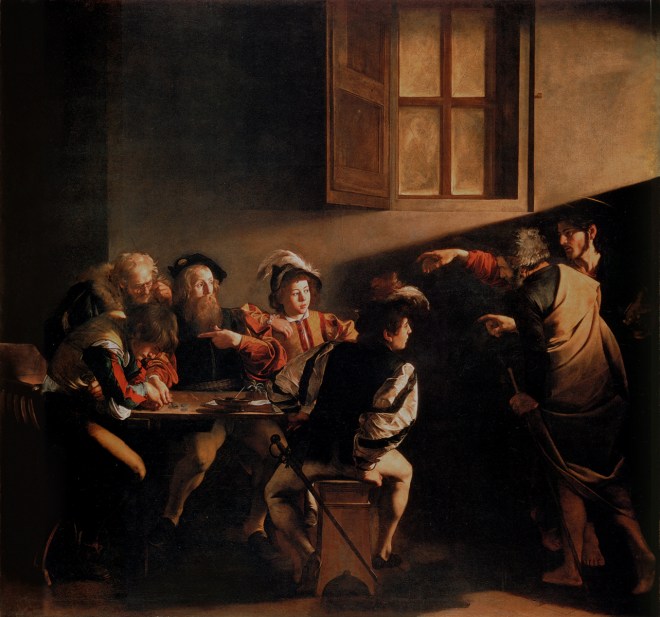
He speaks of Carravagio’s painting ‘The Calling of St. Matthew” (see above):

That finger of Jesus, pointing at Matthew. That’s me. I feel like him. Like Matthew. It is the gesture of Matthew that strikes me: he holds on to his money as if to say, ‘No, not me! No, this money is mine.’ Here, this is me, a sinner on whom the Lord has turned his gaze.

But, for me, the most powerful argument Francis makes is about what Christianity is. It is not, in the end, about certainty. It is about faith as alive and open in doubt:

In this quest to seek and find God in all things there is still an area of uncertainty. There must be. If a person says that he met God with total certainty and is not touched by a margin of uncertainty, then this is not good. For me, this is an important key. If one has the answers to all the questions—that is the proof that God is not with him. It means that he is a false prophet using religion for himself. The great leaders of the people of God, like Moses, have always left room for doubt. You must leave room for the Lord, not for our certainties; we must be humble. Uncertainty is in every true discernment that is open to finding confirmation in spiritual consolation.

Our life is not given to us like an opera libretto, in which all is written down; but it means going, walking, doing, searching, seeing … We must enter into the adventure of the quest for meeting God; we must let God search and encounter us.

This profound mystery – that as soon as we claim certainty about the nature of God, we have lost the meaning of the nature of God – is at the heart of a Christian’s openness to the divine. Now think of this in contrast to the unrelenting fixation of John Paul II and Benedict XVI on enforcing total uniformity in even the tiniest details of sometimes esoteric doctrine, to banish debate entirely, to assert with more and more rigidity the impermissibility of dissent or doubt among the people of God. In the end, that rigidity is a neurosis, not a living faith. And to those who argue that a more open view of faith-in-doubt is tantamount to anarchy, to relativism, even to nihilism, Francis has a simple answer. No, it is not necessarily about these things, although they remain dangers. What makes all this work is what the Jesuits have long called “discernment.”

The wisdom of discernment redeems the necessary ambiguity of life and helps us find the most appropriate means, which do not always coincide with what looks great and strong. The Society of Jesus can be described only in narrative form. Only in narrative form do you discern, not in a philosophical or theological explanation, which allows you rather to discuss … The mystical dimension of discernment never defines its edges and does not complete the thought. The Jesuit must be a person whose thought is incomplete, in the sense of open-ended thinking.

Faith is not in the head; it is in the soul and heart and body. It is our acting in the world, not our debating the finer parts of infallible doctrine in an “inverted funnel”. And look how Francis uses the term “infallible.” He uses it not to refer to the papacy, but to the people of God, you and me, and not in terms of possession of the truth, but rather the open search for it:

The church is the people of God on the journey through history, with joys and sorrows. Thinking with the church, therefore, is my way of being a part of this people. And all the faithful, considered as a whole, are infallible in matters of belief, and the people display this infallibilitas in credendo, this infallibility in believing, through a supernatural sense of the faith of all the people walking together. This is what I understand today as the ‘thinking with the church’ of which St. Ignatius speaks. When the dialogue among the people and the bishops and the pope goes down this road and is genuine, then it is assisted by the Holy Spirit. So this thinking with the church does not concern theologians only.

This is the core message of the Second Vatican Council that John Paul II and Benedict XVI did their utmost to turn back in favor of papal authority. The hierarchy is not the whole church, just a part of it, in community with all the faithful. And he uses the example of the Blessed Virgin to buttress his point:

This is how it is with Mary: If you want to know who she is, you ask theologians; if you want to know how to love her, you have to ask the people. In turn, Mary loved Jesus with the heart of the people, as we read in the Magnificat. We should not even think, therefore, that ‘thinking with the church’ means only thinking with the hierarchy of the church.

And how we live is the only true expression of what we believe. Here is the rebuke to the theocons and their project:

If the Christian is a restorationist, a legalist, if he wants everything clear and safe, then he will find nothing. Tradition and memory of the past must help us to have the courage to open up new areas to God. Those who today always look for disciplinarian solutions, those who long for an exaggerated doctrinal ‘security,’ those who stubbornly try to recover a past that no longer exists­—they have a static and inward-directed view of things. In this way, faith becomes an ideology among other ideologies.

And where is real faith?

I see the holiness in the patience of the people of God: a woman who is raising children, a man who works to bring home the bread, the sick, the elderly priests who have so many wounds but have a smile on their faces because they served the Lord, the sisters who work hard and live a hidden sanctity. This is for me the common sanctity. I often associate sanctity with patience: not only patience as hypomoné [the New Testament Greek word], taking charge of the events and circumstances of life, but also as a constancy in going forward, day by day. This is the sanctity of the militant church also mentioned by St. Ignatius. This was the sanctity of my parents: my dad, my mom, my grandmother Rosa who loved ​​me so much. In my breviary I have the last will of my grandmother Rosa, and I read it often. For me it is like a prayer. She is a saint who has suffered so much, also spiritually, and yet always went forward with courage.

My own beloved grandmother was a saint of a similar kind. I learned so much about Jesus from simply observing her. She lived a hard life, the seventh of thirteen children raising four of her own with no formal education and earning money cleaning the houses of priests. I can never forget her reaching down on the sidewalks to pick up cigarette butts and teasing the last tobacco out of them to make a new one for her disabled husband. I remember her simple warmth and love for me. I recall watching her get lost in the Rosary at Mass – and realizing that however much education I ever got – more than she could comprehend – none of it could give me the faith she had and lived so effortlessly.

I hear her faith in the words of this new Pope: a faith of simplicity and openness, a faith that caused her not to live in the past or future, but now. As Francis says:

There is a temptation to seek God in the past or in a possible future. God is certainly in the past because we can see the footprints. And God is also in the future as a promise. But the ‘concrete’ God, so to speak, is today … We must not focus on occupying the spaces where power is exercised, but rather on starting long-run historical processes. We must initiate processes rather than occupy spaces…  Our life is not given to us like an opera libretto, in which all is written down; but it means going, walking, doing, searching, seeing…. We must enter into the adventure of the quest for meeting God; we must let God search and encounter us. Because God is first; God is always first and makes the first move.

And it seems that God has again made His move in a world that desperately needs Him; and His new servant, his new prophet, is Francis.


Jimenez’s Dangerous Sources

In our latest video from the author of The Book Of Matt: Hidden Truths About the Murder of Matthew Shepard, he defends the use of anonymous sources in his book, given how perilous the drug underworld can be:

https://vimeo.com/74883426/

A reader dissents over the series:

I’m a big fan, but I’m also fascinated (and slightly disturbed) by your aversion to hate crime laws and your recent advertising campaign for The Book of Matthew. I think your readers deserve to know: Have you ever been minding your own business, hanging out on the sidewalk, talking with friends at the end of a fun night out, and had a complete stranger walk up to you and punch your fucking lights out just for being a faggot? How many Saturday nights have you spent in Meridian, Mississippi, or Albuquerque, or Cleveland? Not everyone gets to pedal around all summer in the “A-Gay” cocoon of P-Town. For countless LGBT people living in small-town America, being yourself means risking your life. Hate crime laws are not perfect, but they are a deterrent. For you to argue otherwise is classic homocon elitism.

I don’t believe in arguing from a single personal incident. But yes, I was “gay-bashed” once, though not seriously. Just rushed by a group of young Hispanic men in Adams Morgan a decade or so ago, knocked over, kicked a little, jeered at, and then left. I wasn’t seriously hurt. My view is that the right approach to hate crimes like that, and much more serious ones, is to enforce the existing law against assault. It is already illegal to bash someone for any reason. And recall that in Shepard’s case, the two perpetrators of the crime are serving life-sentences without parole – in a state that had no hate crime laws on the books. For hate crime supporters, that’s an extremely inconvenient fact. And yet they spent the next decade raising gobs of money arguing that hate crime laws was the only way to bring gay-bashers to justice. Another reader:

The death and destruction of the AIDS pandemic led to a period of PTSD and deep mourning and even survivors’ guilt in the community. Gay men of a certain age tried to reach back to a pre-AIDs world to experience what they had “missed” and the drug at hand was meth.  If the Matthew/meth connection had been better known at the time, it would merely have created a new backlash against an already devastated community by the wider world, which was already comfortable with blaming gay men for their “decadence.”

Should the historical record be changed? Certainly. Was it a tragic missed opportunity to have aired the dirty laundry in the 1990s? Unlikely.

This kind of defensive, cowed argument for deliberate lying is exactly what I think civil rights movements should avoid. I think Shepard deserves better than that. And it’s not “dirty laundry”. It’s simply a very relevant fact in the tragedy. And if we had seen  the role of meth up close earlier, we may even have been galvanized to tackle the meth epidemic more aggressively sooner – saving countless lives, careers and relationships.

How Frequent Are Mass Shootings?

Screen Shot 2013-09-19 at 12.29.57 AM

A reader writes:

During your participation in last night’s AC360 Later, Emily Miller took issue with Anne-Marie Slaughter when she said there have been mass shootings “every couple of months” since Newtown, to which Miller countered strongly by saying that was not factual.

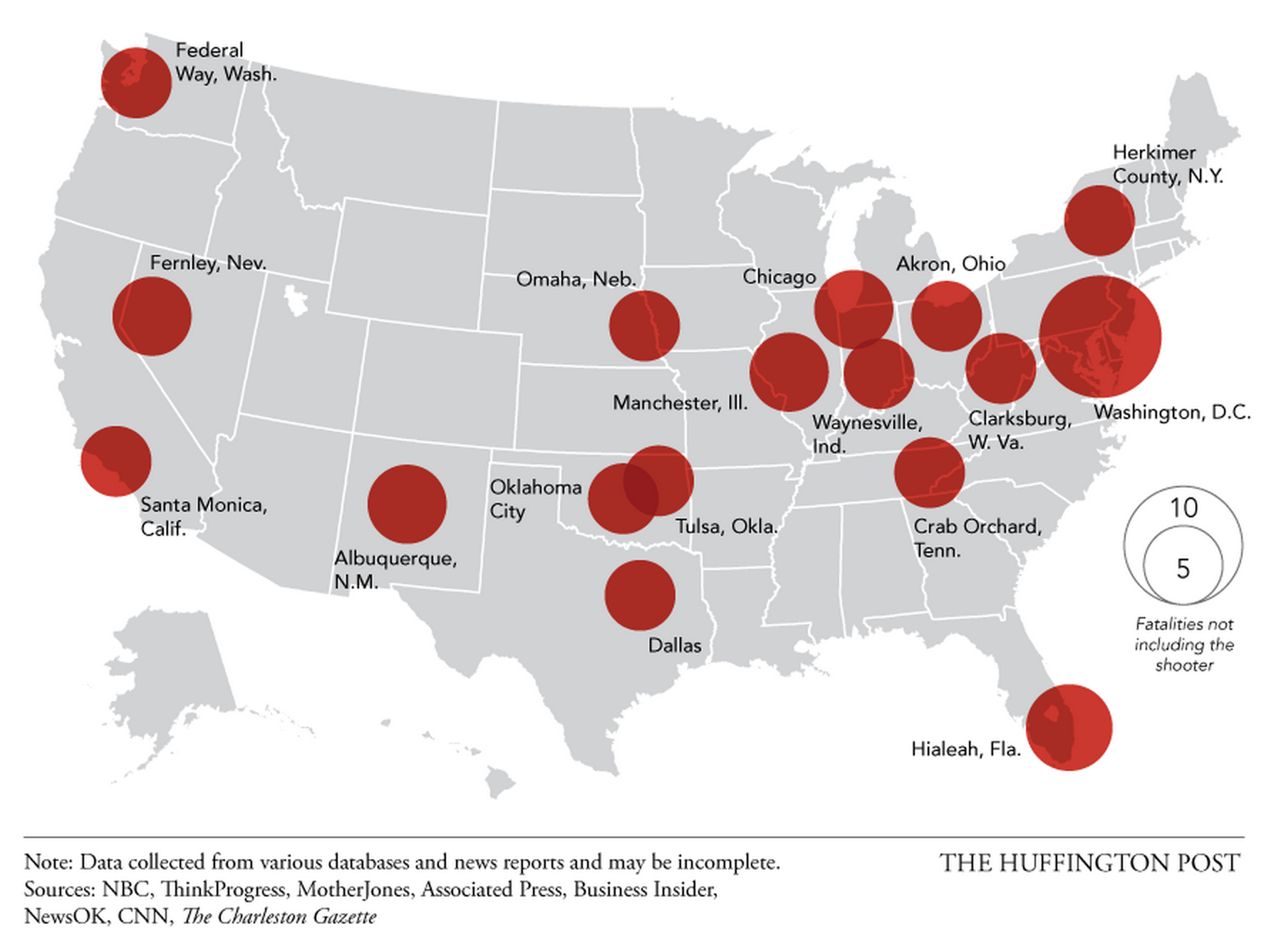
Here are the facts. According to an investigation by Emily Thomas (published yesterday, coincidentally), there have been “at least” 17 mass shootings in 2013 alone [defined by the FBI standard of four victims or more]. So not only is it factually accurate to say there have been mass shootings “every couple of months”, it’s factually MORE accurate to say there have been mass shootings every couple of weeks. In fact, Monday’s tragic Navy Yard shooting was the second mass shooting in September alone, and the month’s not even over. So, as a matter of fact, Anne-Marie was right and Emily was wrong. Chilling graphic here.

Paul Campos looks at a different standard over a longer period of time:

[Looking at shootings in which at least 14 victims died], it turns out that the rate of this type of mass shooting in America was nearly twice as high in the 25 years between 1966 and 1991 as it has been in the 22 years since (there were four such shootings in the former period, and two in the latter). Or we could use the FBI’s definition of a mass shooting: one in which at least four people, not including the perpetrator, are killed. This is a vastly larger category … : there were about 600 such incidents in the United States between 1980 and 2010.  As James Alan Fox, a professor of criminology at Northeastern University points out, the rate of such mass shootings does not appear to be rising

Another reader comments on a related post:

I agree with most of what Frum says about some moderate gun regulations based on personal behavior, but then he crosses into crazy land, both in terms of policy and politics. There are approximately 16,000 homicides each year in the US, 11,000 involving a gun.  How many of those deaths are the result of mass shootings?  Less than 100*. So when Frum says, “The classes of weapons associated with mass casualty shooting could be more strictly controlled,” he is basing a policy decision on a class of homicide that represent only .625% of all homicides.

In my class on risk assessment 20 years ago, this would be called example bias.  Mass shootings are traumatic, random events with huge media coverage that also happen to be very rare when compared to boring, and common, shootings related to criminal activities.  People will incorrectly claim that more people die in fires than in drownings for the same reason – the media covers fires because they are visual, and most people find dying in a fire more horrific than drowning.  Mass shootings are an edge case.  I would be fired as an engineer if I had a large problem to solve and I spent time obsessing on an edge case.

From a political point of view, spending time on the modern sporting rifle ban (technically they are not assault rifles because they cannot fire in fully automatic) is a bad idea not only because the votes do not exist but because the slippery slope arguments stops being crazy if the opposition walks up to the line and leans as far over that line as they can without crossing it.  Banning a gun is as close as you can get to taking guns as you can get.  Nothing riles up the pro-gun base more than the thought of people taking their guns, so even mentioning a ban is close enough to confiscation that you might as well be saying that you will take their guns.

So a word of advice for the gun-control crowd: never mention a gun ban again if you want to pass something like universal background checks that have a chance of actually saving a significant number of lives.  It ain’t gonna happen, and it will likely torpedo any chance of getting any other gun regulation.

*The FBI defines a mass shooting as one involving 4 or more deaths, committed within a 24hr period at a single location not related to criminal activity.  2012 was an exceptional year for mass shootings and exceeded 100, but generally it’s less than 100.

The above map by Jan Diehm is also based on that FBI standard for mass shootings.

A Civil War Within A Civil War, Ctd

Keating relays the latest from Syria:

Today brings news that the Islamic State of Iraq and the Levant, an al Qaeda-affiliated group, has overrun a town near the Turkish border after fighting with the western-backed Free Syrian Army. The development highlights the fact that the Syrian war is not a two-actor conflict anymore. As Time’s Aryn Baker put it a few days ago, “For the past several months rebel groups aligned with ISIS in Aleppo province have spent nearly as much energy battling factions serving under the umbrella of the Western-leaning Free Syrian Army (FSA) as they have fighting the [Assad] regime”.

Fisher analyzes the rebel-on-rebel violence:

Some analysts might be tempted to see a silver lining here.

The United States has long been wary of giving Syrian rebels much support because it doesn’t want to aid the al-Qaeda-allied ISIS, and it’s really tough to aid one rebel group without indirectly helping another. If the FSA and ISIS divorce, that would theoretically make it much easier for the United States and other Western countries to back the FSA without worrying about indirectly helping al-Qaeda. Indeed, as the FSA inevitably loses ground to ISIS, it could be an imperative. If you think that a stronger FSA is in Syria’s interests, either because you want to see the rebels win outright or just to balance the battlefield enough to convince Assad that he can’t win and should cut a negotiated peace deal, then it’s potentially good news that the United States might feel freer to give the FSA a boost.

It wouldn’t be Syria unless even the good news were also bad news, though. The United States has seen this movie before, in Afghanistan. During the 1980s, the United States backed its favored Afghan rebel groups to oust the Soviet military occupation. After the Soviets left, those rebel groups fought among one another, a second war that proved even worse than the first. Because chaos and militancy tend to breed extremism, the group that emerged from Afghanistan’s chaos was the Taliban.

Previous coverage here.

What The Fed Said

Drum translates yesterday’s Fed decision to continue monetary stimulus:

The bottom line is simple: If Republicans really want to see monetary policy get back to normal, they need to stop sabotaging the economy with spending cuts and debt ceiling debacles. If they do that, the recovery will strengthen and the Fed will no longer be forced to sustain loose monetary policy as a way of offsetting stupid fiscal policy.

Soltas weighs in:

Here’s the most important thing anybody can tell you about the taper: It’s not the taper that matters, but the signal the taper sends. By the same logic, the Federal Reserve’s decision today to delay the taper matters little on its own. What counts for everything is the signal: This Fed is committed to restoring vigorous economic growth.

Wolfers argues that the “whole taper debate is one that should never have happened” and that it’s “the result of a failed communication strategy”:

Think back to the June press conference, and you’ll recall Chairman Bernanke signaled that the Fed was thinking about tapering quantitative easing. Taper-talk came to dominate the financial headlines, and a monetary meme was quickly born. The result — as I pointed out at the time–was that markets over-reacted, interpreting the Fed as being less committed to easy monetary policy in the longer run. Long-term interest rates rose, mortgage rates rose, financial conditions tightened. All of this was the result of a needless miscommunication.

Salmon was impressed by the market’s reaction:

If QE does no good, then you might as well not do it. But the lesson we learned on Thursday is that the markets really, really love QE. And insofar as robust markets feed through into a healthier economy, the logical conclusion is that we should retain current policy well into 2014. The downside is limited — and the upside is much bigger than we thought it was.

Barro’s bottom line:

The story of the last five years continues: Fiscal policymakers screw everything up, and the monetary policy authority is the only thing that works. For a guy who’s basically been singlehandedly been keeping the U.S. out of recession, people sure give Ben Bernanke a lot of crap.

A Republican Plan For Working Families?

Reihan calls Republican Senator Mike Lee’s tax plan “the most promising development in Republican domestic policy in years.” His column explains why he supports the plan:

[T]he heart of the proposal is a new $2,500 per-child tax credit, which can be used to offset payroll taxes as well as income taxes. This is on top of the existing $1,000 child tax credit, which Lee leaves in place, along with a number of other tax benefits for low-income parents. In one stroke, large numbers of middle-income households with children will be removed from the federal income tax rolls altogether.

Lee argues that the current tax code unfairly punishes parents. The solvency of pay-as-you-go entitlement programs like Social Security depends on a steady stream of well-educated new workers. Alas, these new workers do not materialize from thin air. Parents invest considerable time and effort in educating their children and making them workforce-ready. Yet those of us who choose not to raise children are entitled to the same Social Security benefits as those of us who do choose to raise children, and who make enormous sacrifices in the process. Lee’s new per-child tax credit is designed to reduce this bias against parenting, which he describes as an investment in human capital at least as important as the investments savers make in their 401(k)s.

W. Bradford Wilcox also focuses on this feature of the plan:

As sociologist Andrew Cherlin and I wrote in a recent policy brief for the Brookings Institution, a policy move like this is likely to: “increase marriage rates and marital stability among low- and moderate-income families who would benefit from the economic security such a policy would provide to their family finances. It would also signal to them that the nation values the parental investments they are making in the next generation, who—it should be noted—will be helping cover the cost of Social Security and Medicare in the near future.” Indeed, experimental efforts to boost the income of working parents in Minnesota and Wisconsin have been linked to higher marriage rates and lower divorce rates among low-income couples.

Barro praises the plan but takes issue with some of the arguments above:

It seems to me that every generation is, by definition, fiscally neutral: Your kid who will be paying Social Security taxes in 40 years will be attending public school in 10 years and collecting Social Security in 70 years. I don’t really owe you anything, fiscally, for the fact you chose to raise a child.

That said, I favor higher child tax credits for a different and simpler reason: A family of four with an income of $100,000 has a significantly lower standard of living than a family of two with an income of $100,000 and therefore should not be expected to pay as much in tax. I’m with Lee on the policy end even if we don’t agree on the exact rationale.

Drum isn’t a fan of the plan:

[H]is plan leaves the current low capital gains rates and estate tax rates alone (good for the rich) and leaves the current high payroll taxes alone as well (bad for the poor). Put this all together, and the almost certain outcome is that the middle class would pay a little less; the upper middle class would pay somewhat more; and the rich would enjoy a big tax cut. In other words, it’s a pretty standard Republican plan.

Dylan Matthews assesses the plan:

There’s still a lot we don’t know about the plan, like how much revenue it’ll raise (Lee’s aiming for 18-20 percent of GDP but the Joint Committee on Taxation’s score will tell the tale) or its actual distributional outcome (hopefully the Tax Policy Center will run the numbers on that). But since the new child credit would probably increase the number of families not paying any income taxes, it’s an interesting proposal for a Republican to make.

And Yglesias, after discovering the he would get a tax break under Lee’s plan, wants Lee’s numbers to get double-checked:

Now if it’s actually true that you can meet all of Mike Lee’s goals consistent with giving me a small tax cut, then good for him. But I’m suspicious that what we’ve got here is simply a tax plan that doesn’t add up. If Lee wants to collect accolades for this plan, he’s going to need to get it rigorously scored by someone credible.