McCain First, Country Last

US-SYRIA-CONFLICT-CONGRESS

The man who crashed in the 2000 primaries, the man who acquiesced to CIA torture (the same methods once used on him) in 2006, the man who claimed to put country first in 2008 and then impetuously picked an unstable half-wit as a veep candidate, the man who wanted to launch a war with Russia over Georgia, and the man who has spent the last five years actively trying to undermine the president’s foreign policy when visiting Israel … well, we should expect stupid amateurish displays of ego like an op-ed in the wrong Pravda.

Yes, it was the wrong Pravda, one founded online in 1999 and not connected to the other Pravda founded in 1912. But McCain is not exactly known for his precision, is he? And at a moment when the US needs to keep relations with Russia stable – because Russia is critical to controlling and destroying Assad’s chemical weapons – McCain lobs a rhetorical hand-grenade at the Kremlin.

What on earth is the point of it? One assumes a riposte to Putin’s op-ed in the New York Times (unlike McCain, Putin didn’t mistakenly put his op-ed on Newsmax). And then you read it and you see the fathomless parochialism that has always clung to this vain, impetuous grandstander. He actually claims he has long been pro-Russia, something so transparently false it is perhaps appropriate it appears in an online outlet with the name of a paper, “Truth”, that became a synonym for its opposite. McCain has been itching for a war with Russia ever since the Cold War ended. But then he itches for war three times before lunch most days.

But this pointlessly provocative op-ed is also obviously serving a purpose. McCain wants the US to go to war in Syria in order to achieve regime change. For him, remember, Iraq was a huge success. Now that he has been stymied in this effort – stymied by the president and the Congress and a huge majority of the American people, 79 percent of whom back the US-Russia agreement – he has decided to try and sabotage it. Think for a minute how important it is right now to retain decent relations with Putin and Lavrov in the attempt to secure and destroy Assad’s chemical weapons. Now read these words:

How has [Putin] strengthened Russia’s international stature? By allying Russia with some of the world’s most offensive and threatening tyrannies. By supporting a Syrian regime that is murdering tens of thousands of its own people to remain in power and by blocking the United Nations from even condemning its atrocities. By refusing to consider the massacre of innocents, the plight of millions of refugees, the growing prospect of a conflagration that engulfs other countries in its flames an appropriate subject for the world’s attention. He is not enhancing Russia’s global reputation. He is destroying it. He has made her a friend to tyrants and an enemy to the oppressed, and untrusted by nations that seek to build a safer, more peaceful and prosperous world.

These sentences could have been written a month ago. There is truth to them – but as a matter of simple pragmatic judgment in this tricky period, could any such rant be more reckless? Directly and personally impugning the president of Russia in a Russian media outlet is the act of an impulsive ego-maniac who is perfectly willing to sabotage his own country’s recent deal with Putin to get some publicity for himself.

McCain First, Country Last, War Forever. That’s his motto. After the last ten years, it isn’t just repellent. It’s recklessly dangerous.

(Photo: Senator John McCain listens during a hearing of the Senate Foreign Relations Committee on Capitol Hill September 3, 2013 in Washington, DC. By Brendan Smialowski/Getty.)


How Long Can Humans Live?

Google just launched a biotech company, Calico, to combat disease and dramatically extend longevity:

Calico will trying and take a different perspective on medical research by focusing on by using data analysis to solve existing problems. Take cancer, for instance. Cancer kills roughly 7.6 million people per year, according to the Center for Disease Control, and despite millions of dollars poured into research a cure remains elusive. Cancer is a small project in Calico’s greater plan for things. “One of the things I thought was amazing is that if you solve cancer, you’d add about three years to people’s average life expectancy,” Page told Time. “We think of solving cancer as this huge thing that’ll totally change the world. But when you really take a step back and look at it, yeah, there are many, many tragic cases of cancer, and it’s very, very sad, but in the aggregate, it’s not as big an advance as you might think.”

Aubrey de Grey suspects the new company is a turning point:

The “beginning of the beginning” of the war on aging  began in the 1990s. Since then, the battle for hearts and minds as to that quest’s feasibility—especially among the high-profile academics who occupy the pinnacle of opinion-formation—has been proceeding at full tilt. With Google’s decision to direct its astronomical resources to a concerted assault on aging, that battle may have been transcended: once financial limitations are removed, curmudgeons no longer matter.

Sonia Arrison looks at the economic impact of longer and longer lives:

As people work longer and spend money longer, the economy will grow. Health begets wealth, and according to University of Chicago economists Kevin Murphy and Robert Topel, gains in life expectancy over the last decade (30 years) are worth over $1.2 million to the current population. They also found that “from 1970 to 2000, gains in life expectancy added about $3.2 trillion per year to national wealth.” While these numbers are staggering, what might be more important is the issue of longevity gains as a competitive advantage.

In a paper titled “The Health and Wealth of Nations,” Harvard economist David Bloom and Queen’s University economist David Canning explain that, based on the available research, if there are “two countries that are identical in all respects, except that one has a five-year advantage in life expectancy,” then the “real income per capita in the healthier country will grow 0.3–0.5% per year faster than in its less healthy counterpart.” These percentages might look small, but they are actually quite significant, since it is known that between 1965 and 1990 countries experienced an average per capita income growth of 2% per year, and Bloom and Canning’s numbers are based on only a five-year longevity advantage. If a country had a 30 or 50-year advantage then having a longer-lived population could generate enormous differences in economic prosperity.

What Wright Got Wrong

James Seaton unravels what Richard Wright was up to in Native Son:

[He] did not want his readers, certainly not his white readers, to sympathize or identify with Bigger Thomas. He did not want bankers’ daughters or anybody else to “weep over” his protagonist. He was determined to shock, frighten, and disturb. He wanted his readers to fear the possibility that they might someday run into a Bigger Thomas, whose “every thought” is “potential murder.” Wright wanted to scare his audience into considering what they otherwise would not accept, that they could never consider themselves truly safe until the United States underwent a radical transformation, specifically a revolution led by the Communist party.

In retrospect, it seems clear that the Richard Wright who wrote Native Son was wrong about many things.

In “How ‘Bigger’ Was Born,” he condemned almost all aspects of black culture and achievement as irrelevant to the reality of undeclared war. He rejected the black church as escapist,  disparaged those who, like the NAACP, “employed a thousand ruses and stratagems of struggle to win their rights,” and dismissed black singers and musicians who “projected their hurts and longings into more naïve and mundane forms—blues, jazz, swing—and, without intellectual guidance, tried to build up a compensatory nourishment for themselves.”

Those first readers of Native Son who accepted the novel as an accurate portrayal of the black experience would have been unprepared for the legal triumph of the NAACP in Brown v. Board of Education (1954) and other such cases, and entirely surprised by the leadership role of the black church in the struggle for civil rights, demonstrated most strikingly, but by no means exclusively, in the career of Martin Luther King Jr. And from the perspective of the 21st century, the folly of Wright’s denigration of the art of composers like Duke Ellington and Billy Strayhorn, musicians like Coleman Hawkins and Louis Armstrong, and singers like Bessie Smith and Billie Holiday as “naïve and mundane” is even more obvious than it was in 1940.

Making Your Characters Contain Multitudes

The novelist Paul Harding praises John Cheever’s short story, “The Jewels of the Cabots,” for teaching him how to write characters with convoluted and contradictory inner lives:

Cheever is a writer who helped teach me to think about characters like a sphere: You’ve got the north pole and the south pole, a polarity with opposite charges contained inside one whole. But then there’s these magnetic fields created between the two of them, which is where the real complexity is, where the real intermingling of those contradictory impulses take shape.

So I strive for these polarities in my own work. You have to be careful that you’re not dogmatic or schematic about it. But the more I think about it, I’m aware that—in all art forms—contradiction is the essential move or method for art.

In music it’s counterpoint. In landscape painting it’s the contrast between the foreground, which is always dark, and the background, which is light. And in writing, it’s death and life. The imminent arrival of death—what greater thing to set life in relief against? In Enon, the whole thing is just a sonata—it’s just one voice—against the threat of utter darkness. The darker it gets, when we arrives at just one remaining pinpoint of light, that pinpoint becomes all the more beautiful and resplendent for its rarity and clarity against the gloom. You put contradictory things next to each other, and in the intermingling of them you get something like the mystery of human experience.

When America Almost Nuked Itself

Michael Mechanic calls Eric Schlosser’s new book on nuclear weapons accidents “the most unsettling work of nonfiction I’ve ever read”:

Here’s the truth: Just days after JFK was sworn in as president, one of the most terrifying weapons in our arsenal was a hair’s breadth from detonating on American soil. It would have pulverized a portion of North Carolina and, given strong northerly winds, could have blanketed East Coast cities (including New York, Baltimore, and Washington, DC) in lethal fallout. The only thing standing between us and an explosion so catastrophic that it would have radically altered the course of history was a simple electronic toggle switch in the cockpit, a part that probably cost a couple of bucks to manufacture and easily could have been undermined by a short circuit—hardly a far-fetched scenario in an electronics-laden airplane that’s breaking apart.

In an interview with Mother Jones, Schlosser describes the extent of the problem:

Throughout the ’50s and ’60s, it was almost boilerplate for Defense Department officials to say that during an accident there was no possibility of a nuclear detonation, while privately, at the weapons laboratories, there were physicists and engineers who were extremely worried and were well aware that we had come close to having it happen on American soil. If you look at the official list of broken arrows that the Pentagon released in the ’80s, it includes 32 serious accidents involving nuclear weapons that might have threatened the public safety. The list is entirely arbitrary: Some of those accidents didn’t even involve weapons that had a nuclear core, so they never could have detonated. But many, many serious accidents aren’t on that list.

One document I got through a Freedom of Information Act request listed more than 1,000 weapons involved in accidents, some of them trivial and some of them not trivial. There’s somebody who worked at the Pentagon who has read this book, and one of his criticisms was that I’m so hard on the Air Force—he said that there were a great number of accidents involving Army weapons that I don’t write about.

In an interview with Rolling Stone, he discusses nuclear safety around the globe:

I am hugely concerned – and people who have more expertise than I do in this area are hugely concerned – about the possibility of terrorists getting ahold of a nuclear weapon, or the possibility of a nuclear weapons accident by one of the nuclear weapons powers. I’m critical of the management of our nuclear weapons, but we invented this technology. I think we probably build the safest weapons on Earth. And yet, when you think of countries like Pakistan and India and North Korea having nuclear weapons, a useful guide would be to look at the rate of industrial accidents in those countries, which is much higher than here, and their ability to manage this incredible, complex technology is really worrisome. People can disagree on what the best policy should be for the United States, but I think everyone should know what the options are and what the real risk is.

A Phone That Reads Your Fingerprint, Ctd

A reader notes:

Stealing fingerprints as shown in your Mythbusters clip will not work for the iPhone. I’m surprised Apple hasn’t publicized this more, given the amount of misinformation out there:

[L]ike the sensor in the iPhone 5S, the sensors that will be in laptops and keyboards and other phones can detect the ridge and valley pattern of your fingerprint not from the layer of dead skin on the outside of your finger (which a fake finger can easily replicate), but from the living layer of skin under the surface of your finger, using an RF [radio frequency] signal. That only works on a live finger; not one that’s been severed from your body. This will protect you from thieves trying to chop off your finger when they mug you for your phone (assuming they’re tech-literate thieves, of course), as well as from people with fake fingers using the fingerprint they lifted from your phone screen.

Another reader:

One of your readers commented that “a password you can remember equates to a password that can be cracked.” This is not necessarily true, especially if you change the paradigm of how we construct passwords.

Randall Munroe of XKCD noted that the normal way we make passwords for our systems is based on requiring a certain number of characters in the password, including requirements for uppercase and lowercase letters, numbers, and punctuation symbols. These kinds of passwords are modestly difficult for computers to crack, and they are rather difficult for humans to remember. This leads people to writing down their passwords, and that’s how the courts can get people to give up their password without violating the 5th Amendment.

A different password strategy altogether flips this script. Instead of requiring a certain number of characters, we could instead require a number of words pulled from the dictionary. These are inherently easier for people to remember. While dictionary words are much easier for a computer algorithm to crack on an individual basis than the complex passwords described above, adding a series of them together dramatically ramps up the difficulty of a computer cracking it while still being very easy for humans to remember. This means people won’t have to write down their passwords, so courts will have to recognize your 5th Amendment right to not give up the contents of your mind.

Regarding another recent thread on iPhone technology:

On that Phoneblok idea, I can assure you that the market will NOT be seeing such a easily-reconfigurable phone anytime soon, if ever.  I am an electrical engineer as well as tech market analyst with expertise in display technology as well as connectivity/interface technologies. Phoneblok appears to be something of an industrial engineer’s dream, but it would be the mechanical and electrical engineer’s nightmare come true.

I’m not saying something similar to the Phoneblok concept is impossible, but I can guarantee you that any such design would be so fraught with inefficiencies and design tradeoffs that just to achieve even a marginal amount of block swapping capability as described that the design would be either too large, too thick, too slow, too-everything that it would be dead on arrival in terms of consumer acceptance (if not simply too expensive in the long run for any OEM to even attempt to build it). In terms of forward compatibility, the rate of change in interface speeds, standards, pinout/interconnect physical design is occurring at a rate that by 3 to 4 years from now, your Phoneblok would likely be obsolete anyway.

The Booze Of The Bourgeoisie

Afshin Molavi sizes up Johnnie Walker’s bid to become the whisky of the global middle class:

It’s uncanny, the ubiquity of the striding Scot and his blended whisky (no “e” for the Scottish 6a00d83451c45669e2015438653bb3970c-550wikind). It’s everywhere, particularly among the upper end of the middle classes that the world’s corporations are chasing. In Thailand, businessmen place a bottle of Black Label on the table before a closing negotiation. In Japan, bottles have become an essential part of the ritualized gift-giving culture. In India, one of Bollywood’s most famous comedians even took the name Johnny Walker. It’s such a status symbol in Asia that Johnnie Walker knockoffs aren’t hard to find. You probably wouldn’t want to serve guests the counterfeit liquor, but the bottle looks good on the mantle.

And in Africa, the newest gold mine of emerging markets, [parent company] Diageo is cultivating a fresh generation of whisky drinkers. In downtown Nairobi, a 20-story billboard of the Striding Man towers alongside a skyscraper. African musicians and athletes have been named “brand ambassadors,” and premium magazines are running a series of print ads that say simply: “Step Up.” As in, step up to a better life, step up to the middle class, step up from that stale beer to a higher state of being: Become a whisky drinker.

Yep, someone we all know must be smiling somewhere.

(Photo by Karin Cooper/Getty Images)

On The Path To A Government Shutdown

TO GO WITH AFP STORY By Otto Bakano -- T

Robert Costa reports that the “the House will soon vote on a continuing resolution that simultaneously funds the federal government and defunds Obamacare.” Altman digests the news:

Why would House Republicans pass a symbolic measure so late in the game? Democratic aides believe it may be the only thing that can get through at the moment. The defund provision buys Boehner breathing room with conservatives, passes the buck to firebrand Senators who have irked GOP leaders by touting an unachievable goal, and, perhaps, forces the Senate to share the blame in the event of a shutdown.

Suderman expects that a shutdown would damage the GOP:

Now, there’s an argument to be made that a government shutdown wouldn’t be so bad. But here’s the thing: A government shutdown wouldn’t stop the implementation of Obamacare, according to the Congressional Research Service. Funding for the implementation process would continue. What a shutdown almost certainly would do is put a lot of public pressure on Republicans to give up and let Democrats take a win—as happened in the 1990s. (The polls on this are pretty clear: The public doesn’t like Obamacare, but they like government shutdowns even less.) And if and when that happens, Republicans stand to lose gains they’ve made on federal spending through the sequestration as well.

Drum predicts what will happen if the government shuts down:

[T]he public, to the apparent surprise of the tea partiers, will run out of patience very quickly.

Democrats will start previewing campaign ads for next year. Phones will ring off the hook. Poll numbers will plummet. Suddenly La Revolución won’t seem quite as much fun anymore. The whole thing will then peter out amid much acrimony and scapegoating while Erick Erickson mutters on his blog about how Republicans can never be trusted to stand their ground in support of true conservatism.

Josh Marshall’s read on the American public:

I don’t think the country’s prepared for a full on government shutdown over Obamacare. Or a full on government shutdown over anything for that matter. I don’t mean the country won’t be able to handle it. I mean, I don’t think anyone is expecting it. The country thinks this stuff ended back in 2011 and 2012 and doesn’t have any real idea we might be about to take another ride on this roller-coaster.

Barro notes that most Republican congressmen don’t want a shutdown:

If you believe the press accounts, there are 30 or 40 House Republicans who won’t vote for a continuing resolution that funds Obamacare. With 30 defections, Speaker John Boehner can’t get what he desperately wants: 217 Republican votes for a bill that protects his key spending priority (maintaining low spending levels from sequestration) while avoiding a fight over Obamacare.

But if 30 to 40 House Republicans won’t vote for a CR that funds Obamacare, that means 190 to 200 of them would vote for such a CR. People talk about the “radicalized House GOP” but on this particular issue, most House Republicans aren’t radicalized. They’ve been dragged into this fight, unwillingly, by Cruz. And that’s why they’re so irritated.

Ezra explains why the GOP can’t round up the necessary votes:

Here’s the Republican Party’s problem, in two sentences: It would be a disaster for the party to shut down the government over Obamacare. But it’s good for every individual Republican politician to support shutting down the government over Obamacare.

These smart-for-one, dumb-for-all problems have a name: Collective-action problems. … The best way to understand the plight of the modern GOP is that the party leadership is no longer powerful enough to solve its collective-action problems.

Collender’s bottom line:

Is it possible that we get to the brink on September 30 at 11 pm and everyone decides that a short-term CR and a cooling off period is needed? Absolutely. Is it as likely this year as it has been in the past? Absolutely not.

A Bold New Network Just Like All The Others

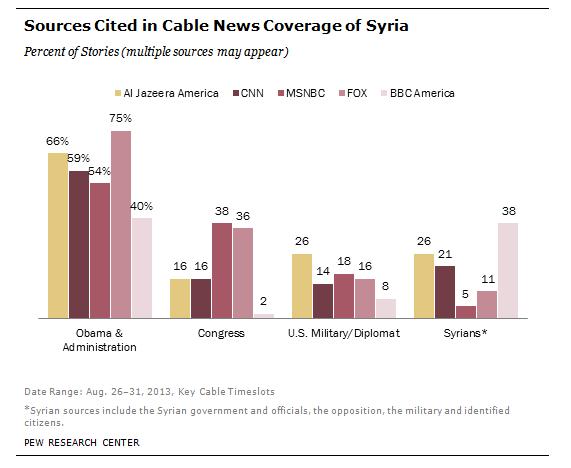
130916_pewgraph2

A new Pew study on Al Jazeera America (AJAM) suggests that the nascent network doesn’t stray far from the cable-news pack:

[A]fter viewing 21 hours of cable news on Syria across five networks, measuring coverage using five metrics, the researchers have arrived at an answer: So far, anyway, Al Jazeera America is more or less CNN – minus Wolf Blitzer, and with a snazzier logo. “The content that Al Jazeera America provided in many ways resembled the coverage on the three major cable competitors” – that is, CNN, Fox News, and MSNBC, Mark Jurkowitz, associate director of the Project for Excellence in Journalism, told Foreign Policy.

AJAM actually reported fewer stories directly from the Middle East than did BBC America or CNN, and it also devoted less airtime to Syrian citizens than either network. Matt Wilstein detects a strategy:

[The study] helped underscore the network’s aim of being a fundamentally American product. While some U.S. viewers may be looking to Al Jazeera America to offer an international perspective not often found on CNN, Fox and MSNBC, for now the network appears happy to broadcast news by and for Americans first.

Arit John sees a waste of potential for what could be a “non-partisan anomaly in this crazy, mixed up liberal-conservative media world”:

The last thing we need is another network putting on the same old song and dance as the other ones, especially to a much smaller audience. But despite our disappointment, AJAM seems pretty happy with the news – they even tweeted about it.

Previous Dish on AJAM here, here and here. Update from a reader:

Being a hard-core supporter of Al Jazeera English (AJE) and its terrific web content (video and essays), I had welcomed the advent of Al Jazeera English (AJA). Imagine my surprise when I received an email in July noting that video content on AJE’s website would no longer be available to those of us who reside in the US.

I didn’t really think about it, as I assumed the new AJA would make a seamless transition (both web and TV based), with the same wonderful international content known and respected on AJE. Big mistake on my part.

I tried to give AJA the benefit of the doubt, I really did. I watched the new cable channel; I checked their website. Sigh. AJA is no clone of AJE. None of the top international reporting; none of the great international video content. In short, AJA is just an expensive clone of the mundane US channels, regurgitating the pablum of the American press – and why on earth would Al Jazeera want to do that? If I want to have my intellect sucked out of my brain, there are already so many options to choose from on American TV.  I (and many others) watched AJE on the web specifically because it wasn’t like those other catatonic-inducing news cable channels.

AJE videos remain blocked in the US. Why? This is what has really stoked my ire: in order to have AJA on US cable TV, Al Jazeera caved to the traditional US cable/ satellite providers and agreed to block AJE web content. It has even managed to block AJE videos on third-party sites. A once-pioneering news organization has in effect drunk the cable KoolAid. They might as well start showing cute cat videos.

Thanks for listening to my diatribe. I tried to vent in emails to AJA, but all I got back were cheery automatic responses that sang the new channels praises. Sigh.

Another reader defends the new network:

An element left out of the “network just like all the others” comparison is that AJAM is 24/7 news, whereas BBC America TV (not radio) only has news on a few times a day. At least that’s true on my cable lineup. So a direct comparison to BBC America TV is kind of phony. You might as well include CBS, which has turned its morning show into a harder-news format, and which I’ve started watching as a result. But the bottom line is that I’m happy to see AJAM as an alternative.

(Graph: Pew Research Center)