How Safe Is Home Birth? Ctd

Laura Helmuth advocates going to the hospital instead:

A meta-analysis of outcomes from home births and hospital births shows that women who give birth at home do have fewer procedures and complications—but their newborns are three times more likely to die. The American College of Obstetricians and Gynecologists advises that hospitals and birthing centers are the safest places to give birth, and they have published guidelines for how to talk pregnant women out of a home birth. Many states are considering or tightening restrictions on midwives and home births, including IdahoNorth CarolinaSouth Carolina, and Indiana, often in response to heartbreaking and infuriating cases of women or infants dying due to incompetent treatment.

But it turns out home birth isn’t as clearly dangerous as I expected.

The Cochrane Collaboration, a highly respected organization that carefully judges medical treatments, analyzed the available evidence—which is admittedly a bit of a mess. (Among other problems, if a home birth delivery goes wrong, the woman has to be rushed to the hospital, where the complicated case may be recorded as a hospital birth rather than a home birth.) But the Cochrane Collaboration concluded that planned home births with low-risk mothers are as safe as hospital births. Once more for emphasis, though: This is only for women who have an extremely low chance of complications and who have access to emergency medical treatment if anything goes wrong.

Details of my own home-birth here. Above is the trailer for the 2008 documentary The Business of Being Born, which champions home-birthing. You can watch the entire film on YouTube. A trailer for the sequel is here.

The Unsound Ear

The Train in the Night is Nick Coleman’s account of hearing loss and music appreciation. From Ben Hamilton’s review of the book:

[E]ventually [Coleman] was diagnosed with sudden neurosensory hearing loss, which, if you’ll excuse the phrase, is even worse than it sounds. Unable even to walk without vomiting, his life became a test of endurance. … Taunted by the “monument” of his record collection, Coleman missed music even as he craved silence. But superstar neurologist Oliver Sacks told him that the “depth” and “spaciousness” which he’d lost could be regained through imagination and memory. “One might expect,” said Sacks, “that such a power, whilst not available (or less available) voluntarily, could occur spontaneously by association with emotion, a memory.”

Hamilton considers what the book suggests about the nature of fandom:

There is inevitably something life-denying about a fan’s addiction to any art form, and Coleman only partially hides from this dilemma.

For him music is a shield, a by-product of hypersensitivity, a symptom of loneliness, and the only way to make sense of life. “I think music was the laboratory in which I learned to contain and then examine emotion,” he writes. This line of thought is followed to its bleakest conclusion: that his obsession was an escape from, rather than a refinement of, reality. But he stops before things can become utterly hopeless. Instead, burdened with what could have been a ruinous impediment, he reaffirms his love of music. It’s just that the damage to his hearing has made it accessible through “pain and exultation” rather than joy and pleasure – pain because of the buzzing mesh through which the melodies must travel; exultation because he can hear anything at all. This may seem like a bitter consolation, but it’s enough to build on. The worst has happened and yet something remains. He hasn’t changed. His body has.

Is It “Street Art” If It’s Legal?

dish_mrbrainwash

RJ Rushmore wonders how online coverage of street art blurs boundaries between “art placed in public space without permission” and perfectly legal “contemporary muralism”:

[I]f you think that “street art” means art placed in public space without permission, it’s pretty clear that street art blogs are not the place to go looking for street art online. But why is that? …

Huge murals captured in the perfect light by professional photographers look great on blogs, regardless of how they look in person. Stickers and wheatpastes captured with an iPhone that look like crap on blogs can stop you in your tracks on the street. And on the street, the work is confronting you, so you’re going to look at it whether it’s Swoon or Mr. Brainwash or someone you’ve never heard of. Online, if you’re like most viewers and see a headline for a blog post along the lines of “Some guy you’ve never heard of who does wheatpastes in a city you’ve never been to,” you’re maybe not so likely to read that post. This may be one reason why street art blogs and general art and culture blogs that cover street art have shifted from covering street art to covering contemporary muralism under the guise of covering street art. …

Or maybe street art just doesn’t mean the same thing that it once did. Maybe mural festivals and the ease of finding legal walls has elevated the genre. Artists can spend days on a mural without worrying about police rather than sneaking around at night and working as quickly as possible. With plentiful legal walls, maybe some artists don’t see the need for working illegally anymore. Can the same goals be achieved at a legal wall as at an illegal spot? I don’t think so, but some may disagree with me.

(Hat tip: Hyperallergic.  Photo of Mr. Brainwash’s work by Flickr user Matt From London)

Enough With The Flashcards

At least according to Ben Orlin, a teacher who wants less memorization in education:

Memorization has enjoyed a surge of defenders recently. They argue that memorization exercises the brain and even fuels deep insights. They say our haste to purge old-school skills-driven teaching from our schools has stranded a generation of students upriver without a paddle. They recommend new apps aiming to make drills fun instead of tedious. Most of all, they complain that rote learning has become taboo, rather than accepted as a healthy part of a balanced scholastic diet.

Certainly, knowledge matters. A head full of facts – even memorized facts – is better than an empty one. But facts enter our heads through many paths – some well-paved, some treacherous.

After pointing to several of those paths, Orlin outlines better ways for “students [to] learn facts, rather than memorize them”:

For example, suppose we’re learning that Maryland fought with the Union during the Civil War. We could invent a mnemonic, like “Maryland starts with ‘marry,’ and a marriage is a union” – cheesy, but fine. Or we could build on other facts. For example, Maryland borders D.C., so if it had seceded, the American capital would have been surrounded by foreign territory. For exactly that reason, Lincoln worked hard to keep Maryland on the side of the North.

What separates memorization from learning is a sense of meaning. When you memorize a fact, it’s arbitrary, interchangeable–it makes no difference to you whether sine of π/2 is one, zero, or a million. But when you learn a fact, it’s bound to others by a web of logic. It could be no other way.

A Disease That Can Spread Through Facebook

Lauren Dimon revisits an apparent outbreak of mass hysteria two years ago, when more than a dozen young women in western New York reported mysterious spasms and tics. After a battery of medical and environmental tests, one high-school student was confirmed to have Tourette’s Syndrome, while the rest, who were classmates, were thought to have unconsciously modeled their illnesses after her. Dimon zeroes in on the only non-student to catch the disease, a 36-year-old woman named Marge who apparently learned of the illness through Facebook:

[Sociologist Robert] Bartholomew said that it’s not unheard of for one or two adults to be affected, but he cannot recall any cases like Marge’s, in which the adults were not intimately involved with the children suffering from the malady. Marge said that she knew about what was going on in town mainly through Facebook postings.

Catching an illness through Facebook sounds wonky. But the contagion of hysteria relies, among many things, upon the unconscious interpretation of what is suggested to us. Fitzsimmons did not even have to be in physical contact with the other girls to “catch” their disease. Marge encapsulates the power of social media to penetrate and trigger actions of the unconscious mind. She marks “a historical shift in terms of the trigger for people being affected and sucked into these cases,” Bartholomew said.

According to Bartholomew, there is “potential for a far greater or global episode, unless we quickly understand how social media is, for the first time, acting as the primary vector or agent of spread for conversion disorder.” He believes that epidemics spread by social media are “inevitable” and that “it’s just a matter of time before we see outbreaks that are not just confined to a single school or factory or even region, but covering a disperse geographical area and causing real social and economic harm.”

That Last Phone You’ll Ever Buy

That’s what the Phoneblok hopes to be:

Ben Richmond is intrigued:

One reason iPhones are rendered steadily and predictably obsolete just months after it debuts heralded as world-changing—is tied intimately to what many like about the iPhone: the attractive and smooth design. Apple’s seamless aesthetic doesn’t leave room for you to customize or upgrade the hardware and once the hardware is worn out, dropped into water or at its limit. When one part goes or is faulty or just doesn’t do what you want it to, the whole phone has to go. How many iPhones have been replaced just for want of an uncracked screen?

Apple is easy to point to, because it’s popular, and if you believe the lawsuits, where Apple goes, so do consumer electronics. But in at least one respect it’s far from unique. As last year’s Apples go to the dump, so too do other electronics. In 2010 the United States generated an estimated 3 million tons of e-waste, and only about a quarter of that is thought to be recycled. The rest is going to the dump or incinerators. Cell phones, while small, are a special problem because they are replaced on average every 12 months.

Brian Heater thinks that “this seems like one of those ideas that’s just too good to be true.” K. T. Bradford points out that Phonebloks isn’t close to coming to market:

Right now, Phonebloks is still in the concept stage. So concept-y that the inventor isn’t even asking for money yet, just attention. He’s gathering people for a crowdspeaking campaign (like a small version of Kony 2012) that will send out a huge burst of social media noise about the phone all at once to prove there is great interest. The thunderclap is scheduled to happen on October 29. The website and YouTube video aren’t too clear on the next steps. Will they try a Kickstarter campaign? Raise venture capitalist money? Bring the idea to an existing manufacturer? Maybe all of the above.

Todd Wasserman wonders how this phone would change the smartphone industry :

While the idea of cutting down on cell phone waste is appealing, such a design would greatly limit design possibilities. The industry also thrives on an upgrade cycle which this design would negate.

“Syria Is Not A Country” Ctd

A reader writes:

Wow. You’ve really dug yourself into a deep hole. The country of Syria was given its name by the Greeks before Alexander, and aside from its shifting borders, Syria has remained constant from Greek toRoman to Umayyad to Abbasid to Ottoman to Arab to French to Syrian rule. There 655px-mpk1-426_sykes_picot_agreement_map_signed_8_may_1916as even a Syrian Roman emperor in 244. If Syria isn’t a country, then neither is Turkey, the UK, or any other country. A few seconds on Wikipedia or with the classics confirms all this, with ancient maps of Syria that are as close to modern Syria as is Sykes-Picot’s or T.E. Lawrence’s maps. Compare the map of Roman Syria from the first century BC to the 19th century map of Ottoman Syria. Aside from Palestine, they’re the same province, which is now the same country.
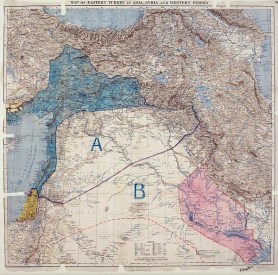
And the theory (which is yours) that the Ottomans gave the minority Shia and Christians “pools of self-governance” and that modern Syria “was precisely constructed to pit a minority … against the majority” is all absurd non-history. Both the Ottomans and the French protected their minority sects, but neither gave them self-governance or control over the majority. The straight line you draw from Sykes-Picot to brutal al-Assad rule does not exist. What’s more, and ironic for your argument, the very name of the al-Assad family comes from Hafez’s father’s opposition to modern Syria! The Syrian military coups that happened 40 years later that ultimately led to Alawite dominance have nothing to do with Sykes-Picot.

There are of course excellent reasons to avoid a foreign entanglement in a sectarian civil war, but unfortunately you’ve badly mangled history and logic to make this point.

It is not “absurd non-history” to note that modern Syria is comprised of a complex mix of extremely different sectarian and ethnic groups who have fought each other for a very long time, and that under French colonial rule, the Alawites were the favored sect. In independent Syria, the Alawites gained real power especially through the military, and ran the country under the Assad dynasty as a deeply sectarian, Shi’a force against the majority Sunni. That also explains their alliance with Iran, the region’s major Shiite power, if you don’t include post-Saddam Iraq. That dynamic means that Syria as a modern state is inherently unstable, unless sectarian identity recedes (fat chance after two years of brutal civil war), and was designed to be inherently unstable. Again, my point was not that Syria is not a name that was attached to the entire region, but that as a unitary state, in its current borders, it is a colonial contraption unfitted to multi-sectarian self-government.  Another informed reader:

I have a Ph.D in anthropology and spent decades working in Syria both with archaeological projects (for fun) and as a researcher in social anthropology studying contemporary society in Syria. I was also a Fulbright Fellow there. Anyway, I have not only read immense amounts of Middle Eastern history but lived at archaeological projects out in the Syria Jazeera as well as done ethnographic research in Damascus. I stumbled on this insight as a grad student (and as some one who had to take long-haul buses around the country). I largely agree with your post on Syria.

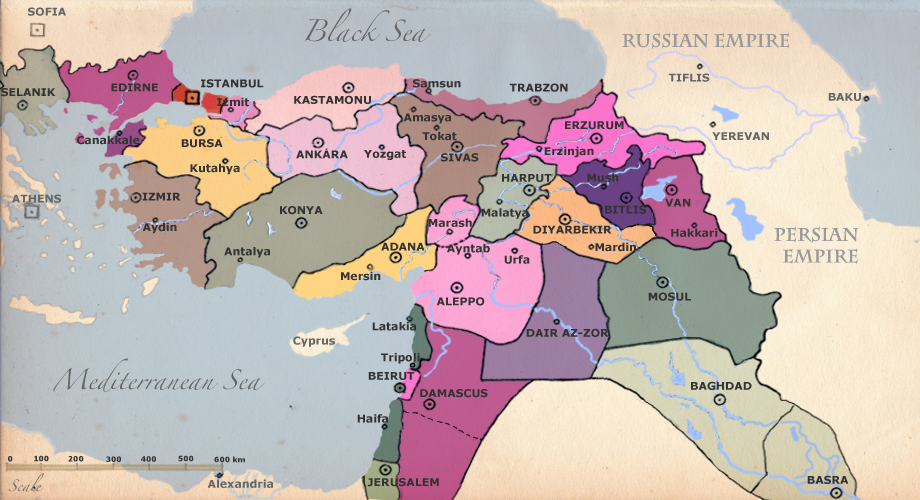
Any potential natural “nations” (of course, all nation states are largely imaginary) of the Middle East can best be found in the old Ottoman provinces, which were much more closely aligned with communities of common interest than the Sykes-Picot nation-states. Of the course the Brits/French pissed all over those separations and alliances. Which is the problem.

You should get some true Ottoman scholars to chime in – I am not an Ottoman expert. Also, it’s hard to find a good online map with the detail needed. Perhaps unsurprisingly, the best I found is from an Armenian advocacy group which has a vested interest in understanding the administrative units of the Ottoman Empires:
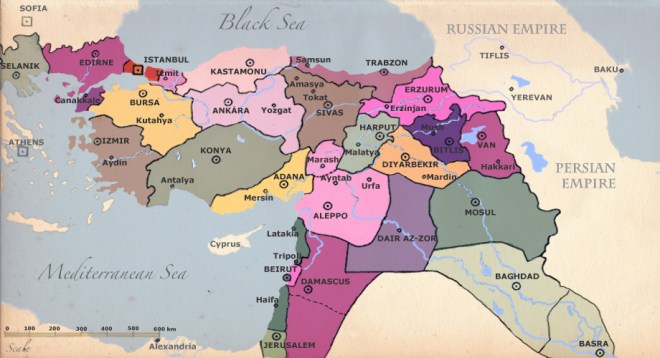
Mapa_osmanian_empire_22_02

But the Ottomans ran a big empire and the provinces were created to make administration easier. So they tended to fall along natural lines of communication with rivers, mountain passes, changes in elevation or whether or not the land was agricultural or only suited for grazing determining what was part of one province and what areas belonged to another. The Ottoman Empire was in existence for a long time and the provincial borders were fluid and changed over time and were often subdivided into smaller units and these sub-units often had governors drawn from the local population. So the province of Mosul was always quite independent, more likely than not to have locals in administration. Before naval power made control of harbors key, the Ottoman province of Basra might have had a local Arab leader. Once the British peeled away Kuwait in 1899 when it became a protectorate, then Basra became more important to the Ottomans and had rulers sent directly from the capital.

Anyway, the Sikes-Picot treaty collected the Ottoman provinces of Basra, Baghdad, and Mosul into Iraq. Just the part of Mosul that possibly had oil made it into Iraq. Much of its hinterland was sliced away and left in what would become Syria. What is now northeastern Syria – and seems to be largely under the control of the Syrian Kurds at the moment – largely traded with Mosul and Aleppo to the east and west with some trade down the Khabur river to Deir-ez-Zor. These are areas that have been linked by trade since the empires of ancient Mesopotamia! These areas have always contained tremendous ethnic and religious diversity (Arab Sunni Muslim, Arab Shia Muslim, Chaldean and Assyrian Christian, Jews – of both Arab and Kurdish ethnicity – Armenian Christians, Yazidis, as well as tribal structures that often divided and reunited these areas in surprising ways) but the natural landforms united these areas as trading partners. You can see this in the patterns of the Akkadian and Babylonian Empires as well as in the route of the Berlin-Baghdad Railroad!

Notice the southern part of the route with stations in Aleppo, Nusaybin, Mosul, Baghdad, then Basra. That’s the unit in which common economic interest and trade patterns allowed diverse populations to work together. That’s what Sikes-Picot cut apart. Notice also that Damascus, Jerusalem, Beirut, Latakia are not part of that economic/trade cluster at all. Damascus (es-Sham) and its immediate countryside was cut off from the broader territory that made up the Ottoman province of es-Sham by Sikes-Picot too. Even in the 1990s, many more buses ran each day from el-Hasake to Aleppo than from el-Hasake to Damascus, and the bus would only fill up after reaching Deir-ez-Zor.

The Ottoman provinces make more sense because pre-modern limits of communications divided the territories not European interests. The diversity of the population within the Ottoman provinces were often able to work together peacefully because they shared a common economic interest. Sikes-Picot severed and distorted those ties. One quick example, the division of Nisibis, an ancient and prosperous city, into the Turkish city of Nusaybin and the Syrian city of Qamishli. Read its history. The idea that Turkish or Syrian nationalism is strong enough to pull this city apart into two nations is laughable. Yet an international border divides it.

The terror (and the hope) of the civil war in Syria has always been that the country would come apart and with it the punishing dividing lines of Sikes-Picot.

That may be necessary for the Middle East to recover from the toll of colonialism. But it will take a lot of time and probably a lot of blood. It seems insane to me that a distant super-power should be involved in mediating something we cannot even begin to fully understand, let alone control. That fact alone buttresses the case for leaving it to its own devices.

Update from a reader:

I’ve been following the debate with interest. It seems to me that is the perfect opportunity to have someone who REALLY knows this history weigh in. In particular my good friend Scott Anderson, author of Lawrence in Arabia: War, Deceit, Imperial Folly and the Making of the Modern Middle East, currently on the NYT bestseller list. Scott has fascinating stories to tell, as the many amazingly great reviews have noted [here, here, here].

Why Syria Could Be Another Iraq

An Iraqi hospital worker inspects burned

Robert Kaplan considers the parallels:

The supporters of robust military intervention are not sufficiently considering how things could become even worse after the demise of dictator Bashar al Assad, with full-scale anarchy perhaps in the offing; how Assad might still serve a cold-blooded purpose by containing al Qaeda in the Levant; how four or five steps ahead the United States might find itself owning or partially owning the situation on the ground in an anarchic Syria; how the American public’s appetite for military intervention in Syria might be less than they think; and how a long-term commitment to Syria might impede American influence in other regional theaters. The Obama administration says it does not want a quagmire and will avoid one; but that was the intention of the younger Bush administration, too.

He admits that “each war or intervention is different in a thousand ways than any other” and that “Syria will unfold in its own unique manner.” But he can’t help but see the similarities:

[A] happy outcome in Syria usually requires a finely calibrated strategy from the beginning. The Bush administration did not have one in Iraq, evinced by the absence of post-invasion planning. And, at least as of this writing, the Obama administration seems to lack one as well. Instead, it appeared until recently to be backing into a military action that it itself only half-heartedly believes in. That, more than any of the factors I have mentioned above, is what ultimately gives me pause.

The key issue to me is what plan do we have for the demise of Assad? None, so far as I can see. Bob is absolutely right to see anarchy as the most logical result.

And it’s truly outrageous for unrepentant supporters of the Iraq war to make the very same mistake as they did last time – not thinking through the full consequences of action. If you remove a Shiite dictator who has run a brutally sectarian regime against a Sunni majority – after the kinds of atrocities we have seen so far – you will get a cycle of massive revenge. You will get ethnic cleansing of the Alawites; mass murder of Christians; and appalling violence. In that climate, Sunni Jihadists will thrive. I simply cannot see how any political resolution is possible in a country designed to make such resolutions impossible. Which is why, not deposing or helping to depose Assad is, it seems to me, the least worst option for the foreseeable future.

And this is the conservative position. History matters; culture matters. You cannot by force of arms undo decades of history or centuries of religious conflict. We saw that so plainly in Iraq. And yet some seem criminally blind to it now – and dare to call themselves conservatives.

(Photo: An Iraqi hospital worker inspects burned bodies outside the morgue of a hospital in the restive Iraqi city of Baquba, northeast of Baghdad, 23 April 2007. The victims were killed when a bomber exploded his car near the city council building, killing four policemen, police Lieutenant Ahmed Ali from Baquba said. The attack wounded another 25 people, many of them policemen, he added. By Ali Tueijri/AFP/Getty Images.)

Was Matthew Shepard’s Murder A Hate Crime?

In today’s video, Stephen Jimenez, author of The Book Of Matt: Hidden Truths About the Murder of Matthew Shepard, considers the role that homophobic hatred played in Matthew Shepard’s murder and whether the brutality of the crime is consistent with other cases of meth-related violence:

A reader counters a previous one:

The gratuitous brutality of the torture and murder is more consistent with anti-gay violence than most drug-related violence – at least in this country. These things should be acknowledged first and last.

This is exactly the issue with these hate crime laws. They make it not about the torture and murder, but about the motivation. If gratuitous brutality, torture and murder are the problem, we have enforceable laws for that. Putting together the specious correlation above, and then using the moral weight borrowed from the claimed correlation to justify the thought-crime, it’s utterly backwards. Hate is a sin, but it cannot be a crime. Justice cannot be objective if it is asked to judge souls, and it must be objective; it’s too corruptible otherwise.

We saw with the Trayvon Martin case the problem we get into when the criminal code ends up resting on what story people attach to the facts. There are always other stories that can be fit on. If we care about the law, we can’t let it rest on something as thin as motivation.

Another:

Regarding the reader who said he was done with you over the Jimenez videos, I can understand where he is coming from; I can feel the pain and fear that the unspoken circumstances surrounding the horrific murder might change opinions about Matthew.

The fact is, a lot of people expect victims to be perfect or else their victim status is suspect, like the idea of rape not being rape if the woman is wearing a short skirt and thereby “asking for it.” And the reader’s fear will probably be right for a percentage of those getting the fuller picture. Adding drugs and bisexuality can negate empathy, especially for those uncomfortable with those issues in the first place.

However, nothing will ever get better if we don’t live with reality as it is. Matthew’s history leading up to his death does not change the fact that his murder was horrific and should never have happened. As much as I understand the reader’s perspective, keeping the truth hidden is not the answer. The reason I subscribe and usually check this blog several times a day comes from the fact that you do deal with reality, showing more than one side or perspective on the topics you cover. I may not always agree, but I sure enjoy the debate.

The Book Of Matt comes out September 24 and you can pre-order it here. Kirkus’ summary of the book:

An award-winning journalist uncovers the suppressed story behind the death of Matthew Shepard, the gay University of Wyoming student whose 1998 murder rocked the nation. Jimenez was a media “Johnny-come-lately” when he arrived in Laramie in 2000 to begin work on the Shepard story. His fascination with the intricate web of secrets surrounding Shepard’s murder and eventual elevation to the status of homosexual martyr developed into a 13-year investigative obsession. The tragedy was “enshrined…as passion play and folktale, but hardly ever for the truth of what it was”: the story of a troubled young man who had died because he had been involved with Laramie’s drug underworld rather than because he was gay.

Drawing on both in-depth research and exhaustive interviews with more than 100 individuals around the United States, Jimenez meticulously re-examines both old and new information about the murder and those involved with it. Everyone had something to hide. For Aaron McKinney, one of the two men convicted of Shepard’s murder, it was the fact that he was Shepard’s part-time bisexual lover and fellow drug dealer. For Shepard, it was that he was an HIV-positive substance abuser with a fondness for crystal meth and history of sexual trauma. Even the city of Laramie had its share of dark secrets that included murky entanglements involving law enforcement officials and the Laramie drug world.

So when McKinney and his accomplices claimed that it had been unwanted sexual advances that had driven him to brutalize Shepard, investigators, journalists and even lawyers involved in the murder trial seized upon the story as an example of hate crime at its most heinous. As Jimenez deconstructs an event that has since passed into the realm of mythology, he humanizes it. The result is a book that is fearless, frank and compelling. Investigative journalism at its relentless and compassionate best.

Steve’s previous videos are here and here. Our full video archive is here.

Republicans Are Holding America Hostage Again

The House GOP is demanding that, in order to fund the federal government and raise the debt ceiling, Democrats agree to defund Obamacare. Chait contextualizes the threat:

Boehner isn’t proposing to attach a perfunctory debt-ceiling hike to “bipartisan solutions,” as has happened in the past. He is proposing that the opposition party extract unacceptable conditions as the price of lifting the debt ceiling. That is an unprecedented demand. Under the Bush presidency, Democrats objected that tax cuts had created [an] unsustainable fiscal position for the government, but it never even occurred to them to threaten to trigger a debt default to force Bush to repeal his tax cuts. Before 2011, the debt ceiling was an occasion for posturing by the out-party and was sometimes raised in conjunction with mutually agreeable policy changes, but the opposition never used the threat of default as a hostage.

Ezra hopes that House Republicans will opt for a government shutdown rather than a default on the nation’s debt:

If the GOP needs to lose a giant showdown in order to empower more realistic voices and move forward, it’s better that showdown happens over a government shutdown then a debt-ceiling breach. A government shutdown is highly visible and dramatic, but it won’t actually destroy the economy. So an “optimistic” case might be that there’s a shutdown for the first few days of October, the GOP gets creamed in public opinion, the hostage-taking strategies of the party’s right flank are discredited, and Washington is at a much better equilibrium by the time the debt ceiling needs to be raised.

And yes, I realize that naming that tornado of lunacy the “optimistic” outcome is enough to make anyone pessimistic about the state of American politics. Good. You should be pessimistic about the state of American politics.

Barro notes that Republicans could defund Obamacare if they didn’t care about the consequences:

Establishment Republicans point out that the “defund Obamacare” strategy is doomed. If Republicans shut down the government over a demand that Obamacare be defunded, they’ll become hugely unpopular, and then they’ll eventually “have” to reopen the government on Democrats’ terms, with Obamacare still going into effect and more money being spent across the government than Republicans could have otherwise demanded.

But why does becoming hugely unpopular mean you have to fold? If House Republicans are really and truly willing to die on the hill of defunding Obamacare, they can do it. Nobody can make them bow to popular opinion and pass a continuing resolution that funds Obamacare implementation. House Republicans can shut down the government all the way to January 2015 and force a default on government bonds if they have the resolve to do so. They would tank the economy and lose the 2014 elections in the process, but the important victories do not come without costs.

Cohn focuses on the Republican leadership:

Conservatives seem determined to provoke a crisis, whether it’s over funding the government past September 30 or increasing the Treasury’s borrowing limit. If that happens, Boehner will face a choice. He can stand by while government services and the economy suffer—or, as Greg Sargent recently suggested, he can “cut the Tea Party loose, and suffer the consequences.” Yes, the consequences might include Boehner losing his job as speaker. Those are the kinds of risks real leaders take, in order to serve the public.

Yglesias expects crisis the pass but not before much damage is done:

[E]ven under that relatively rosy scenario where nothing shuts down and nobody defaults on any payments we’re talking about a protracted months-long period of political crisis that could badly hurt consumer confidence and other areas of the economy.