What Krauthammer Reveals

Leave aside the fact that the intellectual architect of the Iraq War and of the Bush-Cheney torture program has the gall to call any president “incompetent.”  His column today conveys a very 20th Century mindset. It’s a zero-sum world and the US must control as much of it as possible. So we have this puzzlement:

Take at face value Obama’s claim of authorship. Then why isn’t he taking ownership? Why isn’t he calling it the “U.S. proposal” and defining it? Why not issue a U.S. plan containing the precise demands, detailed timeline and threat of action should these conditions fail to be met?

Because he does not want the US to “own” Syria or this proposal. How’s that for an obvious answer that Krauthammer cannot imagine – because he is so trapped in power trips for a second American Century? But Obama, reflecting American public opinion, is perfectly happy to have Putin assume responsibility for the Middle East. Let Russia be drained, bankrupted and exhausted by managing that fractious and decreasingly important part of the world.

Then we get an honest account of what the architect of the Iraq catastrophe wants now – more enmeshment in the sectarian warfare of the Middle East:

Assad is the key link in the anti-Western Shiite crescent stretching from Tehran through Damascus and Beirut to the Mediterranean — on which sits Tartus, Russia’s only military base outside the former Soviet Union. This axis frontally challenges the pro-American Sunni Arab Middle East (Jordan, Yemen, the Gulf Arabs, even the North African states), already terrified at the imminent emergence of a nuclear Iran.

At which point the Iran axis and its Russian patron would achieve dominance over the moderate Arab states, allowing Russia to supplant America as regional hegemon for the first time since Egypt switched to our side in the Cold War in 1972.

And that would be a terrible outcome for the US because … ? He doesn’t spell it out. Here’s what I think would be a terrible outcome for the US: taking sides in the intra-Muslim endless conflict between Sunni Islam and Shiite Islam. The US has no, zero, zilch, nada reason to take such a position. It infuriates each side in turn – we backed the Shia in Iraq (Krauthammer’s bright idea) and now he wants us to back the Sunnis in Syria. This latter strategy, as Leon Wieseltier explained on AC360 Later the other night, is all about Iran. Where Krauthammer and Wieseltier agree is on perpetual conflict with Iran. Because the other thing they agree on is running American Middle East policy as if it were indistinguishable from Israel’s.

Look: If you accept their premises – that we need to be even more deeply involved in the Middle East, by joining one side in a hugely explosive religious schism – their argument makes sense. But I do not accept the premise. I think engaging in the Middle East to back one sect’s interpretation of Islam over another’s is a mug’s game – as I also think is true of the entire paradigm of unchallenged US hegemony in a uni-polar world. That hubristic, over-bearing posture all but guarantees over-reach and disaster. It has already done a huge amount to destroy this country’s reputation, and thereby soft power. It has led us to alienate almost everyone in the world, including most of our allies. At some point, we ought to question the logic of such a cycle of self-defeat.

And look: We have no serious enemy like we did with the Soviet Union or Nazi Germany. No other power even faintly matches our strength. We are in a different world. Moreover, we are bankrupt as a nation.

There is no American public willingness to get involved, and any prolonged conflict right now would increase the already deep and justified disdain for meddling in the Middle East. (As they did with the Iraq war, Krauthammer and Wieseltier keep offering up the same mindset that has actually sowed the seeds for non-interventionism, but that paradox does not seem to have occurred to them.) Obama, in contrast, wants us, it seems clear to me, to withdraw from such self-defeating power trips and was elected precisely to do so. He is living up to that promise – and I see no reason to listen to the unrepentant architect of the greatest foreign policy fiasco since Vietnam when he’s simply calling – again – for a return to Bush-Cheney era policies.

This has not been Obama’s finest hour or finest month. But that should not mean taking the neocon bait of another endless, draining war in a region which has already done its bit to bankrupt us both morally and fiscally. The pressure on Obama to cave to these discredited experts is to be expected. They love to shriek and bully. The test now is not whether Obama can jump through enough hoops to please them (something he will never do anyway). The test is whether Obama can keep us out of that region’s metastasizing war and throw Putin into that nightmare. Just stop arming the Syrian rebels and don’t turn down Putin’s offer to take responsibility for all of it. Then get back to the crucial domestic challenges of immigration, healthcare and the small problem that the entire federal government could be shut down within a week.
Where Rape Is Routine

20130914_gdc367_1190 (1)

The Economist flags a disturbing new report:

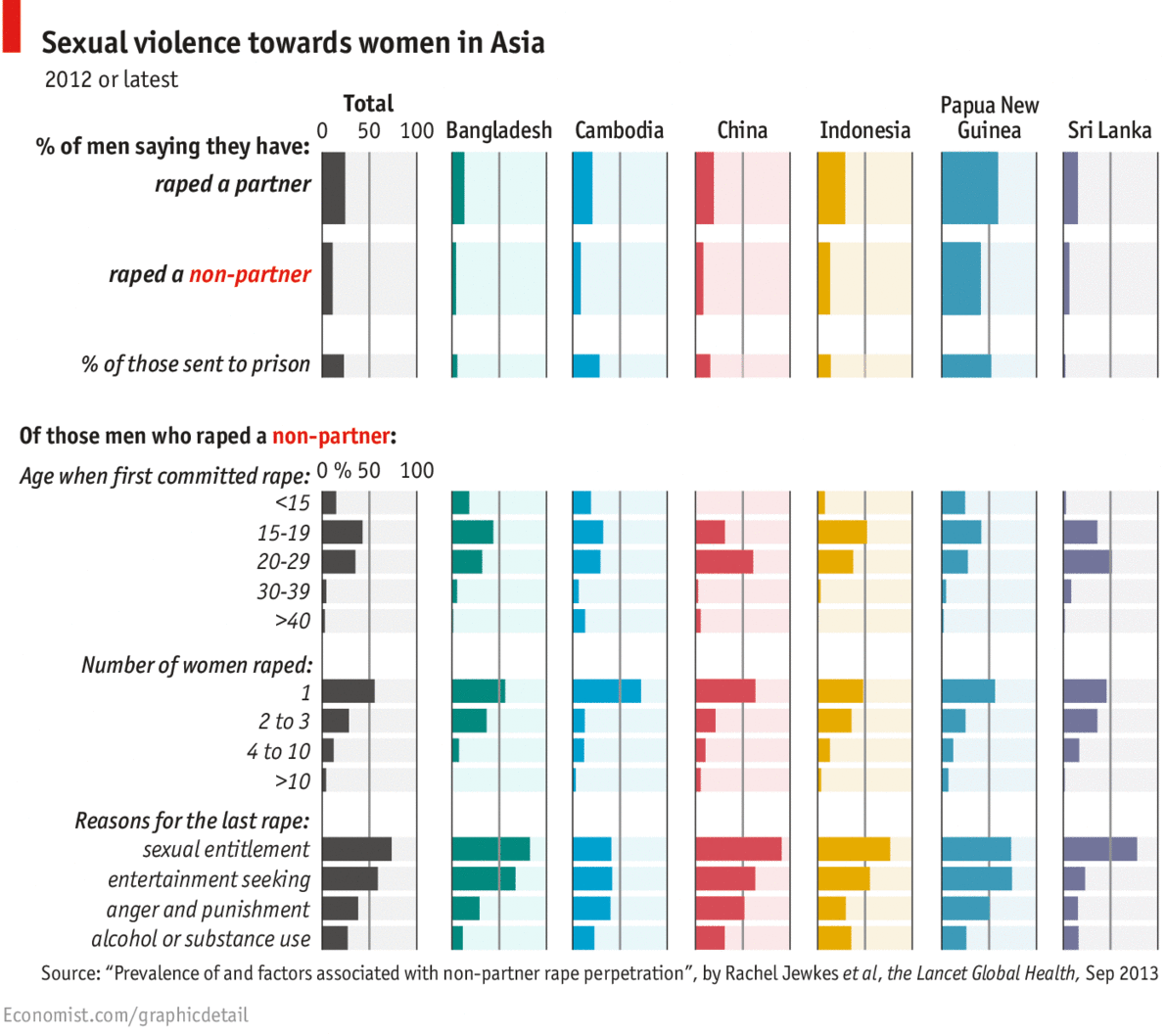
The study, part of a United Nations project, is the first to give a comprehensive tally of rape in several Asian countries. The researchers surveyed more than 10,000 men in Bangladesh, Cambodia, China, Indonesia, Papua New Guinea and Sri Lanka. The men, aged 18-49, met male interviewers. They were never asked about “rape” explicitly; instead they were asked if they had “forced a woman who was not your wife or girlfriend at the time to have sex”. The answer varied from 4% in Bangladesh to a staggering 41% in Papua New Guinea. Shockingly, more than one in seven rapists committed their first rape when they were younger than 15. More than half did so before the age of 20.

Olivia Solon adds to the grim picture:

The vast majority of those men who admitted to rape (between 72 and 97 percent of men depending on the location) didn’t experience any legal consequences. In fact, many men felt that they had the right to have sex with women regardless of consent — more than 80 percent of men who admitted to rape in rural Bangladesh and China felt this way. Perhaps most startlingly, four percent of respondents said they had perpetrated gang rape against a woman or girl (although this varied between just one percent to 14 percent depending on the location).

To help understand the findings, Katelyn Fossett digs up some significant research from the 1970s on factors that encourage rape:

[Anthropologist Peggy Reeves] Sanday dissected the cultural variables that made societies more or less prone to rape, arguing that ideologies of male toughness, traditions of violence, and a lack of female participation in politics were key factors in “rape-prone” societies.

Some of these variables appear to be at play in the [UN-backed] Lancet study as well. Sanday, for instance, has observed traditions of “raiding other groups for wives” in the groups she studies; the Lancet study, similarly, hypothesizes that “the high prevalence of rape in Bougainville (Papua New Guinea) and Jayapura (Indonesia) could be related to previous conflict in these settings.” Sanday’s studies also find a correlation between low rates of female political participation and high rates of rape — a link that is echoed by the Lancet study’s findings. In the U.N. study, the country with the worst rape statistics by far was Papua New Guinea, which also happens to have the lowest rate of female parliamentary representation of the countries studied, with female MPs making up a mere 2.7 percent of Parliament.

Is There A Limit To Longevity?

This embed is invalid


Laura Helmuth presents the two major perspectives:

One of the most fascinating debates in life science these days is between Olshansky and James Vaupel of the Max Planck Institute for Demographic Research in Rostock, Germany. They disagree fundamentally about whether and how average life expectancy will increase in the future, and they’ve been arguing about it for 20 years.

Olshansky, a lovely guy, takes what at first sounds like the pessimistic view. He says the public health measures that raised life expectancy so dramatically from the late 1800s to today have done about as much as they can. We now have a much older population, dying of age-related diseases, and any improvements in treatment will add only incrementally to average life expectancy, and with vanishing returns. He explains his point of view in this charming animated video.

On the other side of the ring is Vaupel, who says that people are living longer and healthier lives all the time and there is no necessary end in sight.

His message is cheerier, but he takes the debate very seriously; he won’t attend conferences where Olshansky is present. His charts are heartening; he takes the records of the longest-lived people in the longest-lived countries for each year and shows that maximum lifespan has been zooming up linearly from 1800 to today. One wants to mentally extend the line into all of our foreseeable futures.

Olshansky says the only way to make major improvements in life expectancy is to find new ways to prevent and treat the diseases of aging. And the most efficient way to do that is to delay the process of aging itself. That’s something that some people already do – somehow. Olshansky says, “The study of the genetics of long-lived people, I think, is going to be the breakthrough technology.” Scientists can now easily extend lifespan in flies, worms, and mice, and there’s a lot of exciting research on genetic pathways in humans that might slow down the aging process and presumably protect us from the age-related diseases that kill most people today. “The secret to longer lives is contained in our own genomes,” Olshansky says.

But as the above chart shows, the secret to longer lives also includes not killing each other.

A Phone That Reads Your Fingerprint, Ctd

A reader writes:

Your post quotes another article that states thumbprints are “convenient and, at least in theory, uncrackable.” Uncrackable? Bruce Schneier, security expert, differs:

So…can biometric authentication be hacked? Almost certainly. I’m sure that someone with a good enough copy of your fingerprint and some rudimentary materials engineering capability — or maybe just a good enough printer — can authenticate his way into your iPhone.

Another adds:

I’m sure VanHemert means well when he says a fingerprint is, in theory, uncrackable – but it’s the opposite. The phone would need to access the encrypted print data on the hard drive in order to authenticate the person unlocking the device, which provides another point of access for someone to break into the phone. With any kind of security measure, the less points of access, the better.

Readers also respond to a recent post on heartbeat-based access:

Speaking as one of the millions of people with cardiac arrhythmias, I would be out of luck if a “heartbeat recognition” system was adopted to replace passwords.

EKGs are not analogous to fingerprints. When I’m in normal sinus rhythm, the system would work as advertised and I would be recognizable. However, I have frequent, random episodes where my heart goes out of pattern. These episodes can be momentary or last for hours, and during an episode my heart rate and rhythm pattern goes all over the place. During those episodes, I would presumably be locked out of my Nymi-encrypted device because it wouldn’t recognize my EKG. A conservative estimate is that four million Americans suffer from atrial fibrillation, various tachycardias, sick sinus syndrome, flutter, heart block, or WPW. Despite our electrical problems, most of us are productive members of society. But we’d lose productivity if heartbeat recognition gained ground.

And September is Atrial Fibrillation Awareness Month, so I’d like to make the healthy tech developers aware that their idea is a non-starter for this fast-growing segment of the population.

Yep, Atrial Fibrillation Awareness Month is a real thing. Another reader:

Unfortunately all biometric-based authentication has a fatal flaw. This includes fingerprints, eye scans, and even heartbeats. The problem is that the data can be copied. And once it is copied there is no way to change it.

When your account password is compromised, it is possible to change it. This is impossible for biometric identification. You can’t change your fingerprint or your eye scan or your heartbeat. It is also always available to anyone who cares to copy it. There is nothing stopping your doctor from copying all of your biometric information and using it to impersonate you. This is not possible with passwords, unless you explicitly give them out at the time you type it, which is only a few times a day. Your body is available to anyone you are around all the time.

Passwords provide the strongest possible security guarantee. Which is absolutely necessary for any Internet-based service. Anything online is accessible to anyone in the entire world. That means you have to defend against the most advanced sophisticated genius level criminal attackers out there.

There is a place for biometric-based authentication. It is good to use in addition to passwords. But it can never be a solid foundation alone.  It is the ability to be completely inside your head and not stored anywhere else that makes passwords theoretically uncrackable. In practice you need to choose a good password and not re-use them nor be fooled into giving them away.

The Sages Of Cyberspace

Henry Farrell considers what it means to be a public intellectual in the Internet age:

Many of these new public intellectuals are more or less self-made. Others are scholars (often with uncomfortable relationships with the academy, such as Clay Shirky, an unorthodox professor who is skeptical that the traditional university model can survive). Others still are entrepreneurs, like technology and media writer and podcaster Jeff Jarvis, working the angles between public argument and emerging business models. These various new-model public intellectuals jostle together in a very different world from the old. They aren’t trying to get review-essays published in Dissent or Commentary. Instead, they want to give TED talks that go viral. They argue with one another on a circuit of business conferences, academic meetings, ideas festivals, and public entertainment. They write books, some excellent, others incoherent.

In some ways, the technology intellectuals are more genuinely public than their predecessors.

The little magazines were just that, little. They were written for an elite and well-educated readership that could be measured in the tens of thousands. By contrast, TED talks are viewed 7.5 million times every month by a global audience of people who are mostly well-educated but are not self-conscious members of a cultural elite in the way that the modal reader of Partisan Review might have been.

In other ways, they are less public. They are more ideologically constrained than either their predecessors or the general population. There are few radical left-wingers, and fewer conservatives. Very many of them sit somewhere on the spectrum between hard libertarianism and moderate liberalism. These new intellectuals disagree on issues such as privacy and security, but agree on more, including basic values of toleration and willingness to let people live their lives as they will. At their best, they offer an open and friendly pragmatism; at their worst, a vision of the future that glosses over real politics, and dissolves the spikiness, argumentativeness, and contrariness of actual human beings into a flavorless celebration of superficial diversity.

Previous Dish on the subject here and here.

The Reason He Wore Black

Writing on the 10th anniversary of Johnny Cash’s death, Michael Stewart Foley praises the singer’s “politics of experience and empathy, a politics that transcended political labels and polarization”:

Cash did not shy away from going on record (vinyl or otherwise) with his feelings about the Vietnam War. Like many veterans (and other country-music stars such as Merle Haggard), he continued to respect the authority of the president and, as such, pledged to support Richard Nixon’s efforts to end the war. But he also routinely pleaded for tolerance, most obviously in a song from the Man in Black LP: “Can you blame the voice of youth for asking, ‘What is truth?’”

For Cash, there was nothing inconsistent in these positions because he did not approach the war as a hawk or a dove, but from the perspective of a younger brother to a boy who had died young (Cash’s older brother, Jack, died in a table-saw accident when Cash was 12). The death in Vietnam of Jimmy Howard, son of country singer Jan Howard, hit Cash especially hard and probably prompted him to write the 1970 song, “Route 1, Box 144”—the story of a “good boy” killed in Vietnam, leaving a wife and baby. The focus of the song is not on the wider politics of the war, but on the kind of familial suffering to which Cash could relate. The following year, when he wrote “Man in Black,” he included the line about wearing black in mourning because “each week we lose a hundred fine young men.”

Clarity Through Dark Comedy

Screen Shot 2013-09-11 at 4.26.50 PM

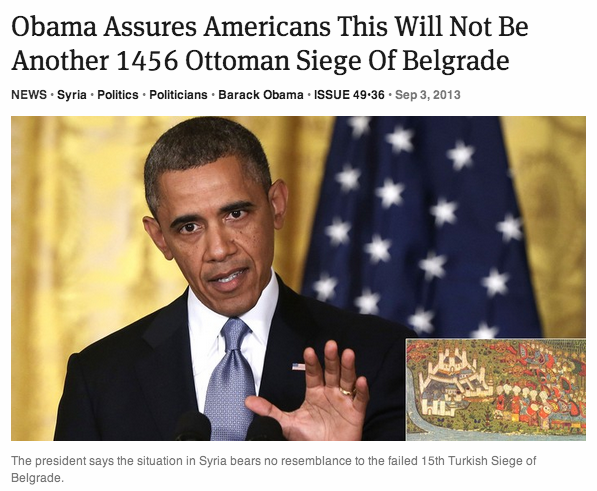
Kabul-based journalist Tom A. Peter contends that The Onion has published some of the best commentary on Syria in recent weeks:

It can be exasperating playing it straight when you write news about a situation that regularly produces absurd scenarios. The Onion’s format allows its writers to plainly make sense of ridiculous situations that can be difficult to explain or fully appreciate in a normal news article.

During many of the trips I made into Syria, I met conservative people who supported the insurgents who used to fight Americans in Iraq, yet these same people were now calling for the same U.S. soldiers they wanted to kill six or seven years ago in Iraq to come to their aid with an intervention in Syria. Meanwhile, as of at least March, the CIA has been compiling a list of targets for potential future drone strikes inside opposition-controlled Syria, according to the Los Angeles Times. The Onion managed to explain this dark, complicated reality in just one fake headline: “Target Of Future Drone Attack Urges American Intervention In Syria.”

Head writer Seth Reiss discusses the site’s approach:

I think one thing we have tried to do with our content is humanize the Syrian people. For example, this piece isn’t calling for U.S. intervention so much as it’s saying that these are people with mothers and fathers and sons and daughters who, obviously, value their lives and relationships. It would be too easy and doing a disservice to the issue to stake out some sort of hardline resolute position i.e. “We should not intervene!” or “We should intervene!” It’s murkier than that. And in that murkiness there is comedy. Dark comedy, but comedy nonetheless.

(Screenshot from this Onion story. Recent Dish on the satire site here.)

“Syria Is Not A Country”

That phrase passed my lips last night on “AC360 Later”, in a heated and, I thought, really interesting discussion. I was pounced on as prejudiced or misinformed or even channeling neoconservatism. So I thought I’d take this opportunity to explain what I mean by that.

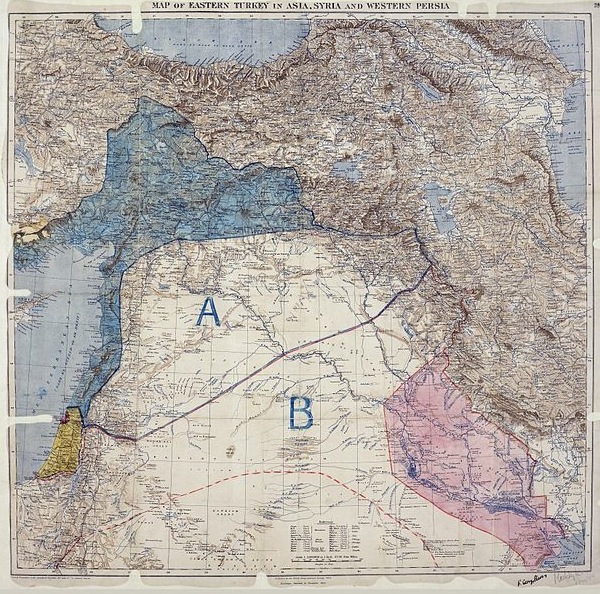
Syria as we now know it was created by one Brit, Mark Sykes, and one Frenchman, Francois Georges-Picot in 1920. Originally, it included a chunk of Iraq (another non-country), but when oil was discovered there (in Mosul), the Brits wanted and got it. With that detail alone, you can see how valid the idea is of a Syrian “nation” is. Certainly no one living in Syria ever called the shots on the creation of the modern 655px-mpk1-426_sykes_picot_agreement_map_signed_8_may_1916state. More to the point, it was precisely constructed to pit a minority group, the Shiite Alawites, against the majority, Sunni Arabs, with the Christians and the Druze and Kurds (also Sunnis) as side-shows. Exactly the same divide-and-rule principle applied to the way the Brits constructed Iraq. But there they used the Sunni minority to control the Shiite majority, with the poor Kurds as side-kicks again.

You can see why colonial powers did this. How do they get a pliant elite of the inhabitants of their constructed states to do their bidding? They appeal to the minority that is terrified of the majority. They give that minority privileges, protection and military training. That minority, in turn, controls the majority. It’s a cynical policy that still reverberates today: the use of sectarianism as a means to maintain power. Over time, the Alawites in Syria and the Sunnis in Iraq entrenched their grip on the state and, as resentment of them by the majority grew, used increasingly brutal methods of oppression to keep the whole show on the road. You can see how, over time, this elevates sectarian and ethnic loyalties over “national” ones. Worse, it gives each group an operational state apparatus to fight over.

The only time of relative long-term stability in the area we now call Syria was under the Ottoman empire which effectively devolved government to local religious authorities. The empire was the neutral ground that kept the whole thing coherent – a monopoly of external force that also gave the Shia and the Sunnis and the Christians their own little pools of self-governance.

Remove that external force and create a unitary state and you have the recipe for permanent warfare or brutal, horrifying repression. It is no accident that two of the most brutal, disgusting dictators emerged in both countries under this rubric: Saddam and Assad.

Now check out Syria’s history after it gained formal independence from the French in 1936 and operational independence after the Second World War in 1946:

There were three coups in the first ten years and with each one, the power of the military (dominated by Alawites) grew. Then in 1958 Syria merged with Egypt – to create the United Arab Republic. One test for how viable and deeply rooted Syria is as a nation? It dissolved itself as such as recently as six decades ago.

When Syria quit the merger with Egypt in 1961, yet another coup soon followed, later followed by another coup in 1970 that brought the Assad dynasty to power. The brutality of that dynasty kept the Sunnis under control, but not without a serious revolt from the 1970s on that eventually resulted in the 1982 massacre in Hama – a bloodletting of unimaginable proportions. Assad killed up to 40,000 Syrians in that bloody rout.

The point I’m making is a simple one. The reason we have such a brutal civil war right now is the same reason we still have a brutal civil war still going on in Iraq. The decades’ long, brutal oppression of a majority group has finally broken with the Arab Spring. All the tensions and hatreds and suspicions that built up in that long period of division and destruction are suddenly finding expression. Inevitably, this will mean much more sectarian bloodletting in the short, medium, and long run. It may mean an endless cycle of violence. The idea that these parties can reach a political agreement  to end the civil war in the foreseeable future is as plausible in Syria as it was in Iraq. It still hasn’t happened in Iraq – after over 100,000 sectarian murders and an exhausting civil conflict – and after we occupied it for a decade and poured trillions of dollars down the drain.

Any political solution to Syria is more than a heavy lift. It’s an impossible one. Only the parties involved can make it happen and none of them is anywhere close to that right now. For the US to take responsibility for this mess, to take on the task of finding a negotiated settlement, would be as quixotic as it would be bankrupting – of both money and human resources. By luck or design, Obama has now handed that responsibility to Putin. He’s welcome to it.

America, the anti-imperial nation, has no business trying to make British colonial experiments endure into the 21st Century. No business at all. It’s a mug’s game – and no one in the region will ever, ever give the US credit or any tangible benefits for the Sisyphean task. We will be blamed for trying and blamed for not trying. We will be blamed for succeeding and blamed for failing.

Which is why, absent the threat to the US of the chemical weapons stockpiled in that “country”, the United States must resist any inclination to get involved or take responsibility. That’s why the CIA’s arming of the rebels is so self-destructive to this nation. Once you arm and train a foreign force, you are responsible in part for its fate. And that kind of responsibility – for a bankrupt America, with enormous challenges at home – is one we should pass to others. Which we have. What we need to do now is grasp the Russian offer with both hands and slap the CIA down. No responsibility doesn’t just mean no war. It also means no covert war.

Is that something the president truly grasps? I sure hope so.

(Illustration: Map of Sykes–Picot Agreement showing Eastern Turkey in Asia, Syria and Western Persia, and areas of control and influence agreed between the British and the French. Signed by Mark Sykes and François Georges-Picot, 8 May 1916.)

The Role Of Meth In Matthew Shepard’s Murder

In our second video from Stephen Jimenez, author of The Book Of Matt: Hidden Truths About the Murder of Matthew Shepard, he explains what he discovered regarding Shepard’s involvement with crystal meth and the drug trade:

A reader comments on the previous video:

Maybe I’ll read Jimenez’s book; maybe I won’t. But neither Mr. Shepard’s involvement with drugs nor any potential sexual relationship with one of the perpetrators of his murder reduces, let alone excludes, the likelihood that his murder was fundamentally an act of horrific anti-gay violence.

The research on the relationship between male (closeted) bisexuality and anti-gay attitudes and anti-gay violence is limited but nevertheless compelling. At least one study is I believe referenced in the Forrest Sawyer documentary on anti-gay violence. Research volunteers had sensors attached to their penises and were shown heterosexual as well as homosexual pornography. My recollection is that there was a substantive correlation between bisexual arousal and anti-gay affect (as represented by their responses to questions about homosexuality and gay people). The gratuitous brutality of the torture and murder is more consistent with anti-gay violence than most drug-related violence – at least in this country. These things should be acknowledged first and last.

Update from Jimenez:

The purpose of the book is not to say hate wasn’t involved; it’s to examine the complex human factors that resulted in such a grotesque murder, and how that murder was reported and perceived. Once they read the book, some readers might still conclude the crime was motivated by hate – but not of the “gay panic” variety that we have come to associate with Matthew’s murder.

Below is more background on The Book Of Matt, which comes out September 24 (pre-order here):

An award-winning journalist uncovers the suppressed story behind the death of Matthew Shepard, the gay University of Wyoming student whose 1998 murder rocked the nation. Jimenez was a media “Johnny-come-lately” when he arrived in Laramie in 2000 to begin work on the Shepard story. His fascination with the intricate web of secrets surrounding Shepard’s murder and eventual elevation to the status of homosexual martyr developed into a 13-year investigative obsession. The tragedy was “enshrined…as passion play and folktale, but hardly ever for the truth of what it was”: the story of a troubled young man who had died because he had been involved with Laramie’s drug underworld rather than because he was gay.

Drawing on both in-depth research and exhaustive interviews with more than 100 individuals around the United States, Jimenez meticulously re-examines both old and new information about the murder and those involved with it. Everyone had something to hide. For Aaron McKinney, one of the two men convicted of Shepard’s murder, it was the fact that he was Shepard’s part-time bisexual lover and fellow drug dealer. For Shepard, it was that he was an HIV-positive substance abuser with a fondness for crystal meth and history of sexual trauma. Even the city of Laramie had its share of dark secrets that included murky entanglements involving law enforcement officials and the Laramie drug world.

So when McKinney and his accomplices claimed that it had been unwanted sexual advances that had driven him to brutalize Shepard, investigators, journalists and even lawyers involved in the murder trial seized upon the story as an example of hate crime at its most heinous. As Jimenez deconstructs an event that has since passed into the realm of mythology, he humanizes it. The result is a book that is fearless, frank and compelling. Investigative journalism at its relentless and compassionate best.

Our full video archive is here.

Divorce Equality Now!

Texas won’t let a married gay couple get divorced. Dahlia Lithwick and Sonja West explain the importance of the case:

[The couple, identified in court documents as “J.B.” and “H.B.”,] can ask that their marriage be declared “void.” In other words, the state is willing to declare that their marriage never existed in the first place. Thus while the men wish to check the “divorced” box, the state is offering a chance to check the “never married” box instead. No harm, no foul.

But this is a transparently flawed solution. The fact is that these two men were married. Texas is trying to retroactively declare that a marriage deemed valid in Massachusetts was never real. And while a state’s ability to be hostile and dismissive to the desires of same-sex couples is still under debate throughout this country, a state’s inability to be hostile and dismissive to the legal declarations of other states is a pretty settled matter.

Simply voiding the marriage creates its own problems. The spouses might have had children or accumulated joint property and debt. Extinguishing the marriage from its outset would flush those legal rights down the drain. Children who were born or adopted to such marriages, for example, could find their legal rights vis-à-vis their parents brought into question. A spouse who raised those children while the other worked or went to school, meanwhile, might have no claim to alimony. As one court has put it, retroactively invalidating marriages would “disrupt thousands of actions taken … by same-sex couples, their employers, their creditors, and many others, throwing property rights into disarray, destroying the legal interests and expectations of … couples and their families, and potentially undermining the ability of citizens to plan their lives.”