Making It Harder To Adopt, Ctd

A reader goes against the grain:

Wow – what a topic. I can not agree more with the ideas of the “anti-adoption movement” … and I’m the mother of four children, two of whom are adopted, openly. Adoption is not easy, for any of the parties involved. Adoption does start with a tragedy; a child and his/her biological family lose the opportunity to grow up together. That is a real loss, and it’s unfortunate that many families who look like mine don’t acknowledge it. From my perspective, my kids need the opportunity to grieve that part of their life, confidently and safely. We grieve with them; it is sad. And at the same time we are so grateful for these beautiful gifts. Adoption is part of who we are as a family and it’s a part of who they are, which is why open adoption is beautiful – hard, but beautiful.

The two people I love almost as much as my children and my husband are the two beautiful women who chose me to be the mother of their children, my children. There is no greater gift. They are amazing women and we honor them every day. This is why women should absolutely not be paid, why open adoptions are essential, why birth families should have a reasonable amount of time to make the decision, and why long-term support for birth and adoptive families is a must.

My husband and I chose the adoption agency we did – The Cradle, in Evanston, Illinois – for exactly that reason. The Cradle provides education and support across both families throughout the lifetime. Birth families choose to place or choose to parent. There is no abandonment – not for the children, not for the birth families, and not for the parents. In truth, adoption work doesn’t end on your child’s “Gotcha Day”; it just begins.

Another:

As an adoptive parent, my views on this subject are hardly unbiased. After going through the adoption process, there are many reforms that I would certainly advocate.

One would be to reduce the incentives for the people making a lot of money off of couples who are desperate for a baby. And it is the baby market (as opposed to the toddler market) that is driving this rent-seeking industry. Most couples, my wife and I included, wanted a new-born and we paid heavily for that privilege.

But where did the money go? Some small part of it went to provide for the birth mother and her other children during the last months of the pregnancy. And I have no problem with that. Most of it went to the facilitator and the adoption agency who both provide services but at a hefty price. The going rate for finding a pregnant birth mother was about $25,000 when we adopted our son 12 years ago. Who knows what it is now? And there were a lot of other fees and expenses on top of that.

At one point during this three-year long process and after several trips that ended in heartbreak and frustration, I somewhat seriously told my wife that it would be a superior moral choice for us just to drive to Mexico find a poor unmarried girl with a new-born and pay her $20,000 to take the baby. I didn’t really mean that, but it was an indicator of my frustration with the process. There has to be a better way to match birth parents and adoptive parents than paying some woman in Seattle $25,000 to give you a name.

All of this considered, I am still strongly pro-adoption. For anyone come out with a strict anti-adoption stance is just denying reality. It sounds clichéd, but there are kids out there who need good homes. When I consider where our son could have been – with a birth mother who I am sure would have loved him but who has had incredible troubles that don’t need to be discussed here – sometimes I just want to cry.

As it stands, we have a great son whom I could not love any more if he was my own flesh and blood. Sometimes I think I love him more because he is not and because he made us a family. There is nothing wrong with adoption, but there is something wrong with our current system.

Faces Of The Day

Tony Abbott Set To Become Australian PM As Campaign Draws To A Close

Shadow Treasurer Joe Hockey kisses a puppy at Kew Guide Dogs on September 6, 2013 in Melbourne, Australia. With just one day left in the campaign, the Liberal-National Party coalition had one of their first stumbles, by releasing a policy to implement an opt-out Internet filter but then abandoning it within hours. The conservative Liberal-National Party coalition looks set to form government in tomorrow’s federal election. By Lisa Maree Williams/Getty Images. A reader recently wrote:

I love the coverage you give to right-wing parties that are not Republicans, contrasting British and Canadian Conservatives with American Reactionaries. However, I’m Australian, and I don’t see any comparisons made with the Australian Liberal and National parties. On the GOP, you wrote the following in a post last year called “America’s Tory President“:

Of which other Western right of center party could the following be said: it holds that man-made climate change is a hoax and that more carbon energy is harmless and indeed vital. On immigration, the party supports a vast wall across the Southern border, and eventual deportation by attrition of 11 million illegal immigrants. On the deficit and debt, the GOP is the only party in the West that refuses to raise any revenues to close the gap, even as revenues are at 60 year lows. On social issues, the GOP would ban any recognition for gay couples, including civil unions and would criminalize abortion in every state by constitutional amendment.

In the last three years the Australian Liberal/National coalition has been a shadow of the GOP.

The Liberal leader, Tony Abbott, has called climate change “crap” and vowed to repeal the government’s tax on greenhouse emissions. The Liberal/Nationals have nourished xenophobia by branding migrants who seek refugee status in Australia “illegal” (despite Australia being signatory to the UN Convention on Refugees, which explicates that seeking refugee status is not illegal), and it has constructed a tortuous immigration processing network outside the jurisdiction of Australian courts with the intent of deterring refugees. Although Australia has very healthy levels of public debt (only 11.6% of GDP), the Liberals have promised large cuts to taxes and spending. The Australian News Ltd press is a Fox-lite spokesman for Liberal/National politics. On social views, a couple weeks ago a bill to recognise same-sex marriage was defeated by the Liberals and Nationals; a Liberal senator likened same-sex marriage to bestiality and polyamory; and, the Liberal Opposition leader has called a woman’s virginity ”the greatest gift you can give someone”.

Although it’s great to see conservative parties in Canada, New Zealand and the UK bucking the GOP’s reactionary trend, right-wing parties like the Australian Liberals and Nationals are following the GOP’s lead. I can only hope that exposing this madness to the scrutiny it deserves will restore pragmatism and sanity to the American and Australian polities.

Has The GOP Left Corporate America Behind?

Eduardo Porter thinks so:

From overhauling immigration laws to increasing spending on the nation’s aging infrastructure, big business leaders have seemed relatively powerless lately as the uncompromising Republicans they helped elect have steadfastly opposed some of their core legislative priorities. The rift is not only unusual in light of the tight historical alignment between the business community and the GOP, but it is also outright incomprehensible after the Supreme Court’s Citizens United decision, which allowed companies to spend unlimited amounts from their corporate treasuries on the 2010 and 2012 elections.

Kevin Drum objects:

The business community has three big issues it cares deeply about: low taxes, reduced regulation, and the demise of labor unions. Those things overwhelm every other desire, and the Republican Party is satisfyingly adamantine on all of them. What’s more, the Tea-Party-ized GOP is, if anything, even more rock solid on them.

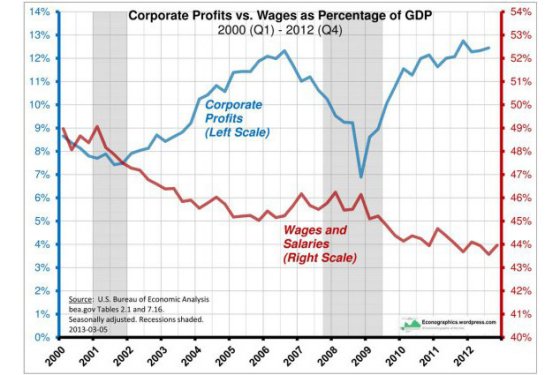
Chait, also skeptical, points to a chart:

Less government sabotage would mean faster economic growth. But it’s not as if the status quo is terrible for businesses. The status quo, while painful for most people, remains pretty good for owners of capital:

a_560x375

So what we’re looking at is a Republican Party that’s somewhat harmful to the overall business climate but helpful to the issues that most businesses care about. If the chaos gets completely out of hand – if, say, Republicans trigger a debt default crisis – then the calculation may change. In the meantime, the House Republicans are the business lobby’s sole bulwark against the Democratic-controlled government that steamrolled through the laws the business lobby is fighting to repeal or weaken.

Greg Sargent adds:

I also feel compelled to remind folks that business leaders knew what they were getting when they helped bankroll the ascension of Tea Partiers to Congress in 2012. They did exactly the same thing in 2010, spending huge sums to help elect Tea Partyers in that cycle, too, only to be rewarded by a debt ceiling crisis staged by the Congressional GOP that they viewed as reckless, dangerous, and potentially harmful to the bottom line. That didn’t stop them from doing the same in 2012.

In response to critics, Porter points out the differences between companies’ political donations and those by their executives.

Great News: College Enrollment Is Down

It’s true:

New Census Bureau estimates published Tuesday point to a record drop in college enrollment after years of steady growth. Total enrollment dipped 467,000 last year, about a 2.3 percent decline from 2011. While it might not seem high, the number represents a significant reversal: It’s the largest year-over-year decline since the Census Bureau began estimating enrollment in 1955.

Nick Anderson celebrates:

Dig into the data, and you’ll find that number of undergraduates 24 or younger shrank by about 122,000 students from 2011 to 2012. The 25-and-older cohort shrank by about 332,000. Older students accounted for nearly three-fourths of the shrinkage — even though older students only make up about a quarter of the undergraduate population. Why is this important? Because older students are plugged into the workforce much more than younger students. So, if the economy is stabilizing after the 2008 financial crisis, making the job market more attractive than it was a few years ago, then our inference is that there will be a significant effect on the college-going decisions of the 25-and-older crowd.

Terry Hartle of the American Council on Education is also heartened by the news:

Higher education enrollment has risen over the last 20 years, Hartle says, but the trend is counter-cyclical. During bad economies, people rush to finish a degree or pick up new skills. That’s why 2007 and 2008 saw a 13 percent increase in enrollment, the biggest jump in 25 years. The half-a-million person drop sounds big, he says, but it’s really just a return to normalcy. “Enrollment tends to level off or fall when the economy is improving,” he says. “Given how much enrollment surged during the economic downturn, a reduction was inevitable.”

What’s more, enrollment by Hispanics jumped by nearly 450,000, reaching an all-time high:

For the first time, a greater share of Hispanic recent high school graduates are enrolled in college than whites. According to the Census Bureau, 49 percent of young Hispanic high school graduates were enrolled in college. By comparison, 47 percent of white non-Hispanic high school graduates were enrolled in college. These findings reflect those of a May Pew Research Center report that showed the share of Hispanic high school graduates enrolled in college immediately after high school surpassed whites in 2012.

FT-hispanic-enrollment-01

Is House Passage Still Possible?

Beutler warns against taking the Syria whip counts too seriously:

If you take members at their word, most of the 217 or so “nos or lean nos” are actually “lean nos.” Anyone who’s leaning is by definition “gettable” by either side, and that right there demonstrates that the committed opponents are less numerous than the whip wielders would have you believe. But members aren’t exactly honest when they’re positioning themselves ahead of important votes. They take positions designed to both avoid scrutiny and maximize leverage. If you’re a member who secretly supports attacking Syria but want to avoid a week of political backlash, and also want to make your mark on the authorization somehow, or secure a favor from your leadership or the administration, you say you’re “leaning no.”

Now whip counts aren’t totally meritless. If interpreted correctly they serve very useful journalistic and organizing functions. They’re great for helping reporters and activists identify and press wishy-washy pols. They also begin to resemble reality just ahead of the actual vote. But as others have noted, you’ll mislead yourself if you use them to extrapolate roll call votes

Meanwhile, John Fund reports that the House might not vote if there isn’t enough support for passage:

“I just don’t believe that if defeat is certain, the House leadership will want to see a president utterly humiliated on the House floor in a public vote,” one top aide to the Republican leadership told me. Should the full Senate vote to approve an attack on Syria — as still appears somewhat likely — the battle would shift to the House. “An attempt would be made to let the whole thing go away. I don’t think it would be done to give the GOP any extra leverage in debt-ceiling or budget negotiations — Obama isn’t the grateful type — but simply because the weakness it would demonstrate wouldn’t be good for the country,” the aide told me.

The Weak Recovery Gets Weaker

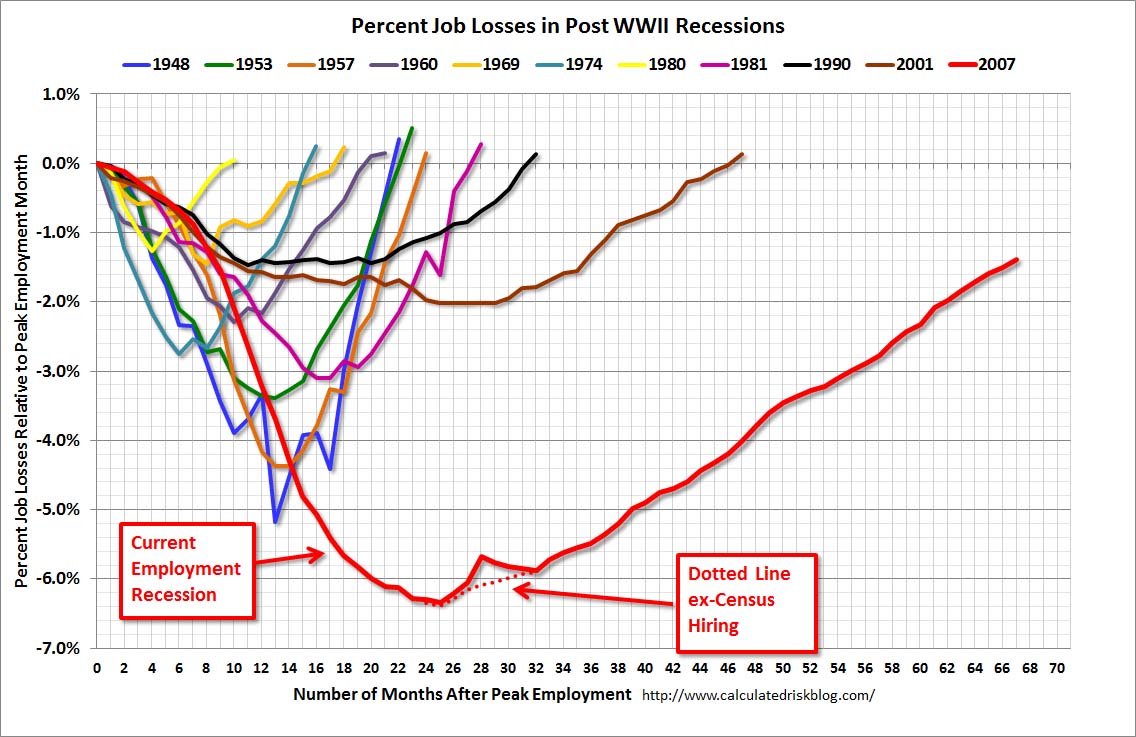
Recovery

Justin Wolfers analyzes today’s disappointing jobs report:

This report says that we’re barely creating enough jobs to keep the unemployment rate falling from its current high levels. Policymakers have been looking for a signal that the recovery has become self-sustaining. This report doesn’t provide it. And until we’re confident that the recovery will keep rolling on, we should delay either any monetary tightening, further fiscal cuts, and definitely postpone the legislative shenanigans that Congress is threatening.

Neil Irwin finds no silver lining:

Yes, the unemployment rate fell a notch to 7.3 percent, from 7.4 percent in July. Yes, the nation added 169,000 jobs, broadly consistent with the pattern of recent months. But in almost all the particulars, you can find signs that this job market is weaker than it appeared just a few months ago, and maybe getting worse.

The drop in the unemployment rate was caused by 312,000 people dropping out of the labor force. The number of people actually reporting having a job actually fell by 115,000 in the survey on which the unemployment rate is based.

Ezra lists five reasons to be depressed. Among them:

In truth, the most important parts of any jobs report are the revisions to the past two jobs reports. That’s because the initial estimate of how many jobs we added or lost in any given month is typically off by about 100,000 jobs. That’s how you get situations like August 2011, when the jobs report said we created no jobs but we later learned we’d created more than 100,000.

Revisions are where we get that better information. They’re the most accurate part of the unemployment numbers. And in this latest jobs report, they’re a huge disappointment: “The change in total nonfarm payroll employment for June was revised from +188,000 to +172,000, and the change for July was revised from +162,000 to +104,000.” That means we added 74,000 fewer jobs than we thought in June and July.

Annie Lowrey focuses on the long-term unemployed:

The slowly improving economy is not really improving for the long-term unemployed: Short-term joblessness has actually declined a smidge since 2007. Long-term joblessness is up 244 percent.

Felix hopes that this report will stop the Fed from tapering off its stimulus:

[T]his report is something of an unwind of what we saw this summer. It shows that the reality of the economy was not as good as we thought it was, and that the market probably got ahead of itself in anticipating a taper beginning very soon. We can’t take any solace in the mediocre economy. But if you’re desperate for good news, here it is: at least we know, now, how mediocre the recovery is, especially on the jobs front. And we’re going to stop hobbling ourselves by pushing long-term interest rates inexorably upwards, thereby making that recovery even harder.

Binyamin Appelbaum is unsure whether or not this report will prevent the Fed from tapering. Ryan Avent feels that the Fed is repeating the same mistake over and over again:

It is painfully obvious that the Fed dislikes having to deploy unconventional policy and wants to stop using it as soon as possible. One of these days it will realise that the best way to get off and stay off unconventional policy is to push forward with it until the economy is back to full employment and inflation pressures are firm enough to justify interest-rate rises. If you don’t kick the ball past the crest of the hill, it just rolls back down and you have to kick it again. Sadly, it may fall to Mr Bernanke’s successor, and early 2014, to give the economy the boot it really needs.

(Chart from Calculated Risk)

Iran’s Tweet Diplomacy

Iran expert Scott Lucas comments on the disparate messages coming from Rouhani’s advisers, namely the one who denied the legitimacy of the Rosh Hashanah tweet via the state-run Fars News Agency:

We believe this is pressure from Fars and the Revolutionary Guards to Rouhani’s team to back off from their moderate positions on Israel and especially Syria. … It’s a legitimate account and [Rouhani] has said that this is the only official account of the president on Twitter.

Fisher points out that the advisor did not “directly dispute the English-language account or say the tweets don’t represent Rouhani’s views”:

The non-denial denial is perhaps in response to the Western media attention to this tweet, but it raised more questions that it answered. Tehran-based reporter Amin Khorami, Al-Monitor’s Arash Karami and others say that the account is actually run by the media office of Rouhani’s presidential campaign team. The campaign has been over for a couple of months, so it raises the question of whether the people running the account continue tweeting in an official or unofficial capacity and whether or not they coordinate directly with Rouhani or his office. The prevailing speculation among Iran-watchers is that Rouhani may be keeping the account semi-official to inure him from criticism by internal hard-liners while allowing continued gestures of good faith toward the West. Although one Iran analyst suggested to me that Washington may be overstating the account’s significance in representing Rouhani’s views.

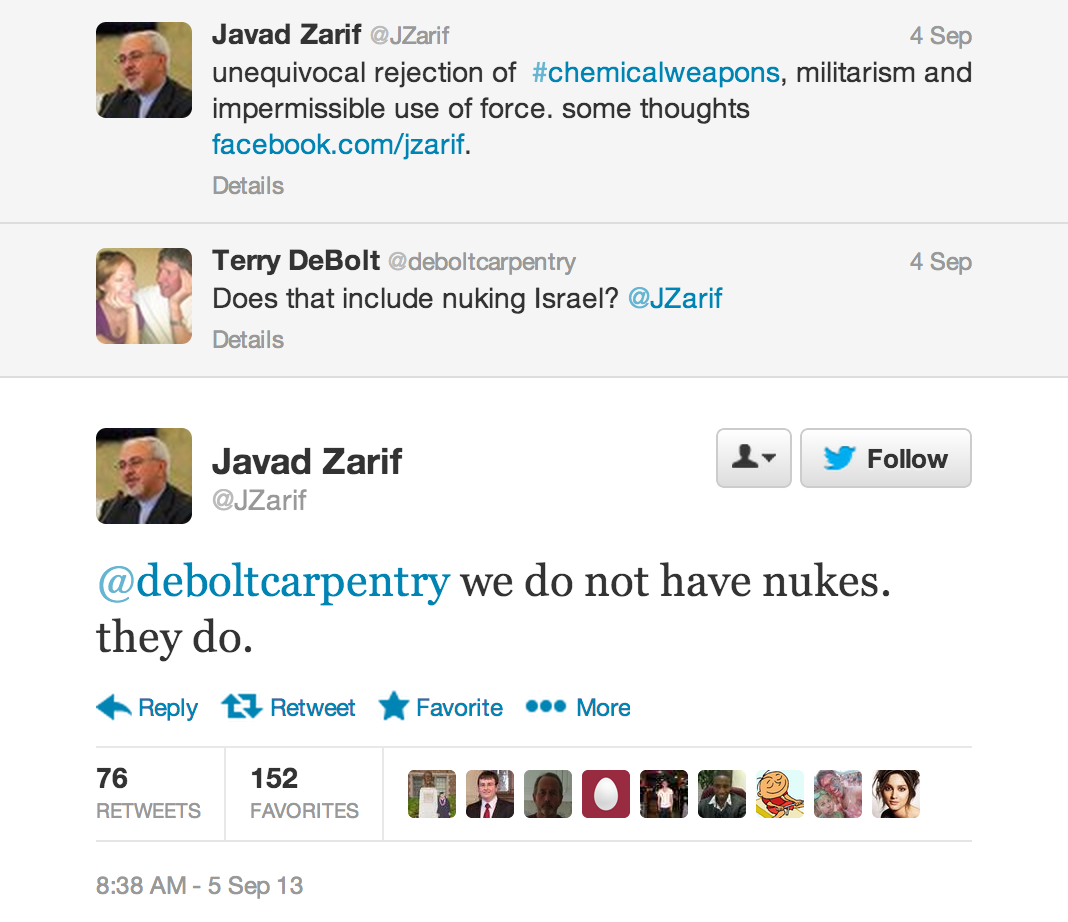
Meanwhile, the Iranian foreign minister continues to mix it up on his new Twitter account:

Screen Shot 2013-09-06 at 2.44.00 PM

Weber Was Wrong

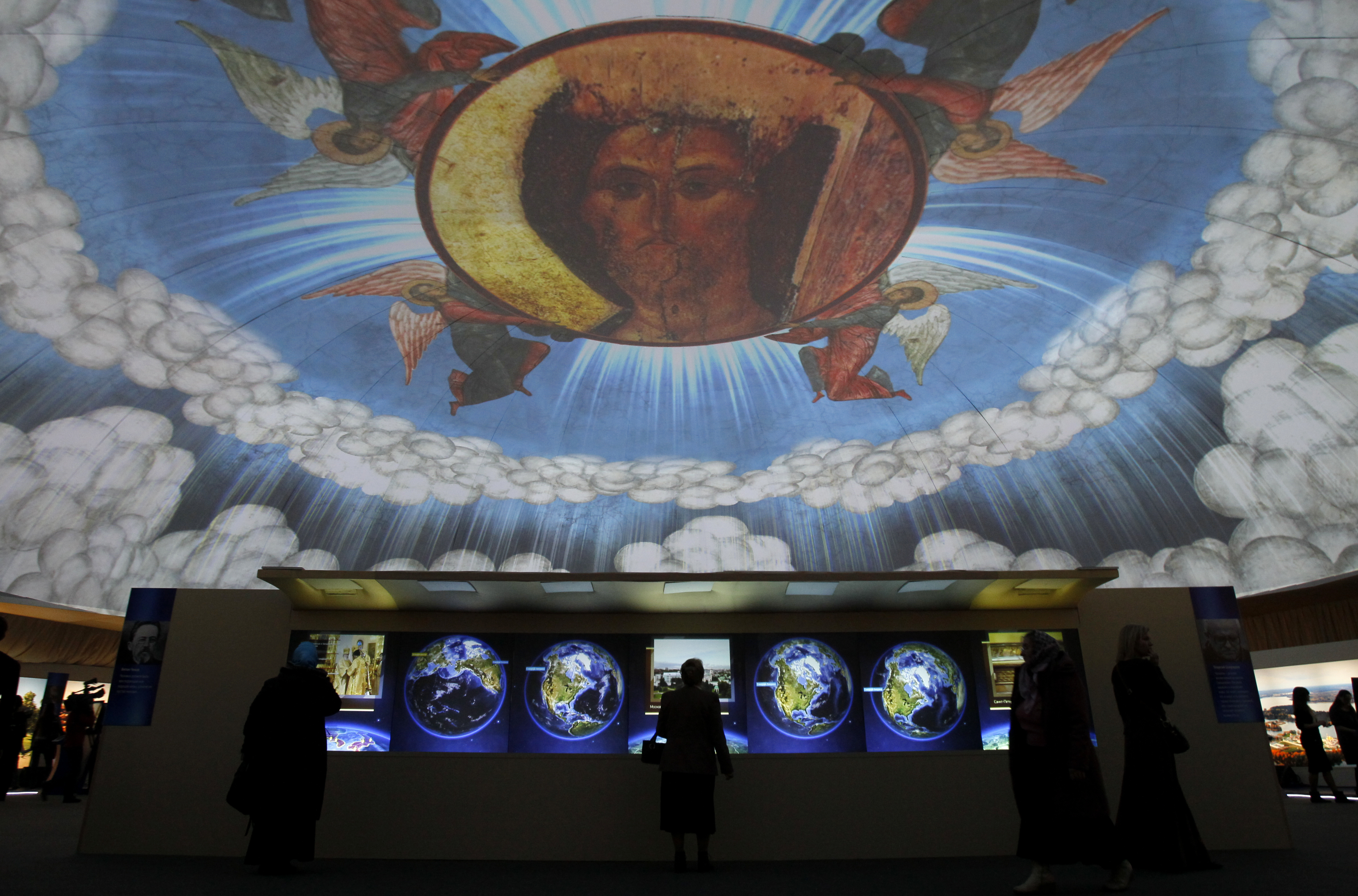
A multimedia show is projected on a spec

Irina Papkova explores how post-communist Russia’s religious revival has forced theorists to rethink the role of spirituality in modern society:

Since the Enlightenment, prominent social thinkers like Auguste Comte, Max Weber and Emile Durkheim have promoted the “secularization thesis.” In a nutshell, this theory proposes that as a society modernizes, the importance of religion will inevitably decline. …

But real life has a disconcerting way of overturning established assumptions.

Once the Soviet Union collapsed in 1991, religion (understood as both levels of faith and institutional structures) resurfaced with such vigor that it challenged not only previous beliefs about the atheistic nature of the Soviet population, but also globally undermined the “secularization thesis.” In 1991, there were 3,451 Orthodox parishes registered on the territory of the Russian Federation. By 2003, this number had risen to 11,299, a rate of expansion of about 300 percent. Other konfessi (religious groups) across Russia developed at even faster rates. For example, registered Islamic communities grew by 400 percent during the same period, while the number of Pentecostal parishes increased from 72 parishes to around 1,500.

And Hitch can only curse from afar.

(Photo: A multimedia show is projected on a specially designed dome as visitors attend the “Russian Orthodox Church – Revival. 1991-2011” exhibition in Moscow on November 5, 2011. By Ivan Sekretarev/AFP/Getty Images)

Assad And The Eschatologists

Tim Murphy notes that bestselling novelist Joel Rosenberg (see his rant below) thinks the Syrian conflict was foretold in the Bible. More troublingly, some politicians are listening:

On Saturday, Rosenberg will travel to Topeka, Kansas, at the invitation of Republican Gov. Sam Brownback, to discuss the situation in the Middle East. The idea behind the prophecy is a fairly straightforward one. In Isaiah 17, the prophet explains that, in the run-up to Armageddon, “Damascus is about to be removed from being a city, and will become a fallen ruin.” The implication is that it will be leveled by God on behalf of Israel as part of the last great struggle for mankind. How exactly that will happen is a bit less clear.

“The honest answer is that the Bible does not say,” Rosenberg wrote on his blog last June. But in Rosenberg’s Twelfth Imam series, he postulates that the emergence of the Mahdi, the Muslim messiah, leads to the rise of a new Islamic caliphate in the Middle East that prepares to decapitate Israel by launching nuclear warheads from Damascus. As the top-rated Amazon review for the final book in the series, Damascus Countdown puts it, “This is a great read for anyone interested not only in the prophetical future of Israel but for Iran and Syria as well.”

Rosenberg may seem like a fringe figure, but he has a large base of support and friends in high places.

Damascus Countdown was, like the two preceding books in the series, Twelfth Imam and Tehran Initiative, a New York Times bestseller. He has been cited as an expert on nuclear policy by Fox News, where host Shannon Bream noted that he had been referred to as a “modern-day Nostradamus.” Former (and future) Republican presidential candidate Rick Santorum wrote a blurb for the hardcover edition of Damascus Countdown and brought the author onto his radio show, Patriot Voices, to discuss the book last spring. In March, Rosenberg met privately with Texas Gov. Rick Perry and Rep. Louie Gohmert in Austin. Gohmert was such a big fan of the novelist he brought a copy of Damascus Countdown as a gift to Israeli prime minister Benjamin Netanyahu in 2011.

They’re all out of their tiny minds.

A Prayer For Peace

In light of his vocal appeals for the US to resist intervening in Syria, Michael Peppard sees Pope Francis shifting away from a “just war” approach to international affairs:

The “just war” tradition of the Catholic Church focuses on principles such as just cause, proportionality, last resort, and serious prospect of success, among others. In recent years, some have developed the principle of “responsibility to protect” as a corollary to the received tradition. Some usually progressive American Catholic voices, such as Michael Sean Winters, have argued that military intervention in Syria does qualify as just.

But from Pope Francis’s statements and previous writings, he leans away from the “just war” discourse and toward the just peacemaking school of thought—or outright pacifism. Conflict has been present from the time of Cain and Abel, he said in On Heaven and Earth, but “I believe that war must never be the path to resolution.” The recurrent human attraction to war is exacerbated, he believes, by “the media’s way of putting things, in black and white,” which “is a sinful tendency that always favors conflict over unity.”

That’s my impression too – in large part because just war theory did nothing to prevent the disaster in Iraq. Christians may need, given the terrifying spread of religious terrorism and unimaginably advanced and increasingly accessible means for widespread destruction, to recalibrate toward a more pacifist position. That’s where my own prayers are leading me after the last decade, and Francis is emerging as a potentially vital figure for framing the next century. Alessandro Speciale notes that “Francis took the unusual step of penning a letter to world leaders ahead of a global day of fasting and prayer for peace in Syria that Catholics will observe on Saturday (Sept. 7).” An excerpt from letter:

[I]t is clear that, for the world’s peoples, armed conflicts are always a deliberate negation of international harmony, and create profound divisions and deep wounds which require many years to heal. Wars are a concrete refusal to pursue the great economic and social goals that the international community has set itself, as seen, for example, in the Millennium Development Goals. Unfortunately, the many armed conflicts which continue to afflict the world today present us daily with dramatic images of misery, hunger, illness and death. Without peace, there can be no form of economic development. Violence never begets peace, the necessary condition for development…

It is regrettable that, from the very beginning of the conflict in Syria, one-sided interests have prevailed and in fact hindered the search for a solution that would have avoided the senseless massacre now unfolding. The leaders of the G20 cannot remain indifferent to the dramatic situation of the beloved Syrian people which has lasted far too long, and even risks bringing greater suffering to a region bitterly tested by strife and needful of peace. To the leaders present, to each and every one, I make a heartfelt appeal for them to help find ways to overcome the conflicting positions and to lay aside the futile pursuit of a military solution. Rather, let there be a renewed commitment to seek, with courage and determination, a peaceful solution through dialogue and negotiation of the parties, unanimously supported by the international community. Moreover, all governments have the moral duty to do everything possible to ensure humanitarian assistance to those suffering because of the conflict, both within and beyond the country’s borders.