Guess Which Buzzfeed Piece Is An Ad? Ctd

Just a little nugget of news I missed last month from the phenomenally financially successful site, Buzzfeed. It has a new feature called a Listiclock, which was developed, of course, with Pepsi. Anthony Ha recently marveled at it:

Every 10 minutes, the minute display will show a list that’s specifically sponsored by Pepsi — apparently, these lists are supposed to be “‘unbelievable,’ fun, and amazing” but aside from a few mentions of Pepzi Next, I’m not sure most readers will be able to detect a big difference between a normal BuzzFeed list and sponsored piece like “10 Traditions You Probably Didn’t Know About.”

Ya think? Then this little gaffe:

This isn’t the first time BuzzFeed has offered a new way to navigate the site as part of an ad campaign, either — a couple of months ago I wrote about the site’s “Flight Mode”, which was promoting GE Aviation’s presence at the Paris Air Show. BuzzFeed President and COO Jon Steinberg told me that ideas often pass back-and-forth between the company’s ad side and editorial side, and that he’s actually interested in exploring a non-sponsored, desktop version of the Listiclock.

At what point will Jonah Peretti acknowledge that it’s all advertizing-as-entertainment and be done with it?

Why Is Summer The Season For Hollywood?

Money On Movies

After a summer of big-budget flops, Catherine Rampell questions the blockbuster strategy of the big studios:

The summer was never actually as profitable as it seemed. The official season, which lasts about a third of the year (at least the way Hollywood divides the calendar), generates around 40 percent of annual ticket sales. Furthermore, box-office revenue may be higher in the summer precisely because that’s when studios have chosen to release their most popular movies. The expected box-office appeal of the film may be driving the release date, in other words, rather than the release date enhancing the box-office performance.

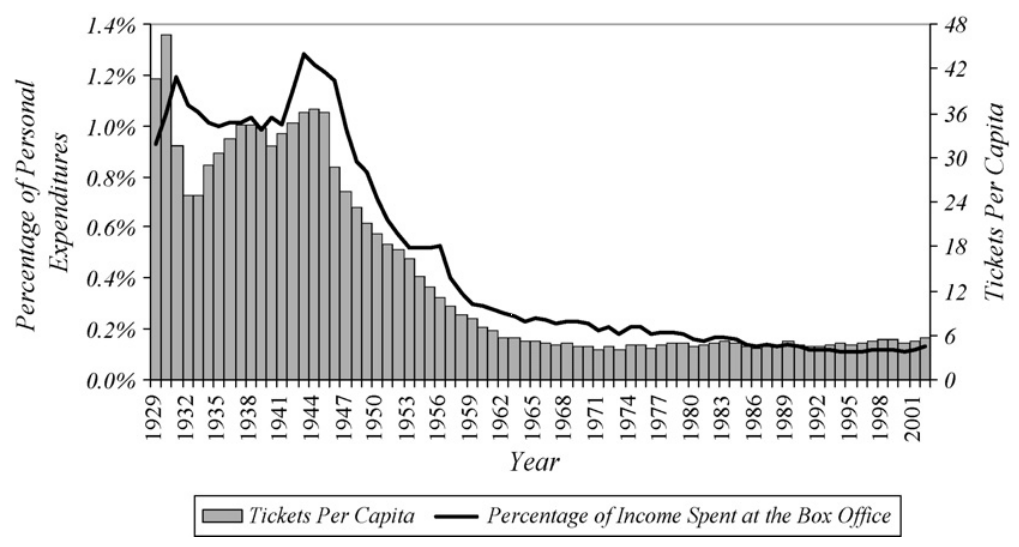
She follows up. Derek Thompson counters with the above chart:

The collapse of movie audiences, which far pre-dates Jaws and summer blockbusters, requires studios to heavily market their films since Americans’ default position on movies these days is not to see them. Studios have cannily created a summer of tent-pole features to focus audience attention on a handful of months when we’re taught to expect to go to the movies. Iron Man III would probably make a billion dollars if it were released on a Tuesday morning in March. But lesser films might benefit from debuting in a season when audiences are predisposed to going to the movies.

More Dish on this summer’s flops and the blockbuster business here, here and here.

Finding The Agreeable Answer

Chris Mooney passes along a study:

According to a new psychology paper, our political passions can even undermine our very basic reasoning skills. More specifically, the study finds that people who are otherwise very good at math may totally flunk a problem that they would otherwise probably be able to solve, simply because giving the right answer goes against their political beliefs.

Drum chimes in:

How big a deal is this? In one sense, it’s even worse than it looks.

Aside from being able to tell that one number is bigger than another, this is literally about the easiest possible data analysis problem you can pose. If ideologues actively turn off their minds even for something this simple, there’s really no chance of changing their minds with anything even modestly more sophisticated. This is something that most of us pretty much knew already, but it’s a little chilling to see it so glaringly confirmed.

But in another sense, it really doesn’t matter at all. These days, even relatively simple public policy issues can only be properly analyzed using statistical techniques that are beyond the understanding of virtually all of us. So the fact that ideology destroys our personal ability to do math hardly matters. In practice, nearly all of us have to rely on the word of experts when it comes to this kind of stuff, and there’s never any shortage of experts to crunch the numbers and produce whatever results our respective tribes demand.

The Ghosts Of Iraq Haunt Syria

Larison dismisses the argument that anti-interventionists are suffering from “Iraq Syndrome”:

[T]his is becoming a common way to describe the absolutely justifiable and sane reaction of the public and even many in Washington to the disaster of the Iraq war. Interventionists call this a syndrome because it is supposed to be seen as an affliction or something from which Americans need to recover, as if there were something unhealthy or harmful in becoming extremely wary of waging wars of choice in countries that we don’t understand very well for dubious and often unobtainable goals. On the contrary, the existence of this so-called “syndrome” is proof that the public is very sensibly recoiling from the repeated misjudgments and mistakes of their political leaders.

Most Americans are firmly against making yet another major foreign policy error, and what they keep hearing from Washington and from much of the media is that they are suffering from some kind of malady that needs to be cured with another war.

This truly is becoming a battle between the Washington war-machine and the people it is supposed to protect. And yes, Iraq is relevant. Of course it is relevant. And no, as Daniel argues, this is not a syndrome. It is not a syndrome to look twice before crossing the street, when you have been run over by a truck twice in the last decade. In any case, the parallels are so close as to be almost absurd. The president is trying to get support for a military campaign against a Baathist leader in a murderously divided Middle Eastern country in order to prevent the use of WMDs and to send a message to Iran. I mean: is there any more obvious analogy? Now I know the president has ruled out “boots on the ground”. But there are already boots on the ground, in a covert war the war-machine has already launched. And, as John Kerry was forced to concede, entering this conflict could quite easily require troops in the near or distant future if we are not to be seen as having empowered Assad rather than removed him.

And the same people and factions that backed that war are now backing this one: the full neocon chorus, AIPAC, the liberal internati0nalists, the Clintons, McCain, and on and on. Since no true accountability for that catastrophe was ever exacted, we are forced to endure the utterly discredited Bill Kristol and Paul Wolfowitz and Fouad Ajami make exactly the same arguments they made then. And yet this time, the man we elected not to repeat the Iraq disaster, the man who only holds the office he does because of his wise opposition to that war, is now apparently eager to risk a repeat of it.

Let’s be clear. The administration is losing this argument, and looks likely to lose the Congress. There are four times as many anti-war votes right now as pro-war ones in the House. The public remains opposed. Only neocons are backing the president forcefully, if he assents to their full-war agenda. The minute he doesn’t launch a full-scale war, they will abandon him. That’s already a horrible reminder that if the president decides to risk his entire second term on this quixotic act of neocon symbolism, he will be very alone very fast, with no country and no Congress behind him and not even the Brits offering some fig leaf of international support.

But in every crisis there is an opportunity.

Lose the vote, don’t go to war, but go to the UN repeatedly and insistently. Gather more and more evidence. Get Ambassador Power to pummel the Russians and Chinese with their grotesque refusal to do anything about this ghastly mass murder. Expose Putin for the brutal thug that he is. And focus on the huge challenges at home: a still-weak economy, a huge overhaul of healthcare, a golden opportunity for immigration reform. That’s why he was elected. And his domestic legacy is at a pivotal point.

I know opposing this president is painful for so many who want him to succeed. It’s painful – agonizing – for me. I understand his genuine and justified revulsion at this use of chemical arms and the wanton, hideous brutality of the Assad regime. I deeply respect his moral stand. He is right that the international community should not stand by. But America cannot be the sucker who is responsible for countering all evil in the world and then blamed for every success and failure. We must not become the sole actor against evil in the world, and not only because, at this point, after GTMO and Abu Ghraib and pre-emptive war, we have no standing to do so. We simply do not have the ability or the resources to do it. We’re as fiscally bankrupt as we are militarily incapable of fighting other people’s wars for them. And asking the military to do another impossible job in another Middle East hell-hole is grotesquely irresponsible.

We should make our case to the world and if we fail, as Obama clearly is, we should accept that and move this drama to a diplomatic stage. Yes, I know the horrors endure. I am not looking away. But if you cannot end someone else’s brutality without profoundly wounding yourself and empowering this vicious little creep at the same time, you should simply keep making your case – until Putin and Assad are close to indistinguishable, and moderate elements in Iran begin to gulp at the barbarism in plain sight.

That will take time; and patience, and resolve. But it’s a far wiser path forward than another unpredictable, horrible, bankrupting war.

The STEM Surplus

Robert Charette thinks the much-discussed shortage of science, technology, engineering and math (STEM) graduates is a myth:

[N]early two-thirds of the STEM job openings in the United States, or about 180,000 jobs per year, will require bachelor’s degrees. Now, if you apply the Commerce Department’s definition of STEM to the NSF’s annual count of science and engineering bachelor’s degrees, that means about 252,000 STEM graduates emerged in 2009. So even if all the STEM openings were entry-level positions and even if only new STEM bachelor’s holders could compete for them, that still leaves 70,000 graduates unable to get a job in their chosen field.

Of course, the pool of U.S. STEM workers is much bigger than that:

It includes new STEM master’s and Ph.D. graduates (in 2009, around 80,000 and 25,000, respectively), STEM associate degree graduates (about 40,000), H-1B visa holders (more than 50,000), other immigrants and visa holders with STEM degrees, technical certificate holders, and non-STEM degree recipients looking to find STEM-related work. And then there’s the vast number of STEM degree holders who graduated in previous years or decades.

More evidence:

What’s perhaps most perplexing about the claim of a STEM worker shortage is that many studies have directly contradicted it, including reports from Duke University, the Rochester Institute of Technology, the Alfred P. Sloan Foundation, and the Rand Corp. A 2004 Rand study, for example, stated that there was no evidence “that such shortages have existed at least since 1990, nor that they are on the horizon.”

That report argued that the best indicator of a shortfall would be a widespread rise in salaries throughout the STEM community. But the price of labor has not risen, as you would expect it to do if STEM workers were scarce.

(Hat tip: Libby A. Nelson)

Making It Harder To Adopt, Ctd

A reader responds to our post on the growing “anti-adoption movement”:

From what little I understand, it’s already pretty difficult to adopt a child, taking months and a lot of examination to prove that the prospective parents will supply a decent household, or whatever euphemism they’re currently using, for the child. And yet, any two idiots can have children regardless of their economic circumstances or emotional stability, and not only are they allowed to raise the children, our society demands it. Does anyone but me realize how fucked up this is?

A few adoptive parents share their perspectives:

Your post on the “anti-adoption movement” touched a really sensitive nerve. As a father who has two daughters by adoption – one through a private adoption and one through a public adoption – I know all too well the shortcomings of the adoption “industry.” I actually agree with many of the proposed reforms of the groups mentioned.

But like with many advocacy groups, they play free and easy with emotions to advance their cause. The home page of Origins-USA is a perfect example: “Every Adoption… begins with a tragedy.” It gets worse from there (“it feels more like a kidnapping”). This is the tenor of the movement – that adoption is, in essence, a sad, tragic, horrible suffering.

I recently went to an “adoption support group” of a couple hundred families, and the main theme seemed to be one of induced guilt – that the parents who adopted children should feel deep guilt at the tragedy our children have been subjected too. And here begins my rant:

Bullshit. The views of adoption started out a shame that both adoptive parents and birth parents kept secret, then moved to an openly celebrated “all is perfect and wonderful” good, and now seems to be moving towards a very public shame and tragedy. It is none of those things. Adoption is complex, with a million stories. Some are tragic, but most children who are adopted lead wonderful, well-adjusted lives. Many in these anti-adoption groups would paint the picture otherwise.

And yes, one of my daughters’ lives and adoption did begin with a tragedy. A tragedy of neglect, abuse and violence. One that she will be battling the demons of her whole life possibly. But there is no one in that story who should harbor guilt, our daughter the first among them. Should we as the adoptive parents feel guilt? Absolutely not. We are not saints or saviors, though we’ve taken on a herculean task we sometimes wonder if we can do, but absolutely feel no guilt about an adoption. Neither should the social workers.

The painting of adoption as a tragedy threatens to paint children and adults of adoption as broken, sorrowful people. That is, in and of itself, the real tragedy.

The other adoptive parent:

I’m a little conflicted on this one. My initial reaction is to be angry. It’s like when Russia put an end to foreign adoptions, saying that they’d heard too many stories of mistreatment at the hands of American parents. What a load of horse pucky. Are you seriously telling me that a kid is better off in a Russian orphanage than with a loving American family?!

Adoption is like anything else. Sometimes there are bad outcomes. But my experience as an adoptive parent, and as someone with a large circle of friends in similar circumstances, is that usually the outcomes are very good – especially when compared to the alternatives. Many birthmothers who give up their children are in screwed-up circumstances – poverty, drugs, crime, or are simply too immature to be a decent parent. On the other side of the equation are generally mature, well-educated adoptive parents who can provide a vastly superior level of security, education, and hopefully love and affection. These people have typically been through a long and wrenching period of dealing with their infertility issues, and being able to parent is an unbelievably precious gift after that ordeal.

That said, there are a couple things that I’m uncomfortable with. I remember talking to a pair of young birthparents who were so happy to know that someone would take their child and give him or her a good life. A couple of days later, they’d been contacted by a few other families, and a bidding war started. That’s an ugly term, but in this case it’s correct. That same lovely couple did a Jekyll/Hyde transition and were very clear that they wanted to cut the best deal that they could.

The other one that really burns me is foreign baby brokers. A poor South American mother gives up her baby for two hundred dollars to a local broker who charges five thousand to the American lawyer who charges another ten thousand plus a bunch of miscellaneous fees. Frankly, I can almost see giving the birth mother $20K to lift her out of poverty, but the idea of giving her a couple hundred bucks and a couple of profiteers the rest just drives me nuts.  Not that all agencies are like that by any means, but it definitely happens.

Lastly, I believe in a full open adoption as long as all parties are sane enough to deal.  Personally, we have an open-door policy to both birthparents and their families (within reason) and have actually vacationed with the birthmother’s family. I believe that it’s very important to hide nothing, to let the child drive the interactions, because it’s their well-being that should trump all.

Update from a reader:

Reading that article about the anti-adoption element really gets to me. See, I’m an adopted child. I had a good life with loving parents who I like to think did a good job raising me. One thing I seemed to miss in that article was a concern for the kids. Lots of concern for the people that gave up children for adoption (and they deserve plenty. Carrying a child to term is not easy, quick, or cheap, unlike an abortion), but none for the kids. I think the needs and well-being of the kids ought to be of more concern than that of the adults.

Where Do Red Lines Come From?

Roff Smith offers a history of the expression:

The phrase “red line” appears to be an adaptation of a much older metaphor – a “line drawn in the sand,” according to Ben Yagoda, a professor of English and journalism at the University of Delaware. One of the earliest recorded instances of anyone drawing a line in the sand took place in ancient Rome around 168 B.C., during a conflict that, curiously enough, involved Syria. A Roman envoy named Popillius was sent to tell King Antiochus IV to abort his attack on Alexandria. When Antiochus tried to play for time, Popillius drew a line in the sand around him and told him he had to decide what he was going to do before he crossed it. He acceded to the Roman demands.

But just how the venerable line in the sand came to be red is a little unclear.

One possibility is that a pundit borrowed the idea of the warning line on a gauge beyond which it is unsafe to rev up the machinery. Another explanation comes from the Battle of Balaclava on October 24, 1854, when the hopelessly outnumbered Sutherland Highlanders, the 93rd Highland Regiment, were told by their commander Sir Colin Campbell: “There is no retreat from here, men. You must die where you stand.” And so they stood firm, wearing their scarlet tunics and awaiting the charge. In his breathless account of the battle, London Times correspondent William Russell wrote that all that remained between the charging Russians and the British regiment’s base of operations was “a thin red streak tipped with steel.”

And now it’s a dick-measuring ribbon.

Dissents Of The Day, Ctd

The pushback from readers continues:

Words are important, so you should use them carefully. You call the proposed action in Syria “war.” Okay, I understand the point that weeks of bombing could be considered a war even though it’s not a traditional ground invasion. No need to quibble there. But you then recklessly compare Syria to Iraq and Afghanistan as if they are close to the same thing (“Or, when push comes to shove, are you actually weaker than McCain and Clinton – and your legacy will be not doomed wars in Iraq and Afghanistan but doomed wars in Syria and Iran?”)

Let’s set aside that nothing has happened in Iran (or Syria) yet. Let’s assume the President gets what he’s asking for in Syria, which is 60 to 90 days of strikes with no troops on the ground. How is that anything – ANYTHING – like Iraq and Afghanistan? Both were full-scale ground invasions costing hundreds of billions of dollars (are we over a trillion?), thousands of American lives, and hundreds of thousands of lives in country. Make the argument you have – that there is no reason to think these limited strikes will accomplish anything – not these stupid rants.

I remember when our entry into Afghanistan would just be for a few months. Ditto Iraq. I can go back right now and read posts assuming just that. And we have boots on the ground in Syria already, as even the president has now conceded. Neither Iraq nor Afghanistan was a “traditional ground invasion” either. The first was conducted with minimal forces alongside the Northern Alliance; the second was accomplished with far fewer troops than required because, yes, we’d be home by Christmas. No one in power anticipated a ten-year occupation. So why do we assume that having entered this awful conflict, we can so easily walk out of it?

I’m sorry but if I’m asked to defend another “this-will-be-over-quickly-no-troops-on-the-ground-ever” war, I have every right to say no. Nothing in my reader’s emails suggest any possible reactions to this war, as if this is entirely a static intellectual exercize. It isn’t. Our opponents can act as well – with a round of possible terrorist attacks in the US, Assad’s forces becoming even more brutal, Iran being forced to support its client state, emboldening its most reactionary elements, attacks on American military targets in the region, and so on. Any single incident could trigger a wider conflict. A little perusal of how the Crimean war broke out would be a useful reminder that what politicians say will happen is usually not what happens, and what they intend can be the last thing they actually accomplish.

Now, of course, not acting could also trigger a conflict, since Israel may infer from the Congress’s refusal on Syria that there is no appetite for war with Iran either, and attack Iran alone. But I doubt Israel will launch a war unilaterally, because it would not do the job. And, besides, at some point, in a democracy, the people must support – preferably overwhelmingly – any war we decide to enter. They don’t in Britain or the US.

Another reader:

Your argument against a Syria strike seems to amount to the assumption that it is an “open-ended” war due to the inherent unpredictability of war and the fact that we can’t guarantee that future circumstances wouldn’t lead to escalation. But by that definition, all war is open-ended. Are you therefore saying that military force is never justified (short of, say, a direct attack on the United States)? If not, I’d like to hear you elaborate more as to when, if ever, a military intervention would be sufficiently close-ended to meet your standard.

Right now, with respect to America’s global interests, I see no war worth fighting. That includes preventing Iran from deterring Israel’s nukes. Another quotes me:

“My point is that foreign policy is not about going around the world preventing bad.” Wow. This is similar to the “America First” arguments used to stay out of WWII and the arguments used to ignore Cambodia and, of course, Rwanda. The US can not be the world’s cop, and I get that. But holy crap – get ready to handle more pictures of dead children and just keep saying “bummer, but we can’t concern ourselves with it.”

I will and have. I opposed intervention in Rwanda and Somalia. Somalia is very instructive. Just a humanitarian mission, which became a war, which became a nightmare. And if only we had only ignored Cambodia instead of waging Kissinger’s vast and vile war crimes against the people of that poor country. Another reader:

I am struck by the lack of discussion of the similarities between the international community’s failed response to the 1995 Srebrenica massacre and the current situation in Syria.

By using chemical weapons, the regime in Syria has indicated that it will use whatever depraved means at its disposal to carry out its policies.  There is no reason to believe that the 8/21 attack will not be repeated, perhaps on a larger scale.  The regime has a the capability to do so and appears likely to do so unless checked by outside forces.

This strikes me as similar to the lead up to the 1995 massacre.  The international community sat by and watched the events unfold in Srebrenica over a period of weeks, and did nothing to intervene, even though it had the capability to stop Serbian armor and artillery that was used to carry out the massacre (actually a series of smaller massacres).  The international community’s inaction in 1995 is rightfully remembered as a grave error – an error that should not be repeated in Syria.  The regime has “crossed a line” and it should be prevented from going further over the line so that the 1,400 dead do not become the 8,000 dead from 1995.  This seems like a blindingly obvious lesson from history to me.

If you genuinely believe that Syria is like Bosnia, fine. I don’t. Europe – even in the Balkans – is a repository of some basic humanitarian norms. The Middle East isn’t – and never has been. And how many people would the Syrian opposition murder if they won this war? They are talking openly about “liquidating” the Alawites. Here’s a little taste of who we’d be supporting:

The Syrian rebels posed casually, standing over their prisoners with firearms pointed down at the shirtless and terrified men. The prisoners, seven in all, were captured Syrian soldiers. Five were trussed, their backs marked with red welts. They kept their faces pressed to the dirt as the rebels’ commander recited a bitter revolutionary verse.

“For fifty years, they are companions to corruption,” he said. “We swear to the Lord of the Throne, that this is our oath: We will take revenge.” The moment the poem ended, the commander, known as “the Uncle,” fired a bullet into the back of the first prisoner’s head. His gunmen followed suit, promptly killing all the men at their feet.

Reader dissent continues into my most recent long post:

“Obama’s case for war is disintegrating fast. And his insistence on a new war – against much of the world and 60 percent of Americans – is easily his biggest misjudgment since taking office.” Really? His case for war? You should be ashamed for saying this repeatedly, like some back bench Republican thinking if only I say it enough, it just might become the truth. He is looking to go to war with Syria as much as he has already declared war on Pakistan by invading it and killing OBL. Has he declared war on Pakistan? Not that I know of. He had a specific intent, and he carried it out. I trust him with this. Yeah, much more than all of you naysayers combined.

It would be a lot better to let the tyrants of the world know that among the undecideds and the “tired of war” criers, there are some who truly will take you to the woodshed for doing something so extraordinarily dreadful to kill over 1400 including 430 children gasping and dying. Will you be saying the same platitudes if Assad dropped a mini nuke on these people – either on purpose or on accident?

Don’t let your enormous bad judgement on the Iraq war cloud your perspective.

If Obama were organizing a meticulously planned and sourced operation of a few men to capture and kill the mass murderer of Americans in Syria, I might agree. He is not. And the resolution Obama sent to the Senate would give him lee-way to do whatever he wanted with respect to chemical weapons. That proposed resolution – and Kerry’s gaffe in the Senate hearing – was clearly open to a broad conflict in the Middle East. As it would have to be. Once you set a train of events in motion, you have to be responsible for the outcome. And we will be.
How Useful Is The UN?

RUSSIA-PUTIN-SECURITY-COUNCIL

A reader writes:

Like you, I’m against military action in Syria. I work in the human rights field, so the ongoing bloodshed in Syria tears me up on a daily basis (or it would, had I not become numb to it long ago). But what you wrote is disingenuous:

The only true disincentive for use of chemical weapons is for the UN to achieve a consensus on that fact and initiate collective action involving all members of the Security Council. And yet Obama has explicitly ruled that out.

We’ve been trying to get the Security Council to act for two years now. There have been several attempts to pass resolutions referring the situation to the ICC, and lately to authorize an intervention, but they’ve been stopped each time by Russia and China. Even the mildest statements of condemnation have been blocked or watered down. So it’s not as though Obama could have gone to the UN but refused it out of hand. He has simply accepted that the Security Council will not be able to reach a consensus on any action he might suggest.

He shouldn’t. He should keep trying. And he has the perfect UN ambassador for it. Another reader:

“The UN to achieve a consensus”? Do you mean to say that we should get all 15 members of the council to agree and contribute to military force in launching a low-risk punitive strike? Including Rwanda, Luxembourg, Togo, and Guatemala? Good luck with that shit.

A few more readers drill down on the issue:

Stop pretending the issue here is that Obama needs to rely more on the United Nations.

The UN does a bunch of great stuff, but at the end of the day, it’s made up of actors representing all the countries of the world, the vast majority of which are incredibly selfish and many of which are flat-out evil. The idea that the United States should not act unless Russia gives us the OK, or unless we cobble together forces from random African or Central American countries with no military power, is bullshit. And it’s a particularly ironic critique, given that Bush checked all these boxes, sought UN approval, assembled a coalition … and Iraq was still a disaster.

There are many reasons to avoid getting drawn into this, but needing the approval of  disjointed, morally empty body like the United Nations sure as hell is not one of them. I would hope Obama, Clinton, Bush – whoever – can and would act in the best interests of the country without having to seek Vladimir Putin’s disgusting approval.

Another:

I’m afraid I’m with your dissenters on this one. I just don’t see how the use of chemical weapons against civilians can simply be allowed to go unchallenged by the world community. I’d dearly love to see the UN take decisive action, but I don’t see the Security Council accomplishing anything. I don’t subscribe to the view that Obama simply decided to ignore the UN. He realizes the reality of Russian intransigence. Sadly, if Putin were a more reasonable man, I think it’s possible that the US and Russia might be able to work together and use the threat of US military action to drive Assad to a Russia-brokered negotiating table. Which seems like the only possible long-term solution.

Perhaps a bigger issue for me is yet one more example of UN paralysis. If the atrocity of chemical attacks on civilians cannot elicit a UN response, what’s the point?  The UN seems to be devolving into a charitable aid organization with no ability to hold accountable those who violate basic human rights (yes, I realize they also failed in this regard during the Bush-Cheney years).

You used the argument that if this was simply about the principle that the use of these weapons should never go unpunished, Obama should have acted months ago. But surely the president’s decision to hold off until now simply reflects his reluctance to resort to military action, which is why he was elected.

Let me turn this around and present you with the same dilemma. For Obama, the scale of the recent attack has clearly changed his calculus. You disagree with his math. Is there any point at which you believe that intervention would be warranted? What if Assad gassed an entire city? Part of Obama’s reasoning must be the real fear that a much larger chemical attack is possible if the Syrian rebels were to make further progress.

There is no point at which I think it would be wise to intervene unilaterally. If Assad were to up the ante even further, the pressure should not be on the US but on Russia and China. If a UN sanctioned intervention is to occur, it will need such an appalling event to galvanize it. But it is emphatically not the responsibility of the United States to be the United Nations for the UN. It’s a mug’s game. It’s bankrupting us, and only isolates us even further in the world. We have to cut this impulse to hold ourselves responsible for everything evil in the world. We are not. We need to hand this disaster to Putin – and let the Jihadists target him for their mass murder, not us.

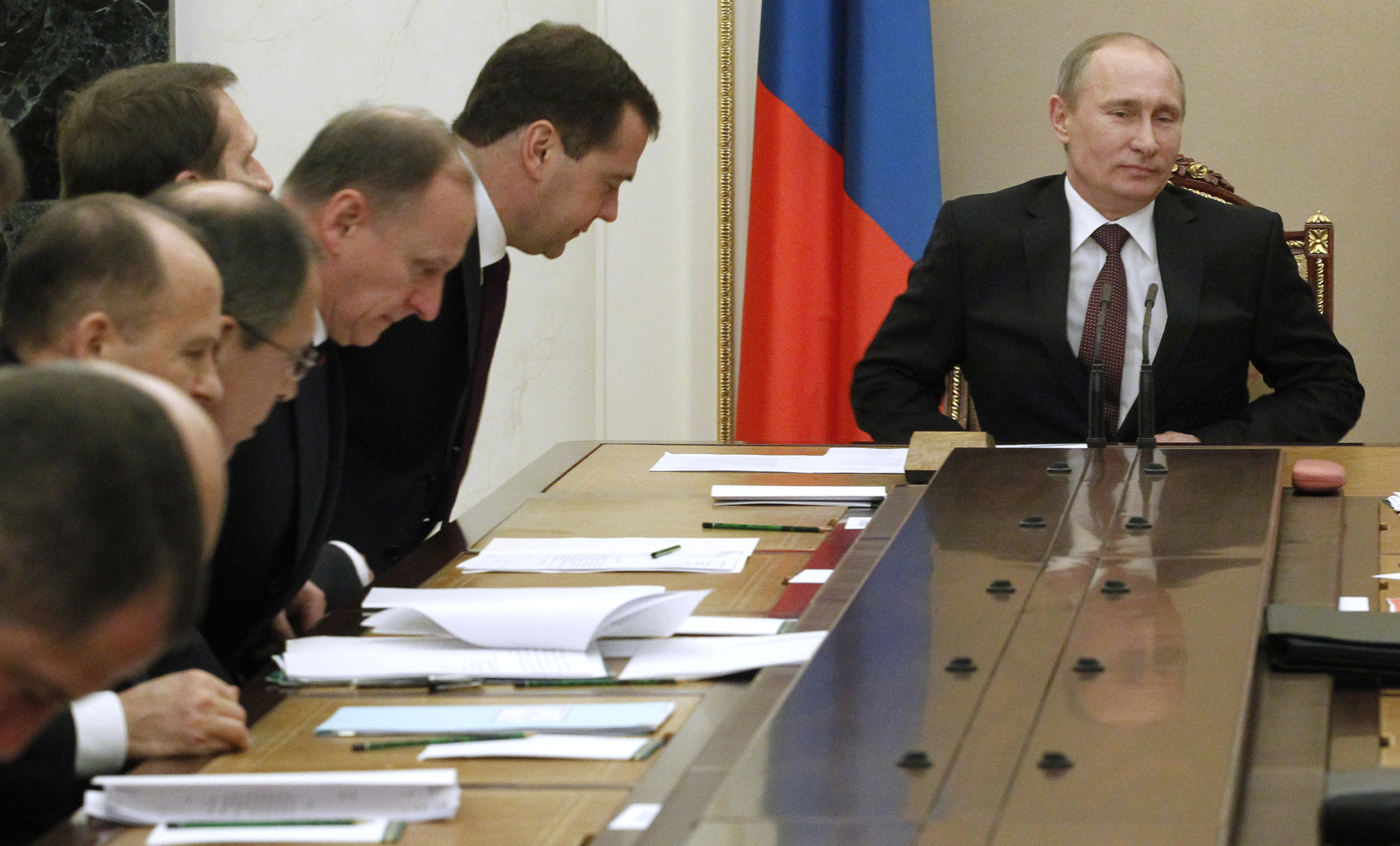
(Photo: Russian President Vladimir Putin chairs a Security Council meeting at the Kremlin in Moscow, on November 21, 2012. By Mikhail Metzel/AFP/Getty Images)

“Not All Like That”

Burroway describes the NALT project:

Dan Savage introduces the new project, recalling he often encounters Christians who tell him, “we’re not all like that,” that not all Christians condemn LGBT people. Savage’s response had been: Don’t tell me, tell the anti-gay Christian leaders who claim to speak for all Christians. Now there’s a platform for those Christians to do just that. Not All Like That was launched [yesterday], providing a platform for “NALT Christians” to post their videos and demonstration that Christians support LGBT people.

Gabriel Arana elaborates on the project’s goals:

The project is a call to arms for Christians who want to take back their faith from the religious right, which has sucked up much of the air in public debates on faith and policy.

When conservatives like Newt Gingrich and Rick Santorum become synecdoches for Christians writ large, it doesn’t leave much room for people like John and Catherine Shore—those who mirror public opinion far more closely than the anti-gay Christians on Fox News.

Indeed, while polling shows support for gay rights varies by denomination, the majority of Catholics and mainline Protestants—the country’s two largest Christian sects—favor same-sex marriage. But the anti-gay crowd seems to have won the public-relations war: In a well-known 2007 study of to 16- to 29-year-olds, 91 percent of non-Christians and 80 percent of active churchgoers described Christianity as “anti-homosexual.” Savage and Shore attribute the disconnect on the religious right’s well-funded media machine; when gay rights are in the news, media bookers turn reflexively to virulently anti-gay personalities like the Family Research Council’s Tony Perkins or Pat Robertson. “Tony Perkins is very loud and the NALT Christians are very quiet,” Savage says.

(Video: Evangelical blogger Fred Clark’s NALT video, a transcript of which is here)