The View From Your Burn

IMG_5084

A reader writes:

Sorry you didn’t make this year’s Burning Man.  It was outstanding in a number of ways: amazing art (especially this year’s crop of art cars), benign weather, the whimsy that ensures that Burners never take themselves too seriously – everything that makes a great burn.  Typical of Burner whimsy was a small site showing the history of transportation in Black Rock City, with hilarious commentary on the fictional days of Burning Man’s “early” years stretching back to the 1800s.  Did you know there was once a Black Rock underground, which had to be abandoned because so many Burners chose to stay in the cool, dustless comfort of the subway stations rather than coming to the surface to enjoy the event?

On the down side, Burning Man was more crowded then ever, although the effect was mainly evident in bike congestion on major arteries such as the Esplanade and long lines trying to visit the building housing the Man. We’re now trying to morph back from our Playa egos of Perky and Lashes to the default world reality of Alan and Judie.  We returned to increased tension in the Middle East and the approaching statute of limitations on wrong-doing resulting in the economic crisis.  We’re forced to start caring about such mundanities again, and we don’t particularly want to.

I urge you to find your way to Black Rock City in the near future so you can experience this wondrous event before it devolves into something more commercial and less freeing.

I created a blog a few years ago to encourage people 50 and over to attend Burning Man.  You might want to check out the series of reasons that my wife and I have for attending regularly at this later stage of our lives.  The frankly erotic atmosphere is certainly one of the benefits, because sex is a life force that has the capacity to keep us young.  The annual burn renews our physical relationship, our commitment to our marriage (of nearly 47 years), and our deep love for each other.  But it also provides us with a set of youthful Burner friends from whom we gain energy and with whom we share whatever wisdom we have acquired over our nearly 70 years of living.

It’s easy not to go.  It’s tough to get ready.  But it’s worth the trip at least once in your life.

I will go. But seriously: Perky and Lashes? Not so much.

(Photo by another reader, who captions: “View from The Man – 8/31/13, 12:00, Black Rock City, NV”, just prior to the wooden man going up in flames.)

The Beginnings Of The Beach Resort

Reviewing The Beach: The History of Paradise on Earth, Adee Braun describes how “long before the beach was a theater of bodies stuffed into tiny suits, exposing as much skin as possible to the sun, beach-going was often a strictly medical undertaking”:

In modern Europe, only peasants sought refuge from the heat in the cool seawater. And so the beach remained mostly empty until the English looked around and began to consider the medicinal potential of their chilly national shoreline. Eighteenth century British high society suffered from a mess of maladies. Fevers, digestive complaints, melancholia, nervous tics, tremors, and even stupidity were the epidemics of the day. The pressures of urban life, pollution, and the general deterioration of society were obviously to blame. Enlightenment physicians began to consider new remedies for old ailments spurred by the new emphasis on science and experimentation.

Their new wonder drug was… water. Cold sea water, specifically.

Beginning in the late 16th century, English physicians endorsed the healing effects of cold water for everything from heat stroke to melancholy. It was believed that a brisk shock of cold water stimulated the entire body, promoting the circulation of humors and even contracting tumors. … By the mid-18th century a standard therapy was developed, which resembled waterboarding far more than a spa treatment. It involved dunking society ladies in the freezing sea repeatedly until the twin effects of cold and suffocation caused terror and panic (read: revitalization). The frightened patient would then be hoisted from the water in her soaking flannel smock, revived with vigorous back rubs and feet warmers, and deposited on dry land for a cup of tea. The adrenaline from the shock of cold was thought to have soothing effects on the body, calming anxiety and restoring the body-soul balance. The patient would repeat her regimen every morning for the next several weeks of her therapeutic seaside sojourn. The men got to take their therapy naked.

It wasn’t enough to nearly drown in the sea to relieve your stresses and ailments; you had to drink it too.

Your Heartbeat As Your Password

Natasha Loma introduces the Nymi:

The wristband relies on authenticating identity by matching the overall shape of the user’s heartwave (captured via an electrocardiogram sensor). Unlike other biotech authentication methods — like fingerprint scanning and iris-/facial-recognition tech — the system doesn’t require the user to authenticate every time they want to unlock something. Because it’s a wearable device, the system sustains authentication so long as the wearer keeps the wristband on.

Dan Goodin worries about security:

Alas, there’s not enough information available about the Nymi’s inner workings to know if it is truly groundbreaking or another dose of the kind of snake oil that’s all too common in the security circuit.

Karl Martin, CEO of the Nymi creator Bionym, said the device hasn’t yet undergone a formal security audit. That means even he can’t say just how impervious it is to the kinds of sophisticated attacks that would inevitably target a universal sign-on gizmo, although he gave some high-level details that are encouraging. That said, there are several classes of hacks that might be used to compromise the security assurances of the device.

Francie Diep has other questions:

When I asked independent researchers if they had any concerns about Nymi, the one thing they brought up was that it’s not clear how accurate the wristband will be at identifying users. Bionym worked with the University of Toronto to test Nymi’s ECG-IDing accuracy in more than 1,000 people, Martin says. They’ve found Nymi is comparable to fingerprint recognition and more accurate than facial recognition. They will test its accuracy further this fall.

However, such results aren’t published yet in the peer-reviewed literature. What has been published indicates it’s “premature” to say an ECG identification scheme can compare to fingerprints and facial recognition, says Kevin Bowyer, the chair of the computer science department at the University of Notre Dame.

Where Iran Really Is Revolutionary

In an interview about the risks of human overpopulation, Alan Weisman, author of The World Without Us, argues that Iran, of all places, has developed “the most successful family-planning program in the history of the planet.” How they did it?

[T]he present ayatollah, Khamenei, issued a fatwa saying there was nothing in the Qur’an against having an operation if you felt that you had enough children that you could take care of. Everything from condoms through pills, injections, tubal ligations, vasectomies, IUDs—everything was free, and everything was available in the farthest reaches of the country.

I interviewed this wonderful woman, an OB/GYN who was part of this, right after the plan was implemented, ten years after the Iranian Revolution, in the late ’80s. She was going on horseback into these little villages to help perform vasectomies and tubal ligations. As the country grew more prosperous, her transportation changed to four-wheel-drive trucks and even helicopters. Everyone was guaranteed contraception if they wanted it.

The only thing that was obligatory in Iran was premarital counseling, which is actually a very nice idea. I recommend it to everybody who’s contemplating getting married. The Quakers do it in our country, and, for six months before a couple gets married, they attend classes. In Iran, you could go to a mosque, or you could just go to a health center. They would talk about things to get you prepared for getting married, including what it costs to have a child, to raise a child, to educate a child.

People got the message really well. They were told, “Have as many children as you want to have, as you think you can take care of.” Most Iranians continue to choose to have either one or two.

A few months ago, Narges Bajoghli reported that sanctions have made birth control harder to come by in the country:

For years, there has been a plethora of birth control pills and other contraceptives easily available and extremely affordable in Iran, a country that boosts one of the most successful family planning programs in the world. It is only in the aftermath of cumulative American-led sanctions against Iran’s banking and financial sectors that most of these options have disappeared from pharmacies. Up until two months ago, pharmacists told me, there were simply no foreign made birth control pills available at all. Many doctors are wary of prescribing the Iranian-made pills because sanctions have made access to the raw materials required to produce them nearly impossible, making many of these drugs unreliable.

The View From Tehran

Juan Cole points out the Islamic Republic is conflicted over its ally’s use of chemical weapons:

Although he later had to walk it back, former Iranian President Akbar Hashemi-Rafsanjani deplored the Syrian government’s use of gas against its own people, and Tehran-watchers are convinced that the Baath army’s action has provoked a heated debate within the closed Iranian elite. Current Iranian President Hasan Rouhani has condemned all chemical weapons use. Because Tehran backs the Syrian Baath government, it has publicly taken the same position as Russia, that the rebels gassed themselves. That allegation is not plausible, and it is clear that even some high ranking Iranian political figures have difficulty saying it with a straight face.

On the other hand, Scott Lucas notes that Iran’s Revolutionary Guards seem ready for vengeance should the US decide to strike:

While the Guards are careful not to say that they will respond with direct attacks against American interests — e.g. through troops in Syria, anti-aircraft support to the Assad regime, or blockage of the Straits of Horumz — its leaders are [signaling] that the Islamic Republic would respond via allied groups by carrying out unspecified attacks against American interests in the Middle East. Revolutionary Guards commander General Mohammad Ali Jafari threatened on Saturday: “The US imagination about limited military intervention in Syria is merely an illusion, as reactions will be coming from beyond Syria’s borders.” Jafari’s warning extended to any countries who joined Washington in the attacks, saying they would face “immediate crises in their national security”.

Alireza Nader examines the struggle between Rouhani and Iran’s hardliners:

Could Rowhani win them over, or even manage to outmaneuver the most recalcitrant Guards officers? This is a possibility considering Rowhani’s sharp political skills and the economic pressures faced by Tehran. But we shouldn’t underestimate the capability of U.S. military strikes against Syria to undermine nuclear negotiations, especially if they inflict significant damage on Assad. …

The key question is whether [the hardliners] will prevent [Rowhani] from adopting a softer line. Supreme Leader Ayatollah Ali Khamenei is a stalwart supporter of the Assad regime, which he views as the frontline of “resistance” against Israel and the United States. Khamenei, despite his supposed fatwa against nuclear weapons, is less likely to care about Assad’s chemical use. He appears to view Syria through a very cold and calculating lens; Tehran must support Assad, as the regional influence and even the existence of the Iranian regime would be in jeopardy without him. Khamenei may also fear a retreat from this steadfast position could endanger Iranian deterrence vis-à-vis the United States in the future. Today Damascus, tomorrow Tehran.

Sune Engel Rasmussen thinks Iran would be better off if it abandoned Assad:

Iran’s support for Assad [is] financially costly and strains an economy already suffering under sanctions, inflation, and widespread mismanagement. This is partly why Iran wouldn’t be able to afford a proportionate response to a U.S. attack on Syria. As Meir Javedanfar has argued, Iran wouldn’t want to risk the loss of hard-to-replace anti-aircraft systems and fighter aircrafts, or to expose its nuclear facilities to attacks from Israel. …

[T]here are plenty of reasons Iran might have already cut Assad loose, were it not for the fact that Syria is Iran’s most important regional ally. But that relationship is changing. The fall of Saddam Hussein has paved the way for much friendlier relations between Iran and Iraq and rendered Syria less vital for Iran than it used to be. So there is a good chance that Supreme Leader Ali Khamenei would be willing to “cut the head off the snake” in Damascus and keep the body. Assad is not as important for Tehran, as is ensuring that Syria’s power structure is friendly to Iran’s interests. Aware that a negotiated solution is the only way to achieve that, Iran has long called for political reforms in Syria.

Karl Vick adds that Iran could dramatically improve its image by working to end Assad’s use of chemical weapons: 

If, as a crucial ally of Assad, Tehran can help coax the Syrian dictator to amend his behavior — perhaps by a dramatic gesture such as surrendering its stockpiles of WMDs to a third party, like Russia — the implications would be immense. Not only would chemical and biological weapons exit the Syrian theater, where combatants include Islamist extremists, but the West would also have an encouraging answer to the question of whether the Iranians, represented by a newly elected leadership, can negotiate in good faith on the question of controlling weapons of mass destruction.

Dissents Of The Day

Libyan Rebels Sieze Control Of Tripoli From Gaddafi Forces

A reader writes:

I’m getting that sickening feeling that you weren’t paying attention when you listened to the president’s statement last week. You last night: “But if we cannot resolve the question without entering another full-scale, open-ended war on the basis of murky intelligence about WMDs, then we should resign ourselves to not resolving the question.” Obama’s statement:

I have decided that the United States should take military action against Syrian regime targets. This would not be an open-ended intervention. We would not put boots on the ground. Instead, our action would be designed to be limited in duration and scope …

Congratulations, you’ve successfully argued against an open-ended war that the administration is clearly and emphatically not proposing.

Read the administration’s proposed resolution. Obama can say whatever he wants. He is not immune to the unpredictable dynamics of war. He can barely handle the unpredictable dynamics of peace – and I don’t blame him at this point in history. But if he thinks he can control something no one has ever been able to control, he really is becoming a second Bush in this particular instance. Another reader:

Enough with the war hysteria. We did not accidentally get drawn into either Iraq or Afghanistan; we went in quite deliberately.  So the apt comparison here is not with either of those wars but with Libya, where despite your overblown concerns, we got through it with the loss of four people.  That’s a tragedy, but it isn’t exactly Antietam.

The object of a punitive strike is to dis-incentivize the use of chemical weapons. That’s it. Now, as it happens, I oppose this action.  But opposing it does not require me to rend my clothing and tear out my hair.  We are a superpower proposing to fire some cruise missiles at a vicious little thug who violated international norms by using chemical weapons. That’s it. It’s the kind of thing the Royal Navy used to do on the authority of a given ship’s captain back in the 19th century.  It is really not that big a deal. Really. Obama has already proved he can strike without getting entangled. He’s not George W. Bush.  And this is not Iraq or World War 3.

The only true disincentive for use of chemical weapons is for the UN to achieve a consensus on that fact and initiate collective action involving all members of the Security Council. And yet Obama has explicitly ruled that out. Another drills down on the Libya comparison:

For my own part, I am deeply conflicted about US intervention in Syria.  I had been inclined to side with the administration’s stance, but many of the arguments you made in your post this evening have caused me to reconsider. That said, when you ask whether “anyone else in Washington” learned what you learned “in the brutal decade after 2000,” have you considered whether you might have taken the lessons of our recent Iraq fiasco too much to heart? Whether, having struggled to make amends with your support for that disastrous enterprise, you are now emotionally biased in the opposite direction?

Let me say: I made the same mistake.  I took the Bush Administration at their word.  I was only a senior in high school at the time, but I was behind the Iraq invasion in 2003.  I watched Colin Powell’s presentation to the UN and I was persuaded.  I bought it.  And, like you, I was eventually forced to face up to my failure in judgment.  So I’m not hating, I’m just asking: have you, perhaps, taken your own failure a bit too hard?

Again, I think most of the points you make hit the mark, but I ask the question because of a couple things that I did take issue with.  It starts with your characterization of Libya: “[Obama] gave in to the hysteria because of an alleged, planned massacre that never happened.” I mean, at the absolute minimum, don’t you have to acknowledge that it’s at least possible that said massacre never happened because Obama “gave in to the hysteria”?

After all, preventing a massacre was, ya know, kinda the whole point of the thing.  Obama had what he judged to be reliable information that Qaddafi was advancing on the city of Benghazi, with its 700,000 or so inhabitants, and was intent on attacking with “no mercy” – the late dictator’s own words.  So Obama acted, with the support of NATO, the Arab League, and a UN Resolution, to prevent the massacre – without any American casualties.

But you seem to suggest that because there was ultimately no massacre, the president’s motives and/or judgment are suspect.  He acts to prevent a massacre he says is imminent, then there is no massacre, but since there was no massacre, you’re skeptical that it was ever imminent. That hardly seems fair,  considering that Qaddafi had already killed plenty of innocent people, had pledged to show no mercy, and had sent a large military force to Benghazi our involvement was limited; and also because we put no troops on the ground, and our military forces suffered no casualties.

That leads to the bigger point: Libya was not Iraq.  Syria isn’t Iraq.  See Mr. Chait: everything isn’t Iraq.

It’s true; our limited intervention didn’t magically precipitate the formation of a thriving Western democracy, any more than did our full-scale occupation of Iraq.  But my point is that it’s possible to deploy our military in the service of good without being inexorably dragged into an endless spiral of wasted money and wasted lives. Limited good is still good.

In Libya, we paid around $1 billion to prevent a murderous despot from deploying his superior military force in the wanton slaughter of a city populated by 700,000 people.  That amount of money will almost buy you seven F-35 fighter jets – of which we currently plan to buy 2,443.  We didn’t end all the bloodshed.  We didn’t usher in an era of peace and prosperity.  We didn’t buy ourselves meaningful influence or a powerful ally.  But I am persuaded we did good, at a reasonable price, and without sacrificing the life of a single American soldier.

Of course you can still argue that it wasn’t worth it; that the billion dollar price tag was still too high; that the good we did comes with too many caveats; or that you just don’t believe Obama and NATO and the UN and the Arab League were being honest in their characterization of the situation.  But the discussion should be on those terms.

And to the extent that it informs our perspective on Syria, I think the example of Libya merits rather more than a curt and implicitly cynical dismissal.  I think it lends credence to the idea that we can plausibly intervene in order to advance certain limited objectives that do limited good -but real, true good – without automatically leading us down the failed path of the second Gulf War.  This is the part of the argument that speaks to me, and you seem not to engage it, preferring instead to insist on the idea that only the lesson of Iraq is that foreign intervention leads inescapably to hopelessly tragic disaster.  What I wonder is whether you still feel the sting of having been wrong – as I was – about it last time.

My point about Libya is not that it was somehow cynical or ill-intentioned. I think it was a genuine concern at a possible massacre. My point is that foreign policy is not about going around the world preventing bad. It is about weighing the interests and values of the United States now and in the long-term. What we created in Libya is a failed state which has helped fuel Jihadism in North Africa. And that may very well lead to more deaths than if Qaddafi were still in power or if the Libyan civil war had not been hijacked by the great powers. Jumping all over the world to prevent massacres is not foreign policy. It’s CNN-driven synapses firing. Another reader references an earlier post:

I’m puzzled. You start out by proclaiming that “the principle of forbidding chemical weapons use against civilians and rebel fighters is a vital one for the future of civilization” and that “to do or say nothing now would have given Assad a green light to exterminate more people without any cost” – but then you explicitly call for the US to do, well, nothing. You want Congress to shoot down the president’s request for authorization, and you want the president to accept that decision.

Like you, I would welcome a better explanation of why Assad used the chemical weapons, and I’d certainly like to know if the US has already undertaken any covert operations in Syria. But no possible motivation (not even the desire to respond to covert US action, if it turns out that’s what happened) can justify the Assad regime’s use of chemical weapons against civilians. President Obama’s argument is the same as yours: something must be done to send Assad – and other dictators – the message that violating the principle of forbidding chemical weapons use against civilians is unacceptable. He has explicitly said that his goal is not regime change – presumably because he shares your worries about what a rebel victory could look like.

So how do you respond in such a way as to deter the future use of chemical weapons without fully joining the war against Assad? A limited military strike. Such a strike might not work, but it would not be merely symbolic, nor would it lack a clear goal. The explicit goal would be to deter the future use of chemical weapons against civilians and rebel fighters. It might not work; the Assad regime might use chemical weapons again. But the US would then have the option of responding again, more strongly, and repeating that pattern until Assad stopped. The only thing guaranteed not to deter Assad from future chemical weapons use is for the US to do nothing.

Listen to yourself: “The US would then have the option of responding again, more strongly, and repeating that pattern until Assad stopped.” So there goes your limited strike! And what of the responses of other actors in the region and world? If Obama misreads the British parliament, then I don’t have a huge amount of confidence he can read the various Jihadist factions in Syria, or the machinations in Tehran or the eery silence from Jerusalem. Another reader notes:

At least one of the senators yesterday made a reference to the possibility that there have been multiple gas attacks, prior to the most deadly one that has garnered the world’s attention. Kerry seemed to confirm it, but then referenced discussing it more during the classified briefing. I have been against any military action against Syria precisely because an isolated lone attack seemed too convenient for the war hawks and too pointless for Assad to have risked the backlash. But if it’s just one of a series of Syrian WMD attacks, and Assad is using these weapons regularly, and we can prove it, then to me that changes the debate considerably.

So why did we not do this when we first had evidence of a chemical attack? The answer is the sheer scale of this one. If the principle is about chemical weapons, period, then the scale should not matter. There is no coherence here. One more reader:

Going to war or striking Syria is not necessarily something that should be put to public vote or sentiment. Public officials were elected to lead and make tough decisions not just reflect public opinion.  Sometimes elected officials need to do what is against public opinion because they are leaders.

But entering into an open-ended conflict in Syria without massive public support would guarantee failure.

(Photo: A mosaic of Gaddafi is seen on the wall of a building, riddled with bullet holes on August 29, 2011 in Tripoli, Libya. By Daniel Berehulak/Getty Images)


What, Exactly, Will Congress Authorize? Ctd

Jack Goldsmith analyzes the Senate’s draft Authorization for Use of Military Force (AUMF), which is narrower than the administration’s AUMF. The Senate’s language on ground troops:

Ground Troops “Limitation.”  Section 3 of the draft provides: “The authority granted in section 2 does not authorize the use of the United States Armed Forces on the ground in Syria for the purpose of combat operations.”

This is a limit on the authority conferred by Congress in Section 2, and not a limit on the President’s independent constitutional power to send ground troops into Syria, even for combat purposes.  Section 3 merely says that the congressional approval of the use of presidential force in Syria does not entail approval for the use of ground troops in Syria.  But it does not speak to, much less prevent, the President from using ground troops on his own authority.

Moreover, even the ground troop limitation on Congress’s authorization contains an exception for ground troops introduced into Syria for a purpose other than “combat operations.”  In other words, Sections 2 and 3 in combination affirmatively authorize the President to introduce U.S. ground troops in Syria for non-combat purposes if he thinks they are necessary and appropriate to achieve the purposes of the authorization. Section 3 is probably written this way to capture the fact DOD Special Operations Forces are being used in Syria, or will be used there, for intelligence-related and other “preparation of the battlefield” tasks.  (I imagine, but of course do not know, that this is a nod to operational reality, since DOD has probably already sent Special Operations Forces into Syria, under the President’s Article II power, to prepare the battlefield.) It is also probably meant as a carve out for search-and-rescue missions, and the like, if necessary.

Andrew Rudalevige also parses the document. On the time limitations:

[T]he resolution says in one of its “whereas” clauses that “the President has authority under the Constitution to use force in order to defend the national security interests of the United States.”  If not quite as broad as the parallel clause in the September 2001 AUMF (“the President has authority under the Constitution to take action to deter and prevent acts of international terrorism against the United States”) it nonetheless seems out of place in a series of “whereases” justifying the resolution in the first place.

If the president does have such authority under the Constitution, unfettered by others’ judgment about what the national security interests of the United States might entail, putting it in statutory language has no effect. If he does not, the clause does not make it so—but it does provide another useful piece of ‘legislative intent’ presidents can point to in future iterations of this interaction. Since in the resolution at present what expires after 60 (or 90) days is the congressional authorization for the operation, not the operation itself, there seems to be a backdoor permission here to continue the latter even after that time, under ongoing claims to “national security interests.”

Obama vs “International Norms”

Richard Price, author of the The Chemical Weapons Taboo, discusses how strikes against Syria might affect it:

Bombing Syria would be the strongest possible upholding and reinforcement of the norm. Will the norm fall by the wayside if that doesn’t happen? No, I don’t think it will. But if there was a strike to enforce it, that would be a watershed moment in many respects. Norms regarding warfare have often been quite effective, like the treatment of prisoners of war. They’re sometimes violated, of course, but a lot of them are treated with a minimal level of decency. These norms trudge on, despite violations, because of beliefs about reciprocity and decency. One violation does not destroy a norm. What matters is how people respond to it.

And you’ll notice something strange about this episode. It’s not as if Syria is defending their use of chemical weapons. They’re denying it. And that helps contribute to the notion this is an unacceptable process. In World War I, the Germans argued that gas might be more humane than bayonets or getting blown up. Some people think that the Bush administration’s view on enhanced interrogation techniques struck a real blow against norms against torture. No one is defending chemical warfare. All the dynamics here have served to highlight that this is a salient norm in global politics today.

Here, again, we keep ignoring what the Bush administration did. They tore up international norms. They made it clear that they had nothing but contempt for them. They occupied a country and failed to provide minimal security for its citizens thereafter, a violation of Geneva. They authorized and practiced grotesque torture of prisoners. They showed contempt for allies. They went to war without full UN permission. They established a torture-and-detention camp in no-man’s and in Cuba precisely to flout international norms.

The idea that America is the only thing standing between chaos and international norms simply ignores the entire history of this rogue, sole super-power in the first decade of the 21st Century. Obama had a chance to restore those norms, but on torture, he simply refused to uphold very clear Geneva imperatives that torturers and their commanders be prosecuted for war crimes. So to take Price’s point:

One violation does not destroy a norm. What matters is how people respond to it.

We know how Obama has responded to it. By doing nothing. Torture is as grave a violation of international law as the use of chemical weapons. I fail to see why a president who refuses to enforce international norms against torture in his own country has any right to tell anyone else on the planet what they can and cannot do in observance of international norms. He has trashed them in the case of torture for domestic political reasons. Why shouldn’t Assad – when he is facing a fight for survival?

We have, in other words, not a leg to stand on when we claim we are enforcing international norms. We only enforce them when we want to. (On chemical weapons, we actively allowed Saddam to use them when it suited us.) In any case, I don’t see how this Syrian adventure will do anything serious to reinforce those norms, as Isaac Chotiner notes:

Does anyone think if Saudi Arabia, say, develops and uses chemical weapons to put down a revolt a decade from now that the United States would go to war? Of course not. (Hypocrisy is not a reason to avoid action, but massive hypocrisy does mean the messages and signals a country thinks it is sending tend to be muddled.) It’s possible that regimes we dislike will hesitate before using these weapons, although that too seems unlikely if those regimes face an existential threat. The possible benefit—i.e. the range of possible bad actors that would be dissuaded by a limited war in Syria—seems awfully small.

Drum argues that most supporters and opponents of war with Syria aren’t focused on chemical weapons:

Enforcing a century-old ban against the use of chemical weapons may sound high-minded in the abstract, but down on the ground there’s virtually no one who (a) actually cares about that and (b) would view a U.S. strike through that lens. You’re for it because you’re a Democrat or a Sunni or an Israeli or a member of the rebel army. You’re against it if you’re a Republican or a Shiite or an Egyptian or Vladimir Putin. Hardly anyone truly cares about American credibility or international norms or foreign policy doctrines or any of the other usual talking points. They’ve just chosen sides, that’s all.

It Depends What The Meaning Of “War” Is

Yesterday, Kerry said:

“We don’t want to go to war in Syria either. It is not what we are here to ask. The President is not asking you to go to war.”

Yes. He. Is.

We have so degraded the seriousness of armed conflict against other regimes and countries that we no longer regard massive bombing campaigns, destruction of other people’s infrastructure, and deaths of civilians and enemy soldiers as somehow “not war”. And it is this very logic that enables this war machine to present itself ludicrously as “defense”. The war in Syria has nothing whatsoever to do with the territorial integrity of the US. We are emphatically under no threat at all. Which is why this elective war – without UN support – is so deeply corrosive of this country’s democracy. Peter Beinart notes:

The United States is reportedly considering launching several hundred Tomahawk missiles against various Syrian military units and installations. General Martin Dempsey, chairman of the Joint Chiefs of Staff, has acknowledged that “there is a probability for collateral damage.” The Obama administration, in other words, is planning to kill and maim an unspecified number of Syrians in order to deter Bashir al-Assad from again using chemical weapons or to uphold the credibility of a potential American military strike against Iran. That’s war.

So how can Kerry say it’s not? Because the ships launching the Tomahawks will be far from Syria, and thus apparently impervious to Syrian retaliation. War, in other words, is what happens when other nations kill Americans, not the other way around.

Larison observes that this abuse of the English language is nothing new:

This was the fiction that the administration promoted during the Libyan war, when it offered the pathetic defense that the U.S. was not involved in hostilities because there was no real chance that the Libyan government’s forces could harm any of the Americans participating in the bombing of Libya. If U.S. involvement in a war is lopsided enough, and if it can be waged from a great enough distance, it isn’t counted as war or “hostilities.” This is a risible argument, but it is one that Kerry was quite comfortable making yesterday. Perhaps he assumes that most members of Congress think of these things in the same way, or perhaps he has convinced himself that the U.S. can carry out acts of war without waging war and can commence hostilities against another state without being engaged in hostilities.

Marching As To War? Ctd

A reader quotes my post from yesterday morning:

For me, the administration hasn’t even begin to present a coherent, let alone a persuasive argument. The congressional debate is absolutely the best forum for this debate to take place – just as the House of Commons was in Britain. If the Congress votes no – which, given the current arguments, it obviously should – then the president should accede to the wishes of the American people as voiced by their representatives. If he were to do that, the kind of transformation Obama promised in America’s foreign policy would be given a huge boost.

Perhaps I am giving too much credit to our president, but for a while I have been wondering if that wasn’t his endgame all along. He is marching well in step with his predecessor, jumping through every hoop to plead the case for war. However, he is doing it in such a way as to fail to convince a war-weary public of its necessity, rightness, goals and likelihood of success. Could it be that he is seeking an end result in which (a) the U.S. does NOT get involved in another quagmire, (b) the power of the presidency to wage war at will is curtailed, and (c) both (a) and (b) are accomplished without any accusations of “weakness” from the right wing?

If so, meep meep.

If so … And I sure hope that’s the case. What I fear is Obama’s liberal interventionist side (see above), enabled by aides like Samantha Power and Susan Rice and John Kerry. Hagel, who was supposed to push back against these utopians, seems neutered by them. But, yes, it’s always good to look at the longer term view with Obama. If the House turns him down, it seems to me he will be saved from his own predicament. He may even try to go to the UN, especially now that Putin has signaled some readiness to consider a resolution using force. Another reader sees another sign of a possible long game:

You’re missing a meep-meep moment. A few days ago the media generally, and the right-wing media especially, were crowing that this showed how weak Obama was. Now he has the Republican leadership lining up behind him, giving him cover.

Yep, it was a great bait-and-switch. But I just don’t believe that Obama is that sneaky. From all I can tell, he has been simply flailing, and a Congressional vote merely offers him some time to come to his senses. Another doesn’t buy the long-game argument at all:

I guess I’m not surprised, but your editorial fails to highlight the degree to which Obama dragged us into this mess. I find myself incapable of agreeing with either side – I can’t fathom how we could possibly intervene for the better, and I can’t fathom how we could possibly sit this out – but I am stunned and embarrassed by how Obama has handled this.

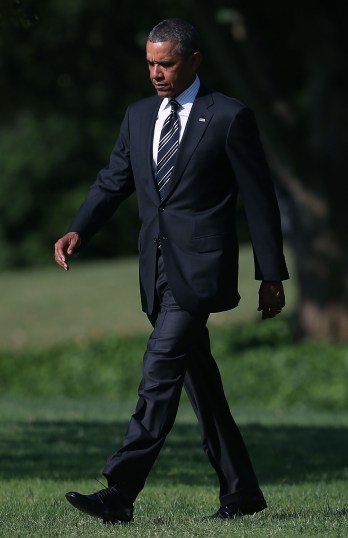
He seems to have confirmed every single Fox Newsy critique of his foreign policy in one fell swoop: by flip-flopping, he comes across as indecisive; by setting a red line, then President Obama Departs The White Houseletting Assad march right across it with no consequence to date, he has weakened the United States in a way I never thought imaginable. He has done so by hanging Kerry out to dry; by letting this decision be made by a Congress he knows will do anything it can to undermine him; by sending a signal to Israel, Turkey and Jordan that the US can’t/won’t act even when it promises it would; by allowing Cameron to fail so spectacularly, and, a decade after Bush, having once again only one single military ally, this time France, he makes us look like a smack-talking weakling.

And this is all coming from someone who not only enormously respects Obama, but also agrees with him policy-wise, almost down the line, and certainly in this arena. Had Obama made a strong case for intervention and decisively taken out Assad’s air force, which, by the way, seems like a very capable goal and a very effective one vis a vis the way in which he is terrorizing his population – I would have been on board. Had Obama decided that it wasn’t worth the risk, the capital, whatever, I could have been convinced. I really see no good options, and therefore no incorrect ones.

But this weak, dithering refusal to make a real decision – again, I am stunned. He has punted this decision to the fools in Congress – something I totally could support had he not suddenly decided to do this at the last minute, after being smeared in Britain – and has walked back his own self-imposed red line. He has sent a message to Assad (and Iran) that, hey, do what you want, and we’ll try to maybe figure something out, but we don’t really have the will. Its just a fucking disaster – and so out of character with who I thought this man was. I didn’t think it would be possible for him to piss off Samantha Power, John McCain, the irresponsible pacifists and the right-wing military crowd, all at the same time – but lo and behold, here we are.

And if you don’t think, however this plays out, that this won’t be one of the main talking points in November 2014 when the Republicans up their numbers in Congress, you are out of your mind. The only winner here: Hillary Clinton and her team, who had been itching to get into Syria months ago, and who now have the distance they need from Obama to win back the neo-connish Dems and turn her policy rightward.

What a fucking mess.

I guess I was lucky not to have watched this fucking mess unspool while I was on vacation. The last thing it suggests is any coherent strategy from the president. Maybe it will shake out for the better – but Obama should have the balls to insist that we cannot stop WMD use in Syria or nuclear development in Iran just as we could not repair Iraq’s sectarian conflict. Another criticizes Obama on a different front:

I’m in much agreement with your post “Marching As To War?” – with one caveat. While I certainly agree with you on the importance, if action is to be taken, of Obama getting congressional approval, I am extremely concerned with something Obama isn’t doing: taking any steps towards an international consensus.

Even Bush got a first UN resolution, a confirmation that everyone agreed that if Iraq had WMDs, they had to give them up. Even Bush established a “coalition of the willing” to demonstrate it wasn’t just the US. (Though the “coalition of the willing” still set a dangerous precedent on the use of force against a country that was not really threatening the security of other countries.) The whole development of international law norms has been to deter countries from doing exactly what Obama is doing.

Somehow I don’t see the US doing this if, say, Russia committed atrocities in Chechnya or China gasses some dissidents. But this is a terrible precedent to hand to the likes of Putin or a Third World dictator. If the US attacks Syria, I completely expect that to be the comeback given when a friendly government and friendly oil concessions are installed in some African nation by Russia or a neighbour after, say, a massacre they can vaguely plausibly claim involved war crimes or even genocide.

I hate to describe Obama as worse than Bush on anything, but he’s going that way on this issue and unfortunately it seems the congressional leadership is too terrified of being seen as soft on terrorism that they’ll back his play even though their constituents don’t.

One more reader:

I wanted to share with you a link to retired Lieutenant Colonel and former West Point instructor David Fitzpatrick’s recent post on Syria at “The Edge of the American West”, a history blog hosted by The Chronicle of Higher Education. I hope Fitzpatrick’s piece is read and circulated by those with the means to generate discussion and pressure for an official response, because the questions it raises are ones which must be answered not just with regard to Syria. Within them lies the specter of Rwanda and a debate about the application of the UN’s responsibility to protect a mandate. At the same time, Fitzpatrick’s questions also demand examining our response to other conflicts, conflicts like the still-ongoing genocide and war in Darfur, which had already claimed between 178,258 and 461,520 lives based on figures published in The Lancet three years ago.

The President has consistently demonstrated he feels the United States has a moral imperative to act in these situations. He said as much in his Nobel Peace Prize acceptance speech, and said as much with regard to Darfur as a candidate for President in 2007, as you can see in [the above video].

With his power as Commander in Chief, I don’t think he’s wrong to feel a moral responsibility to intervene if he believes intervention stands a chance of making a substantial positive difference. (I do disagree with him on whether he ought to act on this felt responsibility.) But, as an Iraq War veteran, I think he also has a responsibility – to his subordinates in the military who will carry out the mission, and to the nation itself – to answer questions like the ones Fitzpatrick raises, and to explain why situations like the ones in Syria or Libya demand forceful American intercession, and why that same America allows situations like the one in Darfur to persist and even worsen. Every member of Congress ought to ask one another the same questions as they prepare to vote on a Syria resolution, and every member of Congress ought to thoroughly explain their answers to their constituents.

One final remark. I left the Marine Corps in 2006. These days I am a graduate student who teaches history at the University of Wisconsin. Yesterday, as I listened to John Kerry equivocate in front of the Senate Foreign Relations Committee regarding an agreement to prohibit deploying troops on the ground in Syria, I have decided to share Fitzpatrick’s post with my students, who are just beginning a semester of immersion in the Vietnam War. In years past our conversations in class invariably include the enduring echoes of Vietnam in America, so Fitzpatrick’s post seems apt.

I also remember visiting my parents on my Iraq post-deployment leave in October 2004. While I was in home I voted absentee in that autumn’s election. With two years remaining on my enlistment and desperately hoping my commander-in-chief (and especially his cronies Cheney and Rumsfeld) would be voted out of office, I nonetheless couldn’t bring myself to cast a ballot for then-Senator Kerry. Despite the outcome of that election, I have never regretted that decision. Every so often, since the day he voted for the Iraq war, this Vietnam veteran has opened his mouth and reminded Americans why he had no business being elected President in 2004. Secretary Kerry seems to be the living embodiment of “Better to remain silent and be thought a fool than to speak out and remove all doubt,” for surely a fool is a man possessing Kerry’s wealth of experience and a dearth of comprehension of that same experience.

(Photo by Mark Wilson/Getty Images)