The Other Southern Comfort, Ctd

Readers continue the thread:

I knew the War On Weed was doomed two years ago when I attended a Hank Williams Jr. concert in red-state Oklahoma. In between lusty cheers every time Hank talked smack about Obama, the rednecks all around me created a virtual haze of marijuana smoke. I’ve been to more than 100 concerts, from Nine Inch Nails to Robert Plant to Merle Haggard. But never have I seen more pot use than at a Hank Jr. show. If obvious conservatives like those in the Sooner State are flouting pot laws, then you know legalization is not far away.

Another isn’t optimistic:

I wouldn’t get too far ahead of yourself.  As a lifelong Alabamian, people here love to preach one way and do another.  Most of the people I know smoke/have smoked pot, but they would never admit it. This is the same culture that gets trashed on a Saturday and then shows up to church on Sunday to pretend it never happened. It’s the same culture that rails against the federal government taking their hard-earned taxes but gladly takes more than its fair share of federal revenues.  It’s the same culture that gave rise to Strom Thurmond, who railed against black rights but made sure to father a child with a black person on the side.  Being hypocritical is ingrained in Southern culture.

Another Southerner agrees:

I was born, raised, and still live in a blood-red area of the South. But pot crosses all boundaries. I’ve smoked pot with liberals, staunch Republicans, hippies, factory workers, lawyers, bankers – you name it. Even though I don’t smoke anymore, in 15 minutes I could make two phone calls and get as much weed as I want. (A quarter of Mexican will run you between $30-$35 … $40 if things are dry. If you want some Kind Bud or something exotic, that’s gonna run you about $20 a gram – which is ridiculous, but I digress.)

One thing about pot in the South is that you don’t talk about it. It’s at both times everywhere and nowhere. It’s all winks and nods and visual cues and “let’s walk down to the woods” or “let’s go sit in the car.”

The odd thing is, I’m not sure many of these closet smokers want it to be legal, especially among the upper-class smokers. It’s almost like they are cool to smoke with their lessers, but if it is legal, they are equal. And God forbid a lawyer meets one of his clients in a weed store.

It reminds me of a joke a Methodist minister told me once: What’s the difference between a Methodist and a Baptist? A Methodist will speak to you if he runs into you at the liquor store.

Washington vs The American People

Kerry And Hagel Testify At Senate Hearing On Use Of Force Against Syria

One of the most astringent events of the last fortnight was the decision of prime minister David Cameron to allow a parliamentary vote on the possibility of a new war in the Middle East. He lost. He lost because the people of Britain absolutely, positively do not want another bank-breaking, inconclusive, morally fraught war in the Middle East. A new poll in the Independent this morning confirms the depth of the popular opposition:

Only 29 per cent agree that the US, without Britain, should launch air strikes against the Assad regime to deter it from using chemical weapons in future, while 57 per cent disagree. 80 per cent believe that any military strikes against Syria should first be sanctioned by the United Nations, while 15 per cent disagree with this statement.

So around 80 percent of the British people – the country closest to the US – oppose what Obama is now so foolishly proposing. 80 percent. How about Americans – those who actually pay for their president’s wars in money or blood or both? The WaPo-ABC poll reveals that

nearly six in 10 oppose missile strikes in light of the U.S. government’s determination that Syria used chemical weapons against its own people. Democrats and Republicans alike oppose strikes by double digit margins, and there is deep opposition among every political and demographic group in the survey. Political independents are among the most clearly opposed, with 66 percent saying they are against military action.

I cannot remember a war in which the public in the most affected countries is so opposed. And that opposition is not likely to melt in a week or so – certainly not if many people listened to John Kerry yesterday. And that poll is about the abstraction of “strikes” – and not about the open-ended war to depose Assad that the administration actually proposed in its own resolution. Mercifully, Americans are not as dumb as many think:

Only 32 percent said Obama had explained clearly why the U.S. should launch strikes. Back in March 2003, as the Iraq War started, 49 percent said that President George W. Bush had compellingly made his case for what was then at stake.

So Obama has much less domestic support than Bush, no backing from the Brits, open hostility by the UN for immediate war, and an obviously conflicted administration. This is a war even less likely to succeed than Iraq and even less popular. It is as if Obama decided to turn himself into Bush – and throw his second term down a rat-hole in the Middle East.

And yes, this is a proposal for an open-ended involvement in a sectarian civil war in the Middle East. Read it:

Senate Foreign Relations Committee – Syria AUMF

This embed is invalid


What we have here is a commitment to degrading the military resources of Assad and an utterly unenforceable attempt to limit that campaign only to prevent the use of chemical arms. If you have never seen a loophole that big before, gaze into it some more. It is so vast you could fit Iraq into it.

The prohibition on “boots on the ground” is also an obvious lie. Even the Senate can’t honestly echo the deceptive propaganda from the White House. So its formulation says:

The authority granted in section 2 does not authorize the use of the United States Armed Forces on the ground in Syria for the purpose of combat operations.

Another loophole you could drive a battalion through. They could be there for intelligence, for training the rebels, for arming them, for providing air cover, and for guiding them politically. So can we get real and admit that the US already has boots on the ground, and probably a lot? The president has already slipped and told us of the covert war he is already waging. This is part of the undemocratic madness of the military-industrial complex. It does what it wants to do. And every president, it seems, acquiesces. Even this one.

But the White House has given us a chance to make our voices heard. The Congress is the best place for such things, and the House is the most responsive to popular opinion. We can still stop this new war. But time is running out.

(Photo: U.S. Secretary of State John Kerry testifies before the Senate Foreign Relations Committee on the topic of ‘The Authorization of Use of Force in Syria’ September 3, 2013 in Washington, DC. By Win McNamee/Getty Images)

A Gold Rush For E-Textbooks

News Corp is betting big money on technology for the K-12 set:

The company plans to cash in on education with custom-made tablet computers and curricula, as American classrooms move ever closer to complete digital integration. It began by purchasing a company called Wireless Generation, rebranding it as Amplify and pouring in more than half a billion dollars. … News Corp.’s $540-million investment shouldn’t come as too much of a surprise. We seem to be on the precipice of one of the biggest changes education has seen since Socrates coined his method.

The Los Angeles Unified School District, the second largest school district in the country, just awarded Apple a $30-million contract. For $678 apiece, every student will have an iPad. Meanwhile, Florida is rushing to meet a new statewide standard requiring half of all classroom instruction to use digital materials, by fall 2015.

Textbook and curriculum creation is a $7.8-billion industry that, until now, Pearson, McGraw-Hill and Houghton Mifflin Harcourt have mostly controlled. But once 45 states adopted the Common Core State Standards Initiative, it opened the door for companies like News Corp. Common Core offers a countrywide set of mathematic and English language arts educational standards, effectively making curriculum creation easier. Instead of developing for each individual market, one size fits (almost) all. Potential financial boons like this don’t come around often.

Investors pumped $1.1 billion into the ed-tech market last year, roughly twice as much as they did in 2007.

What Will Going To Congress Accomplish?

Garance wonders whether congressional authorization will create “a more aggressive or protracted intervention than what we’d have seen had the president not sought Congress’s buy-in”:

[I]f Obama gets congressional approval, he’ll be getting it in what is likely to remain a fairly open-ended way, as part of a strategy with bigger aims, and owe his legislative success in part to the support of the most hawkish members of Congress. Is there any doubt they will continue to pressure him to act under the authorization they will have granted him, and that his White House requested? And that the forces gunning for intervention, once mobilized, will have a momentum of their own?

Chait argues that Congress voting against authorization might deter Assad from further use of chemical weapons:

Imagine that Congress votes not to authorize Obama’s plan. Then further imagine that Bashar al-Assad, emboldened, carries out another chemical attack. The media coverage would be far more intense. And members of Congress who voted no will have to answer for the carnage that will appear on television screens across the world. If the first vote lost by a relatively narrow margin, Obama would probably then call for a second vote and stand a good chance of winning.

The prospect of that happening may itself deter Assad. And when Republicans complain that Obama’s gambit of asking for a congressional vote is a way of shifting responsibility onto Congress, they are, in a sense, correct. Obama will own the consequences of action with or without Congress’s approval. But if it disapproves, Congress will own the consequences of inaction. And those might ultimately prove higher than it is willing to bear.

That Sickening Feeling

Bush Asks Congress For $74.7 Billion In War Aid

I’ve spent much of the day reading, reading and reading all I can about the events in Syria that I missed while on vacation. The more I read, the more opposed I became to what seems to me a potentially disastrous new war in the Middle East. And yet the more I absorbed the full incoherence of the argument for another utterly unpredictable war (you’ve probably read William Polk already but if not, do), and the more the arguments of John Kerry fell apart upon Senate inspection, and the more a look-back at the past two weeks revealed truly staggering policy confusion and doubt in the administration, the more it seemed that momentum was, incredibly, for another war.

And today’s media coverage felt like Iraq replayed as in a bad dream. The liberal internationalists, in an Ahmandownpour of self-righteousness, cannot wait to jump into another sectarian war we cannot control and would be unable to win. The neocons are still – staggeringly – being booked on television! Bret Stephens and Jennifer Rubin actually pulled out yet another Munich analogy  this week (seriously, it’s always Hitler with them) – only to be backed up by the blithering bore who is, alas, our current secretary of state.

The liberal elites are particularly amazing to behold. I watched Anderson Cooper tonight and I may have missed it, but I couldn’t find a single guest opposed to this war, even as most Americans emphatically oppose it. Even O’Reilly was more even-handed (I kept flicking back and forth). We got to listen to Ryan Crocker tell us that we have to intervene and at the same time that the potential replacement for Assad is probably just as foul as the dictator. And we got Fouad Ajami – another pro-Iraq war “expert” who was exposed as an eloquent bullshit artist during the Iraq fiasco – telling us – yes, he said this – to trust the “Syrian people”, as if they exist, as if the sectarian divides and hatreds are not re-fueling as we speak, as if he has no shame and no record. It really as if Iraq never happened, as if the US still had the resources to fight an0ther, brutal and scarring sectarian conflict in someone else’s country on someone else’s behalf who will eventually ally with our foes. It is as if the Bush-Cheney administration never happened. It is as if the “surge” worked.

Obama has long straddled the line between protecting the interests of the American people against Jihadists and extricating the country from two disastrous, budget-breaking, morally crippling wars that all but exhausted America’s deterrent power. This is not an easy balance, and he deserves a break in a truly vexing period of eroding US prestige and power. And Obama hasn’t squandered American soft power, whatever the neocons think. They did that by executing those very failed wars in utterly failed states. Having used our military might to no avail, we now threaten it and are somehow surprised we aren’t taken seriously. This, in other words, is not Obama’s real gamble. His real gamble was in stating he would prevent chemical weapons use in Syria in the first place, when he cannot without endorsing another Iraq-style occupation.

So now we are treated to the argument from “credibility”. Enough with the arguments about credibility! The United States would benefit by nothing more than accepting the fact that we do not have the power to control that region and shouldn’t die trying. Our credibility is threatened not when we stay out of other people’s civil wars, but when we make threats we cannot enforce. I am emphatically not dismissing the Rubicon of chemical weapons, and am as appalled by their use as anyone. But if we cannot resolve the question without entering another full-scale, open-ended war on the basis of murky intelligence about WMDs, then we should resign ourselves to not resolving the question. Repeat after me: American power is much more limited than our elites still want to believe.

Our choice right now is between enabling Assad to stay in power and murder and gas more innocents or entering an unknowable conflict with no clear goals and no vital national interest at stake. If we do the latter, we will prove either that we bombed Assad and he survived or that we bombed Assad and we got al Nusra in charge of the chemical arsenal. If we are truly worried about the spread of Assad’s chemical weapons, we should ensure he keeps a tight lid on them and prevails in the civil war. That’s the goddawful truth we want to avoid and Obama thinks he can elide. He cannot. Get your Niebuhr back out, Mr President.

It is, of course, a vast tragedy that innocent Syrians – men, women and children – are being slaughtered and shelled and now gassed in a deep, sectarian conflict that feeds on cycles of revenge. I understand the moral impulse to try to stop it. I am not blind to the evil in Assad’s mafia family, just as I wasn’t blind to the foul stench of mass murder among the Saddam clan. I also understand the prudential reasons for trying to live up to the red line Obama so foolishly drew. But I learned from Iraq that establishing the evil of a foreign dictator does not mean we should go to war with him. Assad has already massacred 120,000 people in the region we call Syria, and we are not, we are told, going to act decisively enough to remove him from power. Either we lose face by choice or we lose face by walking backward into inevitable defeat. Better to lose face now by choice.

As for Obama? I wish I understood better. But the point of Obama’s entire presidency – something bigger than just him – was to resist the impulse toward what Obama once called “dumb wars.” Dumb wars are often acts of hubris; and when a country has the kind of massive military power the US now wields, every problem looks tempting. Everything the president has said and done has suggested he understands this. And yet in Libya, he gave in to the hysteria because of an alleged, planned massacre that never happened. Has it occurred to the president that someone might have noticed how you trap the US in yet another debilitating, bankrupting quagmire? As for the intelligence, show us. All of it. Prove that the rebels could never have done this. Give a reason why Assad would have suddenly raised the stakes this high in a war he was winning. I’m not interested in educated guesses. Unless this case is proved beyond the slightest reasonable doubt, the Congress has a duty to say no. After Iraq, America deserves no less.

And when you come at this fresh, one thing strikes you. The very notion that a great power like the United States should be involved in any way in resolving the differences between Shia Alawites and Sunni Muslims in the eastern Mediterranean is simply an absurdity. Maybe Obama has realized that too late and is now seeking Congressional support. But if he gets it, it won’t last. It will be followed by a thousand “Benghazis” on Fox News and elsewhere. If and when the civil war makes the dispersion of chemical weapons a threat to us, we can intervene to protect ourselves. Until then, Obama needs a steely form of resistance to the siren call of understandable moral concern. That’s what statesmanship sometimes requires in weighing the long-term interests of this country and its people against the immediate moral necessity of preventing evil. It requires seeing the evil you cannot end more clearly than the evil you can.

I learned that in the brutal decade after 2000. Did anyone else in Washington?

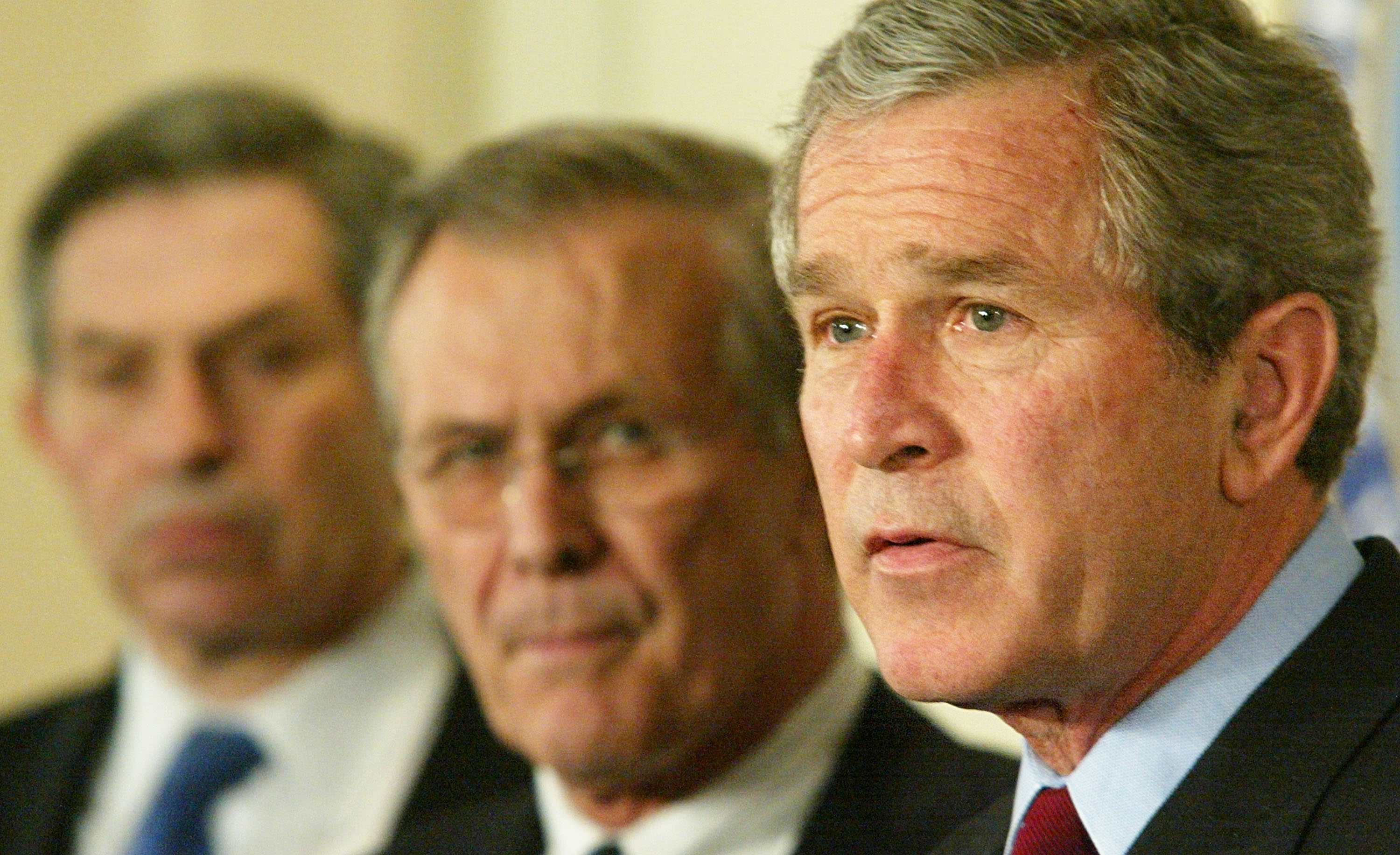
(Photo: U.S. President George W. Bush (R) speaks next to Defense Secretary Donald Rumsfeld (C) and Deputy Defense Secretary Paul Wolfowitz (L) during a visit at the Pentagon March 25, 2003 in Arlington, Virginia. Bush asked Congress for a wartime supplemental appropriations of $74.7 billion to fund needs directly arising from the war in Iraq and the global war against terror. By Alex Wong/Getty Images.)

Should Law School Last Two Years? Ctd

https://twitter.com/rawiniathompson/status/358796481152565249

Jeff Redding thinks the debate over shortening law school misses the real problem with legal education today:

This big-picture problem concerns many, many law students’ lack of exposure to political theory, history, sociology, and other disciplines which help make up what we call the liberal arts. Rather, what I often see are incoming law students who—to no fault of their own—have majored in fields like marketing, finance, and accounting, or even physical therapy. … I call this a problem for a number of reasons, some of which I will develop further in future posts, but for now I’d like to mention how difficult this kind of undergraduate education makes it to get law students (incoming and otherwise) to understand why there are legal disputes in the first place. Put succinctly, I commonly get responses in class and on exams (and in papers) that suggest an underlying befuddlement at why everyone in a given dispute can’t just apply ‘the rule.’

Previous blog debate on the subject here. A reader continues the in-tray debate:

Your readers miss the point entirely. Yes, it’s very nice to take wonderfully interesting classes – I loved the clinics and seminars I took my third year – but why should they be mandatory at a price of $50,000+? That is just insane.

Your reader who taught “street law” may have enjoyed it, but it is entirely useless and irrelevant to the day-to-day experience of a practicing attorney. And the idea that anyone who wants to be a lawyer should have to take these interesting classes, and sink deeper into debt to do so, is pure pie-in-the-sky bullshit.

Can you fathom medical school students being forced, after mastering all the science know-how and specializing in one area (which law students don’t even do), they had to do a fifth or sixth year where they took fascinating classes on the role of medicine in our society, or a seminar on the big toe? If it’s entirely irrelevant to their practical career paths, why force that debt load on them?

If I could take a year to study such nonsense as “Wealth, Democracy and the Rule of Law”, or just get a masters in early colonial American history or comparative government, I would do it in a heartbeat! That’s not the question. The question is: would I step up and pay $50K for the privilege to do so? Well, maybe, but first I have to finish paying off my goddamn law school loans.

Another:

Your readers’ comments are interesting, and I think there are a lot of interesting sub-issues involved with this discussion. I agree that students need more practical experience. The ABA is definitely run by people with some old-fashioned thinking, so that organization needs a shake-up. The number of people who go to law school who really shouldn’t is also a problem. Bankruptcy law regarding loans is insane. The bar exam is just institutionalized hazing and in no way reflects whether someone is qualified to practice law. There is no shortage of problems with law school, but the third year might not be the worst one.

Many people do get that extra practical experience through internships and clinics in your third year. Most people would be honest that during their first-year summers, they were mostly idiots, but by their third years they had a better sense of what they were doing. Perhaps for people like that, a better plan would be to front-load classes in those first two years and then allow firms and the government to hire third-years for full-time paid jobs as paralegals (or paralegals-plus). This way they could focus on the practical skills and get paid. Ideally they would not have to pay tuition, but I am not holding my breath on that one.

We should be discussing all these issues, but I think that the third year of law school really helped in my case. I am a tax lawyer, and tax is one of the areas of the law that is so complex and that changes so often that many people go on to get another law degree (an LLM) specifically for tax law. I frankly recommend it for people trying to break into tax law because it really can matter on your résumé. If I am hiring someone for a tax law job, I need to know that person knows more than just basics like constitutional law and contracts. I also want them to know how about corporate accounting and depreciation and capital gains and a host of other issues. An LLM gives people a background that can help with the hiring process.

I personally don’t have an LLM in tax, but I was able to secure a tax law job by interning in tax jobs every semester and summer after first year and by taking every tax and business class available in my law school during my second and third year in addition to the general bar exam classes everyone takes. My third year was basically my LLM. I had a hiring attorney tell me I was hired from my second-tier law school because I basically had an LLM already. So my third year saved me the money I see so many people putting into LLM programs after law school.

Not all kinds of law require an LLM, but if you aren’t spending your third year taking classes focused on exactly what you want to do with your law degree, then it is a wasted year and a wasted line on your résumé. And if you don’t know what you want to do with your law degree, then why are you shelling out hundreds of thousands of dollars for one? The third year should be your year to focus on practice and specialization year, but you have to know how to use it. Don’t waste it on Madden like Elie Mystal did.

The Congressional Leadership Backs Obama

Boehner supports the president’s decision to attack Syria:

CantorPelosi, and Reid have also voiced their support for intervention. Only McConnell isn’t onboard yet. Dreher sighs:

Unless there is a rebellion in the Congressional ranks, in both parties, we are going to do this thing. We are going to bomb Syria to make Syria safer for al-Qaeda and other Islamists. This country never, ever learns.

Benen, on the other hand, argues that passage still isn’t a sure thing:

[W]ith Boehner and Cantor endorsing the president’s position, GOP lawmakers will obviously have to consider whether to embarrass their own leaders while also embarrassing the president. They might very well do this anyway, but at a minimum, it should give rank-and-file Republicans pause. Indeed, if there’s a contingent within the caucus that’s inclined to follow the leadership’s call, and there’s a similarly sized element of House Democrats who’ll follow House Minority Leader Nancy Pelosi’s (D-Calif.) lead, then the odds of the chamber approving a resolution are probably slightly better now than they were a few hours ago.

The Fix is counting votes. Meanwhile, Galupo bets that any acts of bipartisanship won’t last:

If, as I suspect, a majority of Republicans vote aye on a strike against the Assad regime, they might feel emboldened to confront Obama on the domestic front. If politics stops at the water’s edge of foreign policy, as the cliché goes, Republicans will have earned a measure of good will from the media, and even, to a lesser extent, from the Obama administration itself. With Syria behind them, Republicans could thus reenter the budget and debt ceiling debates with renewed resolve: Okay, Barack; we’re on this side of the water’s edge again.

Horny In Houston

Miles Klee highlights a study:

[E]xperimenters set up duplicate “decoy ads” in the Casual Encounters section of Craigslist and the adult/escorts section of Backpage.com for 15 different cities, collecting the phone numbers and texts of everyone who replied. When all was said and done, they had amassed 677 points of contact and 451 numbers. On average, they estimated, under 5 percent of men in a metropolitan city area – supposedly just those “over 18,” as if a curious youngster wouldn’t lie on a terms of use agreement – are soliciting online sex ads. [They found that] some regions are a little hornier than others: “On average, within the 15 markets explored, one out over every 20 males over the age of 18 in a metropolitan city area was soliciting online sex ads. The findings ranged from approximately one out of every 5 males (Houston, 21.4 percent) to less than one of 166 males (San Francisco, .6 percent).

Update from a reader:

Let me assure you, more than 0.6% of men in San Francisco are looking for sex online. But not on Craigslist (what is this, 1998?) We have apps for that now.

Another:

I call bullshit on this study. The results were pretty sensational and the sample size seemed small – 451 numbers in 15 cities. That’s 30 people per city. So I looked up the actual paper to see if it was credible, and was not exactly impressed.

I’ve laid out an example of how they appear to be doing the math below, but short answer is that they appear to both make math errors and also make unrealistic assumptions to make their numbers look bigger. They even appear to have screwed up population data (which seems pretty hard to do).

Their methodology was to post two fake ads, assume the small number of responses was representative and random, do some math and assume every single other ad posted got the same response rate from a totally different set of customers. Their entire methodology is based on using repeat callers to estimate population sizes, but then they assume other ads get completely different “customers” calling in.

It’s ridiculous and they make much too sweeping claims from their research. Now, I was surprised at the levels of activity they cited other (presumably less grandiose) research as showing, but their research doesn’t appear to add much real evidence. I’m not even sure it’s useful as a measure of relative behavior between cities. They may just be capturing relative popularity of the particular sex sites.

I’m going to use NYC as my example because it’s the most obviously ridiculous. Their headline: 3.4% of men over 18 years old solicit sex online in NYC.

Ridiculous underlying data: They received responses from 7, yes SEVEN, people. Three of whom called twice. They extrapolated from this ludicrous sample an entire population estimate. And they made what appear to be two math errors in doing so.

Math error #1: They say there are about 21 thousand sex ad users, which implies NYC adult male population of ~500 thousand. It’s more like 3 million. Maybe they only considered Manhattan under the logic that Johns, like witches, cannot cross moving water.

Math error #2: My best estimate is that their own math would show an estimate of about 4,400 [((8+7)/4-1)*341.5] as the population using the formula from Chapman they provide and maximizing the possible values. Maybe they used one of their other (apparently arbitrary) methodologies, but they don’t actually say.

Combined these errors change their estimate by an order of magnitude so it’s more like 0.25%. Whoops.

Other cities are slightly less absurd, but it pisses me off when sloppy research gets elevated in the media because it tells a good story. I’m all for confirming my bias that Houston sucks, but this one isn’t fair.

The Other Southern Comfort, Ctd

A reader can relate to this post:

I have some seriously rednecked cousins-in-law down here in Florida, and if there are two things they are proud of, it’s their Southern heritage and their liberty. They still bristle over the Northern War of Aggression and consider anyone north of Orlando a Yankee. They all smoke pot, are still convinced Obama’s a Muslim, work hard, and will fight each other over anything. They would welcome legalization in a heartbeat. One less intrusion on their lives by the goddamned government.

Another illustrates that theme by pointing to the lyrics from “Team Party darling Charlie Daniels’ 1974 song, ‘Long Haired Country Boy'” (seen above):

“People say I’m no good, and crazy as a loon
‘Cause I get stoned in the mornin’, I get drunk in the afternoon…

“‘Cause I ain’t askin’ nobody for nothin’
If I can’t get it on my own
If you don’t like the way I’m livin’
You just leave this long haired country boy alone…

“A poor girl wants to marry, a rich girl wants to flirt
A rich man goes to college, a poor man goes to work
A drunkard wants another drink of wine, and a politician wants your vote
I don’t want much of nothing at all, but I will take another toke

“‘Cause I ain’t asking nobody for nothin’
If I can’t get it on my own
If you don’t like the way I’m livin’
You just leave this long haired country boy alone”

Another reader:

Your post mentioned Willie Nelson, which reminded me of a wonderful Texas Monthly article on the Outlaw Country movement, which brought the rednecks and hippies together in the early ’70s.  My favorite quotes:

BILL BENTLEY “The thing that turned Austin inside out was cocaine. The city got flooded with it.”

STEVE EARLE “It created a caste system. The democracy goes out when people are hiding in bathrooms because some can afford cocaine and some can’t.”

WILLIE NELSON “I never liked it. Eventually I told everybody, ‘You’re wired, you’re fired.’ If you’re going to play music, you better all be on the same drug. You can’t have a guy up here wailing away on cocaine while you’re laid back on a little pot. It just don’t work.”

Questions About Syria

Frum lists four. Among them, “What will it cost?”

A Syria campaign is being advertised as comparatively cheap in money and American lives. We’re promised “no boots on the ground.” But there’s another cost in danger of being overlooked: the opportunity cost.

The president, the secretary of state, the secretary of defense and other top officials have only so much time and energy. If they commit to resolving the Syrian civil war, inevitably they give second shrift, or third shrift, or worse to many other concerns of arguably greater importance to the region and the world.

Egypt, for example, seems to be heading toward the same civil strife as Syria. Who is developing the plan for helping to prevent that outcome? How much high-level support and attention are they getting?

Dave Schuler rattles off other questions:

Assume an attack on Syria is unsuccessful in the sense that Assad continues to use chemical weapons after the attack. What then?

Assume an attack on Syria is successful, Assad stops using chemical weapons (he might have done so anyway), but he is able to defeat the rebels without them. What then?

Assume an attack on Syria is successful, Assad stops using chemical weapons (he might have done so anyway), he is unable to defeat the rebels outright, and the civil war just continues. What then?

Assume an attack on Syria is successful and Assad, hamstringed in his attempts to preserve his regime, is ousted by the rebels. The rebels are radical Islamists. What then?

We attack Syria. Syria, Iran, or both retaliate by attacking Americans or American interests in the Middle East using asymmetric warfare techniques. What then?

We attack Syria. An American aircraft carrier is sunk by asymmetric warfare techniques (that’s actually occurred in war games of conflict in the Middle East). What then?