Susan Shepard highlights a 2005 tax case up for appeal, centered on the whether a man’s strip club provides genuine “artistic performance”:
The origin of the case stems from a provision in New York’s tax code that exempts dramatic and musical performances from sales taxes. The Court ruled that the stage and private performances taking place inside of Nite Moves did not qualify as such. But when courts make a determination as to what is and is not art, they are not on the most solid ground. As the dissenting opinion read, “It does not matter if the dance was artistic or crude, boring or erotic. Under New York’s tax law, a dance is a dance.” After that defeat, [owner Stephen] Dick hired First Amendment expert Robert Corn-Revere, who has petitioned the Supreme Court to hear their appeal.
She interviews anthropologist and dancer Judith Lynn Hanna, who testified in the case that stripping and lap dancing qualify as a “choreographed performance”:
A choreographed performance is a performance that has some plan. And it has some specific use of time, space, effort, and of body movement and posture. Just as a dancer on stage has a routine, whether she’s going to the mirror, whether she’s going to the pole, whether she’s changing flow over the performance, it usually very much depends on the dancer’s earlier background. Some people have had ballet, some have been in dance companies, some draw on moves they had as a cheerleader or social dancing, They watch television or they just watch the dancers who are already dancing and learn like most people learn, which is by watching or being coached.
So the issue was can you have improvisation? Well, of course. Even in a very choreographed ballet performance there can be interpretation by the specific dancer. Some people just think that you don’t dance when you are an exotic dancer or doing striptease, that all you do is get up and shake your booty.
Boris Kachka assembles a brief, detailed biography of the famously reclusive Thomas Pynchon:
There’s an apparent randomness to his public excursions, but mostly they hinge on ordinary personal connections. Take his decision to write liner notes for—and then do an Esquire interview with—a pretty good indie-rock band called Lotion.
Around the time his father died, in 1995, Pynchon went on an alumni tour of his old high school. He and Rob Youngberg, Lotion’s drummer, happened to be visiting the same music teacher. Dr. Luckenbill had taught them 25 years apart. Then Pynchon ran into Youngberg’s mother in an Oyster Bay bank, and she pressed Lotion’s new album on him. Pynchon dug it, and soon he was in their recording studio, taking notes and rattling off obscure facts about ribbon microphones.
“I just remember being amazed at how fluidly funny he was,” says Youngberg. His bandmate Bill Ferguson was copy chief at Esquire; the magazine pitched an interview, and, to everyone’s surprise, he agreed. The Q&A ran beneath text so strange Pynchon must have written it: “The reclusive novelist loves rock and roll, and its name is, well, Lotion. He wanted to play ukulele, so the band gave him an interview.” Ferguson was impressed by Pynchon’s knowledge, humor, and intensity—but also the skittish, mercurial quality of the interaction: “He’s somebody who just—you see him and he sees you. The thing I have in my head is Robert De Niro in Brazil. He knows the truth but he’s got to get out of here now: ‘Keep doing what you’re doing, I won’t be here long.'”
Philip Kennicott complains that the classical music industry has lost its way, stricken by a lack of confidence in what contemporary audiences want:
Many in the managerial class, especially those who first trained as musicians, care deeply about the rich, variegated, and complex history of classical music, but can find no practical way to offer that history to like-minded patrons. Instead they work with a caricature of the audience, dividing it into two classes, one made up of younger, adventurous listeners willing to try anything, and the other composed of older, problematic ones, who want only Beethoven’s Fifth night after night.
But the serious listener, who is adventurous and critical, open and discriminating, does not fit into either of these categories.
Among the most worrisome signs for the orchestra is how little concern there is for listeners who care deeply about the infinite variety of orchestra music—Mozart, Mendelssohn, or Lutosławski—but have little use for syncretic hybrids. As always, there is an economic explanation for the marginalization of the serious listener: interesting repertoire takes more time to rehearse, it is difficult to market, it cannot be repeated with the frequency of more popular fare. And serious listeners are resistant to the basic ideological sleight-of-hand behind so much programming: they do not believe that trivial music is worth the same investment as the core repertory, and so they vote with their feet and stay home. This gets them marked as fickle supporters of the civic institution.
Ashley Thorne co-authored Beach Books: What Do Colleges and Universities Want Students to Read Outside Class? (pdf), an analysis of the summer reading 309 American colleges assigned their incoming first-year students during the 2012-2013 academic year. The major findings:
1. Ninety-seven percent of colleges and universities chose books published in 1990 or later.
2. The most popular book by far was The Immortal Life of Henrietta Lacks.
3. Politically-themed books abounded.
4. Very few of the colleges with common reading programs chose classics.
The top two subject categories were Science and Multiculturalism/Immigration/Racism, and the top genres were memoir and biography. Some book types were notably missing from common reading assignments. Classic texts and books published before 1990 were scarce, and fiction was far outpaced by nonfiction. There were no classics of history; no biographies of, nor autobiographies, speeches, or writings by, American political leaders; no works by ancient philosophers; no works of the Enlightenment; no classical works of Christian, Jewish, Muslim, Hindu, Buddhist, or Confucian thought; and no scientific classics.
The faculty and administrators who devise these programs seem to think that unless the living author can stroll into the classroom and explain what she had for breakfast this morning, the students will be unable to “relate” to her written words. … Defenders of the choices say they want “accessibility” and “relevance”. Mark Twain, Charles Dickens, and even Zora Neale Hurston just don’t make the cut when it comes to relevant social issues. In response to critics, some of the colleges say that the books they pick are likely to be the “classics of the future”, but the turnover among the choices from year to year suggests either that we are due for an unprecedented avalanche of new classics or that most of these hunches are off the mark. …
The choice of a recent book that is often the only book students will have in common with one another points to the death of a shared literary culture. To the extent that colleges want to approach that culture, they display willful selfishness in confining their sights to the present. Contemporary books are worth reading, but their richness is many times increased by the knowledge of what came before. That knowledge is evanescent.
Sean Lee, a blogger living in Lebanon who’s skeptical of intervention, delivers a sharp message to fellow leftists:
[I]f your opinion of Syria is actually an opinion about the United States, I have no interest in hearing it, and it’s probably safe to say that most Syrians (or at least all of the ones I know) who are faced with the business end of the regime’s ordinance don’t either. I can’t think of a single Syrian who’s willing to get killed so you can flaunt your anti-imperialist street cred from the comfort of your local coffee shop.
I think taking a position of the US should not get involved through a military intervention is fine. DON’T put it as “Hands off Syria” implying this is some kind of American conspiracy. DON’T argue this is about US not having a right to taking sides in a civil war. DON’T make it all about money for home since we do want more humanitarian aid. DO frame it as what will help bring the suffering of Syrians to an end.
We’re used to hearing the charge of abstract moralism leveled at advocates of intervention: those puffy Western pundits and armchair generals who convert every instance of mass atrocity into a simple moral quiz best answered with cruise missiles. And it’s true: there’s usually an inverse relationship between the level of a commentator’s self-righteousness and their knowledge of the country they intend to throttle. Tiny, wretched countries like Iraq and Syria suddenly echo the threat of European fascists on the march. There’s been no shortage of this posturing among those makingthe case for intervention in Syria.
But Lee and Kudaimi, like anyone outside of the interventionist bubble, are often forced to interact with a different crowd that, through either ideology or exhaustion, is equally guilty. Just as misguided liberals or delusional neocons perceive militarism as a sign of ethical yet “hardheaded” foreign policy, many on the left and the Paulite right wear their anti-interventionism as a badge of honor, using a horror like Syria as a test of personal strength: it proves they’re not fooled by Washington’s propaganda or vulnerable to humanitarian appeals. And so arguments are reverse-engineered from a general attitude about the United States, global capitalism and waning empire.
For a taste, here’s self-appointed spokesman for the Arab world Robert Fisk, today:
If Barack Obama decides to attack the Syrian regime, he has ensured – for the very first time in history – that the United States will be on the same side as al-Qa’ida. Quite an alliance! Was it not the Three Musketeers who shouted “All for one and one for all” each time they sought combat? This really should be the new battle cry if – or when – the statesmen of the Western world go to war against Bashar al-Assad.
The men who destroyed so many thousands on 9/11 will then be fighting alongside the very nation whose innocents they so cruelly murdered almost exactly 12 years ago. Quite an achievement for Obama, Cameron, Hollande and the rest of the miniature warlords.
If you find it odd that this is the first thing Fisk has to say about a potential strike, you’ll begin to see Lee’s point above. When you’re rolling on a cocktail of sanctimony and snark, there’s neither time nor need for genuine analysis, as Lee points out:
It is the flip side of the rhetoric that was so evident in the run-up to war in Iraq that equated any opposition to an idiotic war with support for Saddam Hussein. Well, guess what? There are lots of perfectly fine opinions that might put you on the same side as al-Qa’ida. Just to name one: if you’re against drone strikes in Yemen, Pakistan and Somalia, as I am, then you’re also “on the same side as al-Qa’ida” according to this logic.
In short: don’t pretend your moral pageant has anything to do with what’s right for Syrians. The months and months of chatter over this war have been a fine reminder that moralism, from the left and right, is utterly useless in writing about the conflict. With little time left before the US makes a final decision whether to strike, anyone serious about Syrian (or Lebanese, or Iraqi, or Israeli) lives can drop the indignation and the piety. An honest observer’s thoughts look a lot less like this or this, and a lot more like this.
(Photo: Demonstrators hold up placards during a protest against potential British military involvement in Syria at a gathering outside the Houses of Parliament in central London on August 29, 2013. By Andrew Cowie/AFP/Getty Images)
Maria Bustillos traces the history of the bleep. Bustillos prefers it to the “dump button delay”, which “is different from bleeping in that the edit is concealed completely from the audience“:
The dump button provides a relatively insidious, more censorship-like form of editing, because its alteration of the original broadcast has been actively concealed. If we are to have disagreements about what constitutes acceptable media for a civilized general audience — and we should — they should be aired in every possible way. Through a very loud bleep, for example. And through litigation, and yes, complaints to the FCC. Through arguments at dinner tables and letters to the editor.
A bleep is honest, immediate, noisy. It’s the cultural superego in motion, calling attention to a difference of opinion regarding the offensiveness of the bleeped material. Here is this questionable thing; think about it for yourself, investigate if you like. In this way, the bleep is a literal demonstration of First Amendment principles: the 1KHz-sound of a community actively engaged in the process of establishing standards, and struggling to understand itself.
I thought I’d add to the discussion a bafflingly homophobic portrayal in a far more recent film: School of Rock. The “gay” (well, gender non-conforming) kid in that movie was ridiculed and undermined at every turn. His love of Liza Minelli – an extremely lazy joke – was presented as a mark of bad taste by Jack Black’s character, the hero of the film. All the other kids “get” rock, while the sad gay kid doesn’t. In the end, the costumes he creates (because naturally, right?) are summarily ditched in favor of the school uniforms. The kid is the only one in the movie who is not redeemed or transformed by his experience in the band.
I remember coming out of that movie thinking the filmmakers would be embarrassed by this portrayal in a decade or so. I hope they are.
Another circles back:
Your reader who recalled Billy Crystal’s Sammy Davis, Jr. impression may have forgotten that Crystal reprised the role when he hosted the Oscars in 2012. Did he get away with it? That depends who you ask: there were certainly many who expressed offense. On the other hand, Davis’ daughter defended Crystal. I think it’s plausible to argue that there’s a reasonable distinction to be made between blackface that is a generalized portrayal of a race and by definition insulting, and the portrayal of a specific person by a person who isn’t of the same ethnicity (or gender – was Will Farrell’s Janet Reno out-of-bounds?).
Anyway, as a fan of old movies who has been occasionally floored by the horrifyingly casual racism often found in them (the already mentioned Breakfast at Tiffany’s being the best example of this in my experience), I’ve enjoyed following this thread.
Another adds, “The reader who brought up Billy Crystal playing Sammy Davis Jr. 30 years ago probably hasn’t seen Robert Downey Jr. in the 2008 movie Tropic Thunder“:
Another:
Your reader is incorrect in writing that Billy Crystal wearing black makeup to play Sammy Davis, Jr. would never get away with it today. Fred Armisen wore black makeup to play Senator and then President Obama on Saturday Night Live from 2008 through the 2012-13 season. After some initial criticism, which was largely based on a why an African-American actor was not playing Obama, no one seemed to care.
Another returns to the theme of childhood classics:
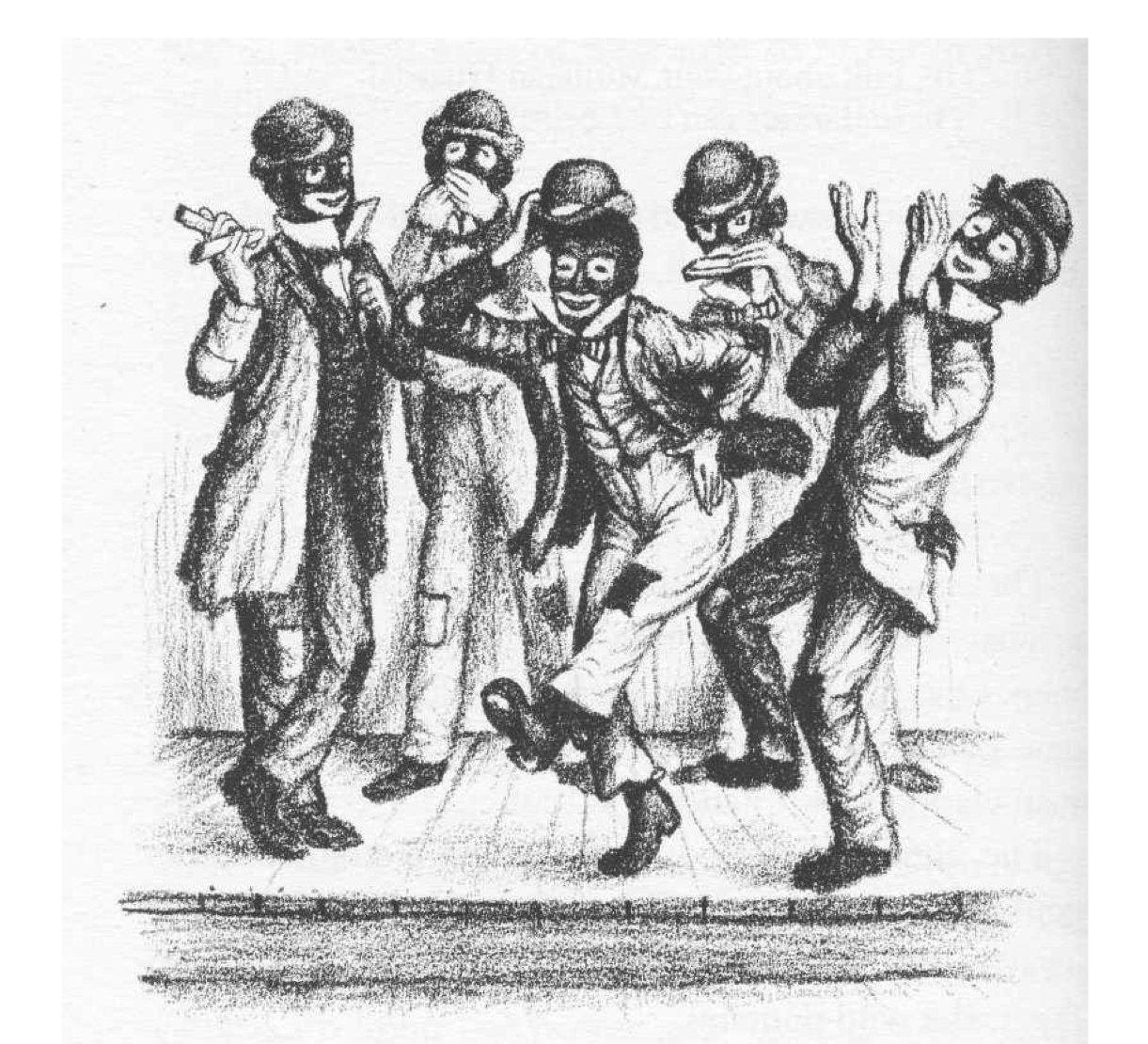
Having grown up in Wisconsin, I read Laura Ingalls Wilder’s classic series to my young daughter and discovered numerous passages that challenged me to stop reading, skip over, or explain. First, and astonishingly, Pa and Ma built the “Little House on the Prairie” in Indian Territory with the explicit intent of forcing the U.S. Army at Fort Gibson and Fort Dodge to expel the natives in favor of the white settlers. Then there is Ma’s constant racism and hatred of the Indians. And a schoolteacher whipping a child, Willie Oleson. And a fire-and-brimstone sermon threatening all with everlasting torture. And, in what must be one of the most amazing passages in children’s literature, Pa’s blackface minstrel show presented to the fulsome delight of the town and his family, singing:
Oh talk about your Mulligan Guards!
These darkies can’t be beat!
We march in time and cut a shine!
Just watch these darkies’ feet!
Throughout all this, I decided to read the text as written and answer any questions as they came. These episodes are offset by the deathly sick Ingalls family being saved by a black doctor, by Laura’s laughter at the sermon, by the individual and collective dignity of the Indians, and by the matter-of-fact truthfulness that all this was really a part of Laura’s world. But I drew the line at showing this illustration of Pa in blackface:
One more reader:
I’d like to offer a limited defense of Dumbo’s crows. No one should dismiss genuine hurt, even if the filmmakers achieve it by ignorance and carelessness rather than malice. Privileged white filmmakers, particularly those working for Walt Disney, do not deserve the benefit of the doubt.
But I do think the depiction of the crows in Dumbo is more complicated. These are highly sympathetic characters. They are smart – much smarter than the childish Dumbo, smarter than the “bad” elephants and circus-master, and even smarter than wisecracking Timothy J. Mouse. It is the crows after all who devise the “magic feather” that allows Dumbo to realize his potential. It is not at all a coincidence that Dumbo, who has been judged by his appearance, consistently terrorized and humiliated, and separated from his only source of genuine love can only find true allies at society’s margins – these put-upon black crows understand his plight all too well. At the film’s finale Dumbo is flying triumphantly with these crows – his friends and most trusted supporters.
They are of course explicitly coded as African-American. It is painfully clumsy at times (but no clumsier than the revered “Porgy and Bess”). Their musical number is not minstrelsy but a fairly faithful song in the style of popular black acts like The Mills Brothers. The singers are African-American – Hall Johnson’s Chorus – and they perform earnestly, not mocking the style. The crows are a bit silly during the song (it is a children’s film) but none of the humor has any racial logic like the awful Native-American sequence in Peter Pan. The worst aspect is the dialect, which is clearly written by writers unfamiliar (or uninterested) with the way black people actually speak.
I think parents showing this film to kids need to spotlight the depiction and explain how it misses the mark. But I think we deprive today’s kids by censoring the film outright. A film ultimately about love and understanding of those who look different than us is too rare to abandon.
The Van Gogh museum in Amsterdam has developed high-quality 3D reproductions of some of its finest paintings, with what it describes as the most advanced copying technique ever seen. Axel Rüger, the museum’s director, said: “It really is the next generation of reproductions because they go into the third dimension. If you’re a layman, they are pretty indistinguishable [from the originals]. Of course, if you’re a connoisseur and you look more closely, you can see the difference.”
Izabella Kaminska believes that, eventually, “it is highly likely that the naked eye will no longer be able to differentiate between reproductions and originals, and that the only way to know for sure which is which will be to carbon date or test the materials microscopically”:
Value then becomes entirely an eye of the beholder thing. In logical terms the value of the Mona Lisa should collapse, especially so if the clue to authenticity is lost or diluted entirely. If the painting stays valued it’s because a narrative, myth of belief system has been attached to that particular version of the object — much as happens with sacred relics or superstitious charms.
When paintings become worth millions of dollars, it’s not because of some intrinsic aesthetic value.
If it was, then known fakes would be valuable, rather than worthless, and outfits like Artisoo would be serious operations, rather than laughingstocks. We value certain objects because they are handmade; because of whose hand made them; and because they are historically important. This is the unique actual painting that Vincent Van Gogh painted in a certain month in 1890, these are his actual brushstrokes, his actual paint; this is a key part of the oeuvre which changed the course of (art) history. There is only one of this painting, it exists in a certain museum, and if you want, you can do the pilgrimage: get on a plane, and fly to Amsterdam, and visit the museum. Kaminska sneers at “sacred relics”, but the financial and sociological and art historical value in these paintings makes them much closer to being sacred relics than they are to being purely decorative works, admired just for what they look like.
(Image: A detail from a 3D printed painting. Van Gogh Museum Amsterdam.)
Maureen O’Connor profiles a victim of “revenge porn” in New Jersey, the only state where the sick practice is illegal:
[Anonymous victim “A”] remembers shooing her young cousins away during a back-to-school shopping trip at Target, when an older man approached to compliment “your pictures.” Another time, printouts of her nude photos were left outside her front door.
A’s story is remarkable not because of the personal betrayal it involved or the public humiliation of having an X-rated digital doppelgänger. Those things happen to countless victims of “revenge porn,” the term for sexually explicit images distributed without the subject’s consent, whether by an ex-boyfriend or anonymous hackers. What’s truly remarkable is that the legal system took interest in A at all.
For victims elsewhere, the legal system provides few options:
At the heart of a burgeoning movement to change that is End Revenge Porn, the advocacy group that A began volunteering for in the wake of her nightmare experience. It’s the brainchild of Florida resident Holly Jacobs, who went public last spring with her five-year battle against a pornographic attack so pervasive it led her to change her name. She has since built a network of around 50 victims and legal experts advocating for laws banning revenge porn, and she’s now spinning End Revenge Porn into a nonprofit called the Cyber Civil Rights Initiative. She works with lawyers, academics, and legislators — including California state senator Anthony Cannella, who has sponsored a California bill to make revenge porn a misdemeanor, punishable by up to six months in jail for a first offense; the popular bill is under consideration right now.
But Lux Alptraum argues new legislation is misguided:
[R]evenge porn is already illegal. Distributing pornographic content without maintaining an extensive database conforming to the specifics of 18 USC 2257 records keeping requirements is a criminal offense. So are harassment and stalking, which could be interpreted to include revenge porn. If it’s already on the books as illegal, why do we need more laws to specifically call it out as illegal? And, more pressingly, if the existing laws aren’t enough to deter and punish the distributors of revenge porn, how can we genuinely believe that one more law is going to fix the problem?
A new NBC poll finds that an overwhelming majority of Americans think Obama should be required to get approval from Congress before attacking Syria. A chart on the key question:
If President Obama is feeling lonely after the British vote, asking Congress to debate military action would give him excellent cover for either gathering support or backing away from unilateral warmaking — and it would also abide by the Constitution. That’s an approach Barack Obama himself would have approved, not so many years ago.
Larison continues to doubt that Obama will bother to get congressional approval:
If Obama doesn’t think he is legally required to go to Congress, wouldn’t it still make sense politically to involve Congress and get their backing for his attack? It might seem so, but the case for the attack is so weak that it wouldn’t withstand much public scrutiny, much less debate in both houses.
Because the proposed military action is supposed to be brief and limited, Obama probably sees going to Congress as a useless headache and unnecessary complication. Of course, it shouldn’t matter whether he feels like doing it. Unlike Cameron, he is obliged to do this when he plans to initiate hostilities against another state. It is up to members of Congress and the public to make him fulfill that obligation. Unless that happens, Obama will go ahead with the attack as if Congress is irrelevant because it will have proven itself to be exactly that.
The lesson Amy Davidson hopes Obama will take from Cameron:
Obama may take the British vote as proof that he can’t risk putting himself in Cameron’s position. But facing Congress after things don’t go according to plan—if there even is a plan—would be all the more humiliating. Obama can’t win this the way that Cameron lost it: by talking as though he is the only one acting according to principle, and that those who disagree just haven’t seen enough pictures of the effects of chemical weapons. There are principles at work in wondering whether something that feels satisfying but causes more death and disorder is right, too. The real Cameron trap is thinking that a leader can go to war personally and apolitically, without having a good answer when asked what’s supposed to happen after the missiles are fired. Does the President get that?




 The Dish