Ending Their Psychological Misery

by Jessie Roberts

P.W. Buchanan discusses a study that compared seniors who committed suicide to seniors who died from natural causes:

While debate about the ethics of elder suicide tends to revolve around terminal illnesses and loss of autonomy, those end-of-life issues didn’t turn out to be the common causes of real-life suicides among the elderly. The study found that those who took their own lives actually had less impairment of “functional autonomy” in their final months of life. Those who took their own lives also had fewer chronic health problems than those who died naturally. “In our study,” the report observes, “suicide cases were found to have a lower risk of having cancer, emphysema, and cardiovascular disease at the time of death.”

Now, one could posit that these elderly people had decided to end their lives precisely because they were still able to and because they anticipated imminent impairment. Significantly, however, the study found that mental health, most notably depression, was a variable that showed up much more frequently in the suicide cases than in the control cases. Based on the psychological autopsies, “the suicide cases were ten times more likely to present a current psychiatric disorder during the six months preceding death than the controls.”

All of which complicates how we think about elder suicide. It might be another vestige of dogma, but why am I more inclined to privilege physical pain and external circumstances when I consider the ethics of suicide? Why does internal pain, in the form of mental illness and chemical imbalance, strike me as a less acceptable reason? And isn’t this why physicians’ opinions are part of the law—because we want to limit suicide to those who are unarguably rational?

Recent Dish on suicide here, here, and here.

Laying Off The Loudness

by Chas Danner

Nine Inch Nails has decided to release its new album, Hesitation Marks, in two versions, one mastered with maximized loudness in mind (as is the norm with virtually all mass-market music released today) and the other meant to respect the more natural dynamic range of the album as it was recorded in the studio. Dan Seifert explains why this is important:

This second “audiophile master” mix is the latest salvo against the overbearing loudness of pop music today, and, according to the band, it’s the first time that anyone has mastered the same album twice for different audiences.

Most songs produced today are louder than ever before, and have less variance between the loud and soft sounds within their tracks. This “brickwall” method of mixing music (which refers to a very compressed and loud audio track) is generally derided by audiophiles because it eliminates the delicate tones that can be heard with quality audio equipment.

Seifert adds that, “Chances are, audiophile-quality mixes of music will never really make the mainstream: for most people, pop music is too ephemeral to waste time, money, and storage space on higher-quality tracks.” But Zach Schonfeld thinks artists and audio engineers have a responsibility to ratchet back the loudness, seeing the alternate version of Hesitation Marks as an unfortunate half measure:

Famously attentive to every millisecond of sound, each snare hit and synth bubble, [Nine Inch Nails’ Trent Reznor is] throwing a bone to the thick-spectacled audiophile corner of his fanbase: He’s offering them a higher-quality product. But he’s also drawing a line in the sand between audiophile and average listener and suggesting that sound quality is only of interest to the former. Reznor is challenging the Loudness Wars, yet simultaneously capitulating to the new normal by offering up the “Audiophile Version” for a niche audience only.

This is a shame. As his producer, Alan Moulder, writes, “It is a fact that when listening back-to-back, loud records will come across more impressively, although in the long run what you sacrifice for that level can be quality and fidelity.” So why not just release the audiophile version on CD and vinyl and let it speak for itself?

Schonfeld also recommends Nick Southall’s fine 2006 essay on the Loudness War, a key section of which is excerpted below:

There are two ways to measure “loudness”—peak levels and average levels. The former refers to the loudest part of a piece of music or sound; a crescendo or climax. The difference between the highest and lowest points makes for the average level. Sadly, the science of psychoacoustics suggests our ears generally respond to the average level rather than the peak level of volume—hence we would perceive a consistently loud piece of rock music as being “louder” than a piece of classical that reaches the same or even a higher volume level during a crescendo, simply because the rock song is “loud” all the way through. “Loud” records grab our attention (obviously—being louder they are harder to ignore on first impression) and in order to grab attention quicker and more effectively in a crowded marketplace, record companies and artists have been striving to make their records as loud as possible from the second the first note is played, whatever the cost.

This isn’t a recent thing. The “Loudness War” has been going on almost as long as pop music has existed, and probably longer—nobody has ever wanted their record to be the quietest on the jukebox or the radio. The Beatles lobbied Parlophone to get their records pressed on thicker vinyl so they could achieve a bigger bass sound more than 40 years ago. The MC5 apparently mixed their second album, Back in the USA, at such extreme volume in the studio that they failed to notice how tinny and thin it sounded—there’s practically no bottom-end to it at all. Then there’s Phil Spector’s legendary “wall of sound” production style, mixed and mastered to sound good on tiny, tinny transistor radios, squeezing as big a sound as possible into as small a space. Three or four decades ago record companies would send out compilations of singles to radio stations on a single vinyl record—if a band or producer heard their song on one of these and it was quieter than the competitions’ song, they would call the mastering engineer and get him to up the levels until it was the loudest, even if that meant corrupting the sound quality.

Civil Rights Illustrated

by Chas Danner

Nate-Powell-March-Book-One

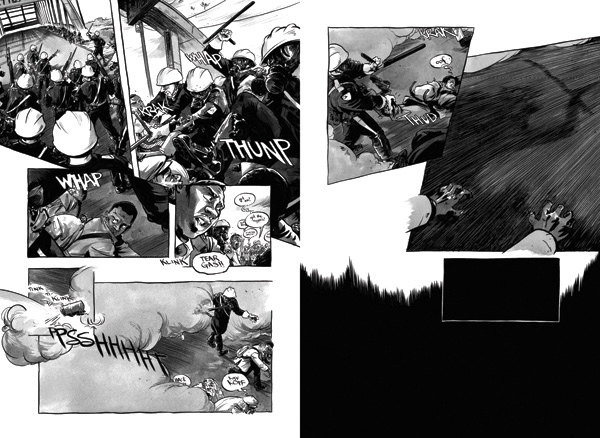
A popular new graphic novel, March: Book One, takes a look at the civil rights movement through the eyes of Congressman John Lewis. Aaron Colter explains why Lewis embraced the project:

Lewis — who spoke at the March on Washington, participated in lunch counter sit-ins, marched miles for social justice, and was jailed on several occasions — remembers another lesser-known but still influential tool for getting out the message of the movement: a 10-cent comic book. Titled Martin Luther King and the Montgomery Story, the comic told the story of Dr. King and the 1955 bus boycotts inspired by Rosa Parks while offering recommendations for non-violent protest tactics borrowed from Mahatma Gandhi. “We read the book in Nashville, Tennessee, and we started sitting in,” said Lewis at the recent Book Expo America. “[This book] has been translated into more than four languages, and it’s been read and inspired people in the Middle East, in Vietnam, especially in Egypt.”

In her review earlier this month, Hillary Brown raved about March: Book One‘s artwork, illustrated by Eisner Award-winning artist Nate Powell:

There’s no question that Powell is one of the most exciting visual talents on the scene, and part of what makes his illustrations a delight to look at is the ease with which he conveys complicated situations. His abilities are particularly evident with text, which skitters and whips around the edges of panels. Often, characters far away are talking, and we see their dialogue rendered so delicately that you can almost read it, but not quite. When action overlaps from one panel into the next, it’s done so seamlessly that it hardly calls attention to itself. Every once in a while, we get a big, dark night scene in the country, reminiscent of the 1930s WPA prints of the South, with a tiny house dwarfed by trees and encroaching black negative space. It’s easy to see the heroes of the civil rights movement as more than human, but the words and pictures work together in March (Book One) to put the everyday back into their lives and, in doing so, enrich the story beyond mere hagiography.

Browse a preview of the book here.

Turning That Frown Upside Down, With A Scalpel

by Patrick Appel

Gwynn Guilford reports on the latest development in South Korean plastic surgery:

Smile Plastic Surgery

[A] new technique called “Smile Lipt” carves a permanent smile into an otherwise angry face. The procedure, whose name combines “lip” with “lift”—get it?—turns up the corners of the mouth using a technique that’s a milder version of what Scottish hoodlums might call the “Glasgow grin.”

… The procedure is, as KRT reports, increasingly popular among men and women in their 20s and 30s—especially flight attendants, consultants and others in industries aiming to offer service with a smile.

She speculates that, “as with the popularity of other cosmetic procedures in South Korea, which have made it hard for the natural of face to compete for jobs, permanent smiles may too become the norm.” Jonathan Coppage worries about the mainstreaming of this procedure:

If one stays agnostic on the medical ethics of cosmetic surgery, the procedures become a matter of free choice and open markets, where patients and doctors have the freedom to arrange an operation, as long as there is no coercion. But the South Korean example is a very effective demonstration of the ultimate limits of a libertarian paradigm revolving around atomistic free actors. Individuals “with photos of starlets whose face they want to copy,” aggregate to create new norms, because they are part of a social order. And social order inescapably comes with the soft coercive power of conformity.

(Photo: Before lipt surgery on top; after surgery on the bottom)

The NFL Tackles The Greatest Threat To Its Survival

by Patrick Appel

NFL Head Injuries

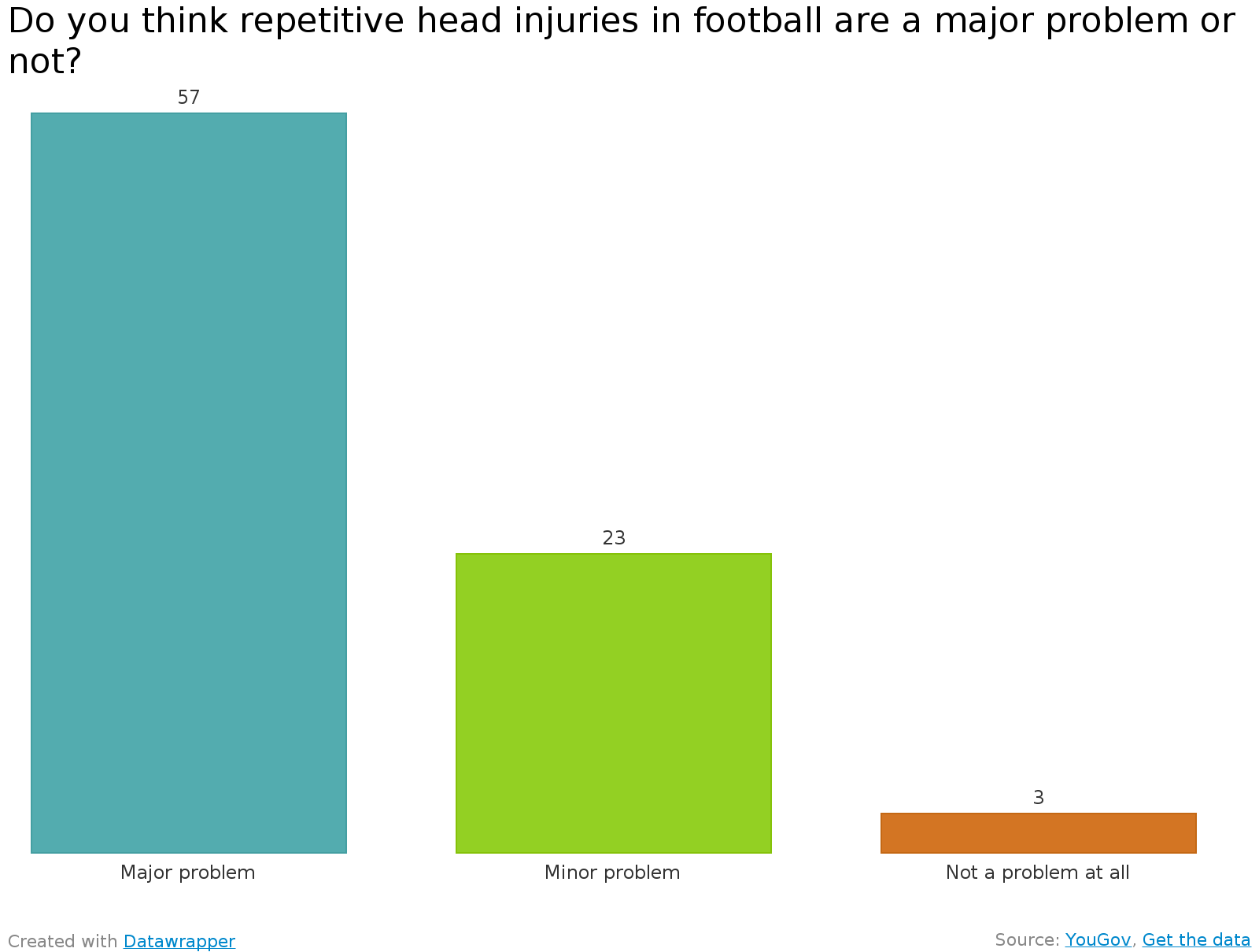
Yesterday, the NFL settled the head injuries lawsuit brought against it by thousands of former players. Jonathan Mahler thinks the settlement is puny:

It was inevitable. Of course, the National Football League wasn’t going to enter into a lengthy discovery process in which it would have to tell the world what it knew — and when — about the dangers of playing professional football. Of course, the NFL wasn’t going to risk a multibillion-dollar verdict. Of course, the NFL wasn’t going to go into another season with this massive lawsuit — featuring at least 10 members of the Hall of Fame as plaintiffs — still hanging over its head.
What is surprising is the paltry size of the settlement that the NFL has gotten away with. The lawyer for the plaintiffs, Christopher Seeger, has said that avoiding litigation will allow players and families in need to get urgent medical care sooner rather than later. Fair enough. But it’s still a sweetheart deal for the NFL: just $765 million, paid out over 20 years. To put that figure into context, the NFL’s 2012 revenues totaled $9.5 billion. Better yet, the league’s estimated revenue for 2025, when it will still be handing out loose change to the families of players who committed suicide after suffering from chronic traumatic encephalopathy, are projected at $25 billion.

Ben McGrath makes related points:

The rough per-capita payout—given that all of the N.F.L.’s current retirees are eligible for compensation, and that it is estimated that there could be as many as twenty thousand of them—could come to less than forty thousand dollars, to be disbursed over a period of a couple decades.

(And not all of the money is actually going to compensation—$75 million will be spent to pay for medical exams, and $10 million is earmarked for research and education. The $675 million that the players will receive won’t be distributed equally; some will get more, up to a maximum of $5 million—others, presumably, much less.) No, it’s not “chump change,” but neither is it much of a hit to the bottom line of the world’s most profitable sports league, an organization that was being sued by almost a quarter of its former athletes. The rights to televise “Monday Night Football” alone are worth one and a half billion dollars a year to the N.F.L., or about twice the size of the settlement. The league’s annual revenues approach ten billion dollars. What’s more, in settling early, the league escaped discovery and depositions that might have revealed more about what it knew, and when. The terms are explicitly agnostic on the subject of whether the plaintiffs’ injuries were caused by football; the N.F.L. admits no liability. What concussion crisis?

Sean Gregory explains why the NFL’s players accepted the settlement:

“[The NFL] is going to say, ‘did your brain damage come from your college hits?’” says Christopher Seeger, co-lead counsel for the plaintiffs.  ”From your pro hits? Do you have a documented history of concussion? Can you prove you were concussed? Can you prove concussions even caused your neurological problem?” In this settlement, players just have to show signs of impairment in order to receive a payout. “They don’t have to prove any of those things,” says Seeger.

Daniel Engber wishes more money had gone to research:

In the past few years, the NFL has disbursed more than $100 million on concussion research, and the Player’s Association has been spending money, too. Still, it’s troubling that as part of its final deal with plaintiffs, the league set aside just $10 million more for purposes of “research and education.” We’re talking about barely more than 1 percent of the total pot, and not all of it will go towards doing science. According to the settlement, that fund will also pay for outreach projects such as one promoting “safety initiatives in youth football.” In light of what we know—and don’t know—about concussions, these are almost guaranteed to be a waste of money. You can’t promote “safety” in football, youth or otherwise, until you understand—scientifically—how dangerous it really is.

And Travis Waldron wonders what the NFL will do next:

While it’s a small step forward, larger questions remain about the future of the game. The NFL has taken significant actions in recent years to help reduce concussions and brain injuries in its game, changing rules, requiring evaluations from independent doctors, and improving testing and treatment procedures. It has couched much of that in gibberish as it refused to explicitly acknowledge the dangers of concussions, but perhaps the absence of major litigation will now allow it to speak frankly about the need to make its game safer — and about the need to improve safety at the college, high school, and youth levels too.

The Dish’s thread on pro-sports head injuries is here.

(Chart from YouGov)

Why Do Chinese Tourists Have Such A Bad Rep? Ctd

by Chris Bodenner

New York City scenes

I’m surprised a dissent like this one didn’t come sooner:

This thread has gotten really ugly really fast. Your blog is now (once again) becoming a place for undiluted bigotry. There are BILLIONS of Chinese people. Is it really proper to tar that whole group with a broad brush because a small number of Chinese tourists have acted badly? (I’m glad my ethnic heritage allows me to be coy about my nation of origin; if I want to pretend I’m Canadian overseas to avoid anti-American bigotry, I have that option.)

A reminder that all the anecdotes from Dish readers are based in a broader reality, not mere stereotype:

Recent examples [of Chinese tourists behaving badly], which have sparked a firestorm of commentary in both Chinese and Western media, include a group of snorkelers who caught and ate endangered sea creatures off the Paracel Islands, visitors to North Korea who threw candy at North Korean children as if they were “feeding ducks”, swimmers who took pictures with a dying dolphin, and a teenage boy from Nanjing who scratched graffiti on a 3,000 year-old relic while touring Egypt with his parents. In response, Chinese officials are making a concerted effort to improve the behavior of Chinese travelers abroad, issuing a list of guidelines that include no spitting, cutting lines, or taking your shoes and socks off in public. Vice Premier Wang Yang has stated that “improving the civilized quality of the citizens” is necessary for “building a good image” for the country.

As the thread has shown repeatedly, the perceived rudeness of Chinese tourists is a symptom of the PRC’s rapid ascension as a wealthy nation – a nation that now has the disposable income to enable a middle class to join the global tourism market in droves. So the thread, in a way, is actually a tribute to China. Its newly-prosperous people, like others before them, just need time to acclimate to the etiquette of traveling abroad. And after all, as our first post pointed out, “Americans are still widely viewed as the world’s most obnoxious tourists.”

Back to the thread: Many readers are recommending a wonderful essay by Evan Osnos, who accompanied a Chinese tour group through Europe a few years ago:

Until recently, Chinese people had abundant reasons not to roam for pleasure. Travelling in ancient China was arduous. As a proverb put it, “You can be comfortable at home for a thousand days, or step out the door and run right into trouble.” Confucius threw guilt into the mix: “While your parents are alive, it is better not to travel far away.” Nevertheless, ancient Buddhist monks visited India, and Zheng He, a fifteenth-century eunuch, famously sailed the emperor’s fleet as far as Africa, to “set eyes on barbarian regions.”

Over the centuries, Chinese migrants settled around the world, but Mao considered tourism anti-Socialist, so it wasn’t until 1978, after his death, that most Chinese gained approval to go abroad for anything other than work or study.

First, they were permitted to visit relatives in Hong Kong, and, later, to tour Thailand, Singapore, and Malaysia. In 1997, the government cleared the way for travellers to venture to other countries in a “planned, organized, and controlled manner.” (China doles out approvals with an eye to geopolitics. Vanuatu became an approved destination in 2005, after it agreed not to give diplomatic recognition to Taiwan.) Eighty per cent of first-time Chinese travellers went in groups, and they soon earned a reputation as passionate, if occasionally overwhelming, guests.

Back to the inbox, a reader underscores a cultural rift between people from Hong Kong and those from mainland China:

Oof, your thread hits really close to home for me. I suspect that you guys have been getting droves of emails with horror stories about badly-behaved Chinese travelers blazing paths of destruction all around the world. While I don’t have any novel reasons about why some Chinese tourists behave so badly, I wanted to share my perspective as a Hong Konger who encounters many mainlanders daily (I live right next to a mid-market shopping outlet which has become a popular tourist destination).

As a former British colony, Hong Kong already has a complicated enough relationship with its current overlord. Political differences aside, though, a whole lot of Hong Kongers truly resent the increasingly heavy presence of the mainland Chinese here. There is a perception that they are responsible for (or exacerbate) many of the city’s social ills: wealthy mainlanders snapping up new apartments in HK as real estate investments and thus driving up housing costs for everyone; “parallel traders” who travel from China to Hong Kong every day and buy out entire stores’ worth of infant milk formula (a good that is much more expensive on the mainland than in Hong Kong, so a tidy profit can be made by reselling it across the border), leading to a shortage of formula for HK mothers; pregnant mainland women entering Hong Kong on tourist visas to give birth in Hong Kong hospitals, etc, etc.

And then there are the mainland Chinese tourists.

Unlike the parallel traders and the nouveau riche apartment collectors, who are largely seen as takers but not contributors to the city, Hong Kong benefits from the money of Chinese tourists (who accounted for a whopping 72% of HK’s tourists in 2012) – but very, very begrudgingly so. (Irony #1.) The reason for the animosity? There is a concept in the Chinese language called “公德心” (pronounced gong duk sum in Cantonese, gong de xin in Mandarin, and many Cantonese blogs and forums also write it this way: “公得心”), which roughly translates into “consideration for the public.” This concept acknowledges that every individual is ultimately part of a collective, and as such we each have the responsibility to take good care of the collective. In practice, someone who has 公德心 is always aware of the effects of his/her behavior on others who share our public spaces, and is careful to respect the way those spaces should look/sound/smell. Now, this isn’t an idea that is exclusive to Hong Kong, but a common refrain among its denizens is that the majority of mainland Chinese tourists simply do not have 公德心 when they should.

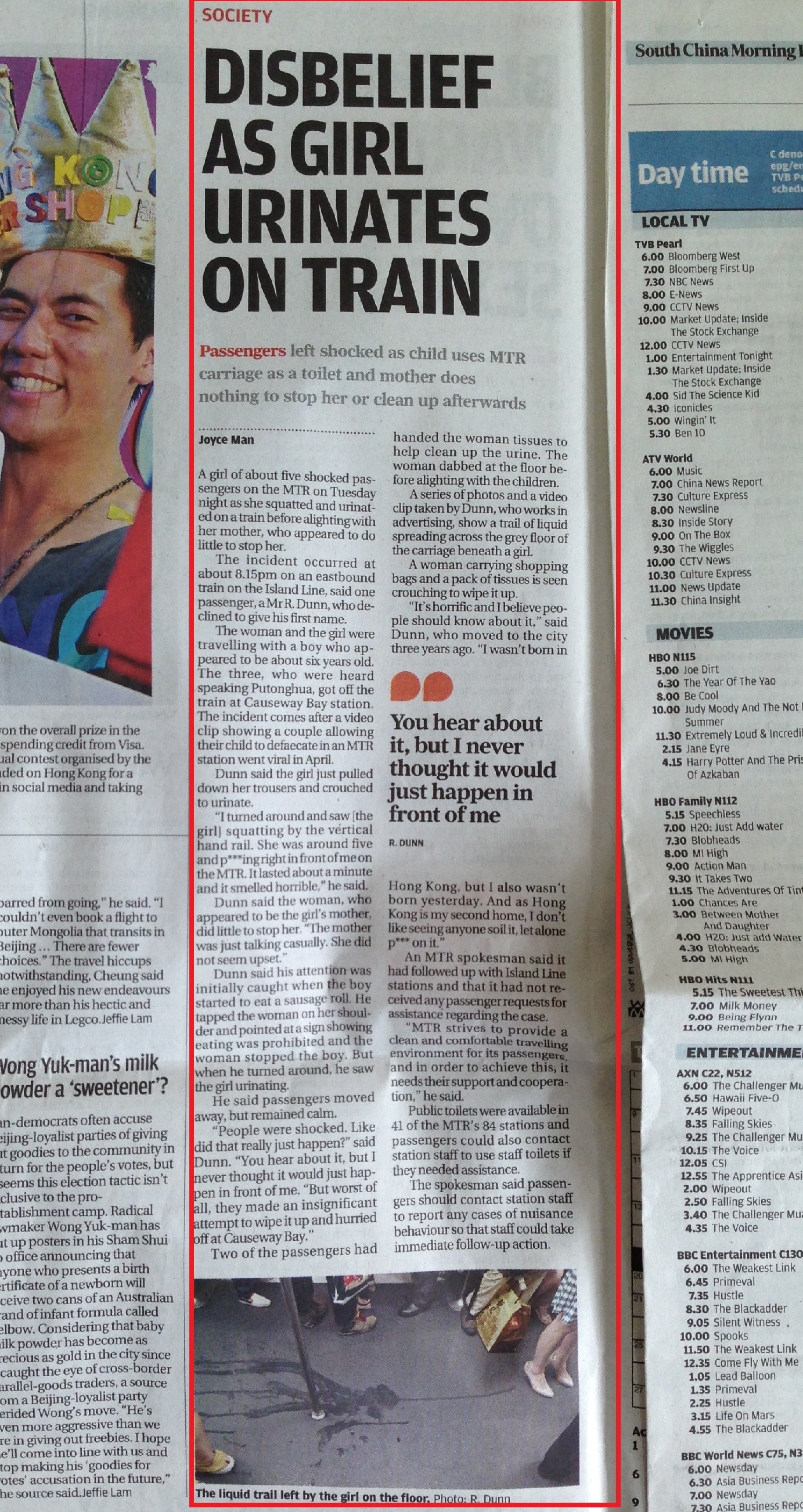
When we say that mainlanders lack 公德心, it means that they talk too loudly in public, spit on our sidewalks, push and shove on public transportation, and jump queues (this last one is IMG_3129especially infuriating because there is always a sizable line for anything you want to do in Hong Kong, whether it’s for McDonald’s or tickets to see the Big Buddha or adding more money to our Octopus cards). Where things should be orderly, people without 公德心 bring chaos. Just a couple of weeks, ago, the South China Morning Post published an article entitled “Disbelief as Girl Urinates on Train” – along with a reader-submitted picture, no less! – about an unidentified mainland child who with the permission of her mother pulled down her pants and peed in a MTR (subway) carriage. Funnily enough, the collective disdain for the ill-mannered mainland Chinese rube has fostered not only a sense of anti-mainland prejudice but a sort of Hong Kong “pride” (Irony #2): many think (whether rightly or wrongly) of Hong Kongers as being more polite, cultured, classy–a better strain of Chinese people overall. We cluck our tongues when even North Korea shakes its head at Chinese tourists; we feel validated whenever some other country’s citizens point out how rude they can be.
Of course, the kicker is that even while many Hong Kongers agree with the stereotypes and feel superior for being from Hong Kong, they are also terrified of being mistaken for mainlanders when they travel overseas. (Irony #3.) It was mentioned in this thread that mainland Chinese tourists often join together in big group tours because it is easier to get visas and easier to navigate cultural/linguistic barriers; Hong Kongers often do the same thing for the same reason. I myself am traveling to the East Coast with my mother and my 79-year-old Malaysian great-aunt in September to visit my brother. All three of us speak English fluently, but even my normally mild-mannered and even-keeled mom has voiced concerns about how we can best avoid looking like mainland tourists and what to do if someone hurls anti-Chinese slurs at us. So I suppose this is just one more grievance Hong Kongers have against the impolite mainland tourist: they make the rest of us ethnic Chinese look bad, too. (But we’ll gladly take their dollars.)

It’s a catch-22: we can’t live with them, and we can’t live without them.

Finally, I just wanted to respond quickly to your reader’s story about the older Chinese couple traveling to Adelaide: it may be the case in Chinese culture that the young are hesitant to criticize the old, but a grown child should not be allowing his parents to perform all the physical labor, either. True filial piety would have dictated that an able-bodied adult son pick up the luggage off the carousel at the direction of his parents. My mom probably would have smacked me if I’d let her struggle and fall all over the bags while I watched from the back.

(Photo: Chinese tourists take photos on Wall Street near the New York Stock Exchange, NYSE, on April 11, 2013 in New York, New York. The growing affluence and openness in China allows the Chinese to travel. By Melanie Stetson Freeman/The Christian Science Monitor via Getty Images)

When Childhood Classics Aren’t Innocent, Ctd

by Chris Bodenner

Another classic cartoon is thrown in the mix:

Have you guys seen Dumbo? Pay close attention to the crows that appear near the end and teach Dumbo to fly. The stereotypes deployed with these characters is almost unbelievable by today’s standards. And yet, not only are they essential to the plot, but Disney has expanded the profile of Dumbo in the new Fantasyland at the Magic Kingdom in Walt Disney World here near Orlando.

If children going to the new Fantasyland haven’t seen Dumbo yet (it was released in 1941), they probably will want to see it after visiting. And then they’ll see these guys (one of whose name is actually “Jim Crow”!). While their end purpose in the movie is certainly admirable, they are portrayed as cavalier bullies at first, and the way they’re berated by Timothy Mouse is just unreal in today’s context. Hell, Song of the South is almost expunged from vision at Disney, but here’s Dumbo, portrayed in their featured theme park as one of their touchstone old films. Don’t they get it?

Another actually defends blackface, in a way:

There is a contemporary assumption that it is inherently racist for a performer to perform in blackface. Obviously this was not always the case. As recently as the mid 1980s, Billy Crystal regularly appeared in blackface to do his Sammy Davis Jr. impression:

Though of course the blackface he used was quite different from the minstrel show variety featured in your thread, where performers have their mouths accentuated, clown-like, with white makeup. Still, Billy Crystal would NEVER get away with that today. But why not? His intent wasn’t racist. It was realism. He also wore a wig and a false moustache. So the dark makeup was of a piece with the rest. But cultural norms change.

Still, the assumption that a blackface performance from the 1930s or ’40s is racist just doesn’t seem on the mark. I had a pop-culture professor back in grad school who was always going on and on about the minstrel show. He actually wrote a book on the subject. He saw the minstrel show as the sort of wellspring of all sorts of musical styles that followed, from jazz to blues to hip hop and as a very positive force in black American culture, and his argument was persuasive. The minstrel show, it is important to remember, typically featured black performers (not white ones) in blackface.

By the 1930s and ’40s, these old performances were likely a well-understood part of the cultural zeitgeist of the past, along with vaudeville. Throwing the odd minstrel show number into a musical seemed no stranger than throwing in the odd vaudeville number I’m sure.

Don’t get me wrong. White attitudes towards black Americans in the 30s and ’40s were insensitive and casually racist. But these performances are not racist in and of themselves, and we would do well as a culture to try to get over looking at them in that way. (Though I must admit that I can definitely understand how a black person watching this stuff today could be deeply offended.)

Another takes more of a middle ground:

Can I ask why everybody is so uncomfortable watching those old classics?

Are they not aware that times and culture have changed? I am asking because as a cartoon fan, I regularly reread the Tintin cartoons, and especially the first ones, written in the ’30s and ’40s have some pretty bleak stereotypes of the Soviets, Native Americans, Chinese, Japanese and Africans. Tintin in the Congo hasn’t been published in English in a long time because of its racism. But remember, the Congo was still under Belgian control in the ’30s! And if you read through the series, you see the change in culture between the ’30s and ’70s. And you see how author Herge gets more modern. How awesome is that?

I have never been perturbed by Tintin and old, off-tone films. Times change. Culture changes. You know it, so why not enjoy it? The changed culture does not make these old pieces of art better or worse; it just makes you aware that culture has changed. And since we live now, we think it’s for the good. Let’s celebrate that instead of cover it up. And who knows what they’ll think of us in another 50 years.

Another example of how a classic series reformed itself:

From 1910 to 1930, more than half of the American juvenile fiction market was produced by the “Stratemeyer Syndicate” founded by Edward Stratemeyer, who produced nearly a thousand volumes by providing 2-3 page outlines of proposed books to impecunious ghostwriters, who would do the actual writing.  The Syndicate created numerous iconic series in the period including Tom Swift, the Rover Boys, Dave Fearless, Ted Scott and the Bobsey Twins, but their most famous series today are The Hardy Boys (starting in 1927) and Nancy Drew (1930). Edward Stratemeyer died in 1930, but his daughter, Harriett Stratemeyer Adams, continued the work of the Syndicate almost to her death in 1984.

The earliest Hardy Boys and Nancy Drew books reflected their times; many of the books contained racial stereotypes (See the Hardy Boys’ The Hidden Harbor Mystery, 1935), or Jewish stereotypes (See Nancy Drew’s The Hidden Staircase, 1930).  During the 1950s, the books’ publisher, Grosset and Dunlap, started receiving complaints about the racial and religious stereotypes in the old books.  The old books also had outdated printing plates, and a much slower pace than the new titles concurrently being published.

Beginning in 1959, Harriett Adams and the Syndicate addressed these issues by discarding the original texts and putting new books inside the old titles. Some were just rewrites of the old story; some were completely new stories with the same title.  But the racial stereotyping in the original texts was gone. One of the earliest Hardy Boys books to be revised was The Hidden Harbor Mystery, 1961.  In the 1935 version, the black characters who worked on an old plantation in the South were the bad guys, stealing from the plantation owners and fomenting a feud between neighbors. But in the 1961 version, the black characters were suddenly the good guys, helping the Hardy Boys solve the mystery and end the feud.

Other stories with Chinese and Mexican stereotypes had similar revisions.  Once the new book with the original title was published, the old book simply went out print, only to be found in used book stores, or later on EBAY. (Some of the original books were also reprinted as collectors editions in the 1990s).  Despite their racist content, most collectors of the series think the original texts were much better written.  The revised texts from the 1960s remain in print today. In addition, the Hardy Boys and Nancy Drew are now owned by Simon and Shuster, which continues to publish completely new titles to this day; the new titles current 2013 sensibilities.

This is an example where we went back and excised the old racial stereotypes.  But did we lose something authentic when we painted over the 1930s America in the Hardy Boys/Nancy Drew original texts with the more sanitized 1960s America reflected in the revised texts?

On that note:

My own experience with this kind of thing occurred a few years ago when I bought some DVD collections of the old Warner Bros. cartoons for my young kids to watch on long car rides. It turns out many of these contain vile sexist and racist stereotypes. But to Warner Bros. credit, they have mostly released these as is, with a note advising essentially that times have changed and they recognize that many of these are not acceptable by today’s standards, but that they are a record and reflection of their times.

I think this is basically healthy. I think it is good that we be reminded how recently these types of terrible images were considered perfectly acceptable. It’s a good wake-up call for folks anytime we start to celebrate how far we’ve come. Many people, especially white males, but also many younger people who may never have really witnessed racial or gender-based prejudice first-hand, need to be reminded how hard it was in this country for almost every out-group until very recently.

The Administration Mellows On Marijuana

by Patrick Appel

DOJ Marijuana Memo by tpmdocs

This embed is invalid


Yesterday the DOJ released the above memo, which indicates that it won’t sue to prevent Colorado or Washington state from legalizing marijuana. Sullum analyzes the document:

There is plenty of wiggle room there for the Justice Department, which can decide at any point that “state enforcement efforts are not sufficiently robust” and move to shut down state-licensed growers and retailers. The experience with medical marijuana, where promises of forbearance led to a “green rush” of cannabusinesses that prompted a crackdown, suggests no one should get too excited about the Obama administration’s willingness to tolerate deviations from prohibitionist orthodoxy. Furthermore, no matter how intrusive the Justice Department turns out to be in practice, all bets are off in the next administration. Still, this wishy-washy yellow light for legalization is better than might have been expected based on Obama’s broken promises regarding medical marijuana.

Kleiman’s read on the situation:

This makes it somewhat safer to be a state-licensed cannabis grower or retailer, but it doesn’t make it safe.

Today’s policy statement – as opposed to a binding rule, which would be part of the U.S. Attorneys Manual explicitly does not constrain the discretion of the United States Attorneys in Washington and Colorado. It creates no rights or remedies. It is subject to revision at any time, and that revision would have retroactive effects.

Pete Guither’s view:

Some of you surely are questioning the sanity of those who are releasing statements of exuberance about this announcement. However, I do understand at least one reason for doing so. Since the administration is playing the “game” of appearing to be reasonable while not actually committing to anything real, a tactic by the other side can be to publicly accept that “appearance” as something real, in order to cement that impression with the public. Thus, when the administration acts in a contrary manner, the public will view the administration as double-dealing once again.

Sullum rounds up other responses to the announcement.

Equality Before The Taxman

by Patrick Appel

This is wonderful news:

According to a big new announcement from the IRS and the Treasury Department, if you’re a legally married gay couple, the federal government will recognize your marriage — even if you live in a state where your marriage isn’t legal.

The statement, released by the Treasury Department Thursday, says that department and the IRS will use a “place of celebration” rule in recognizing same-sex unions (recognition that was illegal before the Supreme Court struck down part of the Defense of Marriage Act last month). That means that the U.S. government recognizes a marriage if the union was legally recognized in the place where it occurred, where it was celebrated. That’s true even if the married couple then lives in a state where gay marriage is illegal.

Steve Benen spells out why this a big deal:

The new policy applies to all federal tax provisions where marriage is a factor, including filing status, claiming personal and dependency exemptions, taking the standard deduction, employee benefits, contributing to an IRA, and claiming the earned income tax credit or child tax credit.

This is no small development.

Under the old policy, if a same-sex couple in Vermont gets married, then moves to Florida, they would no longer be treated as married under tax law. Now, no matter where a same-sex married couple lives, that family can take comfort in knowing they’ll be treated equally under federal tax law.

June Thomas considers other consequences of this decision:

As Matthew Yglesias recently wrote, a willingness to relocate is essential in times of high unemployment, and married gay men and lesbians shouldn’t suffer a loss of rights if they need to move to a state without marriage equality. It’s also good news for the 13 states that, along with the District of Columbia, perform same-sex marriages: Any same-sex couples who want to tie the knot but live in a marriage-denying state would be well-advised to give up on waiting for their state to see sense and spend their wedding dollars in a more welcoming jurisdiction.

Barro notes that same-sex married couples can amend old returns:

[O]ne key component of today’s announcement is that the IRS will accept amended tax returns from gay couples going back as far as 2010. If you filed previous years’ taxes as single because the IRS didn’t recognize your marriage, you can go back and change old tax returns to say you’re married—but only if you want to.

Gay couples will presumably only take this option if doing so gets them a tax refund. Typically, that would happen for one of two reasons. If the spouses had highly unequal incomes, it’s likely they missed out on a marriage bonus, because graduated tax brackets kick in at higher levels for couples than singles. Or, if one spouse put the other on his or her employer-provided health plan in previous years, amending old returns will allow the couple to deduct the cost of that spousal health benefit from tax.

Since only couples getting refund checks will be likely to amend, the IRS decision is likely to cause a short-run revenue loss. But it will be made up in the future, when same-sex married couples have to file their taxes as married whether they want to or not.

Finally, Linda Beale examines remaining legal inequalities:

In spite of the relief this federal ruling provides, same-sex couples will still face enormously complex legal issues because of the states that discriminate against such couples.  They may have adopted children in the state in which the marriage was celebrated, but they may move to a state that doesn’t recognize gay marriages and doesn’t permit gay adoptions.  What kind of issues will that raise?  They may be able to transfer property at death without probate in their home state, but not in their new state of domicile.  All of these issues continue to argue for an equal protection right to gay marriage and the rights and obligations that correspond to it, as well as sister state comity in recognizing gay marriages conducted in other states.

Worlds Of Difference

by Jessie Roberts

Andrew Benedict-Nelson is critical of Jared Diamond’s The World Until Yesterday: What Can We Learn from Traditional Societies?, which compares industrial and hunter-gatherer societies:

It’s easy to say we can learn from people who have been raised differently. It’s harder to determine how those lessons should be applied. Take, for example, the several fascinating chapters on violence and dispute resolution in non-state societies. The core of Diamond’s argument is that traditional systems of dispute resolution have different goals from modern trials.

They seek to restore relationships rather than find the truth or mete out punishment. But as the author goes on to explain, these practices take this form because, in tribal societies, people are likely to remain in contact with the same small group for their entire lives. While repairing those relationships through reconciliation may make people feel better, their crucial purpose is to stave off cycles of retributive violence. By contrast, most Western legal disputes occur between strangers who never have to see each other again when the matter is through, and who probably won’t consider killing each other in any case. If the two parties do know each other, our mobile society gives them as much leeway to become future strangers as they would like.

So by the time Diamond decides that traditional non-Western methods of settling disputes could “inspire” new forms of mediation here, the addition to our “repertoire” seems rather deracinated. The question of exactly how citizens of states should learn from traditional societies is left unresolved. Do existing forms of mediation really count? Can such forms of mediation really deliver just outcomes in a system where the side with more money is likely to win? Diamond zestfully engages these questions, considering everything from European systems of prison rehabilitation to the question of who should pay for trials. But in doing so, he ends up pretty far afield from the stated subject of traditional societies. Or, at least, pretty far afield from a workable merging of the two.