Nadal Hasan was sentenced to death for killing 13 soldiers in Texas just days after Robert Bales was sentenced to life for killing 16 civilians in Kandahar. Hendrik Hertzberg wonders how the Muslim world will respond:
Consider: One member of the U.S. Army is an apple-pie American (white, Catholic, high-school football captain, Ohio State student, married father of two) with a slightly shady past (he was implicated in a financial-fraud case when he worked as a broker, before joining the Army, in 2001). He kills 16 unarmed Afghan Muslim civilians, including four women and nine children. He gets life.
The other member of the U.S. Army is a Muslim, the eldest son of Palestinian immigrants, a medical doctor, an Army officer, unmarried. He kills 13 uniformed American soldiers, unarmed. He gets death.
A third case hovers in the background.
In 2003, in Kuwait, an Army sergeant used hand grenades and a rifle to kill two of his comrades and injure fourteen more. In 2005, a military court sentenced the sergeant to death. Last year – on July 13, 2012 – the Army’s court of appeals affirmed the sentence. While appeals continue, the sergeant remains on death row at Fort Leavenworth, Kansas. This third member of the U.S. Army, Sergeant Hasan Karim Akbar, né Mark Fidel Kools, is also Muslim. He is an African-American whose parents changed his name when they converted to Islam. He kills two American soldiers. He gets death.
Hertzberg hopes Obama will stop the executions:
If he declines to sign a death warrant in one of these cases, he will, of course, be subject to unrestrained demagogic attack from the Republican right. But if he does sign, and if the execution or executions are carried out, he will have essentially confirmed the suspicion that the United States places significantly less value on the lives of Muslims, regardless of nationality, than on the lives of Christians and other non-Muslims, also regardless of nationality. One can only hope that he will have the fortitude to reject that choice – a choice that, besides being morally abhorrent, would be grievously damaging to the national interest.
Back in May, Jonathan Mercer spelled out why national “credibility” is a terrible reason to go to war:
Do leaders assume that other leaders who have been irresolute in the past will be irresolute in the future and that, therefore, their threats are not credible? No; broad and deep evidence dispels that notion. In studies of the various political crises leading up to World War I and of those before and during the Korean War, I found that leaders did indeed worry about their reputations. But their worries were often mistaken.
For example, when North Korea attacked South Korea in 1950, U.S. Secretary of State Dean Acheson was certain that America’s credibility was on the line. He believed that the United States’ allies in the West were in a state of “near-panic, as they watched to see whether the United States would act.” He was wrong.
When one British cabinet secretary remarked to British Prime Minister Clement Attlee that Korea was “a rather distant obligation,” Attlee responded, “Distant — yes, but nonetheless an obligation.” For their part, the French were indeed worried, but not because they doubted U.S. credibility. Instead, they feared that American resolve would lead to a major war over a strategically inconsequential piece of territory. Later, once the war was underway, Acheson feared that Chinese leaders thought the United States was “too feeble or hesitant to make a genuine stand,” as the CIA put it, and could therefore “be bullied or bluffed into backing down before Communist might.” In fact, Mao thought no such thing. He believed that the Americans intended to destroy his revolution, perhaps with nuclear weapons.
Similarly, Ted Hopf, a professor of political science at the National University of Singapore, has found that the Soviet Union did not think the United States was irresolute for abandoning Vietnam; instead, Soviet officials were surprised that Americans would sacrifice so much for something the Soviets viewed as tangential to U.S. interests. And, in his study of Cold War showdowns, Dartmouth College professor Daryl Press found reputation to have been unimportant. During the Cuban Missile Crisis, the Soviets threatened to attack Berlin in response to any American use of force against Cuba; despite a long record of Soviet bluff and bluster over Berlin, policymakers in the United States took these threats seriously. As the record shows, reputations do not matter.
Michael A. Fletcher bemoans the state of racial inequality 50 years after the March on Washington:
In 1963, blacks families earned 55 cents for every dollar earned by whites. In 2011, blacks earned 66 cents for every dollar earned by whites. The black unemployment rate averaged 11.6 percent between 1963 and 2012, more than double the white jobless rate over that time. The black poverty rate of 55.1 percent was just over three times the white rate in 1959. It dropped to 32.2 percent in 1972. But since then, progress has been slow. In 2011, 27.6 percent of black households were in poverty — nearly triple the 9.8 percent white rate, according to the Census Bureau.
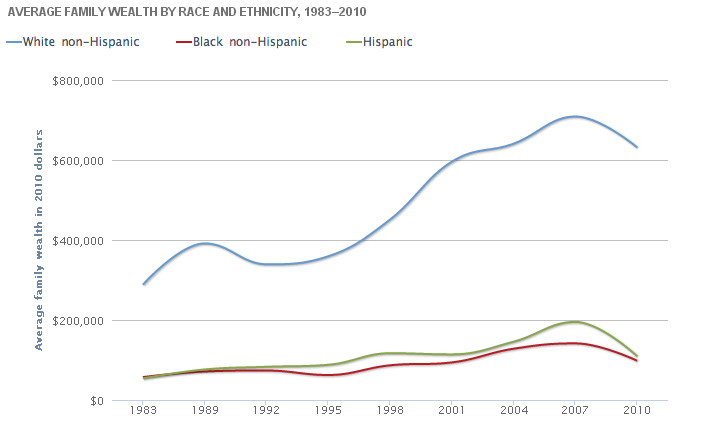
Plumer lays out an array of charts tracking the largely unchanged disparity across the board:
“The wealth gap between minorities and whites has not improved over the past three decades,” reports the Urban Institute. “From 1983 to 2010, average family wealth for whites has been about six times that of blacks and Hispanics — the gap in actual dollars growing as average wealth increased for both groups.” And the Great Recession exacerbated that gap, as blacks and Hispanics were hit especially hard.
Joseph Ritter examines the role of discrimination:
Black workers seem to earn less because of differences in education or upbringing, while black workers’ employment shortfall appears to be more a factor of employer discrimination. In other words, black workers that manage to get a job appear to earn at comparable rates, controlling for education levels—but regardless of education, they appear to have a harder time getting a job, due to their race.
Derek Thompson homes in on the point about education:
“Today, white adults 25 and older are significantly more likely than blacks to have completed at least a bachelor’s degree,” Pew tells us. On the one hand, the black completion rate as a percentage of the white completion rate has increased from 42% then to 62% now. On the other hand, whites are still far more likely to graduate from a bachelor’s program by 25. This college advantage — reinforced through dual-earner households — translates into higher family incomes, higher home-ownership, and (as a result) higher wealth for whites. There is a reason why so many discussions of social mobility begin and conclude with education.
Watch the whole thing here or read the transcript here. Waldman thinks the speech was directed to future generations, not the present:
This seemed to me to be a speech written in the hope it would be read 50 years hence. He’ll get some criticism for not talking about any specific policy issues, but that’s what happens when you swing for the rhetorical fences; you can’t get too bogged down in the mundane arguments of the moment. And what struck me most about it was how little he talked about Martin Luther King. He mentioned him only a few times, but spent much more time talking about ordinary people. This was the running theme of the speech and perhaps what was most important about it.
Brentin Mock agrees that history will be the judge:
Obama’s speech wasn’t, as rapper Keith Murray would say, the most beautifulest thing in the world, but it accomplished what Obama has been setting out to accomplish from the beginning: staying the middle-road course in effort to appeal to the liberals and conservatives among all races in the spirit of perfecting the union. Whether his legacy will reflect a victory on this as an honorable effort or flat failure won’t be determined for decades.
But Jamelle Bouie argues that now is no time for bromides:
What Obama didn’t say, but what the civil rights movement recognized, is that the specific experience of African-Americans requires – and required – a specific response. It’s what motivated the Freedman’s Bureau of Reconstruction, and Martin Luther King Jr.’s call for an inner city “Marshall Plan” during the Second Reconstruction of the 1960s. … [T]he economic legacy of white supremacy is still with us, and—outside of half-measures and rhetoric—we’ve shown little appetite for dealing with it. Simply put, 350 years of bondage and oppression can’t be ameliorated with 50 years of citizenship rights, tepid liberal programs, and “colorblindness.” That includes the president, who works hard to avoid race and its role in shaping our problems.
That Obama could not – or would not – elucidate his plans to address the intractable realities of race and the economic consequences of those realities, even as he acknowledged that “black unemployment has remained almost twice as high as white unemployment, Latino unemployment close behind,” calls into question the logic of a black Presidency in itself. There was something despair-inducing about the way he said “change doesn’t come from Washington, it comes to Washington,” an oratorical turn that cloaked the fact that something vital was being reneged upon. …
Obama’s tic for rhetorical evenhandedness meant that even in his discussion of racial inequality, he had to nod to black failings by pointing to “self-defeating riots” and “criminal excuse-making.” And his tendency to chide black America in public appears all the more cynical when compared with his refusal to point to his own responsibilities to that community as Commander-in-Chief.
Peniel E. Joseph is similarly disappointed by Obama’s vagueness:
[W]here were the specifics that would have truly honored the March on Washington? The 250,000 people who gathered 50 years ago were looking for specific solutions, not just soaring rhetoric. Where was the president’s promise to sign a series of executive orders that would focus on anti-poverty efforts or increase access to higher education? Or governmental action that perhaps could ease the transition of ex-offenders back into communities or promote jobs programs, especially in economically devastated urban and rural communities?
Meanwhile, Ed Kilgore detects a hint of despair from the commander-in-chief:
What struck me most about it was that it seemed a wistful tribute by a politician hemmed in by politics to a social movement that alone has the power to overcome the resistance to change. “Change does not come from Washington but to Washington,” Obama said, and while some may view that as an abdication of responsibility, it’s more a plain fact of the long struggle for justice and equality. This passage in particular seemed a recognition that Obama – once thought to be the Joshua who would bring the civil rights movement into the promised land its “Moses generation” could not reach—was passing the torch to the next generation: There’s a reason why so many who marched that day and in the days to come were young, for the young are unconstrained by habits of fear, unconstrained by the conventions of what is. They dared to dream different and to imagine something better. And I am convinced that same imagination, the same hunger of purpose serves in this generation.
And Jeff Shesol believes Obama was holding himself back:
When Obama permits himself to speak about [race and equality] — as he did in his 2004 debut at the Democratic National Convention, in his “race speech” of 2008, in his unscripted remarks about the Trayvon Martin shooting — he conveys an understanding that enriches our own. On each of those occasions it was said, rightly, that only Obama could have given that speech. But one of the disappointments of yesterday’s speech was that it could have been given — credibly, if less movingly — by any one of a number of Democrats. It was largely devoid not only of first-person pronouns, but first-person perspective.
Like du Bois, Barack Obama has taken the stage at a moment when it is popular to assert that black people are the agents of their own doom. There has never been any other such moment in American history. The response to Trayvon Martin, indeed the response to Barack Obama himself, has been to attack black morality, to highlight black criminality and thus change the conversation from what the American state has done to black people, to what black people have done to themselves. Like Du Bois, Barack Obama believes that this these people have a point. His biographer, David Levering Lewis, says that Du Bois came to look back back on that speech with some embarrassment. I don’t know that Barack Obama will ever reach such a conclusion.
Indeed, if we are – as the president asks us to be – honest with ourselves, we will see that we have elected a president who claims to oppose racial profiling one minute, and then flirts with inaugurating the country’s greatest racial profiler the next. If we are honest with ourselves we will see that we have a president who can condemn the riots as “self-defeating,” but can’t see his way clear to enforce the fair housing law that came out of them. If we are honest with ourselves we will see a president who believes in particular black morality, but eschews particular black policy. It is heart-breaking to see this. But it is also clarifying.
Obama claims that he hasn’t made a decision regarding Syria, but he emphasizes that “the international norm against the use of chemical weapons needs to be kept in place”:
Fisher thinks that this is the primary rationale for using force:
The U.S. decision to move toward possible strikes appears, rightly or wrongly, wisely or unwisely, to be all about reinforcing international norms. It’s not about us; it’s not about “because Obama said so.” It’s about “because international norms say so.”
Alex Massie wants to know exactly what we are trying to achieve:
We are clear that we do not wish to remove Bashar al-Assad from power. So we do not think his use of chemical weapons is that big a deal. Certainly not a big enough deal to make the case for regime change.
The plan, in as much as there is one, seems to be to put him in detention rather than expel him. But to what end? Will bombing Syria persuade Assad to modify his behaviour? Is our objective to make him offer the rebels a “fairer fight”?
… How, having intervened once, can the United States and its allies walk away? Shoving Assad onto the naughty step seems an insufficient response to his misdeeds. If the aim is simply to persuade Assad that any further use of chemical weapons will bring additional consequences it might be wise to consider what those consequences might be.
Marc Lynch likewise worries that intervention will lead to more intervention:
[T]he administration’s loud protestations of limited aims and actions are only partially reassuring. Much the same language was used at the outset of the Libya campaign. Everybody knows that it will be excruciatingly difficult for Obama to hold the line at punitive bombing after those strikes inevitably fail to end the war, Assad remains publicly defiant, the Geneva 2 diplomatic process officially dies, and U.S. allies and Syrian insurgents grumble loudly about the strike’s inadequacy. Once the psychological and political barrier to intervention has been shattered, the demands for escalation and victory will become that much harder to resist. And what happens when Assad launches his next deadly sarin attack — or just massacres a lot of Syrians by non-chemical means? This too Obama clearly knows. But that knowledge may still not be enough to save him.
Eli Lake reports on Iran’s response to America attacking Syria:
Recent U.S. intelligence assessments are not entirely comforting, but one silver lining is that for now the government’s analysts do not expect Iran to attempt terrorist attacks outside the Middle East or Afghanistan in the event of limited U.S. air strikes on Syria, according to U.S. officials who spoke with The Daily Beast on the condition of anonymity. Although Iran as recently as 2011 plotted a terrorist attack in Washington, D.C., a statement Wednesday from the country’s supreme leader, Ayatollah Ali Khamenei, hinted that Iran would focus retaliation inside the Middle East.
Larison thinks bombing Syria will make war with Iran more likely:
A direct attack on Syria would make it virtually impossible for Rouhani to pursue a more conciliatory course, which in turn makes conflict with Iran more likely in the coming years. Iran might not respond militarily to an attack on its ally, but if hard-liners in Tehran are as blinkered as our own “credibility”-obsessed politicians they very well might feel that they have to respond or risk being perceived as weak. Whether Iran retaliates or not, Rouhani will be in no position to offer concessions, and Iran hawks here will use this to justify their own demands for even more sanctions and more aggressive measures against Iran’s nuclear program.
Karim Sadjadpour has a useful primer on Iran’s alliance with Syria. A section on Iran’s strategic interests:
Syria has been Tehran’s only consistent ally since the 1979 Islamic revolution. Whereas the rest of the Arab world supported, and in some cases bankrolled, Saddam Hussein during the Iran-Iraq war, Hafiz al-Assad’s Syria sided with Tehran. While Iranian and Syrian tactical interests have occasionally diverged during the last three decades, on macro-strategic issues the two regimes have more often worked in unison.
Beyond its political support, Syria is also critical to Iran in that it provides it a geographic thoroughfare to Lebanese Shi`a militia Hizb Allah, which is one of the crown jewels of the Iranian revolution. Both Syria and Hizb Allah are crucial elements of Iran’s resistance alliance, and much of Hizb Allah’s armaments are thought to emanate from Iran via the Damascus airport.
Iranian motivations in keeping the al-Assad regime in power are also driven by deep concerns about the composition of a post-Assad government. Given Syria’s overwhelming Sunni Arab demographic majority, Iran fears the prospect of Syria being rendered a Sunni sectarian regime aligned with Saudi Arabia or the United States and hostile to Shi`a Iran. While visiting Damascus in August 2012, former Iranian Supreme National Security Adviser Saeed Jalili stated that “Iran will absolutely not allow the axis of resistance, of which it considers Syria to be a main pillar, to be broken in any way.” In other words, if the ends are opposing the United States and Israel, almost any means are justified.
What is the disadvantage of going to Congress? That they are loud and annoying and someone will try to introduce a resolution tying action in Syria to Obamacare? If the Administration can’t stand up to Ted Cruz, it can hardly hope to frighten Bashar al-Assad. And if going to Congress now feels time-consuming, how does it compare to the hours, days, weeks, and sanity expended on the Benghazi hearings? Those might have happened anyway, but they got a fair share of their formless force from the Administration’s initial decision to not really bother with Congress and the War Powers Act when it came to Libya. If you haven’t been asked in the first place, there is no cost to turning a tragedy into a piece of political theatre.
Alex Altman expects Syrian intervention to become a political bludgeon:
The only sure thing is Obama’s opponents will use Syria against him, no matter how it turns out.
House Speaker John Boehner‘s new letter to the president, released late Wednesday afternoon, is a sign of how they may try. Boehner’s letter requests “a clear explanation of our policy” and interests that require intervention, as well as “a clear, unambiguous explanation of how military action — which is a means, not a policy — will secure U.S. objectives.” It notes points of agreements. It includes a list of 14 important questions. But it’s mostly notable for what it doesn’t include: a request for Obama to seek congressional approval.
Instead Boehner wants “substantive consultation,” a phrase that is vague enough to verge on meaningless. The subtext is clear. Republicans will be happy to hammer the president for acting unilaterally, which Obama himself once disavowed. But many want no part of a vote. Backbenchers could wind up on the wrong side of history. And Boehner would have to wrangle a majority out of a restive party that, on this issue, is perhaps even more divided than usual.
Ramesh Ponnuru doubts that Congress would vote for war:
This is not a military action that we are undertaking to defend ourselves from attack or to protect a core interest. The congressional power to declare war, if it is not to be a dead letter, has to apply here. And it seems to me exceedingly unlikely that Congress would vote to commit us in Syria, because the public manifestly opposes it. This is a war with no clear objective, thus no strategy to attain it, no legal basis, and no public support.
Ed Morrissey, on the other hand, suspects that Congress would authorize force:
Why not go to Congress? There is at least as large a bipartisan group urging action, probably more than enough in both chambers to get easy passage of a limited pass. The authorization would give Obama more political cover on what is undeniably an unpopular action, and spread the blame to both parties. Chuck Todd suggested yesterday that the White House is afraid that “isolationists” will block the authorization, and that the delay in getting approval would be too great … Delay? Well, it’s been months since the first time Syria used chemical weapons, which makes a rush to action here moot. Furthermore, the UN wants more time to determine what exactly happened anyway.
Cassidy wonders whether the delay in Britain will spur congressional debate:
After yesterday’s dramatic developments in London, which culminated in Prime Minister David Cameron delaying a parliamentary vote to authorize British participation in an American-led attack, President Obama faces the choice of putting off the bombing or going ahead without the support of America’s closest European ally. Should he choose to hold off for a few days, which seems likely, it will give Congress time to consider the matter, and to schedule a vote approving military action. Until now, the White House has resisted such a vote, and the Republican leadership has stopped short of demanding one. But now that Britain has allowed the people’s representatives to have a say, and also given the U.N. inspectors in Syria some time to complete their investigation of last week’s awful gas attack, the political dynamic in Washington may change.
There are legitimate issues surrounding the powers of the president and the extent to which Congress can micromanage military attacks. But this is something that Congress should actually spend some time debating, instead of just folding up and letting the president do whatever he wants with nothing more than a bit of muttering about separation of powers. The president may be commander-in-chief, but that doesn’t mean the U.S. military is his personal plaything. It’s past time to make that clear.
Earlier Dish on congressional approval and Syria here.
Evan Soltas’ article make a decent argument for “catch share” in whaling, though I find it curious he neither quotes nor links to any opponents of the idea (instead choosing to summarize their ideas, which strikes me as lazy and uncharitable). I generally support catch share and other conservation solutions that take human activity into account. But had Soltas done more research, he might have realized another problem–whalers break the rules now, and they will break the rules under any catch share system so long as their home countries don’t care to enforce the rules. The International Whaling Commission(IWC) has no enforcement powers. If you hauled a dead humpback whale (actually not that endangered any more) into San Diego harbor, Federal and State authorities would swiftly descend. The same is not true in Japan. Though they’re allowed to take Minke and other smaller whales for “research” purposes, other explicitly protected whales have always been illegally killed by Japanese whaling fleets without consequence.
Years back, my father (Dr. Stephen R. Palumbi) and his colleague Dr. Scott Baker purchased whale meat from Japanese fish markets and used genetic testing to prove that illegal whales were being taken. Blue, fin, sei and other severely endangered great whales were clearly present in the meat supply. A minor furor erupted, with Japan and various useful idiots denying the incontrovertible evidence in front of their faces. Our family home got a number of threatening calls from Japanese-accented men over the next few years (organized crime is involved in the trade). Baker has since repeated the experiment; the illegal species can still be bought without much trouble in Japanese fish markets.
So, catch share is generally a fine conservation strategy. Given proper enforcement mechanisms, which Soltas simply assumes with a wave of his hand at the end of his piece, it might work for whales. But the problem remains: the rules that exist are not being followed. Do whatever you like with the Minke market, but nobody is seriously proposing that blue whales should be hunted. And yet, they are. Until all parties to the IWC are operating in good faith, the rules shouldn’t budge.
And Evan Soltas could have figured all this out if he’d done his homework.
Another reader adds:
Let’s set aside the argument about whales’ intelligence being a reason not to kill or eat them. Instead, I want to address the notion of establishing a “properly regulated market” in whaling as a way to allow their populations to increase.
The history of attempts to manage fisheries makes it clear that “sustainable” management is extremely difficult to pull off. It takes well-crafted regulations, requires strict enforcement and compliance, and relies on fisheries science which is notoriously difficult to get right. The majority of attempts to regulate fisheries for the sake of increasing fish populations have failed or have been so eroded over time by the interests of those who want fish to maximize yield (which typically leads to overexploitation) that the regulations and systems themselves become meaningless.
The assumption that such a system could be put in place for whales is foolhardly. It runs in the face of fisheries management history and fails to take into account the fact that whales are, like many shark species, slow to regenerate. Their feed sources and habitats have been radically reduced. In some kind of ideal scenario, perhaps one could determine some “sustainable worldwide quota” that, as long as it was adhered to, whale populations would increase. But, this sort of paper plan rarely works out in the real world. The idea lacks credibility when factors like human nature, degraded habitats, food sources and more are taken into account.
Nathan Ingraham reports on a major advance in brain-to-brain communication:
Using a non-invasive brain-to-brain setup, a researcher in one lab was able to send a signal from his brain to control the movements of a second researcher in a lab on the other side of campus. It’s believed to be the first human brain-to-brain interface; previous demonstrations have featured rat-to-rat and human-to-rat communication.
The demonstration focused on a simple computer game: Rajesh Rao, a professor at UW who has worked on brain-computer interfacing for more than a decade, looked at a screen and had to fire a cannon to shoot down an enemy plane while avoiding friendly planes. On the other side of campus, Andrea Stocco had the keyboard to execute those commands, but couldn’t see the game itself. But using their brain-to-brain interface, Rao imagined that he was using his right hand to click the space bar on a keyboard – and Stocco’s right hand carried out the command without any conscious movement on his part. Stocco likened it to an involuntary twitch or a nervous tic.
John Biggs emphasizes that this “is not mind control”:
The subject cannot be controlled against his or her will and neither party can “read” each other’s thoughts. Think of this as sending a small shock controlled via the Internet to trigger a fairly involuntary motion.
“It’s very much a first step, but it shows what is possible,” [project contributor Dr. Chantel] Prat said. “Right now, the only way to transfer information from one brain to another is with words,” she said. With advances in computer science and neuroscience, people could eventually perform complicated tasks, such as flying an airplane, and dancing the tango, by transferring information in a noninvasive way from one brain to another. “You can imagine all complex motor skills, which are difficult to verbalize, are just chains of procedures,” Prat said.
Marc Tracy explains why Bush’s critics are captivated by his art:
The paintings are proof that Bush is an artist—that he invests his energies and imagination in creating works that are meant to be aesthetically pleasing and serve no utilitarian purpose. And being an artist is proof that Bush is an honest-to-God person, not the nightmarish, vague presence we all remember. It’s not even that Bush has a soul, just as it’s not even that the paintings are all that good. (And, I mean, are they, really?) It’s that he is of the same species as we are. He possesses an inner life—the very thing whose apparent absence seemed to connect all of his worst outer traits, from his intellectual incuriousness to his bullying nature (the nicknames!) to his economic cruelty to his foreign militarism.
The paintings are a reminder that—as Philip Roth wrote of the White House during the Clinton years—a human being lived there. Someone who provided unprecedented funding for combating AIDS in Africa and evinced tolerance at a personal level. A son, a husband, a father.