Listening

I haven’t come across any new, dispositive facts to change my mind about the complicated specifics in the Michael Brown tragedy. But there is one dispositive fact that is hard to miss and that keeps impressing itself upon me every time I read about Ferguson and its meaning. There is a near-universal consensus among African-American men that there is a crisis about their role in American society, and particularly about their interaction with the police. You can cavil, or criticize or feign shock or refer back to the specifics of the Ferguson case. But it’s there and it’s real and any crisis between any segment of the population with respect to law enforcement is a crisis for the entire society.

Here’s what strikes me – the range of black voices telling us that this is a moment for despair. The rhetoric has gone to eleven. TNC:

Barack Obama is the president of a congenitally racist country, erected upon the plunder of life, liberty, labor, and land. This plunder has not been exclusive to black people. But black people, the community to which both Michael Brown and Barack Obama belong, have the distinct fortune of having survived in significant numbers. For a creedal country like America, this poses a problem—in nearly every major American city one can find a population of people whose very existence, whose very history, whose very traditions, are an assault upon this country’s nationalist instincts. Black people are the chastener of their own country. Their experience says to America, “You wear the mask.”

Here’s Colbert King, one of the sharpest columnists at the Washington Post, with long credentials in the civil rights movement:

We are in a bad place. My 20-year-old grandson, Will, the most gentle and respectful young man you would ever want to meet, posted this on his Facebook page:

“Regarding the recent events in Ferguson: I’ve always wanted to believe my country was free. But today’s grand jury decision tells me this cannot be the case. No country that refuses to hold the police, those so-called ‘defenders of the law,’ accountable for its unjust brutality — and yes, it is often very brutal — can be free. When the grand jury declined to charge Darren Wilson for his actions, what kind of a message does that send? . . . It doesn’t seem fair that police can commit brutal acts against innocent people and get away with it.”

It’s not, Will. Not today. Not in your great-grandmother’s day when that Mississippi grand jury let that white farmer get away with murder. Not ever.

John McWhorter shares my view of the murkiness of the actual incident, but is emphatic nonetheless about the broader problem:

The right-wing take on Brown, that he was simply a “thug,” is a know-nothing position. The question we must ask is: What is the situation that makes two young black men comfortable dismissing a police officer’s request to step aside?

These men were expressing a community-wide sense that the official keepers of order are morally bankrupt. What America owes communities like Ferguson — and black America in general — is a sincere grappling with that take on law enforcement that is so endemic in black communities nationwide. As Northwestern philosopher Charles Mills has put it, “Black citizens are still differentially vulnerable to police violence, thereby illustrating their second class citizenship.”

This is true. It is most of what makes so many black people of all classes sense racism as a key element of black life, and even identity.

What we’re talking about here is not prejudice exhibited by other members of civil society – the kind of prejudice you can argue should be ignored or proven wrong. It is prejudice exhibited by the representatives of the entire system – the police – and its expression is too often violence, even fatal violence. At first, I simply wondered how so many people I respect see no progress at all since the 1930s or earlier. But it is perfectly possible, it now seems clear, for there to be considerable social progress and integration even as police forces – especially in poor, urban areas – come to associate criminality with black men, and treat them as a different class of people – guilty until proven innocent, violent unless proven peaceful.

I can see why this happens, can’t you? Cops are not superhuman. High rates of violence and crime in neighborhoods with large numbers of young black men make a certain kind of prejudice almost impossible to avoid for a fallible human cop – but that makes training to counteract these impulses all the more important to enforce. A cop like Wilson, with clearly minimal finesse in these matters, come across as afraid, unprofessional, and reckless. Ditto this jumpy fool in a much clearer case:

I cannot imagine that happening to a white man. Period. The officer in that case has been fired and charged with assault. But what are the odds that would have happened without a dash-cam video?

The truth is: there are too many eerie parallels between today’s world and yesterday’s.

Although the formal structures are immeasurably better than in the darkest days of slavery and formal segregation, the informal patterns of mind created by history can stay the same. And I sense it is this unchanging attitude – and what it says about the core moral imagination of many non-blacks – that drives reasonable men to sputtering rage and frustration. We are not what we once were – but we remain deeply formed by what we once were. How hard is that nuance to understand?

Will we ever be different? I suspect so. Again from Chris Rock’s interview:

Grown people, people over 30, they’re not changing. But you’ve got kids growing up … I drop my kids off and watch them in the school with all these mostly white kids, and I got to tell you, I drill them every day: Did anything happen today? Did anybody say anything? They look at me like I am crazy … It’s partly generational, but it’s also my kids grew up not only with a black president but with a black secretary of State, a black joint chief of staff, a black attorney general. My children are going to be the first black children in the history of America to actually have the benefit of the doubt of just being moral, intelligent people.

But that may be too sunny a view – and for too many right now a distant prospect. Which is why I favor body cams for cops in these neighborhoods; aggressive attempts to improve schooling in poor black neighborhoods; the end of stop-and-frisk and of the revenue-creating abuses that Radley Balko highlighted. More to the point: I don’t think this should be viewed as some kind of attack on the police. Body cams can protect them from false charges as well as provide an incentive for more civil interactions with black men; and the dragnet criminalization of black men for possessing a joint is a bizarre waste of cops’ time. Their impulses are often understandable – if a huge proportion of criminals in your neighborhood are young black men, you can slide very easily into stereotypes that fatally undermine the rule of law. But that cannot excuse a set of different standards of justice for different types of people.

That’s not a minor bug in a democratic system. It’s a fatal illness. And we need to start treating it like one.

Update from a reader, who rightly keeps our attention on the outrageous killing of a 12-year-old black kid in Cleveland:

We learn more and more horrific details every day (I just saw a story about how the officers who killed him didn’t give CPR for nearly four minutes, essentially killing him once more). While the Ferguson incident was obviously complicated and demands at least some nuance in our response, the Tamir Rice killing, it seems to me, demands communal, shared outrage and pain and anger, the kind that can perhaps genuinely contribute to a meaningful response and to change.

At the very least, it seems to me to be as extreme and grotesque and worth extended attention as any story that has received multi-post, follow-up and conversation kinds of attention on the Dish. And since the Dish is the kind of space that can genuinely push the national conversation forward, I think doing so could help with those broader effects and impacts as well. So I wanted to see if it might not be able to get more of that kind of coverage. Tamir deserves it, and I’d say we all need it.

If you haven’t seen the disturbing footage already, showing the cops giving the kid who made a dumb decision no real time to surrender before shooting him dead, it pretty much says it all:

Ray Rice Returns

Over the weekend, news broke that his suspension from the NFL had been overturned. Caroline Bankoff explains the sequence of events:

Along with the NFL Players Association, Rice appealed his suspension. In a double-jeopardy-type defense, Rice said he told [Roger] Goodell exactly what happened in the elevator during a meeting held after the first video was released, which meant that the release of the more graphic footage should not have resulted in a second penalty.

Meanwhile, Goodell maintained that the second video showed a “starkly different sequence of events” than those described to him by Rice. (Among other things, Goodell claimed that Rice told him that he had merely slapped Janay and that she subsequently fell into a railing and knocked herself unconscious, but that story didn’t appear anywhere in the records of the meeting.) In the end, former federal judge Barbara S. Jones sided with Rice.

Scott Lemieux comments:

Yes, if the NFL had a competently designed system of punishment, knocking a woman unconscious would not merit a significantly lower suspension than using recreational drugs.  Nonetheless, the NFL did not have such a system when Rice committed the offense (and, for that matter, doesn’t now, but anyway.)  The idea that Rice should retroactively receive a greater punishment than Goodell thinks a domestic offender should get in a standard announced after the fact because he “lied to Goodell” is absurd on its face.  And the absurdity is compounded by the fact that it’s vastly more likely that Goodell is lying than Rice is.

Kevin Drum also warily approves of the decision:

Ray Rice committed a crime. We have a system for dealing with crimes: the criminal justice system. Employers are not good candidates to be extrajudicial arms for punishing criminal offenders, and I would be very, very careful about thinking that they should be.

Kavitha A. Davidson has more on the labor angle:

The ruling in no way exonerates Rice. It is not an excuse for his actions or a sign that his brutal beating of his wife was not deserving of stiff punishment. It’s not a commentary that domestic violence discipline is out of the NFL’s purview. It’s not even an explicit acknowledgement that Ray Rice deserves a second chance to play professional football.

Rather, this ruling is purely an indictment of the entire NFL disciplinary process.

Ed Morrissey considers Rice’s future in football:

Rice will play again, even if it’s next year and on a team that doesn’t care about bad publicity. That would make the Oakland Raiders and the Washington Redskins the two most likely options for Rice, the latter of which got bad PR just for tweeting out a Happy Thanksgiving message yesterday. If that’s all it takes for the social-justice warriors to come unglued, having Rice in the backfield won’t make matters any worse than they already are.

Make no mistake: if a team signs Rice, then every time the anti-domestic violence ad runs during an NFL game, people will scream about the hypocrisy the team that signs him is demonstrating. And the critics won’t be entirely wrong, either.

Mike Barnicle offers a note of pessimism:

Roger and the NFL will now have to face the severe consequences of their incompetence or indifference toward the crime of domestic abuse: A few days of embarrassing publicity.

That’s it. That’s all that’s going to happen. Nothing more.

How come? Because the National Football League is a cultural and economic powerhouse. It dominates Sunday in America. And Monday night. And Thursday night too. It is a cash cow, handed billions by TV networks and rewarding its sponsors with huge ratings and ever growing revenues. It has enough clout to force presidents to change their schedule to speak to the nation about minor topics like the economy or war and enough arrogance to ignore for years the physical damage the game has done to its former players.

Update from a reader, who points to a new piece from “Janay Rice, in her own words.”

The Oil Producers’ Price War

Oil Prices

Oil prices continued their decline last week:

The price of oil was down more than 9.9 percent Friday afternoon after the Organization of the Petroleum Exporting Countries decided it would not cut back production significantly in the months ahead. In other words, even amid a sluggish global economy and a boom in oil production in the United States, oil-producing countries from Saudi Arabia to Nigeria to Venezuela are going to keep pumping rather than pull back on output in hopes of pumping prices back up.

Apparently, OPEC is “playing a long-term game in which it tries to obliterate some of its American competition by letting prices fall in the hope that some American producers go bankrupt.” Brad Plumer provides more details on that front:

The catch is that no one quite knows how low prices need to go to curb the US shale boom. According to the International Energy Agency, about 4 percent of US shale projects need a price higher than $80 per barrel to stay afloat. But many projects in North Dakota’s Bakken formation are profitable so long as prices are above $42 per barrel. We’re about to find out how this all shakes out — and which numbers are correct.

Michael Levi criticizes reporting on OPEC’s actions:

Part of the problem here is that media and analyst commentary has juxtaposed the refusal of OPEC countries to slash production now with an imagined world in which OPEC regularly tweaks output to stabilize the market while avoiding large price swings entirely. Seen through that lens, last week’s inaction looks like a radical departure. But, as Bob McNally and Iargued in 2011 (and revisited a few weeks ago), OPEC has been out of the fine-tuning game since at least the mid-2000s, and even Saudi Arabia has been a lot less active at it than before. Our view wasn’t particularly unusual. (See, for example, “The OPEC Oil Cartel Is Irrelevant”, July 2008.) What happened last week is a useful reminder that OPEC no longer stabilizes markets the way it may once have. But it is not yet a revelation of a new era.

Juan Cole focuses on the lack of demand for oil:

The cause of the fall, by $40 a barrel, in petroleum prices since last summer is almost completely on the demand side. Asian economies, especially China, are dramatically slowing, and won’t be requiring as much petroleum to fuel trucks, trains and cars to deliver people and goods around the country. Most petroleum is used to fuel transport. Some is used for heating or cooling, as in Saudi Arabia and Hawaii, but that practice is relatively rare. US journalists seem to feel it obligatory to mention US shale oil production as a contributor to the price fall, since prices are a matter of supply and demand, and US supply has increased by a couple million barrels a day. But frankly that is a minor increase in world terms– global production is roughly 90 million barrels a day. Between Iran, Iraq (Kirkuk), Libya and Syria, enough oil has gone out of production to more than offset the additional American oil. It isn’t that there is more oil being pumped, it is that the world doesn’t want it as much because of cooling economies.

Chris Mooney looks ahead:

Does the slump continue, or is it possible we’ve already overshot and are due for a reversal in oil prices? We can’t be sure, but there are some reasons to think a bounceback could be possible, especially if there’s a European economic recovery. And in the long term, overall fuel consumption is definitely projected to increase, not decline, out towards 2040 — driven largely by demand in developing nations.

You Get The Policing You Pay For

Keli Goff confronts the “sad truth is that we as a society don’t expect, nor do we encourage, our best and our brightest to become police officers”:

According to a 2006 report by USA Today, “In an analysis of disciplinary cases against Florida cops from 1997 to 2002, the International Association of Chiefs of Police found that officers with only high school educations were the subjects of 75% of all disciplinary actions. Officers with four-year degrees accounted for 11% of such actions.”

Police Chief Magazine similarly published findings that indicate that officers with bachelor of arts degrees performed on par with officers who had 10 years’ additional experience. And yet police departments have struggled to toughen up their educational requirements in part because recruiters are concerned that the relatively low pay offered by most entry-level law enforcement jobs would not be enough to attract college graduates. (According to the Bureau of Labor Statistics, the median salary of those on the police force nationwide is $56,980, but that number includes the highest paid detectives.) Of course this is another part of the problem.

We want men and women in law enforcement who treat their jobs as police officers, as what they are: some of the most important jobs in our country that carry a great responsibility. Yet we pay them on par with postal workers.

Update from a reader:

I can’t say it’s all that surprising though. Substitute the word “teacher” for “police officer” and you can find the exact same issues being discussed. I don’t think it’s a coincidence, and it’s not a stretch to say that this is all because of the decades-long campaign against organized labor, especially public employee unions. Labor has been dominated (defeated?) in other areas of the market and this is one of the last sectors to hold out. Cops and firefighters aren’t targeted as explicitly as teachers – it’s not as easy to pull that off politically – but it shouldn’t be surprising that people want the best quality in the their teachers, police, and firefighters, but they don’t want to pay for it. They have been trained to be suspicious and resentful of anyone who “takes” their tax dollars.

I know that unions and some union members give the rest a bad name, but this will get worse before it gets better as we continually and systematically demonize public spending and investment, especially in these areas.

Another reader doesn’t think higher pay is necessarily the answer:

Problem is, even in high-pay departments, you get serious problems. The pay for Seattle recruits is $4602/month. The base pay – not counting overtime – for officers from the day they are sworn in is $69k/year. Halfway through their third year this is up to $80k, and at five years it’s already $90k. Link here. And let us not forget the amazing benefits and job protection, or the fact it’s safer than ever to be a cop.

And yet, Seattle’s police recently got a scathing review by the DoJ, and the most recent mayoral race featured the issue of what to do with the department. The new mayor moved quickly. This leads me to believe that increasing pay isn’t a magic bullet, or even that it’s going to seriously solve the problem.

The Left, The Campus, And The Death Of Humor

So I’m not the only one who sees the super-uptight era of “privilege-checking” and “micro-aggressions” as inherently deadly to comedy and to democratic debate. Chris Rock notices exactly the same thing in a terrific interview with Frank Rich:

What do you make of the attempt to bar Bill Maher from speaking at Berkeley for his riff on Muslims?

Well, I love Bill, but I stopped playing colleges, and the reason is because they’re way too conservative.

In their political views?

Not in their political views—not like they’re voting Republican—but in their social views and their willingness not to offend anybody. Kids raised on a culture of “We’re not going to keep score in the game because we don’t want anybody to lose.” Or just ignoring race to a fault. You can’t say “the black kid over there.” No, it’s “the guy with the red shoes.” You can’t even be offensive on your way to being inoffensive.

When did you start to notice this?

About eight years ago. Probably a couple of tours ago. It was just like, This is not as much fun as it used to be. I remember talking to George Carlin before he died and him saying the exact same thing.

Meanwhile, a reader insists we provide more of a balanced perspective:

As you despair of PC on the left, you completely ignore the PC of the right and what, to their minds, cannot be criticized and is almost beyond discussion. An incomplete list: Reagan, any action taken by the police, the Iraq War, the War on Terror, any action taken in relation to 9-11, CEOs, business in general, torture by Americans, God, the Bible, Judeo-Christian religion, middle-American culture, the flag, the Pledge of Allegiance, guns, getting tough on crime, Manifest Destiny, creationism and the denial of global warming or its man-made causes. If you’re going to call out what you call PC, please consider the identity politics of the right as well, with your normal even-handedness.

Happy to – and I do my bit to chip away at these rigid certitudes when I can. And humor is a great way to cut right through these things. What are the subjects right-wingers cannot take a joke about? Ditto the lefties. Get the answer to that right and you’ve figured out what’s really going on.

When The Self Settles Down

Melissa Dahl observes that William James’ 1890 text The Principles of Psychology “is thought to be the first time modern psychology observed the idea that personality settles down, or stabilizes, in adulthood.” She points to the work of Paul T. Costa Jr. and Robert McCrae that seems to support that insight:

Costa and McCrae’s work has found that from about age 18 to 30, people tend to become more neurotic, more introverted, and less open to new experiences; they also tend to become more agreeable and more conscientious. After age 30, these same trends are seen, but the rate of change dips. “It’s not that personality is fixed and can’t change,” Costa said. “But it’s relatively stable and consistent. What you see at 35, 40 is what you’re going to see at 85, 90.”

This makes intuitive sense: It’s maturity he’s speaking of, really. In the body, physical maturity happens rapidly throughout childhood and adolescence, and then stabilizes once you’ve reached your adult height, for example. If at least half of personality has a biological basis, it makes sense that it would follow that developmental arc, too. And if many of our character traits are also influenced by our environment, well, think of all the changes that occur in adolescence and early adulthood: college, first jobs, first loves, frequent moves. Speaking (very) broadly, life tends to settle down in the 30s, so it makes sense that our personalities do, too.

“There’s nothing magical about age 30,” Costa said. “But if you look at it from a developmental view, you can see the wisdom of [William James’s provocative statement].” In adulthood, as our lives become more constant, “it’ll take some relatively powerful change in the environment” to change our behavior.

Recent Dish on life at mid-life here. Update from a reader:

I happened to read (again!) Patrick O’Brian’s Master and Commander last week. The passage below struck home, and now I see that it turns James’s science into poetry. It’s Dr. Maturin reflecting on a friend and former Free Irish co-revolutionary, James Dillon, whose personality has darkened with age, a life of secrecy, and increased responsibility as a naval officer:

What is more, it appears to me that this is a critical time for him, a lesser climacteric – a time that will settle him in that particular course he will never leave again, but will persevere in for the rest of his life. It has often seemed to me that towards this period (in which we all three lie, more or less) men strike out their permanent characters; or have those characters struck into them. Merriment, roaring high spirits before this: then some chance concatenation, or some hidden predilection (or rather inherent bias) working through, and the man is in the road he cannot leave but must go on, making it deeper and deeper (a groove, or channel), until he is lost in his mere character – persona – no longer human, but an accretion of qualities belonging to this character. James Dillon was a delightful being. Now he is closing in. It is odd – will I say heart-breaking? – how cheerfulness goes: gaiety of mind, natural free-springing joy. Authority is its great enemy – the assumption of authority. I know few men over fifty that seem to me entirely human: virtually none who has long exercised authority.

Why Doesn’t Ferguson Happen Abroad?

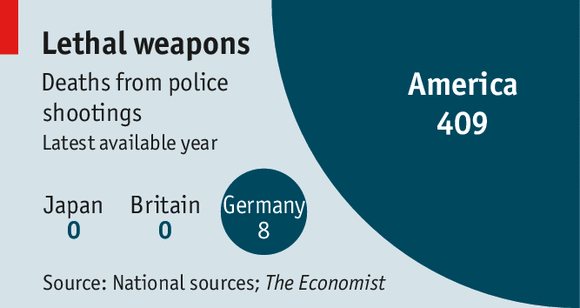
Lethal Shootings

Yglesias connects police shootings to gun prevalence:

Ferguson is in many ways all about race and racism. But this chart reveals an important sense in which it’s not about that at all. If you know anything about the UK or Germany, you’ll know that these are not even remotely societies who’ve eliminated the problem of racism. If anything, having struggled with it for less time than the United States, they’re even worse than we are. Where they outperform us is in drastically reducing the civilian death toll without ending racism or entrenched poverty or any of the St. Louis area’s other problems.

A well-armed population leads to police shootings of the unarmed in two ways. One is that police officers have to be constantly vigilant about the possibility that they are facing a gun-wielding suspect. Cleveland police officers shot and killed a 12 year-old boy recently, because they not-entirely-unreasonably thought his toy gun was a real gun.

The other, more relevant to the Michael Brown case, is that when civilians are well-armed, police have to be as well. That turns every encounter into a potentially lethal situation.

Ed Krayewski thinks this theory too simplistic:

Matt Yglesias says the cops’ assumption Rice’s toy gun was real “wasn’t unreasonable.” For someone that spends a lot of time arguing from authority, he doesn’t hold the “experts” to a high standard. You can’t be deferential to cops’ judgment AND not expect them to make better judgments and then blame anything other than your attitude on the police violence that predictably follows. Boys, and girls, have been playing with toy guns for decades and somehow cops used to be able to handle it without arresting or shooting children.

Waldman joins the conversation:

The most common explanation is that since we have so many guns in America, police are under greater threat than other police. Which is true, but American police also kill unarmed people all the time — people who have a knife or a stick, or who are just acting erratically. There are mentally disturbed people in other countries, too, so why is it that police in Germany or France or Britain or Japan manage to deal with these threats without killing the suspect?

This is where we get to the particular American police ideology, which says that any threat to an officer’s safety, even an unlikely one, can and often should be met with deadly force.

Adam Ozimek suggests some reforms:

First, remove collective bargaining for police officers entirely. They should be employed at will, and should be able to be fired without any arbitration whatsoever. Workplace protections can be good for workers, but retaining the public’s trust in the police is far more important than making police officer be a nice job for someone.

Second, if a police officer shoots someone who is unarmed they should be fired even if they can prove they reasonably felt threatened. Self-defense can be a good reason to not bring criminal charges against a police officer for shooting someone, but it’s not necessarily a good reason to let them keep their jobs. The near constant stream of cases of police being too quick to shoot suggest their incentives right now lean too strongly towards shooting first and thinking later.

Update from a reader:

The graphic you posted puts US police killings at 409. It turns out no one knows what the number is for sure, but it is likely much higher, at least 1000 per year.

Giving Your All

Julian Savulescu argues that “few people if any have ever been anything like a perfect utilitarian”:

It would require donating one of your kidneys to a perfect stranger. It would require sacrificing your life, family and sleep to the level that enabled you to maximize the well-being of others. Because you could improve the lives of so many, so much, utilitarianism requires enormous sacrifices. People have donated large parts of their wealth and even a kidney, but this still does not approach the sacrifice required by utilitarianism. …

People think I am a utilitarian, but I am not. I, like nearly everyone else, find Utilitarianism to be too demanding. I try to live my life according to “easy rescue consequentialism” – you should perform those acts which are at small cost to you and which benefit others greatly. Peter Singer, the greatest modern utilitarian, in fact appeals to this principle to capture people’s emotions – his most famous example is that of a small child drowning in a pond. You could save the child’s life by just getting your shoes wet. He argues morality requires that you rescue the child. But this is merely an easy rescue. Utilitarianism requires that you sacrifice your life to provide organs to save seven or eight lives. Easy rescue consequentialism is, by contrast, a relaxed but useful moral doctrine.

A Massacre Of Jews At Prayer, Ctd

A reader rounds out our coverage:

In your most recent post, you cite Freddie deBoer in noting a double standard in the American media, wherein Palestinians are blamed collectively for such acts of violence while Israelis face no such censure for atrocities carried out by their government.  You cited Jonathan Tobin’s pushback, who cited Palestinian “political culture in which religious symbols such as the imagined peril to the mosques on the Mount have been employed by generations of Palestinian leaders to whip up hatred for Jews.”

I think a comparison to the religious reactions to mutual atrocities is very instructive.  Calls for revenge, vicious anti-Semitic and/or anti-Israel political cartoons are all part and parcel of the Palestinian reaction.  But the purpose of the email is that I dearly want to point out to you the Jewish Orthodox reaction to the four murders. You won’t see calls for revenge.

(Yes, you might see it in right-wing politicians, but not among the Jewish Orthodox whom you routinely label as fundamentalist).  The bottom line of these reactions are the same: we have our own choices on how to act, and that the best way to fight against darkness is to increase the light; the best way to fight against hate is to increase love.  The Jewish “fundamentalist” response to tragedy, throughout history, codified almost 900 years ago by Maimonides, is always the same: start with introspection.

You can start with a letter written by Rebbetzin Tzippora Heller, who’s 12-year-old grandson fled for his life from the massacre, but whose son-in-law was seriously injured and needs multiple surgeries.  In her first letter (published here), the harshest thing she can say about the attackers is:

Please continue praying for my son-in-law … and the other victims. Pray that God gives strength to the five new widows and 24 new orphans. Thank God that we are not like our enemies.

In her second letter, she reminded all that our reaction to the events are our choice.  She closed with:

You can choose light. You can choose learning. You can choose acts of kindness. You can choose closeness to the wounded by continuing to pray …. You can transcend your limitations and your attachment to materialism by giving charity.

Even more impressive was the reaction of the four new widows.  They released a letter just two days after burying their husbands.  In it, the grieving widows urged: “accept upon ourselves to increase the love and affection for each other, whether between a person and his fellow, whether between distinct communities within the Jewish people.”

In the article, “In Har Nof, introspection, but no religious war“, the writer summarized her findings: “In shadow of Tuesday’s terrorist attack, congregants dismiss the notion that Temple Mount tensions drove rampage, say they need to ‘be stronger, pray harder’”  She noted: A poster with a photo of a bloodied prayer shawl screams out “End the hatred!”

At site of Jerusalem terror attack, no calls for revenge, just grief, the Ha’aretz writer quoted an 18-year-old girl at the funeral:

We live our lives according to God’s commandments.  That is why most of us have returned to our regular duties – because our regular day is a way of praising God. In other places when this happens, there are calls for revenge, but not here, not in our neighborhood.

Quite the fundamenalists, eh?  The differences are stark and obvious.

Another adds regarding the first post in the thread:

Israel should never have released those types of photographs for publication.  I do not have a problem whatsoever with you publishing them, as they were provided by the government of Israel, but Israel can more than make its case without distributing those types of photographs.  Let Hamas engage in that type of gamesmanship.  The rabbis should be remembered for their scholarship and how they lived, not by how they died.  Those photographs rob the rabbis of their dignity.

Living Into The Big Unknown

5171748787_07ba8d6236_o

Jack Miles contemplates how “science keeps revealing how much we don’t, perhaps can’t, know” – and considers how that connects to religious pluralism. He argues that our ignorance can inform the way we understand faith:

However we cope with our ignorance, we cannot, by definition, call the coping knowledge. What do we call it? Let’s not give it a name, not even the name religion; the dilemma precedes religion and irreligion alike. But if we can concede that religion is among the ways that humankind has coped with the permanence and imponderability of human ignorance, then we may discover at least a new freedom to conduct comparisons. If we grant that we must all somehow go beyond our knowledge in order to come to enough closure to get on with the living of our lives, then how do religious modes of doing just that compare with irreligious modes? Since the challenge is practical rather than theoretical, the comparison should be of practices and outcomes rather than of theories and premises—yet the hope must be for a reasonable way of coping with the impossibility of our ever living a perfectly rational life.

Religion seems to to assume one aspect when considered as a special claim to knowledge and quite another aspect when considered as a ritualized confession of ignorance. One may certainly be struck by the peculiar way in which ostensibly authoritative pronouncements made in the course of religious revelation always seem to arrive coupled to the disconcerting proviso that ordinary human knowing could not have reached what is about to be conveyed: “For my thoughts are not your thoughts, neither are your ways my ways, saith the Lord, for as the heavens are higher than the earth, so are my ways higher than your ways, and my thoughts than your thoughts” (Isaiah 55:8–9). So much, it would seem, for empirical confirmation. But rather than construe such language as vicarious boasting, one may take it, counterintuitively, as Isaiah’s way of reckoning with the limitations of his own mind. To this day, most expressions of religious commitment can be understood as utterances in either of those registers. The boastful construction is smug, loud, insufferable, and can sometimes seem omnipresent. The confessional construction is reticent and thus easily overlooked, yet its appeal shouldn’t be underestimated. The world harbors many a muffled believer and many a shy practitioner, reluctant to undergo cross-examination about a confession of inadequacy that defies ready articulation.

(Photo of “a huge supernova remnant crossing over the constellations of Taurus and Auriga” by Adam Evans)