Al-Jazeera Arrives, Ctd

by Brendan James

Laura Bennett is impressed with the new American channel, but notes that “the overall effect is not quite as different from the rest of cable news as Al Jazeera imagines it”:

The overall message is clear: that this is an open and democratic forum, a place for guests to freely express complicated and wide-ranging views rather than have them crammed into ideological categories. Of course, in its own sly way, Al Jazeera pushes its politics with the same insistence as Fox or MSNBC, if not with nearly the same theatrics; an undercurrent of Bush-era exasperation with American blinkeredness still runs through every report from the Middle East. And it’s strange to see #pray4Egypt flashing on the bottom of the screen, a subtle bit of community-building that makes audience participation seem more ideological than ever.

But Al Jazeera’s coverage is fueled by a placid faith in the reasonableness of its position rather than a knee-jerk ideological defensiveness.

Lloyd Grove felt that, during the network’s debut, the “pace was slow, the production values were plodding and predictable, and the presentation relied heavily on yakking, and more yakking, straight to camera.” But he hopes the network will succeed:

[I]n an age of media belt tightening, when once-imposing journalistic institutions are being shuttered or sold for a fraction of their historic value, it is heartening that a Gulf-state emir, of all people, is willing to spend hundreds of millions, and probably billions, of dollars to field a serious news organization in the United States. For that reason alone, I am rooting for Al Jazeera America and its 850-odd staffers led by veteran ABC News executive Kate O’Brian, and hope they find a way to reach an audience, attract advertisers, and land on a growing number of cable systems.

Ana Marie Cox doles out high praise for AJAM’s nightly news program, America Tonight:

What’s revolutionary about the show is what wasn’t in it: no mention of “Obamacare” (indeed, I’m not sure there was a mention of Obama, specifically). No mention of rodeo clowns, or Ted Cruz’s birth certificate, or Hillary. Nothing about gun control or Trayvon Martin, either. Nor voting rights, gay rights and the Olympics, nor the Tea Party.

It’s as if the producers: a) knew that the first primaries for 2016 were a year away; and b) understood that some topics, while worthwhile, had not further evolved since they were last discussed. While there was a suspicious lack of “America” to the stories on “America Tonight”, what stories did run bore more relevance to the contemporary lives of average Americans than anything on the other networks.

Does Birth Order Matter? Ctd

by Chris Bodenner

A reader writes:

One point about the arguments you’ve posted so far: They all seem to operate from the assumption the family dynamic is a closed system absent of any outside influences.  That certainly isn’t our experience. With two working parents, our daughters spend a good deal of time with the sitter and her three boys (all older than our girls).  My first born might be that at our house, but she’s the fourth during the day, Monday through Friday.  My wife and I are certain she modeled eating, walking, potty training and many other developmental milestones off of her weekday siblings’ examples. We are grateful for this because it made our lives much easier as first-time parents. But if someone was evaluating her birth order and the impact on her development, temperament, personality, etc. they’d get it all wrong without that additional background about her upbringing.

Thanks for the great blog.  It’s a godsend for busy parents who don’t have a ton of time but still need a helpful filter and fresh perspective on the day’s news.

An expert weighs in:

There are hundreds of studies looking at the effects of birth order, mainly because it is among the easiest parameters to ask a test subject on a questionnaire. Effects ranging from long-term income to personality type get assigned to birth order. Unfortunately, most of these studies suffer from two major flaws, outlined in Welcome To Your Child’s Brain. The first issue is:

who answers the survey? If you ask family members about each other, they answer in terms of their relationships. Mothers tend to think their older children are more responsible, and their younger children are more rebellious. Well, duh – this is the relationship between siblings. In studies where the evaluator is a non-family member, these effects go away.

The second issue is more subtle: every family with children has a firstborn, but only multi-child families have later-borns. So on average, later-borns come from larger families – and therefore have fewer resources per child. Once this socioeconomic confound is removed, many more effects go away.

After all this, one remaining factor that remains significant is theory-of-mind, a measure of empathy. Younger siblings acquire theory-of-mind before older siblings, by about 6-8 months for each older sibling. Reasons might include having a sibling to emulate, or having to understand the motivations of others to compete for resources. This does not necessarily mean more intelligence – but it might mean more empathy.

Not All Cancer Kills

by Patrick Appel

Virginia Postrel discourages grouping different types of cancer together:

[T]hough [prostate cancer specialist Peter] Carroll thinks calling slow-growing prostate tumors “cancer” is important to encourage vigilance, [urologist Ian] Thompson wants to change the nomenclature, using the term IDLE (indolent lesions of epithelial origin) to describe low-risk cases where waiting isn’t likely to make a difference. Just using the word “cancer,” he argues, creates unnecessary suffering.

“The number of people that will die from those slow-growing prostate cancers is really low,” he says, but the unacknowledged costs of giving them a cancer diagnosis are huge: “the person who can’t sleep for two weeks before his next test results, and all the follow-up biopsies and all the lost wages, and the people who can’t get life insurance because they now have a new cancer diagnosis, the person whose firm says, ‘Well, we’re concerned you have cancer and therefore you can’t be promoted to this job.’”

It’s a compelling case, but changing the vocabulary finesses the fundamental cultural issue: the widespread and incorrect belief that “cancer” is a single condition, defined only by site in the body, rather than a broad category like “infectious disease.” Someone doesn’t develop “cancer” but, rather, “a cancer.” How frightening that diagnosis should be depends on which one.

Antiheroes Everywhere, Ctd

by Brendan James

A reader makes an interesting point about our attraction to antiheroes:

All the antiheroes that have been mentioned so far have a single thing in common: competence. We are invested in a character if they are shown to be competent at what they do. It gives them dimension. We don’t care about those truly rotten, no-good, one-dimensional thugs and ne’er-do-wells who serve as their subordinates, simply because they get caught easily, or are shown in some other way not to be very good at it, the ‘it’ here being evil. But we care about their bosses, the Tony Sopranos and the Walter Whites, because their bosses have been demonstrated to be good, very good, at being terrible.

Is that really all it takes for us to forgive, or at least look past, murder, treachery, deceit, betrayal, and manipulation, of which both Tony Soprano and Walter White are most certainly guilty? That you’re good at it? That’s what it takes in real life, too. We have a secret respect for sociopaths whom we find to be talented, even if what they do is abhorrent to us. That’s why we elect them to higher office.

Shouldn’t we change that? Doesn’t that say more about us than them?

Another supports the view that Breaking Bad is a critique, not an example, of the antihero ethos:

Your reader wrote, “Walter White … is the show, and we very much care what happens to him.”

Um, sorry. No.

Anyone who cares what happens to Walter White shares at least some of his extensive laundry list of pathologies.  Except for the obvious hiccup it would cause in the show’s dramatic arc, Walter White should have been put down like a rabid dog a long time ago and I wouldn’t care who did it – Jesse, Skyler, Gus, Mike, Jane, Tio or any of the thugs who drift in and out of the show, apparently unable to figure out how depraved Walter White is because of his mad chemistry skillz.

The only reason I’ve watched this long is to see Walter White take his licks and hope that someone takes off that stupid hat of his…with his head still in it. I’ve never wanted any character in film or TV – including the villains – to meet his or her demise more than I want it for Walter White. Not an iota of redemptive value in the man. (Yes, I suppose hating on Walter White is one of my pathologies.)

Another can’t accept viewers are still feeling for Walter, despite his role as the protagonist:

That reader has written himself or herself out of the moral universe. If there is to be sympathy for Walter White, it is only of the most limited kind: grief for what he was and what he has become.

But even that’s a stretch. At this point, if you still hope that Walter somehow makes it out of this alive, you truly are fraternizing with the devil, and a devil that has systematically dismantled the chances for wholeness of all the people around him. Hoping the best for him is wicked.

Deciding Between The Decades

by Patrick Appel

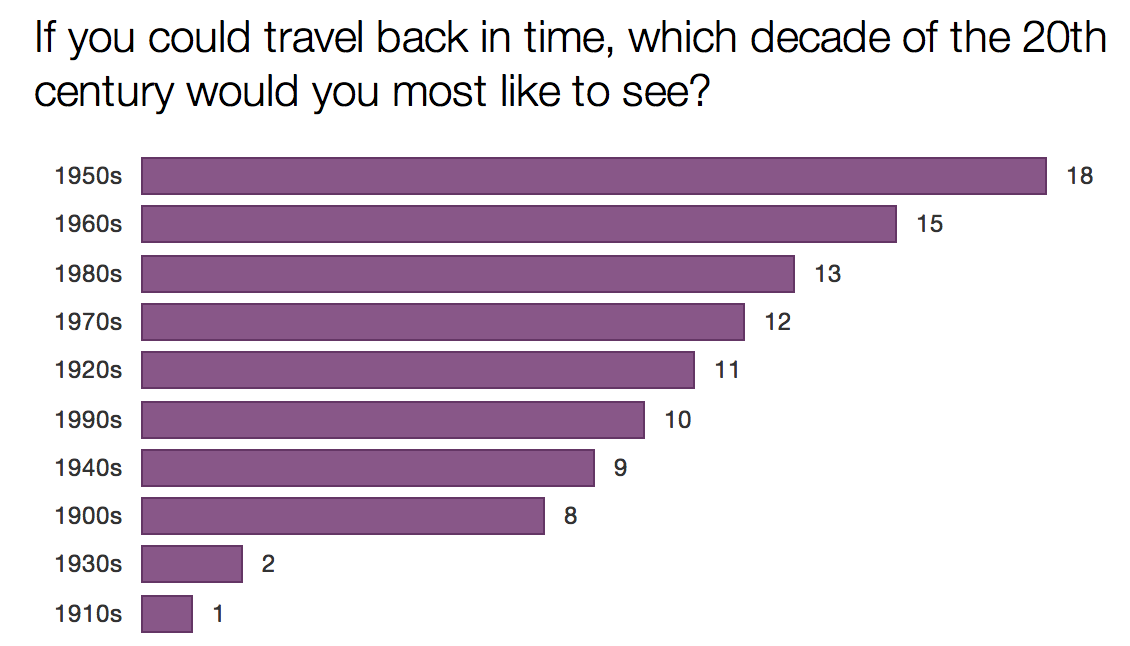
The results of a recent YouGov survey:

Time Travel

Drum breaks down the numbers by age:

[T]he most popular choice of nearly every age group is a decade of their youth. millennials like the ’90s, when they were growing up. My generation likes the ’80s, when we were just out of college. Only the thirtysomethings seem not to care, showing no particular preference for any decade between the ’50s and ’90s.

But it’s the nostalgia of seniors for the ’50s that intrigues me the most. I’d love to see a demographic breakdown of that. I assume that nonwhites aren’t pining away for that era, which means that white seniors must really be in love with it to produce such a high overall number.

Millman compares Republicans and Democrats:

Republicans and Democrats largely agree about the decades before the 1980s. Democrats actually like the Republican-dominated 1920s better than Republicans do, and Republicans slightly prefer the Kennedy-Johnson ’60s over Democratic views of that decade, but from the 1900s through the 1970s, memories move roughly in tandem. Then, in the 1980s, there’s a split, as Republicans prefer the ’80s somewhat over the ’70s, while Democrats feel the opposite. And then, with the ’90s, there’s a huge disparity, with Democrats preferring them slightly over the ’80s, and roughly in-line with the ’50s, ’60s and ’70s, while Republicans loathe the ’90s only slightly less than they do the ’30s or the ’10s.

And, finally, Yglesias asks why the 1990s gets so little love.

What Egypt Has Become

by Patrick Appel

Jon Lee Anderson compares Egypt’s military junta to the former military dictatorships of Latin America that the US supported in the name of fighting Communism:

Today’s Islamists can be yesterday’s Marxists, it seems: killable on behalf of notional constructs of law and order. … The no-holds-barred military terror in Egypt, and the language the military is employing to justify it, is reminiscent of the worst of human legacies. These are the sort of statements made not by ordinary armies but by armies that have embraced ideological convictions that make it easy to shoot down people in the streets, even civilians, if you believe that they are with the terrorists—or whatever it is you decide to call them.

Nathan Brown looks ahead:

What is clear now is that Egypt’s constitutional moment is over.

The hope born in the 2011 uprising was that diverse political forces would come to an agreement on the rules of politics — ones that would protect human rights, provide for a popular voice in governance, and devise mechanisms of accountability, and do such things in ways that were broadly accepted. That hope is not just dead; it was murdered by the country’s feuding leaders. The question is no longer whether the current course is the wisest one for Egypt  – it almost certainly is not. But this is the choice that Egyptian leaders have made for each other.

The result, while it is based on a destruction of the hopes of 2011, is one that will have recognizably democratic elements (elections, a multiparty system, civilian leaders). It will likely establish itself as operational even if it does not provide full stability or social and political peace. Its actual working will enable rather than avoid repression. Egypt’s international interlocutors in the West may have advised against this path, but they will have to decide soon whether or not to accept it. The current regime’s insistence that this is a sovereign decision will make Western governments uncomfortable for now but they will likely ultimately accept it. They will still face the question of whether to treat it as a distasteful autocracy or a flawed but aspiring democracy — or whether to bother to make the distinction.

Syria In The Red

by Brendan James

More images and testimonials of this week’s purported chemical attack flood in, with Human Rights Watch currently placing the death toll at several hundred. Jay Newton-Small sums up the administration’s tepid response, despite previous red-line rhetoric:

[T]he White House isn’t exactly springing into action. “We are calling for this U.N. investigation to be conducted,” said Obama spokesman Josh Earnest on Wednesday. “This is a situation that is ongoing, and our efforts to work with the international community and to work with the Syrian opposition to remove [President Bashar] Assad from power are ongoing.” Earnest upgraded his rhetoric slightly Thursday morning, telling reporters aboard Air Force One en route to Buffalo where the President was scheduled to give a speech about making college more affordable, that the images out of Syria “are nothing short of horrifying.”

Still, the translation amounts to: Don’t hold your breath waiting for air strikes.

Jon Western wonders if this latest attack will serve as “Syria’s Srebrenica”:

If you recall, Srebrenica did not fundamentally change the traditional, realist strategic logic on the ground during the Bosnian conflict — yet all of the internal notes on White House deliberations (as reported in Ivo Daalder’s Getting to Dayton or Derek Chollet’s history of Dayton) reveal how conceptions of interests and ideals became intertwined with the scale of the atrocity.   Domestically, there was some Congressional pressure to do more in Bosnia, but very little pressure from public opinion. Srebrenica was a game changer.

I think this is what we are likely to see happen now in Syria — and I think it changes the equation regardless of whether or not there is definitive proof as to who perpetrated the attack.  The mere fact of such a large scale loss of life in a chemical attack — along with changing dynamics throughout the region — will produce significant pressure on, and within, the administration to commit resources — airstrikes on key Syrian military installations and probably no-fly, no missile zone over Syria — something, anything, to move the conflict to some kind of end-game.

Still, Max Fisher lists off the reasons not to expect a new agenda from the White House:

Any White House cares first and foremost about domestic politics, and this administration was punished severely for its leadership on Libya; many of the same political voices that demanded the intervention spent months hammering the White House when, in the foreseeably dangerous post-conflict disorder of Benghazi, a militant group succeeded in attacking the local U.S. diplomatic outpost and killing the ambassador. You might think that Libya would have been considered a political success for the Obama administration, but it became a major political liability.

The White House’s efforts to reach out to Islamist groups in Egypt and Tunisia, meanwhile, received condemnation and criticism at home. Pragmatic, long-view Middle East watchers turn out to represent a fairly narrow slice of the American electorate. And political figures who ask the White House to take big foreign policy risks appear quite willing to punish the administration if anything goes wrong.

The Poor Door, Ctd

by Chris Bodenner

A reader quotes Josh Barro:

“The only real outrage is that Extell had to build affordable units at all.” Pardon me, but fuck that. A legitimate goal for a city is to make provision for housing to its low-income residents. In the not-so distant-past, that goal was met by housing projects in the ghetto. It only took a generation or two to quickly realize that wasn’t the best way to go.

The new way is to lavish massive subsidies on developers in exchange for a certain number of the total housing units in a development to remain affordable for a period of time. It works like a mortgage, only no repayment is required. The subsidy could be direct cash in the project or more lucrative low-income housing tax credit deals.

Here Extell is being allowed to boost its square footage and have their development subsidized. The city is able to meet its goals. Extell could jog on and find another project, but they didn’t because there is more money to be made. Outrage? Excuse me again when I say fuck that.

Another:

As a New Yorker who lives in a similar “80/20” building on the Upper West Side, I strongly support John Barro’s position. I pay $5200 a month for a 1050 square foot apartment with two beds and two baths on a high floor of our building that has Hudson River views.

I know to 99% of the country, that figure is ridiculous, but in New York, it is what it is. Over the past few months, our management company has been jacking rents on both vacancies and renewals by at least 20%, meaning that if I want to stay in my apartment I have to pay $6200 or more. So my wife and I have decided to move.

Meanwhile, 12 floors below us are “low-income tenants” living in basically the same apartment without the view of the Hudson River – for less than $1,000 a month. Do you know how much more disposable income I would have if I could pay $1,000 a month? Of course, the 20% of the units that are rent-controlled/rent-stablized will not be faced with the same level of rent increases.

Look, I don’t have the answers to the affordability of Manhattan, but my wife and I work our asses off to afford the life we live. So it’s unfair, unnecessary and unreasonable for folks who can’t afford it to be afforded the right to live in the same building, in basically the same apartment, for $5,000 less per month than me.

Another New Yorker:

This “new” development does not sound all that new to me. What I am about to describe are events of 15 years ago.  After ten years on the Section 8 waiting list, my mother moved from a slum on E. 103rd Street to a new building on 95th Street.  This building had two wings: one of five or six stories of Section 8 housing connected to a high-rise tower of luxury condos, separated by the spa and fitness facility.  Along with a separate elevator bank, there was a separate entrance for the Section 8 wing to the street, but one could use the avenue entrance door at any time.  At first blush, the “separateness” seemed to be appalling.

Then a reality check.  My mother’s apartment was very nice and nicely equipped, the common areas were well-maintained, there was 24-hour building security, the building staff – from management to cleaning staff – treated my mother as they treated every other resident: with respect and dignity.  And when my mother died, there was no trouble gaining access to her apartment, we received a very nice condolence card from the building management, and every staff person we came into contact had something nice to say about Mom.

Bottom line: For the last few years of my mother’s life she lived in a safe, clean building, and she was treated with dignity in the place she called home.  Compared to where she lived before that, this was a dream come true.  The separate “entrance” was – and is – a non-issue.

Update from a reader:

I am not familiar with the details of the proposed project in Manhattan, or of the building in which your reader lives who complained about the cheap rents offered to low-income families; however, I am in the commercial real estate industry and familiar with the issues and incentives and how it plays out here in the DC suburbs.

As in Manhattan, the extremely affluent DC area has a problem trying to provide affordable workforce housing.  Programs providing developers with increased density or tax relief to incentivize construction of such housing, leveraging tax revenues by having the major capital outlays be made by the developers.

I would be careful about assumptions that the subsidized apartments are essentially the same other than not having river views.  A couple of years ago, a local GOP politician and a conservative think tank with dubious credentials stirred up our community with talk about how recipients of public housing were getting luxury amenities and implied that subsidized housing residents were living in $1,000,000 homes.  A review of tax assessment information for one of the developments, however, showed that there were MANY differences between the market-priced housing and the subsidized town-home units.  The subsidized units not only were much smaller, but had basic finishes (the market units had granite and other high-end finishes) and no garages, fireplaces or decks (all of which were present in the market-priced homes).  Nobody who was living in the market-priced housing would want to trade places with the subsidized residents.

How Can Cities Reverse Brain Drain?

by Tracy R. Walsh

portland

Garance Franke-Ruta thinks college graduates should have some student loans forgiven if they move to struggling areas:

Cities like Detroit; Cleveland; and Gary, Indiana, need people: young people, college-educated people, people with an entrepreneurial spirit who might be willing to put down roots and pay local taxes and taken on renovation projects and bring new views and businesses and opportunities to distressed, underpopulated communities. Debt-burdened recent college graduates, for their part, need cheap housing and to pay off their student loans. . … Maybe it’s time to try to yoke these two problems together and allow for partial loan forgiveness for people who commit to living in distressed communities for a set period of time. The rents in Detroit couldn’t be cheaper, nor could houses, should anyone want to lay down deeper roots. Think of it as something akin to Washington’s first-time-homebuyer tax credit, but available to renters, too, and accomplished through educational-debt reduction rather than the tax code.

Meanwhile, Aaron Renn wants city governments to take a page from corporate America and recruit residents:

While most cities have paid lip service to attracting newcomers, few have put any real muscle behind it. There might be a website or marketing-type materials, but often these are not very good. The lack of seriousness in these efforts is shown by the critical missing piece: sales. That is, going out and actively recruiting individual, specific people to want to live in a place, not just to fill a specific opening at a specific company. Ask yourself this: The last few times you visited a place, did anyone try to sell you on it as a community you might want to live in or build a career or business? In my experience, the answer is almost always no.

(Photo by Michael Coté)

When Animals Grieve, Ctd

by Chris Bodenner

A reader joins the previous ones:

Recently my husband and I have been dealing with the decline and loss of our two beloved cats, EchoNoot and Echo, who had been our “babies” long before we had human children. Noot entered our lives as a blue-eyed handful of white fluff in 1996.  In 2000, Echo joined us as a tiny grey kitten.  Noot was very avuncular (even motherly?) toward little Echo, gently playing with him, bathing him, sleeping with him.  As the years passed, they remained buddies, and seemed to grow closer to each other, and further from us, after our first baby arrived in 2006.  They went from being major lap cats and sleeping with us before we had kids (Echo slept cheek to cheek with me), to cozying up together in more remote areas of the house, such as the bathroom cabinet, to escape the little hands and frequent shrieks of our three children.  I always felt a bit guilty that our cats had been a bit displaced by the kids.  After all, they were here first.  But at least they had each other.

In his last few years, Noot had a number of health problems, including diabetes.  But with proper treatment and TLC, he made it to the respectable age of 16.  Then, one night last December at 3AM, my husband heard a strange meowing sound and found Noot having a major seizure.  He looked so afraid.  I brought him to the emergency vet, still seizing, but they were unable to determine the cause of the seizures and he continued to have them throughout the next day. He had likely experienced major brain damage, and after 24 hours of the vet trying every drug he could think of, we decided we did not want him to have another seizure and we were ready to let him go.  I went to visit him at the veterinary hospital late at night while my husband stayed home with the sleeping kids, and even though he was unconscious I stroked him and lay my head against him and told him how much we loved him.  Then I stayed with him while the doctor gave him the drugs that brought his suffering to an end.

After Noot was gone, we were thrown off by our grief and by the huge hole his death left in our family. Eight months later, we still think of him all the time. Echo was very confused by Noot’s absence and went through a huge change in behavior.

Usually quiet, he meowed loudly all over the house for months, especially at night, presumably looking for Noot.  Without his “older brother” cat to keep him company, he suddenly inserted himself into the daily life of our family, came out and sought affection from the kids during the day, and started sleeping in our bed again after six years of hiding out with Noot.  I was delighted to have my little gray buddy sleeping in the crook of my arm with his cheek against mine again after so many years.  We think of cats as being more solitary animals, but Echo clearly noticed his companion was gone and grieved deeply for him.

Last fall, Echo had been diagnosed at age 12 with chronic renal failure, after the vet had noticed an unexpected weight loss since his last visit.  Other than slimming down a bit (which was not entirely unwelcome, as he had been a bit pear-shaped for quite some time), he exhibited no other outward symptoms and retained enough kidney function to carry on with his usual activities.  We changed to prescription food and gave him daily meds and were happy to see him still jumping up on the counter to drink out of the faucet and generally looking well.

This spring, we had to add at-home subcutaneous fluid infusions a few times a week, to help flush the toxins out of his body, but he still appeared largely well.  He also started eating less, and keeping weight on him became more of a challenge. About a month ago, he stopped eating entirely and started his final decline.  He was hospitalized to get IV fluids for a few days, to see if they could give him enough of a boost to start eating again. They released him hoping we could get him to eat at home.  In addition to new meds and daily subcutaneous fluid infusions, I tried everything to get him to eat something – regular food, treats, super-rich food, high-calorie nutritional gel, liquid food, and sometimes he would give me some hope by eating a little, but never a significant amount.  He continued to get weaker but did not look like he was in pain.  We tried to give him as much love as possible. (I’ve attached a photo of Echo in better days.)

While Andrew was working through deciding “when it was time” for Dusty, I was struggling with making the same decision for my Echo. We wanted to keep him with us as long as possible, and yet we knew that his kidneys could not be fixed and so he had a limited amount of time left.  I had read that the very end of kidney failure can be excruciatingly painful.  We did not want to wait too long and have him reach the point where he was in pain and afraid.  But it was so hard to let him go.

This weekend he took another turn for the worse and it appeared that he was no longer drinking.  I left the kids with good friends Sunday night for a sleepover, and my husband and I had a difficult discussion about Echo over dinner.  We agreed that it was time to help him have a good death.  When we got home, we picked up Echo is his cozy bed, put his blankie over him, and he rode on my lap in the passenger seat. No scary cat cage/carrier for this trip.

In the exam room, he lay wrapped in his blanket on his warm bed, in my lap, with my husband and I both softly petting him and talking to him, while the drugs were administered.  He died totally relaxed and purring loudly, which is the best possible death we could have given him.  We have to remind each other we did the best we could, that we did everything possible to keep him alive, and that helping him die well was what he really needed from us in the end.  But it is still so hard, isn’t it?

Another reader:

I know this is piling on because everyone has a story to tell about their pets passing away. I’ve always had my other animals present when one of my dogs was euthanized.  It was a comfort to me as well as to the dying pet – until the last one.  My beautiful Golden Retriever had a hemangiosarcoma of the spleen (also labeled the “silent killer”) and within two hours was literally bleeding to death.  At the time I didn’t know the diagnosis, only that she needed immediate care at the emergency clinic.  She was put to sleep there.  I was so traumatized and desolate that I couldn’t even think.

I always thought that our younger dog, Chloe, a reactive rescue, was the Alpha in our family.  After Abby died, Chloe at first relished the extra attention. But she eventually took up the same habits as many others have described – eating very little, acting depressed, etc.  The most amazing thing to me was the fact that Chloe had never learned to tell us she needed to go potty; Abby always did it.  She never had to let us know it was time to eat; Abby did it for her.  She was lost without Abby’s guidance and all along we had it backwards.  Chloe was loud, pushy, and unpredictable, and yet it was Abby who was quietly in control the whole time.

Chloe eventually got another sibling, and her attitude changed after first letting the puppy know who was boss.  She is a much happier having another dog in her pack.  My best to Eddy, Andrew and Aaron.  It does get better, but not without the wistful smile on your face when you remember your four-legged buddy.

Another zooms out a little:

I have been loosely following your long-running thread on the decline and death of sweet Dusty and other readers’ pets. I’ve been navigating similar waters now for a year. My wife, son and I had a beautiful black lab, Manny. And like so many of your readers, I have an endless supply of stories that would make us laugh and cry – often at the same time. As a parent, I was so appreciative of how loyal, trustworthy and tolerant he was of my son who – as a toddler – harassed him endlessly. But mostly I think of Manny’s greatest gift was his love that he gave me ceaselessly as I mourned the death of my mom last September.

I was estranged from her – as with the rest of my immediate family – and I was forbidden from seeing her at the end. I could have flown or driven from the Bay Area to LA in time to make it, but I honored their ostracism so not to cause a scene at the hospital. Turns out I could have gone because the rest of them decided to let her die alone at the hospital that night. So my mourning was, and continues to be, soul wrenching.

Manny was my loyal companion through it all. As I neared the holidays, I dreaded having to participate in festivities and spend time with my in-laws – who I dearly love but have struggled with because they have implored me to reconnect with my surviving family despite years of physical, psychological and emotional abuse directed at all three of us. The holidays at the in-laws were indeed hellish. But I was so thankful to come home on January 1st and be back with just the four of us (my loving spouse, beautiful boy and loving lab). Manny died the next morning of heart failure. He was 13 and half – quite long for a lab.

While I do consider myself spiritual and one who has his believes (but not religious), I have never bought into concepts of “meant to be” or spirits visiting us or even animals having some human-like intuition. Not any more. I don’t believe in “coincidence” very much now. As I reflected back on Manny’s life, I could not help but keep coming back to the timing of us death: 24 hours after our return from what I knew would be a hellish 10-day trip with in-laws that would test my last nerve. This was a trip that I had been dreading since Halloween. He stayed with me even then. Had he died prior to then, I would have absolutely lost it. Manny knew. He KNEW. He took his very last ounce of loving energy to stay with me and get me through it all.