The Anti-Hero’s Other Half, Ctd

by Chas Danner

Emily Bazelon notes Skyler White’s transformation in the latest Breaking Bad episode (spoilers):

For me, [the] central thrill of this episode [was that] Skyler chose. She chose Walt over Hank and Marie. She chose asking for a lawyer over confessing like a good girl. She chose sin over remorse. Can she still be the show’s moral fulcrum? I don’t think so.

Hank assumed Skyler would cooperate; he also must have thought she would go to pieces. The genius of this scene is how much he underestimates her. He opens a door to innocence—“you’re done being his victim”—and fully expects her to walk through it, even turning on his tape recorder right there in the restaurant with a little paper lantern overhead. And Skyler refuses to play the role he has scripted for her. In earlier seasons, she has struggled against Walt’s expectations. Now it’s her brother-in-law whom she has to outsmart and push away. And in fact, she is a step ahead of him. She can see how little evidence he has and how much he needs her to build his case. She decides not to give him what he wants.

Alan Sepinwall marvels:

[Skyler] is not a saint. If she was a saint, she wouldn’t belong on a show that recognizes the messy contradictions that come with being a human being on this planet. She’s a complicated person, sometimes a victim, sometimes a fool, sometimes a heroine. She is, in other words, a worthy, fascinating character in this story, and even if it’s Walt’s story, Skyler’s role matters, and needs to be considered once again before things are over and done with.

Alyssa’s take on the scene shown above being one of the show’s great “baroque horrors” is here. Previous Dish on the meaning of Skyler White here.

The Struggle Of A Second Language

by Patrick Appel

Ta-Nehisi reflects on learning French in Paris:

I came here everyone told me that the enemy was the French. It would be their rudeness, their retreat into English that would defeat me. But I am here now and it is clear that–as with attempting to learn anything–the only real enemy is me. My confidence comes and goes. I have no innate intelligence here–intelligence is overrated. What matters is toughness, a willingness to believe against what is apparent. Learning is invisible act. And what I see is disturbing. In class my brain scatters, just as it did when I was in second grade. I have to tell myself every five minutes to concentrate.

The hardest thing about learning a language is that, at its core, it is black magic. No one can tell you when, where or how you will crossover–some people will even tell you that no such crossover exists. The only answer is to put one foot in front of the other, to keep walking, to understand that the way is up. The only answer is a resource which many of us have long ago discarded. C’est à dire, faith.

One of TNC’s commenters adds:

Learning a second language as an adult involves an implied contract. The negative side is that you’re now, if not the village idiot, then at least the village’s linguistically-challenged person. You will struggle for words, you miss stuff, you can’t make jokes, you’re stiff and slow, you’re not eloquent. All that beautiful stuff you said about Paris in English? You have no idea how to say that in French. Your brain is rewiring itself for something unanticipated, more or less as happens with people with head traumas who must relearn their native language. You’re not the same person you are in English: if I can be blunt, you’re dumber in French. For now.

The positive side? You’re opening yourself up to another world, and the people in that world. People appreciate that, on a pretty fundamental level. You’re learning humility, and there are few more visceral ways to do it. You are taking steps toward knowing people in a way you couldn’t know them before. You’re going to learn the intricate social dance that happens when two people who know each other’s language to different degrees figure out – word by word – how they like to talk to one another

Dreher applauds TNC:

What a wise man, welcoming the humiliation of hard experience, in faith.

What Our Conspiracy Theories Say About Us

by Patrick Appel

Jessie Walker discusses his new book, The United States of Paranoia:

Victoria Taylor calls Walker’s book “a thoroughly researched and completely readable look at infamous and forgotten conspiracy theories and presumed cabals throughout American history”:

Walker identifies five American conspiracy archetypes: the perceived enemy within (think the Salem witch trials), the enemy outside (al-Qaeda, Indian tribes during the colonial period, religious movements), the enemy above (e.g. the government, secretive masterminding organizations out to establish a New World Order, like the Illuminati), the enemy below (slave uprisings) and the “benevolent conspiracy” (angels, the Theosophical Society). Some groups fall into more than one category, and in some cases the differentiating lines are blurred, but just about all myths can be viewed as at least one of these.

In another review, Laura Miller explains how conspiracy theories catch on:

As Walker sees it, our brains are predisposed to see patterns in random data and to apply stories to explain them, which is why conspiracy theory can be so contagious. Although conspiracies do exist, we need to be vigilant against our propensity to find them whether they are there or not. The most sensible outlook would appear to be that of Robert Anton Wilson, who concluded that “powerful people” could well be “engaged in criminal plots” but who found it unlikely that “the conspirators were capable of carrying out those plots competently.” Or, I would add, of covering them up effectively. It’s the ineptness of human beings in executing elaborate schemes and then shutting up about it afterward that makes me skeptical of almost all conspiracy theories. Besides, if the U.S. government was masterful enough to engineer the 9/11 attacks, why couldn’t it also plant some WMD in Iraq?

Salon has an excerpt from the book. It concludes:

The first decade of the twenty-first century saw three particularly notable eruptions of elite paranoia. The first came with the reactions to the 9/11 attacks. The second was the response to Katrina, when powerful people’s fears both fed and were reinforced by the centralization and militarization of disaster relief. And the third began when Barack Obama became president, as commentators treated a group of unconnected crimes as a grand, malevolent movement. As is often the case with paranoid perspectives, this connect-the-dots fantasy said more about the tellers’ anxieties than it did about any order actually emerging in the world.

Put Off By Punctuation

by Matt Sitman

Josh Jones highlights novelist Cormac McCarthy’s unusual punctuation style which, as he confirmed in an interview with Oprah, entails never using quotation marks or semi-colons:

James Joyce is a good model for punctuation. He keeps it to an absolute minimum. There’s no reason to blot the page up with weird little marks. I mean, if you write properly you shouldn’t have to punctuate.

More on his style:

McCarthy declares his stylistic convictions with simplicity: “I believe in periods, in capitals, in the occasional comma, and that’s it.” It’s a discipline he learned first in a college English class, where he worked to simplify 18th century essays for a textbook the professor was editing. Early modern English is notoriously cluttered with confounding punctuation, which did not become standardized until comparatively recently.

McCarthy, enamored of the prose style of the Neoclassical English writers but annoyed by their over-reliance on semicolons, remembers paring down an essay “by Swift or something” and hearing his professor say, “this is very good, this is exactly what’s needed.” Encouraged, he continued to simplify, working, he says to Oprah, “to make it easier, not to make it harder” to decipher his prose. For those who find McCarthy sometimes maddeningly opaque, this statement of intent may not help clarify things much.

Not everyone is enamored, however. From Jacob Lambert’s 2009 parody of McCarthy’s The Road:

With the first gray light he rose and walked out to the road and squatted and studied the country to the south. Godless and blasted. A madman’s timeshare. The trees dead, the grass dead, the shrubs dead also. The rivers dead. And the streams and reeds, the mosses and voles. Dead as well. He glassed the ruins, hoping for a shred of color, a wisp of smoke, a faroff Cracker Barrel. There was nothing but swirling gloom, a grasping murk. He sat with the binoculars and the gray, and thought: the child is my warrant. If he is not the word of God God never spoke, although he might have scribbled something on a paperscrap and passed it along. He bit hard on his blistered upperlip. If only I had thought to give him a name. If only.

An hour later they were on The Road, an Oprah’s Book Club selection. He pushed the cart and both he and the boy carried knapsacks in case they had to make a run for it. Cannibal rapists, roving bloodcults. Greenpeace volunteers. In the knapsacks were essential things: tins of food, metal utensils, a broken Slinky, a canopener, three bullets, a picture of ham. He looked out over the barren waste, the scorpled remain. The road was empty, as was its wont. Quiet, moveless. Are you okay? he said, quotation marks dead as the reeds. The boy nodded. Then they started down the road, humming a sprightly tune. The tune was silent, and unsprightly.

This Is How Immigration Reform Dies

by Patrick Appel

Republican Rep. Bob Goodlatte, head of the committee that has jurisdiction over immigration, has come out against a pathway to citizenship. Brian Beutler thinks immigration reform’s chances just got slimmer:

How likely is immigration reform to become law if the Republican with the most immediate power to shape the legislation opposes citizenship for current immigrants? I’d say not very likely — not without him and the contingent in the party he speaks for getting tossed under the bus.

Ezra adds:

If you’re peering into the tea leaves, here’s what that means.

First, Goodlatte thinks the trends in the House Republican Conference support flat-out opposition. As head of the relevant committee, if he thought serious immigration reform had a chance, he’d hold a bit of fire in order to ensure he kept his role in the process. That was his strategy early in the debate.

Second, he’s fairly confident that House Republican leadership won’t roll him to get a bill done. Again, if that seemed like a possibility, he might be a bit more reticent in order to preserve his seat at the table and avoid any humiliation. But this suggests he doesn’t believe Boehner et al will fight him to pass something that the Senate could stomach and the president could sign.

Josh Marshall wants supporters of immigration reform to stop “pretending that this bill is going to pass and get about the business of explaining to voters who is stopping it from passing or in fact stopping it from even getting a vote”:

 This tends to be something center-left reformers never get. The bill is dead or near dying. Letting this drag on only demoralizes people who think that government can act in the common good because it makes it seem as though the bill is dying of natural causes or some hopeless terminal illness — something tied to the nature of the Congress or the ‘process’ itself.

But that’s deeply misleading and damaging to the prospects of reform ever succeeding. The bill didn’t die. It was killed. So forget the heroic measures to revive it and get about telling the public who killed it and holding them accountable for their actions.

The Poor Door

A New York developer is under fire after proposing separate entryways for rich and less-rich tenants at a planned luxury condo:

A 33-story building slated to be built on Riverside Boulevard between 61st and 62nd street will have an entirely separate entrance for people of lower socioeconomic means: a door for the poor, or as we call it, a “Poor Door.” The affordable homes will be oriented towards the back of the building, while market-rate units will have a view of the Hudson.

Emily Badger calls the building, which will include 55 affordable-housing units, “a perfect metaphor for New York City’s gaping inequality”:

Of course, it’s easy to segregate affordable housing–and the people who live in it–into its own part of town, its own neighborhoods, even its own isolated blocks. But it takes some serious creativity to keep the haves and have-nots apart in the very same building.

Bill Bradley sees a case of tax incentives backfiring:

Floors two through six of the building will be available only to residents earning less than 60 percent of the area median income, putting them under the “affordable” umbrella. Those five floors are part of the exact same building as the luxury condos, but because of the separate entrance they could be legally designated as a separate entity. So technically, [the developer] would have an entire building consisting of affordable housing. On paper, this makes the project eligible for subsidies ostensibly meant to protect lower-income tenants, not move them out of sight.

Unsurprisingly, critics are out in force. Barro is one of the very few to defend the separate entrances:

We require and incent developers who build market-rate housing to also sell or rent some units in the same developments at cut-rate prices. The idea is that affordable housing shouldn’t just be affordable and livable; it should be substantially similar in location and character to new luxury housing. If rich people are getting brand new apartments overlooking the Hudson River, so should some lucky winners of affordable housing lotteries. … Getting mad about the “poor door” is absurd. The only real outrage is that Extell had to build affordable units at all.

How Gay Is Russia?

by Chris Bodenner

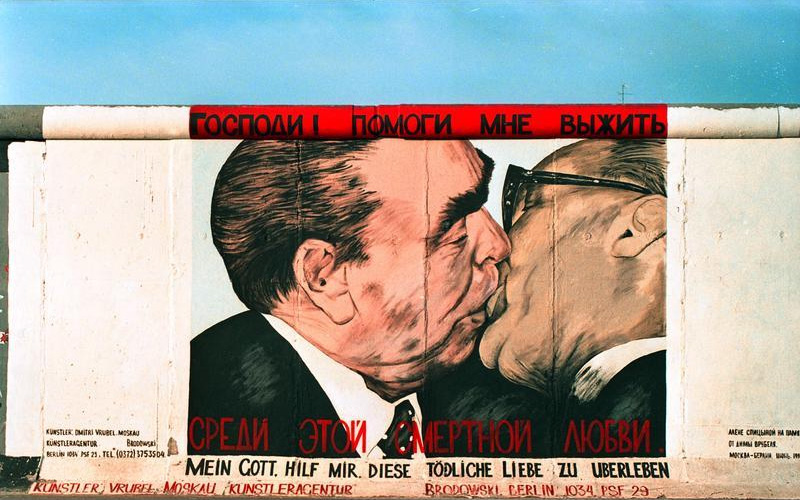
Berlin, East Side Gallery

A reader writes:

I’d like to comment on the “controversial” lip-kiss shared between two Russian athletes earlier in the week. It’s important to remember that other cultures have not eroticized same-sex kisses as Americans have. Here is a link about the history/culture of Russian lip-locking. And of course we can’t forget the iconic (fraternal) kiss of Eastern Bloc history, seen here [and a graffiti reproduction seen above].

We’re dealing with societies that, while deeply homophobic, still have a deep sense of same-sex friendship. I studied abroad in Moscow and Greece – both conservative Orthodox Christian countries – and was shocked to have a good Russian guy-friend, my age, put his head on my shoulder to take a nap during a long train ride. In Greece, men will drape their arms over each other in public and display physical affection that, unfortunately, will never fly among heterosexual men in this country and in much of the West. As the American media eroticizes this behavior, we run the risk of unintentionally unleashing a homophobia on same-sex (especially male) friendship that we in America experienced in the mid-20th century.

Another reader shares his first-hand perspective on Russian culture and homophobia:

As a gay man who lived in Moscow for 18 years (1989-2007), I consider myself and my dear Russian gay friends and lovers to be rather quite a bit more knowledgeable on the subject of gay life in that country than the usual parade of Cold War-trained “experts.”  I was there last September, and I’m in constant contact with a broad circle of Russian gay friends on Facebook. I would venture to say Russia has been in many ways less homophobic than the US, until very recently.  Russia has become suddenly more closed, and the US has become almost as suddenly more open.

People were absolutely fine with you being gay in Russia, with one big caveat:

like so many other things in Soviet society, you were not to speak of it. I lived with one of my lovers six blocks from the home he grew up in, we slept in one bed that his family helped us set up, and I was a constant guest at their city and country homes for any occasion, large or small.  But no one spoke of the nature of our relationship, keeping up the appearance that we were “just good friends.” He came out after we broke up, and their family is still as close as ever.  No religiously-motivated banishments, no condemnations, only a bit of mourning over the grandchild-not-to-be.  With other lovers we were out from the start, and I was treated with respect and usually with affection.

The current rise in homophobia is completely artificial, as evidenced by the unanimous vote in parliament, which included the gay clique in the clownish right-wing Liberal Democratic party, headed by the notorious bisexual Zhirinovsky (who was a habitué of some of the wildest Moscow sex clubs in the ’90s and whom I have personally seen make speeches about tolerance in a gay bar two blocks from my home there), and his deputy, the closeted gay (and up to now high profile gay-rights supporter) Mitrofanov.

The current campaign is part of intimidating the young professional class that began to rebel last year, and gays were very active participants in that movement. The rise of a money-driven brand of Orthodoxy has also fueled the fire, but it is a ridiculous farce.  It is being marketed to the broader public not as anti-gay, but as anti-pedophile, and while many are fooled for the time being, it is not the sort of thing that will hold up over the long term. Russians generally have a very healthy, sometimes even extreme mistrust of their government, and Putin’s chickens will come home to roost sooner rather than later.  Most Russian (and Russian gays) probably just say “just be quiet and everything will be OK,” which is exactly what Putin wants.

Moscow’s enormous gay bars and numerous others throughout the country are still partying all night long, the elaborate bath houses are still open 24/7. This campaign has more to do with crushing any issue-politics groups and providing an “us” vs. “them” cover for Putin’s dysfunctional structure and failings than it is about a national homophobic bias.

Previous Dish on gay-ish campy culture in Russia here. Update from a reader who sees things getting better in the US:

I’d like to provide an anecdotal rebuttal to this comment: “In Greece, men will drape their arms over each other in public and display physical affection that, unfortunately, will never fly among heterosexual men in this country and in much of the West.” It might please this reader to know that I do not believe that male/male affectionate behavior shall “never fly among heterosexual men in” the US.

My 19-year-old son played soccer for many years, and most of it on a “premier” travel team. One of the most interesting and amazing aspects of this all-male team’s group behavior was their: a) totally comfort with the concept of homosexuality; b) their often pretending to be in some way homosexual towards one another – and I’m not talking in an ugly and minimizing way but instead in a fun and I would dare say team-bonding manner; c) their complete immodesty with each other; and finally and most importantly to this discussion, d) their very affectionate behavior towards and among themselves. They would sit on each other’s laps, often drape arms around the guy next to them during relaxation periods; sit and lay very close to one another without any concern for appearances; lay around in beds together during team trips and generally have incredibly affectionate behaviors towards their team-mates.

These behaviors – and their apparent total lack of concern in terms of appearing gay – was often a topic of discussion amongst their Gen X (or older) parents. We all recognized that something has irrevocably changed in our sons’ generation.
How Nefarious Is The NSA?

by Patrick Appel

Ambinder rattles off reasons to be concerned about the NSA scandal. First on his list:

The NSA is the most powerful single institution in the world. It can collect more information, more quickly, and cause action from that information, more efficiently than any company, country or intelligence entity. Even if no one accused the NSA of doing anything wrong, it is the interest of a freedom-seeking society to layer in as much transparency as possible for no other reason than that there is really no historical precedent for an organization that large with that much power not abusing it, whether incidentally or deliberately.

In a separate post, he defends the NSA on various counts:

It is eye-raising to base one’s objection to NSA’s self-reporting on the idea that there is no way to independently check what the NSA says. Well, of course. There is a logical problem here because someone or some entity will be at the bottom of the chain. It has always been difficult to establish transparent legal and formal mechanisms to make sure that agencies that secretly collect secrets don’t abuse their power. But it is easier now than it has ever been. The evidence suggests that NSA has MORE checks on its power now than ever before.

The Bradley Manning Sentencing: Reax

by Brendan James

This morning he received a 35-year prison sentence. Michael Scherer sums up the news:

The sentence was considerably less than the lifetime sentence Manning faced under the original charges brought by the government, including aiding the enemy, for which he was acquitted. It was also nearly half of the 60 years recommended by the prosecutors after he was convicted in July of leaking information and six violations of the Espionage Act. Manning’s lawyer, David Coombs, had previously suggested that Manning face only 25 years in prison, given that the information he leaked would likely be declassified after that time.

Manning, 25, was dishonorably discharged and had his rank reduced to private and his pay forfeited. He will get credit for three and a half years already served in prison. If he serves his entire term, he would be a free man at the age of 58, but under military rules he could become eligible for parole after serving one third of his sentence.

Molly Redden suspects he could have faced much worse:

For their part, Manning’s defense team is probably relieved.

Earlier this week, his attorney David Coombs asked the judge, Col. Denise Lind, for a sentence that would allow Manning “to have a life,” while attorneys for the military asked her to make an example of him. Said Capt. Joe Morrow, “There is value in deterrence. … This court must send a message to any soldier contemplating stealing classified information. National security crimes that undermine the entire system must be taken seriously.” Not visibly reacting to the verdict was Manning himself—who appeared stone faced as Lind read out his sentence, and as a military escort walked him out of the courtroom.

Marcy Wheeler walks throughs Manning’s chances for parole:

Bradley could be released after serving one third of his sentence. In light of the fact Judge Lind has imposed a term of 35 years, Mr. Manning, considering the time he has already served, could potentially be eligible for release in as little as 9 years from now. As painful as it is to admit, this sentence, and Bradley Manning’s prospects could have very easily looked far worse.

Ryan Evans declares good riddance:

Manning is lucky he did not receive life, which he should have. The sympathy for this “troubled young man” is emblematic of a post-accountability society. No one, it seems, is to be held responsible for their actions any longer. Instead, blame is shifted to a difficult childhood, bullying, loneliness, or—my personal favorite—“the system.” In Manning’s own words, he was “dealing with a lot of issues.” … Manning himself has admitted that he understood what he was getting into when he agreed to provide these documents to WikiLeaks. To those who argue that he should not be held accountable for that decision, I ask: Why not?

Charlie Savage notes that, in addition to time already served, Manning “will be credited with 112 days for the treatment he endured at a military jail that the judge ruled was unlawful.” Charles P. Pierce adds:

Manning was treated barbarically over those 112 days. This didn’t happen by accident. This wasn’t an oversight. It was a policy decision. He was treated that way deliberately by this government. He was treated that way because that is how this administration wanted him treated. This is an administration that simply does not want the people to know what is being done in its name. The last administration didn’t want that either, but C-Plus Augustus wasn’t a constitutional law professor promising the most open and transparent administration in history, either.) And that’s the part of the story that shouldn’t go away with Bradley Manning.

Scott Lemieux, who expected a gentler sentence, agrees:

I don’t object to Manning being charged with a crime. I certainly strongly object to the way he was treated in prison. And I think the idea that his leaks merit a 35-year sentence is absurd. And as I said before, it’s particularly appalling when you consider the Obama administration’s “look forward not back” approach on torture. It’s hard to square this life-ruining sentence with the fact that no torturer was even considered worthy of being charged. I’d also say that at this point that it’s pretty hard to the American government to complain when other countries refuse to extradite whistleblowers.

All Eyes On Egypt

by Brendan James

PAKISTAN-EGYPT-UNREST-PROTEST

Madawi Al-Rasheed observes how the Saudi theocracy is keeping its own Islamist opposition in order as Egypt burns nearby. King Abdullah recently set the tone, declaring full support for the junta in Cairo:

The king’s message was clear: zero tolerance for all those who use Islam to pursue political agendas, sort of an oxymoron in the Saudi context as the state itself had been manipulating, co-opting, and promoting Islam for agendas that are nothing but political. The foundation of the state itself is a process of instrumentalizing Islam to revive the Al-Saud control of vast territories, under the pretext of purifying Arabia from blasphemy, innovation, and atheism. The Muslim Brotherhood and its likes appear to be latecomers to the project of politicizing Islam.

King Abdullah’s message, supposedly meant for Egyptians, did not go unheeded among the many Saudi Islamists who abhorred their government’s support for the Egyptian coup. Since July 3, they have turned into defenders of Morsi and the Brotherhood, issuing statements on social media condemning their own government for backing the coup.

A small group of activists launched an online petition to gather signatures against the aid that had been promised to Egypt immediately after the coup. Following the circulation of the petition, a couple of veteran activists such as Mohsin al-Awaji were briefly detained while many other Islamists remain banned from travel, most famous is Sheikh Salman al-Awdah whose television program “you have Rights” was abruptly stopped on an Islamist independent television channel. The government is carefully watching the hyperactivity of Islamists and their statements on television and online, which have so far strongly condemned the Egyptian coup and their own government’s unequivocal endorsement of General Sisi.

Michael Koplow notices that Turkey’s government is alarmed for the opposite reason, as an Islamist party supportive of the Brotherhood:

[T]he specter of crowds massing in the streets and the military overthrowing the government hits a little too close to home for Erdoğan given what he was dealing with in June and the history of Turkish military coups. Erdoğan’s biggest claim to fame is his defanging of the military, and even after demonstrating that Turkish civilian control (and undemocratic intimidation) over the army is complete with the Ergenekon verdicts a couple of weeks ago, no Turkish prime minister – and certainly no Turkish prime minister with Erdoğan’s background – is ever going to feel completely safe from the long arm of the military. Erdoğan looks at what is taking place in Egypt through a distinctly Turkish prism, and in many ways his views on the Egyptian coup are actually a complex psychological projection of his fears about his own position. …

Erdoğan sees the army removing an elected government amidst accusations of policy overreach and undemocratic behavior, and he imagines a nightmare alternate universe where the same could happen to him.

Previous Dish on the region’s reaction to Morsi’s ouster here and here.

(Photo: Islamic political party Jamaat-e-Islami activists march in support of ousted Egyptian president Mohamed Morsi in Karachi, Pakistan on August 20, 2013. Supporters of Morsi announced new demonstrations as Egypt grew increasingly polarised and the death toll in four days of violence topped 750. By Asif Hassan/AFP/Getty Images)