The Worst Chemical Weapon Attack In Decades?

by Chas Danner

https://twitter.com/michaeldweiss/status/370216269804367872

https://twitter.com/lizobagy/status/370209257569804288

Syrian rebel groups claim that hundreds have been killed in what may have been a chemical weapon attack by Assad on the suburbs east of Damascus. The attack may be the beginning of a larger offensive by regime forces. David Kenner gives his summary:

The information coming out of the Ghouta region, where the rebels enjoy significant support, is still unconfirmed by independent observers. But videos allegedly taken Wednesday in the area showed Syrians lying on the floor gasping for breath, medics struggling to save infants, and rows of bodies of those who had reportedly died in the attack (warning: the footage above is graphic). Syrian state media denied that chemical weapons had been used, attributing such stories to media channels that “are involved in the shedding of the Syrians’ blood and supporting terrorism.”

The opposition Local Coordination Committee, however, reported that at least 755 people had been killed in the attack. If that figure is true, what is happening on the outskirts of Damascus today is the worst chemical weapons attack since then-Iraqi President Saddam Hussein unleashed poison gas on the Kurdish town of Halabja in 1988, killing an estimated 5,000 people.

One report even says the death total could be over 1,300. Chemical weapon expert Ralph Trapp compares this attack to previous ones:

It is possible a gas was involved, but the images I’ve seen were not clear enough to see other symptoms beyond difficulty in breathing and suffocation. It certainly looks like some sort of poisoning. … [But] this is one of the first videos I’ve seen from Syria where the numbers start to make sense. If you have a gas attack you would expect large numbers of people, children and adults, to be affected, particularly if it’s in a built up area.

Jean Pascal Zanders’ analysis:

I am not sure whether the claims of nerve agent use accompanying the footage and images are correct. The people are not convulsing (except for one man shaking his legs while shouting out, but the remainder of his body does not suffer from involuntary contractions) and I have not seen anybody applying nerve agent antidotes. Nor do medical staff and other people appear to suffer from secondary exposure while carrying or treating victims.

It is clear that something terrible has happened. The scenes could not have been stage managed.

Jeffrey Goldberg weighs in:

Two questions are raised by reports of this attack. The first, of course, is whether or not it happened the way Syrian rebels said it happened. That is why immediately dispatching the UN team, already in-country, to the affected areas is so vital. If this process worked the way it should, they would be there already. If the Syrian regime denies the UN inspectors permission to visit these areas, well, that is kind of an answer in itself.

The second question is, why would the Assad regime launch its biggest chemical attack on rebels and civilians precisely at the moment when a UN inspection team was parked in Damascus? The answer to that question is easy: Because Assad believes that no one – not the UN, not President Obama, not other Western powers, not the Arab League – will do a damn thing to stop him.

There is a good chance he is correct.

Guardian live-blog here. A Reddit page is collecting information and videos here.
The Resistance To Republican Rebranding

by Patrick Appel

Chait wonders whether House Republicans will prevent the GOP from nominating a candidate who can rebrand the party:

Republicans can escape the damage inflicted by its Congressional wing by nominating a candidate who runs against it in 2016. That’s what the party did in 2000: George W. Bush made a few comments distancing himself from Congress, and that was enough to clear him of all the branding damage the Republicans Revolutionaries had done for a half dozen years and position himself as a moderate. It didn’t stop Bush from governing hand-in-glove with the selfsame Republican Congress once in office.

So the danger for Republicans isn’t that they’ll lose the House. It isn’t even that they’ll irrevocably poison their own brand. It’s that they’ll create an intra-party orthodoxy so strong it will prevent them from nominating a candidate who can distance himself from Steve King’s racial ideology and Paul Ryan’s economic ideology. In the meantime, they can inflict an awful lot of damage to the country at very little cost to themselves.

Humphreys thinks that the GOP has stopped listening:

As Mark Kleiman has noted, the American left lost on the crime issue starting in the 1960s and 1970s because it stopped listening to the public (not unlike how the left later lost the public education issue).

The extraordinary surge of crime that began in the 1960s caused enormous suffering. And when Americans are suffering, they get very angry when politicians tell them their suffering is no big deal (“Many neighborhoods are as safe as ever!”), or is really due to something else (“We don’t have a crime problem, we have a poverty problem!”), or that the public should apologize for being upset (“Complaining about crime is just coded racism”). Americans who feel unheard often express their anger by voting for some politician — any politician — who seems to be listening. And when it came to crime, for many years most of those politicians were conservative.

Liberals were in shock on crime policy for a long time afterwards. They had been talking amongst themselves when they should have been listening to people outside the bubble. California Republicans made the same mistake when they decided to go anti-immigrant in the 1980s. The Tea Party is committing the same blunder right now as they plan out where they will store all the roses the public will supposedly buy them if the federal government is shut down on October 1. Failure to listen isn’t a left or right thing. Rather, it’s a thoroughly human weakness about which political parties should be constantly vigilant.

Antiheroes Everywhere, Ctd

by Brendan James

A reader challenges this post:

Walter White may be cut-throat, he may be a murdering, lying, cheating asshole, but he is the show, and we very much care what happens to him. Personally, I’d love to see him beat cancer, ditch that wife of his and unearth the millions in the desert to retire peacefully in Belize, or Russia, leaving Hank to fume and foment. Walter set out on a course that was rooted in good intentions. He wanted to care for his family. The road to hell, as they say… so in the process he lost his soul.

Take it all the way, Walt. You are the devil now. Live like it. We’ll have sympathy for the devil.

Another reader agrees that the antihero market is overcrowded but that the good finds are worth it:

Your post reminded me of how good and sick I got of movies featuring anti-heroes when I was young. Butch Cassidy, Bonnie and Clyde, Easy Rider – you could go on and on. But then came the ultimate anti-hero film: The Godfather.

That one I loved! I can still remember how delightfully shocked I was to find myself admiring Don Corleone, and, even more astonishing, rooting for Michael to follow in his father’s footsteps, instead of becoming the “good” Corleone that his father wanted him to be. The last scene, where we see the various capi kissing Michael’s hand through the horrified eyes of Michael’s wife, and were pleased for Michael, was glorious. I have never even bothered to watch The Sopranos – from what I hear, it is a latter-day attempt to equal the Godfather, and that is impossible.

Todd VanDerWerff put it well when he wrote “where The Godfather succeeds in (relative) succinctness, The Sopranos succeeds in accumulation.” There’s an argument that the serialized format of TV is better geared toward winning our sympathy for the bad guys. I wonder if the first reader above would be so supportive of Walter White if we only got to know him over two hours. (Incidentally, Sopranos showrunner David Chase actually wanted his pilot to be spun into film, now an odd and unappealing thought.)

What Happens If We Cut Off Egypt?

by Patrick Appel

Noah Millman is unsure:

America already has had the experience multiple times of cutting off clients who have crossed a red line of one sort or another. For example, we abandoned the Shah when he had plainly lost the support of his people. This did not win us any goodwill once the Iranian revolution brought to power a profoundly anti-American regime – because the Iranians had not forgotten America’s longstanding support of the Shah, and because the Ayatollahs had their own reasons for setting themselves up in opposition to America.

For another example, in response to Pakistan’s escalating program of nuclear weapons acquisition – and, not incidentally, in response to the collapse of the Soviet Union – beginning in 1990 the United States increasingly distanced itself from Pakistan. Over the course of the next decade, Pakistan still developed a nuclear arsenal, a generation of Pakistani officers grew up without relationships with the United States, and Pakistan became deeply involved in the Taliban regime in Afghanistan. We all know what happened next.

His larger point:

On a relative basis, Egypt is much less-influential than it was fifty years ago. On an absolute basis, though, it’s a much, much bigger country. If we decide that Egypt doesn’t much matter to us, I think we can safely say that we’ve decided that the Middle East doesn’t much matter to us.

Which it well might not. But I am not shocked that the American government is reluctant to decide on the fly and under the pressure of rapidly-changing circumstances in one country to significantly reorder its priorities in this part of the world.

Your Characters Shouldn’t Be Lonely

by Matt Sitman

That’s Fight Club author Chuck Palahniuk’s writing advice. He advocates avoiding “thought” verbs in your prose, such as “Thinks, Knows, Understands, Realizes, Believes, Wants, Remembers, Imagines, Desires, and a hundred others you love to use”:

One of the most-common mistakes that beginning writers make is leaving their characters alone. Writing, you may be alone. Reading, your audience may be alone. But your character should spend very, very little time alone. Because a solitary character starts thinking or worrying or wondering.

For example: Waiting for the bus, Mark started to worry about how long the trip would take..”

A better break-down might be: “The schedule said the bus would come by at noon, but Mark’s watch said it was already 11:57. You could see all the way down the road, as far as the Mall, and not see a bus. No doubt, the driver was parked at the turn-around, the far end of the line, taking a nap. The driver was kicked back, asleep, and Mark was going to be late. Or worse, the driver was drinking, and he’d pull up drunk and charge Mark seventy-five cents for death in a fiery traffic accident…”

A character alone must lapse into fantasy or memory, but even then you can’t use “thought” verbs or any of their abstract relatives.

Oh, and you can just forget about using the verbs forget and remember.

When Help Is Not A Choice, Ctd

by Chris Bodenner

In response to a recent post on the ethics of mandatory psychiatric treatment, a reader shares her story:

My brother is schizophrenic. But he’s one of the lucky ones. He has a very involved family, an incredible psychiatrist, and is on medication that works for him. He’s finishing up college. He has a job and a fiancee. Fingers crossed, he’s going to be able to have the sort of normal life that seemed impossible when he first started hearing voices eight years ago.

He never would have reached this point if my family hadn’t managed to involuntary commit him twice. The first time was in the U.S. He was a college student being supported by my parents, but counted as an adult when it came to medical care. Luckily for us, as he’d made suicidal statements, a very understanding judge considered him “a danger to himself” and had him committed and forcibly given medication.

The second time was in Egypt. He was a college student there. His medication made him so exhausted the entire time that he hated it and thought he could safely stop taking it. He relapsed, my sister and I flew to Cairo to track him down, and had him forcibly committed to a private clinic. I signed the papers. It was easy. It’s the only time I’ve ever been thankful for a country’s lack of civil liberties laws.

He was put on a new medicine, which works and doesn’t have the terrible side effects. He’s been sane for five years now, and is very responsible about managing his illness. Now he has complete personal autonomy when it comes to his medical care.

But that’s the point. If someone is in the middle of a schizophrenic episode, they don’t have autonomy over their thoughts, senses or actions. Forcibly putting a person on medication isn’t taking away their autonomy; it’s restoring their autonomy. By committing him, we gave him back his sanity and his personal autonomy, and almost certainly saved his life. It was the best thing my sister and I have ever done.

(Incidentally, he was a very heavy pot smoker as a teenager. And then he moved to hash when he was in Egypt. Our family has a history of severe mental illness, so he was genetically predisposed, but I definitely believe that marijuana contributed to him developing full-blown schizophrenia. I only smoked pot very occasionally in college. I haven’t touched the stuff since my brother became ill. It now terrifies me.)

Previous Dish on cannabis and schizophrenia here.

A Shooting Victim Against Stop-And-Frisk, Ctd

by Chris Bodenner

A reader writes:

A few years ago I was attacked and beaten unconscious on my street in Brooklyn. I was set upon my three young black men, one armed with a pipe and wearing, yes, a hoodie.

During the attack, another man came to my aid. He saw the attack, rushed in and received a blow to the head with that same pipe for his trouble. But this man, a complete stranger to me, made enough noise and drew enough attention that my attackers fled.

Brian Beutler is correct to say that I can’t draw a conclusion from the fact that the only person who has ever attacked me was a young black man wearing a hoodie. But here’s one fact I can add: The only person who has ever rescued me from a street attack was a young black man wearing a hoodie.

Sadly the story of the Australian baseball player randomly targeted in Oklahoma didn’t end nearly as well. Update from a reader with another story:

I lived in the Bushwick neighborhood in Brooklyn for 7 years, moving promptly after a group of black boys in hoodies attacked me on my way home from work.

It was 6:00 PM and the same few blocks I walked for years with no incident. As I left the subway exit, the boys were ahead of me, and since I am a fast walker I passed by them. Bam! One punched me in the face, they all jumped me, stealing my iPhone (I fought back enough that they didn’t get my bag or wallet, and when the other commuters approached they ran). I walked away, which I consider lucky.

What surprised me most was the most common reaction amongst my friends and family: “Why when you saw a group of black boys did you not cross the street? Why would you pass them?” My reply was usually, “If I crossed the street every time I saw a group of black kids, I’d never get anywhere. I live in Brooklyn!”  That night there was a snowstorm leaving about two feet of snow, and in the morning I went to dig my car out so I could look at places to live outside of the city. I was approached by two black kids in hoodies and shovels.

They offered to dig my car out so long as I paid them, as they did a few others digging themselves out. I felt in that moment I had a choice. I honestly didn’t know if these boys were two of the gang that jumped me. I was jumpy enough I could have told them to get lost. Instead, I thanked them for their help. Noticing that one of them was using a heavy coal shovel instead of a lighter snow shovel, I gave him some extra money and told him to buy a better shovel.

I was traumatized by what happened the night before, but if I didn’t accept their help, I felt like I’d be like all those people who told me to assume any group of black boys in hoodies were thugs. I refused to lump all “black boys in hoodies” together. These kids were out trying to earn money, not steal it.  I refused to believe that was true. I wonder sometimes if maybe they were part  of that gang, or knew the kids who were. It doesn’t matter I suppose, but I do feel good about maintaining my integrity. I can say that what happened didn’t make me prejudiced or cynical, because if it did, then those boys who jumped me would have taken much more than my iPhone.

Sound Sleep, Sound Mind

by Matt Sitman

Russell Foster, who researches the neuroscience of sleep, explores its importance for mental health:

In an interview, Foster discusses his early experiments into the connection between sleep and sanity:

[P]eople have been talking about people with really disrupted sleep with mental illness since the 1880s. So it’s a well-described phenomenon, but largely ignored. When people did start thinking about it in the 1970s, for example, they assumed that the abnormal sleep was a result of the antipsychotics that were being introduced at the time, but of course ignoring the fact that for the previous 100 years people had been talking about poor sleep without any antipsychotics. And then the other argument was that it is not the antipsychotics — it’s because of the socialized relations.

This really intrigued me, so we used this tiny little wristwatch device to measure the rest activity cycle of patients diagnosed with schizophrenia.

These patterns were absolutely smashed — these are the worst rest activity patterns I’ve seen, whether from a mouse or a human. This was really profound and I thought: “Hang on.” I worked really closely with my colleague, Katharina Wulff, and Katharina had the really good idea to compare unemployed individuals and look at their sleep-rest patterns as a parallel to work on those patients with schizophrenia. And actually, the unemployed don’t have particularly abnormal sleep patterns at all; their statistics are not very different from the working population, so clearly lack of a job was not causing this. Also, we had enough data to suggest that these abnormal sleep patterns were occurring irrespective of the antipsychotic medication.

Must Scientists Be Apolitical?

by Tracy R. Walsh

Dan Cass thinks climate researchers “can be passionate moral leaders and still retain their integrity”:

The majority of climate scientists are probably right to follow their current strategy, which is keep calm and carry on. They are expanding our knowledge about the climate, doing what they are best at and which the rest of us are unable to do. However, we are in a global crisis, and I believe that the scientific fraternity has an ethical obligation to take action. We need some scientists to show social leadership, not just scientific leadership.

He recommends they follow a famous example:

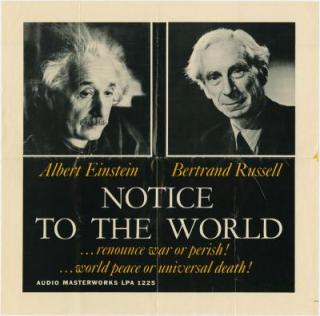
In 1955, Albert Einstein signed a letter calling on the world to renounce nuclear weapons.

The 00001219Russell-Einstein manifesto was endorsed by the smartest scientists of the generation, including several Nobel Prize winners. … As a result of the manifesto, the scientists formed Pugwash, an organization of scientists devoted to a political project: preventing nuclear war. Joseph Rotblat was a founder of the organization and when the New York Times invited him to write on the 50th anniversary of the manifesto, he said: “We took action then because we felt that the world situation was entering a dangerous phase, in which extraordinary efforts were required to prevent a catastrophe.”

Rotblat and Pugwash shared the Nobel Prize for peace, and he is a hero of mine for showing that scientists can be passionate moral leaders and still retain their integrity. The work done by scientists through Pugwash helped make the world a safer place. Their work contributed to the key international agreements on weapons of mass destruction, including the Partial Test Ban Treaty of 1963, the Non-Proliferation Treaty of 1968, and the Biological Weapons Convention of 1972.

(Image via McMaster University)

Dick Pics On Display

By Tracy R. Walsh

If you’ve anonymously shared a crotch shot over the past few months, your junk may soon be part of an exhibit:

Four artists interested in feminism, the Internet, sex, porn, and power have decided that the dick pics they’ve gathered are important enough to share with the public. Over 300 men who have engaged in a little harmless online exhibitionism sending this summer may be surprised to learn that their members will mounted, framed, and put on display on August 23 at a Brooklyn gallery space by an artist collective known as Future Femme.

The artists collected the photos through social media and dating sites. The unwitting models apparently don’t have much legal recourse:

It’s true that if your dick appears in the show and you were misled about the solicitor’s true identity you have a chance at legal retribution. Because one of the artists posed as someone else [on Grindr] she’s liable to be sued for internet impersonation, a class A demeanor in New York that caries a $1,000 fine and up to a year in prison. But unless any of these users walk into the Bushwick exhibit and recognize themselves, they’ll never know more than one stranger saw their dicks. But if a dick pic gets shown in a public space and the dick’s owner doesn’t know, is it moral? Is it right?

Jessica Roy is uneasy:

It’s pretty obvious what the outrage would look like were the genders in this story reversed, and revenge porn–the practice of publishing naked photos of someone online without their consent–is ethically unacceptable no matter your gender. But in response, the artists claim they’re doing it as a reaction to the feelings of assault women can feel when they randomly receive an unsolicited dickpic. They’re also posting each framed penis photo next to a picture of their own genitals, and there will be no names or faces that will make it possible to identify the dick owner.

Eric Shorey is one of the few men to have offered his opinion:

The art project, while licentious and shocking, could certainly be thought of as an interesting exploration of gender, sexuality, and predation in the age of the Internet. Or, conversely, it could be thought of as some horny girls having a laugh at the expense of men. Either way, the art piece is sure to start some much needed conversations about hook-up culture and the digital mating patterns of our fellow human beings.