Dissents Of The Day, Ctd

The first dissenter follows up:

Thank you for publishing my email. I just wanted to clarify a couple things. First, my point was not that you had argued a discussion of male physiology should be substituted for one of rape culture. Rather, it was that this substitution was a likely rhetorical effect of your response to Bruni. I don’t think that effect was intended. But rape culture is reinforced as much by such Testosterone-3D-stickseffects as it is by explicit arguments.

To take a more obviously egregious example, when someone asks a woman who’s been raped, “Why didn’t you fight back?”, the intention of the question could be a whole range of things – curiosity, trying to elicit whether the rapist had a weapon or whether she was drugged, etc. But the effect of the question, when asked within a culture that tends to disbelieve and shame women who’ve been raped (unless the rape was committed by the near-mythical stranger in the bushes with a knife), is to dissuade her from reporting or talking about the rape.

Second, I’m increasingly unclear on the grounds of your criticism of Bruni’s op-ed. How is your call for a culture of male virtue fundamentally different from Bruni’s call for a culture of masculinity that’s not centered around the denigration and sexual conquest of women?

Both, unless I’m misunderstanding you, would make it socially unacceptable to treat women as objects for domination and violence and, as a result, would make it much harder for rapists, who rely on a culture that tacitly okays treating women that way, to get away with their crimes. So how, then, does testosterone fit it in to all this? Are you actually suggesting that not making rape jokes or calling out other men who let slip that they try to have sex with women who are too drunk to consent goes against the grain of the male psyche? If so, I suspect a lot of your male readers would take personal offense. If not, why worry about how to make this change in a way that’s compatible with testosterone – especially since scientists still know very little about how testosterone interacts with culture.

Given what a red herring male physiology has been (and often still is) among people who think men just can’t help themselves around a women who is too attractive, too drunk, etc., why not just keep the focus on telling men not to rape – and not to valorize those who do?

First point: As a writer I have long believed that my job is to express what I believe is true, and worrying about how such an argument could affect or be used by others is a very secondary mission. I cannot control what others will do with my arguments; I can only really control my own words. When you see previous controversies – race and IQ, the end of plagues, the differences between men and women, the rights of bigots to free speech – you can see where I’m coming from. I cannot write while looking over my shoulder – and won’t start now.

Second: yes, I wrote that I agreed with much of what Frank proposed. I’m just under no illusion that will “solve” the problem because cultural change can only do so much against the violence associated with testosterone. And I think it will be more successful if it comes at this issue with a positive vision of masculinity rather than an assumption that masculinity is only a social construct, and is itself the problem. The other dissenter also writes back:

I’m writing to thank you for taking my argument seriously, and for addressing it publicly. You rightly call my argument out as a liberal one. Indeed it is. My fundamental problem with the conservatism you admire is that it too often overlooks past injustices in its desire to hold on to (often worthy) older values.

While I still strongly disagree with you, I have great respect for your willingness to be open to critique, and to engage in civil discussion of difficult issues. These virtues render your blog a public asset, particularly at a time when shrieking extremism too often passes for debate. And it’s why I plan to continue reading the Dish for years to come.

I also am grateful for the sharp input and pushback from such intelligent, probing readers. It’s this civil interaction that this blog aspires to – not a final word, but a continuing conversation.
The American Response To Egypt

https://twitter.com/attackerman/status/368022051614773248

https://twitter.com/minafayek/status/368021211823226880

Max Fisher doubts the cancellation of the US-Egyptian military exercises this year will give us any leverage over the junta:

[The Generals] surely understood that they would pay a high price for this violence. If the generals are willing to accept 500-plus civilians deaths and the strong possibility of sectarian violence, maybe even a return to the Islamist insurgencies of the 1990s, then it’s hard to imagine they’ll be fussed by missing out on some military exercises with the United States.

Chotiner comes down hard on Obama’s announcement:

[T]he problem is not that Obama looks weak per se; it’s the policy behind the weakness. He hasn’t tried to use aid as leverage (and still refuses to use the word “coup”), he hasn’t (one assumes) put much pressure on American allies who are backing the Egyptian military, and he hasn’t even attempted to lay out the reasons that military rule in Egypt might, in the long term, play against American interests. One need only look to the Middle East and Pakistan to see how military repression can lead to extremism, and rampant anti-Americanism. It was notable that Obama took time to mention that Morsi’s undemocratic actions undermined his case for rule, but not that the military’s much more violent and undemocratic actions did the same.

Heilbrunn nods:

Obama further tried to console Egyptians by making it clear that the “United States strongly condemns” what is taking place. Big deal. It is Obama’s passivity that deserves condemnation. A forceful move would have been to suspend aid to Egypt’s military. So far, Washington appears to have derived zero leverage from continuing aid. Until Obama acts, Egypt’s military will interpret his inaction as acquiesence to its brutal measures.

Earlier Dish on the cancellation of military exercises here.

Time To Cut Off Cairo’s Aid, Ctd

A reader writes:

I don’t see how the US can continue to fund Egypt as this shit goes on, but cutting off aid to Egypt isn’t that simple. The aid to Egypt is basically a bribe to the Egyptian military to make sure Israel doesn’t have to fight a war along its Sinai border. That is how it started, and especially post-Mubarak, is how it has played out. I don’t think that Egypt’s ruling class would invade Israel at the drop of a hat if this bribe is removed, but if the Muslim Brotherhood crowd returns to power, that shit would heat up real fast.

Hence, presumably, the lack-luster Obama stance on the junta now running Egypt. Canceling military exercises is not likely to have any effect on the junta’s murderous contempt for civilian life and democratic processes. Here’s the rationale for such a lame response:

Administration officials fear that suspending that aid could destabilize the region, jeopardize Israel’s security, and would deprive the United States of its only lever to use on the generals. Analysts also say that if the United States withdrew its support, Egypt’s generals would be able to replace it with increased assistance from Saudi Arabia.

I can see these points, but when we have no way to prevent the massacres of yesterday, and when, with continued aid, we become complicit in it, our “only leverage” is no leverage.

The same, of course, can be said of aid to Israel: it has given the US no leverage at all over the continued expansion and entrenchment of Eretz Israel. It has simply made the US complicit in de facto apartheid on the West Bank and any bombs that kill Palestinian civilians. Israel, like Egypt, can live without it. And in my view, we should let them. In the coming epochal violence and shifts in the Muslim Middle East, America’s best policy, it seems to me, is distance.

But of course both aid to Israel and Egypt is also fueled by domestic pork-barrel politics. Another reader explains:

I worked throughout the ’90s for a contractor doing work in Cairo for USAID. Here’s how it worked: the US government gave Egypt $n billion per year. It amounted to roughly the same amount we gave Israel.

There was a difference, however. We said to Israel, “spend it wisely, my friends”. We said to Egypt, “we’ll have to approve how you spend it, and most of it should go to American contracting companies.” So the public finance project that we were working on for the Egyptian Ministry of Finance featured a lot of US-made computers, Jeep Cherokees, and guest lectures by IBM in Egypt and abroad. Doing things this way meant most of the money came back to the USA.  It became a shadow pork-barrel operation. If that’s still the way it works, it would explain why Congress has been reluctant so far to defund it.

Oh, and by the way.  Israel spends most of theirs on American weapons, so we get that back as well.  I think the English invented this system back in their empire days.

Yes, it is an ancient imperial device. But at least Britain also controlled the countries it aided. America today is an empire without any control over its client states – the worst of both worlds.

Islam, Putin, Obama And Gays

984ad02bb8d1b74085033c67d80d9c6c

Andrew McCarthy is only for gay equality when he can use it to bash Obama, but he raises some interesting points about the US position on Russia’s abolition of free speech and assembly for gay people. If relations with Russia can be severed on these grounds, why on earth are we still trying to manage relationships with Islamist regimes that treat gay people far, far worse? I think he’s absolutely right to point out how viciously homophobic laws are completely mainstream in much of the Muslim world. And he uses this statement by the president to accuse him of rank hypocrisy:

I have no patience for countries that try to treat gays or lesbians or transgender persons in ways that intimidate or are harmful to them.

This is the core case:

Will President Obama call out King Abdullah of Saudi Arabia the way he called out Putin? Will he start lecturing and cutting off American aid to violent and thin-skinned Muslim populations? Will he start demanding that Islamic leaders in the United States loudly and unambiguously call for reform of anti-gay laws and practices in Muslim countries?

I guess there are a few responses to this.

The first is to agree that the gay rights element was not the core reason for abandoning the “re-set” with Russia; and that Obama was indeed bullshitting a little when citing it as such. But bullshitting (a constant in politics) is not the same as rank hypocrisy and Obama has not ended relations with Russia, just given up on a real re-set. Russia, moreover, has just intensified its anti-gay policies, and could perhaps be prodded to reverse them. Such options, as McCarthy shows, do not exist in the Muslim Middle East.

As for Saudi Arabia, any engagement with that theocracy is repellent in terms of human and civil rights, but our dependency on foreign oil compels us to deal with them (if fracking doesn’t help us gain more distance). As for Iran, we have such an interest in keeping its nuclear program to civilian use that other issues fade into the background. And, of course, Obama has presided over the most punitive sanctions regime ever imposed on the country.

So good debating point, and healthy reminder of how poisonously backward much of the Middle East is. But in the end, no dice.

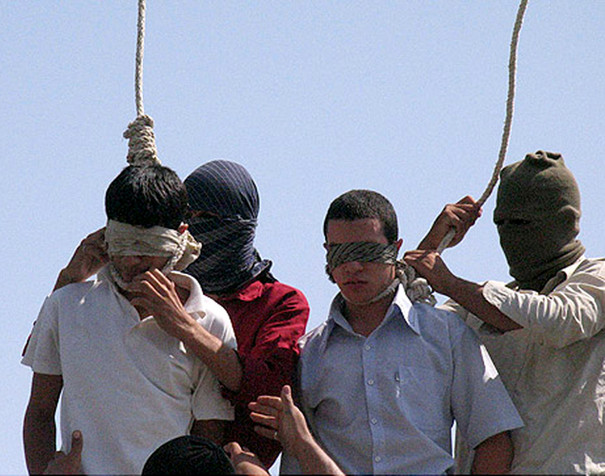
(Photo: the execution of two young men for homosexual activity in Iran in 2005)

Obama And The Economy

The news from Gallup cannot be buoying the president in yet another summer swoon. Approval of his economic performance is back to near 2011 levels:

db-igtvgr0i7rud2ajyacwHow to account for this, when the economy is actually growing again, and when the US recovery has been more powerful than any other developed country? I’d say a few things: the simple fact that he cannot truly execute his economic policy as long as the GOP controls the House and blocks new infrastructure spending and mandates a sequester that has both cut the deficit but also dampened growth; the lack of good new jobs for vast swathes of the middle class stranded after the banking crisis (hence the sharp decline in white working-class support); and the anemic level of growth that has done little to recoup the huge losses of the recession.

Voters gave Obama enough time to get things back on track, and they’re not happy with the track. And why should they be? Obama can say the Congress and state governments have foiled him – but, in the end, the GOP’s cynical strategy appears to be working: sabotage the economy so Obama gets all the blame, and cling on to whiter and whiter districts to keep the obstruction going, and keep growth low. That the GOP’s alternative economic plans are either Randian dreams or austerity-on-steroids does not matter as long as they are not in power. Oppositionism is all they need for now.

But there are long-term reasons why this assessment may be far too gloomy. Growth is accelerating somewhat; the deficit is falling fast; unemployment looks set to fall still further. The GOP may well blow its cynical strategy and favor a showdown over spending with Obama this fall. The result of that epic shoot-out will probably shift the political climate more powerfully than any poll can indicate now. But at some point, in any case, if the GOP seems set on governing, its own alternatives will rise to the surface. We saw what happened to Paul Ryan’s budget once it had to be attached to a national ticket: it was basically junked, and even then, he lost. So we wait and see.

But the main reason why Obama’s economic approval isn’t doomed is, in my view, simpler.

Here’s a piece from the British Tory paper, the Telegraph, that explains why. It follows conservative economics when in power from the vantage point of the Coalition government in Britain. And it shows that full-bore austerians, when actually forced to govern a country, rather than simply launch an opposition, have conceded much of the argument to Obama’s pragmatic legacy. It is Obama who is now the model for much of Europe, after excessive austerity along GOP lines proved disastrous. Money quote:

In claiming to be “fiscal conservatives but monetary activists”, Britain’s Tory leadership seem broadly to have returned to a Friedmanite path. In a half-hearted sort of way, David Cameron wants to shrink the state – but he also thinks monetary intervention can counter the adverse consequences on demand. There is also lip-service paid to Hayek, with a little dabbling in supply-side reform.

The Coalition has thus ended up with what used to be called the “neoclassical synthesis” – adherence to the basic principles of laissez-faire economics, but with a bit of Friedman, Keynes and even Hayek thrown in. In this sense, the crisis hasn’t changed the prevailing economic orthodoxy very much, since this is basically the thinking that has instructed policy-making for half a century or more.

What may now be true of Britain is even more so of the US, where leaders have from the start adopted a fundamentally pragmatic approach to the crisis. Rather than let ideology rule, America has focused more on what’s proven to work. The result has been a much swifter, albeit still not entirely secure, recovery. Belatedly, the Coalition seems to be following its lead. What took it so long?

Obama has always been a pragmatist (not a leftist) in economics, and I’d argue that his response to the Great Recession was easily the best of any Western leader because of it. Maybe this isn’t clear now; but in the end, it will be and is already validated by the evidence. I believe that, in the end, that evidence will be critical, if Obama can deploy it effectively to make his case. And in the context of the strongest growth among Western developed countries, he can.

Egypt On The Edge

Juan Cole analyzes the situation:

Although al-Sisi said he recognized an interim civilian president, supreme court chief justice Adly Mansour, and although a civilian prime minister and cabinet was put in place to oversee a transition to new elections, al-Sisi is in charge. It is a junta, bent on uprooting the Muslim Brotherhood. Without buy-in from the Brotherhood, there can be no democratic transition in Egypt. And after Black Wednesday, there is unlikely to be such buy-in, perhaps for a very long time. Wednesday’s massacre may have been intended to forestall Brotherhood participation in civil politics. Perhaps the generals even hope the Brotherhood will turn to terrorism, providing a pretext for their destruction.

Paul Pillar has the same thought:

Wouldn’t the breeding of more Egyptian terrorists be a bad thing from the viewpoint of Egyptian military leaders? Not if they wish to present themselves as a bastion against terrorism and to lay claim as such to American support.

Larison adds:

Of course, it is perverse to consider the military a “bastion” against a threat that their actions are making worse, but this will probably be accepted here in the U.S. as a “necessary” arrangement.

Instead of doing our best to disentangle the U.S. from our ties to the leaders of the coup, which seems the only sane thing to do at this point, Washington will find new excuses for why this week’s disaster requires even more “engagement” than before.

Issandr El Amrani worries about a militarized Muslim Brotherhood:

An Islamist camp that, as elements of it are apparently beginning to, sets fire to churches and attacks police stations is one that becomes much easier to demonize domestically and internationally. But it is also much more unpredictable than Egypt’s homegrown violent Islamist movements were in the 1980s and 1990s, because there is a context of a globalized jihadi movement that barely existed then, and because the region as a whole is turmoil and Egypt’s borders are not nearly as well controlled as they were then (and today’s Libya is a far less reliable neighbor than even the erratic Colonel Qadhafi was then.)

Shadi Hamid fears that Egypt’s military junta will prove worse than Mubarak:

Democratic transitions, even in the best of circumstances, are uneven, painful affairs. But it no longer makes much sense to say that Egypt is in such a transition. Even in the unlikely event that political violence somehow ceases, the changes ushered in by the July 3 military coup and its aftermath will be exceedingly difficult to reverse. The army’s interventionist role in politics has become entrenched. Rather than at least pretending to rise above politics, the military and other state bodies have become explicitly partisan institutions. This will only exacerbate societal conflict in a deeply polarized country. Continuous civil conflict, in turn, will be used to justify permanent war against an array of internal and foreign enemies, both real and imagined.

Cook thinks that both the Muslim Brotherhood and the Egyptian military have imitated the Mubarak regime:

Just as Egypt’s political system before the January 25 uprising was rigged in favor of Mubarak and his constituents, the Brothers sought to stack the new order in their favor, and today’s winners will build a political system that reflects their interests. This is neither surprising nor sui generis. In the United States, rules, regulations, and laws are a function of the powerful, too. But in America, the capacity for change exists; whereas in Egypt, those institutions are absent. Although virtually all political actors have leveraged the language of political reform and espoused liberal ideas, they have nevertheless sought to wield power through exclusion. This has created an environment in which the losers do not process their grievances through elections, parliamentary debate, consensus-building, and compromise — but through military intervention and street protests. This plays into the hands of those powerful groups embedded within the state who have worked to restore the old order almost from the time that Hosni Mubarak stepped down into ignominy two and a half years ago.

Peter Hessler likewise focuses on the effect of Egypt’s past regimes:

In Egypt, the current conflict reflects the vastly different responses that groups can have to a fledgling democracy after decades of dictatorship. For the Brotherhood, this means stubbornly following what it believes to be the correct and legitimate political path, even if it alienates others and leads to disaster; for the military, it’s a matter of implementing the worst instincts of the majority. In each case, one can recognize a seed of democratic instinct, but it’s grown in twisted ways, because the political and social environment was damaged by the regimes of the past half-century.

The Conflict Within Israel’s 1967 Borders

Beinart argues that a Palestinian state wouldn’t end the Israeli-Palestinian conflict:

For Netanyahu, the creation of a Palestinian state must mean the end of Palestinian claims against Israel. But there’s a problem. Even if Israel relinquishes the West Bank, it will still contain more than a million Palestinians. Jews generally call these folks “Israeli Arabs.” But surveys suggest that they increasingly call themselves “Palestinian” citizens of Israel. And even after the creation of a Palestinian state, they’ll have claims.

Israel’s Palestinian citizens don’t want to leave. Over the decades they have developed an identity distinct from their West Bank and Gazan cousins. They appreciate living in a prosperous, democratic country. But—and this is what keeps Netanyahu up at night—they don’t want that country to be a Jewish state (PDF).

They don’t feel warm and fuzzy about a flag with a Jewish star and a national anthem that talks about the “Jewish soul.” They believe, as a high-profile Israeli government commission acknowledged in 2003, that Israel’s treatment of them “has been primarily neglectful and discriminatory.” Their kids can’t aspire to be prime minister. In ways both deeply symbolic and highly practical, they feel like second-class citizens as non-Jews in a Jewish state.

For Zionists who believe in the legitimacy of a state that protects and represents the Jewish people—and I’m one of them—the opposition of Israel’s Palestinian citizens to Israel’s Jewish identity is a profound challenge. Netanyahu wants Abbas to solve it for him. That’s the real agenda behind his insistence that Abbas recognize Israel as a Jewish state. But Abbas can’t solve Netanyahu’s problem. Politically, he can’t accept something the Palestinians living inside Israel don’t. And even if he did, all he’d do is alienate himself from Israel’s Palestinian citizens. He wouldn’t make them feel less alienated from Israel’s anthem and flag.

Zionism always had an element of utopianism to it. But it is not in any way pleasant to observe the long-term consequences of such a radical experiment.

Terrorists On Twitter

The site’s recommendations engine is a boon for al Qaeda recruiters:

Let’s say your interest in terrorism was sparked by al Qaeda’s newest affiliate, the Syrian group Jabhat al-Nusra. So you follow their well-publicized Twitter account. … Armed with its knowledge of your interest in terrorism, Twitter slowly moves the Lady Gagas and Justin Biebers down the list [of recommended accounts], while moving hardcore terrorists and extremists higher and higher. Twitter’s recommendations are the cream of the crop, all the essential accounts a budding terrorist might want to discover. But it’s not just the low-hanging fruit. The more focused your initial follows are, the more specific the recommendations. Further experimentation shows that if you know one honest-to-God terrorist online, Twitter will cheerfully connect you with many others.

130814_bergertwit3 2

And it’s not just jihadists. Following the American Nazi Party serves up an equally compelling menu of white supremacists, anti-Semites, and violent terrorist groups. It doesn’t matter what twisted ideology you’re interested in, Twitter is there to help you get connected.

But al-Qaeda isn’t totally up on its social media savvy:

Last night, an al Qaeda affiliate asked its loyal Twitter followers for suggestions to help with Public Relations, and the Twitter hive mind answered. A linguist fluent in Arabic tells Business Insider the original hashtag translated to “#Suggestions_to_Develop_Jihadist_Media”. J.M. Berger, a counter terrorism expert who wrote the book “Jihad Joe: Americans Who Go To War In The Name Of Jihad,” started the trolling with this tweet:

Leading inevitably to:

https://twitter.com/spankthemoney/status/367612117391654913

https://twitter.com/TomKenniston/status/367706613290790912

And the Dish fave:

The Case Against The Personal Essay

Phoebe Maltz Bovy argues that “only fiction can be about the trivial without being trivial”:

The miracle of fiction is less about its execution than its promise: a story, not a delivery of life advice or an exhaustive documentation of reality. While personal essays fail as news because the subject matter isn’t newsworthy, they fail as storytelling because of how the texts are classified. A first-person protagonist and author may share a name and every event described may have happened as recorded, but if the document is labeled nonfiction, we respond to it differently.

Imagine Lucky Jim presented not as a novel but as a personal essay in The Chronicle of Higher Education. We’d be chastising the writer for his poor work ethic and for not being appropriately appreciative of his good fortune to even have a job. Or compare Jami Attenberg’s recent novel, The Middlesteins, about an obese matriarch, with the New York Times’s health-blog series “Fat Dad.” Take a wild guess at which of the two inspired the following response: “Thank you for this very important piece about the importance of family meals.”

No matter how rich the storytelling, the online personal-essay format, with its subtlety-free headlines and comments-welcome presentation, reduces these texts from nuanced portraits of human behavior to straightforward arguments about how to live.

Correcting Franzen

Jonathan Franzen’s recent interview with Colombian author Juan Gabriel Vásquez aggravates Chad W. Post’s anti-Franzen bias. He cites the following question as evidence:

Jonathan Franzen: I’m struck by how different in feel The Informers and The Sound of Things Falling are from the Latin American “boom” novels of a generation ago. I’m thinking of both their cosmopolitanism (European story elements in the first book, an American main character in the new one) and their situation in a modern urban Bogotá. To me it feels as if there’s been a kind of awakening in Latin American fiction, a clearing of the magical mists, and I’m wondering to what extent you see your work as a reaction to that of Márquez and his peers. Did you come to fiction writing with a conscious program?

“This is the kind of bullshit question that no one would ever ask an American author,” says Post, who rewrites the above passage:

I’m struck by how different in feel The Corrections and Freedom are from the American “modernist” novels of a generation ago.

I’m thinking of both their disinterest in language and representations of the inner workings of the human experience (the straightforward neo-realistic prose that dominates both of them) and the obsession with the suburbs. To me it feels as if there’s been a kind of awakening in American fiction, a clearing of the obfuscating mists, and I’m working to what extent you see your work as a reaction to that of Faulkner and his peers. Did you come to fiction writing with a conscious program?

Post’s point:

Implicit in Franzen’s question is the idea that there was—or is—a certain “type” of Latin American writing and that anything different than that is some sort of political statement or bold move, as if Latin American writers can’t write about Europe or America or anything modern and universal. Get back to the banana plantations and bring us some talking butterflies! Beyond being insulting to Latin American writers, it really makes the person asking the question—Franzen in this case—seem like an ignoramus. So all y’all Mexicans actually know about Europe? Holeey shit!

Meanwhile, Jason Diamond assembles “A Handy Guide To Why Jonathan Franzen Pisses You Off” here.