Egypt Is Erupting Again, Ctd

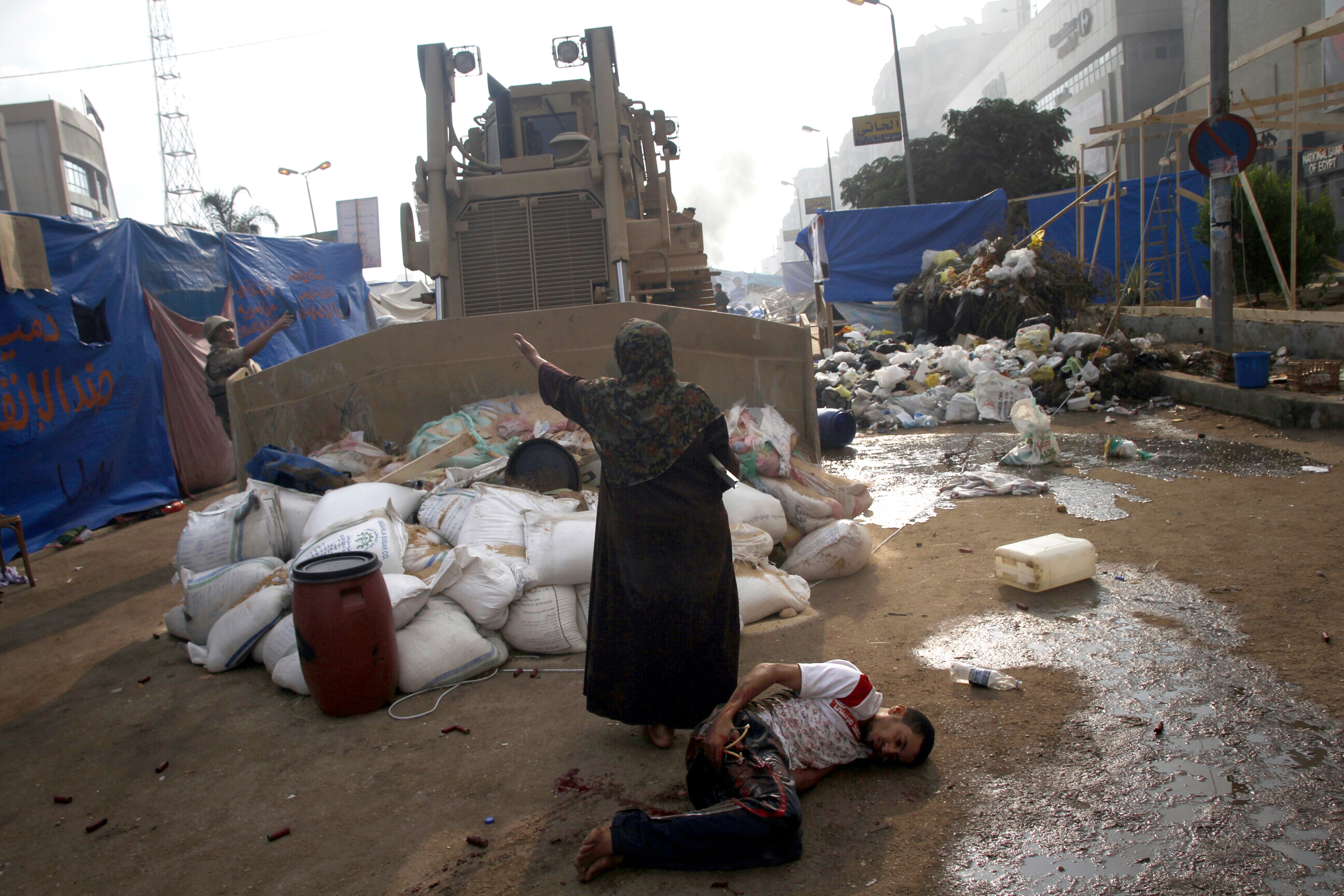
What many are calling the iconic image of the past 24 hours:

EGYPT-POLITICS-UNREST

From the Getty description of the scene captured by Mohammed Abdel Moneim:

An Egyptian woman tries to stop a military bulldozer from hurting a wounded youth during clashes that broke out as Egyptian security forces moved in to disperse supporters of Egypt’s deposed president Mohamed Morsi in a huge protest camp near Rabaa al-Adawiya mosque in eastern Cairo on August 14, 2013. The fate of the young man is not certain, but at the time of taking these photos he was seriously injured having been shot by birdshot. For further information refer to this link.

For more, photojournalist Mosa’ab Elshamy has published a powerful gallery of images he took during today’s crackdown. Below are some additional tweets since our last update:

What’s So Bad About Booker?

Corey Booker Thanks Constituents After Winning Primary

Most Americans haven’t heard of Cory Booker, who is almost certain to be New Jersey’s next Senator. Pareene provides an unflattering introduction:

In many ways, Booker is perfectly suited for the United States Senate. He won’t be expected to accomplish anything. He will have so many more opportunities to spend time with even more rich people with elite backgrounds and worldviews similar to his. He will have much more access to television studios and Sunday shows and cable news cameras. He will, in short, be the worst kind of senator. The kind that has no power and no real desire to exercise power on behalf of the people the senator ostensibly represents, but the kind that always expresses opinions on television about whatever national issues people on television care about that day.

Enten thinks that Booker will “probably be right in the middle of the Democratic caucus” and places him “slightly to the right of then junior Senator Barack Obama of Illinois“:

That said, it isn’t Booker’s style to stay quiet. He isn’t likely to put his nose to the grindstone and table pieces of legislation that please your tax accountant and nobody else. This is a man who thrives on the affection of fans on Twitterwho runs into buildings that are on fire, who likes to be heard.

So, if Booker isn’t going to make very liberal comments or pass very progressive legislation, then how will he make his presence felt? He’ll do what Obama promised to do when running for president: reach across the aisle.

Weigel is surprised that “that no Democrat ever scored a hit on the guy, who is loathed by some progressives in a way that’s only now being noticed”:

How often do Republicans toss out a conservative for a “gosh, guy, I want to cut deals” moderate? The only progressive argument for Booker, honestly, is that there have been only four African-Americans ever elected to the U.S. Senate, and from only three states, and that the long-term interests of a party that depends on huge minority turnout adding to white liberal turnout are served by promoting nonwhite stars.

Scott Lemieux doesn’t understand what all the fuss is about:

[I]f I’m going to be sold on the idea that he’s some kind of unique threat to the Democratic Party, I’d like someone to name one issue on which he’s to the right of the prohibitive frontrunner for the Democratic nomination in 2016.

(Photo: Newark Mayor Corey Booker greets people along with Hoboken Mayor Dawn Zimmer (R) at the Hoboken PATH station after winning the Democratic primary for U.S. Senate on August 14, 2013. Booker will face off in a special October election against former Bogota, NJ mayor Steve Lonegan to fill the empty Senate seat left formerly held by Frank Lautenberg, who died on June 3rd. By Michael Bocchieri/Getty Images)

Captive To The Commune

Mark Lilla reviews Paul-Julian Robert’s My Fathers, My Mother, and Me, a new documentary about Friedrichshof, an infamous Austrian commune that was once the largest in Europe. The commune, where the filmmaker was raised, was founded by Otto Mühl:

Films of the earlier years make the place seem idyllic. But over the years Mühl became increasingly dictatorial and in the Eighties it came to light that he was sexually abusing some of the children. The commune was dissolved, and in 1991 he was convicted of pedophilia and spent seven years in prison. He died this past May at the age of eighty-seven.

The mystery at the heart of the film:

[W]hat drew so many young people to this sociopath and kept them with him for so many years? Why did they adore him? Why did they turn a blind eye to the way their children were treated?

To Robert’s evident frustration, his mother is unable to enlighten us. She is neither defensive nor flighty, just very adept at keeping reality at bay. One feels sorry for her, too. She tears up occasionally and says her son has the wrong picture of what it was like. Mühl was not so important, she says; we made our decisions together. The children seemed happy and they were saved from the stifling, soul-destroying childrearing practices of the middle classes. But she has no answers, and isn’t eager to find any. She is old now, nicely dressed, soft-spoken and all suffering. One sees that she has trouble digesting her son’s revelations and confessions; she genuinely has no idea how the experience scarred him. It’s not evident that the son understands that, or sees that she, too, suffered from the collapse of her illusions. He’s a sensitive but pitiless young man, which is what makes this such an extraordinarily gripping film.

Time To Cut Off Cairo’s Aid, Ctd

Larison seconds the idea:

The U.S. can’t constructively influence what the Egyptian military and its interim government do, and it should stop pretending that it can. [Cutting off aid] isn’t going to remedy any of Egypt’s ills, but it would be the first step in acknowledging that it is beyond the ability of the U.S. government to remedy them. In the meantime, it does nothing but harm America’s reputation to be backing a coup government that kills civilian protesters in the streets. It costs the U.S. very little to end that support, and it gains the U.S. nothing but grief to continue the status quo.

Ali Gharib joins the chorus:

Reconciliation now seems hopeless; Egypt is shattered.

The Washington Post editorial board, with whom I frequently disagree, correctly noted that the Obama administration’s actions make it “complicit in the new and horrifyingly bloody crackdown.” At least one liberal, the Egyptian politician Mohammed El Baradei, resigned the position he took as vice president after the coup. There can be no justification for America and its leaders in the Obama administration to not also resign its role as the military regime’s funder.

Bloomberg’s editorial agrees:

Egypt’s generals must be made to understand that the kind of brutality that took place today in Cairo has consequences.

Dissents Of The Day

A reader writes:

Your post “The Roots Of Rape” was disappointing to read. I know testosterone is important to you; you’ve posted about its impact on your health and identity many times. The problem with using Bruni’s op-ed as an excuse to talk about testosterone and the physiological differences between the sexes, is that, whether you intend it to or not, you commit the same bait and switch that’s endemic to rape culture: substituting a discussion of men’s physiology for a discussion of the culture that allows that physiology to be used as an excuse for rape.

Such a substitution is particularly insidious not just because most men do not rape, but also because current research shows that most men who do rape are serial rapists who get away with their crimes over and over again by relying on the pervasive belief that what happened between them and their victims, who are nearly always acquaintances, was a hormone-fueled “misunderstanding” that wasn’t really rape.

I know that you didn’t intend to feed into these beliefs with your post, and that you went out of your way to say that rape is a heinous crime. But using your public platform to segue from Bruni’s discussion of rape culture to your own discussion of male physiology is at the very least an awkward non sequitur. At worst, by responding to Bruni with the observation that men on a physiological level are men, you implicitly reinforce a culture that has a long history of dismissing rape with “boys will be boys.”

Perhaps you’ll consider instead devoting some blog space to research on Predatory Theory, which describes how serial rapists, who it’s worth repeating tend to commit acquaintance rapes rather than rape strangers, rely on rape culture to get away with their crimes over and over again. Two posts that include thorough citations are here and here. A post that deals with the most frequent objections to the above posts is here. Thanks for taking a look.

Happy to do so and to invite readers also to look at this aspect of the issue. But I specifically did not argue that we should “substitute” a discussion of testosterone’s power for a cultural campaign against rape. I merely argued that any cultural attempt to rein in sexual violence should take into account the power of testosterone, in order to be more effective. Starting from a premise that it’s either DNA or culture misses this critical factor.

Testosterone is correlated with a tendency to physical violence. And rape is an act of violence. Of course, I am not arguing that this excuses violence – simply that there are causes as well as culture that are in play.

Look at the murder statistics, for example. 90 percent of homicides are committed by half the population, i.e. men. It is a remarkably stable statistic through time and space and culture. Does anyone truly believe that this is random or generated by sexist discrimination against men or entirely a function of cultural expectations? Why is it so staggeringly resilient, if culture is so important? Why is it the same now as it was long before feminism?

My point is that you will more successfully counter rape by going with the grain of the male psyche, rather than insisting that it is a function of mere culture. And I suggested the model of the gentleman as a better way to appeal to the better angels of the male nature. I’m open to other suggestions.

Another female reader is less forgiving:

I found your piece on the roots of rape logically and ethically disastrous. You don’t quite come out and say “boys will be boys,” but really, your argument that “men will never be women” comes insultingly close to the mark.

To argue that somehow systemic, glorified violence against women across the globe is attributable to testosterone (which, as I’m sure you know, women also possess, just in lesser quantities) is not just simply untrue, it is dangerously close to declaring that the “naturally” violent proclivities of men are to be expected as part of life.  You see, the men just can’t help it – it’s the hormones!

Your remedy for this allegedly unalterable reality is to “appeal to male pride.”  This throwback to the supposed days of gentlemanly chivalry (when women were so well treated) is, like the argument of the writer you critique, a case for a shift in culture. You simply want to shift it backwards 50 years or more.  Your logic seems to be that we need to stroke the egos of would-be rapists and hopefully cajole them out of a crime they are somehow designed to commit.

Really? Would you argue then, that the answer to terrorist, gay-bashing or child-molesting violence would be to find a way to “channel testosterone to calmer waters” for the men who commit these acts?  Would you argue that we’d have less religious violence if we stopped condemning terrorism and instead praised jihadists for their “courage, confidence and prudent risk-taking?” No, of course you wouldn’t.

But when it comes to rape, somehow it’s the job of would-be victims to be be deferential and make sure the would-be perpetrators feel duly appreciated.  We should celebrate military academies and the Boy Scouts (both institutions with a painful history of sexual abuse, by the way) in the hopes that puffing up male egos will keep them from the need to rape? By extension, then, men are rapists because they aren’t sufficiently admired, because their “self-esteem” is not sufficiently fed. They then turn to violence to feed it. Are you kidding? Who was more admired than Catholic priests were by their parishes 50 years ago? As we know from allegations that still continue to surface, rape was unquestioned and unpunished precisely during the era in which the military, the Boy Scouts, and the notion that Father Knows Best received national applause. I’m really at a loss for why you would think a return to this era would help anyone.

There’s a lot packed into that email. So let me address this point first:

Would you argue that we’d have less religious violence if we stopped condemning terrorism and instead praised jihadists for their “courage, confidence and prudent risk-taking?” No, of course you wouldn’t.

But would I hold that abolishing religion as a cultural facilitator of this violence would solve the problem? No, I wouldn’t. Because the religious impulse is so strong and universal – like testosterone – that it requires taming, not attacking. And you tame it from within, by supporting non-fundamentalist faith, by arguing for the incompatibility of true religion with violence, just as for the incompatibility of real manhood with rape.

And I’m not talking, pace my reader, about appealing to the aspirations of rapists – but of all men – in order to reduce the rate of sexual violence. That doesn’t mean a return to the 1950s. It requires new models of male virtue – like a president who is devoted to his family and daughters, or a clerical hierarchy that brings women in as full equals, or a sportsman who combines daring on the field with restraint in his own life. These role models are culturally important. But will they ever end rape? Tragically, no. Just as they will never end the maleness of much violence.

Does this mean I am complicit in things I believe cannot be abolished, but merely ameliorated? I sure hope not. I do not believe, for example, that homophobia will ever disappear among young men. To be different sexually in adolescence will always be stigmatized by peer groups. We can do all we can to stop it by targeting bullies and offering role models and a future for gay boys; but we will be more effective if we recognize that homophobia – like all distrust of out-groups – is an enduring part of fallen human nature and work from there.

This is a core distinction between a conservative approach to such issues and a liberal one. I plead guilty to conservatism, because, in its proper understanding, it is more reality-based and less utopian.
How Powerful Are The Poor?

Net Wealth

Ezra Klein argues against the notion “that corporations win every fight and everyone else — particularly the poor — get shafted”:

Corporate America holds real power in Washington. But to a degree that’s often overlooked, so too do the people, and the political party, most concerned with directly improving the lot of the poor. That’s the reality of politics right now: Corporate American and the poor can both wield a lot of power at the same time, as they’re not typically locked in a zero-sum struggle with each other. If anything, it’s the middle class, or perhaps the upper-middle class, that’s been left out.

Larry Bartels counters with the above chart on “what has happened to the net wealth of people at different points in the U.S. wealth distribution over the past decade”:

Stop a moment to think about what those numbers are telling us. Millions of people in the bottom tier of the working class have lost, on average, 85% of their net worth.

(Their average net wealth, which was already falling before the onset of the Great Recession, went from $6700 as recently as 2007 to $1500 in 2011). People even lower in the wealth distribution don’t appear in the graph because their net worth was negative all along; but in real terms, they have been hit even harder (at the 5th percentile, $39,000 in debt in 2011 as compared with $13,000 in 2007). Meanwhile, those near the top of the wealth distribution have been held harmless.

Ezra goes another round:

The absurdity of [Bartels’] case is nicely encapsulated by the top line on the graph: How can anyone say the rich hold power in Washington when their net worth fell by 27 percent between 2007 and 2011? But that’s only to say that net worth during the worst recession since the Great Depression isn’t a measure of political power. What happens in Congress is not the sole determinant of America’s economic experience — the two can even diverge sharply at times.

(Chart from (pdf) “Wealth Disparities Before And After The Great Recession” by Fabian Pfeffer, Sheldon Danziger, and Robert Schoeni)

What Makes Education Systems Work?

Dana Goldstein reviews Amanda Ripley new book, The Smartest Kids in the World: And How They Got That Way:

Ripley believes that compared with their counterparts abroad, too many American educators rely on poverty as an excuse for poor student achievement. Indeed, a large body of research shows that teachers who hold high expectations for all children, regardless of their socioeconomic background, get better results. At a Finnish school, Ripley interviews a teacher who articulates this way of thinking. “I don’t want to have too much empathy for them,” he says of his immigrant students, “because I have to teach. If I thought about all of this too much, I would give better marks to them for worse work. I’d think, ‘Oh you poor kid. Oh, well, what can I do?’ That would make my job too easy.”

While this is sound pedagogy, Ripley may be paying short shrift to the fact that countries like Finland, with functional, affordable health care, and housing programs, free teachers to spend a lot less time doing social work and more time focusing on academics. If The Smartest Kids in the World has a weakness, it is that the students it profiles are all broadly middle-class or affluent, so readers don’t get much of a sense of the very real effects that poverty and inequality can have on academic achievement across the world.

Charles Kenny wants education policies around the globe to become more evidence-based:

[Justin Sandefur and Lant Pritchett of the Center for Global Development] argue that varying results from the same policy intervention across different regions and implementing agencies suggest not that evaluation is pointless, but that we should be experimenting and evaluating much more often. In some cases, it will turn out that a new policy has broadly similar effects when evaluated in many different places: Cash transfers to poor families have been evaluated in a range of different communities around the world and pretty consistently lead to better health and education outcomes for kids, for example. But for many—perhaps the majority—of policy problems, there isn’t a one-size-fits-all solution. When an expert says, “If it worked in Cleveland, it will work here,” ask why it worked in Cleveland, and whether the conditions the same here. Then try it, and evaluate it. And then try something else. And so on.

Can Obama Hatred Be Harnessed?

Rubio warned yesterday that, if Congress doesn’t pass immigration reform, Obama may legalize millions of undocumented immigrants by executive order. Catherine Thompson explains:

”I have been saying for more than a year that I believe that this president will be tempted,” Rubio said. ”If nothing happens in Congress, he will be tempted to issue an executive order, like he did for the DREAM Act kids a year ago, where he basically legalizes 11 million people by the sign of a pen.”

“We won’t get any E-Verify, we won’t get any border security, but he’ll legalize them,” he continued.

Drum thinks Rubio’s comment is “interesting for what it says about how Rubio views his tea party base”:

Basically, he’s given up on reasoning with them. Instead, he figures the only way to win them over is to appeal to their paranoid belief in Obama the tyrant, the man who’s unilaterally ruining America by running roughshod over Congress with his dictatorial executive order powers. Reason might not work, but perhaps they hate and fear Obama even more than 11 million undocumented immigrants.

Benjy Sarlin believes that Rubio’s gambit could backfire:

Many Republicans say they’re concerned about the security components of a bill because they fear Obama or a future Democratic president will find some legal rationale to delay or derail their implementation. Democratic and Republican supporters of the bill insist that they can find ways to prevent that from happening, either by specifying a clear set of security measures or by tying legalization to ironclad border metrics. But Rubio’s claim could feed perceptions on the right that Obama can’t be trusted to enforce the law and thus will ignore even the toughest border deal.

Bring The Noizu

In a review of Japanoise: Music at the Edge of Circulation, Scott McLemee defines the genre of Noizu:

The term is a neologism in Japanglish (cf. Franglais) referring to the underground movement or milieu devoted to producing — and enduring – squalls of atonal electronic sound blasted at incredibly high volume. Noizu stands in relation to hardcore punk or extreme heavy metal band something like the roar of a jet engine does to chamber music. Connoisseurs call the sound “harsh,” at least when they are praising a performance or recording.

The “noisician” works with a set of electronic boxes that distort, echo, or clip the frequencies of a sound; they are sometimes connected to one another according to a plan, and sometimes by chance. “Outputs go back into inputs,” [author David] Novak writes, “effects are looped together, and circuits are turned in on themselves. Sounds are transformed, saturated with distortion, and overloaded to the point that any original source becomes unrecognizable.” By the end of the performance, “the circuit is overturned, the gear is wrecked, and the network is destroyed.”

The point is to create, in Novak’s words, “the biggest, loudest, and most intense invocation of sonic immediacy imaginable” — sometimes blasting the audience into “a state of hypnosis, dreaming sleep, or trance.” …[T]he question of whether Noizu is a category of music is a question of taste and, even more, of definition – including self-definition, since there are people in the Noizu scene who insist that it is an experience utterly distinct from music.

(Video: Noizu artist Merzbow)

Time To Cut Off Cairo’s Aid

After today’s grotesque violence, I think the balance of the argument has decisively shifted. There is no way the US can aid a government that guns down its citizens in the streets. Those who argued for it long ago have been vindicated by events. Lynch, in a powerful post, agrees:

With blood in Egypt’s streets and a return to a state of emergency, it’s time for Washington to stop pretending. Its efforts to maintain its lines of communication with the Egyptian military, quietly mediate the crisis, and help lay the groundwork for some new, democratic political process have utterly failed. Egypt’s new military regime, and a sizable and vocal portion of the Egyptian population, have made it very clear that they just want the United States to leave it alone. For once, Washington should give them their wish. As long as Egypt remains on its current path, the Obama administration should suspend all aid, keep the embassy in Cairo closed, and refrain from treating the military regime as a legitimate government. …

The hard truth is that the United States has no real influence to lose right now anyway, and immediate impact isn’t the point. Taking a (much belated) stand is the only way for the United States to regain any credibility — with Cairo, with the region, and with its own tattered democratic rhetoric.

Meanwhile, Mike Giglio reports on being arrested and beaten by Egyptian police. He wasn’t alone:

I was arrested along with an Egyptian freelance photographer, Mahmoud Abou Zeid, and a French freelance photographer, Louis Jammes. They were in the same area during the clashes and also rounded up. Both were beaten after identifying themselves as journalists. Also, in detention, I ran into the award-winning French photo and video journalist Mani. (He doesn’t use his real name.) Mani had been on the Rabaa side of the demonstration, trying to film. For what it’s worth, he says he saw no weapons on the pro-Morsi side, just rocks and sticks. This was my impression, too. I was on the Rabaa front line just before the fighting started and saw no arms; only sticks, and then fireworks that were launched at the police from the side streets.

Other journalists were killed. Gideon Rachman doubts that, at this point, elections can heal the country:

Egypt may hold elections, at some point. But it is inconceivable that the army – having effectively declared war on the Muslim Brotherhood – will risk allowing them to win elections, again. Many Egyptian commentators argue that the Brotherhood are, anyway, much less popular than when President Morsi won election. But it seems highly improbable that the army will risk testing that proposition at the ballot box. If Egypt has any elections in the near future, they will be a sham.

End the aid.