In 1972, America conducted only several hundred paramilitary drug raids a year, according to Michelle Alexander’s “The New Jim Crow: Mass Incarceration in the Age of Colorblindness.” By the early nineteen-eighties, there were three thousand a year; by 2001, Alexander notes, the annual count had skyrocketed to forty thousand. Today, even that number seems impossibly low, with one annual count of combat-style home raids hovering around eighty thousand.
The ACLU has requested “information from law-enforcement agencies and National Guard offices on how federal funding has helped to drive the militarization of local and state police departments”:
Kara Dansky, the senior counsel of the A.C.L.U.’s Center for Justice, told me that the resulting data has just begun to pour in, and many agencies have proven to be coöperative. The biggest surprise thus far, Dansky says, is how little uniformity and clarity there is about when officers are advised to use extreme SWAT tactics, particularly in cases where mentally-ill or suicidal individuals are their targets. “One major trend that we’re seeing is that police departments across the country vary tremendously in terms of how, if at all, they document information pertaining to their SWAT deployments,” Dansky said. “We have very little doubt that there are circumstances where the use of military tactics or equipment would be an appropriate response to a domestic law-enforcement situation.… But there aren’t always clear standards in place for when certain tactics are appropriate.”
Earlier Dish on police militarization here, here, and here.
Last month, Douthat argued that “the European experience suggests that at least some abortion restrictions are compatible with equality and female advancement.” Katha Pollitt fired back:
Abortion is complicated, like everything that has to do with sex. Germany’s abortion rate is much lower than ours, but Sweden’s is almost the same. The Netherlands is almost as low as Germany, despite permitting abortion much later. In much of Italy, it’s hard to find an abortion because so many doctors refuse to perform them—and yet Italy, like Germany, has one of the world’s lowest fertility rates. One thing seems pretty clear, though: all these countries have plenty of abortions. But in the Western European countries with time limits, there is less need for second trimester abortion because there is far better access to abortion earlier.
I somehow don’t think that is a trade-off conservative pundits are willing to make.
[I]t is an oversimplification to suggest that France or Germany are somehow obviously more “pro-life” overall than the United States, given the multiplicity of differences between our system and theirs. But it’s also an oversimplification to say that the U.S. is unique among developed nations in having significant variations in abortion access, or robust political debate on the issue. And the reason to look at the European experience is not because the continent is somehow an exemplar of exactly the policies that pro-life American conservatives are pushing now, or would put in place if given constitutional license. Rather, it’s because it provides examples of many different approaches to the issue — stringently pro-life with a stronger welfare state (Ireland), expansively pro-choice with a much stronger welfare state (Sweden), more pro-life in law but relatively pro-choice in practice (Spain, until recently), relatively pro-choice in law but more culturally pro-life (Italy, arguably), and so on — that don’t necessarily map on to America’s right vs. left debate at all.
This variation, in turn, gives us more data on the original question that my column asked: What happens to a modern society when abortion is restricted?
Dana Stevens givesElysium – not to be confused with the brilliant PSB album – low marks:
Like District 9, Elysium takes on contemporary problems of economic and social injustice—this time not racial prejudice but the vast worldwide gulf between haves and have-nots. But after taking some pains to imagine and present a mid-22nd-century world that’s a plausibly grim extrapolation of the one we live in, Blomkamp proceeds to spend the last two-thirds of his film crashing spaceships into lawns, or staging high-tech fistfights between Elysium’s stolid hero and his even duller arch-nemesis. It’s a waste of a perfectly good dystopia.
Blomkamp is a talented, loosely visionary director, but, after two movies, it appears to be a limited vision. He’s stuck between real rebellion and real marketability.
So the new movie is a mess of violence and parental devotional, but rarely at the same time. Depending on the audience, one is meant to make the other palatable. And Damon is here to make Elysium palatable to everyone.
Blomkamp is a holder of strong political convictions (in interviews, he has said of his film, “This isn’t science fiction. This is today. This is now.”) and as his issue horizon has expanded from apartheid to immigration, health-care access, and the general divide between haves and have-nots, his narrative focus seems to have gotten hazier.
There’s still much to recommend Elysium. Damon gives a characteristically appealing performance. Blomkamp generously spares us the kind of tedious exposition—how Elysium works, why its atmosphere doesn’t float away, etc.—that so often clogs up science-fiction fare. And the visuals are terrific enough to merit the price of a ticket all on their own. For a while, they enable Blomkamp to create a world so physically persuasive as to keep disbelief suspended. But eventually the accumulation of illogic is too heavy, and Elysium crashes back to Earth.
Update from a reader:
Why are you bashing a filmmaker who is trying to create something different within the confines of Hollywood? Read my other favorite Andrew (O’Hehir) on Elysium, or at least offer a link to him.
Douthat complains about Pinker’s “impressively swift march from allowing, grudgingly, that scientific discoveries do not ‘dictate’ values to asserting that they ‘militate’ very strongly in favor of … why, of Steven Pinker’s very own moral worldview!”:
His argument seems vaguely plausible only if you regard the paradigmatic shaped-by-science era as the post-Cold War Pax Americana rather than, say, the chaos of 1914-45, when instead of a humanist consensus the scientifically-advanced West featured radically-incommensurate moral worldviews basically settling their differences by force of arms.
Like Sam Harris, who wrote an entire book claiming that “science” somehow vindicates his preferred form of philosophical utilitarianism (when what he really meant was that if you assume utilitarian goals, science can help you pursue them), Pinker seems to have trouble imagining any reasoning person disagreeing about either the moral necessity of “maximizing human flourishing” or the content of what “flourishing” actually means — even though recent history furnishes plenty of examples and a decent imagination can furnish many more.
Like his whiggish antecedents, he mistakes a real-but-complicated historical relationship between science and humanism for a necessary intellectual line in which the latter vindicates the former, or at least militates strongly in its favor. And his invocation of “the scientific facts” to justify what is, at bottom, a philosophical preference for Mill over Nietzsche is the pretty much the essence of what critics mean by scientism: Empirically overconfident, intellectually unsubtle, and deeply incurious about the ways in which human beings can rationally disagree.
Noah Millman takes both Pinker and Douthat to task. From his conclusion:
Modern science is an extraordinary achievement of human civilization. I am even willing to agree that the knowledge science is capable of producing is genuinely of a different kind from all other forms of knowledge, and that it is the only method that can reliably build suspension bridges of reason across the vast voids of ignorance. It does not follow, therefore, that we can’t learn anything useful any other way. And it certainly doesn’t follow that people following a strictly scientific approach will necessarily learn usefully-applicable things more swiftly than those following other, more traditional or more humanistic approaches. That’s all critics of scientism really need to argue.
Joel Kotkin and Ali Modarres worry about the lack of kids in urban areas:
Increasingly, our great American cities, from New York and Chicago to Los Angeles and Seattle, are evolving into playgrounds for the rich, traps for the poor, and way stations for the ambitious young en route eventually to less congested places. The middle-class family has been pushed to the margins, breaking dramatically with urban history. The development raises at least two important questions: Are cities without children sustainable? And are they desirable?
The trend they find troubling:
Over the past two decades, the percentage of families that have children has fallen in most of the country, but nowhere more dramatically than in our largest, densest urban areas. In cities with populations greater than 500,000, the population of children aged 14 and younger actually declined between 2000 and 2010, according to U.S. Census data, with New York, Chicago, Los Angeles, and Detroit experiencing the largest numerical drop. Many urban school districts—such as Chicago, which has 145,000 fewer school-age children than it had a decade ago—have seen enrollments plummet and are busily closing schools. The 14-and-younger population increased in only about one-third of all census-designated places, with the greatest rate of growth occurring in smaller urban areas with fewer than 250,000 residents.
Reyan Ali defends Kidz Bop, the CD series featuring bowdlerized Top-40 hits:
Loads of frivolous, materialistic pop songs have no beneficial messages, and rewriting their lyrics while keeping the tune doesn’t deprive young listeners of a worthwhile experience. The Kidz Bop version of “Thrift Shop” retains the track’s closest thing to a positive thesis (i.e. be thrifty and engage in a smarter kind of conspicuous consumption) while extracting references that have little to no effect on that song’s message. Are the rewritten results corny? Certainly, but they’re also there to be consumed by children who’ll accept, laugh at, or entirely overlook the new turns of phrase.
But not all the songs are so benign:
In 2011, Rich Albertoni a writer at the Madison, Wisconsin, alternative weekly Isthmus, pointed out that the Kidz Bop version of Lady Gaga’s “Born This Way” excluded the song’s key verses about inclusivity.
The passages, “No matter gay, straight or bi/Lesbian, transgendered life/I’m on the right track, baby/I was born to survive” and “No matter black, white or beige/Chola or Orient/I’m on the right track, baby/I was born to be brave” had both been axed in their entirety entirely. “Funny,” he wrote, “because for this parent, that’s one of the few meaningful lines this collection of pop songs might have had to offer.”
Removing those verses deprives listeners of one of the best elements found in pop music: its ability to create positive cultural change. As an LGBT anthem that nonetheless makes it a point to champion all sorts of subcultures, “Born This Way” carries a message that shouldn’t be discarded out of the fear that overzealous parents might be offended by mentions to any of these groups. And if such parents are offended, then a message of love and understanding is the sort that’s worth offending them over.
The express bus lines in York Region, Ontario (north of Toronto) uses the system suggested by Yglesias. Transit Enforcement officers usually board the bus right before the doors closes or two-three stops down the line to inspect tickets and see if they’re valid. Drivers have nothing to do with tickets and don’t even inspect. The fine is $155 for not having a valid ticket or monthly/weekly pass. From a report last year, the enforcement and security manager said about the system: “‘Now, we’re ingrained in transit,’ he said. ‘People call us now. They take great offense to those who would try to abuse our system.'”
In Vancouver, the subway (Skyline) has a similar system – no gates, just validation stations. Then, once you’re in the waiting area, an officer comes up to you asking to see your ticket. The fine is $173 and if you don’t pay, they can stop renewing your driver’s license. My experience is that it’s faster and better, but I’ve seen people who obviously didn’t pay (didn’t validate ticket at stop and just boarded the bus) and I’ve seen people getting caught.
Several more readers weigh in with examples:
Finally a subject on which I am an expert. I work at an international research center on Bus Rapid Transit in Santiago, Chile, but am currently in India looking at their examples.
The problem with getting rail level capacity out of bus systems instead the engineering (that we can do), it is the political will. Bogota didn’t start BRT, but developed a model system due to the leadership of its mayor Enrique Peñalosa. He famously said, “An advanced city is not a place where the poor move about in cars, rather it’s where even the rich use public transportation.”
It is politically difficult because it usually requires taking space away from car users and giving it to bus users. Even in a city like Delhi (where I am now) where the majority of the population don’t have cars, this has proven to be politically unpopular. Now imagine in a US city where even a bicycle lane can prompt accusations of a “war on cars.” Since there is a set amount of space for surface mobility conflict over whose needs should be met or prioritized is inevitable. Clearly historically in the US the needs of car users have been prioritized. But if we think about it democratically priority for buses is not only fair, but make sense in terms of efficient use of limited resources.
The funny thing about the Delhi BRT corridor is that while there is congestion on all the major streets people complain about it more there because they can look over and see the buses moving faster… and that makes it unfair. The trick is making it make them want to take a bus.
Another:
“Worst of all, even though a bus is a much more efficient use of crowded space than a private car, it ends up stuck in the same traffic jam as everyone else.” I’m sure there are other examples (I think the idea came from Bogota), but in Mexico City, the buses have their own lane in the centre of the road, and there are regular bus stops which basically work like train stations. This makes the buses much faster than in other cities. I read somewhere that setting up a subway-like system that uses public roads instead of building an underground network costs less than 5% of what an underground, train-based equivalent would, and I can attest to the fact that the system is very popular and works well.
Another:
Saw this post and thought of Chicago’s plan for 16 miles of Ashland Ave, a major north-south corridor. Due to the setup of Chicago’s “L” trains, my boyfriend has to take a train into downtown and then another out to get to UIC, where he works. The idea is almost exactly as Yglesias recommended: remove a lane of car traffic and use it exclusively for bus travel, removing the traffic component that my drives my boyfriend into such a rage (seriously, don’t even mention buses to him if you don’t want an earful).
Since Chicago is nowhere near able to afford more above-ground train lines, which may not be feasible anyway due to a shrinking population, this seems like a wonderful (and MUCH cheaper) alternative. I even caught my boyfriend, who told me about the plan, mentioning it as an alternate way for him to get to work. Here’s the link to an overview of the project.
Update from another:
I’m surprised no one has emailed yet about the Bus Rapid Transit system in Curitiba. It was the first large-scale system with buses in separated rights-of-way (1974) and is still a model across the world. The system was designed by architect Jaime Lerner, who would go on to be the mayor. Here’s a great TED Talk he gave. It’s cheaper than a subway, with decent capacity. Not as high as a subway, but if designed correctly similar to many light rail at a fraction of the cost. The issue is with design: the places where a bus needs rights-of-way most – in narrow, congested sections – are the places where it’s most costly to place them. So a lot of systems wind up with bus lanes where there isn’t traffic, and mixed lanes (slow) where there is.
Steven Pinker says scientists are guided by two fundamental precepts:
The first is that the world is intelligible. The phenomena we experience may be explained by principles that are more general than the phenomena themselves. These principles may in turn be explained by more fundamental principles, and so on. In making sense of our world, there should be few occasions in which we are forced to concede “It just is” or “It’s magic” or “Because I said so.” The commitment to intelligibility is not a matter of brute faith, but gradually validates itself as more and more of the world becomes explicable in scientific terms. The processes of life, for example, used to be attributed to a mysterious élan vital; now we know they are powered by chemical and physical reactions among complex molecules.
The second ideal is that the acquisition of knowledge is hard.
The world does not go out of its way to reveal its workings, and even if it did, our minds are prone to illusions, fallacies, and superstitions. Most of the traditional causes of belief – faith, revelation, dogma, authority, charisma, conventional wisdom, the invigorating glow of subjective certainty – are generators of error and should be dismissed as sources of knowledge. To understand the world, we must cultivate work-arounds for our cognitive limitations, including skepticism, open debate, formal precision, and empirical tests, often requiring feats of ingenuity.
David McRaney observes that the scientific method is totally unlike how humans naturally make sense of the world – which is why it’s so effective:
Your natural tendency is to start from a conclusion and work backward to confirm your assumptions, but the scientific method drives down the wrong side of the road and tries to disconfirm your assumptions. …. You prefer to see causes rather than effects, signals in the noise, patterns in the randomness. You prefer easy-to-understand stories, and thus turn everything in life into a narrative so that complicated problems become easy. Scientists work to remove the narrative, to boil it away, leaving behind only the raw facts. Those data sit there naked and exposed so they can be reflected upon and rearranged by each new visitor.
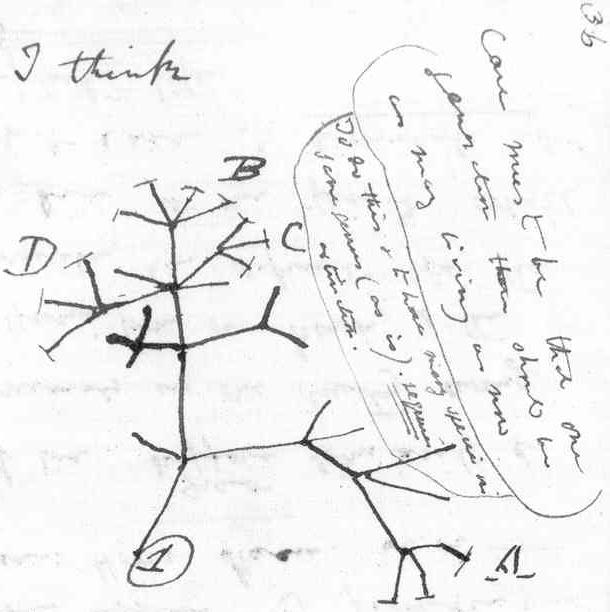
(Photo: Charles Darwin’s earliest extant sketch of an evolutionary tree, 1837)
A reader can relate to our post on civil asset forfeiture laws:
I’m an attorney living in Indiana. My sister-in-law was recently arrested for calling in a prescription for herself (impersonating a doctor’s office) for a pain killer. She was an addict and needed treatment (which she is receiving now, thank goodness). She was in her car when she picked up the prescription at the drive-thru window of the pharmacy. After her arrest, they began civil forfeiture proceedings to take her car (her dead mother’s car, by the way – with great sentimental value). I read the statute and couldn’t believe how broad it is.
She was lucky; she had money to rent a car for the four months it took her expensive attorney to fight to get her car back. I told her that my reading of the statute made the prospects look awfully grim. As far as I can tell, she got her car back just because they felt like being nice. There was nothing anywhere in the law saying that she had to get it back. I have no faith in our state legislature, of course, but it would be nice if these laws could be re-written to make some kind of sense – only taking property away from the really bad criminals. Someone who has an addiction shouldn’t be in that category.
Update from another attorney:
Here’s where I get pissed about civil forfeiture: It is damn near only used in drug crimes. The don’t forfeit the car when someone commits DUI. But what I wonder is, why not financial crimes?
When HSBC got indicted for laundering money for drug cartels, on day one the justice department should have frozen accounts, seized buildings, phone systems, computers, bank branches, everything that in any way touched on the scheme. CITI? You committed massive mortgage fraud? JP Morgan, you bribed officials in Birmingham? That’s racketeering; we’re taking your computer systems, and seizing accounts that are at all traceable. If there’s a place where civil forfeiture actually makes sense, it’s fraud and financial crimes (what with money being the goal of such crimes), yet forfeiture is never pursued in those cases, and jail is not an option for a corporate defendant, so we are left with a peanuts fine and it’s off to the next scam for the peep.
In July, The Wolverine, helmed by supposed movie star Hugh Jackman, opened to relatively underwhelming figures. 2 Guns, last weekend’s big Mark Wahlberg/Denzel Washington vehicle, underperformed too, but not as epically as The Lone Ranger’s flop in July. That movie featured another supposed movie star, Johnny Depp (Hollywood’s third-most valuable, according to Vulture), and movie-star hopeful Armie Hammer. “Tumbleweeds blew through theaters playing The Lone Ranger over the weekend, calling into question Johnny Depp’s star power,” fretted the Times. This calamity came just one week after Channing Tatum’s White House Down took in a disappointing $25.7 million its opening weekend. “[D]oes he even deserve his A-list status?,” wrote Vulture’s Kyle Buchanan. And summer movie season started with After Earth, an appallingly bad Will Smith star vehicle that failed to connect with audiences, prompting The Independent to wonder, “Is Will Smith’s reign at the summer box office over?”
Why all the performance-anxiety when it comes to male leads?
Yes, male movie stars tend to be more bankable than their female counterparts, and so it’s not great for the business as a whole if there are fewer of them. But that doesn’t entirely explain the endless, nervous parsing of what Channing Tatum’s stardom or (non-stardom) means. This isn’t solely a crisis about profits; it’s a cultural identity crisis. We go to the movies to see heroes doing heroic things, unlike the small screen, where the episodic nature of television has given way to the rise of the anti-hero. The emphasis on actors being able to singlehandedly, swaggeringly “open” or “carry” or “rescue” a movie seems like an extension of that wish. And now movie stars, like sports and political figures before them, have let us down. Or maybe not “us,” but more specifically, America’s men. Hollywood movies are made to appeal to a male audience, after all. It’s not so much that women are rejecting Hollywood’s vision of what manhood is; it’s more that American men don’t know who they want to be any more.
Update from a reader:
Wow, there are a lot of fudged facts and bad assumptions in the rather uninspired piece you posted by Noreen Malone. As someone in the film business, let me run a few things down:
1) The Wolverine opened just fine and will make a nice profit over its run. I’m not sure where she comes up with “underwhelming”, unless she was expecting it to make $100 million first weekend, which nobody out here expected it to do.
2) 2 Guns opened at #1 at the BO, made more than a third of its budget first weekend, and will end up as a minor hit. It was also made for a lower budget ($61 million) than the names in it would suggest, and marketed at that lower budget, so the success it did have was due in large part to its stars’ likability.
3) White House Down has the unfortunate distinction of being the second White-House-related terrorism movie of the summer. It was destined to fail. The fact that it even opened at $25 million is a testament to Tatum’s fan base. And, other than that one, Tatum has been gold, and he’ll have another huge hit next year with the 21 Jump Street sequel. The guy’s as legit a movie star as exists in the world today.
4) The Lone Ranger has been a well-publicized disaster for two years. Its budget was such that it has essentially no chance to make money, and they pulled a lot of advertising dollars at the end to try to cut their losses. Also, Johnny Depp has said repeatedly that he doesn’t care if his movies make money. He’s an accidental movie star on the strength of the Pirates movies and Alice in Wonderland, but other than that, he’s done quirky, indie things, many of which have failed at the BO. A huge name, but not a guy who does enough promotion or gives enough of a shit that he should be a barometer for the state of movie stardom generally.
5) After Earth was a vanity project for Will Smith that he essentially bought as a present for his son. It’s a complete anomaly and will likely not be repeated. It’s his Battlefield Earth. If he did Men in Black 4 tomorrow, it would be a huge hit.
Most importantly, what Malone says is nothing new. People have been saying that for 20 years. William Goldman wrote about it extensively in his topical books on Hollywood. No movie star has ever been able to get a huge opening for a terrible movie. Adam Sandler had 10 hits in a row … then he did Little Nicky, and nobody came. That doesn’t mean he’s no longer a movie star. It means that people don’t want to see movie stars in shit movies. Which, if you think about it, is actually a reassuring thing to know about American audiences. It’s comforting to know that quality still matters somewhat.
(Unless we’re talking about Grown Ups 2. I don’t know what to make of the fact that that POS is a hit.)