Not The Literary Type

In a Paris Review interview from 1969, E.B. White confesses:

I was never a voracious reader and, in fact, have done little reading in my life. There are too many other things I would rather do than read. In my youth I read animal stories—William J. Long and Ernest Seton Thompson. I have read a great many books about small boat voyages—they fascinate me even though they usually have no merit. In the twenties, I read the newspaper columns: F.P.A., Christopher Morley, Don Marquis. I tried contributing and had a few things published. (As a child, I was a member of the St. Nicholas League and from that eminence was hurled into the literary life, wearing my silver badge and my gold badge.) My reading habits have not changed over the years, only my eyesight has changed. I don’t like being indoors and get out every chance I get. In order to read, one must sit down, usually indoors. I am restless and would rather sail a boat than crack a book. I’ve never had a very lively literary curiosity, and it has sometimes seemed to me that I am not really a literary fellow at all. Except that I write for a living.

Asked to name books in the previous decade that impressed him, White responds:

I admire anybody who has the guts to write anything at all. As for what comes out on paper, I’m not well equipped to speak about it. When I should be reading, I am almost always doing something else. It is a matter of some embarrassment to me that I have never read Joyce and a dozen other writers who have changed the face of literature. But there you are. I picked up Ulysses the other evening, when my eye lit on it, and gave it a go. I stayed with it only for about twenty minutes, then was off and away. It takes more than a genius to keep me reading a book. But when I latch onto a book like They Live by the Wind, by Wendell P. Bradley, I am glued tight to the chair. It is because Bradley wrote about something that has always fascinated (and uplifted) me—sailing. He wrote about it very well, too.

I was deeply impressed by Rachel Carson’s Silent Spring. It may well be the book by which the human race will stand or fall. I enjoyed Speak, Memory by Nabokov when I read it—a fine example of remembering.

(Hat tip: Longform)
Song Of Walter White

Kera Bolonik eloquently unpacks Breaking Bad‘s nods to Walt Whitman. She describes a scene in which Walter White’s lab assistant, Gale, recites “When I Heard the Learn’d Astronomer”:

“When I Heard the Learn’d Astronomer” is, among other things, a declaration of disillusionment with convention, and of liberation, of emerging from the passive seat and propelling oneself into the world to participate and engage with it:

When I was shown the charts and diagrams, to add, divide, and measure them,
When I sitting heard the astronomer where he lectured with much applause in the lecture-room,
How soon unaccountable I became tired and sick,
Till rising and gliding out I wander’d off by myself,
In the mystical moist night-air,…

How the poem applies to White:

Though Walt initially gets into meth cooking for what he thinks will be quick and easy money, he soon discovers that it gives him a second chance: not only as Jesse’s teacher, not only to redeem his legacy as a legendary chemist (if only in an illicit universe), but as a way of embracing life full throttle. The lessons of the “Learn’d Astronomer” apply to Walter White too. He has been a consummate underachiever, trying to impart in vain his vast wisdom on unappreciative, disrespectful students, including Jesse, whom he flunked out of high school chemistry years before.

The Walter White we first encounter in the pilot is a shell: hapless, mild-mannered, self-effacing, a public high school chemistry teacher struggling very hard to support his pregnant wife, Skyler, and his teenage son with cerebral palsy. It takes a diagnosis of inoperable lung cancer just after his 50th birthday to breathe life into a man who’d been hiding behind “the charts and diagrams,” cleaving to his resignation. Getting a death sentence and subsequently turning to meth production (ostensibly, he first does it to build a nest egg for his family) thrusts Walter out of the “lecture-room” and into the “mystical moist night-air.” As he declares to an incredulous Jesse, who can’t believe that this is his former straight-and-narrow teacher: “I feel … awake.”

Mike Chasar has more.

On Anger And Writing, Ctd

Laura Bogart discusses how the emotion informs her writing and life:

In some ways, anger has been my saving grace. The ability to get good and pissed-off at the ways I’ve been mistreated—and not just by my family—is life affirming. The whisper of my roiling blood tells me that I matter, that I don’t deserve what I’m getting (or not getting). My current therapist actually has made a very potent distinction between anger and rage. Anger, she says, is that affirming force. Rage, she says, is a kicked dog that bites the first person that tries to pet her. My work in nonfiction and fiction examines the often hairline difference between the two, which has made me very aware of whether what I’m experiencing is anger or rage. That is to say, whether what I’m feeling is a legitimate reaction to a genuine slight, or just an excuse to bare my teeth.

A perfect example:

So, I’ve moved below a woman with a teenage son, and on occasion, they can get a little loud. I’m a quiet-loving introvert who, if I had my preferences, would live inside a hermetically sealed bubble. My initial reaction to the first bit of dubstep (and why is it that the people with the worst tastes always blare it the loudest?) was to become a human volcano. How dare they intrude on my solitude? Don’t they know I need quiet to write? So I got out my broomstick (if I’d had curlers in my hair and pink fuzzy slippers, my transformation into cranky hausfrau would have been complete) and I banged on the ceiling like I was trying out for a job as a sound effects specialist in the new Thor movie. The woman came down, immediately apologetic, almost tearfully apologetic, and told me that her son was just sharing his new favorite song with her. That’s when I what our lady of Oprah would call a “light bulb” moment: The music hadn’t rattled the cupboards; it had only lasted a moment; and, oh yes, other people have a right to enjoy life in their apartments.

Previous Dish on the subject here.

Why Haven’t More Muslims Won The Nobel Prize?

Tom Chivers counters Dawkins’ tweet:

It might be true that Islam is holding back scientific and other achievement among Muslims. I actually wouldn’t be surprised if it were. But you don’t get to simply assert it, because there are far too many other variables. Islamic countries are themselves usually poorer than Western ones (and far poorer than the average Trinity alumnus). Their standards of public health are lower, nutrition, education, everything. Does the average Muslim do worse in the Nobel prize stakes than the average similarly deprived Christian or atheist or Hindu? I don’t know. You need to do proper analysis, statistical regression, to work that out. What’s worse, Dawkins knows that.

Nelson Jones thinks Dawkins makes a weak case:

The reason for this isn’t an international conspiracy and it’s ridiculous to view it as some sort of failure on the part of Islam. Rather, it shows that modern science (by which I mean academic, research-intensive science) has been and remains an overwhelmingly Western phenomenon. To ask “where are all the Muslims?” as Dawkins does is to miss the point. One might as well ask, Where are all the Chinese? China has just eight native-born Nobel winners, and all but two of them are affiliated with Western universities, mostly in the United States.

Dan Murphy adds:

When the Nobel Prize was founded in 1901, the vast majority of the world’s Muslims lived in countries ruled by foreign powers, and for much of the 20th century Muslims did not have much access to great centers of learning like Cambridge.

Owen Jones thinks Dawkins makes atheists look bad:

As a non-believer, I want the atheist case to be made. I want religious belief to be scrutinised and challenged. I want Britain to be a genuinely secular nation, where religious belief is protected and defended as a private matter of conscience. But I feel prevented from doing so because atheism in public life has become so dominated by a particular breed that ends up dressing up bigotry as non-belief.

And Nesrine Malik rolls her eyes at Dawkins:

To wearily engage with his logic briefly: Yes, it is technically true that fewer Muslims (10) than Trinity College Cambridge members (32) have won Nobel prizes. But insert pretty much any other group of people instead of “Muslims”, and the statement would be true. You are comparing a specialized academic institution to an arbitrarily chosen group of people. Go on. Try it. All the world’s Chinese, all the world’s Indians, all the world’s lefthanded people, all the world’s cyclists.

Dawkins responds to that argument:

[F]air point. Somebody mentioned redheads (neither he nor I have figures on redheaded scientific achievement but we get the point). I myself tweeted that Trinity Cambridge has more Nobel Prizes than any single country in the world except the USA, Britain (tautologically), Germany and France. You could well think there was something gratuitous in my picking on Muslims, were it not for the ubiquity of the two positive boasts with which I began [There are 1.6 billion Muslims, nearly a quarter of the world’s population, and we are growing fast” and “Islamic science deserves enormous respect.” Redheads (and the other hypothetical categories we might mention) don’t boast of their large populations and don’t boast of their prowess in science.

The Lottery Tax

Pat Garofalo calls lottery tickets “a tax on those who can least afford it”:

Study after study has shown that lottery tickets are disproportionately purchased by low-income, less-educated people, and that lottery purchases go up when the economy and the unemployment rate gets worse. (22 state lotteries set sales records during the height of the Great Recession.)

James Gibney suggests a solution to this problem:

The research also shows, however, that the bigger the jackpot, the more affluent the ticket buyers.

One 2004 study by Emily Oster, now an economist at the University of Chicago, actually projected (with the usual academic caveats) a jackpot size at which Powerball becomes progressive: around $806 million.

Oster looked at buyers of Connecticut state lottery tickets by zip code and found that as the size of the jackpot grew, sales increased in richer areas: in fact, “at the highest jackpot levels the poorest 20% contribute only about 19% [of state sales] and the richest contribute close to 32%.” She suggested that “fewer games, with longer odds and higher jackpots, could allay some fears about regressivity.”

The Shifting Landscape Of Literature

Nobel Prize-winning writer Orhan Pamuk responds to the suggestion that the growth of countries like India, China, and Turkey will “breathe new life” into the novel:

The novel is a middle-class art. And we see the proliferation of middle classes in India, China, definitely in Turkey, so everyone is writing novels. If you want to predict the future, I can predict that in Europe, in the West, the importance of literary novels will decrease, while in China, India, popular literature will continue. Innovation will come from there, because the populations are large, there will be a lot of production.

In a 2005 Paris Review interview, Pamuk ruminated on the complications of own identity as a “Turkish” novelist:

First, I’m a born Turk. I’m happy with that. Internationally, I am perceived to be more Turkish than I actually see myself. I am known as a Turkish author. When Proust writes about love, he is seen as someone talking about universal love. Especially at the beginning, when I wrote about love, people would say that I was writing about Turkish love. When my work began to be translated, Turks were proud of it. They claimed me as their own. I was more of a Turk for them. Once you get to be internationally known, your Turkishness is underlined internationally, then your Turkishness is underlined by Turks themselves, who reclaim you. Your sense of national identity becomes something that others manipulate. It is imposed by other people. Now they are more worried about the international representation of Turkey than about my art. This causes more and more problems in my country. Through what they read in the popular press, a lot of people who don’t know my books are beginning to worry about what I say to the outside world about Turkey. Literature is made of good and bad, demons and angels, and more and more they are only worried about my demons.

For a helpful list of essays by and about Pamuk, go here.

Conservatives Against Christie

The New Jersey governor is more popular with liberals than conservatives. Allahpundit wonders whether the far right would rally around Christie should he become the nominee:

I keep thinking that, for all the slobber over his “electability,” he might be so widely and deeply disliked by a small but significant minority of righties that they end up staying home if he’s nominee and costing him the election. To be “electable” with a few percentage points’ worth of conservatives sitting out, he’d have to offset them by grabbing more centrist Democrats than expected from the Democratic nominee. How likely is that if Hillary’s the pick and Bill Clinton’s out there every day for her on the trail?

Pareene argues that Christie is more extreme than he’s given credit for:

The ironic thing about this conservative distrust is that Christie actually would be a very conservative president.

He’s an anti-abortion and anti-gay marriage staunch Catholic who believes in low taxes and no regulations and all the rest of the important, eternally unchanging policies on the checklist. Christie’s branding is designed to make him attractive to moderates in the Northeast — this is how the press fell in love with him, obviously — but it’s just that: branding. On the issues, he’s a man solidly of the right.

Barro thinks Christie is counting on these kinds of criticisms:

If Gov. Chris Christie (R-N.J.) wants to win the presidency in 2016, he needs to look conservative enough to be the Republican nominee and moderate enough to be president. He’s successfully executing one part of a strategy to do this: Convincing liberal commentators that he’s an unreconstructed conservative given too much credit for moderation. When he draws their fire, he convinces conservatives that he’s one of them.

Bernstein’s view:

Christie is a viable candidate, but probably starts off with more things to overcome than do some of the others chomping at the bit. I’m afraid that’s about as much as you can say about nomination candidates in a wide-open field at this early point in the race.

Why Do Chinese Tourists Have Such A Bad Rep?

Defacing ancient ruins and defecating in public doesn’t help:

Another reason could be that the Chinese lack a guidebook culture:

The Chinese have gained wealth so quickly that they have become thrust into global tourist culture without the time to create guideposts that other nationalities might enjoy. For instance, there is no Chinese equivalent of Lonely Planet, encouraging young Chinese to go explore the world and respect the cultures and communities they enter.

Plus, bureaucratic and language barriers encourage group travel:

In many countries, Chinese are still viewed with suspicion during visa review processes. Chinese tourists always seem to travel in huge packs because joining a tour group makes getting a visa easier. Finally, tourism sites across the world have learned to accommodate the language needs of the English speaking world, but Chinese tourists are rarely fluent in English or the language of the country they’re visiting, leaving many opportunities for miscommunication and misunderstanding.

Another reason why Chinese tourists are so unpopular:

[O]ne thing many Chinese vacationers don’t want to do with their money is tip – a custom in some places which many have ignored, Wang said. Though most travel agents in China would educate their clients about tipping in a foreign country ahead of their trip, most people ended up tipping very little or none. Some are not used to the idea of tipping, and they fail to understand that staff working at the Maldives resorts, who usually earn a meagre salary, rely heavily on tips, Wang said. This has created increasing tensions between the Chinese and their hosts. Staff would naturally prefer serving guests from countries with a tipping culture. Other staff have gone after Chinese clients and asked openly for tips, a rare thing for them to do in the past.

Of course, having access to guidebooks is no guarantee of good manners; Americans are still widely viewed as the world’s most obnoxious tourists.

What Trillion Dollar Deficit?

Budget Deficit

The part of Josh Green’s interview with Rand Paul that’s getting the most attention:

You know, the thing is, people want to say [my budget is] extreme. But what I would say is extreme is a trillion-dollar deficit every year. I mean, that’s an extremely bad situation.

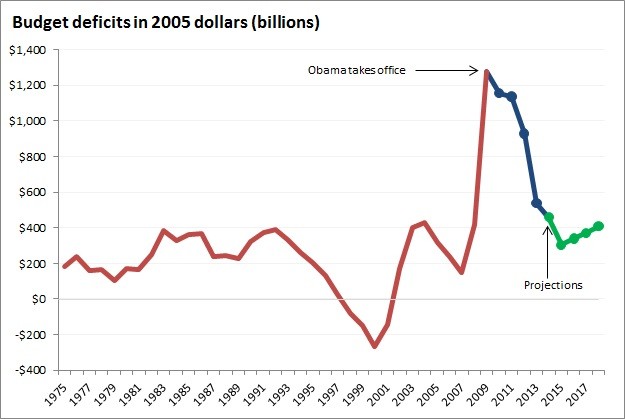
Waldman counters with the above chart:

Actually, according to the latest Congressional Budget Office (CBO) figures, the deficit for 2013 will be $642 billion. That’s a lot of money to you and me, but it isn’t a trillion dollars, and it’s the lowest deficit since 2008. The CBO is also projecting that in 2014 the deficit will fall to $560 billion, and in 2015 it will fall further, to $378 billion.

Those projections will inevitably be revised over time. Maybe the deficit will actually be larger, or maybe it will be smaller. One thing we can say for sure though, is that for the moment at least, there are no more “trillion-dollar deficits,” not every year, and not any year. In fact, the reduction of the deficit over Barack Obama’s term has been nothing short of stunning.

Chait is unsurprised by Paul’s ignorance:

For Rand (and Ron) Paul, the dread specter of fiscal collapse and hyperinflation is more of a generalized fact of life than something that depends on particular “numbers.” The whole political rise of the Pauls since 2008 owes a great deal to the economic crisis and the resulting spike in the deficit, which drove large numbers of people to join the freak-out bunker where the Pauls have resided all along. Of course Rand Paul isn’t going to notice the apocalypse is receding — its imminent appearance is a fixed piece of his worldview.

Krugman wonders what the public believes:

Larry Bartels likes to cite a 1996 poll in which voters were asked whether the deficit had increased or decreased under Clinton (it had, in fact, fallen sharply). A plurality of voters — and a heavy majority of Republicans — thought the deficit had gone up.

So I’d love to see a comparable poll now — asking, say, what has happened to the deficit since 2009. (It has actually been cut more than 50 percent). My bet is that it would look like that 1996 poll.

Scientific Breakthrough Of The Day

Scientists have produced a vaccine for malaria. Nathan Olivarez-Giles summarizes the results of the small study:

The vaccine, which is made using a weakened form of the disease, was administered in varying doses to a group of more than three dozen volunteers. Six people, each of whom were given a full five doses of the vaccine, were unable to contract malaria when exposed to the disease, the study says. This is the first time any vaccine has achieved 100% effectiveness in any trial, researchers report. Nine others were given four doses of PfSPZ, three of whom became infected in the trial. Of another 12 who took part in the trial but weren’t given the vaccine, 11 contracted malaria, the study says.

Ashley Feinberg explains how the vaccine is made:

[P]art of the reason it’s taken so long to get to this point is that the process of actually making the vaccine is incredibly difficult and complex. First [head researcher Stephen Hoffman] had to raise mosquitoes in sterile conditions “on an industrial scale.” He would feed them blood that had been infected with the malaria parasite and then exposed to radiation to so that the parasite would weaken. That way, the body would recognize its presence without being infected with the actual disease.

Next, billions of these parasites were harvested from the mosquitoes’ salivary glands, purified, and cryopreserved. And while all this was happening, most researchers in the field were expecting him to fail. They didn’t think it would be possible to mass-produce this virus in a way that passed the highly strict quality and safety standards that human medicine must undergo. And now, as [director of the US National Institute of Allergy and Infectious Diseases Anthony] Fauci mentioned to Nature, “To my amazement, Hoffman did it.”

Jason Koebler qualifies the successful trial:

The NIH trial is not without red flags, however. The vaccine was barely effective in smaller doses, which means booster shots or larger doses will need to be administered, which can drive up cost and decrease enrollment. Secondly, the vaccine needs to be injected directly into the bloodstream. That’s not a problem if you’re getting it in a hospital or clinic, but that means whoever is giving the vaccine will need to be specially trained. Self administration, at this point, is not an option.

But the fact that the NIH and the U.S. Department of Defense are behind this, and malaria’s long list of deep-pocketed enemies, make it unlikely that funding will be an issue going forward.

Why this development is such a big deal:

No effective malaria vaccine is available at present. The World Health Organization has set a target to develop a malaria vaccine with 80% efficacy by 2025, but until now, says [Anthony Fauci, director of the US National Institute of Allergy and Infectious Diseases], “we have not even gotten anywhere near that level of efficacy.”