Charting City Lit

dish_chart

Using data from Google N-Gram, the largest database of digitized books, Edgard Barbosa created the above graphic illustrating the frequency of city names over the last two centuries. Kelsey Campbell-Dollaghan comments:

First, the obvious: That English-language books tend to feature English-language cities, like New York and London. But beyond that, things get more interesting. For example, Rome starts off strong—thanks to its strong hold on the Victorian-era imagination—and peters out in contemporary times. Meanwhile, Beijing and Mumbai are nearly absent (with the exception of a few blips during the peak of Britain’s colonial reign) from the 19th century, but explode over the past two or three decades.

In another Google N-Gram study, a scholar has found that the rise of individualistic words and phrases parallels increasing urbanism over the last 200 years:

Use of the words “individual,” “self,” and “unique” all steadily rose over the course of the two centuries, while “obedience,” “authority,” “belong,” and “pray” all gradually declined. The use of the words “feel” and “emotion” also increased, reflecting “the growing importance of psychological expression,” she writes.

Greenfield does not see this as evidence of our ethical decline, but rather an entirely logical shift that reflected the realities of our new environments. In her view, a mindset that values “choice, obtaining things for oneself, child-centeredness, psychological mindedness, and the unique, individual self” is one that is more likely to thrive in an urban area.

The Perfect Political Slogan

Richard Morris attests to the difficultly of crafting it:

I once sat in a room of about 20 people, where we were invited to write a memorable line to adorn the platform at conference. Entirely predictably, this process was an unmitigated disaster. After an hour of coming up with any number of lines that randomly sorted words like New, Better, Fair, Green, Future, Britain, Fresh, Together and Change into a new order, we all agreed that perhaps it would be better if we got one person to write one memorable line with a single pertinent thought. We then, ahem, “discussed” for another hour who should write it.

He zooms out – and offers some advice:

[W]e’ve all become fixated with “the one great line”. And it’s all Barack Obama’s fault, with “Change we can believe in”. In reality, not even this line stood alone. Other lines dominated the campaign, like “Yes, we can” and the Fairey Posters “Hope” and “Change“. But since 2008, it’s become a “mandatory” – and an obsession – to write a great campaign line. And it takes up an inordinate amount of headspace.

So can I make a suggestion to all the parties. If you want a great line, get a single person to write it. Then get a single person to approve it. Then spend two years and a lot of money saying it over and over again. And get someone to say it with affection, with emotion and with conviction. It’s the only way.

Alone With The Written Word

David Paul Deavel nominates Ben Yagoda’s How to Not Write Bad as a successor to The Elements Of Style. Part of why he’s impressed:

As good as most of his guidance and judgments are, what I like most about Yagoda’s book is the more general advice he gives to those who really want to write better. It primarily involves habits of reading and thinking rather than learning specific rules. Yagoda is skeptical of accounts of the past in which everyone was writing elegant letters with classical and biblical allusions between battles of the Civil War. There may have been great letters, but few were writing them. Today more people than ever are writing on blogs and other social media. The problem is that most of this digital writing is not all that good due to the fact that it is done in a rather mindless fashion. Most people are “multi-tasking,” which is a perfect condition in which to write bad. Precision, accuracy, and diction that avoid ambiguity, vagueness, and cliché will inevitably be sacrificed when one is not “mindful” or concentrated on the difficult task of writing. Yagoda says what my students and I need to hear: Turn off the radio, the phone, and the social media if you want to write something that’s not bad.

Emma Woolf similarly tries to limit distractions when writing:

Isolation is a big part of writing (if you crave constant company then writing’s probably not for you) because you need to be alone simply to get the words down.

But you also need to experience life and people and relationships in order to have something to write about. When I went freelance a few years ago, after a decade in publishing, I found the enforced solitude hard. I missed the banter and time-wasting with colleagues, I even missed the silly office politics. These days I escape writing-at-home madness at the British Library: in its hallowed reading rooms, surrounded by other freelancers, I feel less caged (and you can’t work there in pajamas).

Avoiding the distractions of social media and the Internet is another problem for writers these days. I struggle with this: currently my screensaver is the warning from Jonathan Franzen: “It’s doubtful that anyone with an Internet connection at his workplace is writing good fiction.” It was Franzen who told Time magazine he’d resorted to pouring super-glue into his Ethernet port to deprive himself of Internet access. (He went on to write the novel Freedom, so it obviously worked for him.) Other writers, including Zadie Smith, use applications that prevent them from going online; I haven’t tried this software yet, but I’m considering it.

The Folly Of Molly Mormonism

In an interview, “Natalie,” a 23-year-old Mormon feminist, describes how her teenage sexuality collided with her faith:

The thing is, masturbation is a normal thing, but [the community] doesn’t talk to girls about it—I have since learned that they talk to boys about it—because we’re not supposed to desire. So I knew it was something a girl is not supposed to do, which made it even worse. So then it became kind of masochistic for me. It was like, Oh, Natalie ate too much today, she’s going to masturbate. I didn’t want to cut myself, I wasn’t ballsy enough to get drunk, I wasn’t ballsy enough to smoke—it was the biggest thing I could think to do to hurt myself within my religion. Which is really sad, that I was using my sexuality to hurt myself. So that was one of the things that I had to unpack with my therapist.

After that, I put my religion in a box for about a year. I was kind of like, I need to know who I am right now.

She eventually made her way to BYU-Idaho and decided she would give the religion another chance, describing her first two semesters there as her attempt “to be the good Molly Mormon” – an ideal she eventually relinquished. And what, exactly, is a Molly Mormon?

It’s kind of the Mormon idea about how a woman’s supposed to act.

Molly Mormons are women who are so spiritually obsessed that everything has to be by the book. Oh, your dress is not knee length! Oh no! It’s encapsulated by this sense that you have to be modest enough to be deemed attractive but not immodest enough to be deemed sexy. Being blonde and petite is sort of an added bonus. There’s a different type of body shaming that happens within Mormonism. It’s not necessarily the same as you see in Vogue or watching Sex and the City, where it’s like, “I have to be a size 4.” It’s more trying to be this modest female paradigm virtue where you’re supposed to be enticing and attractive but also sweet and naïve.

Why Don Draper Read Dante

Alan Jacobs recently made this observation about how we misread Dante:

Dante is not at all interested in placing persons (or as he would see them, ex-persons) in their proper places in the afterlife, nor is he interested in speculating on the precise nature of the sufferings of the damned: he is, rather, interested in exploring the nature of sin. The topic of the Inferno is not Hell but sin, for the Pilgrim must understand what sin is so he can renounce it, and thereby begin to find a way out of that dark, dark wood.

J.L. Wall uses that insight to unpack the meaning of Mad Men, the latest season of which begins with Don Draper reading Dante on the beach – a clue, he thinks, to understanding what the show’s writers are trying to do with their elusive main character:

Don Draper and Mad Men are, like Dante, less concerned with Hell than with sin.

Though the imagery was ratcheted up in this most recent season, questions of sin’s reality or applicability have been present since the show’s beginning. And not only with Don: The second-season character arc for Peggy Olsen, Don’s protege, is dominated by her conservative Catholic mother and a liberal priest both trying to confront her with the reality of sin and steer her off its path.Whether or not Peggy still believes in sin’s reality, Don does—and knows himself to be a sinner. Lying in bed with his neighbor, he shies away from the sight of the crucifix on her neck and ultimately pushes it from sight as they make love. (Her name, Sylvia, is etymologically related to the “dark wood”—selva—into which Don’s voiceover announces he has stumbled.) As much as Don’s flashbacks are dominated by scenes as a child in a whorehouse, they are equally dominated by discussions of sin, purity, penance, and redemption. His memories aren’t dominated by sex, that is, but by the connection between sex and his self-identification as a sinner.

Are Religious People Less Creative?

Connor Wood thinks so, offering reasons why faith can stifle “openness to new experience and, by implication, creativity”:

The data are clear: religious people are happier with their relationships, more likely to be married (which itself seems to make people happier), more likely to have children, more satisfied with life, more generous with charities (including secular ones), and less likely to get depressed or attempt suicide than secular folks. In other words, they’re more stable.

But here’s the thing: fulfilling all of a religion’s requirements, from attending its services or learning its rituals to organizing the Saturday potluck, takes energy. Like, a lot of it. And the more energy you put into the everyday minutiae of group life, the less energy you have to explore new horizons.

Dreher elaborates:

In past centuries, even creative people pretty much shared the wider society’s metaphysical and religious assumptions. The core beliefs weren’t under constant assault by radical questioning, coming from all angles. Secular modernity, especially in this century, changed all that. Now the religious believer has to devote much of his energy simply to holding ground — I’m talking about within his own mind — that in ages past was not contested. It is emotionally and psychologically exhausting. Religious individuals and communities may be working so hard to hold on to what they have that they see questioning in any sense as a threat to internal and external cohesion, and thus suppress creatives within their community. And, to be fair, it may be true that for people committed to objective metaphysical and religious truth, a time of great cultural flux is not the time to embrace creative experimentation.

What’s more, the broader culture teaches creatives to view religion and a religious mode of thinking with suspicion. We live in a time and a place in which people with creative gifts are enveloped by an ethos of expressive individualism, a way of seeing the world that rejects accepting the disciplines of religion and tradition, and poses them as threats to creativity — which, for the artist, means a threat to his sense of self. The fact that accepting the limits of certain moral and artistic conventions can actually promote creativity by compelling the artist to innovate within established limits is not well accepted. It is a paradoxical truth that imposing restrictions on the free ranging of the creative mind may compel that mind to do its best work. But some creative types only see limits not as rudders, but as anchors. Unfortunately, some religious traditions, suspicious and disdainful of art, buy into this false dichotomy between religion and creativity from the other side.

Love In Passing

https://vimeo.com/70543642

An anonymous New Yorker posted the following story on Missed Connections this week:

I saw you on the Manhattan-bound Brooklyn Q train.  I was wearing a blue-striped t-shirt and a pair of maroon pants. You were wearing a vintage red skirt and a smart white blouse. We both wore glasses. I guess we still do.

You got on at DeKalb and sat across from me and we made eye contact, briefly. I fell in love with you a little bit, in that stupid way where you completely make up a fictional version of the person you’re looking at and fall in love with that person. But still I think there was something there.

Several times we looked at each other and then looked away. I tried to think of something to say to you — maybe pretend I didn’t know where I was going and ask you for directions or say something nice about your boot-shaped earrings, or just say, “Hot day.” It all seemed so stupid.

At one point, I caught you staring at me and you immediately averted your eyes. You pulled a book out of your bag and started reading it — a biography of Lyndon Johnson — but I noticed you never once turned a page.

My stop was Union Square, but at Union Square I decided to stay on, rationalizing that I could just as easily transfer to the 7 at 42nd Street, but then I didn’t get off at 42nd Street either. You must have missed your stop as well, because when we got all the way to the end of the line at Ditmars, we both just sat there in the car, waiting.

I cocked my head at you inquisitively. You shrugged and held up your book as if that was the reason.

Still I said nothing.

We took the train all the way back down — down through Astoria, across the East River, weaving through midtown, from Times Square to Herald Square to Union Square, under SoHo and Chinatown, up across the bridge back into Brooklyn, past Barclays and Prospect Park, past Flatbush and Midwood and Sheepshead Bay, all the way to Coney Island. And when we got to Coney Island, I knew I had to say something.

Still I said nothing.

And so we went back up. Up and down the Q line, over and over. We caught the rush hour crowds and then saw them thin out again. We watched the sun set over Manhattan as we crossed the East River. I gave myself deadlines: I’ll talk to her before Newkirk; I’ll talk to her before Canal. Still I remained silent.

For months we sat on the train saying nothing to each other. We survived on bags of skittles sold to us by kids raising money for their basketball teams. We must have heard a million mariachi bands, had our faces nearly kicked in by a hundred thousand break dancers. I gave money to the beggars until I ran out of singles. When the train went above ground I’d get text messages and voicemails (“Where are you? What happened? Are you okay?”) until my phone ran out of battery.

I’ll talk to her before daybreak; I’ll talk to her before Tuesday. The longer I waited, the harder it got. What could I possibly say to you now, now that we’ve passed this same station for the hundredth time? Maybe if I could go back to the first time the Q switched over to the local R line for the weekend, I could have said, “Well, this is inconvenient,” but I couldn’t very well say it now, could I? I would kick myself for days after every time you sneezed — why hadn’t I said “Bless You”? That tiny gesture could have been enough to pivot us into a conversation, but here in stupid silence still we sat.

There were nights when we were the only two souls in the car, perhaps even on the whole train, and even then I felt self-conscious about bothering you. She’s reading her book, I thought, she doesn’t want to talk to me. Still, there were moments when I felt a connection. Someone would shout something crazy about Jesus and we’d immediately look at each other to register our reactions. A couple of teenagers would exit, holding hands, and we’d both think: Young Love.

For sixty years, we sat in that car, just barely pretending not to notice each other. I got to know you so well, if only peripherally. I memorized the folds of your body, the contours of your face, the patterns of your breath. I saw you cry once after you’d glanced at a neighbor’s newspaper. I wondered if you were crying about something specific, or just the general passage of time, so unnoticeable until suddenly noticeable. I wanted to comfort you, wrap my arms around you, assure you I knew everything would be fine, but it felt too familiar; I stayed glued to my seat.

One day, in the middle of the afternoon, you stood up as the train pulled into Queensboro Plaza. It was difficult for you, this simple task of standing up, you hadn’t done it in sixty years. Holding onto the rails, you managed to get yourself to the door. You hesitated briefly there, perhaps waiting for me to say something, giving me one last chance to stop you, but rather than spit out a lifetime of suppressed almost-conversations I said nothing, and I watched you slip out between the closing sliding doors.

It took me a few more stops before I realized you were really gone. I kept waiting for you to reenter the subway car, sit down next to me, rest your head on my shoulder. Nothing would be said. Nothing would need to be said.

When the train returned to Queensboro Plaza, I craned my neck as we entered the station. Perhaps you were there, on the platform, still waiting. Perhaps I would see you, smiling and bright, your long gray hair waving in the wind from the oncoming train.

But no, you were gone. And I realized most likely I would never see you again. And I thought about how amazing it is that you can know somebody for sixty years and yet still not really know that person at all.

America’s First Sex Manual

Originally published in England in 1684, Aristotle’s Complete Master-Piece, In Three Parts; Displaying the Secrets of Nature in the Generation of Man saw its first American edition in 1766. The book (which does not actually draw on Aristotle) was the most popular of its kind until 1830:

[W]hile the book’s attitudes toward monogamy are unsurprisingly Puritanical, its conceptions of anatomy and biology are outlandish and exotic, more kin to Medieval travel books than Renaissance anatomy texts. Its pages, “cobbled together from the works of Nicholas Culpepper, Albertus Magnus, and … ‘a good dose of old wife’s tale’” include such cases as parents who conceived “monsters” by looking at images while procreating, such as those depicted … in “The Effigies of a Maid all Hairy, and an Infant that was Black, by the Imagination of their Parents.” Most of the text’s woodcuts, even those meant to be straightforwardly anatomical, show a similar preoccupation with the bizarre. And birth defects, abnormalities, and, troublingly, racial differences, are almost uniformly attributed to some parental sin. …

There’s quite a bit of meaning for early modern literary scholars to tease out and religious conservatives to agree with. Medical historians may find the book’s conception of heterosexual pleasure surprisingly sunny, though this is only because it was thought to lead to “profit.” As Edinburgh auction house Lyon & Turnbull’s book specialist Cathy Marsden observes,

There are … interesting bits about the 17th century notion that it was considered beneficial for a woman to enjoy sexual intercourse in order to conceive. It suggests that both men and women should enjoy sex. That’s interesting because much later on, when they realised that a woman didn’t have to climax in order to conceive, the idea of a woman enjoying sex was considered far less important.

Check out illustrations from the book here, and the full book is available here.

In A World Of Jane

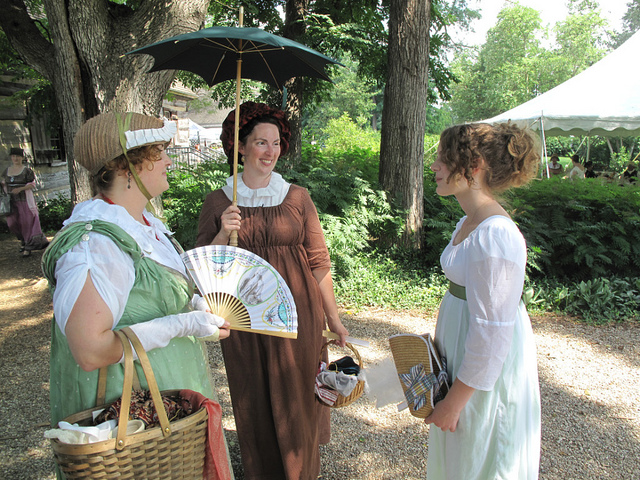
dish_janeausten

For her book Among the Janeites, Deborah Yaffe explored the world of hardcore Jane Austen fans. Here she confronts misconceptions about the community:

You run across plenty of articles that suggest Janeites are a tea-sipping, cat-hugging group of middle-aged librarians who spend their spare time knitting afghans. (Not that there’s anything wrong with all that.) The dress-up side of the fandom, in particular, seems to call forth ridicule from the terminally ironic. The subliminal, or not-so-subliminal, message is that it’s all terribly cutesy and trivial.

There’s definitely a sexist aspect to all this, I think:

Janeite fandom in the 21st-century U.S. is heavily female; the people with the money to attend those photogenic conferences are often middle-aged or older; and condescending to older women is a popular media pastime. And of course, that condescension mirrors the way that Jane Austen herself has sometimes been viewed, as a sexually frustrated spinster pouring her romantic fantasies into her books, or a sweet little auntie penning those charming courtship stories. All these stereotypes (many of them stoked by the Austen movies, I think) miss out on the tough, uncompromising side of her work.

And plenty of the Janeites I met respond to that side of Austen; not everyone sees her in those cozy, tea-sipping terms. In fact, my feeling is that Janeites are quite diverse—if not in their demographics, then at least in their responses to Austen. For some people, she’s a feminist; for others, she’s a conservative. Some believe she lived contentedly in the bosom of a supportive family, and others see her as angry and rebellious. Austen’s books are a lot edgier and more complicated than Austen movies, and so are the people who are drawn to them.

Previous Dish on Jane Austen here.

(Photo of the 2013 Jane Austen Festival in Louisville by Flickr user ozimanndias8)

Shakespeare In Prison

Malcolm Harris is skeptical about programs like Shakespeare Behind Bars:

The syllogism goes like this: If Shakespeare speaks to universal humanity, and Shakespeare speaks to a prisoner, then the prisoner is human after all. The non-incarcerated can rest easier knowing bad guys get rehabilitated and punished. But this instruction isn’t just a performance for viewers at home, it is educational. What exactly do jailers want their captives to learn?

Wrestling with questions of choice and responsibility, of betrayal and remorse — in the official American curriculum this is called existential thought. But Hamlet, Lear, and Macbeth aren’t everymen. It isn’t simply enrichment to dress up a society’s captive marginalized as kings and princes and have them rehearse tragedy. Even if it’s more fashionable to do post-colonial readings of Shakespeare than write him off as emblematic of Western hegemony, the use of treacherous Nordic royals as exemplars of human interiority is suspect.

His broader argument:

At the heart of both the Shakespearean tragedy and the story the American justice system tells about itself is a bad choice. Prisoners, it’s nice to think, are people who have made mistakes and are facing the consequences. But this national bedtime story is contradicted on the front page of the paper every day. An alien observer looking at the US prison population would never guess its organizing principle is justice. Rather, the penal system is index and engine of social marginalization, with the groups who most frighten the people who run it — young black men, trans women — facing the highest incarceration rates. Adam Gopnik is right when he calls the American mass incarceration “a fundamental fact of our country today—perhaps the fundamental fact, as slavery was the fundamental fact of 1850.” American prisons are central to defining and maintaining the host of unequal, intersecting relations that make up the national fabric, all while literally acting out tales of human universality in middle English.

This American Life‘s episode on prisoners’ performances of Hamlet is here.