The War On Online Hookups

The military is cracking down on the “hundreds” of officers and enlistees who use Craigslist Baghdad for hookups:

In Afghanistan, where commanders have forbid any sexual encounters between unwed people, virtually anyone who tries to set up a meeting online can become a target of investigators. One Marine lance corporal found that out in 2012, after he posted an advertisement on Craigslist for a sexual rendezvous. The guy he met at Camp Leatherneck, whom he thought was also looking to hook up, turned out to be an undercover agent with the NCIS.

My first thought: there’s a Craigslist Baghdad? Lester Brathwaite is indignant:

What is this, Baton Rouge? Officers entrapping sexed-up service members? Isn’t there a war or something going on? And considering the danger these brave and incredibly horny men face each day, what’s wrong with getting an innocent beej from a fellow soldier?

Laura Beck adds:

I guess whenever you confine a bunch of 23-year-olds in one place, they’re gonna get laid or post penis pics trying.

Why Is Circumcision Declining?

A boy shouts as he under goes circumcisi

Amid dropping rates in the US, a married couple debates whether or not to perform the operation on their son:

[O]ne of my husband’s ex-jock friends wrote a surprisingly thoughtful, persuasive, and well reasoned emailed argument to my husband in favor of circumcising our son.  After the analysis though, his final—and key—factor was, “And it’s hard enough for a guy to get blowjobs as it is.” Shockingly, the misguided belief that uncircumcised men have more difficulties procuring oral sex is shared beyond the male college athlete demographic. An OBGYN mother-in-law asked my friend, who was carrying her grandson-to-be at the time: “Don’t you want him to get blow jobs some day?”

Still, it seems that a groundswell against circumcision has begun in our country. Circumcision rates in the United States are dropping. They decreased 8 percent from 1999 to 2009. Interestingly, in my circle, the movement against the procedure seems to be led not by men, but by women. Predictably, these are the same mothers who are also advocating for natural childbirth (more midwives and birthing balls) and less medical intervention (fewer oxytocin drips, monitors, and less laboring while laying one one’s back) during delivery.

Today, only about half of infant boys have their genitals mutilated and permanently scarred in the US. That’s a big shift away from the expectations of the past. It will surely provoke more questioning of the strange, ancient, religious practice as routine medical care in the US. In many parts of the US, especially the West, unmutilated men will soon greatly outnumber those whose sensitive, tiny dicks have been painfully sliced after birth. Razib Khan puzzles over the declining numbers:

One might think that this is due to demographic changes in the West, as Hispanics have lower rates of circumcision than non-Hispanics (black or white). But while California had circumcision rates of 22% in 2009, Washington state’s was 15%.

It seems that Medicaid coverage has a strong effect, but this can’t explain all of the variation. In the late 1970s the western states had the same circumcision rates as the northeastern states. Today northeastern states have circumcision rates two to three times higher than in the west. And it doesn’t map onto politics either. Extremely conservative (and western) Utah has circumcision rates of 42%. Blue Rhode Island has rates of 76%.

Finally, I want to observe here that the males who were born during the era of diverging circumcision rates are now entering sexual maturity en masse. This is going to shape the expectations of both sexes, and perhaps result in some surprises for those who relocate to the other coast as they transition to adulthood….

(Photo: A boy shouts as he under goes circumcision during ceremony in Kajang outside Kuala Lumpur on November 20, 2011. By Mohd Rasfan/AFP/Getty Images)

Ask Frederic Rich Anything: Are Christianists Really Still A Threat?

Yesterday we heard about a fictional President Palin, while today the author of Christian Nation explains his political motivation for writing the book, as well as how he believes there is still a “deep bench” of Christianist politicians worth worrying about:

Frederic Rich is an American lawyer, environmentalist and writer. His novel Christian Nation imagines what would happen if America became a theocracy. From the publisher:

When President McCain dies and Sarah Palin becomes president, the reader, along with the nation, stumbles down a terrifyingly credible path toward theocracy, realizing too late that the Christian right meant precisely what it said. In the spirit of Philip Roth’s The Plot Against America, one of America’s foremost lawyers lays out in chilling detail what such a future might look like: constitutional protections dismantled; all aspects of life dominated by an authoritarian law called “The Blessing,” enforced by a totally integrated digital world known as the “Purity Web.” Readers will find themselves haunted by the questions the narrator struggles to answer in this fictional memoir: “What happened, why did it happen, how could it have happened?”

Our full Ask Anything Archive is here.

Kerry’s “Fool’s Errand”? Ctd

US-ISRAEL-PALESTINE-PEACE-TALKS-DIPLOMACY

Michael Cohen credits Kerry for getting this far:

The diplomatic breakthrough engineered by John Kerry that led to direct talks in Washington this week is really nothing less than astounding. Not only did Kerry – largely through his own grit and guile – get both sides to the table, he did so without raising any of the hackles of “pro-Israel” groups in the US and particularly in Congress. [Few] took Kerry’s shuttle diplomacy seriously and then suddenly the talks became a fait accompli before the usual suspects could torpedo it in advance.

Beyond this initial accomplishment, there are two other reasons for confidence in Kerry’s methods: first, he has made clear that the nine month talks are for the whole enchilada, namely all unresolved issues – no interim agreement or confidence building effort that can be undermined by the rejectionists on both sides as was the case with Oslo. Second, by getting the Arab League to reaffirm its commitment to recognizing Israel if a deal for Palestinian statehood is reached, he is not only putting pressure on Hamas, he is giving the Israelis one exceptionally large carrot. Any deal Netanyahu achieves, particularly one that dismantles settlements of divides Jerusalem, will set off a firestorm among right-wing and territorial-obsessed Israelis.

He’s done substantively far more in a few months as secretary of state than Hillary Clinton did in her entire competent, but quietist, term.  Daoud Kattab explains why the Palestinians want heavy US guidance in peace talks this time around, despite America’s strong ties with Israel:

For the Palestinian side, the idea of trilateral, rather than bilateral, talks changes the dynamics of the negotiations for the better. By getting the United States into the negotiation room, the Palestinians are hoping that Washington will square its public posture — which has been rather fair and in sync with the international position on Palestine — and its real position in shielding Israel from the rest of the world. Palestinian thinking is that through their Arab and Muslim allies, they can help ensure that the Americans remain honest in the talks or bear the fruits of overt bias in the already boiling Middle East. Having US negotiators in the room also provides a sense of continuity that might help ensure that the basic issues of the sovereignty of the Palestinian state, equality of the land swaps (in size and quality) and genuine sharing of Jerusalem (especially the Old City) are reached.

While Palestinians are not expecting absolute fairness from the Americans, they are hoping that the cost of failure, that is, its ramifications on foreign policy and the strategic interests of the United States, is such that it will help produce a fairer US role in these talks.

Paul Pillar suggests that Netanyahu, and even Hamas, could still surprise us with progress:

A decades-old charter, even though it has effectively been countermanded by more recent declarations by Hamas leaders, is taken as the basis for saying that Hamas “does not recognize Israel’s right to exist” and therefore should be shunned if not strangled. Yet the charter of the Likud Party, which explicitly rejects the right of a Palestinian state to exist—a rejection that prominent members of the party have in effect reasserted—is not taken as a reason for disqualifying Likud leaders as interlocutors in a negotiation ostensibly aimed at creating a Palestinian state. The important point for the present purpose, however, is that even if one believes that the worst things said about Hamas’s objectives are probably true, careful consideration of cost, risks and possible benefits leads to the conclusion that Hamas should be engaged.

Let us approach Benjamin Netanyahu in the same spirit. We are entitled to retain healthy skepticism about his objectives, the more unfavorable interpretations of which may still turn out to be true. But we should give him every chance to demonstrate otherwise.

Previous Dish on the potential of the new talks here and here.

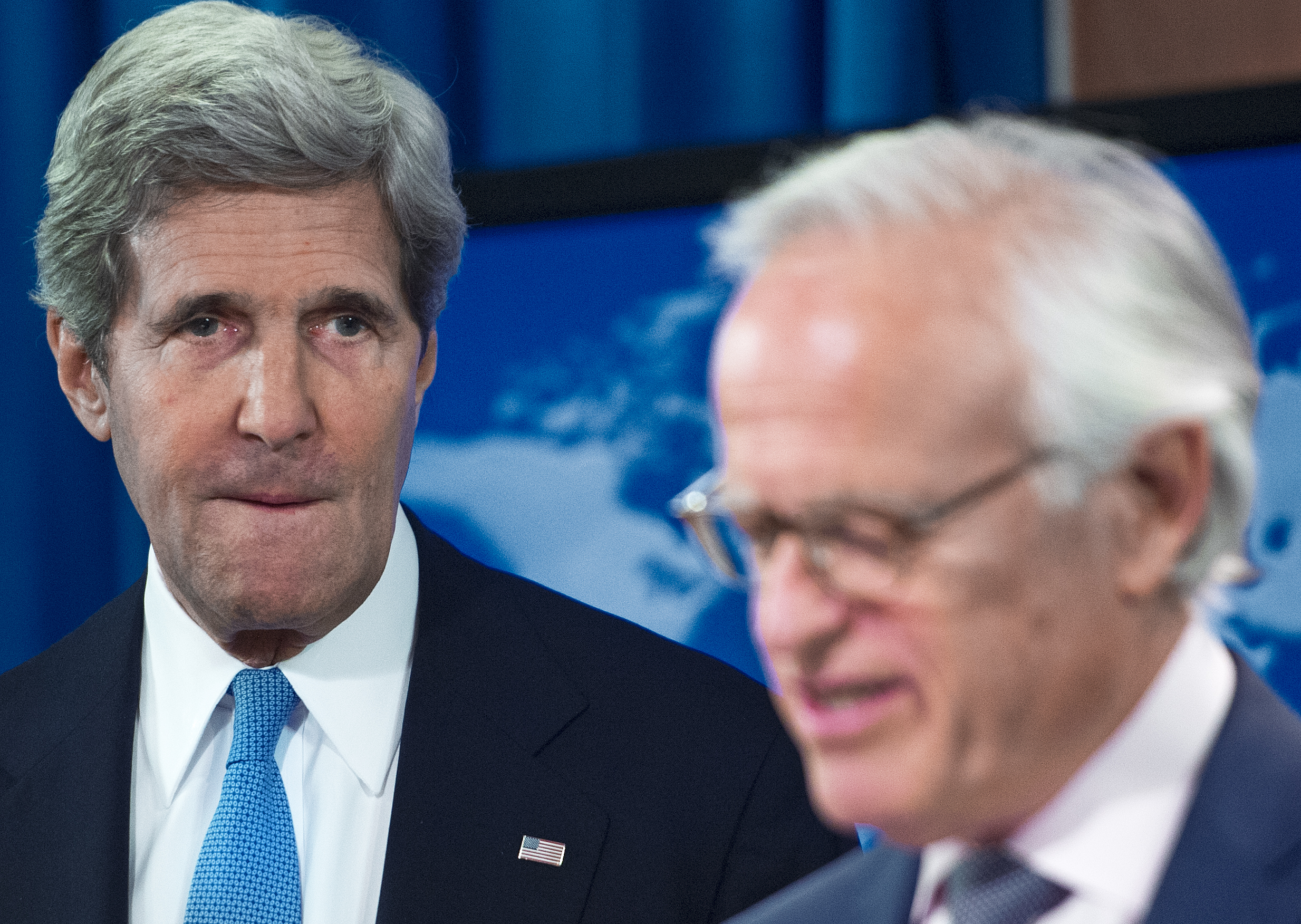
(Photo: US Secretary of State John Kerry listens during a press conference at the State Department on July 29, 2013, after announcing former US ambassador to Israel, Martin Indyk will head the Israeli-Palestinian peace talks that begin later this evening in Washington, DC. Just hours before Israeli and Palestinian negotiators were to resume talks frozen for three years, Kerry said Indyk would take on the difficult task of trying to guide both sides to reach a full-fledged peace deal. By Paul J. Richards AFP/Getty Images)

Expanding Access To Disappointment

Reihan thinks that massive open online course (MOOCs) may be “the logical culmination” of two trends in higher education:

At the same time that the higher education sector is taking on tougher-to-teach students, it has aimed to use labor less intensively. Elite liberal arts colleges that offered a great deal of personal attention and hand-holding gave rise to large land grant universities that offered somewhat less personal attention and hand-holding. State schools, in turn, gave rise to community colleges, which offer still less of both, which in turn left room for for-profit higher education institutions that eagerly recruit students with minimal preparation for college-level coursework while offering them hardly any personal attention or hand-holding at all. With each step, higher education has in a sense become more inclusive. Yet with each step, the institutions in question also see a higher attrition rate.

By way of illustration, consider the four-year and six-year graduation rates at a few California colleges and universities.

For students who entered Stanford University, one of America’s most prestigious and selective research universities, in the fall of 2005, 79 percent graduated in four years while 96 percent graduated in six. At highly-selective but public UCLA, the numbers were 68 percent in four year and 90 percent in six. At Cal State Northridge, a considerably less-selective land grant public institution, 13 percent graduated in four years and 46 percent graduated in six. Pierce College, a community college located in California’s diverse San Fernando Valley, had a 23 percent graduation rate over three years for its associate’s degree program, and 13 percent succeeded in transferring to four-year colleges. The for-profit University of Phoenix of Southern California, which prides itself on its accessibility, had a four-year graduation rate of 2 percent and a six-year graduation rate of 15 percent. You get the picture.

More Dish on MOOCs here, here, here, and here.

It Was The Best Of Lines, It Was The Worst Of Lines

Stephen King dissects his favorite opening line from literature:

With really good books, a powerful sense of voice is established in the first line. My favorite example is from Douglas Fairbairn’s novel, Shoot, which begins with a confrontation in the woods. There are two groups of hunters from different parts of town. One gets shot accidentally, and over time tensions escalate. Later in the book, they meet again in the woods to wage war — they re-enact Vietnam, essentially. And the story begins this way:

This is what happened.

For me, this has always been the quintessential opening line. It’s flat and clean as an affidavit. It establishes just what kind of speaker we’re dealing with: someone willing to say, I will tell you the truth. I’ll tell you the facts. I’ll cut through the bullshit and show you exactly what happened. It suggests that there’s an important story here, too, in a way that says to the reader: and you want to know.

A line like “This is what happened,” doesn’t actually say anything–there’s zero action or context — but it doesn’t matter. It’s a voice, and an invitation, that’s very difficult for me to refuse. It’s like finding a good friend who has valuable information to share. Here’s somebody, it says, who can provide entertainment, an escape, and maybe even a way of looking at the world that will open your eyes. In fiction, that’s irresistible. It’s why we read.

Joe Fassler collected the favorite first lines of nearly two dozen authors here. Jonathan Franzen’s pick:

Someone must have slandered Josef K., because one morning, without his having done anything bad, he was arrested. —Franz Kafka, The Trial (Franzen’s translation)

The method of the whole novel is here in a nutshell. You think you’re being introduced to the persecution of an innocent man, but if you read the chapter that follows carefully, you see that Josef K. is in fact doing all sorts of bad things in his life. If you then go back and reread the first sentence, it becomes significant that the very first impulse of the narrator (who is aligned with Josef K.’s point of view) is to blame somebody else.

For a contrast, check out the Bulwer-Lytton Fiction Contest, which rewards horrendous first sentences. This year’s winner:

She strutted into my office wearing a dress that clung to her like Saran Wrap to a sloppily butchered pork knuckle, bone and sinew jutting and lurching asymmetrically beneath its folds, the tightness exaggerating the granularity of the suet and causing what little palatable meat there was to sweat, its transparency the thief of imagination.

Another Way For The Earth To Die

600px-Venus_globe

It could become another Venus:

The “runaway greenhouse” — which is thought to have happened on Venus in the past — is basically a climate change worst-case scenario: We reach a critical point where the atmosphere is so thick with greenhouse gases that no sunlight can escape back into space, the planet heats uncontrollably, the oceans evaporate completely, and things get, well, pretty uncomfortable, to put it mildly. “Everything is really quite dead at that point,” Colin Goldblatt, a planetary scientist at Canada’s University of Victoria, says in a chipper English accent. Goldblatt has been working to understand whether a runaway greenhouse could ever happen on Earth.

Scientists have long believed that even with extreme greenhouse gas concentrations, our sun simply doesn’t heat the planet enough to trigger this effect. But using a series of custom computer programs that model incoming sunlight, greenhouse gas concentration, radiation absorbed by water vapor, and a host of other physical factors, Goldblatt has revised that threshold down, and in a paper published Sunday in Nature Geoscience says that a runaway greenhouse could kick off with the amount of sunlight we get today.

Clouds act as Earth’s saving grace:

So, what’s keeping us cool? The [paper’s] authors suggest two things. The first is that our atmosphere isn’t uniformly saturated with water; some areas are less humid and allow more heat to radiate out into space. The other factor is the existence of clouds. Depending on their properties, clouds can either insulate or reflect sunlight back into space. On balance, however, it appears they are key to keeping our planet’s climate moderate.

But clouds won’t help us out indefinitely. Long before the Sun expands and swallows the Earth, the amount of light it emits will rise enough to make a runaway greenhouse more likely. The authors estimate that, with an all-water atmosphere, we’ve got about 1.5 billion years until the Earth is sterilized by skyrocketing temperatures. If other greenhouse gasses are present, then that day will come even sooner.

(Image of Venus via Wikimedia Commons)

For Her Love Of The Game

Stacey May Fowles pushes back against a Tom Maloney article making light of a surge in female fandom at Blue Jays games. From Maloney’s piece:

The percentage of women within the Gen-Y group at Rogers Centre jumped to an astounding 50 per cent from 30 per cent over a two-year span. … “It’s fun, like a concert,” says [game attendee Emily] King, 29, who works in advertising and lives within an easy stroll of the stadium. “I’m not sure we’re actually watching the game, to be clear. … It’s the best patio in the city, the best people-watching in the city.”

“It’s outside, it’s social,” says [Olivia] Polak, 30, in ophthalmology and living 30 minutes away. “We’re here with like eight other girls for a bachelorette party instead of just sitting in a bar. It’s not expensive and we can ‘watch’ the game – in quotations.”

Fowles counters:

I certainly don’t deny that these kinds of fans exist—but I cannot agree that they’re a problem. … The actual problem lies in consistently putting this very limited depiction of women’s relationship to sports into the world. It does real exclusionary damage in terms of attracting new fans, a project that both makes good economic sense and goes far in improving the overall experience for everyone.

This idea that women don’t really watch permeates sports.

Last year, The Score Blog’s Ellen Etchingham brilliantly summed up our severely limited viewpoint of female sports fandom in her reaction to While the Men Watch, CBC’s abhorrent hockey feed for women. In it, she describes the dominant stereotype as follows: “Women don’t understand sports. Women don’t care about sports. If women watch sports, they only do so because a man pushes it on them. Women are interested in fashion, cleaning, shopping, and men.”

She further articulates how offensive it is for female fans to have this heteronormative femininity constantly pushed on us by the media, as many use sports to actually escape that very thing. For Etchingham, hockey has acted as a haven, a break from strict societal norms. “For many of the so-called serious female fans, watching the game is one of the best social avenues for meeting people and hanging out in a relatively ungendered way,” she explains. “Being into sports allows us to be guys, not in the sense of men, but in the sense of participants in a laid-back, friendly, easygoing social milieu that doesn’t feel defined by gender lines. Many female fans explicitly resist the category ‘female fans,’ because for us part of what is great about being a fan is the sense that female or male doesn’t matter so much.”

The Latest Leak

Greenwald reports new details on a surveillance system known as XKeyscore, which, according to NSA PowerPoint slides, allows an analyst to search a user’s emails, chats, and browser history after obtaining an email, IP address, or enough metadata:

[T]raining materials for XKeyscore detail how analysts can use it and other systems to mine enormous agency databases by filling in a simple on-screen form giving only a broad justification for the search. The request is not reviewed by a court or any NSA personnel before it is processed. XKeyscore, the documents boast, is the NSA’s “widest reaching” system developing intelligence from computer networks – what the agency calls Digital Network Intelligence (DNI). One presentation claims the program covers “nearly everything a typical user does on the internet”, including the content of emails, websites visited and searches, as well as their metadata.

As usual, Ambers provides a thorough walkthrough:

XKEYSCORE is not a thing that DOES collecting; it’s a series of user interfaces, back end databases, servers and software that selects certain types of metadata that the NSA has ALREADY collected using other methods. XKEYSCORE, as D.B. Grady and I reported in our book, is the worldwide base level database for such metadata. XKEYSCORE is useful because it gets the “front end full take feeds” from the various NSA collection points around the world and importantly, knows what to do with it to make it responsive to search queries. As the [NSA’s PowerPoint] presentation says, the stuff itself is collected by some entity called F6 and something else called FORNSAT and then something with the acronym SSO. …

I should probably refrain from being more specific. FORNSAT simply means “foreign satellite collection,” which refers to NSA tapping into satellites that process data used by other countries. And SSO — Special Source Operations — refers to the branch of NSA’s Signals Intelligence Division that taps cables, finds microwave paths, and otherwise collects data not generated by F6 or foreign satellites. Basically, everything else. The presentation suggests that the NSA collects internet traffic from 150 sites — specific facilities — worldwide.

Drum considers its implications for domestic surveillance “murky” so far:

Greenwald suggests that this validates Snowden’s statement in an earlier interview that “I, sitting at my desk, certainly had the authorities to wiretap anyone, from you, or your accountant, to a federal judge, to even the President if I had a personal email.” But that’s not clear at all.

X-KEYSCORE appears to be a database search tool, not a real-time surveillance tool, nor does it appear to give anyone “authority” to wiretap a U.S. citizen. Rather, it hoovers up tremendous volumes of foreign communications, which can then be searched by NSA analysts. As Greenwald points out, there are known “compliance problems” with NSA’s surveillance programs, since communications by U.S. persons with foreign targets end up in the same database and can therefore end up on an analyst’s desktop. The NSA’s minimization procedures are supposed to prevent such “inadvertent” targeting of U.S. persons, but as Greenwald reported earlier, there are plenty of exceptions to this rule.

Charles Johnson is also skeptical of Glenn’s portrayal of the system:

Greenwald, searching for “warrant” immediately brings up the most important point, buried in the tenth paragraph under tons of exaggeration and hyperbole:

Under US law, the NSA is required to obtain an individualized Fisa warrant only if the target of their surveillance is a ‘US person’, though no such warrant is required for intercepting the communications of Americans with foreign targets. But XKeyscore provides the technological capability, if not the legal authority, to target even US persons for extensive electronic surveillance without a warrant provided that some identifying information, such as their email or IP address, is known to the analyst.

That’s right — once again, Greenwald is not documenting any actual wrongdoing. It’s a very deliberate rhetorical trick he uses over and over — conflating the ability to do something with actually doing it, and glossing over the fact that there are very serious legal consequences in store for anyone who actually does abuse these systems.

Shane Harris wonders if the PowerPoint obtained by Snowden – which was created in 2008 – is overselling the capabilities of the actual system:

The proponents of a particular tool or program frequently create promotional materials like the XKeyscore presentation to encourage analysts to use their technology, and to promote interest among lawmakers who control the NSA’s budget. This was true of a slide presentation describing the PRISM system revealed earlier by the Guardian and the Washington Post, the official told Foreign Policy. It had “made the rounds” of intelligence agencies and offered exaggerated claims about PRISM’s capabilities, such that it was the biggest contributor of information to the president’s daily intelligence briefing. This official strongly disputed that PRISM was so extraordinary.

The XKeyscore presentation claims that “over 300 terrorists [were] captured using intelligence generated from” the tool. It also claims to be able to search more deeply in different data sets than other NSA data miners. But if there is more to be said about how precisely XKeyscore can do this, it’s either not in the document or is contained on the handful of slides that have been blacked out.

Derek Mead notes that at the very least, “the existence of the program contradicts claims by government officials that the NSA doesn’t have the capability to tap emails in real time”:

It’s not clear if the system is still in use, but the system’s scalability is yet another reason the NSA’s Utah data center is of concern. Also not clear is what legal checks the system has. The materials boast that an analyst can easily do a thorough search of an individual’s online history with a lone piece of identification—say an email, or an IP address. As Glenn Greenwald notes, the NSA is required to get a court order from the secret FISA court to spy on Americans, but regardless, XKeyscore appears to offer (or have offered) an incredible ability to access user data with little difficulty.

Card-Carrying Criminals

Kevin Poulsen narrates the fantastic tale of a talented, successful manufacturer of fake IDs who – as his customers and competitors eventually discovered – happened to work for the Secret Service:

Buying the cards from “Celtic” was simple. You’d give him the name you want on the card, the state, date of birth, height, and weight, and a headshot. Celtic would then whip up a digital proof of what the card would look like – sometimes watermarked with a big CELTIC across the front, more often not. If you were satisfied with the proof, then, and only then, would you send your payment by Western Union. Then Celtic would manufacture the physical card in his plant (whether it was at the Secret Service field office, or at an undercover offsite is unclear), pop it in the mail, and send you the tracking number. For U.S. customers, it was three days from order to delivery. …

From the Secret Service’s standpoint, selling fake IDs – “novelties,” in the parlance of the underground – would have held a number of advantages. Unlike intangible commodities like credit card numbers or passwords, fake IDs must be shipped physically, which gives the agency an address to check out for every customer. And, being photo IDs, the customer had to provide their photos. It’s a rare law enforcement operation that lets the cops collect mug shots before they’ve made a single arrest.