Heather Havrilesky notices that, whether intentionally or by accident, TV anti-heroes since Tony Soprano are becoming less and less sympathetic:
The trick that David Chase pulled off with The Sopranos was that he made us feel protective, affectionate love for a bad, bad guy, a guy who wanted to grow but couldn’t, a guy who, at the end of the day, just wanted to daydream about the good old days and stuff his face with onion rings. When Tony had a panic attack or missed the ducks in his pool or got beat up or embarrassed, it made us feel terribly sorry for him in spite of ourselves.
That’s not how we feel about Walter White.
But that’s not how we’re supposed to feel about him. Just as Walt wasn’t designed to occupy the same place in our hearts as Tony Soprano, neither was Don Draper of Mad Men. But because Matthew Weiner and the show’s other writers take pains to show us why Don does what he does, it’s more of a problem when we come way from these character sketches feeling unmoved.
In the show’s sixth season, Don didn’t necessarily make bigger mistakes than he ever had, but his hungry ego and his weaknesses were on full display like never before. Aside from being called a monster by Peggy and assuming the fetal position toward the end of the season, Don didn’t register guilt or awareness of his own terrible behavior that often. Even though it may be Weiner’s intention to demonstrate the limitations of Don’s consciousness, even though Mad Men is arguably guided by ideas more than emotions, and Don’s shortcomings are meant to embody the shortcomings of not just an entire generation but also late capitalist American society itself, the exercise can grow tiresome when Don is less likable than the writers seem to believe.
Michael J. Totten reports on the disintegrating scene in Tunisia:
My Tunisian fixer Ahmed tells me he’s all but certain the labor parties will win the next election and that [governing Islamist party] Ennahda will be out on its ass. He can’t really know that, but it’s certainly plausible. Ennahda might even fall sooner than that if one of the liberal parties resigns from the government or if demonstrations become an unstoppable tide like they did during the revolution a few years ago. The country’s political center of gravity has been moving away from the Islamists since the day they entered the government, and the only hard power leverage they have is the banned Salafist movement, and even that’s just theoretical.
Tunisia is mellow, even pacifist, compared with Algeria. The army is smaller than Egypt’s, and it is not—or at least it has not been—a political player. So I don’t expect a full-blown Algerian-style insurgency or an Egyptian-style military coup. Nor is a Tiananmen Square-style massacre in the cards. Tunisia is not a police state, and Ennahda admits it’s afraid of the army.
But tensions are rising, the situation is volatile, the country is more dangerous now than even a week ago, and the region is always surprising. Keep an eye out because even the “moderate” Islamists empowered by the Arab Spring are back on their heels. They thought they owned the future, but they do not.
Max Boot sees an opening for fresh neocon meddling as the Arab Spring “sputters”:
This is why it’s vitally important–as Michael Doran and I argued in Foreign Policy magazine–to develop our capacity for waging political warfare, as we did in the early days of the Cold War, when the U.S. helped various anti-Communist forces. Today we should be helping anti-Islamist forces. Instead, because we have let our capacity for political warfare atrophy, we are forced to either send F-16s and Predators to push regime change (as in Libya in 2011) or sit by ineffectually (as in much of the Middle East ever since).
There needs to be a better way–the U.S. needs to be able to overtly and covertly support more moderate and secular forces in the battle over the future of countries such as Libya and Tunisia, where there is an excellent chance of a decent and democratic outcome. Instead the widespread perception is of American retreat, leaving our natural allies at the mercy of radicals.
As we mentioned earlier today, Bradley Manning was found guilty of violating the Espionage Act while acquitted of the separate charge of “aiding the enemy.” The former Army private now “faces a possible maximum sentence of more than 130 years in military jail after he was convicted of most charges on which he stood trial.” Paul Waldman and Jaime Fuller’s take:
It’s one thing to have only limited sympathy for Manning—after all, he didn’t just leak evidence of government malfeasance, he leaked hundreds of thousands of documents, most of which showed no one doing anything wrong, and the indiscriminate dump surely did damage to American diplomatic efforts. But if he had been convicted of “aiding the enemy,” it would have set an extremely dangerous precedent. National security leaks happen all the time—those who report on the topic wouldn’t be able to do their jobs without them—and if every time someone in the Pentagon passed a tidbit to a reporter they could be charged with something akin to treason, the chilling effect would be, well, chilling.
Manning was many things—you can call him misguided, overzealous, or foolish if you like. But had the court called him a traitor, we would have entered territory we don’t want to visit.
Fred Kaplan, who called it a “moderate” verdict, is on the same page:
Had the judge accepted the argument and found Manning guilty of the [“aiding the enemy”] charge, the implications would have been profound. By such a verdict’s logic, The New Yorker could have been accused of aiding the enemy for publishing Seymour Hersh’s article about the torture of detainees at Abu Ghraib. Hersh’s intention may have been to call attention to war crimes being committed by U.S. officers in Iraq, but a prosecutor could certainly have argued that the story served al-Qaida’s interests; and it’s certainly true that the revelations over Abu Ghraib were used as recruitment tools by jihadists worldwide.
Though Manning dodged the “aiding the enemy” charge, Dan Gillmor still worries about press freedom:
By finding Manning guilty of five counts of espionage, the judge endorsed the government’s other radical theories, and left the journalism organization that initially passed along the leaks to the public, Wikileaks, no less vulnerable than it had been before the case started. Anyone who thinks Julian Assange isn’t still a target of the US Government hasn’t been paying attention; if the US can pry him loose from Ecuador’s embassy in London and extradite him, you can be certain that he’ll face charges, too, and the Manning verdict will be vital to that case.
DJ Pangburn wants us to revisit the Espionage Act:
How could an act written in 1917 possibly address or, rather, handle the complexity of a whistleblower of Manning’s scale and intent? The fact is that the Espionage Act of 1917 was never written with Bradley Manning in mind. Its goal was not to address whistleblowing at all, but the delivery of intelligence to foreign governments. …
Now, it is one thing to create the legal mechanism to prosecute spies who deliver information to the enemy. But it is quite another to prosecute a soldier, or any American for that matter (journalists, for instance) for publishing documents that shine a light on shameful deeds. Manning wasn’t paid for his work by any foreign nation or agent. He wasn’t working on anyone’s behalf apart from his countrymen. All of this is to say that the Espionage Act needs to be amended to make room for whistleblowers. Because, as it stands, any whistleblower is at the mercy of the law, and the President’s particular whistleblower policies.
Looking back, Peter Walker runs through all the secret information we now know as a result of Manning’s leak.
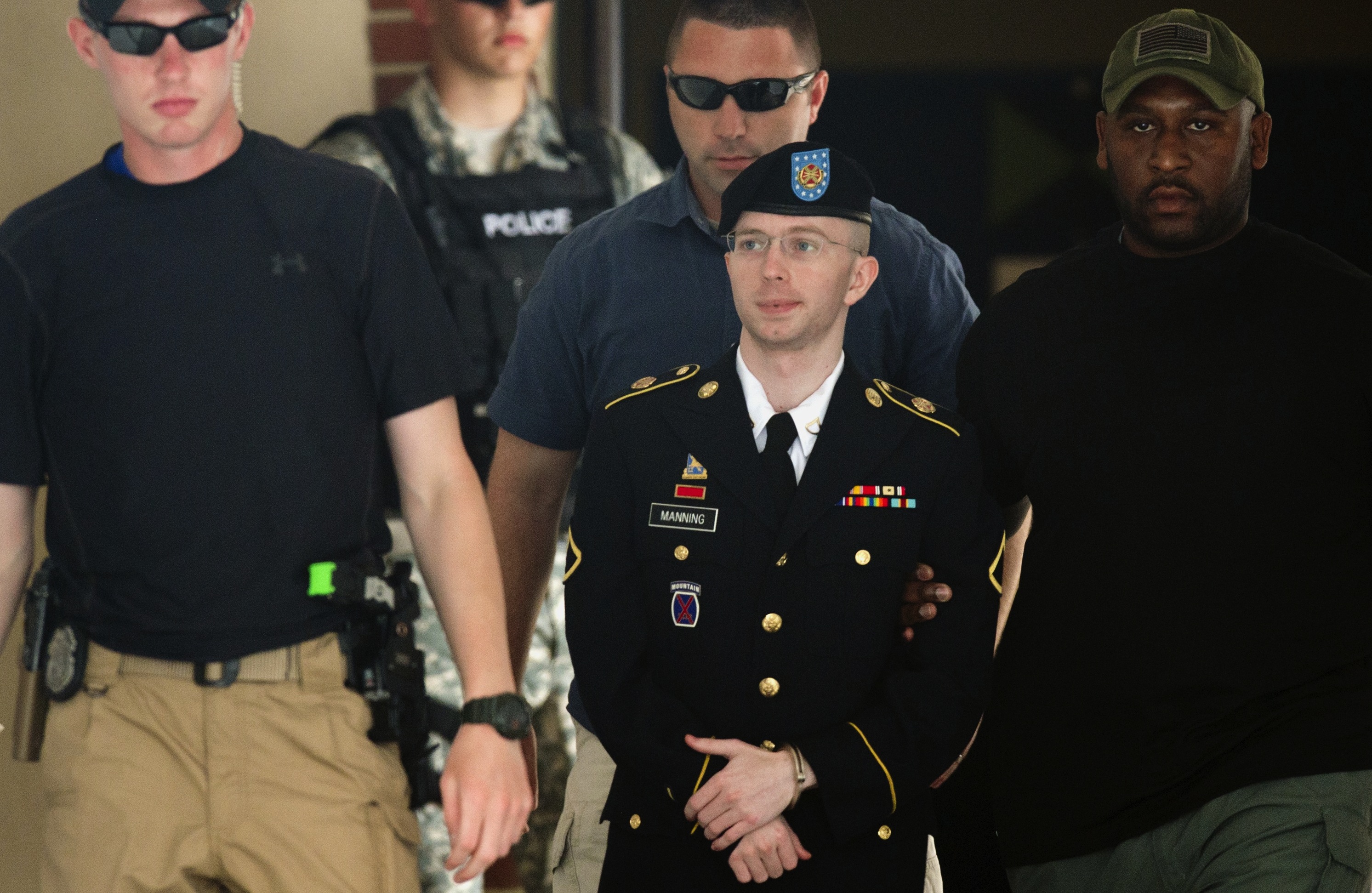
(Photo: US Army Private First Class Bradley Manning leaves a military court facility after hearing his verdict in the trial at Fort Meade, Maryland on July 30, 2013. Colonel Denise Lind found Manning guilty of 20 of 22 counts related to his leaking of a huge trove of secret US diplomatic cables and military logs to the WikiLeaks website. She said she would begin sentencing hearings on July 31 at the Fort Meade military base outside Washington where the trial was held. By Saul Loeb/AFP/Getty Images)
Dustin Rowles, who wrote the Pajiba post mentioned by a reader in our earlier post on After Tiller, recently went through a harrowing ordeal with his wife after doctors determined she was pregnant with monoamniotic twins:
The doctor told us that if we went forward with the pregnancy, if one fetus died in utero it would probably leave the other baby severely brain damaged. He said if that happened, we could make a plan to go to one of two states in the country — Florida or Colorado — that still have individual Doctors providing late-term abortions. Kansas used to be an option, we were told, but the Doctor who conducted procedures to terminate the pregnancies of severely brain damaged and deformed babies with no chance of a decent quality of life had been shot and killed. Ain’t that America.
We decided to terminate. It was the most difficult, most agonizing decision either my wife or I had ever made. We both are pro-choice, but when it comes to abortion, in the typical scenario, you decide to terminate a pregnancy you don’t want. We had made a decision to terminate the potential lives of two babies that we did want. That we wanted very badly.
However, we felt that the risks were too high and that it would be irresponsible to risk not only our future but that of our son, who was four. We didn’t want him to have to grow up in a home with parents that had to devote all their emotional and financial resources to profoundly disabled siblings. More than that, we didn’t want to bring beings into the world that would have to spend a lifetime suffering, who might have a severely low quality of life.
The thing is, there was no one from whom we could solicit advice. There’s not even a lot of anecdotal information with which to work when you’re pregnant with monoamniotic twins. There is one major support page online, but there is a lot of self-selection in posters, and most of the people who write have had a positive outcome that has either confirmed or bolstered their religious convictions. Many of the posts make clear that termination was never an option — and/or should not be an option — for others in this situation, which we totally disagreed with. What we were aiming to do was make the right choice for us — a rational, logical decision that an objective couple in our situation would make. We were relatively young. We could still have more children. We could wait a few months or a couple of years and try again.
The more we thought about it, the more sense it made to end the pregnancy. We felt — and we still feel — that this is a fundamentally personal decision, and we were shocked at the politicization of this medical issue, when of course nobody else can tell you what is right for your family. It is a decision that has the potential to fundamentally alter the entire course of your life, and until you are personally faced with something like this, there is no way to know how you are going to react or what the right course of action will be.
Rowles and his wife subsequently changed their minds and opted to continue the pregnancy. Mercifully, though their twin girls were born premature, they both beat the odds and survived with no ill effects. You can read the rest of his story here. And to read all the late-term abortion stories from Dish readers, go here.
When talking about their weekend adventures, some of Mahdavi’s informants focused on the recreational aspect of the parties: “[There is] alcohol, there is sex, there is dancing, there is—it’s just fun! It’s what we do for fun!” Others viewed the parties as a representation of “all things Western,” a way of gaining status and claiming a cosmopolitan identity; some also expressed ideas about sex as freedom that harked back to ideas underlying the sexual revolution in the United States. Still others claimed parties offered escape and “eased the pain” of living in Iran. As one man said, “Sex is the main thing here; it’s our drug, it’s what makes our lives bearable, that’s what makes parties so necessary.” “If we don’t live like this, we cannot exist in the Islamic Republic,” a woman declared. “We hate our government, despise our families, and our husbands make us sick. If we don’t look fabulous, smile, laugh, and dance, well then we might as well just go and die.”
But the new sexual culture in Iran, Mahdavi believes, is not simply an embrace of Western consumerism and morality nor merely an escapist hedonism, a “last resort.” Urban young adults, the focus of Mahdavi’s inquiry, made up about two-thirds of Iran’s population; they were mobile, highly educated, underemployed, and dissatisfied with the political regime at the time. Some were directly involved in politics. Many used the Internet to make connections, blog about their frustrations, and peer into youth cultures elsewhere around the world. Willingly taking risks with their social and sexual behavior, as these Iranian young people were doing, was viewed as a step toward social and political reform—not just a means of escape and excitement. After all, the consequences of partying in Tehran were different from in Los Angeles, despite similarities in flashy dress, electronic music, and group sex.
Previous Dish on sex in the Islamic Republic here, here, here, and here.
I hope you are still curating the long-running thread on suicide as you did for abortion. Around the web, I still see the abortion thread linked to, as recently as yesterday, when a commenter over at Pajiba did so regarding the trailer for a new documentary, After Tiller, about America’s late-term abortion providers.
I look forward to the film: the trailer states there are now only four doctors in the country who can perform late-term abortions. Four. “I can’t retire; there aren’t enough of us.” Keep in mind that it seems likely (film unseen, of course) that the four people so described are the only four of whom the public is aware, because they operate in clinics whose services are publicly known. This makes me angry, since whatever legal restrictions anti-abortion people enact, the same conditions won’t apply to rich women, who have access to money, privacy, and lawyers – power unimaginable for poor women. What was the birthrate for Congressional wives before Roe v. Wade? Before contraception? What does “preferential option for the poor” mean anymore?
The reason to continue the suicide thread is the same as for abortion: until we hear the stories behind life-and-death decisions, we base our judgments on abstracts and absolutes, missing the human part of the equation. We need these points of view.
Agreed, and we will continue both threads as best we can. From what Katie Walsh says in her review of After Tiller (a clip seen above), the film seems very much in the spirit of our anonymous “It’s So Personal” series:
[The film’s] heartbreaking stories [of those considering late-term abortion] are sensitively captured by [filmmakers Lana Wilson and Martha Shane], who chose not to show any of the patients’ faces to cloak their identities but also as a stylistic choice, and as they tell their stories in counseling sessions, the camera rests on a shoe fidgeting, or a hand clutching a tissue. Just focusing on their voices and stories is such a powerful thing within the film, listening to the women as the doctors and counselors listen to them. This gentle approach is what “After Tiller” does so well in its treatment of this tough material.
The doctors and nurses themselves are gentle and compassionate, and Wilson and Shane are wise to mirror that in their filmmaking. While the sight of anti-abortion protestors may inspire a certain reaction from an audience member depending on their personal beliefs, there is nothing in the film’s presentation to vilify or ridicule them. They are presented as part of the reality and struggles, the obstacles that these doctors must face in order to do their work, but the film also allows their voices to be heard in this debate.
Nothing the Cardinal says above is wrong exactly, but it’s classic spin from the bullshit artist who runs the New York archdiocese. The idea that Pope Benedict used the same tone toward homosexuals as Pope Francis – that there has been continuity on this – is absurd. Benedict’s move – strongly backed by Dolan – was at complete odds with Francis’ new tone. It was not to reassert the core doctrine that there is no sin in homosexuality, merely in non-procreative sex. That had definitely been the case already, and clarified in the 1975 letter that signaled the kind of openness and spirit that Francis represents. What Benedict did was deliberately to conflate the sin with the sinner eleven years later in 1986:
In the discussion which followed the publication of the [1975] Declaration, however, an overly benign interpretation was given to the homosexual condition itself, some going so far as to call it neutral, or even good. Although the particular inclination of the homosexual person is not a sin, it is a more or less strong tendency ordered toward an intrinsic moral evil; and thus the inclination itself must be seen as an objective disorder.
My italics. Not the acts – the very orientation itself is objectively disordered. Being gay was in no way, for Benedict or Dolan, even a morally neutral disposition. It was rather a form of disorder of the very heart and soul, that made gay people living refutations of God’s Creation – living crimes against nature.
This demonization of gay men was a return in Catholic teaching to medieval view of sodomites (which was chronologically linked to hatred of Jews as well, as John Boswell showed in his landmark book, Christianity, Homosexuality and Social Tolerance). Its plain meaning can be gleaned from the fact that, in an attempt to divert blame from himself for the child-rape scandal, Benedict subsequently issued an unprecedented discriminatory ruling, barring all gay men from entering the priesthood, solely because they were gay, with no distinction between their identity and their sexual acts.
In the end, [homosexuals’] attitude toward man and woman is somehow distorted, off center, and, in any case, is not within the direction of creation of which we have spoken.
That’s not about acts; it’s about a way of being human.
The Church does not teach that homosexuality is a choice, and so, to sustain the stigmatization of homosexuality in the face of new research and data, Benedict had to opine that gay people are intrinsically outside “the direction of creation” and our very nature is “somehow distorted.” Dolan can spin this any way he wants. But the proof of the malice was the blunt discrimination against gay priests regardless of their conduct in 2005, the absurdly brutal attacks on gay parents and gay people in the debate over civil marriage equality, and the obsessive-compulsive insistence on never hiring lay people who might conceivably be married to someone of the same gender (something never done with, say, re-married or divorced heterosexuals).
Dolan and Benedict have never, ever spoken of gay people the way Francis did. The question to be asked of Dolan is: why nit? Or is he just an apparatchik? Does Dolan still favor barring all gay seminarians solely because of their orientation? Will he stop discriminating against gay people while tolerating straight people who use contraception or are divorced or who have re-married? Does he refute the statements of the previous Pope? I wish Charlie and Gayle had been able to penetrate his bullshit. But it requires a granular theological expertise few general interest journalists have time to master.
Analyzing new numbers from Pew, Allahpundit finds good reason for Big Brother Republicans such as King and Christie to fear the insurgent libertarian from Kentucky – a “major swing against government surveillance among tea partiers”:
Three years ago, at least a plurality of every ideological segment except moderate Democrats thought the feds didn’t go far enough to protect the country. Three years later, nearly every segment has swung the other way. The only holdouts are moderate Democrats (oddly) and moderate Republicans. More specifically, non-tea-party Republicans tilt 41/43 towards thinking the feds haven’t done enough to protect the country; among tea partiers, the tilt is … 55/31 towards thinking they’ve gone too far in restricting civil liberties, a 35-point(!) swing since 2010. That’s what a battle for the soul of the party looks like — a double-digit spread among the centrist and conservative wings on a key point of national security.
Normally I’d dismiss a turnaround as sharp as that as driven by partisan reaction to the White House. Elect a Democratic president and you’ll see Dems warm to his counterterror program and Republicans sour on it, no matter how much it resembles the last GOP administration’s program. But Pew’s reference point here isn’t an earlier poll taken during the Bush era; it’s 2010, nearly two years into Hopenchange. This shift has happened entirely on Obama’s watch.
Readers join my jaw-dropping reaction to the Clinton camp cutting down Weiner and Abedin:
What’s far worse is that Huma worked as a close, long-time aide for Hillary, so these comments must add to her pain greatly. How dare people compare the great Hillary Clinton to the lowly little staffer Huma? Imagine Huma reading that? After years of being Hillary’s aide, it must be a kick in the face, right at the time when you need your friends the most. Well, you know what this means: Hillary’s running for president.
And as ruthless and self-obsessed as ever. Another reader:
Chutzpah indeed. And then we have the typically Clintonian betrayal of their friends. This whole article from 2010 in the Washington Post is all about how Abedin is Clinton’s right-hand woman. Money quote:
“I have one daughter. But if I had a second daughter, it would [be] Huma,” Clinton said at a pre-wedding celebration for Abedin and Weiner in 2010.
Another:
I hope you are aware that Bill Clinton actually officiated at the wedding of Abedin and Weiner? If that’s not enough to put your jaw through the floorboards … !
Another:
The only thing your post about the Clintons, Huma, Weiner and Maureen Dowd was missing was this vintage paragraph from MoDo’s June 2003 review of Hillary’s memoir:
Bill is bookended in history by Monica’s plea to him in a note: ”I need you right now not as president, but as a man” and Hillary’s explanation of why she stuck with him: ”As his wife, I wanted to wring Bill’s neck. But he was not only my husband, he was also my president.” It makes you wonder whether Hillary would have forgiven Bill if he were merely her United States trade representative.
Another dissents:
The story is suspect and thinly sourced and gossipy and even feels fabricated. It’s tabloidy, NYPost sort of fluff junk. You elevated it beyond its credibility and importance.
Another elaborates:
I think you need to chill a bit on this. Lumping Hillary and Bill in with what the press now calls “the Clintonistas” and what you referred to as “the Clinton machine” is very close to a smear.
You linked to a story in the NY Post, which you have called “unreliable” and a “disgrace” and suggested was guilty of “crimes against journalism” in the past. There isn’t a single source identified in that piece that can be verified as being close to Bill or Hillary; “a top state Democrat”?, “another prominent Democrat”? PUH-lease.
This idea of some dark group of Clinton loyalists who are busy conspiring together and worrying about the NY mayoral election is a bit far-fetched. How many people would the NY Post be willing to call “a prominent Hillary Rodham Clinton political operative” if it fits their narrative? I bet there are hundreds who could fit that label over HRC’s 25-year national career.
An even better question: how many of them are working for Christine Quinn right now?
And in the NYT Dowd piece you quote, you inserted the word “Clintonista” in parentheses [ugh], when clearly it was referring to people in Huma Abedin‘s circle of friends commenting about her drawing the wrong lesson from Hillary.
Please think about correcting on the blog.
I’m sorry but I’ve been around Washington for quite a while and the sudden flurry of anonymous Clinton friends suddenly trashing Huma and pounding Weiner is not a vast Clintonista conspiracy, but it is classic Clincestuous spin. Another reader:
Do you think that, if Hillary runs in 2016, her female supporters will overlook her complicity with her husband’s lies and her own lies from Bill’s presidency because they want to shatter the glass ceiling? Will they see any irony in what the Clintons are doing now to try to force Weiner to pull out (har har) and will that factor into how they cast their vote in a potential primary or general election? Probably everyone will forget about this chutzpah by the time a campaign rolls around in 2015.
I think we ought to have a woman President, just as we ought to a have Latino, Asian, Native American, or gay, etc. President. I just don’t ever want the Clintons back in power. Kind of like the Bushes, can’t they go away and leave us alone?
They won’t, because this is what they have always lived for.