Debating Diabetes, Ctd

A reader with Type-2 diabetes joins the one with Type 1 to divorce the disease from obesity:

Your dissenting reader with the Type-1 diabetic child tells a compelling story, but the implicit conclusion you reach is all wrong. No, we shouldn’t let people with Type 1 off the “diabetes=obesity” hook. We should throw away the hook!

For one thing, the mechanism of diabetes causation is not well understood, so we simply cannot say that obesity causes Type-2 diabetes at all. The two are strongly correlated, but research strongly hints at a cluster of shared causes, rather than a straightforward chain of get fat -> stay fat for X time -> develop the diabetes you’ve earned by being fat, you obese loser that is so widely assumed, including by most press accounts.

For another thing, not everyone who develops Type-2 diabetes is or was ever overweight, or has a family history of obesity or diabetes. I know – I was diagnosed with Type 2 at age 36. I’ve never had a body-mass index over 24, and for most of my life I’ve been skinny as a string bean, as are most of the men in my diabetes-free family tree.

The first thing my doctor did after my diagnosis was pack me off to a so-you’ve-got-diabetes class at the local hospital. The class, like just every online and print resource I could find, focused its advice not on managing glucose intake and natural insulin function, but on weight loss. But I didn’t need to lose weight!

I’m 6’0″, and was down to 150. My doctor wanted me to try to gain 10 pounds! In the meantime, I was asking a question that confounded every doctor, dietitian, and American Diabetes Association hotline expert I talked to: What should I eat for breakfast? If I needed to lose weight, they had answers. If I was on insulin, they had answers. But if I was at an appropriate weight, and just wanted to find a plate of foods that my weakened insulin system could handle without unhealthy blood-glucose spikes, breakfast was a stumper. Our cultural faith in the diabetes=obesity myth runs so deep that the medical and diabetes-research professions cannot even answer the question, “What should a diabetic eat for breakfast, if he’s not fat?”

Now for the good news: I’ve managed my diabetes with diet changes, exercise, and minimal medication. I’ve kept my A1C well below 7, often below 6, since my diagnosis. The keys seemed to be significantly reducing, but also more evenly distributing, my carbohydrate intake. Chiefly, no liquid carbs (except wine and beer, because, come on). No soda, minimal juice, no sugar or flavored syrups in coffee. (Advice to your non-diabetic readers: Stop drinking sugar. Don’t go soft like Bloomberg and reduce your serving size; just don’t drink anything with sugar or corn syrup on the ingredient list.)

Yes, I miss the great big glasses of orange juice that used to start my day, and the tall glass of milk with supper, and the heaping plates of pasta too. But I’m healthier and fitter than ever before, except for, you know, diabetes. The problem is, I had to figure this out by myself, because I didn’t fit the assumed paradigm of diabetes=obesity. Riding in the annual diabetes fundraiser bike event Tour de Cure, I’ve met many people who, like me, had to figure out treatment plans themselves because their problem was having diabetes, not being fat.

I don’t see much evidence that the focus on treating obesity is actually helping people who are both fat and diabetic, but I do see evidence that this focus harms those with diabetes for whom weight is not also a crisis. Yes, people, especially kids, with Type-1 diabetes are the primary victims of the diabetes=obesity myth, but so to are a good number of adults with Type 2. So don’t just exempt the kiddos from the stigma. End the overall stigma of diabetes=obesity=you earned it.

Sometimes Pink Is Just A Color, Ctd

A reader writes:

The comment from your reader who was a butch little girl broke my heart a little. I have an8 year old who is a little gender-queer, but not trans, everlastand probably not gay, and he had a terrible time at school this year.  My son is an awesome kid – sweet, smart, and funny. He is both one of the butchest boys I know and one of the most gender-queer. He truly has no regard for gendered clothing, shows, or interests. He loves karate and superheroes and video games and Spongebob and Star Wars: Clone Wars. He also loves sparkly, brightly colored clothing and nail polish and hair color and My Little Ponies and Tinker Bell. He has been both Samurai Jack for Halloween and a fairy. He plays with girls and boys.
This year, I allowed him to paint his nails black and orange just before Halloween.  I didn’t think anything about it. It was the week before Halloween! His second grade classmates taunted him for it and called him a girl. One of them punched him in the balls. None of the boys would play with him any more. Only one girl would play with him.  My son has a rebellious streak and decided to respond by bringing “girl books” to school and wearing pink shirts and more fingernail polish. The bullying continued. Despite an anti-bullying policy, the school’s main intervention was to advise us to get him to tone down the gender non-conformity.  We did, but I can’t help but think that the message that my son got was that gender bullying is okay and that it was somehow his fault if someone bullies him for being a nonconformist.

We’re transferring schools this year. I can’t take it and my son shouldn’t have to.

Another:

I’m now a 60-year-old gay man, partnered for almost 25 years and living a reasonably happy life. When I was little, I was a mama’s boy and definitely not considered a typical boy.

I played with dolls, like to dress up and loved doing whatever Mom was doing. In my baby book, Mom even recorded my atypical personality at the age of three, “Ricke is still a little girl at heart.” I knew that I was different from my other little male friends, but it didn’t seem to make much difference until about 3rd grade. It was then that I began to be bullied at school for being a sissy. Feeling miserable and lonely, I began to pray nightly that God would change me into a girl during the night and that I’d wake up feeling that everything in my life would be OK. That was the only solution that came to my young mind back in the 1950s. I knew nothing about homosexuality and on my own, couldn’t see any other way for me to fit in.

Well, that obviously didn’t happen. In high school I began to understand that I was gay and by college fully accepted it and began to live my life. I grew up to be a man who can take care of himself. Thanks to Mom, I can cook, bake, iron, sew, knit, hang wallpaper, paint a room or an entire house, and in general do what needs to be done. But it does make me wonder about the current trend toward diagnosing transsexualism in young children. I certainly don’t feel like a woman trapped in a man’s body now.

Another:

I am really appreciating all of the posts you’ve had in the last year or so on trans experiences.  I don’t recall there being so many in the past, and your uptick coincides with my own son’s transition (from Laura to Lucas). I’ve also become acquainted with a young woman at our church who has a young son who is a “princess boy.”  She is very supportive, but her ex-husband is So Very Not.  I’ve been passing on all of your posts to her and they have been very helpful.  So thank you on behalf of both of us, plus the many other family members and friends who have also found various of your posts so enlightening.

The Etymology Of Etiquette

David Graeber explains the origin of “please” and “thank you”:

The English “please” is short for “if you please,” “if it pleases you to do this” — it is the same in most European languages (French si il vous plait, Spanish por favor). Its literal meaning is “you are under no obligation to do this.” “Hand me the salt. Not that I am saying that you have to!” This is not true; there is a social obligation, and it would be almost impossible not to comply. But etiquette largely consists of the exchange of polite fictions (to use less polite language, lies). When you ask someone to pass the salt, you are also giving them an order; by attaching the word “please,” you are saying that it is not an order. But, in fact, it is.

In English, “thank you” derives from “think” …

[I]t originally meant, “I will remember what you did for me” — which is usually not true either — but in other languages (the Portuguese obrigado is a good example) the standard term follows the form of the English “much obliged” — it actually does means “I am in your debt.” The French merci is even more graphic: it derives from “mercy,” as in begging for mercy; by saying it you are symbolically placing yourself in your benefactor”s power — since a debtor is, after all, a criminal. Saying “you’re welcome,” or “it’s nothing” (French de rien, Spanish de nada) — the latter has at least the advantage of often being literally true — is a way of reassuring the one to whom one has passed the salt that you are not actually inscribing a debit in your imaginary moral account book. So is saying “my pleasure” — you are saying, “No, actually, it’s a credit, not a debit — you did me a favor because in asking me to pass the salt, you gave me the opportunity to do something I found rewarding in itself!”

This Extraordinary Pope

I’ve just watched the actual video of Pope Francis’ airplane press conference, and it’s even more remarkable than the quotes we gleaned earlier from reporters like John Allen. What’s so striking to me is not what he said, but how he said it: the gentleness, the humor, the transparency. I find myself with tears in my eyes as I watch him. I’ve lived a long time to hear a Pope speak like that – with gentleness and openness, reasserting established dogma with sudden, sweeping exceptions that aren’t quite exceptions – except they sure sound like them.

In the written text, I was disappointed, for example, by his absurd statement that Pope John Paul II had definitively shut down the question of women priests. Firstly, no Pope has the authority to shut down a debate like that, especially one that is purely managerial and pragmatic, and not a matter of doctrine. The statement is so absurd part of me wondered whether Francis wasn’t deploying a little irony  … and then I listened to him actually speak the words. And it was far sweeter than irony.

He asserts orthodoxy and then swerves dramatically to one side, his voice lilting and becoming more intense, as if to say, “Yes, I know this is what the Church teaches, and I am not challenging that. But look at the wider picture. Remember that in the Church, the honor accorded to Jesus’ mother is higher than that of any of the apostles, and that women, simply by virtue of being women, are above priests in importance to the Body of Christ.” That’s both a repetition of orthodoxy and yet also a whole-sale re-imagination of it.

Think of this Pope’s refusal to revisit the issue of women in the priesthood and then note that he washed the feet of a woman in Holy Week – the first time any Pope had washed the feet of a woman, let alone, as was the case, a Muslim woman in juvenile detention. Remember also the remarks of one of the most powerful religious figures on earth about atheists:

The Lord has redeemed all of us, all of us, with the Blood of Christ: all of us, not just Catholics. Everyone! ‘Father, the atheists?’ Even the atheists. Everyone! …  ‘But I don’t believe, Father, I am an atheist!’ But do good: we will meet one another there.

And this is surely part of the point. What Francis is telling us, it seems to me, is that we should stop squabbling about these esoteric doctrines – while he assents to orthodoxy almost reflexively – and simply do good to others, which is the only thing that really matters. Stop obsessing in your mind and act in the world: help someone, love someone, forgive someone, meet someone.

One of the most telling things about Jesus is that he did not elucidate a theology. It had to be inferred by Paul. Jesus merely told stories of great charm and mystery. But he also clearly transformed the lives of those he encountered by the way in which he lived and died. It was that that convinced so many that this human being wasn’t just any other human being, that the divine had somehow transformed him, and he could transform others.  I heard in the voice of Francis today the voice of Jesus confronted with the woman about to be stoned for adultery. No, he does not condone adultery. But the entire dynamic of the story is about something else: it’s about how Jesus defused an impending, brutal execution by bobbing and weaving and drawing in the sand and then speaking intimately with the woman herself with what can only be called revolutionary empathy.

“They are our brothers.” That’s the tone of Jesus. That is, for the Papacy, revolutionary empathy.

Perhaps this is a better way of seeing the difference between Francis and what came before him.

It is impossible to think of Jesus seeing the marginalized of his time, like lepers or Samaritans, and teaching them that they are “somehow distorted, off center, and … not within the direction of creation” because of something they simply are and cannot change. Jesus – as represented by the Gospels – clearly sees that kind of rigid, callous thinking as the mark of Pharisees, the sign of a religion that has forgotten love in its obsession with law, and therefore cannot be connected with the Father of all Creation which is Love. Francis, mind you, does not rebuke Benedict XVI; he pours out affection for him. But everything he is saying and doing is an obvious, implicit rejection of what came before.

What Francis is doing is not suddenly changing orthodoxy; he is instead pointing us in another direction entirely. He is following Saint Francis’ injunction: “Preach the Gospel everywhere; if necessary with words.” He is a walking instantiation of the way Jesus asked us to live: with affection and openness, charity and forgiveness; and a reluctance to seize on issues of theology instead of simply living a life of faith, which is above all a life of action in the service of others:

We all have a duty to do good. And this commandment for everyone to do good, I think, is a beautiful path towards peace. If we, each doing our own part, if we do good to others, if we meet there, doing good, and we go slowly, gently, little by little, we will make that culture of encounter: we need that so much.

Yes, we do, Holy Father. We so sorely do.

A Pit Stop On The Road To Democracy? Ctd

Following the second murder of an Tunisian opposition figure in six months, Fadil Aliriza spotlights mounting tension in the original “Arab Spring” nation:

In the background of Tunisia’s political scene, there is a steady hum of anger and frustration. Any big event risks tapping into that well of anger. Tunisians are angry that there has been little progress since the revolution. The economy has not improved and has, in some sectors, weakened. Unemployment refuses to decrease. Corruption is still integral to every facet of Tunisian life. Government and municipal services remain inaccessible and unresponsive to most of the population. Police brutality continues. Stark economic inequalities between people of different economic classes, and between developed coastal regions and underdeveloped interior regions, persist. Political divisions tend to fall along sharp ideological lines, and, despite Tunisia’s woes, assembly members take regular breaks from their task of drafting the constitution.

In this tinderbox, the second political assassination in six months has acted like a spark, and people are looking for someone to blame.

Meanwhile, Juan Cole surveys the chaos in Libya, where “over the weekend, all hell broke loose”:

The assassination of a militant secularist nationalist in Benghazi just after the assassination of of a militant leftist secularist in Tunis raised the question of whether the extremist Libyan and Tunisian devotees of political Islam coorinated the attacks so as to foment turmoil that might form a path whereby they could take over the country.

It seems obvious that the Libyan government needs to swallow its pride and get outside help in accelerating the training of new security forces. What were probably extremist fundamentalist terror cells bombed the courthouse in Benghazi, in front of which crowds gathered on Feb. 17, 2011, to kick off the revolution, was bombed and partially destroyed. Another bomb was set off Sunday evening in Benghazi, as well. …

And no, these problems of transition would not justify having kept the totalitarian and murderous dictatorship of Muammar Gaddafi in place. In fact, many of the extremist fundamentalists were provoked to a life of violence by his oppression. I have a bad feeling about this.

Previous Dish on the recent upheavals in the Arab world here.

The Shrinking Of Big Law, Ctd

Noam Scheiber responds to critics of his piece on the decline of corporate law firms:

Big Law boosters point to the fact that revenue at the country’s 100 biggest firms grew by 3.4 percent last year—a reasonable increase, if hardly the 8-12 percent increases of the early-to-mid-2000s. But when you unpack the number a bit, it looks even less impressive. It turns out that the bump was driven primarily by a huge fourth quarter after three middling ones. And that big fourth quarter was, in turn, the result of some idiosyncratic factors—like a rush by corporations to complete transactions before the dreaded fiscal cliff took effect on January 1, and law firms aggressively seeking payment before the end of the year (for similar reasons).

Meanwhile, other data show the problems for the legal profession continuing. Of the law students who graduated in 2008, 75 percent of found a legal job within nine months, according to the National Association for Law Placement (NALP). For those who graduated in 2012, the number had fallen to 64 percent, a record low. Of course, Big Law firms typically hire associates well in advance, so these numbers partly reflect the hiring environment that existed a year or more earlier. And, in fairness, NALP reports that hiring at big firms did recover a bit for the class of 2012 after a terrible 2011, even if it was still well below the 2009 level. Still, the fact that the market for lawyers was historically weak more than three years after the recession is pretty alarming. NALP refers ominously to a “new normal” in law-firm hiring.

Update from a reader:

Here’s the main problem with Scheiber’s thesis: Where the heck is all the business going to go when 90% of big law firms collapse?

I’ve been a big law associate for a number of years, and I think I would have noticed if 9 out of 10 of my colleagues had been wandering the halls with nothing to do.  So, when the firm-pocalypse comes and wipes out 180 big firms, how are the remaining 20 (which will likely be the busiest 20) absorb all of the abandoned legal work without massive expansion?  Even if they could expand like that, with only 20 law firms, how could you ever find one that wasn’t already representing your adversary or negotiating counter-party?

And it’s not like thousands of little firms will spring up to replace all the fallen giants.  Small-firms are just not capable or cost efficient enough at handling the kinds of matters that the big boys do. You can’t run a giant, months-long document review out of a five-person law firm unless you aren’t doing anything else, and if you aren’t doing anything else, how does your firm survive when the case suddenly settles and you haven’t booked anything else because your whole firm was working on that one case which could have lasted months?

Will The Generals Give Up Power?

EGYPT-POLITICS-UNREST

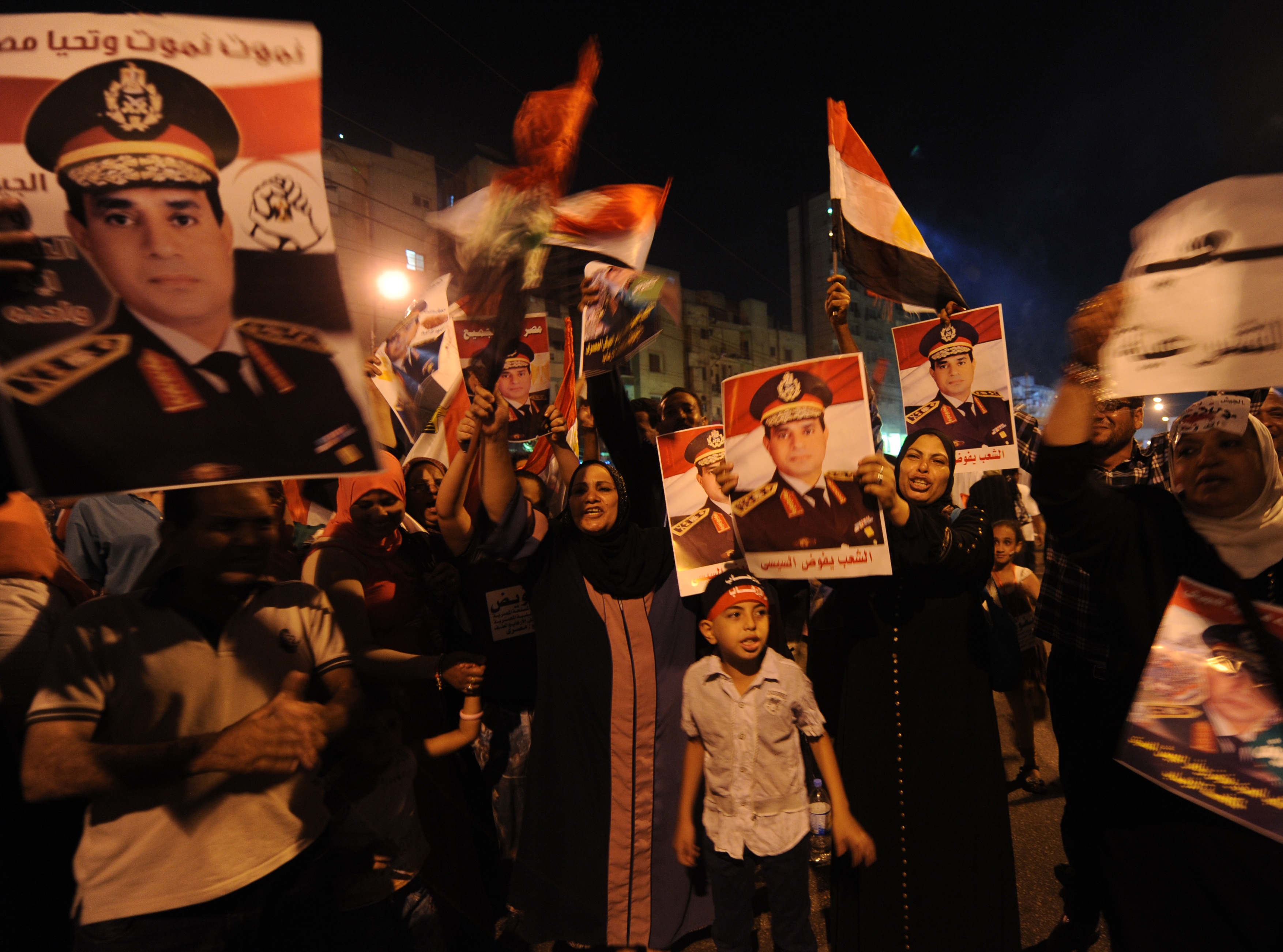
Amid reports that the Egyptian military will be reinstating Mubarak-era security measures, Ahmed Feteha highlights concerns (WSJ) that General Sisi will become the country’s next dictator:

In the weeks since Mr. Morsi was removed from office, Gen. Sisi has been the country’s most popular figure. State-run media regularly compare “the field marshall of the people” to larger-than-life Egyptian leaders like Anwar Sadat and even Ahmose, the pharaoh who expelled the Hyksos invaders from the country 3,500 years ago.

Even after Saturday’s bloodshed, the media largely echoed the official line blaming the Muslim Brotherhood, not Gen. Sisi’s rallying cry against the Islamist group. But in throwing over Mr. Morsi, Gen. Sisi is largely responsible for alienating Islamists, who account for at least a quarter of the population. On Friday, as pro-army crowds gathered, the government added fuel to the fire by filing criminal charges against Mr. Morsi for collaborating with the Hamas militant group during the 2011 Egyptian revolution.

Gen. Sisi has promised that he has no desire to rule. But many find it hard to believe that he will head back to the barracks after seizing the heights of Egyptian political life. And with hundreds of thousands of supporters chanting Gen. Sisi’s name in Tahrir Square, the little-known general is increasingly looking like Egypt’s king rather than its kingmaker.

The Guardian‘s editorial board is similarly worried:

[Sisi] has begun to adopt a special tone of intimacy, that of the leader in deep discussion with his people, which suggest he sees himself in the line of descent from Nasser. …

The Egyptian army’s overweening sense of entitlement is an aspect of the country’s political pathology. An army that has seen no combat for a generation and faces no serious challenge from external enemies nevertheless absorbs massive resources, enjoys marked privileges, and arrogates to itself special political rights. Egypt should be reducing the influence of its military, not reinforcing it. But, in the immediate future, the decisions of the army, and what are probably now its rather nervous civilian allies, are critical. They must release Brotherhood leaders, find a formula for the rehabilitation of Morsi and a framework for talks that the Brotherhood can accept. Otherwise there will soon be more blood on Cairo’s pavements.

But John Beck sees signs that the military’s recent authoritarianism will soon erode popular support for Sisi:

“I think, it’s clear that the issue is the role of the military in politics. Sisi is very much at the forefront in the process of undermining the democratic process,” says Maha Azzam, an associate fellow on the Middle East and North Africa program with the Royal Institute of International Affairs. “I think as each day passes… it’s becoming less credible to stand by what is becoming clearly both a coup and a military takeover and a return of the old regime,” she added. “There’s no grey. You either stand with the military takeover… or you stand against the coup.”

More and more Egyptians may be falling into the latter camp. The Salafist Nour Party — a former ally of the Muslim Brotherhood which then supported the military’s ouster of Morsi — said in a statement on Wednesday that the call for protest “foreshadows civil war.” Other, more secular groups who welcomed Morsi’s ouster also saw Sisi’s announcement as a move designed to provoke violence and create an excuse to impose curfews and increase the military’s hold on power. “We are stuck in the middle between military and fundamental authoritarianism,” says Bassam Maher, an activist and NGO worker.

He added, that while many “revolutionary” activists are becoming increasingly suspicious of Sisi’s motives, they have been reluctant to stand against the military directly because they do not wish to be thought of as aligned with the Muslim Brotherhood or other Islamist groups, which they also oppose. Many activists describe themselves as paralyzed and conflicted about opposing the army’s recent moves.

(Photo: Opponents to deposed Egyptian president Mohamed Morsi hold portraits of Egyptian army chief General Abdel Fattah al-Sisi as they demonstrate at Itihadiya main street in Cairo on July 26, 2013. Hundreds of thousands of anti-Morsi protesters gathered in Cairo’s Tahrir Square and around the Itihadiya presidential palace in response to Sisi’s call for Egyptians to show their support for a security clampdown on ‘terrorism’. By Fayez Nureldine/AFP/Getty Images)

The Puritanism Of Progressive Parents, Ctd

A reader writes:

As a progressive liberal parent, parenting in progressive liberal Seattle, I’m finding the lopsided caricature of liberal parenting presented recently on the blog to be rather unfair. In the specific case of fluoridation, it is by no means proven that fluoride is harmless –  some studies have linked fluoride to disruption of the endocrine system, leading to metabolic disorders and thyroid problems.  Could America’s obesity rates be somehow linked to its obsession with fluoridating its water?  The case against fluoridation is given here.

But in general, I would consider being against fluoridation to be a somewhat conservative stance. To me the idea of adding medicines to drinking water seems to be the nanny state operating at its finest (there is no other reason for adding fluoride to water beyond the prevention of tooth decay).  If I want to use fluoride, then it’s super simple for me to just buy a fluoridated toothpaste, giving me a degree of choice and control over what I put into my body that federally-mandated fluoridation just doesn’t give me.

On a more general note, I’m a firm believer in “you are what you eat”. I don’t think it’s an accident that my daughter is very rarely sick.

It’s because she generally gets her five fruits and vegetables a day.  But I have to be vigilant over what my eight-year-old daughter puts in her body because no one else is doing it for me.  Added sugars, salt, high fructose corn syrup, and hydrogenated fats are routinely added to processed foods, often when you would least expect them. Why do juice boxes require added sugar? Wherever she goes – camps, after school activities, birthday parties – she is presented with an overwhelming abundance of boxed pizza, boxed mac ‘n cheese and processed sugary treats. Try finding a vegetable, or even fruit,  on any kids menu in America. And that’s before we get to the barrage of propaganda on behalf of (government subsidized) Big Ag that she’s subjected to every time she turns on the TV.

It seems to me that “conservatism” is all about preserving the status quo of Big Ag and Big Pharma, whereas it is we progressive liberals who are seeking to return to and conserve an earlier simpler world where we can all have access to nutritious food grown in proper soil by local farmers. If we occasionally seem paranoid and over-zealous – and we are sometimes – it’s because that simple goal is nowadays really difficult to achieve.

Update from a conservative reader:

It warmed my heart to see this self-described “progressive liberal” parent from Seattle rail against government-mandated fluoridation and government-subsidized Big Ag – it certainly isn’t the libertarians pushing this stuff. I only wish that more of my friends on the left would see the virtues of smaller government.

Francis’ Sunlight: Reax

VATICAN-POPE-AUDIENCE

Jimmy Akin thinks the press is reading too much into the Pope’s words on homosexuality:

Disclaiming a right to “judge” others is something that goes back to Jesus. It does not mean a failure to recognize the moral character of others’ actions, however. One can form a moral appraisal that what someone else is doing is wrong (Jesus obviously does not forbid that) without having or showing malice toward them.

The statement that they should not be marginalized is similarly in keeping with the Holy See’s approach to the subject, as 1992 Vatican document On the Pastoral Care of Homosexual Persons. The statement that same-sex attraction “is not the problem,” when understood correctly, is also nothing new. “The problem,” as Pope Francis seems to here be understanding it, is going beyond merely having a sinful tendency–a temptation to which one is subject. Obviously, temptations are a problem, but if we resist temptation we do not sin. “The problem,” on this understanding, is giving into the temptation and sinning or–worse–building an ideology around the sin and trying to advocate the sin.

But this was precisely what Benedict was trying to ratchet back, by arguing in 2005 that, whatever their conduct or faith, gay men should be barred from seminaries because homosexuality itself is objectively disordered and gays’ very being is inherently against the logic of God’s creation. Benedict’s pronouncements on gays were almost a definition of marginalization: “somehow distorted, off center, and … not within the direction of creation.” Isn’t that what the ancient world said of lepers and the Jewish world say of Samaritans? Benedict’s fastidious, obsessive-compulsive need to re-make all Creation in the image of his own hermetically-sealed and completely abstract theology ended up betraying the most important message of Jesus: that the last shall be first, that everyone is invited to God’s table, and that those you call “distorted” and “off-center” are actually at the very center of a loving God’s compassion.

And this interpretation is of a piece with what he said about divorced and re-married Catholics at the same presser:

“This theme always comes up … I believe this is a time of mercy, a change of epoch. It’s a kairos moment for mercy … In terms of Communion for those who have divorced and remarried, it has to be seen within the larger pastoral context of marriage. When the council of eight cardinals meets Oct. 1-3, one of the things they’ll consider is how to move forward with the pastoral care of marriage. Also, just 15 days ago or so, I met the secretary of the Synod of Bishops, and maybe it will also focus on the pastoral care of marriage. It’s complicated.”

I think it’s bizarre to ignore a Pope when he proclaims “a change of epoch,” when he calls our time a “kairos” moment for mercy. That means a turning point, a hinge of history. Why use that language if you are merely insisting on total continuity with the past? And the issue with re-married Catholics is exactly the same as for gays: the licitness of sexual congress outside one, life-long, monogamous, non-contracepted heterosexual marriage. Kevin Clarke agrees that Francis didn’t depart from traditional church teaching but sees a welcome shift regardless:

His citation of current catechism on the treatment of gay and lesbian people was not revolutionary in any sense; what startles may be the spectacle of a pope saying anything out loud on the matter and stressing the importance of church teaching on the human dignity of gay and lesbian people.

Francis was also asked why he did not spend much time speaking about abortion or gay marriage during his trip (church teaching is already clear, he said) and about the difficulties of divorced and remarried Catholics. “I believe this is a time of mercy, a change of epoch,” the pope said.

Likewise, Francis DeBernardo of the gay-friendly New Ways Ministries thinks this language is a sign that things will get better for gay Catholics: “Even if [Francis] doesn’t drop the sin language, this is still a major step forward, and one that can pave the way for further advancements down the road.” One gay Catholic, Michael O’Loughlin, agrees:

In addition to mercy, Francis’ comments also provide hope, hope to those who live on the margins of the church. In a special way, those who live without—without money, without recognized dignity, without full embrace from institutions of power—are called to live prophetic lives. But sometimes being offered some hope from the powerful, in this case Pope Francis and the church, is needed in order to keep moving forward with the struggle. Francis’ comments, however offhand and however easily dismissed they will be by traditionalists, are worth celebrating.

Elizabeth Scalia also applauds Francis’s call to mercy and forgiveness – and tells us all to relax:

I understand some folks’ concerns that perhaps Francis is too heavy on the mercy and too light on the justice side of things — and certainly the cross itself teaches us that both must be held in balance. But this is still a pretty fresh papacy. The sense I’m getting is that Francis means to scrape some long-attached barnacles from the Barque of Peter, so we can see what the deeper hues of Justice and Mercy look like; he’s readying it to travel some rough, challenging waters…

I’ll tell the new hysterics the same thing I told the old hysterics: you’re gonna be surprised who makes it into heaven and who doesn’t, because it’s not going to line up with what you or I think is Catholicism-done-Correctly, so be sweet to everyone, mind your own soul, not theirs, and trust Jesus to sort it out.

Admitting that “I love the guy,” James Martin, a fellow Jesuit, praises Francis and claims he’s initiating real change in the Church:

Praising Francis does not mean denigrating John Paul or Benedict. Each pope brings unique gifts to the office. But Francis’s election as pope has definitely brought change to the church.

The essentials have not changed: each pope preaches the Gospel and proclaims the Risen Christ. But as we saw last week in Rio, Francis speaks in a different way: plainly, simply, with unadorned prose. Francis has a different style: more relaxed, less formal, more familiar. Francis’s appeal is different and, judging from the crowds, effective. The Pope does the same thing–preaches the Gospel and proclaims the Risen Christ–in a new way. Francis is a different person for a different time.

What Pope Francis did and said in Rio de Janeiro, how he did it and said it, and how the crowds reacted to what he did and said, show that things can change. And that God can change them. All this is an answer to despair. It is a reminder that nothing is impossible with God. So every time I see Francis, hear him speak or read one of his homilies I’m reminded of this great truth.

Martin emails the Dish to add:

The lesser-noticed change in the Pope’s revolutionary words during his in-flight interview was, at least according to the translation in the Italian-language “Vatican Insider,” the use of the word “gay,” which is traditionally not used by popes, bishops, or Vatican officials.

This is a sea change.

(Photo by Alberto Pizzoli/AFP/Getty Images)

Egypt Erupts Again, Ctd

EGYPT-POLITICS-UNREST

Read the Dish’s coverage of the bloodshed from Saturday here. More violence could be imminent:

Supporters of Egypt’s deposed president Mohamed Morsi have called for a “million-person march” against his ouster after authorities warned of “decisive” action if protesters are considered a threat. Organisers of protests against the military’s overthrow of Morsi urged demonstrators to march on security buildings on Monday night and called a march for Tuesday. In a statement, the Anti-Coup Alliance of Islamist groups urged Egyptians “to go out into the streets and squares, to regain their freedom and dignity – that are being usurped by the bloody coup – and for the rights of the martyrs assassinated by its bullets.” The protest calls, which raises the possibility of fresh confrontations, comes after at least 72 people were killed at a sit-in in support of Morsi on Saturday morning.

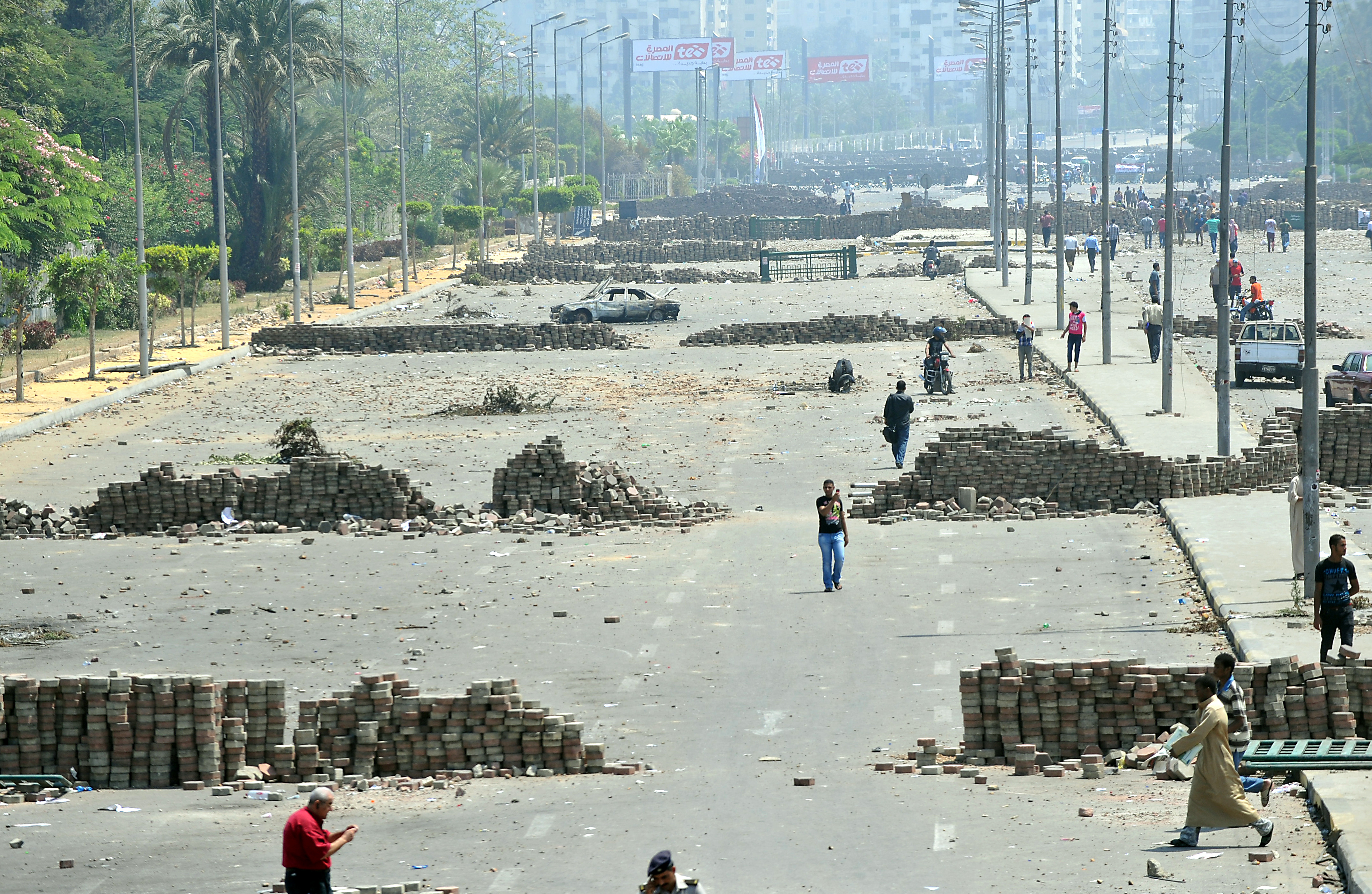
Meanwhile, as seen above, pro-Morsi supporters have fortified their Rabaa encampment in Nasr City near where Saturday’s massacre occurred. Elsewhere, the Egyptian military continues to arrest Islamists and attempt to justify their violent crackdown:

But in a new report, Human Rights Watch emphasizes how nothing the protesters did could have possibly justified the level of the response by security forces:

“The use of deadly fire on such a scale so soon after the interim president announced the need to impose order by force suggests a shocking willingness by the police and by certain politicians to ratchet up violence against pro-Morsy protesters,” said Nadim Houry, deputy Middle East and North Africa director at Human Rights Watch. “It is almost impossible to imagine that so many killings would take place without an intention to kill, or at least a criminal disregard for people’s lives.” …

According to a doctor who was at the scene, the police began to fire teargas when the protesters were approximately 200 meters away. A skirmish ensued between the protesters and the police and men in civilian clothes, lasting for about two hours: protesters set cars on fire and threw rocks, while police fired birdshot and more teargas from their position near the bridge. The doctor told Human Rights Watch that after approximately two hours, live bullets were fired at the protesters from what appeared to be an elevated position, possibly from a nearby building. The timing was corroborated by two other witnesses. Fouad, another doctor working in the Rabaa field hospital, said, “The pattern of injuries we saw here was completely the opposite of the Republican Guard. In the Republican Guard incident [on July 8, 2013] it was mostly random live fire, it only looked like 10 percent [of those killed] were shot by snipers. This time it was like 80 percent were shot by snipers targeted from above.”