K-Lo: The Pope Said Nothing

I was looking forward to the reaction from the theocon Catholic right to Pope Francis’ refreshingly Christian reflections on homosexual people. Kathryn-Jean Lopez does not disappoint – but it’s a pretzel she has to twist into. Here is what Lopez heard the Pope say:

If the chronology of Allen’s report reflects the conversation, Pope Francis had just finished talking about redemption, the fact that Peter himself denied Christ and would later become pope. He warned against a culture in which sins of the past are dug up on people. Should a sin – we’re talking a sin, not a crime – destroy a man, decades later? That doesn’t seem Christian, it seems clear, was the pope’s point.

Huh? There is no chronology in a press conference other than the chronology of the questions. And the idea that the Pope was merely saying that forgiveness is an essential Catholic practice when he specifically reflected on “gay people” “of good will” is a bizarre digression. Forgiveness is an essential Catholic practice in all circumstances. And, in any case, the gay individual he was citing in the previous answer was, he insisted, completely innocent of all the accusations of sin. So there was nothing to forgive! Good try, K-Lo, but, sorry, this was clearly a rebuke to the cruelty and homophobic panic of the recent past from a man who is the first Pope from a Catholic country where marriage equality is the law of the land (and who favored civil unions for gays there).

K-Lo then goes on fearlessly to reiterate Benedict’s foul and anti-Christian pronouncement that no gay men should be allowed into the priesthood … :

Homosexuality is incompatible with the priestly vocation. Otherwise, celibacy itself would lose its meaning as a renunciation. It would be extremely dangerous if celibacy became a sort of pretext for bringing people into the priesthood who don’t want to get married anyway. For, in the end, their attitude toward man and woman is somehow distorted, off center, and, in any case, is not within the direction of creation of which we have spoken.

… and claims it is completely consistent with this statement from Francis:

When I meet a gay person, I have to distinguish between their being gay and being part of a lobby. If they accept the Lord and have good will, who am I to judge them? They shouldn’t be marginalized. The tendency [to homosexuality] is not the problem . . . they’re our brothers.

For Benedict, gay people were “objectively disordered” whose “attitude toward man and woman is somehow distorted, off center, and, in any case, is not within the direction of creation.” For Francis, “they’re our brothers” and “who am I to judge?”

There are none so blind as those who refuse to see. But Jesus came to open eyes to love, not close them.
In Praise Of Bill Simmons

Below is an excerpt from a Friday discussion moderated by PBS’s Mark Glaser on Nate Silver leaving the NYT to set up shop at ESPN (which sponsors Grantland):

I want to add a personal note about Grantland and Bill Simmons. They remain role models for me and the Dish. If we had been able to find a home like ESPN that was prepared to really give us resources and freedom and had a viable business model, we’d have been thrilled a few years ago. We ran the post from Big Lead not as in any way a criticism of Bill and Grantland, but simply as a way to explore and debate further the economics of online media and individual sites (sorry, but I cannot write the words “personal brand” without throwing up a little in my mouth). Anyway, I wanted to make that completely clear. I revere Bill as much as I revere Nate.

A reader is on the same page:

The Dish was the first news website I ever paid for. I would immediately pay for a subscription to Grantland that was in remotely the same cost range (then again, if the Dish charged $100 a year I would pay for that too). Grantland has become the first thing I open in the morning (although I usually see some of the Dish on my phone before getting to work), and I consume almost all of their written material (I haven’t ventured into video or podcast land because I have to do my actual job). Their writing is consistently thought provoking.

I’m fortunate enough not to have to worry about dropping a few hundred on stuff like this; most people are. What are your thoughts on this type of corporate sponsorship?  (They routinely disclose their ties to ESPN/Disney when they come up in the course of a given story.)

At this point we don’t need it, but at some point, if we really wanted to expand faster than our revenue allows us, sponsorship is something we never ruled out. We’re just trying to build a robust, reader-supported site as a first step. It’s much harder, but we’re also trying to forge a model for other smaller sites so we can expand the range of truly independent ventures online. If you want to help us with that, [tinypass_offer text=”please subscribe”]. I keep meeting regular readers who haven’t yet been prodded to pay by the meter (partly because they access the Dish in many different devices); and they always say they intend to. Well, stop intending to and, if that’s you, please take a moment now, get your credit card out and take two minutes to spend $2 a month or $20 a year to help shift the balance in online media away from pageview mania responsive to advertizers, toward more quality content, responsive to readers. [tinypass_offer text=”Click here”].

Another reader:

A grain of salt on the grain of salt offered by the Big Lead on Grantland’s reliance on ESPN for viability.  Bill Simmons and you are, by far, my two favorite people to read online.  I like sports, politics and pop culture, and Simmons (who is in his early 40s, like me) covers the sports and pop culture while you take care of the politics and the leftover pop culture/Internet memes that I’d otherwise miss.  Frankly, I don’t have much time do much else online – if I have time to look at only four websites in a day, which is often, it’s you, Grantland, Facebook and Twitter (not necessarily in that order).

The idea behind Grantland came about when Simmons was nearing the end of his contract with ESPN a few years ago, and told them that he wanted to start his own website where quality writers could have the freedom to write what they wanted. He wanted to get away from ESPN because, among other things, he chafed often at the rules at ESPN when he wrote on their website (e.g. no curse words, nothing overtly sexual, no criticism of any sportscasters at ESPN or other networks – this one really bothered him). He wanted to have the freedom to write about whatever he wanted (and tell edgier jokes) without worrying about upsetting the suits at ESPN.  John Skipper, to his credit, convinced Simmons that he could do the same thing with an affiliated site, which is how they came up with the idea of Grantland.  Other than a small box in the middle/bottom of the ESPN home page, you wouldn’t know of the affiliation, and good luck finding “ESPN” or “Disney” on the Grantland site.

Though he mostly writes about topics you couldn’t care less about, trust me that he is an incredibly talented and funny writer.  He built his own brand before ever being hired by ESPN (and before “blogging” was a thing), and I can attest to the fact that his loyal readers (and there are hundreds of thousands if not millions) would have followed him anywhere, just like yours did.

Would he have the (possibly) bloated staff he has now had he gone out on his own, or been able to attract all of the writers currently employed by Grantland?  Possibly not, but I am 100% confident (and I’m sure Simmons is, too) that he could have built a standalone profitable website similar to what Grantland is today without any backing from ESPN/Disney.  And the goodwill and additional cross-promotion that ESPN is able to do with Simmons under their employ helps drive a lot of other business for them. For example, he was on their NBA pre-game show this year, and I made every effort to watch it when he was on (even DVRing it at times), which is something I would never do in a million years if Simmons weren’t on the show.

The point being, the Big Lead (along with every other sports blogging site on the planet) has a lot of jealousy towards Simmons because he was among the first, and still by far the best, at looking at sports in a new and modern way, and they are always looking to knock him off his perch a bit.

Agreed. That’s my view as well. We air all sorts of opinions – and we knock many of them down here as well. I’m glad, with your help, we knocked Big Lead’s argument down. Here’s hoping Grantland continues to thrive. I just wish we’d had an ESPN in our past willing to make that leap by empowering us.

Reality Check

jwowsa1ks020ehlt19i1la

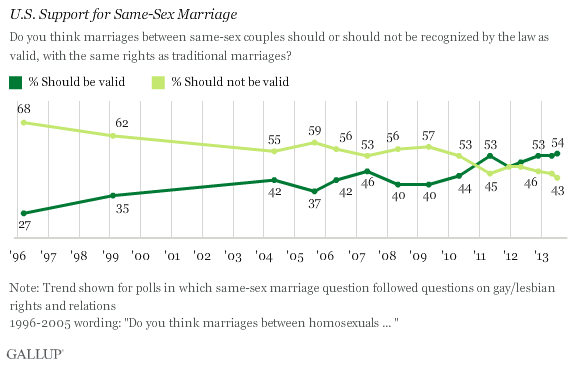
New numbers from Gallup show marriage equality continuing to gain ground:

Gallup used two separate approaches to measure public support for gay marriage this month, and they produced similar results: 52% would vote for a federal law legalizing same-sex marriages in all 50 states, and 54% think gay marriages should be recognized as valid, with the same rights as marriages between men and women. … [G]roups showing at least 60% support for legalizing same-sex marriage nationwide include Democrats, adults aged 18 to 34, those who rarely or never attend a church or other place of worship, moderates, Easterners, and Catholics.

The new poll doesn’t change much on the generic question as to approval of marriage equality. But what’s truly striking to me is how a majority would be happy to extend marriage equality to all fifty states. If that trend continues, I can easily imagine Anthony Kennedy writing a Loving vs Virginia decision in a few years’ time. I’ve always been a federalist on this, and remain so. But the public may be out-stripping even me now on this question.

And, of course, this is yet another crisis for the GOP.

Their core, white evangelical base is fanatically opposed to all things gay – let alone marriage equality – because their religious literalism and fundamentalism prevent them from exercizing any political pragmatism. So-called “conservatives” in the poll are opposed to marriage equality by 67 – 30 percent. The same number for “Republicans.” That akes the GOP base more reactionary than the South in general, which opposes marriage equality by 51 – 43 percent. The GOP is a fanatical minority within a minority.

And again, Catholics are at the forefront of the push for equality 60 – 36, defying the theocons and far more in tune with the new Pope than the old one. The moderates? They favor equality by 63 – 32 percent. They are people who once may have voted Republican. This issue is one reason they’ve switched sides.

The Clintons vs The Weiners!


In what can only be described as an extract from the annals of extreme chutzpah, the Clintons – yes, the Clintons! – are now weighing in, via surrogates, to force Anthony Weiner from the race for mayor of New York. Apparently, the Clintons believe that an embarrassing dick pic – along with lying in his apology – should be enough to force the horny narcissist from the race.

My jaw is hovering near the floor-boards.

So far as we know, Anthony Weiner has never committed adultery or sexually harassed or abused anyone. And Huma Abedin has not blamed a vast right-wing conspiracy for her husband’s libidinous indiscretions. None of that could be said about the Clintons. Bill lied and lied and lied again and again and again – until he was lying under oath, and lying to his own cabinet, telling them to go out and deny the very things he knew he had done. Bill didn’t send his dick pic to some activist paramour; he told state troopers to bring that hot woman he spied in the hotel lobby up to his room where he exposed himself to her and told her to “lick it.” And this creep has the gall to vent about Weiner.

The Clintons, via Sidney Blumenthal, orchestrated a whisper campaign to portray a young intern, Monica Lewinsky, as a deluded stalker who was lying about her affair with the president. If that dress had never emerged, both Clintons would still be smearing her today. As for recklessness, Bill Clinton, knowing full well that he was already being sued for sexual harassment by elements on the far right, went right ahead and had sex with an intern working for him at the White House – destroying the promise of his second term, and giving the hypocritical, extremist Republicans the political gift of a lifetime. Talk about betrayal of his supporters and everyone who had ever worked for him, including his cabinet. The Weiner affair is a trivial non-event compared with the Clintons’ reckless, mutual self-destruction.

Even now, the Clintons, through their various spokespeople, are lying:

“The Clintons are upset with the comparisons that the Weiners seem to be encouraging — that Huma is ‘standing by her man’ the way Hillary did with Bill, which is not what she in fact did,’’ said a top state Democrat.

Really? Let’s go to the tape:

Almost everything that man says in the video above is a lie. Hillary knew that and yet still stood by her man in that critical New Hampshire primary interview with Steve Croft, giving her husband crucial cover to stay in a race many were telling him to pull out of. Listen to her lies above – and Hillary’s assertion that the press created this story by paying Gennifer Flowers. She went much, much, much further than Huma’s dignified statement, knowing full well that she had been complicit for years in her husband’s sexual harassment and abuse. What has always mattered to Hillary Clinton is her path to power, not the abused women her husband left as media roadkill and Hillary stepped on afterward. Which makes this chutzpah all the more remarkable:

“The Clintons are pissed off that Weiner’s campaign is saying that Huma is just like Hillary,’’ said the source. “How dare they compare Huma with Hillary? Hillary was the first lady. Hillary was a senator. She was secretary of state.”

There you have not an argument, but a resort to authority. Huma Abedin, dealing with a political husband caught up in sexual embarrassment and lies, is not comparable with Hillary Clinton because Hillary Clinton … has held high office? You really do have to be neck-deep in Washington presumption to insinuate such a thing. But, staggeringly, that’s now the position of Maureen Dowd – that sexual harassment, abuse and perjury – were okay for the Clintons because Bill was so talented at politics, while Weiner is a loser. You really couldn’t make this up:

[Clintonistas] fear Huma learned the wrong lesson from Hillary, given that Bill was a roguish genius while Weiner’s a creepy loser. “Bill Clinton was the greatest political and policy mind of a generation,” said one. “Anthony is behaving similarly without the chops or résumé.” As often as Bill apologized, he didn’t promise he would “never, ever” do it again, as Weiner did. “What people won’t forgive is lying in the apology,” said the Clinton pal. “It has to be sincere, and it sure as hell has to be accurate.”

But lying under oath? Fine if you’re talented enough. The double standards here are so grotesque they remind you once again of who the Clintons are: liars who think that the rules should never apply to them.

They sicken me to my stomach. But they’ve given Anthony Weiner one more reason to stay in the race. He should let the voters decide his fate, not the Clinton machine. Now, it’s a matter of principle.

Francis’ Sunlight

This picture taken 21 March 2007 shows a

How can I describe my response to the following simple words:

“There’s a lot of talk about the gay lobby, but I’ve never seen it on the Vatican ID card … When I meet a gay person, I have to distinguish between their being gay and being part of a lobby. If they accept the Lord and have goodwill, who am I to judge them? They shouldn’t be marginalized. The tendency [to homosexuality] is not the problem … they’re our brothers.”

Let’s parse this as conservatively as we can. What does it mean to be part of a “gay lobby”? In the context of the curia, I think it means that a group of cardinals or Vatican officials saw their sexual orientation as what defined them as a group, and operated as a faction within the Church’s center. I find that as repellent as any other kind of lobby that places a particular human characteristic ahead of the only quality necessary for a church official: dedication to God, God’s people, and the Church. But even then, Francis is making light of the hysteria: “I’ve never seen it on the Vatican ID card.” Not since John XXIII has a Pope deployed humor quite as easily and effectively as this one.

But so far, so banal – if utterly different than the panicked, tightly-wound homophobia of the last Pontiff. Then the revolutionary part:

“When I meet a gay person, I have to distinguish between their being gay and being part of a lobby. If they accept the Lord and have goodwill, who am I to judge them? They shouldn’t be marginalized. The tendency [to homosexuality] is not the problem … they’re our brothers.”

The tendency to homosexuality is not the problem. This is a direct rejection of the last Pope and his predecessor. The key letter was issued in 1986 and the key, horrifying directive issued in 2005 barring all gay men from the priesthood – however they conduct themselves and regardless of their gifts and sincerity. Here’s Ratzinger’s CDF statement on homosexuality, which walked back the previous, much more inclusive, position taken in 1975.

In the discussion which followed the publication of the [1975] Declaration, however, an overly benign interpretation was given to the homosexual condition itself, some going so far as to call it neutral, or even good. Although the particular inclination of the homosexual person is not a sin, it is a more or less strong tendency ordered toward an intrinsic moral evil; and thus the inclination itself must be seen as an objective disorder.

This is the new doctrine Ratzinger introduced into Catholicism: that gay people are uniquely inclined toward an intrinsic moral evil, that there is something inherently immoral about us, that we are in a special class of sub-humans, because our loves – when expressed fully with our bodies as well as souls – are intrinsically evil. This doctrine was so contrary to the Gospels, so callous, and so grotesquely unjust – barring any gay man from entering seminaries solely because of something he cannot change – that it was, for me, one of the low points of my spiritual life in the church. Not only was the Pope attacking the souls of an entire class of human beings, he was deeming them unfit for priestly authority. Child rapists could be tolerated; sincere, celibate gay priests were intrinsically disordered unlike any other group in society. I wrote on this page at the time:

Some of the basic principles of the Catholic faith – treating each individual as equally worthy in God’s eyes, judging people by what they do, not who they are – are being violated by this policy. The astonishing work of gay priests across the centuries and across the globe is being denied and stigmatized and ignored. This is a huge stain on the church – reminiscent of its long, terrible history of anti-Semitism.

And so in a few off-the-cuff remarks, Pope Francis returned the Church’s leadership to the spirit and love of the Gospels. This does not mean a change in the doctrine that all non-procreative non-marital sexual expression – from masturbation to foreplay to homosexual or contracepted sex – is immoral. But what it does is explicitly end the Vatican’s demonization and marginalization of gay people made in the image of God, people who have served the Church from its very beginnings, in ways large and small.

It says a lot about the cramped, fearful, nit-picking dead-end of the last Pontiff that simply asserting human dignity should bring such joy. But it has been clear for a while now that the Holy Spirit and the intercession of Saint Francis are opening the windows of the church again – so that sunlight and transparency and simplicity can flood the previously darkened rooms of a retreating reactionary Vatican.

We have a Pope. By God, we have a Pope.

You Think “Weiner” Is Bad? Ctd

This embed is invalid


Dish readers continue to pool their vast collective knowledge:

I believe I’ve got a name that is even more preposterous than Bill Boner or Harry Baals or Dick Swett. I once worked with a guy from Zimbabwe named Lovemore Dick.

Don’t believe me? There’s several of them from Zimbabwe and Mozambique on Facebook, along with Lovemore Dickson. Look ’em up. And none of them is the one I know. Seems to be a popular name.

Another reader:

I live half an hour from this Air Force base, named after Eastern NC’s own WW2 hero: Seymour Johnson.

Another:

In the ’80s at SUNY Binghamton, a very nice guy named Gil Dickoff ran for office in the Student Association. He ran against someone named Smith. Gill lost the election. And what was the headline in Pipedream, the student newspaper?  “Smith Beats Dickoff Handily”

Another:

There was a family furniture store here in Pasadena named J.H Bigger. You guessed it: The manager’s name was Dick. Dick Bigger.

Another:

In the fine tradition of funny Dick names, I give you: Dick Champion.

Many more contenders after the jump:

I just had to write in.  I’ve had two people in my life who could illicit a laugh whenever I heard their name:

1. Dick Beiter. He was my flag football coach when I was 8-9 years old. I swear to god that was his true name. (He had three sons and one daughter. The oldest son had Down’s syndrome and served as the “lineman” when we played; he would go along the sidelines and mark the first down line after each play.)

2. Dick Burns. He was my high school history teacher. Of course, the yearbook says “Richard” but he went by “Dick” among colleagues. Hilarious. Try not to laugh in class!

Another:

Here’s a photo of a now-extinct New Orleans auto dealership: Dick Bohn Ford. (And yes, you pronounce it “bone”.)

Another:

Perhaps you recognize this reputable car dealership from your time on Cape Cod:

Screen Shot 2013-07-28 at 5.38.18 PM

Another:

Back in the early 1980s there was a company in Salt Lake City called Richard Long Erection Company, always referred to as Dick Long Erection Co.

(Though Google has no record of it.) Another reader:

As I see that Northwest Ohio is not yet representin’, let me add these two gems to the thread: Former Ohio state representative from Huron County, Richard “Dick” Rench, and retired Toledo judge Peter Handwork.

Another reader:

I’m actually a little surprised you haven’t gotten this one already, but when I did my freshman orientation at UCLA, the counselors told us a number of ridiculous lies leading up the most ridiculous one of all – except that one happened to be true: The University Research Library has a plaque dedicated to the former campus librarian, Hugh G. Dick.

Another gets off the Dicks:

As long as everyone is contributing their favorite unfortunate names, here’s mine: Gay Hitler, a dentist from Circleville, Ohio (born in 1882).

Another:

When my brother attended Minot (ND) State Teacher’s College in the 1960s, there was a girl’s dorm named after a former Dean of Women, Helen Hoar. Can you imagine sending your 18-year-old daughter to live in Hoar Hall?

The mascot of Minot State is the Beavers, and back then photos of selected girls on campus were sent to celebrities every year (think Jackie Gleason, Johnny Carson, etc) so they could choose “Miss Beaver.”

And at the University of North Dakota, the chair of the Speech Department in the ’70s was Hazel Heiman. Campus lore had it that her son’s name was Buster.

Another:

My ex’s sister was known as Kitten … and the family name was Raper.  The poor girl.

And another:

Can anything top Professor I. Metin Kunt, who was visiting at Yale when I was an undergrad there?  When we saw his name listed in the Blue Book course guide, we were sure it was a joke. But no: here’s a current link to an online sales page for one of his books, with his name on the cover.  Was “Ibrahim” so toxic that he had to shorten it to “I”?

Last but certainly not least:

I’m sure I’m not the only baseball fan reading this thread who thought of the Detroit Tiger pitcher Doug Fister, who was obtained two years ago from Seattle in exchange for another pitcher named Charlie Furbush. It is now referred to, whenever possible, as the Fister-Furbush trade.

Debating Diabetes

A reader writes:

I was so glad to see the letter from your reader who protested the constant equation by the media of “diabetes” with “obesity”. I myself am a 40-year-old Type-1 diabetic, diagnosed at 15 with the highest blood sugar on record at that particular Baltimore hospital (I’d apparently been insulin-deficient for more than a month). The most interesting thing to me about this terminology trend is that it’s pretty recent in the US, coming into regular practice with the obesity epidemic, and, especially, the juvenile obesity epidemic.

I lived in Japan for two years from 1999 to 2001, and I taught English at a language school in Tokyo. We teachers had to do a lot of mundane back-and-forths, and we ended up talking about ourselves a lot, just to get students out of their shells. Whenever I let people know that I was diabetic, all the students – to a person – laughed. Japan is a country of very few diabetics, and the ones it had were, typically, old and fat. So when I – a tall, slender, young American guy in the prime of life, or whatever – divulged that I was diabetic, it was just so absurd to my students on its face that they could only assume I was making a weird joke, like saying “I eat with my feet” or “I’m married to a man.” I remember marveling at how weird that reaction seemed at the time.

Fast-forward to a decade later, and the stereotype of the fat unhealthy diabetic who brought the disease on himself is in full bloom in the US.

This stereotype didn’t exist when I was diagnosed in 1988. If you’d said to me the word “diabetic” before the disease landed on me, I’d have thought, “Oh, that’s that tragic disease that keeps you from eating all the sugar you want and forces you to prick your finger and jab yourself with syringes all day, all night, forever” – not “Oh, that’s that hilarious disease that fat people get after too many deep-fried bacon double cheesesteaks.”

The diabetics I met in the wake of my diagnosis were all plucky kids who put me to shame with their easy, breezy approach to what I saw as a horrific daily regimen of sharp objects, blood, and boring food. And the very first diabetic I ever met, a boy in my second grade class, was one of the best soccer players in my school.

But it feels that, over the last decade – ever since the word “obesity” started being regularly used in teevee news stories – accompanied by the obligatory B-reel of faceless fat people walking – diabetes has become a disease that folks are more comfortable pointing and laughing at. In my formative years as a diabetic, I became very comfortable with being pitied for my disease – “you have to give yourself shot?! Four times a day?! I could never do that!” – but being a joke? Irritating. The letter from your reader reminded me of the good old days.

In conclusion, thanks a lot, Paula Deen.

The Context Of Kink

Lisa Miller wonders where sexual idiosyncrasies stem from. First she looks to childhood:

There is hardly a transvestite—defined in the literature as a straight man whose sexual arousal depends on wearing women’s clothes—who doesn’t remember being dressed up in his older sister’s bras and panties. Enema fetishists, for whom the ultimate erotic act is to be splayed across someone’s lap with a rubber hose in their rectum, are rarer than they used to be, says Lehne, but those that do exist tend to be older Jewish men of Eastern European descent whose mothers used enemas to force the issue when their little ones didn’t poo on cue. The Other Side of Desire contains the story of a man with a foot fetish so overpowering that he found it difficult to listen to the weather report in winter; just hearing the words feet of snow could make him hard. He confided to a therapist that in second grade, ashamed that he could not read, he looked down at the floor to avoid being called on. There, he saw his classmates’ feet.

On to society:

What you find sexually titillating probably depends as much on where you live and when you live there as it does on whether an amputee librarian taught you how to use the Dewey decimal system. Hairless genitals are the thing right now, whether you call them a taste or a fetish; but in the first part of the twentieth century, an earthy abundance of pubic hair was preferred. Foot fetishes increase during sexually transmitted disease epidemics, Ohio State researchers found in 1998; the Brits have raincoat fetishes; and the Japanese, for whatever reason, have a predilection for used schoolgirl underpants. In Israel, according to a survey by PornMD, porn surfers search prostate most of all; in the ­Palestinian territories, family; and in Syria—go figure—aunt.

Book-Buying In 3D

Virginia Postrel argues that bookstores like Barnes & Noble can be saved:

Separate the discovery and atmospheric value of bookstores from the book-warehousing function. Make them smaller, with the inventory limited to curated examination copies — one copy per title. (Publishers should be willing to supply such copies free, just as they do for potential reviewers.) Charge for daily, monthly or annual memberships that entitle customers to hang out, browse the shelves, buy snacks and use the Wi-Fi. Give members an easy way to order books online, whether from a retail site or the publishers directly, without feeling guilty.

Peter Osnos agrees that “bookstores are for browsing”:

[T]hey should also be showrooms in which the selection on hand is backed up by the vast catalog and data bases of books that can be ordered. No customer should ever leave a store having asked for a book that can be located somewhere without closing the sale. I once saw a relevant sign in a hotel in Egypt of all places that today’s booksellers should adopt: “The answer is yes; there is no other answer.”

Looking at market trends, James Surowiecki sees optimism for print-lovers:

Of course, a lot of people [find that] physical books are “technologically obsolete,” and the book industry is heading down the path that the music industry took, where digital downloads decimated CD sales and put record stores out of business. It’s true that, between 2009 and 2011, e-book sales rose at triple-digit annual rates. But last year, according to industry trade groups, e-book sales rose just forty-four per cent. (They currently account for about a fifth of the total market.) This kind of deceleration in the growth rate isn’t what you’d expect if e-books were going to replace printed books anytime soon. In a recent survey by the Codex Group, ninety-seven per cent of people who read e-books said that they were still wedded to print, and only three per cent of frequent book buyers read only digital.

He finds that print books are here to stay for good reason:

The truth is that the book is an exceptionally good piece of technology—easy to read, portable, durable, and inexpensive.

Previous Dish on digital reading here, here, and here.

It’s Hard To Ex Out Your Exes

funny-Facebook-ex-girlfriend-relationship-status

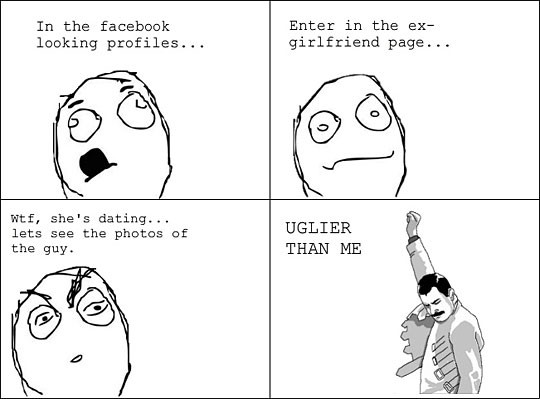
Maureen O’Connor believes that in the era of social media, breakups are an increasingly relative concept:

[M]ore often than not, you will see him again. Like “dialing” a cell phone or “filming” a digital video, “one-night stand” is an anachronism. Even if you only have sex once, you will spend time with your hookup when he finds you on Facebook, appears in a mutual friend’s Instagram, or texts about a weird bump he found on his penis. Older generations didn’t have a word for this kind of thing—they couldn’t have. But these are, in fact, relationships. Even casual dates have expansive biographies to plow through and life narratives you can follow for years.

You hear about their hangovers when you check Twitter for the morning news. You see their new apartments when you browse Facebook at work. They can jump into your pants whenever they want by sending text messages that land in your pocket. Online, you watch your exes’ lives unfold parallel to yours—living, shifting digital portraits of roads not taken with partners you did not keep.

There was also a time, I am told, when staying in touch was difficult. Exes were characters from a foreclosed past, symbols from former and forgone lives. Now they are part of the permanent present. I was a college freshman when Facebook launched. All my exes live online, and so do their exes, and so do their exes, too. I carry the population of a metaphorical Texas in a cell phone on my person at all times. Etiquette can’t keep up with us—not that we would honor it anyway—so ex relationships run on lust and impulse and nosiness and envy alternating with fantasy. It’s a dozen soap operas playing at the same time on a dozen different screens, and you are the star of them all. It’s both as thrilling and as sickening as it sounds.

Previous Dish on social media and exes here.