You Think “Weiner” Is Bad? Ctd

integrityincongress

A reader can top Harry Baals:

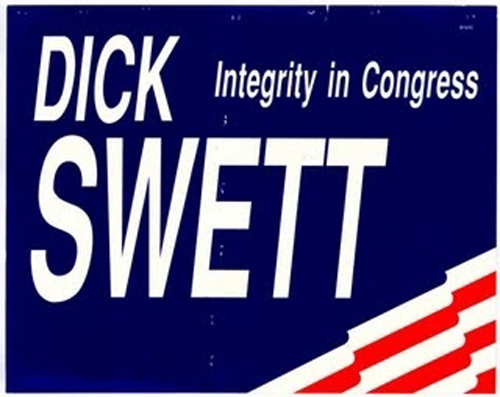
I know this is juvenile, but I can’t help it.  Here in New Hampshire, Dick Swett was a congressman for a few terms in the early 1990s. His campaign posters never failed to elicit a smile. Best of all, he was subjected to the Daily Show treatment when he stood up and asked President Obama a question at a town hall in Nashua in 2010.

Another:

I used to be a political consultant, and in the office we would keep track of great political “Dick” names. In the early 1990s, the president of the Cook County Board (the county that contains Chicago) was Dick Phelan. The last name was pronounced exactly the way it would to have your doctor write you an ED prescription.

Another:

When I did political fundraising in Michigan there was a big time lobbyist named Dick Weiner. Yes, just like Anthony.  That was a difficult call to make without laughing!

Another:

I was doing some personal research on Blower Bentleys yesterday and came across this video on the 1937 Grand Prix circuit:

I’m turning 52 tomorrow, maybe I’ll finally grow up.

Another:

I’ve always found the most unfortunate politician’s name to be Dick Mountjoy, a politician in the California State Assembly and Senate.  It didn’t help that I first encountered him while on a middle-school field trip to Sacramento.  I’d say his name was tailor-made for an adolescent’s sense of humor, but I can’t honestly say that I find his name any less hilarious now 15+ years on.

Another shifts genders:

Your reader who served with SFC Boner reminded me of a sailor off the USS Blue Ridge I met several times while I was deployed to Japan: a woman named Seaman Boob.

Imagine hearing that name get passed over the 1MC several times a day. Getting promoted didn’t help her much either; I believe she was an an interior communications electrician, so she became IC3 Boob, then IC2 Boob, and if she stayed in long enough, IC1 Boob …

Another:

Clearly the American military enjoys a significant advantage in terms of amusing names: the relative ethic diversity and the omnipresence of the nametape on the uniform make it impossible to ignore.  In my brief military career alone, I’ve had the pleasure of meeting Sergeant First Class Crazybear, Sergeant Sargent, and Major Horney.

Nothing, however, will outstrip a fond memory at the end of a deployment to Iraq at Ali Al Salem Airbase, Kuwait.  I was redeploying separately from my unit, and there were about 50 random sleep-deprived souls scattered about the waiting area, ready to head back home. In such situations, a relatively senior individual is designated to ride herd on the other passengers and ensure everyone is present through the time-tested Army roll call.  We all stood in yet another formation as a major read our names off in a loud, commanding voice:

“Garrity!”

“Here!”

“Gilchrist!”

“Here!”

The major paused.  A note of uncertainty crept into his voice.

“Glass … coke?”

And from the back, loud and triumphant:

“It’s pronounced Glasscock, sir!”

Another looks to the sports world:

Allow me to introduce you to Dick Pole, former Major League Baseball player and coach. And here are a few more from baseball, including Rusty Kuntz.

Another:

Let us not forget Randy Bush, who played outfield for the Twins in the 1980s.

Another:

This person isn’t a public official or a news reporter, but I still think the classic funny name of all time is a retired ob-gyn in Virginia named Harry Beaver.  Yes, he goes by Harry, not Harold.

And another:

Whenever I hear about people with funny/unfortunate names, I always think back to one of my college professors at UC Santa Cruz. Harry Beevers was one of the preeminent plant biologists of the 20th century. He was instrumental in discovering the glyoxylate cycle and the glyoxysome in plant cells. He was from the Northeast of England and spoke with a pronounced Durham / Geordie accent. He was a little intimidating in his classroom lectures but brilliant.

Another might just be pulling our leg:

In Junior High School (Greenfield Jr High, in El Cajon, CA) close to 30 years ago, my gym coaches were Harold Balls and John Hiscock. No joke. Of course the common refrain (amongst both students and staff) was, ” Where’s Hiscock and Balls?”, followed by much snickering.

I heard that after I left, Hiscock retired and was replaced by a coach named Longerbone. The whole thing was so preposterous that a local radio station once called the school on air to confirm that this wasn’t some kind of joke.

Another:

When I was in college I worked at a call center doing tech support for AT&T Wireless. One time I fielded a call from someone named Harry Johnson. My supervisor heard me laughing (while my microphone was muted, of course) and wandered over to check it out. When he saw the name Harry Johnson on my computer screen he started laughing too. Then, in one of the coolest but least responsible things a boss has ever done, he told the rest of our 15-person team to put their customers on hold and check out my screen.

One more:

My first GYN was named Dr. Stiff. Nice man, went to our church, had a good (and I should add, properly scientific) talk – along with his female partner in his practice – with all us high school girls about the sorts of things you need to see a GYN about, and made us feel very comfortable, and then I started going to him. I say this because I would not have chosen a GYN named Dr. Stiff out of the phone book – which might have been why he was trying to drum up business at church!

More readers are snickering over at our Facebook page. Update from a reader:

Now that you’ve expanded the review into the sport world, you have to acknowledge the legendary NASCAR racer, who died earlier this year: Dick Trickle. I once asked someone who worked in the sport, why he didn’t go by Richard or Rick? He said that Trickle started racing in Wisconsin on dirt tracks, where one of the other competitors was Richard Head, who did not go by Richard. I assume Trickle figured, by comparison …

And then there was the former head football coach at Glassboro State College in New Jersey in the ’80s: Richard Wackar. He did not go by Richard.

I assume you now realize this thread may never end?

Subscribers need to get their [tinypass_offer text=”$2/month”]’s worth.

Dolphins Have Names, Ctd

Linguist Geoffery Pullum calls the latest news item about dolphins’ communication skills “patently obvious twaddle”:

What the scientists did according to this new report was to capture the signature sound (the specific typical whistle noise) of each individual in a group of wild bottlenose dolphins and play the sounds back to the group. And what happened?

“The researchers found that individuals only responded to their own calls, by sounding their whistle back.”

Now, think about that. If you call out “Geoff Pullum!” in a crowded street, and I’m there within earshot, I’m likely to turn round and look at you. But what I am not likely to do is yell “Geoff Pullum!” back at you. The very description in the article of what happens when a dolphin hears their own signature whistle reveals that signature whistles do not function anything like names. It sounds analogous to a study of dog behavior finding that if you play Fido a recording of his own bark, he will bark.

Update from a reader:

Why does he assume dolphins and humans communicate the same way? What if repeating back his own name is simply an efficient way of saying “Yes, I’m here?”

When I first read the story, it seemed like dolphins use their names as message headers the same way pilots do. Whenever a pilot radios someone, she begins the conversation by saying who she’s calling and who she is, and then typically ends the conversation by repeating her own callsign:

Airplane N12345: Tower, November 12345.

Tower: Aircraft calling tower go ahead.

N12345: 345 holding short 22-left, ready to go.

Tower: November 12345, line up and wait runway 22-left, landing traffic one mile final on 18.

N12345: 345 [has received and understood your transmission]

So what’s so “obvious[ly] twaddle” about:

Dolphin 1: Dolphin 1 [calling anyone], just saw some tasty-looking tuna.

Dolphin 2, 30 miles away: Dolphin 2 [here, I have received and understood your song, and I’m coming too].

Dolphin 1: Dolphin 1 [understands you Dolphin 2 and will save some tuna for you].

Seems to me they’re pretty efficient communicators.

A Pit Stop On The Road To Democracy?

While addressing this week’s Iraqi prison break, Jon Lee Anderson zooms out:

Five hundred Al Qaeda terrorists back on the streets can do a lot of damage wherever they choose to go—to Iraq, Syria, Lebanon, or the fragile Jordan, where hundreds of thousands of Syrian refugees now live in camps along the border. Martin Kobler, the U.N. envoy to Iraq, warned this week that the likelihood of a regional conflagration was growing: “The problems in Iraq cannot be separated from the problems of the region. The battlefields are merging.”

Kobler is right. The Middle East is more of a powder keg, with more fuses, than it has been in years. Political violence is surging, with regional actors like Saudi Arabia and Iran lining up on opposing sides, and the United States and Russia arrayed behind them.

Sheri Berman considers all the recent tumult in the Middle East “not a bug in political development, but a feature”:

[T]he false starts and problems, the turmoil and the chaos and yes, sometimes even the violence, were an inherent and often necessary part of the process that ultimately abolished authoritarianism and paved the way for liberal democracy. …

What has happened time and again [throughout history] is that a country begins with a nondemocratic regime, proceeds through a phase (or several phases) of minimal or illiberal democratic experience, and eventually emerges with a consolidated liberal democracy. Almost all early democratic experiments around the world were illiberal or deeply problematic, and many ended badly. Only after many generations and attempts were most countries able to consolidate truly liberal democraciesthat is, to eradicate deeply ingrained nondemocratic behaviors and attitudes and develop new ways of thinking and acting that would enable liberal democracy to survive and flourish.

Jay Ulfelder pushes back on that argument:

As a grossly simplified description of the democratization trajectories followed by the United States and much of Western Europe, I think this works. As a road map that the rest of the world will eventually follow, however, I’m not so sure. In historical terms, the period during which the US and Europe could confidently be described as “consolidated liberal” democracies has been relatively brief, and some thoughtful observers argue that that era has already passed. What’s more, the geopolitical, economic, demographic, and environmental context in which political development is now occurring differs sharply from the context in which those earlier arcs unfurled, and the pace of change in that context seems to be accelerating still.

Don’t get me wrong, I’m still optimistic that global politics in the twenty-first century will continue to evolve in a more democratic direction. The tumult occurring in Egypt, Tunisia, Libya, Syria, Bahrain, Kuwait, and other corners of the Arab world is just the latest evidence that it’s getting harder and harder to sustain the kind of full-blown, paternalistic authoritarian rule that was the prevailing form of national politics around the globe throughout the twentieth century. I’m just not as certain as Berman seems to be about exactly what institutional forms that tumult will eventually produce.

Voter ID Laws Are A Bad Way To Steal An Election, Ctd

Douthat suggests the GOP rethink its voter ID push:

[P]recisely because the liberal outrage over voter ID laws is disproportionate — for understandable historical reasons and cynical political reasons alike — to their actual impact, it is quite possibly self-defeating for Republicans to keep pushing them.

In exchange for a marginal benefit to their candidates on election day, the G.O.P. is handing Democrats a powerful symbolic issue for mobilizing minority voters, and sending a message to African-Americans that their suspicions about conservatism are basically correct, and that rather than actually doing outreach to blacks the right would rather not have them vote at all. At best, the political benefit to the G.O.P. might outweigh the cost in non-presidential election cycles, for the House and for state offices, when minority turnout already tends to be depressed. But in that case, these kind of laws are just a way of consolidating the G.O.P.’s position as the new 1970s/1980s Democrats: A party that wields enough power in the states and Congress to postpone the kind of outreach it needs to be competitive at the presidential level. And as such, they’re another case of the G.O.P. playing a factional role in our politics, rather than trying to represent the nation as a whole.

Christie: “Live Unfree Or Die”

NJ Governor Chris Christie Holds Town Hall Meeting

The New Jersey governor’s remarks about growing concerns that the balance between security and liberty has shifted too much toward security were revealing in one respect. They suggest that he sees no trade-off between liberty and security at all. Christie is the walking antithesis of New Hampshire’s motto: “Live Free Or Die”. His view, it appears, is: “Live Unfree Or Die”.

There is, of course, a solid argument for tilting the balance in favor of security over liberty. That’s why I couldn’t quite muster the outrage of many of my libertarian and liberaltarian friends about PRISM. Too much relaxation of security could lead to a successful attack which could make future defense of pre-9/11 liberty even harder to defend. This is a tough area, especially for those of us not privy to intelligence about various threats. But there is none of this in Christie’s remarks, and I fear that this is one of his hallmarks – total, black-and-white certainty in areas where gray is inherently the dominant color. Note also the anti-intellectual populism at work:

“These esoteric, intellectual debates — I want them to come to New Jersey and sit across from the widows and the orphans and have that conversation. And they won’t, because that’s a much tougher conversation to have. The next attack that comes, that kills thousands of Americans as a result, people are going to be looking back on the people having this intellectual debate and wondering whether they put …”

He stopped himself at that point for some reason. But look: it’s a very strange thing for a Republican to call constitutional rights “esoteric”.

They aren’t. They’re basic. In a democracy, they are as core a set of values as we have. To reduce the difficult trade-off between preventing terror and maintaining civil liberties to a stark conversation with the victims of 9/11 is to load the emotional dice so heavily you are dismissing the entire debate as worthless. It’s Cheney-esque.

Then there’s this canard:

“President Obama has done nothing to change the policies of the Bush administration in the war on terrorism. And I mean practically nothing,” he said. “And you know why? Cause they work.”

We now know that the central anti-terrorism policy of the Bush administration was a program of brutal, indiscriminate torture of suspects. The second pillar was the invasion and occupation of two countries for a decade. Obama has abolished the former and, by the end of his term, will have ended both wars, whose consequences are still being felt in a bankrupted federal government, a wave of terrorist blowback and a collapse of America’s global credibility and moral standing.

The silver lining in this is that, for the first time in a while, these unreconstructed Cheney-style bromides are being challenged within the GOP, by Senator Paul in particular. And on a core question in our democracy – do we sacrifice our core liberties because of a network of religious terrorists? – we now know where Christie stands. Against freedom. And for his own power.

(Photo: Jessica Kourkounis/Getty Images.)

Further Thoughts On Weiner

Anthony Weiner Greets NYC Commuters Day After Announcing Mayoral Bid

I was reading TNC’s take late last night – and his superb comments section at the Atlantic – and realized that my first post was missing something important.

It may well be gay confirmation bias that misled me a bit. The thing about most gay hook-up sites is that they are almost entirely anonymous fantasy platforms which may, in a very small percentage of actual exchanges, lead to, you know, sex. The same can be said about straight sites like OKCupid et al. Everyone is there for roughly the same reasons – varying from voyeurism to romance to sex – and everyone, apart from the ruthless Darwinism of sexual attractiveness, is on an even footing. It’s a form of erotic play, really, almost all of the time. The pay-off is, in many ways, not even the point. It is to enter a world of sexual titillation and distraction.

This, I now better understand, is not what Weiner was doing. For some reason, I missed this essential piece in the NYT about the nature of the chats and sexts. Weiner wasn’t on those sites; he was using Twitter and Facebook and texts. He sent pics to women who had not already consented to sex-talk:

Ms. Cordova, who had traded messages with Mr. Weiner, a New York Democrat, about their shared concern over his conservative critics, said she had never sent him anything provocative. Asked if she was taken aback by his decision to send the photo, she responded, “Oh gosh, yes.”

The whole piece – and its granular detail – shifted my perspective on this. I think he went past the line of “consenting horned-up adults” into a form of sexual aggression, the kind of guy who won’t leave you alone at a bar. He did so with known and usually much younger admirers, not strangers in a fantasy scenario. He went from casual conversation to dick pics in an instant. I should have more closely examined the details of the exchanges before filtering them through my gay frontal cortex.

Second, that disproportion of power between him and his interlocutors, while not illegal, is still creepily Clintonian.

That’s an ethical and moral judgment about a man’s character – and I sure don’t think Weiner should drop out of the race rather than let the voters make their decision. And in public life, these character judgments are by no means the only factor in assessing a politician (who are almost all, by definition, psychologically damaged in some way. Clinton was a very good president on policy – but he remains a self-centered, sociopathic prick of the first order. You can trade one aspect for the other in politics the way you wouldn’t in your personal life. But the reason I endorsed Dole in 1996 was my view that Clinton had proven himself incapable of the kind of self-control we need in a president. I thought and wrote that he was a walking scandal waiting to explode. That would have costs for the entire country. And I was right.

TNC also makes an important point about cruelty. When you ask forgiveness of followers, donors, voters and relatives, and they give it, you do not let them down a second time after absolution. TNC:

I believe that how you treat people matters. It is folly to embarrass your pregnant wife before an entire nation. To do the same thing again is cruelty.

I’m not sure what the details of the Abedin-Weiner marriage are so wouldn’t go that far with such certainty. But, yes, Weiner’s inability to stop after his first episode cannot be viewed entirely through the prism of his own human weakness. He’s not a private person, and he could have chosen to remain one while he still struggled with being human. He chose ambition even though it would almost certainly mean cruelty and embarrassment to others. I don’t want him to drop out; I don’t think his behavior is in any way as bad as Eliot Spitzer’s criminal hypocrisy or Mayor Bob Filner’s sexual harassment, or Bill Clinton’s endless lies and sexual abuse of women. But I wouldn’t vote for him.

There’s a place for sexting – when it’s totally consensual and adult, when you’re not embarrassing a spouse, and when you’re not actually running for a major public office.

(Photo: Anthony Weiner listens to a question from the media after courting voters outside a Harlem subway station a day after announcing he will enter the New York mayoral race on May 23, 2013 in New York City. By Mario Tama/Getty Images)

How Not To Oppose Immigration Reform

Republican congressman Steve King recently said this about undocumented immigrants who came to the US as children:

For [every DREAMer] who’s a valedictorian, there’s another 100 out there that — they weigh 130 pounds and they’ve got calves the size of cantaloupes because they’re hauling 75 pounds of marijuana across the desert. Those people would be legalized with the same act.

Amy Davidson parses King’s words:

King speaks as though he thinks that if he could just convey the figures and shapes of these young people, their sheer physicality, others would recoil, just as he does, at the idea of letting them be American. What he asks is not that we listen to their stories, or add up their accomplishments, or read the history of this country, but just that we look at them, like he does. At their legs, arms—anywhere, it would seem, but in their eyes, where he’d have to acknowledge their individuality.

Chait notes that rebukes have only caused King to dig himself deeper:

John Boehner dutifully castigated King’s comments as “deeply offensive and wrong.” But if you take a shot at the King, you’d best not miss. And by “miss” I mean “fail to remove his larynx.”

 Because King came back on the House floor [yesterday] to defend himself in an epic, world-historical speech, beginning with the origins of human civilization and continuing on through the Greeks, the Romans, the Founding Fathers, and, finally, the present era of melon-calved Latino drug-smuggling youth

Alex Altman expects for Democrats to raise King’s profile:

Democrats will try to make King a GOP anchor, much like they used Todd Akin to paint the party as hostile to women. Already operatives are pointing to the comment of Ken Cuccinelli, the Republican candidate for Virginia governor, that King was one of his “very favorite Congressmen.” Republicans can call King’s comments “hateful” and “ignorant,” as Speaker John Boehner did Thursday. But they can’t shut him up, and they may not be able to erase the perception that he speaks for the rest of the party as well.

And Josh Marshall thinks that King’s views represent a sizable part of the GOP base:

King is speaking for the raw, undomesticated voice of that slice of the electorate for whom these social and population trends spell a basically non-stop state of white panic expressed through Obama conspiracy theories, fears of marauding Mexican hordes, hyper-opposition to primarily Latin American immigration and so much more.

Yes, King is more intemperate, voluable and perhaps more hateful than most. But he does speak for that relatively small slice of the electorate which makes up a pretty big slice of the GOP electorate and keeps the GOP anchored in opposition to immigration reform and to policies which put most of the non-white population off-limits to the party indefinitely. That’s why the whole plan to ‘double down’ on the ‘whites only’ strategy now increasingly favored by Republicans isn’t so much of a strategy as a recognition that it can’t break free or discipline that mammoth part of its voter base.

Notes On Jane Austen, And Vice Versa

Jane Austen banknote

The famed author just got some major face-time:

[Bank of England governor Mark] Carney’s announcement [that Jane Austen is going on the £10 note] was aimed at quelling a three-month storm of protest unleashed when [former Bank governor Sir Mervyn King] announced that the only woman to appear on an English banknote other than the Queenthe prison reformer Elizabeth Frywould be replaced by Winston Churchill, probably in 2016. She and Florence Nightingale are the only two women, other than the Queen, to have appeared on English banknotes since they started portraying historical figures in 1970. Campaigners threatened to take the Bank to court for discrimination under the 2010 Equality Act and launched a petition on the campaign site Change.org which secured more than 35,000 signatures.

Public reaction seems to be largely positive, but Belinda Webb isn’t impressed by the pick:

Jane Austen as a choice of woman to be on the £10 bank note would be fine, if we were in the 18th century. I can’t help but feel she is the safe, bland, acceptable, middle-class choice. Austen is the woman men don’t mind giving us as a representation because she is no threat to the prevailing order whatsoever.

But Austen scholar Bharat Tandon objects to the popular conception of “dear old Aunt Jane”:

[I]t may be that the top brass at the Bank of England have been cannier than they imagined, for Austen was, in her time, one of the most elegantly hard-headed chroniclers of the pressures of money on women. …

It cannot be a coincidence that both of her earliest published novels begin with women suffering under the inequities of the inheritance system. The Dashwood sisters in Sense and Sensibility are suddenly made reliant on their brother and his penny-pinching wife Fanny (“people always live for ever when there is any annuity to be paid them”), and the Bennet girls’ prospects in Pride and Prejudice are constrained by the entail of the family inheritance to their male cousin Mr Collins. It’s hard to read the subsequent romances without feeling the pressure of money, which becomes an invisible but powerful agency, almost a character in its own right, just as it does in later 19th-century novels by Dickens and Trollope.

Meanwhile, Katherine Connell notes that “amusingly, the quote from Pride and Prejudice selected for inclusion on the bill seems to have been chosen by someone who didn’t read the book”:

“I declare after all there is no enjoyment like reading!” were the insincere words spoken by the affected Miss Bingly to Mr. Darcy in a futile attempt to attract his attention:

Miss Bingley’s attention was quite as much engaged in watching Mr. Darcy’s progress through his book, as in reading her own; and she was perpetually either making some inquiry, or looking at his page. She could not win him, however, to any conversation; he merely answered her question, and read on. At length, quite exhausted by the attempt to be amused with her own book, which she had only chosen because it was the second volume of his, she gave a great yawn and said, “How pleasant it is to spend an evening in this way! I declare after all there is no enjoyment like reading! How much sooner one tires of any thing than of a book! — When I have a house of my own, I shall be miserable if I have not an excellent library.”

Austen would no doubt appreciate the irony.

Sometimes Pink Is Just A Color, Ctd

And sometimes blue is too. A female reader quotes Alice Dreger:

But the truth is, as Sarah was suggesting, that a lot of “gender nonconforming” kids don’t have a simple story of being “trapped in the wrong body.” They are expressing more subtle, more complex, and more varied messages of self. What they need isn’t therapy; what they need is to know that it’s OK to be gender non-conforming.

That’s me in a nutshell, and I would imagine there are more of “us” than there are of strictly transgender children/people. The lack of understanding of those kinds of kids was probably the most traumatic part of my little butch childhood and remains a source of some pain and loneliness to this day. I still find myself seeking distance from others when I see their confusion and/or fear about what I look like and how I carry myself.

At nearly 50, I can suss out how desperate people are to have clear guidelines for what defines male and female.

This strict binary understanding provides them with a lot of comfort, though I might add that nearly all of the ideas of male-typical or female-typical interests are cultural understandings and not biological ones. Pink is always just a color, folks. But as a very butchy-looking child, who was better at sports than all of the neighborhood boys save my own brother, who was always competitive, never wanted to wear dresses and wore my hair short since I was little, I was never confused by what I liked and wanted to do.

But everyone else was, and they were extremely angry about the confusion I raised in them – when I was four damn years old. To have strangers, teachers, school peers ask me, angrily, “What’s wrong with you? Do you wish you were a boy?”, “Are you a boy or girl? Answer me!” or “Why are you here at the ball park, this is for boys?” always raised the same thought in my head, “What in the hell are you talking about? Of course I don’t wish I was a boy. I’m just a good athlete and hate dresses.” With those thoughts also came a deep fear for my own safety and utter embarrassment that I was somehow disappointing everyone by simply being who I was naturally. Fortunately, I was big and strong and only got physically threatened a few times as a kid.

I’ve never felt what’s described as gender dysphoria. I still don’t want to be a man, even though some still think I look like one. I don’t consider myself transgender, no matter how hard people try to pull this butch woman into that camp. I know I’m not easily definable, that I reside on the outside, but I can’t be anything other than I am now anymore than I could when I was four. I also know that who I am still confuses and angers many people and that I need to be very aware of when that’s happening so that confusion doesn’t turn into violence against me. With all of the progress on LGBT rights and understanding over the years, that part most certainly hasn’t changed.

Thanks for listening. It’s funny how your blog pulls so many of us to tell really deep stories about our lives that we haven’t shared with very many people. Until I wrote this post, I think I’ve only ever told of my childhood experiences to one other person – my partner. So, truly. Thank you for the outlet. It feels strangely safe when so many other places both virtual and real don’t.

Dissent Of The Day

A reader writes:

Each time I read a post or piece that mentions “obesity and diabetes,” I send along an email in a desperate attempt to get people – many of them medical professionals = to stop using the blanket term “diabetes” with “obesity.” Why? Because my young daughter has Type 1 Diabetes, an autoimmune disease that affects millions of Americans and usually manifests in childhood (used to be called Juvenile Diabetes). Type 1 diabetes has nothing to do with obesity.

In fact, when most children are diagnosed, they are on their way to starvation, as their bodies no longer metabolize their food components. Because people so casually throw around the umbrella term “diabetes” and are so cruel to obese people, Type 1 diabetics get stigmatized by it. My child, who is very slight for her age group (as are many type 1 children), has to constantly answer questions like, “Did you eat too much sugar?” or weather comments like “Only fat people get diabetes.”

Type 1 children already feel different. They either have to wear insulin pumps day and night or take multiple shots each day. They have to take time out of class to prick their fingers multiple times a day to check their blood glucose. They live in fear of life-threatening high and low blood sugars. Their parents have to wake up during the night, often several times, to prick their fingers while they sleep. Is it too much to ask that journalists and medical professionals use the proper nomenclature?

No, it isn’t and we’ll be more careful in future.