A $70 Trillion Methane Bomb?

dish_ice

A new study puts a price tag on the potentially devastating consequences of climate change in the Arctic:

Governments and industry have expected the widespread warming of the Arctic region in the past 20 years to be an economic boon, allowing the exploitation of new gas and oilfields and enabling shipping to travel faster between Europe and Asia. But the release of a single giant “pulse” of methane from thawing Arctic permafrost beneath the East Siberian sea “could come with a $60tn [trillion] global price tag”, according to the researchers who have for the first time quantified the effects on the global economy. …

[U]sing the Stern review, [the study authors] calculated that 80% of the extra impacts by value will occur in the poorer economies of Africa, Asia and South America.

“Inundation of low-lying areas, extreme heat stress, droughts and storms are all magnified by the extra methane emissions,” the authors write. They argue that global economic bodies have not taken into account the risks of rapid ice melt and that the only economic downside to the warming of the Arctic they have identified so far has been the possible risk of oil spills.

But, they say, economists are missing the big picture. “Neither the World Economic Forum nor the International Monetary Fund currently recognise the economic danger of Arctic change. [They must] pay much more attention to this invisible time-bomb. The impacts of just one [giant “pulse” of methane] approaches the $70-tn value of the world economy in 2012″, said Prof Gail Whiteman, at the Rotterdam School of Management and another author.

Atmospheric scientist James Samenow pushes back on the study, saying that “most everything known and published about methane indicates this scenario is very unlikely”:

And, here’s the kicker: Nature, the same organization which published Wednesday’s commentary, published a scientific review of methane hydrates and climate change by Carolyn Ruppel in 2011 which suggests the scenario in said commentary is virtually impossible.

Peter Wadhams, one of the study’s authors, rebuts Samenow. Recent Dish on climate change here, here, and here.

(Photo: US Geological Survey)

The Internet’s Vigilante Justice

Laura Hudson worries about it:

Shaming, it seems, has become a core competency of the Internet, and it’s one that can destroy both lives and livelihoods. But the question of who’s responsible for the destruction — the person engaging in the behavior or the person revealing it — depends on whom you ask. At its best, social media has given a voice to the disenfranchised, allowing them to bypass the gatekeepers of power and publicize injustices that might otherwise remain invisible. At its worst, it’s a weapon of mass reputation destruction, capable of amplifying slander, bullying, and casual idiocy on a scale never before possible.

Alyssa shares many of Hudson’s concerns:

In courts, when juries or judges find defendants guilty, they have guidelines for the sentences that can result from those judgements, and the people on whom they’re imposed can often appeal those sentences or find ways to reduce them. An internet shaming obviously doesn’t carry the weight of law–having Penny Arcade mad at you doesn’t mean that you’re going to have an enormously difficult time getting hired for many categories of jobs–but that doesn’t mean it doesn’t have consequences, or that it’s not intended to. Getting someone fired or harassed as retaliation is no joke, it’s not necessarily proportional, and it’s certainly not restorative. I’m all for a serious conversation about what the appropriate social and material consequences should be for harassing or threatening people online should be, and how best to carry them out. But as satisfying as shaming someone can feel in the moment, I’m not sure it gets us any closer to conclusions in that conversation that will make the internet a healthier place.

Peak Beard?

Emine Saner says beards may be a victim of their own success:

“In years to come, when they make movies or write books about this time, the beard will be used as a definitive visual shorthand for the early 21st century, as the mustache is for the seventies and a pair of muttonchops for Regency England,” wrote the cultural commentator Ekow Eshunin an essay on beards last year. Eshun tracks this modern sprouting back to the pre-beard nineties dotcom boom, the speed and slickness of it at odds with slacker style, grunge, facial bushiness, and New Labour, for whom “beards were everything they abhorred. Beards were Clause IV and Militant. Donkey jackets and picket lines. Marx and Engels.” After the dot-com bust, 9/11 and the war on terror, writes Eshun, “came a more reflective public mood” and a yearning for a simpler time. The craze for a kind of pastoral idyll took hold, even if the men lived in Hackney, Portland or Brooklyn–artisanal food, crafts, folk music. And beards.

Erin Gloria Ryan thinks the “peak beard” argument is credible, if depressing:

The piece’s author, Emine Saner, describes herself as a “staunch pogonophile,” (Greek for “beardfucker”) so we know she’s not just another snooty Times writer in khaki cargo shorts mincing over to Brooklyn so they can write about hipsters with a detached air of wounded nerd superiority; she’s on the side of beards. She’s a beard advocate. According to Saner, beards are everywhere–they’re at the Oscars. They’re at the Grammys, and not just on Mumford and his Sons. They’re on your barber, the tattoo artist, the guy at the bike shop, the guy in the cubicle over, the bartender, the guy on the train, the guy you are having sex with, the guy you want to have sex with. The butcher, the baker, the candlestick maker. Etc. All the cool kids are growing furry sweaters on their faces. “Beards, beards, beards,” she writes. I agree. Beards.

But Saner warns that we may be reaching a “saturation point,” that there is nowhere else for beards to grow, and that, simply due to the nature of trend life cycles, the next phase in male facial hair fashion won’t hearken back to a simpler, more barn raising-intensive time. Since everyone has a beard now, soon the only way for a guy to distinguish himself will be to shave it all off and present his face to the world like a naked baby.

The one thing beards have going for them is that they’re less hassle than shaving every day. And men are lazy. Let’s also not forget one obvious fact: having a beard is the default option for the male of our species. If you do nothing, you have a beard. The default is not a fashion statement; it is the basis for all fashion statements for the male face.

Vandals And Saboteurs, Ctd

Reuters reports that, in response to the Obama administration’s “public education campaign on healthcare reform, Republicans and their allies are mobilizing a counter-offensive including town hall meetings, protests and media promotions to dissuade uninsured Americans from obtaining health coverage.” Beutler fumes:

It’s bad enough to just not care all that much if the U.S. has a large uninsured population. But if there’s an excuse for encouraging people who have the means to remain uninsured, I can’t fathom it.

It almost goes without saying that this effort is being undertaken to keep younger, healthier people out of the exchanges, and send the individual insurance market into an adverse-selection “death spiral.” That would ruin the system for people who want the help Obamacare offers them. And so the campaign effectively amounts to asking people to continue putting their well-being and livelihoods at risk for the good of the cause of keeping health care for sick people unaffordable.

Drum can hardly believe that “they’re literally going to be encouraging people not to buy health insurance”:

What’s next? A campaign to get people to skip wearing seat belts? To skip using baby seats in cars? To skip vaccinations for their kids? It’s times like this that words fail those of us with a few remaining vestiges of human decency.

Cohn notes how unusual this kind of obstruction is:

If you’re among those people who agrees about the inherent malevolence of Obamacare, then this might all seem very reasonable. (Hey, they burned draft cards to protest the Vietnam War—and Obamacare is just as awful!) But if you don’t see things that way, you might be wondering if this is the way opposition parties and movements typically act when a law they don’t like is about to take effect. The answer is no.

And Sarah Kliff thinks that Republicans may unintentionally be helping Obamacare succeed:

Republicans have set Obamacare expectations so incredibly low that, if Godzilla doesn’t march in on Oct. 1 and gobble up our health insurance coverage and legions of IRS agents fail to microchip the masses, that could plausibly look like a success.

Earlier Dish on Republicans’ attempts to sabotage Obamacare here.


Where Is The Midwest? Ctd

image001

Another map from a reader:

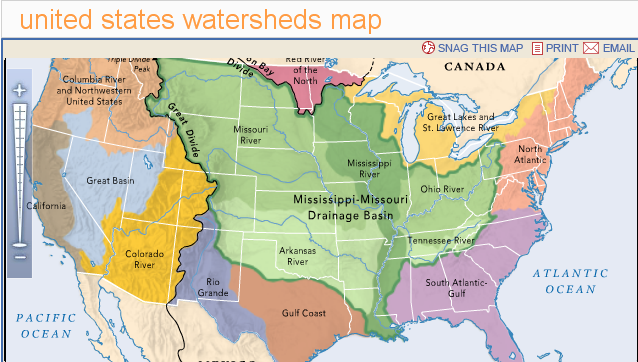
It explains how Pittsburgh and Topeka are both sometimes “Midwest”.  I think another factor, in addition to geology, climate, rainfall, and highways, is rivers and watersheds.  Areas that share a watershed are connected physically by a river and have similar geology seem to form contiguous units.

Another writes:

Such a cool thread.  And, being the reader who (I think) got the whole “South vs Social Mobility” thread rolling, I feel a compulsion to weigh in on the Midwest one. I’m not Midwestern, but I find the cultural boundaries of the US to be endlessly fascinating, since they don’t really hew to state lines, even though everyone expects them to do so.  In particular, your reader who pointed out the 100th Meridian dividing line is pretty dead on (though I might move the Midwest/West boundary myself over to the west by about 150 miles). Think of all the things in “Midwestern” states that are so reminiscent of the West: Mount Rushmore; Teddy Roosevelt’s Badlands and its roaming bison; Dodge City, Kansas.  Those are all, in fact, on the other side of the 100th meridian.

Also, perhaps the reason that Texas has such a self-centered identity complex is because it has no other singular region in which to identify.  El Paso is solidly in the West.  Houston is solidly in the South.  Dallas, though it considers itself nominally “Southwestern” (how?), is really both Southern and Great Plains at once.  And who knows what the hell San Antonio is – not Southern, not Western, not Midwestern.  Hence, my theory is that Texas pride is so overbearing because Texans need to find they have something in common.

Another:

As is often the case in such matters, too many of your commenters have fallen into the trap of trying to logically, geometrically locate the “mid” of the West, rather than follow the historical evolution of the vernacular.

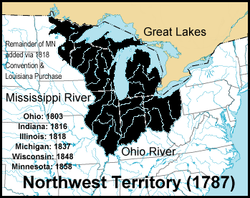
The tipoff is that nobody in the South thinks of themselves as Midwesterners, no matter where they lie, East to West. That’s because the historical precursor to the idea of the Midwest is the old Northwest Territory, which led to the settlement of the northwestern corner of the United States. At least, what used to be the northwestern corner of the United States, that is, the Great Lakes region (more or less).

The Louisiana Purchase blew up that claim to fame pretty much right as the Northwestern 250px-Northwest-territory-usa-1787Territory was formalized, but rather than die, the idea simply evolved. The people of the old northwest knew that, politically speaking and population-wise, they were still “West” even if the (largely fictional) western boundary of the nation had vaulted far beyond them. They lived in the more-or-less-west, the kind-of-west, the really-not-as-East-as-it-looks-on-your-map, or as it finally came to be known (with a shrug inserted in place of a hyphen) the Midwest.

Later, with the further addition of the Oregon Territory, the “westerners” of the Louisiana Purchase, similarly bereft of their edge status, likewise laid claim to living in the Midwest. They, as any Ohioan (living in the first Midwestern state) knows, are mere pretenders to the throne.

Another:

I have to dispute your reader who was “born and raised in the Midwest”, who continued: “I have one very simple rule: if it’s in the Eastern Standard Time Zone, it’s not Midwest.”  Try telling that to the residents of Dayton, Ohio (where I was born), where everybody identifies their region as the Midwest.  This is nothing new – when I was young (circa 1960), our local TV station produced a weekly music show called Midwestern Hayride.

In fact, as the border zone, Ohio turns out to be much more complex and interesting than it usually gets credit for.  Here’s how you should understand the three largest cities in Ohio, geographically, culturally, and politically: Cleveland is an Eastern city (old, industrial, ethnic);  Columbus is a Midwestern city (mostly flat, sprawling, surrounded by cornfields, service-oriented, much more homogeneous demographically); Cincinnati is a Southern city (geographically and politically more like Kentucky than most of the rest of Ohio).

Another passes along the Onion’s take on the subject:

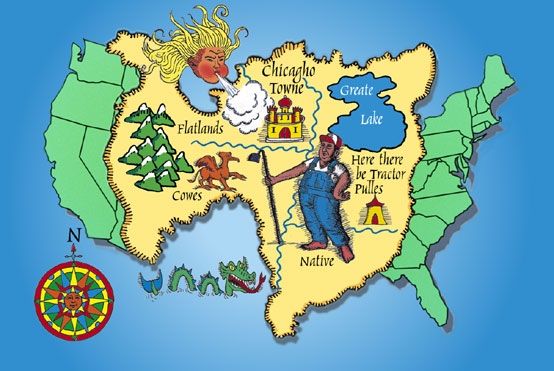
Midwest Map

“The Midwestern Aborigines are ruddy, generally heavy-set folk, clad in plain, non-designer costumery,” Eldred said. “They tend to live in simple, one-story dwellings whose interiors are decorated with Hummels and ‘Bless This House’ needlepoint wall-hangings. And though coarse and unattractive, these simple people were rather friendly, offering us quaint native fare such as ‘hotdish’ and ‘casserole.’ … [T]heir mode of dress is largely restricted to sweatpants and sweatshirts, the women’s being adorned with hearts and teddy bears and the men’s with college-football insignias.

Could Grantland Survive Without Corporate Help?

A reader writes:

I enjoyed your recent post about Nate Silver and am glad he’s moving to ESPN – one of my daily reads (in addition to the Times). I also like the idea of a Silver-led version of Grantland. But I thought I’d pass along the Big Lead’s recent piece on Grantland, which is very successful in some ways but is apparently dependent on its connections to ESPN not just for editing and support but also basic financial viability.

The article’s a bit critical of Simmons, probably in part due to professional jealousy, but I don’t think it’s entirely misplaced in its judgment (though I like Simmons for the most part). ESPN is an extraordinarily profitable media corporation that still struggles for journalistic respectability, largely because of the obvious potential conflicts of interest involved in reporting on athletes and athletics and broadcasting sports. Grantland seems possibly like a kind of write-off for them, and it’s basically safe. In some ways, 538 is a riskier and bolder move, but I think that the lessons regarding old vs. new media are more complex than a clear victory by bloggers over the old media.

A sizable excerpt from the Big Lead piece:

Grantland sought to “prove long-form has a place online.” Has it done so? Sort of.

It is hard to fashion a general principle from Grantland. The site was not a startup. ESPN affiliation offered it immediate credibility and promotion. ESPN coffers offered it cash to launch and to operate at a loss if need be. ESPN’s existing Internet infrastructure offered it multiple traffic fire hoses, including plum placement on ESPN.com and Bill Simmons’ twitter feed (now over 2 million followers). This project was more than a domain name and a dream. The floor was much higher.

The site’s birth conditions shaped its development. Grantland is utopian and expensive. The masthead has 10 people listed as some form of editor. Another 18 are listed as staff writers. There are additional, high-profile contributors. We presume there are more uncredited grunts doing technical support. Even presuming they are paid at standard rates, that is substantial overhead. Most Internet outfits are skeletal. Grantland is not just fleshed. It is bloated.

Grantland is not optimized to pay for itself with traffic. Writers are afforded time to produce thoughtful content, only thoughtful content. The site publishes a relatively small amount, only Monday through Friday. Grantland is an Internet place where weekends still exist.

How is the site’s traffic? According to Comscore, Grantland has hovered around or a bit above two million unique visitors for the past 12 months. Their number for May, after a recent uptick, was 2,474,000 unique visitors, up 26 percent from May 2012. For some perspective, that is 76 percent of the traffic generated by Deadspin over the same month. Is that traffic enough to make the site self-sufficient financially? The answer in January was “it depends on how you do the accounting” and ESPN “doesn’t discuss financials.” We suspect ESPN would argue important ad metrics are shifting from raw traffic to audience engagement. The company declined a request to provide data that would have buttressed that point.

Grantland, denied the WWL teat, probably would not survive, at least as constituted. But that does not prove long form content does not work on the Internet. Long-form, writerly content was seldom, if ever self-sustaining before the Internet. The New Yorker still prints because it is “The New Yorker.” The magazine was notably unprofitable when magazines were booming. Even before print, scholars relied on independent wealth or, more likely, someone else’s independent wealth to furnish expensive libraries and disseminate their work. The Internet has not changed the climate, so much as it has intensified and quantified it. …

Long-form content will work on the Internet, as it has throughout history, with someone or something else subsidizing it.

Read the rest of the piece here.

The Shrinking Of Big Law, Ctd

Mark Obbie takes issue with Scheiber’s thesis:

From the cover lines and title (“Big Law in Free Fall,” “The Last Days of Big Law”) to an outlandishly flimsy nut graf (claiming just one in 10 top firms will survive the imminent apocalypse, or so says “one common hypothesis” that then never gets explained or examined), the story looks at one sore throat and proclaims it a cancer pandemic. Its prognosis on the death of the mid-sized full-service firm echoes a forecast made so many times it has lost all credibility. Then the piece takes yet another giant step into journalism hell by shooting readers through a time warp that conveniently skips the past 30 or so years of Big Law business history. Big Law has been declared dying for decades. Pieces touting the death of Big Law have been written for decades. Unfortunately, “Big Law Still Really, Really Dying,” while arguable (except where it’s still really, really profitable), doesn’t sell copy.

Meanwhile, Leah Plunkett focuses on the Americans who can’t afford legal help:

When people can’t get lawyers to help them with complex problems, they stand to lose (pdf) the things that are most precious to them, like custody of their children, the roof over their heads, or that quintessentially American opportunity to make a fresh start after crashing and burning.

Even if all Americans could afford to pay for lawyers, there may well not be any lawyers around. Outside of cities, lawyers can be scarce. As The New York Timesrecently reported, South Dakota has gone so far as to pass a law that will pay lawyers to work in that state’s rural communities. A worthy endeavor, but it’s difficult to imagine that the program will do much to get the over-supply of lawyers on Wall Street to migrate to Main Street: The annual stipend for South Dakota’s program is less than a month’s salary for a first-year Big Law associate in New York.1 And of course, as others have discussed, today’s young lawyers—who might otherwise be intrigued by doing Little Law on the Prairie—frequently face financial debt that is insurmountable on all but a Big Law salary.

Which Way Does The Senate Lean?

The Crystal Ball’s 2014 Senate ratings:

2014 Senate

Kyle Kondik previews the 2014, 2016, and 2018 Senate races:

The Democrats are overextended on the 2014 map, which probably means the Republicans should, at the very least, make a dent in the Democratic Senate majority next year. Two years later, the Republicans will be defending a map on which they are overextended, which could help the Democrats make up for some of their possible 2014 losses. And then the Democrats are overextended again in 2018.

All of which suggests that 60-vote Senate majorities are going to be elusive for either party, and future Senate majority leaders, be they Democrats or Republicans, are going to be continually tempted by some form of the “nuclear option” in limiting the filibuster. Given its rapidly increasing use, future Senate majorities — maybe even as soon as this one — might decide they have little choice but to reach for the button.

Enten thinks that, over the long run, the Senate favors Republicans:

Only about 26% of the country as a whole live in the top 10 metropolitan areas. For minorities, those percentages climb significantly: 37% of blacks, who voted for Obama by a 10:1 ratio, live in the top ten metropolitan areas. This includes Washington, DC, which doesn’t have any representation in Congress. Further, 45% of Latinos, who voted for Obama by greater than a 2.5:1 ratio, live in the top ten metropolitan areas.

That’s why it should be no surprise that 36 of the 50 states in the union have a higher percentage of non-Hispanic whites than the nation as a whole. That puts the Democratic party behind the eight ball in winning more states than Republicans. If racial polarization in terms of voting patterns continue to exist or get worse, then it will only go downhill for Democrats in winning more states.

This isn’t that big of a deal in winning presidential contests. The electoral college may be a lot of things, but it does take into account population in assigning electoral votes. Indeed, at this point, the Democrats seem to be enjoying an advantage in the electoral college. That is, they are in a better position to win the electoral college and lose the national vote than are Republicans.

On the Senate level, it is, however, a very big deal.

A History Of Hate In Burma

MYANMAR-POLITICS-ANNIVERSARY

Juan Cole Matthew Walton looks at the backdrop behind the recent uptick of Buddhist-on-Muslim violence:

Muslims in Myanmar have faced the everyday discrimination and challenges that non-Buddhists face in an overwhelmingly Buddhist majority country, but there have also been instances of more targeted oppression. Riots in 1930 were directed more generally at the immigrant Indian population (as a stand-in for the colonial power), but the 1938 riots (although also intended as anti-colonial actions) targeted Muslims more explicitly. After the establishment of military rule in 1962, Muslims were explicitly excluded from the Burmese military. Anti-Muslim riots occurred again in Mandalay in 1997 and Taungoo in 2001. While these latter incidents involved large numbers of monks, many have speculated that the incidents were organized by the military to deflect attention from other issues or to galvanize nationalist sentiment. …

The 969 movement is the public face of the current resurgent Buddhist nationalism.

The movement derives its name from the nine great qualities of the Buddha, the six great qualities of the dhamma (his teachings), and the nine great qualities of the sangha (monkhood), the “triple gems” of Buddhism. There is also a sense in which 969 is intended as a numerological counter to the Muslim 786 symbol. 786 is a numerological representation of “Bismillah Rahmane ne Rahim” (which, interestingly, is considered haram by some branches of Islam) and is pragmatically used by Muslims in Myanmar and elsewhere in South Asia as an identifying marker, particular in the case of halal restaurants. A groundless yet widespread rumor in Myanmar is that 786—adding up to 21—is a secret Muslim code that indicates a desire to take over either Myanmar or the world (depending on the scope of the teller’s ambitions) in the 21st century.

Recent Dish on religious violence in Burma here, here and here.

(Photo: Myanmar police force stand guard near Martyrs’ Mausoleum during a ceremony as Myanmar marks the 66th anniversary of Martyrs’ Day at the Martyrs’ Mausoleum in Yangon on July 19, 2013. By Soe Than WIN/AFP/Getty Images)

Ask A Window-View Champ Anything

Doug Chini, who nailed the vast majority of the 42 contests he has entered so far, takes questions from readers:

What do you do professionally?

I’m a corporate lawyer in New York City, which actually gives you the discipline to fight through some of the harder searches.

How much time do you typically put in for each contest?
screen-shot-2013-05-10-at-11-26-51-pmIt varies. I typically spend 10-15 minutes just analyzing the image and on occasion, as with last week’s Mostar view, the answer pops right out. But for difficult ones, and if I have time, I can spend several hours over the course of the weekend. In those cases, as with writing, it makes sense to work in small stretches and come back with fresh eyes.

What was your all-time favorite VFYW contest?

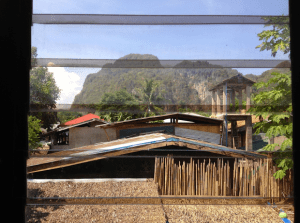
Well, in terms of the ones I’ve found it would have to be the El Nido view in the Philippines (VFYW #153). Tracking down the actual window required plotting dozens of images from the local cliffs on a time-line. By the end of that process my computer’s desktop looked like the floor of Baker Street after Sherlock Holmes spent a night digging through a stack of old newspapers.

The most amusing contest, however, was VFYW #116, which I never found. I normally begin a search by adjusting the image’s brightness and contrast, but when I did so that week, boy was I in for a surprise. I’ll let the readers go back and, er, reflect on that one.

What are the most common red herrings?

Recently it’s been red tile roofs. Whenever we get a Mediterranean view, there’s invariably a group of readers who think it’s California because of those roofs, but it rarely is. More broadly, certain architectural characteristics, like shanty construction, are common across a wide swathe of the planet, but people tend to assume they’re specific to regions they’ve previously traveled to. Unless you’re certain, I think it’s better to cast a wide net at the beginning of the search rather than develop tunnel vision.

Do you ever reach a point with some contests when you just admit to yourself that you’re stumped and give up?

Not really, because I rarely push too hard for an extended stretch of time. Instead, I’ll plug away right up to the deadline with whatever snatches of free time are available, even if it means searching on the elliptical at the gym.

Which VFYW victory were you most proud of?

That’s a hard one. Cork (VFYW #117) comes to mind first, as I found it just as I was about to turn the computer off for the night. And the Rohrmoos view (VFYW #148) in Austria required a pure brute-force search because there were no good clues. When I found that one I felt like Rocky running up the steps of the Philly Museum of Art (except swap Stallone with a dork sitting at a computer).

But if we’re talking “pride,” I’d have to say Sarlat-la-Caneda (VFYW #158). I only had one day to work on it, which meant I had to quickly narrow down the likely area using small details until I could locate the final, critical clue. (If the Dish staff allows, I may send in a detailed visual in the next month or so that shows how that one played out.)

What are some photo clues that the average person might not think would be helpful?

The most prosaic of details, like garbage cans, traffic signs and chimneys are often fairly specific to a region or country and can narrow down the search area. Also, the position of satellite dishes and the direction of shadows can give you a sense for the compass direction of the picture, which helps when searching satellite imagery.

Our previous co-champions, who we honored for our 100th contest, also respond:

What do you do professionally?

Mike: Electrical engineer

Yoko: Nursing

How much time do you typically put in for each contest?

Mike: About eight hours, usually a few hours at a time over Saturday and Sunday. About half my time is typically spent documenting the location. (I did most of the documentation – that’s why my time is longer than Yoko’s).

Yoko: It depends… from 15 minutes to the whole weekend.  We usually found the window on Saturday morning, otherwise, we couldn’t go out. Typically, 3 hours or so.

What was your all-time favorite contest?

Mike: Dhaka, Bangladesh. The part I regret is that Yoko was traveling that weekend, so I found it myself. It turned out to be a great win, because it was a solo win – nobody else got the building – but I wish Yoko had been part of it.

Yoko: My favorite was Edinburgh. It was a lovely scene. The cobblestone street in the photo helped me find the window. (Note from Mike: Yoko found this window in about fifteen minutes).

Which VFYW victory were you most proud of?

Mike: #68, Ulaanbaatar. I had found windows before that, but this was the first one Yoko and I solved together. She found the window after we talked about the clues, and I wrote up the entry.

Yoko: Dhaka. Mike found the window by himself. Usually, I helped him too much.

What are some photo clues that the average person might not think would be helpful?

Mike: Curbs and utility poles.

Yoko: Hmm… Electric utility cables (how messy, how old…) can be clues. Also, the window frames sometimes tell me many things.

What are the most common red herrings?

Mike: License plates. There are so many, and they change so quickly. It’s easy to look at a plate and think you know where it’s from (or even to look it up on a license plate site), only to discover that it hasn’t been used for years, or even worse, that the same design is used in myriad countries or states.

Yoko: Mike’s advice. He always says, “It must be China!”