Breaking Hamas

Jeffrey Goldberg offers a reliably bellicose strategy to achieve peace in the Middle East:

Engineer the ouster of Hamas from the Gaza Strip. Both the Palestinian Authority and Israel see Hamas as a bitter enemy; both sides understand that Hamas is an impediment to peace talks. The end of Hamas’s rule — the Gaza Strip constituting about half of what would be a future Palestinian state — could set the stage for actual, fruitful negotiations. …

The White House could lobby Hamas’s remaining benefactors in Turkey and Qatar to trim their funding. If such lobbying failed, Congress could “pull strings to speed up delivery of or withhold the advanced weapons systems that both countries are eagerly awaiting, depending upon how the conversation goes. Turkey, for example, is expecting Sidewinder missiles and Chinook helicopters, and it would like to purchase Predator and Reaper drones. Qatar, for its part, is expecting delivery of Large Aircraft Infrared Countermeasures (LAIRCM) Systems, and 500 Javelin-Guided Missiles.”

Just so long as nothing is done to halt the settlements, and nothing is asked of Israel, while Hamas is targeted. That’s the neoconservative idea of balance. Jonathan Schanzer likewise insists the military takeover in Egypt has given the US the chance:

Since Morsy’s ouster, the military has been unleashed: It has arrested at least 29 Brotherhood financiers, including at least one significant contributor to Hamas’s coffers, according to a senior Israeli security official. It has also reportedly deployed 30,000 troops to the Sinai and purportedly destroyed roughly 800 of the 1,000 tunnels connecting Egypt to Gaza. Ala al-Rafati, the Hamas economy minister, recently told Reuters that these operations cost Hamas $230 million — about a tenth of Gaza’s GDP.

All of this presents U.S. Secretary of State Kerry with a rare opportunity to try to hasten the group’s financial demise. And it is in his interest to do so.  The group, after all, carried out suicide bombings against Israeli civilian targets in the 1990s to torpedo the peace process. It’s a fair bet that Hamas will launch a new campaign of violence now that talks are ramping back up.
More Dish on the potential of the new talks here and here.

What Does Stop-And-Frisk Accomplish?

Stop And Frisk

TNC is unimpressed by its track record:

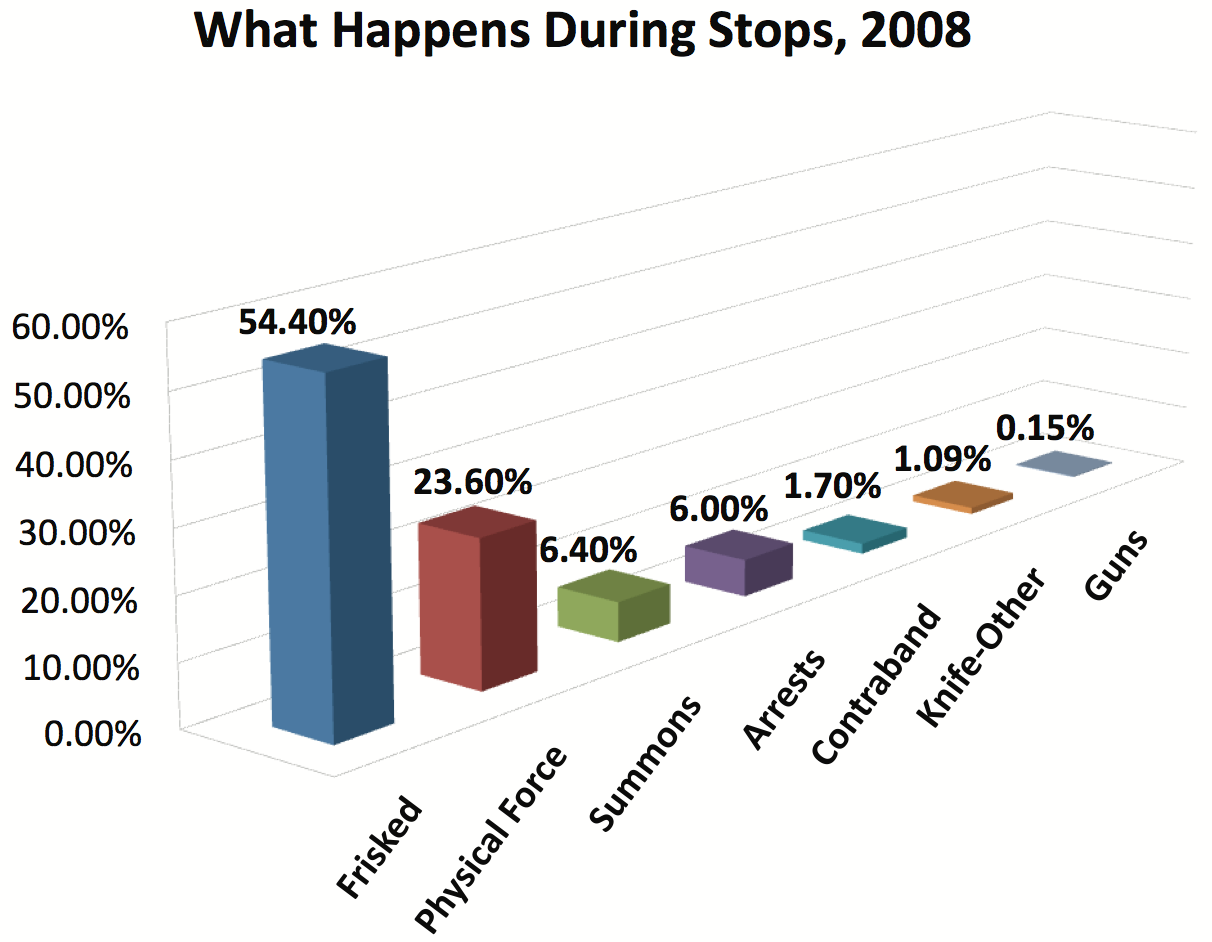
I am not totally opposed to policies in which individuals surrender some of their rights for the betterment of the whole. The entire State is premised on such a surrendering. But at every stop that surrendering should be questioned and interrogated, to see if it actually will produce the benefits which it claims. In the case of Stop and Frisk you have a policy bearing no evidence of decreasing violence, and bearing great evidence of increasing tension between the police and the community they claim to serve. It is a policy which regularly results in the usage of physical force, but rarely results in the actual recovery of guns.

Sullum adds that “debate about the effectiveness of New York’s stop-and-frisk program is interesting, but it should not be dispositive”:

For that matter, the demograpic profile of the people who are usually hassled by the cops, while it certainly should bother anyone who claims to be concerned about racial profiling or the 14th Amendment’s guarantee of equal protection, is not the most decisive argument against stop and frisk, which is the Fourth Amendment. As Mike Riggs noted yesterday, [NYPD Commissioner Ray] Kelly seems to think everyone detained by the cops must be guilty of something. “The notion anyone stopped has done absolutely nothing wrong is not really the case,” he said on MSNBC’s Morning Joe, because police “need reasonable suspicion to stop someone and question them.” Kelly not only confuses reasonable suspicion with guilt beyond a reasonable doubt; he assumes his cops really do have a sound legal basis for every stop they make and every pat-down they perform. That assumption is hard to credit, given that stops result in an arrest or summons only 12 percent of the time and pat-downs almost never discover guns. If the stop-and-frisk program is unconstitutional, as it appears to be, its putative effectiveness does not make it less so.

(Chart from a 2010 report (pdf) by the Center On Race, Crime And Justice)

The Speech Before The Battle

Josh Barro analyzes Obama’s economic speech from yesterday, the first in a series of speeches the president has planned on the subject:

It’s likely the White House’s real goal with these speeches is one they can’t say out loud: Defend status-quo policy, and the tepid recovery it is allowing, against any future crises that Republicans might manufacture.

Andrew Sprung sharpens that point:

If an extremist GOP, drunk with its budget war victories over Obama since 2011, rivets the entire nation by shutting down the government because Obama won’t agree to defund Obamacare, or threatens the nation with default because Obama won’t agree to ruinous new spending cuts on top of sequestration — then Obama’s sane, sober, repetitive, essentially centrist calls for long-term investment and commitment to the middle class should trigger a public opinion backlash against the GOP, just as Bill Clinton’s did when the Republicans shut down the government because the president wouldn’t agree to massive cuts to Medicaid and Medicare …  Obama has said that he won’t negotiate over the debt ceiling. He most definitely will not agree to spending bills that defund Obamacare implementation. Will events finally drive him to hold firm in some kind of full-scale showdown with intransigent Republicans?

That’s how I saw it. Obama shows his persistent attention to the economy, which has improved on his watch, while the GOP tends to their fanatical base and moves toward shutting down the entire government because they lost the last election and cannot bear to see the winner actually govern, even from the banal center. Beutler is on a similar page:

Whether this is the White House’s true intent or not, the speeches will have the effect of reminding the country, implicitly, that of all the things the government can do to improve the economy, a debt default threat is among the worst. Addressing the issue obliquely is actually key to preserving the fragile governing coalition he’s helped to build in the Senate, and to avoid the sense that he’s the one drawing battle lines. And If voters have the question of the country’s economic future in mind through the summer, it will make picking a debt limit fight all the more dangerous for the GOP, and certainly be preferable to blindsiding the country with a new round of brinksmanship that puts the fragile recovery on the line once again.

How Jon Cohn understood the purpose of the president’s speech:

Obama mentioned Republican obstructionism in his speech, not once but several times, and not in short bursts but for extended soliloquies. There’s a reason. Major fiscal fights loom—over how to pay for government services, and under what conditions to raise the nation’s borrowing limit. House Republicans are already warning of new attempts at brinkmanship—like threatening to shut down the government if Obama won’t agree to de-funding of his health care plan.

Wednesday’s speech was the beginning of an effort to remind the American people about the stakes in those fights, and who supports what. Obama’s not going to win over the conservative base of the Republican Party, obviously, but he’s having at least some success working with less extreme members, like Senators John McCain and Lindsey Graham. Not coincidentally, Obama chose his words carefully, criticizing a “a sizable group of Republican lawmakers” who have threatened not to raise the debt limit but also praising the “growing number of Republican Senators [who] are trying to get things done.”

Chait adds:

Obama’s ultimate goal is not merely to insulate himself from blame if and when House Republicans shut down the government or threaten to default on the debt, but to build a coalition with pragmatic Republicans to negotiate around Boehner’s back. It’s not totally hopeless: Mitch McConnell is fighting back a revolt among pragmatic Republicans, like John McCain, who want to compromise on the budget.

Suderman doubts that Obama can break the gridlock:

Obama’s insistence that he would do everything he could to break congressional gridlock only underscored how little there is he can do in response. “I will not allow gridlock, inaction or willful indifference to get in our way,” he said. “Whatever executive authority I have to help the middle class, I’ll use it. Where I can’t act on my own, I’ll pick up the phone and call CEOs, and philanthropists, and college presidents – anybody who can help – and enlist them in our efforts.” That’s right: The president is willing to pick up the phone and call philanthropists and college presidents, if that’s what it takes.

There isn’t, in other words, much he can do—or at least not much he can do that he also wants to do. And in Obama’s view, that seems to be the real problem.

And Drum wishes Obama’s speech had been bolder:

In what possible universe would bold new proposals break through the brick wall of modern Republican opposition to anything that’s not a tax cut for the rich? Obama could announce that John Galt has invented a free energy machine and just needs a small federal grant to commercialize it, and Republicans would oppose it. Obama could announce anything at all, and Republicans will reflexively oppose it.

The reason Obama should be bolder is not because it might “break through the resistance.” He should be bolder precisely because it wouldn’t make any difference. If you’re going to meet an adamantine wall no matter what you do, why not shoot for the stars? At least that way you’ve made it clear whose side you’re on.

Ask Ken Mehlman Anything: What’s The Future For Marriage Equality?

A reader understandably asks:

I think your readers are a little bit more interested in what Ken was thinking while he was in the closet and shepherding anti-gay marriage laws in several states as head of the Republican Party. Why hasn’t he been asked this?

Because he felt that he had adequately addressed that question already, and our policy in the Ask Anythings is not to insist on an answer for any specific question. We give a huge amount of autonomy to the guests – and that was no different for Mehlman than for anyone else. Here are his previous confessions:

In an interview with Salon, the chairman of President Bush’s 2004 reelection campaign says he personally apologizes to people who “were harmed by the campaigns in which I was involved.” Ken Mehlman came out as gay in 2010. At the time, he expressed regret that he didn’t push back against the Bush campaign’s support for a federal anti-gay marriage amendment and anti-gay marriage initiatives on state ballots. “I can’t change the fact that I wasn’t in this place personally when I was in politics, and I genuinely regret that. It was very hard, personally,” he said.

Earlier this year, he said: “At a personal level, I wish I had spoken out against the effort,” Mehlman said. “As I’ve been involved in the fight for marriage equality, one of the things I’ve learned is how many people were harmed by the campaigns in which I was involved. I apologize to them and tell them I am sorry.”

I know exactly why these responses may not feel sufficient to many Dish readers.

But the Ask Anythings are not designed as classic persistent interviews by a lone interviewer. They’re constructed to give the speaker a chance to say whatever he or she feels – to shine or not, in the eyes of the readers. I am not in the room when the sessions are recorded, (with a few exceptions). The questions are voted on by readers. And what a guest chooses to talk about is often as revealing as what he or she chooses not to talk about. Our policy is to let them prove or hang themselves – and let you be the judge.

I also totally understand the sentiment that the man should still be raked over the coals for the 2004 campaign, especially in Ohio. But I have a firm and long policy in these cultural wars. Those seeking heretics will always lose to those seeking converts. And Mehlman is not just talking the talk on this; he has made a real difference in recent years in advancing the cause – which seems to me more important than settling old scores. Given that Mehlman has publicly apologized (unlike, say, Bill Clinton) to the gay victims of his past, I was not going to force another one in a format where we never do that anyway. It was my call to maintain these rules, but, of course, if Mehlman had wanted to apologize and explain again, I would not have stood in the way. He chose not to.

Because of these very limitations on Ask Anythings, we’ll be offering subscribers this fall a series of podcast conversations between me and a variety of other human beings where, trust me, I follow up questions relentlessly. They will not be traditional interviews, as on cable news or TV generally, just as the Ask Anything isn’t like anything on TV. They’ll be conversations – wide-ranging, spontaneous and with no topics off the table. They have no fixed time limit – and vary wildly in length and content.

We’re calling them “Andrew Asks Anything”. We have several in the bag and I’ll be taping more this fall. Stay tuned. But these will only be for subscribers. To become one, [tinypass_offer text=”click here”]. It’s as little as $2 a month, and, without ads, is our only source of income.

Ken’s previous answers are here. Our full Ask Anything archive is here.

The Puritanism Of Progressive Parents, Ctd

A reader writes:

I’ll leave readers to decide how convincingly Mark Oppenheimer made his case about liberal puritanism, but as a proud Stumptowner, I gotta call BS on dragging Portland into it.  Like so many local issues, when an essayist just grabs a headline and lazily uses it as a metaphor for some larger theme, his whole premise is undermined by misunderstanding what actually happened.

So here’s what actually happened. Flouridation has gone down at the ballot three times here – 1956, 1962, and 1978.  Oregon, like other Western states, was red until the Clinton years.  The voters who defeated these measures through the decades were not the hipster stereotypes you see on Portlandia.  In this year’s election, the proponents outspent opponents 3 to 1 and represented a lot of the bedrock liberal interests that fuel Portland’s liberalism.

The reason voters rejected it is the same reason they always do: they have a romantic love of the natural beauty of Oregon and are enormously proud that their water comes straight from the Bull Run Reservoir in the Mt Hood wilderness.  It arrives completely untouched and untreated – pure Cascade spring water.  Most Oregonians are immigrants who were attracted to this region for the natural bounty, and Bull Run water is a powerful testament and metaphor for that purity.  The measure failed by 20 points, not because radical lefties were afraid of fluoride (even in Portland, you don’t get 60% on far-left votes), but because of the idiosyncrasies of tap water.  Lots of random Oregonians voted to save the water in its natural state.  That’s how we roll.

(For the record, I voted for fluoride.)

Update from a few readers:

“It arrives completely untouched and untreated – pure Cascade spring water.” Bullshit. All tap water in the country is treated. One hiker with giardia taking a dump in the watershed and the whole city, well, you get the idea. (The watershed is generally off-limits, but still.) From the City’s website:

The 102 square-mile protected Bull Run watershed collects water from rain and snowmelt that then flows to the Bull Run River and its tributaries. The river drains into two reservoirs, where more than 17 billion gallons are stored. The Portland Water Bureau treats the water before it enters into the three conduits that transport it to Portland. The water moves through the system by gravity, requiring no fossil fuel consumption to move water from its intake to the main storage reservoir at Powell Butte.

The other reader:

With all due respect to my fellow Portlander, my read of the anti-fluoride vote was very different.  I didn’t see it as a romantic desire to preserve the natural beauty or the clear water coming from Bull Run and helping maintain our PBFs.  Rather, I saw it as exactly the kind puritanism the author of the original piece so justifiably pointed out.

I wrote a piece for Skepchick on the subject and posted it to my Facebook wall and my circle disseminated it widely.  When I was interviewed by the Oregonian (local paper) about the issue, friends of my partner at PSU started asking why I was “shilling for the chemical industry” and accused me of the most sinister motives.  I didn’t “care about children” etc.  It is the psychology of purity and taboo in run completely rampant.

The left has entered into a love affair with the naturalistic fallacy which, at times, is equally infuriating and amusing.  Infuriating because there’s no scientifically supportable reason to be anti-fluoride, anti-vaccine or anti-GMO and the hypocrisy of leftists who mock right-wing partisans for their global warming denial or their evolution denial is just a little too rich for my tastes.  It is amusing because Whole Foods and other companies have discovered that the primrose path to the wallets of liberals is marked by the signs “Natural” and “Organic”.  Put those words on your product and lefties will beat a path to your door to give you their money. There’s a very cynical part of me that gets a chuckle out of it.  Then I remember the public policy implications of neither side being willing to be “humble before the data” of the real world and I face-palm and despair for the kind of mess we’re going to burden my grandchildren with.

Now, I say this as a committed liberal (although I like to think of myself as a Burkean Liberal, by which I mean that my public policy commitments are, on the whole, pretty in line with social democracy but tempered and held in check by a rather pessimistic view of human nature that we are not perfectible as a species and we should, where possible, look for incremental changes instead of radical lurchings pillar to post in public policy).  Above all we should try not to break things because as many ways as there are to have a society, there are far more ways to have a bad society than a good one.

Lives We Know How To Save

Atul Gawande spotlights medical innovations that have failed to catch on. For instance:

The global problem of death in childbirth is a pressing example. Every year, three hundred thousand mothers and more than six million children die around the time of birth, largely in poorer countries. Most of these deaths are due to events that occur during or shortly after delivery. A mother may hemorrhage. She or her baby may suffer an infection. Many babies can’t take their first breath without assistance, and newborns, especially those born small, have trouble regulating their body temperature after birth. Simple, lifesaving solutions have been known for decades. They just haven’t spread.

Many solutions aren’t ones you can try at home, and that’s part of the problem. Increasingly, however, women around the world are giving birth in hospitals. In India, a government program offers mothers up to fourteen hundred rupees—more than what most Indians live on for a month—when they deliver in a hospital, and now, in many areas, the majority of births are in facilities. Death rates in India have fallen, but they’re still ten times greater than in high-income countries like our own.

Not long ago, I visited a few community hospitals in north India, where just one-third of mothers received the medication recommended to prevent hemorrhage; less than ten per cent of the newborns were given adequate warming; and only four per cent of birth attendants washed their hands for vaginal examination and delivery. In an average childbirth, clinicians followed only about ten of twenty-nine basic recommended practices.

He goes on to describe attempts to improve these practices.

Does A Company Have Religious Rights?

Sarah Posner spotlights a lawsuit challenging Obamacare’s contraception mandate:

At issue in Hobby Lobby’s lawsuit is far more than whether its employees will have coverage for all 20 methods of birth control Department of Health and Human Services regulations require employers to cover free of co-pays and deductibles. The suit, and others like it, is asking the courts to recognize for-profit corporations as entities with religious consciences that can be, in the legal parlance of [Religious Freedom Restoration Act (RFRA)], “substantially burdened” by government regulations.

The burden, Hobby Lobby argued, and the Tenth Circuit agreed, is that the government will impose fines of $100 per employee per day for failing to comply with the coverage requirement, potentially totaling $475 million in fines per year. That, the court found, amounted to a “Hobson’s choice,” forcing Hobby Lobby to choose between “catastrophic fines or violating its religious beliefs.”

[Hobby Lobby lawyer Kyle] Duncan maintained that the notion of a corporation having religious-freedom rights was “not a novel proposition,” but admitted there were no cases “squarely on point.” The vociferous dissents in Tenth Circuit’s 168-page opinion point to the conflicting legal theories that in all likelihood will be sorted out by the Supreme Court. The Tenth Circuit’s chief judge, Mary Beck Briscoe, excoriated the majority for finding that the operation of a successful for-profit corporation could be seen as a “form of evangelism,” effectively deeming them “faith-based businesses” entitled to free-exercise rights. That, Briscoe contended, “is nothing short of a radical revision of First Amendment law, as well as the law of corporations.”

Suicide Leaves Behind Nothing, Ctd

A reader writes:

I’ve been reading the suicide thread and I just don’t understand how suicide is selfish. When torture victims break, we don’t call them selfish. People can be tortured by their brain’s messed-up chemistry as brutally as they can be tortured with stress positions and sensory deprivation. People break. That’s not a character flaw. Too much pain and a person will do whatever he or she has to to make it stop.

Another:

What could be more selfish than other people presuming that we should stay alive just to meet their needs?  How is that not as, if not more, selfish than the selfishness they associate with individuals who take their own life? It’s my life, not theirs.

More readers share their stories:

I’ve known five people who have committed suicide. I agreed with two of them. The other three were needless tragedies, from what I knew of their lives. The common thing between them all: they were suffering, in one form or the other.

The first ones were early in my life, and they were young as well. Most took their life with a firearm and left their family and friends emotions and well-being as mangled as they had left their corpses. They became unmitigated tragedies akin to murder.

In my 20s, a woman that I had grown up with killed herself. However, in her case, I knew why she had ended her life and I could understand her reasons. She had been fighting serious medical problems her whole life and in final years, the complications were severe. She had a horrible quality of life and she talked about suicide for several months before committing the act. My regret is that she used such a brutal method to end her suffering because she didn’t know any better.

Over the years, I have acted as a hospice caretaker for my late friends and I have witnessed the agony of their last days. Hospice does help, but we as a society are geared to having someone live to the end of their days, regardless of their desires or how bitter and traumatising the outcome and stigmatizing their death if they should choose to end their struggle early.

The one exception to this pattern was a friend who, suffering with late stage colon cancer, chose to stop fighting, live his life as best he could for as long as he could, and when it got bad enough, he committed suicide. The outcome was different. No horror or trauma. His friends and family were deeply sad, but we were glad his suffering had ended. He planned it, he had a farewell party, and he went peacefully. Death was going to have him, but he choose and controlled his terms to meet death. I cannot disagree with him on choosing that path.

The subject of suicide (and euthanasia) is troublesome and complex. We have no cultural framework to deal with them in a constructive manner. We need to talk about end of life issues more and quit shoving the subject to the fringes of society. I suggest that in the course of discussing suicide, we must recognize that it can offer an end to suffering when death truly is the only way out.

Another:

A dear friend of mine from college, an Iraq war veteran, took his life in 2011. His funeral service was the most difficult experience I had ever endured. He was 24 years old and had so many who loved him. We played rugby together and the men’s and women’s teams from our college both attended. We were all so devastated.

The reception was better. We shared funny stories and loving memories. Some of his artwork was on display. There were so many pictures of him laughing and smiling. I don’t know if it was to punish myself or blame myself for not seeing it, but when I got home I looked through every one of the pictures of him on Facebook to see if there was some glimpse of what drove him to suicide. Two years later we all try to remember him and smile, but I find the fact that he would only be 26 now so painful. Suicide leaves wounds.

Then last year my cousin took his own life. I experienced a new level of “difficult.” Sometimes I feel so selfish because he took his life just hours after midnight, hours after my birthday had finished, and I don’t know if I’ll be able to really celebrate again. My birthday is tomorrow. I was in Mexico at the time, got back three days later, and called my mother to say we had landed back in the states. That’s when I heard the news. I was in the middle of the Atlanta airport, sitting across from my fiance, and I have never felt more lost in my life. He was a hero firefighter. He was a devout Christian. He was always donating money and his time to charity. A little over 24 hours before he took his life, he had organized an ran a charity event that raised thousands. Over 900 people came to pay their respects at his wake. 900!

At the funeral our family was there for six hours, as mourners came through non-stop. Didn’t he know that he had this effect on everyone? Is it worse if he didn’t or if he did know and didn’t feel like it had enough meaning to stop him? Nearly one year later the wounds on our family, especially his parents and siblings, are as fresh as ever. I love him so dearly, but sometimes I feel so mad and selfish that he would make us feel this way. If he is at peace, does it make our pain less important? I’m still lost.

Do Neighborhood Watch Programs Work?

It depends on the hood:

[N]eighborhood watch programs might be good at reducing crime—but only in neighborhoods where there isn’t much crime to begin with. Minor crime reduction in low-crime areas is worth celebrating (really, it is—no one should have to live in fear that their house or car will be broken into, or that they will be mugged during a late-night stroll), but for the neighborhoods where we need additional security and measures of protection the most your local neighborhood watch isn’t going to be able to do much good.

Update from a reader:

The article you linked to was poorly-reasoned. The latter does not follow from the former:

“The primary problem … is that the areas with highest crime rates are the most reluctant to organize…. Many people refuse to host or attend community meetings, in part because they distrust their neighbors,” – National Institute of Justice study.

“So neighborhood watch programs might be good at reducing crime—but only in neighborhoods where there isn’t much crime to begin with… For the neighborhoods where we need additional security and measures of protection the most your local neighborhood watch isn’t going to be able to do much good,” – Daniel Luzer.

The quote says no such thing; the fact that there are less neighborhood watches in areas with high crime rates is discussed, but their effectiveness where they exist is not.

Seems like a minor point, but it matters to me. I live in a high-crime city with horribly low police levels and high levels of citizen distrust of the police that deign to work here. Just Monday my friend called 911 when someone tried to get into her house (behind a closed gate) – after nine rings, she gave up. However, our neighborhood responded immediately. Our ‘hood email is very active, very talkative, and very social. In fact, it’s why I’ve stayed for 12 years. We know 50 of our neighbors very well, 50 more to talk to in the street. We socialize regularly. We garden together, make wine, trade backyard livestock and know-how, and of course, party. We’re not a formal “neighborhood watch,” but we definitely send a “we’re not easy marks” message to criminals – having interrupted a number of crimes in progress.

We’re a mix of medium, low and very low income, and a mix of education levels from no high school graduation to doctorate. We’re a mix of ethnicities and sexualities. When there’s someone we don’t know walking around, an email goes out to the neighborhood list and other eyes give the person a second glance. Is it a scary sort of tribal, us/not-us vibe? It can be, and we actively guard against it. Is there racial hostility? We are very aware of that; an African-American man who has lived in the neighborhood for 30 years was “flagged” on email by a newbie who didn’t recognize him. It’s a great, ah, growing opportunity for us to recognize our own racism, and pull that infection out.

Our frequent face-to-face interaction is the key. It allows us to be idiots and change our ways; it allows us to have fun together; it allows us to be generous and to accept generosity. It’s a pretty great place to live. Our next party is a Blazing Saddles-themed potluck and movie night, a week from Saturday; the Tuesday after that, we’re having a BBQ for National Night Out.

I strongly encourage everyone to meet their neighbors. It takes a critical mass of involvement and good will to have what we have, so it won’t necessarily be easy or immediate – but you never know until you try. The biggest benefit is the love and sense of community we get here, and it is truly awesome.

Kerry’s “Fool’s Errand” Ctd

Brent Sasley argues that, despite the current right-wing coalition in government, Israeli politicking may favor some movement on peace negotiations:

In theory, then, Netanyahu, a rightwinger anyway, is constrained by his rightist coalition and so at best will pursue talks as a deception to maintain the occupation. But this glimpse doesn’t tell the whole story of peacemaking politics. … [I]t’s misleading to say that his own Likud party can stop him from engaging in serious talks. It can make things difficult for him, of course; but the rejectionists don’t control the masses of the party. The party has been beset by internal fighting over the distribution of power and personal ambitions that have nothing to do with the peace process. No other leader has the popular familiarity or stature to challenge Netanyahu in the party and carry it to victory in the next election. Even the rejectionists know this, pledging their loyalty to Netanyahu and affirming they will work with him. This would likely be confirmed even more obviously if Netanyahu made negotiations a party referendum on his leadership. …

Also in the government is Yair Lapid, leader of Yesh Atid. His ambition is to become prime minister, and as soon as possible. He’s been quoted as saying that if the party hadn’t joined the government, “in a year-and-a-half, I’ll replace [Netanyahu] as prime minister.” There’s no indication he has given up on his frantic schedule, and being in government gives him the chance to build a policy reputation and new support base. To do this he’ll need a lot more votes than he received in the last election (19 Knesset seats). He’ll certainly play to the right to this end, taking a more hawkish stance on peace process issues. But his party is comprised of several doves and centrists, who — combined with the need to take some votes from the left — will pull him toward a more moderate position.

In short, engaging in a genuine negotiating process is his best chance to build support.

Yossi Beilan, less sanguine, predicts the leaders will need a Plan B – “an interim agreement establishing a Palestinian state on provisional borders”:

Even if Netanyahu’s interest in an interim arrangement stems out of hope that it will become permanent, Abbas should learn an important lesson from history. Begin gave up on the Sinai in order to keep the West Bank and Gaza. Sharon left Gaza to retain the West Bank, and Netanyahu has in principle agreed to a Palestinian state in order to preserve lands that have not yet been transferred to Palestinians. Change may be slow but it is certain. Eventually, a permanent agreement will be reached and a Palestinian state established on 1967 borders with some minor, mutually-agreed-upon adjustments. After all, if an interim agreement is not negotiated, the Oslo accords will prevail. It is better to at least guarantee the Palestinians a state even if its borders are provisional.

More Dish on the potential of the new talks here.