A Sport The Dish Can Get Behind

A reader writes:

I’m sure you’re getting a GIANT deluge of secret wrestling fan e-mails sparked by this post, because there are literally millions of us. It’s a brilliant art form when done right, and Daniel Bryan of the Beard is, in my mind, the best artist it has ever produced. What’s interesting about him is that he is also completely subversive – short, bearded, disheveled, a vegan, and a television star who doesn’t actually own a TV. That he’s as popular as he is right now (poised to dethrone the biggest star in the business) is a reflection of society in a way that pro wrestling has always been. Here’s a nice article that recognizes that.

Welcome to the world of pro wrestling, Andrew. I think you may enjoy yourself.

Muscle, beards, half-naked men and high camp? I think I might. Bonus Bryan beard, at Comic Con, after the jump:

Update from a reader:

I love that you’re covering the WWE. I’ve been reading the Dish for years, and my boyfriend got me into professional wrestling last year. My favorite was immediately Daniel Bryan. So much so, I went to meet him at a Comic Con in Philly last month. He is just as awesome in person. Keep up the wrestling coverage!

Another grants her wish:

Well, at first I was going to write regarding the Daniel Bryan “face of the day” but lost my motivation, but I have found it again with the latest wrestling post. I wanted to make a correction of the original Face of the Day post. “Respect the Beard” is the slogan on Bryan’s (his actual name is Bryan Danielson) newest t-shirt. His catch phrase, however, as you can see in the video you posted, is a simple “Yes!”

While Bryan is currently a face (good guy), this phrase originated while he was working as a heel (bad guy). After winning the World Heavyweight Championship (the #2 title in the promotion behind the WWE Championship), over the weeks that followed his victory (over an already incapacitated opponent, The Big Show) Bryan transitioned from face to egotistical heel. This is when he started pointing and shouting “Yes!” as he made his way to the ring. This caught on to a certain degree, and there were consistent smatterings of “Yes!” chants in the crowd.

Then, at Wrestlemania XXVIII in Florida, he was scheduled to wrestle Sheamus, a big Irishman that WWE was in the middle of pushing as a dominant face character. Smarks (this is essentially the term for wrestling fans who follow it online and discuss the “backstage” news) were looking forward to this match: the two had been scheduled to wrestle over the United States Championship (one of two “mid-card” titles) at Wrestlemania XXVII, but the match was cut from the card to save time.

Bryan versus Sheamus was the first match on the card for Wrestlemania XXVIII. WWE usually tries to have a “hot opener” – a match that is relatively short (10, maybe 15 minutes), but is face-paced and gets the crowd into the show. This is what the crowd was expecting, but not what the crowd got. In an effort to make Sheamus look dominant, WWE had Sheamus defeat Bryan in 18 seconds (this is known as a Squash). The crowd booed this lustily, having been denied a match between two excellent wrestlers. The next night on Raw the crowd, feeling that Bryan had been treated badly by the WWE, went nuts for the guy. Chanting “Yes!” loudly and repeatedly not only for Bryan, but during much of the entire show. This even spilled over into a Miami Heat basketball game the next night.

Being a heel, Bryan folded this into his character, and he eventually decided crowds were “mocking him” with the Yes! chants, which basically led to his character going off his rocker (leading to the non-stop beard growing) and Bryan repeatedly shouting No! as the crowds still chanted Yes! He was then paired up with a wrestler named Kane in an “odd couple” pairing, leading to some incredibly bad and campy, yet simultaneously hilarious, skits involvingDr. Shelby” and such hilarious lines as “I am the Tag Team Champions! This eventually led to Bryan turning face again, because the team simply got so popular. After the team split up, Bryan’s “Yes!” chants from the crowd kept getting louder, and louder, and louder, and he now consistently gets the biggest cheers from the live crowds – they simply go nuts for the guy. And now he’s getting his chance to wrestle at the very top of the card, facing John Cena for the WWE title at Summerslam (listen to those cheers at the end).

And there is a very brief history of Yes!

Eastern Europe’s Deepening Darkness

RUSSIA-GAY-PROTEST

Fear and loathing of homosexuals is on the rise in Eastern Europe, according to a biannual survey (pdf) of European social attitudes. In Ukraine, which held its first gay pride march in May, just 34 percent of people believe that “Gay men and lesbians should be free to live their own lives as they wish,” down from 37 percent in 2005. Hungary, Slovakia, and Slovenia are also less tolerant today than they were eight years ago. Sociologist Richard Mole thinks Eastern Europe’s political history is part of the problem:

The one factor that applies to the region as a whole is the legacy of communism. In the communist era, citizens were expected to adhere to the psychology of the collective. This meant that “alternative” sexualities were considered a dangerous sign of individualism. Homosexuality was further seen as contrary to the public good, in that it failed to produce children.

When communism collapsed, the ideological vacuum this created was quickly filled by religion and nationalism, both of which have fueled intolerance towards homosexuals due to their supposed threat to traditional values and the continued existence of the nation. Tapping into this pre-existing antipathy towards homosexuality, politicians have been able to use LGBT rights as a lightning rod to divert attention from corruption and economic downturns.

It was ever thus, from the early Middle Ages onward. The survey did not measure attitudes in Russia, where four Dutch nationals were recently arrested for violating the country’s law against “gay propaganda.”

(Photo: A Russian gay rights activist stands in front of Russian State Duma building on January 22, 2013 after being punched during a protest in Moscow. By Andrey Smirnov/AFP/Getty Images)

Why Does Marijuana Prevent Diabetes And Obesity? Ctd

A reader makes a key distinction:

I have found that the type of marijuana I smoke has a direct correlation to whether or not I get the munchies, or “couch lock.” If I smoke high grade sativa strains such as Jack Herer or Sour Diesel, it suppresses my appetite, I get no paranoia, and in fact I get a nice boost of energy.  There is nothing like a couple of puffs followed by a walk on a Saturday or Sunday afternoon with nothing else to do or worry about.  So consider: this “evil” drug means I eat less and do more exercise.

If I smoke indica strains, however, I’m generally useless and want to eat everything in site.  I find I get the giggles a bit more on indica strains, but I’ll pass that up to avoid couch lock and the munchies.

Updates from two readers:

The differences between Indica and Sativa strains of weed is everything. Being able to tell the difference between the two and then refining your selection even further based on THC content, can really allow you to tailor your smoking experience to any particular situation or desired type of high. Your reader is right on about the benefits of both types and I really think dissemination of this knowledge would really help a lot of users in areas where weed is legal. And that is the key – marijuana must usually be legal for all of this to matter because legality brings transparency and more choice. (Unfortunately I live in North Carolina, so my selection is determined by whatever current crop my grower just harvested.)

The other:

I absolutely agree that strain matters.  I’m a pretty avid runner, putting in anywhere between seven to 15 miles a day. I always smoke before I run. Always, but only sativa. Sativa makes me want to exercise (my personal favorites are G.C. and Blue Dream) while Indica has the opposite effect. The best part of my run is when I start feeling a “runner’s high” around mile three. My thing is: why should I wait until mile three to experience that?

Previous posts here and here.

The Blockbuster Blueprint

Suderman points to it, a formula that “lays out, on a page-by-page basis, exactly what should happen when in a screenplay”:

[I]t came from a screenplay guidebook, Save the Cat! The Last Book on Screenwriting You’ll Ever Need. In the book, author Blake Snyder, a successful spec screenwriter who became an influential screenplay guru, preaches a variant on the basic three-act structure that has dominated blockbuster filmmaking since the late 1970s.

When Snyder published his book in 2005, it was as if an explosion ripped through Hollywood. The book offered something previous screenplay guru tomes didn’t. Instead of a broad overview of how a screen story fits together, his book broke down the three-act structure into a detailed “beat sheet”: 15 key story “beats”—pivotal events that have to happen—and then gave each of those beats a name and a screenplay page number. Given that each page of a screenplay is expected to equal a minute of film, this makes Snyder’s guide essentially a minute-to-minute movie formula.

McArdle hates that so many contemporary, formulaic movies are targeted at male adolescents:

I watch movies from decades past, like “Chariots of Fire” or the “Killing Fields” or “Sophie’s Choice,” and I’m struck that few of them could ever be made now; they’re both too slow, and too subtle. (Note: none of these movies is particularly subtle.) For that matter, as the Official Blog Spouse points out, “Jurassic Park” might not get made now; there’s almost no action in the first hour, and it definitely doesn’t conform to Blake Snyder’s formula. Steven Spielberg recently told a film school class that “Lincoln” was “this close” to premiering on HBO. If Steven Spielberg can’t get a movie made because he’s insufficiently formulaic, Hollywood has an enormous problem.

Alyssa also thinks the studios need to diversify:

I wonder if part of the problem, and one of the reasons we see fewer of the lower-priced movies aimed at adult audiences instead of attempts to pull in teenagers and young men, is that studios have gotten into the habit of wanting the same outcome from every film, rather than understanding that their slate of films can function like a stock portfolio, the profits from some bigger profits fueling smaller movies that could have a longer critical and commercial shelf life.

The Right’s Brand Of Populism

Douthat defines “libertarian populism” as a political orientation that “sees the cause of limited government as a means not only to safeguarding liberty, but to unwinding webs of privilege and rent-seeking and enabling true equality of opportunity as well.” Wilkinson doubts it will catch on:

I see two problems. First, right-wing populism in America has always amounted to white identity politics, which is why the only notable libertarian-leaning politicians to generate real excitement among conservative voters have risen to prominence through alliances with racist and nativist movements. Ron Paul’s racist newsletters were not incidental to his later success, and it comes as little surprise that a man styling himself a “Southern Avenger” numbers among Rand Paul’s top aides. This is what actually-existing right-wing libertarian populism looks like, and that’s what it needs to look like if it is to remain popular, or right-wing. Second, political parties are coalitions of interests, and the Republican Party is the party of the rich, as well as the ideological champion of big business. A principled anti-corporatist, pro-working-class agenda stands as much chance in the GOP as a principled anti-public-sector-union stance in the Democratic Party. It simply makes no sense.

Douthat defends the movement:

[T]he idea of “an effort to make the GOP no longer the party of the rich, in both reality and perception,” as [Tim] Carney puts it, doesn’t seem impossibly far fetched right now. Not because it wouldn’t be wrenching in various ways (it would), not because it wouldn’t cut against the party’s historical identity (it would), but because parties want to win elections, and it isn’t obvious what other course a G.O.P. that hopes to win again should take.

Obama’s second term crash with non-college whites could create an opening, I suppose. And Larison adds that libertarian populism is “virtually the only alternative on offer arguing that there is something fundamentally wrong with the party’s current economic agenda”:

Parties are coalitions of interests, and Republicans rely on the votes of a lot of people whose interests are currently neglected by the party’s policy agenda. One reason that the GOP can be “the party of the rich” while relying on the votes of working- and middle-class voters is that it portrays its reliable support for corporate interests as a defense of free markets, entrepreneurship, and small businesses. One virtue of a libertarian populist agenda is that it exposes this fraud and presents an alternative that is still potentially palatable to a conservative electorate.

The GOP’s Great New Jerseyan Hope?

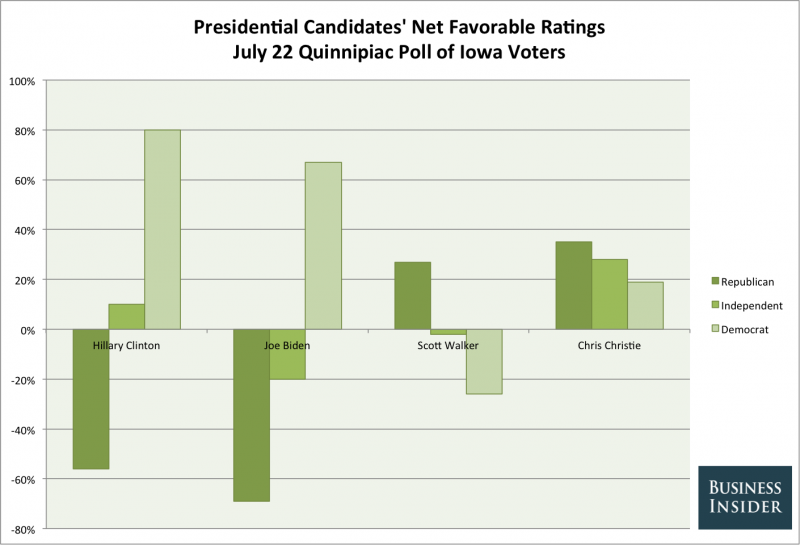
Favorables

Barro feels that Chris Christie is the GOP’s best bet for 2016:

If you’re a political party whose problem is that your appeal is not broad enough, nominating the candidate with broad appeal should be a no-brainer.

Christie is sure to face conservative resistance over substantive policy issues (like his acceptance of the Medicaid expansion) and stylistic ones (like his literal embrace of President Obama last October). But his actions that have antagonized conservative base voters are the same ones that allow Christie to maintain a broad appeal.

And Christie seems to be sufficiently conservative for the Republicans who follow his governing actions most closely. Ninety-six percent of Republicans in New Jersey approve of the job he’s doing as Governor, according to a June Quinnipiac poll.

Yglesias doubts that Christie could run successfully as a moderate. He notes the last two GOP nominees could have touted their moderate credentials:

[C]ompared to their major rivals both Mitt Romney and John McCain were the moderates in the field. But while both Romney and McCain had some major moments of moderation in their records, they didn’t have any moderation in their platforms as presidential candidates. The deal struck by party leaders in both cases was basically we’ll overlook a record of heterodoxy in exchange for clear indications that you plan to govern in a totally orthodox manner. It would have been child’s play for Romney to draw a contrast between the pragmatic, ideologically flexible, “get things done” approach he took as Governor of Massachusetts and the uncompromising conservatism and obstructionism of the hideously unpopular Boehner/McConnell GOP but Romney chose not to draw that contrast because despite Romney’s personal record the Romney operation was founded on orthodoxy.

Meanwhile, Kornacki points out that, should he run, Christie would face a tough choice over whether to remain governor or not:

If the polls are right and Chris Christie wins a lopsided reelection victory this fall, it will put the New Jersey governor in position to seek the presidency in 2016. That’s the conventional wisdom, at least, and there’s plenty to be said for it. After all, by racking up a big margin in a deeply blue state, Christie would be making a powerful statement to Republicans across the country about his electability.

What’s not getting much attention is the flip-side: the severe consequences that winning a second term as governor could have for Christie’s ability to raise money for a national campaign – and the possibility that he might be compelled to resign his office during his second term if he’s going to seek the White House.

Egypt’s Inbetweeners

Steven A. Cook offers the pros and cons of the new interim government:

There are reasons to like the transition that [interim President Adly] Mansour and the Supreme Council of the Armed Forces (SCAF) have set up, notably its sequence. The generals have put constitutional revisions before parliamentary and presidential elections, which will avoid the destabilizing politics that occurred during the transition from Mubarak to Morsi, when Egyptians voted for a parliament and a president whose responsibilities had yet to be enumerated. Once elected, politicians sought to maximize their powers and, in turn, enshrine their prerogative in a new constitution. Even so, there is an undeniable flaw at the heart of the new process — it does not match the politics of the moment.

Egypt’s new cabinet is an emblem of that problem. It is a transitional body intended to guide Egypt for a mere nine months, yet it took two weeks of navigating a thicket of competing personalities, with axes to grind and conflicting worldviews, to put together. The result is far from stellar. It is basically a collection of retreads with backgrounds in the transitional cabinets of Essam Sharaf (prime minister between March and November 2011) and Kemal Ganzouri (prime minister between December 2011 and August 2012), as well as a group of second-rung Mubarak officials. This means that, collectively, Egypt’s new leaders have nothing to show in the way of accomplishments during their previous stints of service.

Recent Dish on Egypt here and here.

The Capitulation Of Samantha Power

Senate Committee Holds Nomination Hearing For Samantha Power To Become United Nations Representative

In totalitarian states, it is not unusual to see public officials mouth official slogans and mantras that they do not fully believe in. It’s part of the kabuki dance required to maintain the status quo ideology that undergirds the entire polity. In democracies, there is, of course, no threat of physical coercion or imprisonment or torture or assassination if someone actually speaks truth to power, or simply speaks their mind. There is merely a reverse impulse against truth-telling: ambition. And since Robert Bork testified honestly in front of the Senate, and was effectively hounded from smeared by Ted Kennedy for doing so, no appointee has said anything but the minimal amount of horseshit to survive the process. Nomination hearings are a farce, an orchestrated dance of deception and banality, signifying nothing but grease on the political pole.

And so it’s as unsurprising as it is repellent to read Samantha Power’s testimony yesterday, in which she basically said anything she thought she needed to get approved, regardless of her past views, worldview, passion and intelligence. In that eternal contest between ambition and principles, there was, it turns out, no contest. Just capitulation to the powers that be. The main threat was from the neocons:

Mort Klein, head of the Zionist Organization of America, the nation’s oldest pro-Israel group, said he opposes Power’s appointment based on a 2002 comment she made suggesting the U.S. stop spending money on the Israeli military and instead invest billions of dollars in a new Palestinian state. Power recommended the U.S. send “a mammoth protection force” in order to create a “military presence” in Israel and rationalized that the move would alienate a powerful pro-Israel lobby in the U.S. which she referred to as “a domestic constituency of tremendous political and financial import.”

Yet yesterday, she all but sounded like a member of Netanyahu’s cabinet. David Rieff is as dismayed as I am:

Hers was, to put it mildly, a supremely chameleon-like performance.

In addressing Wyoming senator John Barrasso’s anxieties about recent UN efforts to forge a treaty on the international trade in small arms and the effect it might have on the virtually unfettered right of U.S. citizens to own rifles and pistols, Power was quick to concur that the Second Amendment was sacrosanct. On Israel, about which in some of her earlier journalism she had been somewhat critical, Power’s testimony was, to the senators’ evident satisfaction, so stridently one-sided as to be almost wholly indistinguishable from the talking points of Israeli diplomats.

Her prepared statement emphasized the United States had “no greater friend in the world than the State of Israel,” when a more clear-eyed assessment surely would be that it is the other way around. And she went on to say that addressing the “disproportionate” critical focus on Israel would be a central priority for her. Later, in an answer to a question, Power opined that the real reason Israel is so often singled out for such criticism at the UN is because “50 percent of the countries [there] are not democratic.”

Who came up with that? Charles Krauthammer? Bill Kristol? But it was what Rand Paul rightly called non-responsive responses that stick in the throat. Rieff again:

Power conceded at the hearing that her “perspective” on a number of important questions had been changed by “serving in the executive branch.” But whatever her real views now are, they were nowhere in evidence either in her prepared statement or in her responses to senators’ questions.

Senate hearings are, effectively, a tragicomedy of vacuity. But boy, did Samantha Power know her part well.

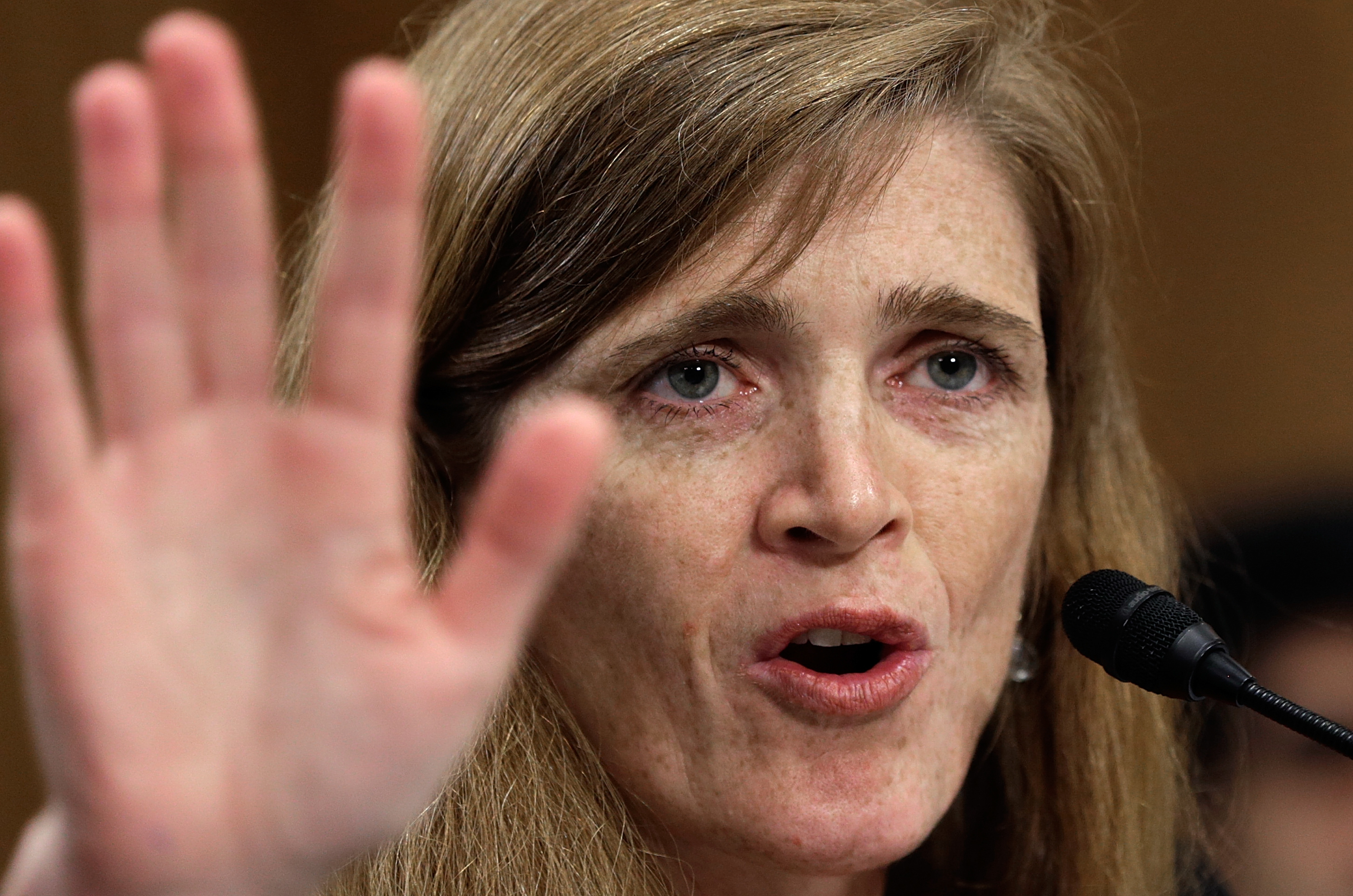
(Photo: Samantha Power, the nominee to be the U.S. representative to the United Nations, testifies before the Senate Foreign Relations Committee on July 17, 2013. Power has received broad bipartisan support for her nomination. By Win McNamee/Getty Images)

Breaking: Man Gets Off Online

Anthony Weiner Holds Press Conference As New Sexting Evidence Emerges

It’s worth noting, I think, that yesterday, a little before before the new Weiner “news” broke, we had a post that explored online dating and hook-ups. For increasing numbers of people, this is their primary arena for sexual flirting, dirty-talk, “selfies”, fantasy, and – much more rarely – actual sex. As Ross Douthat noted, this trend is not a gradual one:

College has also dipped since 2000 as a place to meet, but only modestly; bars and restaurants have ticked upward, and the internet, predictably, has exploded.

With countless interactive hook-up sites, and ever more apps that combine sexting with GPS, a huge proportion of the current and future generations will have sent pics of their boobs or butts or junk as a form of sexual play, fantasy, virtual interactive pornography, and, to a lesser extent, getting laid. That’s simply the reality. Humans are sexual beings, and given a new obsessive-compulsive toy to play with, the Internet, their first instinct was to see how they could use it to get off. Porn and virtual sex sites not only power the web, they helped create it.

I see nothing here that any sane society would try to stop or regulate. Men are more prone to this instant, impulsive, fantasy-driven sexual gratification (testosterone is a powerful drug), but women are also involved. And if you display every detail of every sext-chat in public, both parties will be as embarrassed as if someone had taped the sex talk in their bedroom and broadcast it on the radio.

But embarrassment is not shame. And as long as both parties are adults acting consensually – and in virtual space, no coercion is really possible – I fail to see any scandal. In fact, I see it as a way to blow off steam, without the risk of STDs or pregnancy. It can indeed distort one’s view of sexuality; it can objectify people with ruthless efficiency; it can make actual sex more difficult (see our NO-FAP thread). But it’s nothing different than another arena for us to court, display and preen our sexual selves. It was ever thus.

Obviously, running for mayor of New York City exponentially increases the risk of exposure and embarrassment.

But even then, for any married man, the core ethical question, it seems to me, is whether the behavior is with his spouse’s awareness and consent – or not. As I’ve argued before, couples should be allowed some flexibility in managing their marriages, as they see fit. No one outside a marriage can fully know what’s in it, or what makes it work. For my part, I favor maximal privacy for all married couples in navigating the shoals of sex and life online and off.

Monogamous, monogamish, and open relationships are all up to the couples themselves and all have risks and advantages. But ultimately it is up to the spouse to decide if there has been a transgression or not, and whether to forgive and move forward or not. The truly awful spectacle yesterday was seeing Huma Abedin being forced to undergo another public humiliation as the price for her husband’s public career. But she clearly stated she was not abandoning her husband. And for me, as for us, that should close the matter.

And let’s be clear, there is no victim here. A flirty, horny 22-year-old who talks a great sex game is not a victim. She’s a player – and good for her. This nonsense about her being “immature” and Weiner being “predatory” is belied by the facts. She knew he was married when she sexted him and he returned the favors. The only salient question is whether, having lied in the first place about sexting, Weiner was caught deceiving the public again by claiming he had stopped sexting and re-built his marriage, while the compulsion was clearly not over. That’s a question of public trust, and there’s little doubt that Weiner has squandered it. On the question of lying, the NYT’s harrumph this morning is a valid one. Once a politician has deceived people, he gets a second chance. When he deceives them a second time on the same issue, he loses whatever public trust he might have hoped for.

But I see no reason why that trust should not be tested where it should be: at the ballot box. Weiner should not, er, withdraw prematurely. He should do us all a favor, if his wife agrees, and plow on until we can all smoke a collective cigarette. In this new Internet Age someone has to be the person who makes sexting not an excludable characteristic for public office. If it becomes one, then the range of representatives we can choose from in the future and present will be very, very different in experience and background than the people they are supposed to represent.

And so I’m more than sympathetic to Amanda Hess’s yawns:

What would the American public find if it combed through all of your Facebook messages, Twitter DMs, and Gchat history? If it had an exclusive peek into your webcam, or could scroll through your iPhone pics at will? This great nation is littered with hard drives full of poorly lit topless pics, broken promises to former lovers, and messages that sounded sexy at the time but look very stupid now. Anthony Weiner’s sexts don’t make him look like a sexual predator or even a freak. They make him look very, very ordinary.

Ambers has mixed feelings:

It wouldn’t bother me if Weiner continued to sext after his resignation so long as he admitted that, to him, such behavior was not immoral, not wrong, and not a violation of whatever boundaries he and Huma Abedin have set for their marriage. Also, discreet. He had to be discreet. Instead, he insists that the behavior is wrong, that he learned his lesson, and that his wife has forgiven him. What lessons has he learned? Not clear.

Ambers is right about the core contradiction. Weiner’s concession that he did something wrong – when he never had sex with anyone other than his wife – undermines his entire position. He’s also shrewd to home in on the way in which Weiner used his public persona for sexual power. This was not sexting anonymously with strangers for fantasy and fun. It was sexting liberal activists who get turned on by healthcare reform (poor dears). Hence the ethical issue:

It’s unseemly that he seemed to promise his paramour a blogging job in exchange for getting rid of the incriminating messages, which surely must have signaled to her the enormous power that she held over him. That a potential mayor is willing to put himself in this position, a position where he basically plea-bargains against blackmail, is a strike against his competence.

It sure is. But let’s not pre-empt this. Let’s recall that Weiner, unlike Eliot Spitzer, committed no crime, and had sex with no-one but his wife. It seems absurd that the one with actual, serious transgressions should sail through, via cable TV news, to public life again and the other, whose sin is primarily online flirting, should be ritually drummed out of a race.

The future of Weiner’s marriage and career is in the hands of his wife and the voting public, respectively. One has made her choice. Let the people, with all the facts at their disposal, make the second.

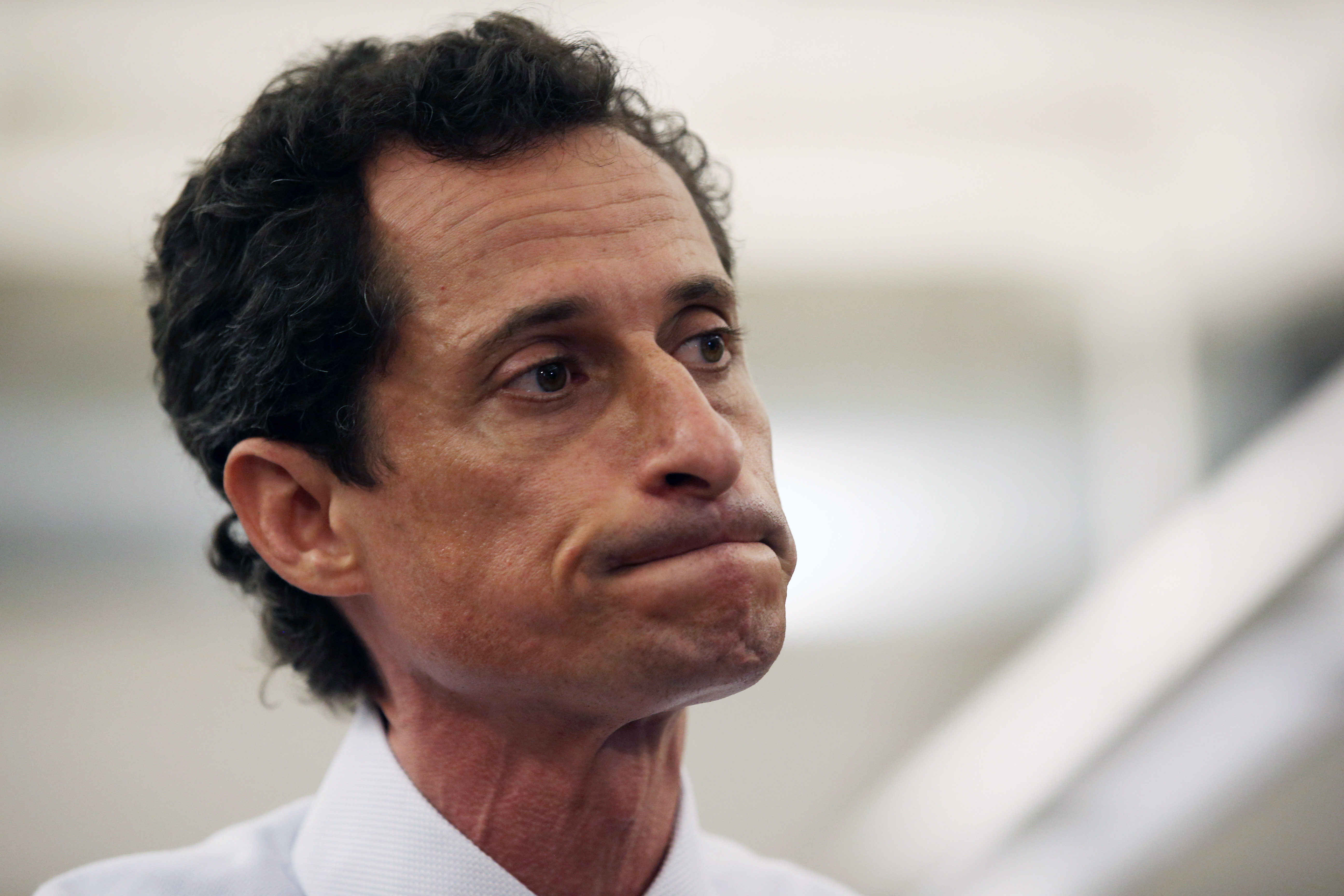
(Photo: Anthony Weiner, a leading candidate for New York City mayor, stands with his wife Huma Abedin during a press conference on July 23, 2013 in New York City. By John Moore/Getty Images.)

It’s Not Racist … Ctd

Conor Friedersdorf spots a “glaring contradiction” between Victor Davis Hanson’s opposition to affirmative action and his support for racial profiling:

I don’t fault Hanson for opposing affirmative action (though I reject large chunks of his rhetoric on race). I nevertheless find it perverse that he insists on the scrupulous treatment of young black males as individuals anytime they would benefit from group preferences, and then, when they’d most benefit from being treated as individuals rather than dark-skinned objects of suspicion, he prejudges all young black males based on statistics about the racial group to which they belong.

For Hanson, it is a miscarriage of justice worth lamenting if an Asian American applicant to UC Berkeley loses a spot to a black applicant due to racial preferences. And perhaps that is an injustice. Maybe the Asian American is the child of an impoverished family of Hmong refugees and the black applicant is the president’s daughter. What is the likely result of that injustice? The Asian American applicant must attend UCLA or UCI.

What are the consequences of racial-profiling, the form of individuality-effacement Hanson defends? Countless innocent black men — that is to say, the vast majority who will never rob or assault anyone — walking around under constant, unjust suspicion from fellow citizens and law enforcement; racial tension heightened in America; prejudice passed down across generations; and some innocent blacks killed while under wrongful suspicion. Opining on affirmative action, Hanson wrote, “It is well past time to move on and to see people as just people.”

He should take his own advice.