
Cameron’s Online Porn Crackdown

Cameron And Theresa May Visit Hertfordshire After Results Show A Reduction In Crime In The UK

On Monday, while Brits were enthralled with the new royal baby, the prime minister unveiled a sweeping anti-porn campaign requiring citizens to tell their ISPs if they want to look at dirty pictures. Oliver Wright reports:

Under his proposals, by the end of next year all households will have to “opt out” of automatic porn filters, which would come as standard with internet broadband and cover all devices in a house. Possession of the most extreme forms of adult pornography will become an offence, while online content will have the same restrictions as DVDs sold in sex shops. To tackle child abuse images, search engines have been told they will have to redact results from specific searches, while anyone accessing websites shut down by the police for containing such images will see a message warning them that what they were doing was illegal.

Cracking down on child porn is critical of course, but there are a lot of problems with the PM’s plan. For one, not even Cameron seems to know what it entails:

Mr Cameron said he did not “believe” written pornography, such as erotic novel Fifty Shades of Grey, would be blocked under the plans. But he added: “It will depend on how the filters work.” … He then added: “I’m not saying we’ve thought of everything and there will be many problems down the line as we deal with this, but we’re trying to crunch through these problems and work out what you can do and can’t do.”

Loz Blain highlights the potential for abuse:

The very fact that your web will effectively be censored unless you specifically ask your provider for access to porn raises all sorts of issues. For starters, the famous British gutter press will be delighted to reveal the names of famous people who have asked for the filter to be disabled. Somewhere, there will be a very useful list of people who are porn users, and one day it will leak.

And many of them, if the past is any guide, will be the most uptight Tory MPs. What’s more, some parts of the plan seem designed to apply to the web of yesteryear. For example, Cameron said that Google has a “moral duty” to “blacklist” certain words. David Nosowitz pounces:

This is absurdly, insultingly presumptuous. A prime minister is demanding a foreign corporation kowtow to his demands and implement a childishly naive proposal based on his own showy morality. …

Many of the illegal corners of the internet aren’t indexed by Google, anyway. Try searching for child porn right now; you won’t find any. Try searching for an online store that’ll mail you heroin. You won’t find that, either. But both exist, and you will find news stories or forums about both that can lead you there. Discussion of illegal activities isn’t illegal, but makes any indexing restriction on Google pretty much worthless.

A former head of the Child Exploitation and Online Protection Center, Jim Gamble, raised the same point:

Gamble said Mr. Cameron’s plan to tackle child abuse images by removing results from search engines like Google would be “laughed at” by pedophiles. “There are 50,000 predators … downloading abusive images on peer-to-peer, not from Google,” he said. “Yet from CEOP intelligence only 192 were arrested last year. That’s simply not good enough. We’ve got to attack the root cause, invest with new money, real investment in child protection teams, victim support and policing on the ground. Let’s create a real deterrent. Not a pop-up that pedophiles will laugh at.”

And of course civil libertarians aren’t thrilled:

Jim Killock, from the Open Rights Group, said Cameron’s plan was not only bound to fail but also sets a dangerous precedent of government intervention when it comes to freedom of expression and access to information. “I’m not sure censorship is ever the answer,” he said. “It’s a shocking attempt to claim the moral high ground. … I don’t think he fully understands what he is proposing.”

Meanwhile, Leo Mirani hasn’t missed the irony that a British tabloid is one of the initiative’s few supporters:

[Cameron] may be trying to appease the highly influential right-wing British newspaper, The Daily Mail, which has been running a campaign against online porn for months. The prime minister released his speech to the paper a day in advance. In its coverage of the speech, the paper quotes Cameron as saying, “The Daily Mail has campaigned hard to make internet search engine filters ‘default on.’ Today they can declare that campaign a success.” Yet the Daily Mail has built the world’s most trafficked news website largely on the basis of pictures of celebrities in various stages of undress. Considering the unpredictable and overly enthusiastic nature of filtering algorithms, it is not inconceivable that the Daily Mail may find itself a victim of its own success.

Well, that would be too delicious an irony, wouldn’t it?

(Photo: PC Kris Seward shows the Prime Minister David Cameron the mobile device as he visits community police in Hertfordshire on July 17, 2013 in Cheshunt, England. Cameron was observing the their new crime prevention initiatives, including targeted CCTV and a new PC based mobile device. By Paul Rogers – WPA Pool/Getty Images)

The South vs Social Mobility, Ctd

Al-Ga-Ms-SC-1

The popular thread continues: A reader points to this analysis of how ancient “black soil” helped make the South (Cretaceous rock units -139-65 million years old – are shown in shades of green. Older rock units are in gray, younger ones in yellow):

During the Cretaceous era, 139-65 million years ago, shallow seas covered much of the southern United States. These tropical waters were productive–giving rise to tiny marine plankton with carbonate skeletons which overtime accumulated into massive chalk formations. The chalk, both alkaline and porous, led to fertile and well-drained soils in a band, mirroring that ancient coastline and stretching across the now much drier South. This arc of rich and dark soils in Alabama has long been known as the Black Belt.

But many, including Booker T. Washington, co-opted the term to refer to the entire Southern band. Washington wrote in his 1901 autobiography, Up from Slavery, “The term was first used to designate a part of the country which was distinguished by the color of the soil. The part of the country possessing this thick, dark, and naturally rich soil …” Over time this rich soil produced an amazingly productive agricultural region, especially for cotton. In 1859 alone a harvest of over 4,000 cotton bales was not uncommon within the belt. And yet, just tens of miles north or south this harvest was rare. Of course this level of cotton production required extensive labor …

Another:

Your reader’s email providing “answers” on the South and social mobility leaves me with questions. “Where can someone right out of high school rise to a six figure income right away without working on an oil rig?” I’m not sure, but I am highly skeptical that the answer is “natural gas”. First off, a lot of these jobs being created in energy and natural gas in particular are not the sort of jobs you get right out of high school. Second, here are some salaries for available natural gas jobs in the Keystone state from a quick Google search (from Indeed.com):

338 available jobs making $30,000+
218 making $50,000+
105 making $70,000+
39 making $90,000+
and only 13 making $110,000+

Finally, even if there are a ton of great jobs waiting for any high-school grad, this article from Philly.com puts the total employment picture into perspective:

Even if shale-gas development has created 245,000 direct and indirect jobs – the number used by the Pennsylvania Department of Labor and Industry, and touted by industry trade groups – that still amounts to only 4 percent of total employment in a state with 5.7 million jobs.

(As an aside, it’s also worth noting that most energy analysts, and the President of the United States, recognize that in reality natural gas will almost certainly benefit MORE from efforts to address global warming – with or without fracking – than any other energy source.)

Maybe I’m wrong, and digging something out of the ground is a better route to economic mobility than cultivating a creative skill-set that provides unique, real-world value. I remain, however, unconvinced.

Another:

I had the opportunity to reflect on your thread this morning, as I left the interstate in a torrential downpour, and instead commuted to downtown Memphis via US-51, in a route that took me through the Whitehaven suburb of Memphis, directly past Graceland. I’ve lived in the Memphis area my entire life, and I can remember the same area in the early 1980s, when it was a much whiter and more affluent area. I also have been witness to the slow decline over the past decades, and this morning spent the ride dodging flash flooding and reflecting on the white flight that has occurred in Memphis, juxtaposed against the maps showing relative social mobility.

The problem isn’t the lack of social mobility, in my mind. The problem is that the post-civil rights area resulted in the mass migration of the affluent away from those who were already destitute. In so doing, the entire economic base that supported the region shifted, and further entrenched the already stagnant economics of the minorities left behind while geographically consolidating the economic fortunes of the better off. There are abandoned factories and businesses, and crumbling schools all over this area, along with the scavenger pawn shops and dollar stores that moved in to fill some of the voids.

This, to me, is what I think of when I read about the lack of social mobility. Everything that might have contributed to mobility was simply relocated, and the skeletons left to rot.

Smoking Bans And Hazy Science

Arthur Caplan points to a recent study suggesting that the health reasons for outdoor smoking bans aren’t backed up by strong data:

In getting these bans enacted three justifications were used: Smoking on beaches and in parks posed a health hazard to nonsmokers, especially children; cigarette butts were toxic to humans and animals and constituted an unacceptable form of litter; and public smoking by adults provided a dangerous model that threatened the future well-being of children and adolescents.

The problem is that the scientific evidence supporting each of these arguments is exceedingly weak. Consider the comments of some of the toughest anti-smoking groups in the nation about the best rationale for bans–the hazards of smoking in public to others. An official of the American Lung Association, concerned that efforts to ban smoking on beaches and in parks might deflect attention from more effective public health interventions, told [study authors Ronald Bayer and Kathleen E. Bachynski] in an interview, “I don’t think we should be making claims that are not supported by the data. If you try to tie it [banning smoking on beaches and in parks] to a health outcome, that’s where you get in trouble.”  A representative of the Campaign for Tobacco-Free Kids was even more direct in another interview: “There is not a lot of science around outdoor smoking bans…. There is some science, but you have to be very close to the smoke in an outdoor setting…. The last thing we want to do is put our credibility on the line with regard to the science.”

Where Is The Midwest? Ctd

A reader writes:

Your reader says that Pittsburgh cannot count as an East Coast city because it is 7+ hours from the coast. Then please explain to me why it belongs in the same region as Chicago (8 hours from Pittsburgh); Des Moines, IA (12); Lincoln, NE (14); and Rapid City, SD (19). Granted, the distance from Wilmington, NC to Shreveport, LA is a solid 14 hours, and no one thinks that North Carolina and Louisiana are in wildly different regions. I just get riled because frequently people from the East Coast actually have no idea how huge this country is, and make flippant statements like “Pittsburgh is too far from the coast so lump it in with the flyovers.” America is vast, and contains multitudes. Explore!

Another reader:

I was born and raised in the Midwest and lived in various states for 40 years, and it never ceases to amaze me how people conflate anything that’s not East Coast as Midwest. While I love my East Coast brethren, they are profoundly ignorant of the geography of this country. Pittsburgh is about as Midwestern as San Francisco. Wyoming in the Midwest? Huh?

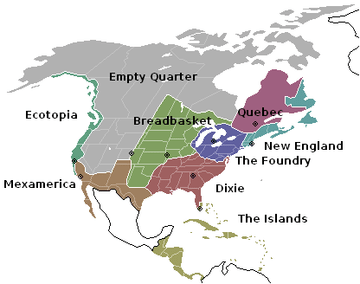
I have one very simple rule: if it’s in the 360px-NinenationsEastern Standard Time Zone, it’s not Midwest. To extend it, there are only a few tiny portions in Mountain Time that are Midwestern. Broadly speaking, there are two basic parts of the Midwest: the Great Lakes region and the Great Plains region. They may look similar to someone sitting in DC or New York, but they are different culturally, topographically and politically. But the best map and definition that’s ever been written to date is still Joel Garreau’s Nine Nations of North America. Garreau really nailed the specific differences and demarcation points (though I would lobby for an additional “nation” that picks up the Scandinavian quality of the people in the Upper Midwest into Canada).

Another:

Here’s a definition from a born-and-raised Midwesterner who often drives to its outer reaches: Midwest = Germans + Grids + Gardens

Germans: On this map of ethnic ancestry from the 2000 census, there’s a broad swath of German-plurality counties starting from central New York, through Pennsylvania stretching westward to the Rockies and beyond. Germans help define the southern border of the Midwest (though stray Finnish, Dutch and African-American counties are certainly Midwestern as well). Germans heavily influenced Midwestern architecture, food, religion, and its devotion to public education.  The “American” cultures of Kentucky and southern Missouri are southern – the accents change, Baptists predominate, and so does the food (it gets better down South, but that’s not Paula Deen’s doing). But not all German areas are Midwestern, so a limit to this is:

Grids. A central man-made feature of the Midwest is its grid pattern, which, thanks to the Land Ordinance of 1785 and Glaciation, stretches from south of Cleveland toward Cincinnati, and then west to the Rockies, defining the eastern and southern borders of the region. There are a few pockets where “queer” roads must follow the hills, such as around Bloomington, Indiana, or Athens, Ohio, or in the Ozarks. Those areas are on the fringes of the Midwest. Driving a Detroit-made sedan or pick-up truck down a straight state highway is a Midwestern rite of passage. So straight roads and flatlands (not Appalachian or Ozark zomias) help define the Midwest. This grid was made possible in part by Glaciation, which covered the land with very fertile soil. So the last characteristic is:

Gardens. (I couldn’t find a better synonym for farms that maintained the alliteration.) Anywhere that farming occurs on a wide scale and without irrigation is Midwestern, which defines the western border from about Joplin, Missouri, northward to Topeka, Lincoln continuing to just west of Fargo. Northern Michigan and Wisconsin are also peripherally Midwestern, and I suspect residents of those regions agree, though I can’t speak to northern Minnesota.

Putting this all together, Germans, Grids and Gardens means the Midwest begins in Downtown Cleveland, south to about Athens, Ohio, then west about Cape Girardeau, Missouri, with a bump up I-55 to St. Louis, and back down I-44 to Joplin, then north to Topeka, Lincoln, west of Fargo, to Canada.

Update from a reader:

Was that “born-and-raised Midwesterner” really suggesting that the defining characteristic of the Midwest is that it’s GGG?

Heh. One more reader:

There’s a historic line of demarcation that cuts right through some of the most contentious 100thmeridianstates. The 100th meridian quite accurately separates the lower-lying, well-watered eastern half of the Great Plains from the high-country, arid western half. Rainfall drops from two feet to a foot at the meridian; altitude crosses from under to above 2000 feet. In the past, east of the 100th was lush tallgrass prairie; west, sunburned shortgrass. Today, in the east, Mother Nature does a lot of the irrigating; in the west, farmers pump the aquifers and cosset every drop of rain. East is dairy cows; west is steers raised for beef.

See where the U.S. highway system goes from a dense mesh to a loose net on this map? That’s the 100th meridian, and those roads speak volumes about the human population density on either side of it. Much has been written about the meridian – Wallace Stegner’s biography of John Wesley Powell is named for it, for example – and it remains meaningful to the regional culture today, as this 2011 article from the Pierre, South Dakota Capital Journal notes. I’d suggest that it’s what really divides the Midwest – a green and pleasant, neighbors-and-towns land – from the brown and solitary West.

It’s Not Racist …

… if you tell your children to be wary of all young black males they might meet:

The advice was not about race per se, but instead about the tendency of males of one particular age and race to commit an inordinate amount of violent crime.

It was after some first-hand episodes with young African-American males that I offered a similar lecture to my own son. The advice was born out of experience rather than subjective stereotyping. When I was a graduate student living in East Palo Alto, two adult black males once tried to break through the door of my apartment — while I was in it. On a second occasion, four black males attempted to steal my bicycle — while I was on it. I could cite three more examples that more or less conform to the same apprehensions once expressed by a younger Jesse Jackson. Regrettably, I expect that my son already has his own warnings prepared to pass on to his own future children.

That’s the gist of Victor Davis Hanson’s new piece in National Review. All young black men are guilty until proven innocent – a sentiment with which New York’s chief cop apparently agrees (especially if he can gussy up his racial profiling with minor pot possession, thus making the future of any young black male that little bit harder). I don’t think anyone in this debate, including the president, has denied the disproportionate amount of crime committed by young black men (primarily against other young black men). The question is how we should personally deal with that fact while living in a multiracial society. Treating random strangers as inherently dangerous because of their age, gender and skin color is a choice to champion fear over reason, a decision to embrace easy racism over any attempt to overcome it.

It’s also spectacularly stupid.

I can fully understand and appreciate TNC’s incandescent, yet reasoned, rage at the piece. Do yourself a favor and read it in full. But Ta-Nehisi’s core point is that making such blanket warnings about an entire group of human beings is just dumb if you actually care about the safety of your kids. It puts the race/gender/age category before all other obvious contexts: neighborhood, street, school, college, inner city, distant suburb, daytime, night, crowded places, dark streets, and the actual observed behavior of the young black man. As TNC notes:

This is the kind of advice which betrays a greater interest in maintaining one’s worldview than in maintaining one’s safety.

Indeed. And what ever else may be said about Victor Davis Hanson, he is far from stupid.

The interesting question to me is how this sentiment is different from that of John Derbyshire, who wrote almost the exact same column as Victor Davis Hanson did a little over a year earlier, framed around exactly the same trope – mocking the “Talk” parents give to African-American boys by explaining the “Talk” non-black parents give to non-black kids. Derbyshire’s rant was in a different magazine, but he was still fired from National Review for it. The difference is that Derbyshire tells his children to avoid all “blacks”, while Hanson focuses on advising his children solely about young black men. Any young black men they don’t know.

Is that the distinction National Review will now cling to as the acceptable face of prejudice?

(Thumbnail image: Screencap from The Hunted And The Hated)

Life In The Fast-Pass Lane

While visiting an amusement park, McArdle bought a fast pass that allowed her to jump the line, but she was put off by the attitude of some of her fellow fast-passers:

The real problem with fast passes isn’t that they allow a tiny number of people to jump the queue; it’s that those people start feeling that they should never have to mingle with the people who don’t have the passes. They act like entitled jerks who have the right to shove everyone else out of the way.

Her broader point:

[M]ore people are living a fast pass Life. Getting a special queue with special service isn’t a rare treat, something to indulge in on your first vacation in three years. It’s a permanent condition.

Jump the security queue at the airport because you’re a frequent flyer. Walk straight into your rental car because you’re a Hertz#1 Club Gold member. Don’t like the kids your children are hanging around with? Push them into an elite program, or buy a house in a more exclusive school district. Join a gated community so the wrong people can’t even walk near you.

The economic elite used to just buy more of the things we all enjoyed. Now they have access to a different set of experiences entirely. No, that’s not quite true — of course the rich used to be able to afford better vacations and nicer cars. But increasingly they’re enjoying an exclusive version of the things we all do — right there in front of us, where we can resent them for it.

Joyner adds:

I’m not sure how one gets around the “entitlement” problem. Rich people have always had ways to avoid the worst aspects of life but, as the divide between the rich and everyone else widens, they’re able to buy their way out of more of them.

Sometimes Pink Is Just A Color

Alice Dreger, a professor of bioethics, revised her views on gender dysphoria after receiving a letter from a mother of a “pink boy” – one “whose manner of play and dress has often tended toward what’s common in girls”:

The approach I called “therapeutic” seeks to see a child’s gender dysphoria evaporate, if at all possible. This typically involves strictly limiting the child’s access to gender-atypical activities and trying to help the child adjust to fit a social environment that (supposedly) requires gender divisions. It also often involves family therapy. Though it would seem to promise to make a child more comfortable with his body, there’s very little data that the therapeutic approach “works.” Moreover, the proponents of it have tended to be obsessed with measuring outcomes in terms of ultimate gender identity and sexual orientation rather than ultimate well-being, which surely is what should really matter.

By contrast, the approach I called “accommodating” seeks to prepare the gender dysphoric child for a transgendered life—a life that will ultimately involve hormonal and surgical sex change. Though it seems superficially more gender progressive, the problem I have with this approach is that it may end up sending more children down a high-medical-intervention path than is really necessary to maximize well-being in the population of children who go through gender dysphoria.

“You’ve done a good job of outlining the warring factions,” Sarah told me. But, she added, “I think that there is a third, quieter point of view:

the perspective that, sure, transgender kids exist, but really, most of these gender-nonconforming kids are just kids who don’t fall to the most-masculine or most-feminine ends of the spectrum, and that’s okay. They don’t need treatment, they don’t need sexual reassignment, they just need a supportive home life, schools with anti-bullying protocols, and therapy for any harassment they face for being different.”

I felt kind of stupid reading Sarah’s message, because I realized that I had, in fact, left out this approach. I had targeted my article to parents who report that their male children are insisting they are girls or that their female children are insisting they are boys. But the truth is, as Sarah was suggesting, that a lot of “gender nonconforming” kids don’t have a simple story of being “trapped in the wrong body.” They are expressing more subtle, more complex, and more varied messages of self. What they need isn’t therapy; what they need is to know that it’s OK to be gender non-conforming. It’s perfectly OK be a male who has feminine-typical interests, behaviors, and desires, or a female who has masculine-typical interests, behaviors, and desires.

(Video: A father tells the story of his “pink boy” wanting a pink bicycle.)

The Future Of Education Is Experiencing Technical Difficulties

San Jose State University has put its massive open online course (MOOC) project on hold because more than half the students in the pilot program failed their online courses, with pass rates for some classes as low as 20 percent.  George Anders suggests that Silicon Valley philosophies don’t translate well into higher education:

Lots of Silicon Valley startups try to make a virtue out of a hit-and-miss approach to product development. It’s common for software companies, in particular, to bring not-quite-proven ideas to market in a hurry, so they can be rapidly refined or quietly kicked aside as public feedback comes in.

This approach, known as “failing fast,” is admired and celebrated in tech circles, where it’s seen as a way to speed up innovation. But education may turn out to be a fiercer, more unforgiving domain.

After all, major universities have spent decades—even centuries—building their reputations. It’s vital that they be seen as having students’ best interests at heart. It’s unlikely that other schools will want to risk the stumbles of San Jose State’s  pilot program. The likely result: schools will put pressure on MOOC developers to do whatever it takes to succeed slowly, rather than being in a hurry to fail fast.

Will Oremus wonders what will come next:

It’s a sure bet that somehow, at some point, online instruction will indeed reshape higher education, if perhaps in more modest ways than its most ardent backers assume. Missteps are part of the process. Still, this is not the first heavily hyped online-learning venture to make headlines for going dramatically awry. The question is, what university will be eager to offer up its students as the next lab rats in what amounts to a massive pedagogical R&D program by for-profit Silicon Valley startups?

Where We Meet Our Mates

Douthat notes that fewer and fewer Americans are marrying fellow churchgoers or neighbors. More and more are meeting online:

[T]he data on unions formed online looks pretty encouraging, and it’s possible that the internet is helping to compensate for the eclipse of other forms of community, rather than contributing directly to those other forms’ eclipse.

But it seems fair to assume that there are still a lot of people who would prefer to meet their future spouse the old fashioned way — through initial flesh-and-blood encounters embedded in a larger pre-existing social network. If that’s your preference, the university campus is one of the few flesh-and-blood arenas that seems to be holding its own as a place to form lasting attachments.

Millman expands on the possible social consequences of widespread online dating:

The hidden costs of internet dating aren’t some much to the romantic “market” as to the rest of society. How many young people don’t go to church or synagogue because there’s no reason to go there to meet marital prospects? And once that dynamic starts, it inevitably accelerates, as the residual group who does show up is increasingly untenable romantically (because they are there for other reasons – or can’t find an “adequate” mate digitally). Then there’s the problem that if you meet someone digitally, you’re probably meeting someone with a distinct social circle – as opposed to someone from within your own social world. That’s good if the relationship doesn’t work out – less risk of collateral damage. But it creates complications if the relationship results in marriage, as now you have two circles to navigate that don’t overlap well. That happens plenty if you meet in meatspace, of course, but it’s much more certain to happen if you meet digitally than if you meet, say, at church.

The South vs Social Mobility, Ctd

Screen Shot 2013-07-22 at 11.20.59 AM

Several readers have voiced skepticism over our coverage of this map and the accompanying piece from the NYT:

I would be interested to see that map compared to a map of “chances anyone in this county is an earner in the top fifth.” Some parts of the country simply have no or very few opportunities that earn at those levels, so it should be no surprise that you find few people “rise” to that level – with the inverse true for places like NYC, SF and Seattle. To study mobility, unobscured by regional differences in wealth, one would need to re-calibrate to the quintiles within each county, rather than comparing local samples to national averages.

Another reader:

Quite clearly the map shows (and the original paper makes clear) the importance of race, whether that be African-American or Native American. But this does not mean that somehow the Red States only care about taking care of their “white, GOP brethren,” as one reader implied. What does the data (pdf) from the paper say? Check out Table 5. Two of the best negative correlations with intergenerational mobility are the county’s rate of divorce and its share of single moms – two things that disproportionately affect African-Americans and Native Americans.

Utah, meanwhile, confounds your “two Americas” reading. Look at the blue area in Utah in the map you posted. This is because of Mormonism. Check out this blog post, for an interesting discussion on the similarities between Utah and Denmark, two places of high intergenerational mobility.

Another goes into much more detail on the previous points:

The graphs you’re presenting from the New York Times article are HIGHLY misleading.

First off, they look at social mobility without taking into account the regional differences in cost of living. From the chart: “The top 5th is equal to family income of more than $70,000 for the child by age 30, or more than $100,000 by age 45.” Anyone who’s anyone knows that living on $70,000 per year income on the Upper West Side of Manhattan is vastly different than living on $70,000 per year in the rural South.  In one place you are “poor” and the other you can live like a king.  I’ll gladly earn $65,000 and live in Tuscaloosa, Alabama vs. earning $75,000 and living on the Upper West Side of Manhattan. Yet, in one case I haven’t reached the top 5% of income earners while the other I have.  This is clearly not true in reality.

Without a cost of living adjustment, the data is essentially meaningless. Income tells you next to nothing. What you can buy with that income is what matters! And that varies greatly by region. The chart essentially tells you where the dollar is worth more and where it is worth less.

Secondly, look at the people presented in the article as the “poor” struggling to attain a middle-class lifestyle. Stacey Calvin is presented as a “poor” person struggling to enter the middle class in suburban Atlanta. She has three kids. Is a single mom. Works only part time. Yet, from the picture of her, has the latest in smartphone technology, a three-bedroom home, and remote-control cable television. She and her kids are wearing fashionable clothing. This is NOT the picture of someone mired in poverty.

The next example is Michael Novajovsky, who is an educated network engineer.  He is married, three kids, has a beautiful house (as far as one can tell from the picture), earns $27/hour for a temporary job. From his Facebook page, you can see he isn’t mired in poverty either.

Lastly, how about breaking the data down by zip code or neighborhood.  New York City is not homogenous.  It includes Harlem, the Upper West Side, etc.  Simply aggregating numbers of very different neighborhoods as one is highly misleading.  Especially compared to a place like Atlanta that is spread much further about geographically.

Another:

I happen to live in Atlanta and recognize the difficulty in getting from the south side of the metro Atlanta area to where jobs are located to the north side of the metro Atlanta area if you rely on public  transportation. However, I respectfully submit citing the NYT article in support of your contention “the South” (which I guess does not include Red State/low-tax Texas by your assessment of the NYT map) seems at times to be a different country is cherry picking items from the story. As evidenced by the map itself, the NYT reporter stated “Climbing the income ladder occurs less often in the Southeast and industrial Midwest, the data shows, with the odds notably low in Atlanta, Charlotte, Memphis, Raleigh, Indianapolis, Cincinnati and Columbus.Would be interested in your thoughts on why the same problem being present in the industrial Midwest fits with your interpretation of the article.

I think the map can bear many different interpretations. I focused on the obvious fact that race is a factor, and that the band in the South correlates very closely to slave-ownership patterns in the past. There may well be other explanations for other regions – but the Southern aspect is what immediately struck me, and, I’d say, anyone who looked at it. Update from a reader:

I wish you would stop saying that race explains the differences in social mobility found in the recent study.  The authors, in their summary of their findings (pdf), explicitly state that the differences remain after controlling for race.

Unfiltered feedback on our Facebook page.