Why Does Marijuana Prevent Diabetes And Obesity? Ctd

A reader adds anecdotal evidence to the research:

I’ve fought the weight battle my whole life.  Now I’m down 37 pounds and seem to be maintaining at that new level. One of the reasons is marijuana. I’ve dieted frequently over the last couple of decades but no matter what I did I couldn’t seem to push below 239. It was as if my body just said “Thus far, no further.” I was tired of losing the battle, and my doctor was warning that diabetes could be in my future, so I concluded that I needed to shake things up.  I began by swapping marijuana for alcohol.  I’m now at 223, no longer technically obese, though I could certainly lose a few more pounds.

What’s stranger, though, is how easily I’m maintaining at 223. In the past the regaining of weight began almost immediately post-diet. Yes, I’m being reasonably disciplined, but not very. I’m smoking a moderate amount of legal medical weed once a day, in the evening when the work is done and I know I won’t be driving – same rules I had for alcohol consumption.  So far so good.  Not only is my weight down but my pulse and blood pressure are those of a much younger, fitter man than I’ve ever been.  I almost feel as if I’m cheating.

No idea why it works.  But it seems to.

Update from a reader:

“No idea why it works”? I do. Not drinking is the easiest way to lose and keep weight off. I would argue it has nothing to do with he/she replaced it with. My four-pack turned into an eight-pack when I stopped drinking for a few months. I’m very fit and exercise regularly. Those last five pounds that I couldn’t lose before, gone. They creep back over time if I drink even though I’m not a big drinker, 1-2 drinks/per week. When people who see me with my shirt off ask how I did it I simply say I quit drinking. The most common reply is “oh, I could never do that”.

Another writes:

Your post on lower rates of obesity and diabetes in regular marijuana users doesn’t surprise me at all, especially since I have seen so many cases of cannabinoid hyperemesis syndrome (also known as the “anti-munchies”) in my patients over the last three years.  This condition is characterized by periodic cycles of abdominal pain and vomiting in frequent marijuana users, and many of them have had extensive and costly medical testing without any definitive results.

The only definitive relief comes from abstaining from cannabis, although there are several unusual features of the condition (patients state that their nausea and pain are relieved by hot showers or baths) that help in diagnosis.  The mechanism of this disorder may simply be due to the brain “pushing back” against a constant flood of cannabinoids in the blood, similarly to the way chronic alcoholics or opiate addicts will experience tolerance and then withdrawal to those particular drugs.  Not every regular marijuana user develops this condition, but perhaps increasing rates of the condition are contributing to an overall decrease in obesity rates in this population.

A doctor is skeptical of the research we posted:

In general, I get frustrated with general reporting of scientific data.  It’s unfortunate that most people who write these articles 1) don’t understand science or research and 2) don’t understand statistics. Unfortunately, many scientists themselves don’t understand statistics, since the vast minority actually have masters degrees in clinical epidemiology.

So, what we get is post that links to a recent epidemiological study and claims that the data supporting cannabis and weight loss “are clear.” In fact, the study you referenced tells us nothing of the sort (despite the author’s claims in the discussion).  The cohort sampled showed a direct overlap between patients who used tobacco and those who used marijuana.  I don’t care if the epidemiologists claim to be able to use fancy statistical methods to control for tobacco use, the fact is that they can’t actually do that.  All this study tells us is that there MAY be an association between cannabis and weight loss, but frankly drawing that conclusion is a stretch.


Importing Innovators

Charles Kenny finds evidence that the US has attracted more than its fair share of immigrant innovators:

[Carsten] Fink and his colleague Ernest Miguelez found that in 2010 about 10 percent of inventors worldwide lived outside their country of nationality when making their international patent application. The proportion of international patent applications made from the U.S. by non-nationals was twice as high—around 20 percent. That proportion approximately doubled from 1985 to 2010, and it’s the highest share out of any large economy. It compares with a non-national share of international patent applications of about 2 percent in Japan and closer to 5 percent in Germany and France.

The U.S. is by far the biggest global net beneficiary of innovator migration. Between 2001 and 2010, 14,893 inventors with U.K. nationality applied for international patents while residing in the U.S., for example. And there were three times as many Chinese inventors in the U.S. than British ones. That illustrates the U.S. has done particularly well in attracting innovative talent from the developing world—more than half of the U.S. non-national innovator population comes from countries outside the Organisation for Economic Co-operation and Development club of rich countries.

He goes on to worry about “more and more Indian and Chinese graduates of U.S. universities are returning home rather than dealing with the hassle of American immigration procedures.” Reihan isn’t as concerned.

Kerry’s “Fool’s Errand”?

Life Continues In The Havat Gilad, West Bank Outpost

Jeffrey Goldberg believes – surprise! – that Kerry getting Israelis and Palestinians to sit down for fresh negotiations is “a fool’s errand” and that “the collapse of these talks, which is almost inevitable, could have dangerous consequences.” Nevertheless, Goldberg gives Kerry advice:

Kerry is understood in Israel as a true friend; his lobbying could be effective. If the Israelis would take small, unilateral steps on settlements, they could change the Palestinian calculus and improve Israel’s reputation (which has become a genuine national-security concern). On the other side, Kerry might want to try a bit more aggressively to help the Palestinian Authority become a viable governing body with a functioning economy and a bureaucracy that is reasonably free of corruption. Strengthening the Palestinian Authority (and working to weaken Hamas) while cajoling the Israelis to wean themselves from their addiction to settlements are two steps Kerry could take to advance negotiations.

Addiction to settlements? As if it’s some kind of compulsion rather than a long-thought-out, relentlessly implemented strategy for territorial expansion. And how on earth is Netanyahu able to take “incremental steps” when Goldberg himself concedes in the same column that

the Jewish settlement movement on the West Bank is now the most powerful political force in Israel. This is a movement whose leaders and Knesset representatives and cabinet ministers will subvert any peace process that would lead to the dismantling of even a single settlement, including any of the dozens of well-populated ones far beyond Israel’s West Bank security barrier.

As for a viable, much less corrupt governing body on the West Bank, let me simply quote Leon Wieseltier (as slippery as Goldberg on this subject):

Nobody lifted a finger to help Salam Fayyad, who was the Palestinian leader we were all waiting for. No Palestinians and no Israelis. He came and went. It’s a historical scandal of the first magnitude.

(Notice that Wieseltier has to blame the Palestinians as well, for fear he might stumble onto the truth about the settlements and their centrality to the problem.) And yet Goldberg returns to a critique that could have been made in the 1990s. (And Wieseltier, of course, like the entire American Jewish Establishment, was one of those who didn’t lift a finger even on his keyboard when we had a chance for progress five years ago. He preferred to go an an anti-Semite hunt, which is his default position on everything.) Maysoon Zayid notes the deliberately weakened position of the Palestinian Authority:

[President Mahmoud] Abbas, who will decide the fate of the Palestinians if Kerry and the USA have their way, has been a lame duck for the past four years. … Simply put, he is no Yassir Arafat. Unless this agreement on a two-state solution includes a Palestine with the ’67 borders, East Jerusalem as its capital, and addresses water rights as well as the right of return, it will not fly with the average Palestinian on the street or in the camps.

Yuval Diskin, former director of Israel’s Shin Bet, doesn’t sound optimistic:

This is Netanyahu’s moment of truth. He can prove to all of his most vociferous naysayers and critics (me among them) that he is not just a politician passing his—and our—time in the prime minister’s office, but a leader who is capable of grasping the gravity of the situation; a leader capable of freeing himself of his trepidations, fears and secret advisers; a leader capable of understanding the critical need to rise above himself and establish a proper set of priorities; and, most important, a leader capable of shepherding the nation (or, at least a majority of it) to the right path. I have huge doubts as to whether Netanyahu is such a leader, but I will be the first one to praise him if he proves otherwise.

Yeah, right. I suspect Netanyahu would rather ethnically cleanse the West Bank than cede an inch of it. Stephen Walt predicts “a lot of talk, but ultimately no action”:

The Palestinians have nothing left to give up (save for symbolic concessions over the so-called “right to return”), and I can’t see Netanyahu offering them a deal that comes even close to a viable state. And while Kerry’s tenacity is admirable, I’ve yet to see any sign of a genuinely different U.S. approach. Remember: Assorted U.S. diplomats have spent thousands of hours going back and forth with both sides over the years and have ended up with bupkis. So I think we’ll see more talks, along with more settlement building, and ultimately no agreement. And then Obama and Kerry will be gone, and another “opportunity” for peace — if it even is one — will have been lost.

Which is the point, of course. Still, Shibley Telhami thinks peace talks are more necessary now than ever:

[T]he conflict remains the prism of pain through which Arabs view Washington and much of the world — even more so since the region’s uprisings. In October 2011, when I asked Arabs in Morocco, Egypt, Saudi Arabia, Jordan, Lebanon, and the UAE what two steps the United States could do to improve their view of Washington, 55 percent of respondents said “brokering Israeli-Palestinian peace” based on the 1967 borders, with 42 percent choosing “stopping aid to Israel” as the second step. In comparison, only 12 percent suggested providing more economic aid to the region, and 11 percent proposed greater efforts at democratization. In a 2012 poll in Egypt, 66 percent identified brokering peace followed by 46 percent who recommended stopping aid to Israel; only 12 percent suggested that Washington do more to spread democracy.

(Photo: A Jewish settler boy swims in a pool on July 22, 2013 near the Jewish outpost Settlement of Har Bracha, West Bank. By Uriel Sinai/Getty Images)

Al Qaeda Strikes Back In Iraq – And Syria

Over the weekend, al Qaeda-linked insurgents staged well coordinated attacks on Taji and Abu Ghraib prisons, freeing at many as 500 inmates, including senior al Qaeda members:

Suicide bombers drove cars packed with explosives to the gates of the [Abu Ghraib] prison on the outskirts of Baghdad on Sunday night and blasted their way into the compound, while gunmen attacked guards with mortars and rocket-propelled grenades. Other militants took up positions near the main road, fighting off security reinforcements sent from Baghdad as several militants wearing suicide vests entered the prison on foot to help free the inmates.

Hayes Brown thinks the consequences go beyond Iraq’s borders:

The sudden influx of a large number of trained fighters and convicted terrorists into Iraq would be a problem even if there wasn’t a civil war next door. Given the ongoing conflict in Syria, however, this could mark a radical shift in how the war proceeds.

While talks of a merger between the two have gone back and forth, AQI and Syrian rebel group Jahbat al-Nusra have been cooperating for months, to the point that the State Department has listed Nusra as a subsidiary of the terrorist group. Aaron Zelin, Richard Borow Fellow at the Washington Institute for Middle East Policy, told ThinkProgress that it will be interesting to see if those who escaped do go to Syria, whether they will bring with them some of their more radical tactics. At present, according to Zelin, there are jihadi groups who provide social services to civilians and perform other acts that could see themselves undermined by an influx of “hardened fighters” captured during the U.S. “surge” in Iraq.

Michael Crowley worries that Iraq is “living on borrowed time”:

“[Al Qaeda’s fighters have] got the wind at their backs from the Syrian rebellion,” where Sunni rebels are fighting an Alawite Shi‘ite regime, says Kenneth Katzman, a Congressional Research Service analyst who recently completed a detailed report on Iraq. “Their goal is to destabilize and bring down the Maliki government, and they think igniting sectarian conflict might accomplish that.”

Sectarian violence in the country has killed at least 2500 people since April. More evidence that nothing – not even the surge – produced anything of any long-term benefit to the US, Iraq or the Middle East. Just carnage and chaos.

900 Million Miles From Home

What the earth looks like from Saturn, courtesy of NASA’s Cassini spacecraft:

N00213962

Robert T. Gonzalez captions:

Earth is the bright, starburst-looking flash of light at the middle of the photo, our moon the speck just down and to the left. From Saturn, our planet is hardly distinguishable as the orb we know and love. That being said, I’d love to see you snap a photo this good from 898,410,414 miles away. And remember, this is a raw, unprocessed image–just one in huge batch that Cassini beamed down to Earth on Saturday.

Cassini also captured Saturn and Earth in the same frame:

pia17038annotated

(Photos by NASA)

The View From Your Window Contest: Winner #163

Screen Shot 2013-07-20 at 11.58.26 AM

A reader writes:

Looooongtime reader, but this is my first VFYW contest entry, so I’m probably wrong. But I’ve taken float planes from downtown Vancouver to beautiful Vancouver Island many times.  The 20 minute trip is a blast, and the picture looks just like the view a couple of minutes after water takeoff, passing over their gorgeous park (named after the same guy as the hockey CUP). So to use the old “Clue” game format, I’m calling it Stanley Park, in Vancouver, from a seaplane.

Another:

Ticonderoga, New York?  Fort Ticonderoga is slightly left of center.

Another:

I approached this VFYW with confidence, armed with the recent pointer from a previous winner: identify bridges. Unfortunately, this view didn’t have any. What it does have is a fort, with an American flag. Now we can narrow the view down to navigable rivers in the United States. The abundance of quaint little churches hints at the Northeast. Perhaps the Hudson or the Susquahanna. The fact that the river seems to be making a 90 degree angle leads me to guess this is where the West Branch and the North Branch of the Susquehanna Merge. If that is the case, this picture was taken from Shikellamy State Park. Wikipedia offers this promising view, which may or may not feature the vista in question. Unfortunately, there doesn’t seem to be a fort here. Which means I’m not looking hard enough, or all rivers look the same.

Thanks for a fun Sunday afternoon; this may take over the niche previously occupied by crossword puzzles.

Another:

Is it Vicksburg, Mississippi?  Glad to see the Stars and Stripes flying there again …

Another:

Thanks for giving us an easier one this week. I know it’s easy because I could get it.

The view screamed Northeastern US, especially with what appeared to be a 19th century fort in the foreground. After a little fruitless searching in the Hudson river Valley (Ticonderoga?), a search for New England forts quickly came up with an identical picture. The contest photo was taken from the Observatory built into the Penobscot Narrows Bridge, looking out over Fort Knox, the town of Bucksport, Maine and the Verso Paper Company’s Bucksport Mill. The observatory has three levels, so let’s guess it was taken from the highest level, center window, as the reflections of the windows behind the photographer are on both sides of the frame.

One of these days I’ll get a hard window, and get on the list of people who can win.

Another sends a view from above:

VFYW Maine Bird's Eye Marked2 - Copy

Another reader:

So after a few tough weeks (Ethiopia? Really?), you ratcheted down the difficulty level. This wasn’t a difficult view at all, but I’m pretty sure you chose this one just to blow my mind. I insidementioned a few weeks back in the Portugal contest how bridges are an important part ofviewfinding and that lately I’ve become obsessed with bridges. Well, well, didn’t bridges go notably absent for a few weeks?

And no bridge here, either. But that’s because – wait for it – the view was taken from INSIDE A BRIDGE! This M. Night Shyamalan twist is from the Penobscot Narrows Observatory, a cable-stayed bridge (like Portugal) that boasts the fastest elevator in Maine, New Hampshire, or Vermont. How fast? Fast enough to get you to the top of the world’s tallest public bridge-observatory in the world in one minute.

What you see once the adrenaline wears off is a rather pretty view of bucolic Bucksport, Maine across the Penobscot River, with the slight eyesore of the Verso paper mill to the left. No doubt your submitter is a VFYW junkie on his way to Bar Harbor and Acadia National Park who couldn’t resist the urge to send in a view from an unconventional window.

Another:

Apparently this is the first, tallest and only bridge observatory in the US, and one of only four in VFYW_7-20_Observatorythe world.  The form of the bridge towers were designed to mimic the Washington Monument, as some of the stone used to construct the more famous obelisk was sourced from nearby quarries.  Fort Knox below was constructed following the Aroostook War, which was never really a war, but rather a state of tension between the US and Britain over the boundary with New Brunswick.  Interestingly, one consequence of the diplomatic intervention which forestalled actual warfare in the Aroostook “War” was the establishment of a railroad right-of-way which would eventually become part of the Montreal Maine and Atlantic railway, most recently in the news for the tragic disaster which struck Lac-Megantic, Quebec and spurring on a renewed debate as to the safety of transport of tar sands oil by rail versus long-distance pipelines.

Another sends a video from the observation deck:

Another reader:

Usually I spend about an hour on this contest every week. But today, I am very, very lucky that I opened this week’s VFYW with my girlfriend sitting next to me. She recognized it instantly as the Penobscot Narrows Observatory, overlooking Fort Knox and Bucksport, Maine. (The tower is technically in Prospect, Maine). She drives past the observatory every time she visits her grandparents, who live just a few miles away. She and I are moving in to an apartment together this month, and now I can’t stop imagining The View From Your Window Book as our first coffee table book! Crossing my fingers that we’re the winners!

There are 18 windows total on the north face of the observatory, so I hope the tiebreaker isn’t whoever guesses the exact window. But if I have to guess, I’ll say that the picture was taken from the top floor of the three observatory decks, the easternmost window on the north face of the tower. I found a 360 degree view of the top floor, and the three western windows on the north face are in the stairway area (it looks like an awkward place to take a picture), so I suppose it’s a guessing game between the three eastern windows.

Details from the submitter:

Should be a pretty easy contest. It’s from the highest bridge observatory in the world on the Penobscot Narrows Bridge in Maine. I think it’s from the third window from the left on the north side of the observatory, top floor. (The elevator only goes to the floor below so you get a 360˚ view).

Driving back from my first trip to Acadia in way too long, we stopped at the observatory. When it was rebuilt as a cable-stayed bridge in 2007 (after the previous 1930s-era bridge was found to be structurally unsound due to corrosion) it was built with what is now the highest bridge deck observatory in the world. It was totally worth the price of admission to zoom up in an elevator and wander around the observatory watching the river below. Usually, such observatories are found in cities, this is in a rural area with a view of the paper mill and the rolling hills in all directions – all the way back to Cadillac Mountain in Acadia.

When you step out of the elevator you’re only two or three feet from the windows, and you’re told to look first at the horizon to dispel issues of vertigo from looking straight down 420 feet. This reminded my girlfriend of the a story about the rickety old bridge. In high school, her cross country team was going on a trip to Acadia for a training camp. The bus driver got to the bridge and refused to drive across. Not because it had been condemned at that point, but because the driver was afraid to drive across high bridges. He would only cross if someone else drove and he could lie on the floor and not see out. Apparently this was deemed too much of a liability, and the bus took the 30-mile detour to Bangor, where the bridges aren’t quite so high above the river.

By the way, If you need me to vet windows, just email me and I can give thumbs up or downs. I seem to have a knack for submitting VFYW contest photos from observation locations – I submitted Enger Tower in Duluth a few years back. And maybe some day I’ll win a book : )

More than 250 readers entered the contest this week and nearly all of them correctly answered the bridge observatory, making it one of our easiest contests ever.  Since more than a dozen correct guessers of previous contests also guessed the correct window this week, the tiebreaker goes to a long-time correct guesser who has entered at least 20 contests without yet winning:

To use a standard VFYW contest cliche, the church spires in the background “screamed New England.” For once, the screaming was correct. A search for “New England coastal forts” produced Fort Knox (the original Fort Knox, I guess). The nearby bridge observatory is the only place that could produce that view.

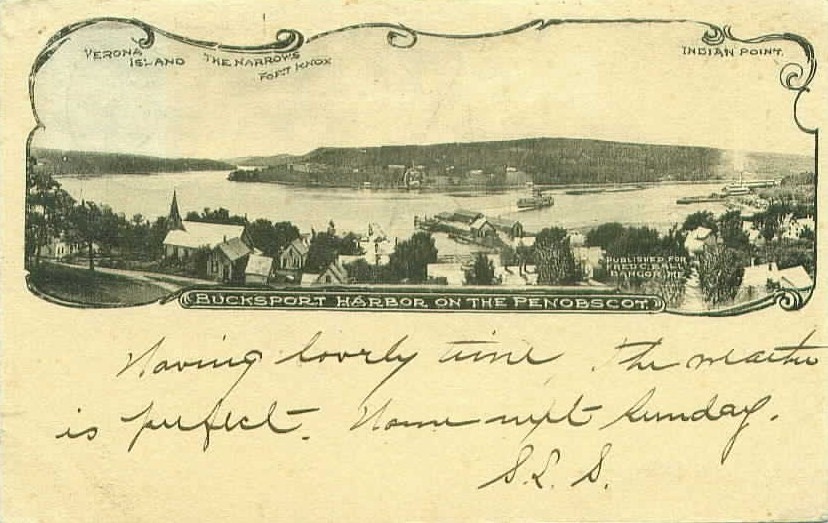
One more reader sends “a postcard from 1905 showing the reverse view (of the fort from the town, without the bridge)”:

Fort Knox 1905

(Archive)

The Old Media Knives In Nate’s Back

The Signal & The Noise - 2013 SXSW Music, Film + Interactive Festival

I’m not sure the role of public editor at the NYT includes the gossipy reporting of staff envy, resentment and resistance to the emergence of an Internet star in their midst. But Margaret Sullivan sure delivered – and she, at least by her account, was a defender of the 538 blog on the NYT site.

Still, if you wondered how the old-guard of journalism really regards the upstarts of the web, it’s a revealing piece:

His entire probability-based way of looking at politics ran against the kind of political journalism that The Times specializes in: polling, the horse race, campaign coverage, analysis based on campaign-trail observation, and opinion writing, or “punditry,” as he put it, famously describing it as “fundamentally useless.” …

A number of traditional and well-respected Times journalists disliked his work. The first time I wrote about him I suggested that print readers should have the same access to his writing that online readers were getting. I was surprised to quickly hear by e-mail from three high-profile Times political journalists, criticizing him and his work. They were also tough on me for seeming to endorse what he wrote, since I was suggesting that it get more visibility…

The Times tried very hard to give him a lot of editorial help and a great platform. It bent over backward to do so, and this, too, disturbed some staff members. It was about to devote a significant number of staff positions to beefing up his presence into its own mini-department.

I’m thrilled Nate got his new gig at ESPN. But it isn’t good news for journalism that the NYT could not really digest his work. In the first place, Nate (who’s become a friend since the Dish first featured his work in the 2008 campaign) is about as real, sweet and modest as anyone can be without turning into mush. His ego is as well concealed as mine sometimes swivels like a Drudge police siren. So personality clashes were almost certainly not an issue – or not Nate-generated.

But fear was: fear that his analysis could render moot some of the horse-race journalism that the NYT still does and does well. It’s a misplaced fear. Campaigns are narratives driven by human beings – no statistical analysis could begin to describe them adequately. There’s no reason the two approaches cannot work together and inform each other. But the pretensions and defensiveness of the old media guard seem to have made that a tough compromise to settle on – to the detriment of NYT readers. And when the top brass actually started spending resources on the upstart, then jealousy took over. What usually happens, ahem, is that the lone blogger attached to a media company gets brought in for traffic, buzz, innovation, etc. and is then promptly ignored, or taken for granted, while the old guard tolerates him or her, and all the actual resources and investment go to the established institutional structure. Institutions tend not to like individuals who can dominate attention in a way others do not. It weakens their sense of control – something that remains in their minds even as it has largely evaporated from the media world.

Jill Abramson rightly, in my view, took a different tack, trying to build 538 into something bigger and worth investing in. But the knives in Nate’s back were too plentiful to remove – and ESPN clearly outbid them and had no bitter dead-enders carping about the newbie. Besides, ESPN had already proven its willingness to invest in one key blogger/writer, Bill Simmons, and create a whole site within a site around him. Marc Tracy listened to an ESPN conference call on the news and talked to Silver directly about the Simmons model:

The calls were most useful for drawing out the shape and ambitions of Silver’s future site, whose model, as he and Skipper said many times, is Bill Simmons’ Grantland. “That Grantland precedent was as close as anything in media,” Silver said. It, too, will be editorially independent, and it will be similarly staffed, at least once FiveThirtyEight is fully staffed up post-relaunch ([ESPN president President John] Skipper pegged Grantland’s staff in “the low dozens”). It was clearly very important to Silver that he did not have to guess whether ESPN could build a Grantland-like site around him—that, instead, ESPN (and ESPN acting under the influence of Skipper) is what built Grantland.

Travis Waldron also considers the Grantland model:

Grantland is an important aspect to the story, since it provides the model for the new FiveThirtyEight. The site has been an unabashed success in the two years since it launched, so it’s no surprise ESPN wanted to duplicate it, and Silver’s site sounds like it will end up as Grantland with more numbers. Silver and Simmons are a lot alike, big names with devoted online followings who will bring traffic and readers and influence, and Silver repeatedly stressed the editorial independence ESPN has given Simmons as important to why he took the job. And while he guaranteed the new FiveThirtyEight would cover sports, politics, and economics, the rest is up in the air and dependent on who he hires, much like Grantland’s beats developed more through the voices that came aboard — think Wesley Morris’ movie reviews and cultural critiques or Jonah Keri’s baseball coverage — than through a specific plan to cover certain aspects of sports.

I thought Nate’s role at the NYT was one real bright spot in the evolution of journalism at the Times. So, it now seems, did plenty of others. And that was the problem. The good news is that the NYT needed Nate much more than he needed them, and what matters is getting an audience to write what you love to write about. At ESPN, he has all the resources he needs and none of the extraordinary resentment and envy so many old-school editors and journalists feel toward the blogstars.

Did I mention how great it is to answer to no-one?

(Photo: Nate Silver, Founder & President of fivethirtyeight.com speaks onstage at The Signal & The Noise during the 2013 SXSW Music, Film + Interactive Festival at Austin Convention Center on March 10, 2013 in Austin, Texas. By Amy E. Price/Getty Images for SXSW.)

What Went Wrong With The Motor City?

Detroit Abandoned Buildings

Chait, who grew up outside of Detroit, calls the city “the residual wound of the rise and fall of postwar America, the place where the egalitarian economy was born, and it where also died”:

It’s hard to imagine any plausible way to pull the city out of its death spiral. New jobs would help, but there’s nothing compelling the workers who got those jobs to reside in the city. The conventional urban policy solutions never intersected with the reality of Detroit’s crisis. As Ed Glaeser points out, urban renewal centered on furnishing housing and transportation, both of Detroit had in excessive quantities. The city needed better governance and education.

The major renewal project of my youth was the “People Mover.” It was initially conceived as a light rail project to connect the suburbs to the city, a massively expensive undertaking in a huge area with abundant freeways. It shrunk to a small downtown monorail loop. It became a stop on the downtown field trip, for suburban schoolkids — you’d visit the art museum, eat lunch in Greektown, ride a loop on the monorail, and pile back into the schoolbus. The People Mover operates at about 2 percent of its planned capacity. The People Mover is a relic to a time when it was possible to imagine a simple construction project could save the city. The sorts of solutions imaginative reformers contemplate today are vastly more radical.

Ilya Somin, who highlights another misguided Detroit development project, partially blames Detroit’s decline on “the city’s extensive use of eminent domain to transfer property to politically influential private interests”:

For many years, Detroit aggressively used eminent domain to promote “economic development” and “urban renewal.” The most notorious example was the 1981 Poletown case, in which some 4000 people lost their homes, and numerous businesses were forced to move in order to make way for a General Motors factory. As I explained in this article, the Poletown takings – like many other similar condemnations – ended up destroying far more development than they ever created. In his prescient dissent in Poletown, Michigan Supreme Court Justice James Ryan warned that there was no real reason to expect that the project would produce the growth promised by GM and noted that Detroit and the court had “subordinated a constitutional right to private corporate interests.”

Eminent domain abuse certainly wasn’t the only cause of Detroit’s troubles. But the city’s record is a strong argument against oft-heard claims that the use of eminent domain to transfer property to private economic interests is the key to revitalizing economically troubled cities.

(Photo: A tree stump sits among the ruins of the Packard Automotive Plant, a 35 acre site where luxury cars were manufactured until the 1950’s on May 2, 2013 in Detroit, Michigan. Sitting on the East side of Detroit, the former automotive plant is now a site for scavengers, urban explorers and graffiti artists. By Ann Hermes/The Christian Science Monitor via Getty Images.)

Vandals And Saboteurs

John Boehner Holds Weekly Press Briefing At The Capitol

“Some of my Republican colleagues are already saying we won’t raise the debt limit unless there’s repeal of ObamaCare. I’d love to repeal ObamaCare, but I promise you that’s not going to happen on the debt limit. So some would like to set up another one of these shutdown-the-government threats. And most Americans are really tired of those kinds of shenanigans here in Washington,” – Senator John McCain.

What stands out to me – again – is the nihilism of it all. A candidate ran for president on a platform for a right-of-center plan for universal Screen Shot 2013-07-23 at 11.12.09 AMhealth coverage, much more incremental than the Clintons’ proposal, far less statist than Nixon’s, and adopting several conservative ideas – such as the healthcare exchanges which already seem to be bearing fruit in lowering premium prices.

He got it through the Congress, was re-elected solidly, his own party won the popular vote in both Houses … and the GOP in the House is effectively threatening to sabotage the economy and the government’s fiscal stability to cut off its funding. What do they intend to do about tens of millions of people without insurance (or more than ten million people living in this country without papers)? Not a single thing – except bromides against big g0vernment that could have been uttered (and were) in the 1980s.

Screen Shot 2013-07-23 at 11.15.30 AMWhatever else this is, it is emphatically not an opposition party in a democratic system.

It is a nullification party, unable to pass anything itself but endless, fruitless repeals of the ACA, incapable of supporting immigration reform as well as health reform, eager to deny the president even his own executive officials, and abusing the filibuster to make any kind of progress in addressing what few deny are real problems. This is a protest movement – not a democratic opposition. It’s acting out, not opposing.

And its only rationale is to drag this president down, even if it means, as it has, that their own reputation is at record lows. And they are having some small effect as Americans understandably look at Washington’s mess and throw up a little in their mouths.

What can the president do? He’s decided to go out on the trail again urging more action on the economy and rightly touting his economic stewardship as the most effective in the West since the crisis began. He’ll be trying to reach precisely those Americans who need health insurance when the new law comes into effect.

It turns out the election meant nothing to the GOP. Their contempt for the public as a whole – and not just their primary voters – is palpable. And their positive contribution to the issues facing this country and the world are non-existent.

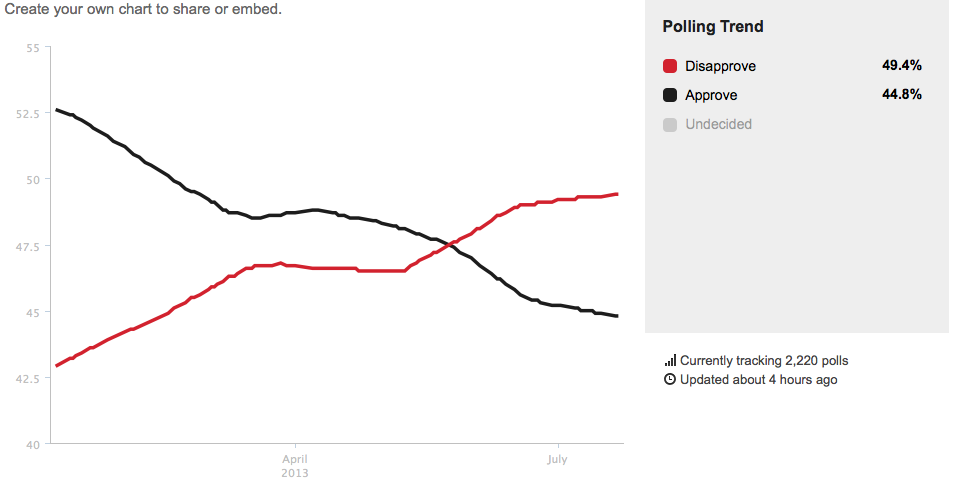
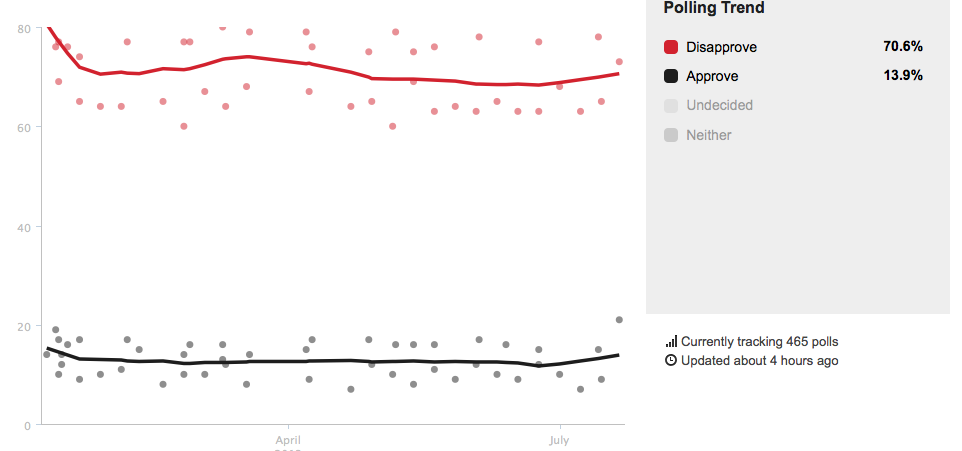
(Photo by Getty. Graphs of Obama’s and the Congress’s approval ratings, from Pollster’s poll of polls.)

Where Is The Midwest? Ctd

Screen Shot 2013-07-22 at 3.20.13 PM

A reader writes:

This is an eternal argument, man.  Is Oklahoma in the Midwest, or is it a Southern state, or maybe Southwestern? The answer is: it depends on what part of Oklahoma you’re talking about.  Oklahoma is at a crossroads in this country, in a number of ways.  If you’re from Ponca City, not far from Wichita, that’s pretty heavily Midwest.  If you’re from Idabel, down in the southwestern corner, you probably have more in common with Louisianans than you do with Iowans.  If you’re from Gage, out in the panhandle, you’re within spitting distance of New Mexico and Colorado.  And folks down by Lake Texoma … well.

And it’s not just cultural; it’s geographic, as well.  I was just the other day messing around with a map of North American biomes.  To illustrate a point to a friend, I overlaid a US map with state outlines over this map [see above]. Sorry, my bastardized version is on my home computer, but I figure you can tell pretty clearly that the big crossroads right in the middle is, in fact, right in the middle of Oklahoma. There are, like, ten colors on the map that fall within the Oklahoma state line. So, yeah, we’re a little bit of everything; we can provide you with just about anything except for tundra and oceanfront property (to my everlasting sorrow).

Another reader:

My favorite definition of the Midwesterner:

If you call a carbonated beverage pop or soda pop, you are from the Midwest. Hence, Pittsburgh is in the Midwest. Being about a 7+ hour drive from the Atlantic Ocean, Pittsburgh should not be called an East Coast city. A related definition: If you call all carbonated beverages Coke, you are from the South.

Another:

I’ll proffer the great Pop vs Soda map (the one by county is almost older than the Internet, but I think still the best). According to these maps, the dividing line between pop and soda country runs between Syracuse and Rochester. So Syracuse is in the east and Rochester in the Midwest. Of course, while it seems to get the outside boundaries pretty well (other than the western boundary), Saint Louis and eastern Wisconsin call fizzy drinks “sodas” unlike the rest of their midwestern brethren. Tulsa, which is in pretty-southern Oklahoma, must be midwestern (pop) while Indianapolis, in very-Midwestern Indiana, calls it Coke. So it must be in the South.