Don’t Think Of A Scrotum

Inspired by Dostoevsky’s observation, “Try not to think of a polar bear, and you will see that the cursed thing will come to mind every minute,” psychologist Daniel Wegner designed experiments to test how well people can suppress their own thoughts. The answer: poorly. Subjects forbidden to think about a subject not only thought of it more often; they continued to think about it for days on end. In tribute to Wegner, who died earlier this month, Maria Konnikova reprints a 2012 essay on his findings:

The more effort we expend on keeping something from our mind, the more likely we are to be reminded of it—because at some level, we have to keep reminding ourselves not to think about it. As long as not thinking is in the back of our minds, we will be prompted to think of precisely the thing we shouldn’t be thinking about. Wegner calls this an ironic monitoring process: each time we think about a distracter topic to put off the topic we’d like to avoid (something we do consciously), our minds unconsciously search for the unwanted thought so that they can pounce on it if it makes so much as a peep. And if we are tired or stressed or distracted—or even if our mind goes silent for a moment—the unwanted thought will take the opportunity to assert itself.

It’s especially bad in social situations, when we try to avoid making mistakes that would carry some sort of social cost, such as trying not to swear or make sexual references or touch on an otherwise sensitive area of conversation. People who are asked to keep something private are more likely to mention it or allude to it in some way in a conversation. People who are asked not to think of anything sexual are more likely to slip up—and even show greater levels of physical arousal. People with eating disorders are more likely to mention food. People who have some sort of social prejudice—racism, sexism, homophobia—are more likely to say something biased when they are trying to be on their best behavior—especially if they are stressed or otherwise mentally engaged at the time.

Update from a reader:

When I was a child, a friend of my dad’s told me, “If you see a white horse, make a wish – and it’ll come true … unless you think of a red fox.”

How Great Is Gatsby?

Not very, argues Jonathan Povilovis. From his lengthy critique, which questions its status as “The Great American Novel”:

Jay Gatsby disowned his family and made millions illegally, which for many is just cause to hold up self-righteous noses and applaud the fact that his funeral was under-attended—the bastard deserved it. But even if you’re happy to think that the ‘20’s were corrupt no matter how you look at them, so who cares how Gatsby got rich; or even if you’re left-leaning enough to see that Tom Buchanan did even less to earn his fortune than Gatsby did his, tossing the legalities aside, there’s still something unsettling about this whole narrative. What scares the hell out of me is not that I still want to cheer for Jay Gatsby even though he’s done some bad things—I don’t care that I don’t care that he’s simply done bad things. I care that he did them all for a person. He wanted to be with Daisy, the woman he loved.

What this means is that Gatsby is a man with very serious desire. He not only broke laws but also went to (literally) absurd lengths to lie, to falsely present himself to Daisy (and everyone else) in order to gain her love. But unfortunate for him and critical for us is that the way that Gatsby went about trying to [get] Daisy’s love excludes the possibility that he could earn it, because earning love takes more than just serious desire: it also takes some serious integrity. In other words, real love requires that you submit to a pretty high standard set of ethical rules, including a level of honesty and vulnerability between you and your lover, often requiring you to relinquish some of those more selfish desires; but this is not the kind of love that appears center stage in Fitzgerald’s novel.

Update from a reader:

The faulty logic in Povilovis’ essay is quite stunning. Where would we be without the lessons of the flawed character?

Would that line of reasoning not discount the importance of virtually every 20th century protagonist worth a damn (along with Shakespeare’s and so on, back through the Greeks and Romans).  Aren’t the flaws the entire point?  Isn’t it the sad bittersweet irony what makes the novel achingly “great,” and elevates the tragic mythology to a deeper level of metaphor that can speak on many levels – as a sweeping symbol of our flawed “great” country to the day-to-day struggles we each face in that quest for our own version of greatest above our personal baggage and the weight of our choices.

While Jay Gatsby was not in fact “great” in the most meaningful sense, there is a deeper meaning in his aspirations and yearning for that illusive mantel, as there is for Nick Adams and Lady Brett and Don Corleone and Tony Soprano and Walter White and Macbeth. Povilovis’ complaint seems to miss the point of literature entirely.

Another adds, “I’d rather have Atticus Finch as a father, but when I read a book, maybe I want to peer into the heart of darkness.” Another reader:

I don’t think Povilovis is suggesting The Great Gatsby isn’t a great novel; I think he’s saying Gatsby is a disturbing hero because of the great effort he makes to reinvent himself for this woman he loves, which is all founded on a lie.

But that tale of reinvention is why Gatsby endures.  Here is a man who (spoiler alert) cuts most of his ties with home, assumes a new identity and breaks the law, all to grab the money and power to make himself acceptable to Daisy.   And all his success, which American Gospel says should bring him contentment, fails him.  It doesn’t win him Daisy (Fitzgerald doesn’t seem fully convinced Daisy is actually worth it) and it can’t get him respect or acceptance in the class he’s muscled his way into.  As H.L. Mencken wrote of Rudolph Valentino, a year after Gatsby was published, he had achieved “a colossal and preposterous nothing.”

In some ways, Fitzgerald wrote a shorter and more lyrical version of the novels Theodore Dreiser had been sledgehammering out for years, about the seduction of material wealth and how the burning American desire for more can masks a rootless and more troubling anomie. But Dreiser, great and brave as he was, didn’t have the sympathy for his characters that Fitzgerald did.  Dreiser could outline the facts of the tragedy; Fitzgerald could break your heart.

Gatsby, by all rights, shouldn’t be borne back to the past; he should have carved out a new life and new identity for himself, made a tidy living, and found respectability.  That’s an American ideal: You can move away from your roots and start anew.  But like so many of us, he can’t pull himself away from the dreams of his past, and in the end, his enviable wealth fails him.

Gatsby’s story is one of destructive desire.  That is the story of many American dreams, and that’s what makes Gatsby great.

Meanwhile, Colin Marshall relays Gertrude Stein’s letter to Fitzgerald about the novel, which includes these comments:

I like the melody of your dedication and it shows that you have a background of beauty and tenderness and that is a comfort. The next good thing is that you write naturally in sentences and that too is a comfort. You write naturally in sentences and one can read all of them and that among other things is a comfort. You are creating the contemporary world much as Thackeray did his in Pendennis and Vanity Fair and this isn’t a bad compliment. You make a modern world and a modern orgy strangely enough it was never done until you did it in This Side of Paradise. My belief in This Side of Paradise was alright. This is as good a book and different and older and that is what one does, one does not get better but different and older and that is always a pleasure.

Recent Dish on Fitzgerald and his novel herehere, and here. And go here for the recent debate over The Godfather as a great American novel.

The Building Blocks Of Urban Recovery

Alec MacGillis is unsure that Detroit has them:

We’ve heard so much about all the vacant buildings in Detroit and the budding return of deal-seeking hipsters that there’s an assumption that the city is just waiting to be discovered by a wave of new residents of the sort that are flooding into Brooklyn and Washington but also, in smaller numbers, parts of Baltimore, Philadelphia and Pittsburgh. What this misses is one of Detroit’s cruel ironies: while it has many, many vacant buildings available for a song, it lacks the sort of housing stock on which urban renaissances are born.

The “urban renewal” wave of the 1950s and ’60s was more disastrous in Detroit than anywhere else—to make room for a web of new expressways (built partly to speed travel among the big auto plants on the periphery), the city knocked down not only a major African-American neighborhood (thus contributing to the racial tensions that spawned the 1967 riots) but also a swath of buildings on the southwest corner of downtown, exactly the sort of warehouses and small factories that have been reborn as loft apartments and condos in other cities. There are also precious few of the brownstones and other rowhouses that are so popular with gentrifiers in other cities. As Jane Jacobs explained years ago, cities thrive on density, but Detroit, for the reasons described above, was always more spread out than other big cities. What is mostly left for housing, with the exception of rejuvenating pockets like the Midtown area around Wayne State and the Detroit Institute of Art, are some breathtakingly handsome Art Deco towers downtown in various stages of vacancy, and a sea of single family homes scattered across the vast expanse, offering less than ideal raw material for the sort of bikes-and-coffee-shop comeback we’ve seen in other cities.

Yglesias notes another handicap Detroit suffers – a lack of major universities:

The overall higher education sector in the United States takes a lot of criticism these days, but in part precisely because of the things that make it seem kind of bloated and inefficient it’s a very valuable urban amenity. Universities both create little neighborhood-level retail clusters around them, and along with medical facilities become the twin pillars of a regional knowledge-based economy. Of course cities can thrive without necessarily playing host to a prestigious private university or a public university flagship campus (San Antonio, for example) but for lots of older cities hit hard by the macroeconomic trends of the 1970s and 1980s the existence of major universities has provided a foundation for rebuilding.

Face Of The Day

Daniel_Bryan_beard

A reader writes:

As a push to increase the Dish’s pro wrestling coverage – one of the few controversial topics you don’t cover, according to that study – I submit the attached picture of current WWE wrestler Daniel Bryan.  Even better than the picture is his catch phrase, “Respect The Beard”.

Update from a reader:

With your two mentions of pro wrestling in one day, I would be remiss not to share with you the latest project I’m working on: Total Divas! The show focuses on seven female wrestlers, one of whom, Brie Bella, is the live-in girlfriend of Daniel Bryan. The tag line of the show should be “What’s real and what’s wrestling?” as it is produced by the same production company that has brought us eight seasons of Keeping Up With the Kardashians. Sadly it focuses more on boyfriend trouble and cat-fights than on the struggles of women trying to make it in the predominantly male business. But one aspect of the show that is interesting (and WWE sanctioned) is that it throws back the curtain on what goes into the highly choreographed performances that occur in the ring. (Never call it “fake.”)

Electrifying trailer after the jump:

Another reader:

I saw your post about Daniel Bryan and “Total Divas” and my jaw dropped.  I’m a longtime fan of the blog and I WORKED on “Total Divas”. I would take breaks between the scenes and read your blog.  Now seeing both of these together? My mind is officially blown.

The Sounds Of Elitism

Robin James looks at two recent NYT stories on urban noise through the lens of Luigi Russolo’s 1913 futurist manifesto The Art of Noise (pdf):

Russolo was worried that traditional musical sounds were too pure to have any affective punch:

In the pounding atmosphere of great cities as well as in the formerly silent countryside, machines create today such a large number of varied noises that pure sound, with its littleness and its monotony, now fails to arouse any emotion (Russolo, 5).

Russolo thought we needed industrial noise to reinvigorate art music. “We get infinitely more pleasure imagining combinations of the sounds of trolleys, autos and other vehicles, and loud crowds,” he argues, “than listening once more, for instance, to the heroic or pastoral symphonies” (6). Modernist aesthetics value transgression and difficulty. The ability to tolerate and appreciate noise was a sign of avant-garde taste; so, cultural elites stereotypically valued “noisy” works, while the unwashed masses preferred kitsch. In the Times article, this modernist association between noise tolerance and privilege is reversed: sensitivity is a privilege reserved for those with means to protect themselves from it and preserve their delicate aural/affective palate, and noise-tolerance is the effect of exposure. …

You can even see this reversal in contemporary pop music aesthetics: mainstream pop–from the Biebs to Skrillex–is really noisy, while hipsters and NPR listeners prefer traditionally pretty, harmonious, folk-y, “new sincerity”-style artists.

Update from a reader:

This is as lazy as Thomas Friedman basing a column on a chat with a cabbie and as wrong as Peggy Noonan’s take on the IRS.

First, the use of the useless word “hipster” alongside NPR listenership as flags of privilege is lazy and tautological. Even if one charitably (in this context) interprets “hipster” as “trust fund kid”, I dare James to come to a show at Brooklyn’s Death by Audio or one of promoter Todd P’s more extreme events and come away insisting that “hipsters” don’t like noise. Likewise, I’d argue that the majority of free jazz fans today are probably NPR listeners. And can we merely stipulate that not all NPR listeners share the musical tastes of the producers who select the acts on the network’s air, as well as that a lot of “hipsters” like Skrillex?

Second, I don’t think it’s folks from Washington Heights, East New York, or Newark who flock to Lincoln Center to see performances of works by Boulez, Messiaen, Ligeti, etc. Or at Poisson Rouge on nights when noisier acts are playing.

Second, WTF does James mean by “noise” here? Bieber’s music is profoundly simple and euphonious. Skrillex is more complex but not by much. So it’s noise because it includes the same high-in-the-mix samples as so much other music today? If so, where would James put the original recyclers of the title of Russolo’s manifesto, The Art of Noise? Because at least here in the U.S., that band’s popularity was confined to college kids and … hipsters.

This is where blogging fails: when it attempts to offer instant and contrarian responses to more reasoned writing. I suggest a new Dish award, or at least a flag alongside the Poseur and Hathos alerts, for cultural analysis this lazy and jejune.

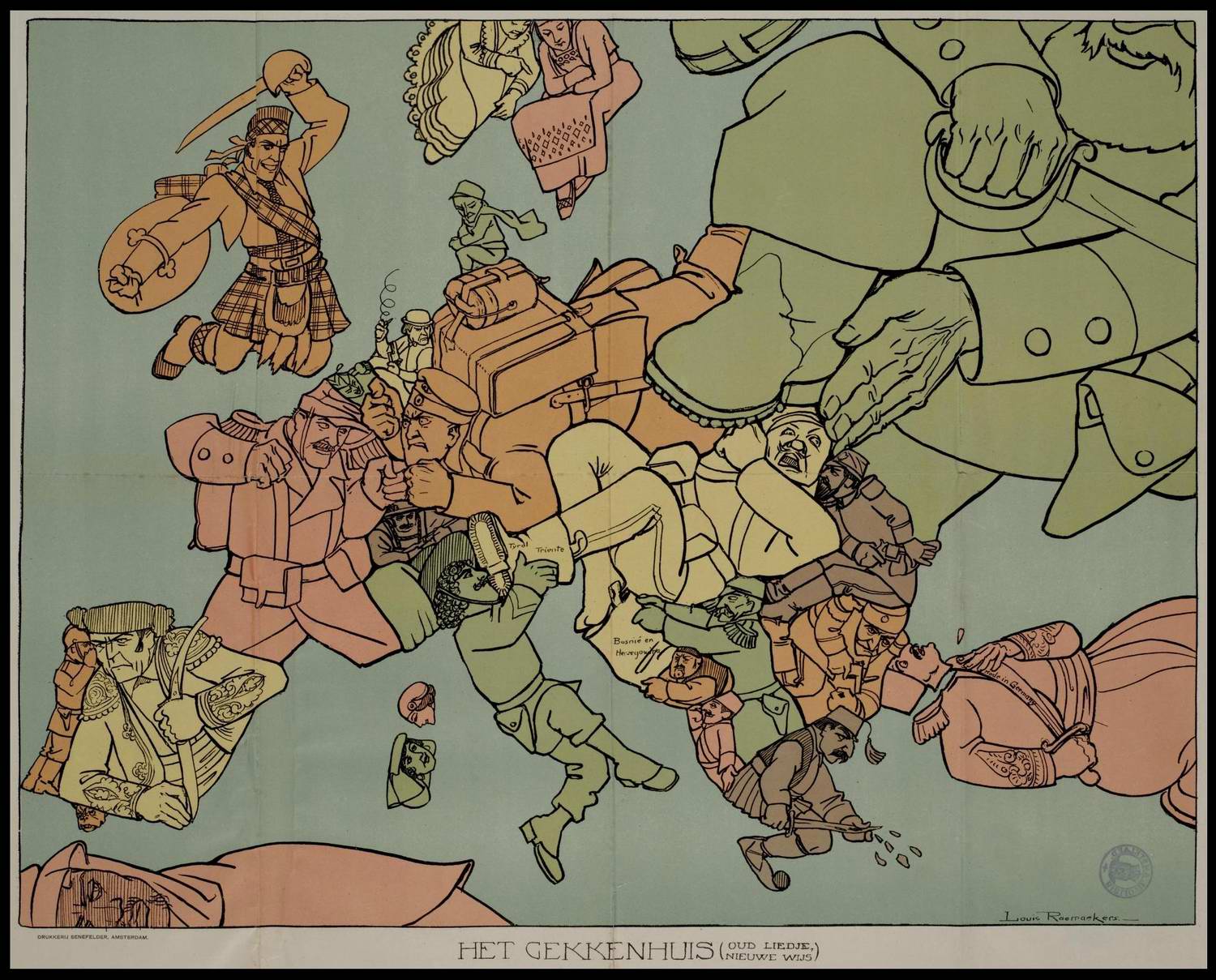
Maps As Propaganda

14c

Laura Mallonnee studies the subject:

[M]aps as visual systems have never been objective, but are susceptible to manipulation–especially political censorship. Before statistics were widely available online from entities like the U.S. Census or the Center for Disease Control, the only mapmakers were either governments or large companies that could invest the capital to both gather the data and map it. Neil Alan, the current president of the North American Cartographic Information Society, pointed out that as a condition for its presence in China, Google currently lists the land contested in the Chinese-Indian border dispute as Chinese territory. Even color choice can be powerful. “Red is a warning, cautionary color, so you right away jade the readers by choosing the colors that you do,” he says.

In 2012, China put a map on its passport laying claim to a host of disputed territories, while in 2011, India forced The Economist to censor every copy of an issue featuring a map of Kashmir. In 2005, Mark Monmonier, author of How To Lie With Maps, wrote that maps by their nature are especially vulnerable to manipulation:

Most maps are massive reductions of the reality they represent, and clarity demands that much of that reality be suppressed. The mapmaker who tries to tell the whole truth in a single map typically produces a confusing display, especially if the area is large and the phenomenon at least moderately complex. Map users understand this and trust the mapmaker to select relevant facts and highlight what’s important. … When combined with the public’s naive acceptance of maps as objective representations, cartographic genrealization becomes an open invitation to both deliberate and unintentional prevarication.

Recent Dish on the power of maps here, here, and here.

(Image of a Dutch map from 1915. More propaganda maps here: “They were obtained from the University of Amsterdam website where you can zoom in to high magnification. [via Briefe an Konrad]”.)

Suicide Leaves Behind Nothing, Ctd

A reader writes:

I want to echo what your reader said about his connections tethering him to the world.  I 5663fc34-2dfb-4287-9f83-f3af4dcf2da3-1absolutely share the sentiment.  I have an objectively great life, full of privilege, but I feel as if I’m always carrying around a massive dark truth about reality.  At some point in my early 20s, I read a lot of existential philosophy and have been managing an existential crisis ever since.  I purposely create responsibility and connections in my life to keep myself from being able to consider ending it.  If I didn’t have my dog to take care of (and a family some day in the future, hopefully), I’d look at life in a “I could take it or leave it” manner.

Another reader:

I’ve never really responded to any of your posts but I felt compelled to write in about your new thread on suicide. Describing suicide as “among the most selfish acts” really resonated with me. In fact, it’s the exact lesson I learned after my failed (thankfully) suicide attempt at the age of 14.

I was in a coma for three days and I woke up to absolute devastation around me.

My parents, brother, and friends were horribly affected. For years afterwards my mother suffered from a sort of PTSD, having frequent and intrusive flashbacks to the memories of finding me unresponsive in my bed, carrying me to the car, and driving me to the hospital. At the age of 14, I learned that my life is really not mine alone to do what I please. Although I had no “dependents” (my own children, an animal), I realized that other people’s happiness, emotional and physical wellbeing did depend on my continued existence.

I am now 27, and though I have struggled off and on with thoughts of suicide throughout my young adult life (thankfully less and less as I grow older), I have never seriously considered taking my life again. It probably seems morbid, but I would often picture my family and friends if I were to take my life again, how terrible it would be for them, and it gives me a strange motivation to keep on going.

At the age of 14, I simply was not able to comprehend the complex ways that my life intersected and affected those around me. Whenever I hear or read about teenagers taking their life, I think about how it might be possible to impart this same lesson on young people without needing a failed suicide attempt to learn it.

Another:

My brother committed suicide three years ago.  Suicide leaves many questions, and not enough answers.  I did a lot of reading on suicide after my brother died to try and find some answers.  You might be interested in the research by Dr. Thomas Joiner.  His theory on suicide is right on the mark, in my opinion.  Three pillars: 1. Burdensomeness, which leads to the mistaken belief that your death is worth more than your life to others 2. Loneliness/Alienation 3. A fearlessness of death that builds up over time.  All three need to come together at the same time, like a perfect storm.

Another:

My father committed suicide about two years ago, and one of the hardest things to think about is whether he knew how much his family all loved him. We know he loved us. We don’t see his suicide as some big middle finger at us. But what keeps me up at night is wondering whether, in his last moments, he understood how deeply we wanted him in our lives. If he knew that and still committed suicide, so be it. His was the result of a long and terrible struggle with depression, and I can appreciate that he desperately needed to find peace. But if he left us without knowing that; if his depression prevented him from seeing it – well, what a terrible world.

Lights Out For Liz Cheney?

Weigel assesses the Wyoming Senate primary:

Harper Polling, the first company to take a temperature in the Wyoming GOP Senate primary, returns with a bevy of bad news for Liz Cheney. In a trial heat with Sen. Mike Enzi, she trails him 55-21. … There’s no way Enzi ends up winning by 34 points, but Cheney has to do an unheard-of amount of damage to him to close in.

Harry Enten believes that Cheney is going to lose:

In order to successfully challenge someone in a primary, you need to be more popular than the incumbent. Enzi is actually the more popular one.

He sports a 76% favorable rating against just 6% who see him in an unfavorable light. Despite being less well known, Cheney has a higher unfavorable rating at 15%. Her favorable rating, meanwhile, is 31pt lower at 45%. That will go up as the campaign goes on, but so will her unfavorable rating.

You might be wondering whether or not Cheney’s connection to her father Dick will help her during the campaign. The former vice-president does have a 58pt net favorable rating, yet that’s significantly less than Enzi’s 70pt net favorable rating. The younger Cheney is going to have to come up with a better strategy than just connecting herself to her father if she wants to win.

Larison thinks that running as a Tea Partier won’t work for Cheney:

To think of this challenge as a Tea Party-style insurgency is to get things backwards. That sort of insurgency requires someone to pose as an opponent of political insiders and a critic of the current party leadership in Washington, and Cheney is neither of these. She might try to use the rhetoric of an insurgent candidate, but it will be impossible to miss that Cheney’s run is backed by outside money and Washington connections. It will be an exceedingly cynical attempt to exploit anti-Washington sentiment in order to entrench a family dynasty in national politics.

Turning Human Beings Into 2.9013

Physicist Alan Sokal, who was last seen demolishing postmodernist pretensions, has set his sights on positive psychology. This time his target is the critical positivity ratio, which blogger Neuroskeptic describes as “the idea that if your ratio of positive to negative emotions is over a certain value, 2.9013, then you will ‘flourish’; any lower and you won’t.”

The concept was laid out in an influential 2005 paper, which according to Google Scholar has been cited more than 950 times. Neuroskeptic explains what Sokal and his colleagues, Nicholas Brown and Harris Friedman, found:

[T]he idea of a single ‘critical ratio’ that determines success or failure everywhere and for everyone is absurd in itself. … But even were there a magic ratio, it wouldn’t be 2.9013. The whole analysis in the 2005 paper was based on taking a poorly-described dataset and then making it fit a mathematical model, purely by means of elementary misunderstandings.”

Of course it drew on 1960s geophysics:

[Study author Marcial] Losada observed positive and negative emotions change over time, and that we can model this process in the form of a Lorenz system. The Lorenz system is a mathematical function famous for being pretty (e.g. ooh!). There are infinitely many Lorenz systems, based on three set-up ‘parameters’, each of which can be any number. It turns out that Losada set two of those three variables to the values used by a geophysicist in 1962, who picked them purely to make a pretty illustration for his paper about air flow.

If you set up a Lorenz system in exactly this way, and set it running, you can get a number out, 2.9013. This number is meaningful only within this particular system, with those particular parameters. Yet by means of an epic series of assumptions, Losada declared this meaningless quantity to be the Key to Happiness and Success.

Mathematicians David H. Bailey and Jonathan M. Borwein aren’t terribly surprised:

From all indications, the Fredrickson-Losada article is an exercise in “physics envy” — trying very hard to dress work in the social sciences, which, by definition, are not closely connected to very precise physical laws and processes, in the exalted language of mathematics and mathematical physics. It is also the case that the whole area of social psychology has been rocked by recent scandals and by a prevalence of sloppy ‘science’. It has been described by Nobel economist Dan Kahneman as a “train wreck waiting to happen.”

But more generally, the lesson for all who would apply mathematics in this or any other arena of modern science and engineering is clear. Mathematics is a powerful tool, but there is no point in attempting to apply it beyond reasonable boundaries, or with a level of numeric precision far beyond what is justified by the original problem in hand. Mathematical excesses can lead to nonsense.

Watch out, David Brooks.