Rape By Fraud?

New Jersey state Assemblyman Troy Singleton is proposing a law that would make it illegal to lie to a prospective sexual partner in order to get them in bed. The bill – which is unlikely to pass – defines “sexual assault by fraud” as “an act of sexual penetration to which a person has given consent because the actor has misrepresented the purpose of the act or has represented he is someone he is not”. Elizabeth Nolan Brown loses it:

No no no just no: we do not need a legal remedy for people having bad judgement. Is it a shame that some people misrepresent themselves to get people to sleep with them? Sure. But not every aspect of social and sexual relationships can be a matter for government concern. What’s next, making it a misdemeanor to use outdated photos on your Tinder profile? Criminalizing push-up bras? Throwing people in jail who say they’ll call the next day but don’t?

The situation Singleton says spawned his proposal involves Mischele Lewis, a woman defrauded by a man claiming to be a British military official. The pair had sex and Lewis also paid the man, William Allen Jordan, $5,000 for an alleged security clearance. When Jordan turned out to be a scam artist, Lewis pressed charges and he wound up pleading guilty to defrauding her. Justice served, right? Not in the warped worldview of New Jersey prosecutors, who apparently can’t stand the idea that some areas of interpersonal dynamics aren’t within their prosecutorial reach.

This is too much even for Amanda Marcotte:

Given that this law has very little chance of passing, it shouldn’t matter much. But it does! Because it gives those who oppose any legislation attempting to address sexual abuse (affirmative consent laws, for instance) the ability to point and say: Look, those crazies think everything is rape, even fibbing!

Rape is a fairly straightforward crime. It’s a matter of having sex with someone who does not want to have sex at that moment in time. Despite claims to the contrary, affirmative consent supporters don’t actually want to make it legal to retroactively retract consent. But this law would open the door to allowing people to do so, which actually does muddy the definition and understanding of rape. Jerks who exploit people’s desire to be loved in order to defraud them can be convicted under other laws. Otherwise, relationship fouls are simply not criminal offenses.

It’s good to see that there’s a limiting principle in the state’s sexual policing power. Even for Marcotte.

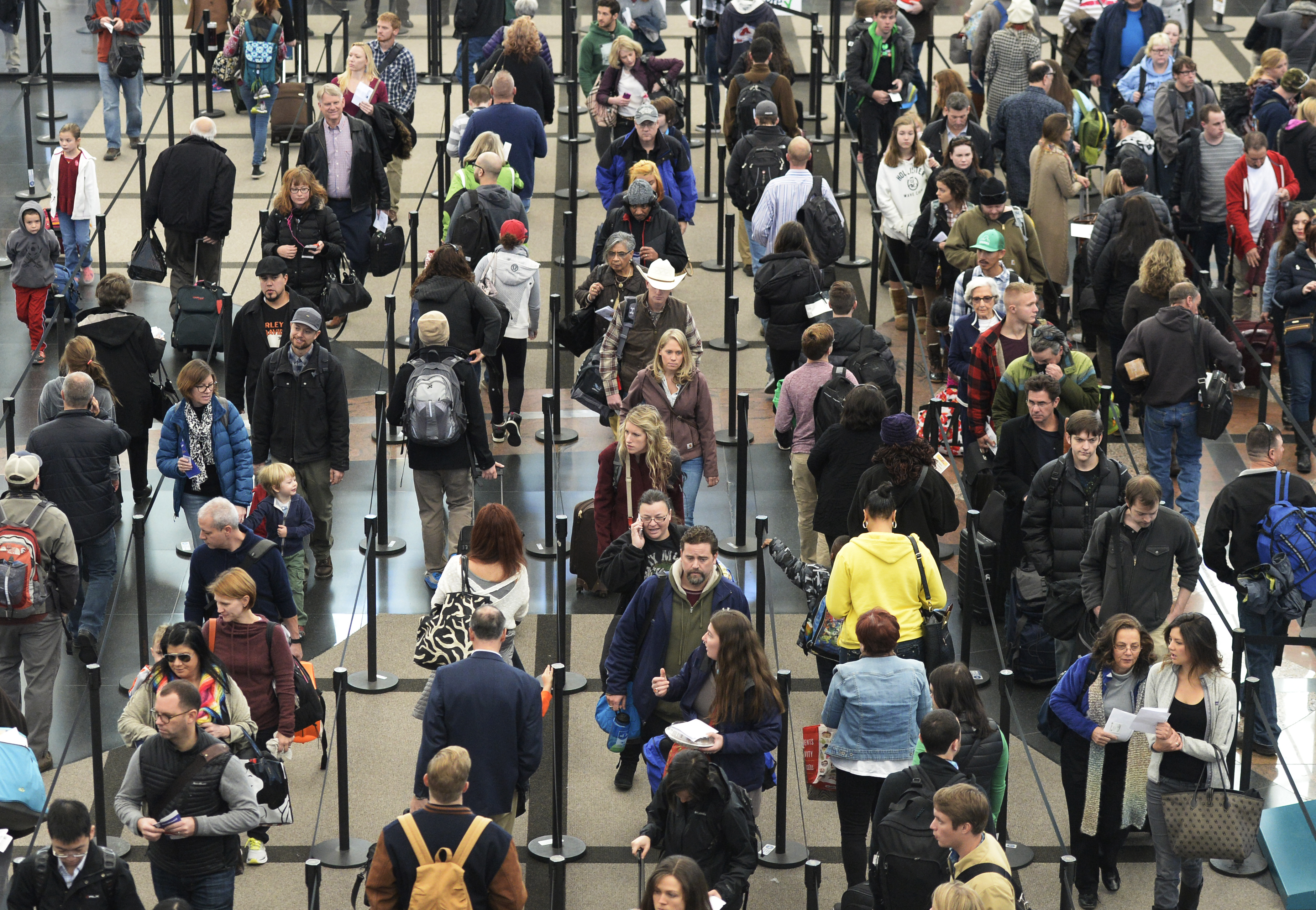
Maxing Out Our Airports

Traveling for thanksgiving

Adam Minter predicts Thanksgiving-type travel days year-round in coming years:

[E]ven with billions worth of improvements in the pipeline, the picture for travelers remains bleak. Of the 30 busiest U.S. airports (accounting for 70 percent of total U.S. passenger flow), 13 already feel like the day before Thanksgiving one day a week on average. Three airports — Midway, Las Vegas McCarran, and Orlando International — suffer those levels of congestion twice a week. Worse yet, the capacity improvements that are currently slated won’t help much. Within six years, the study notes, 27 of the 30 busiest airports will be Thanksgiving-busy at least once a week.

That this state of affairs is unnatural should be apparent to anyone who flies outside the U.S. even occasionally. In 2011, the World Economic Forum ranked U.S. aviation infrastructure 32nd in the world — behind Malaysia (an assessment that, in my personal experience, remains accurate). This is both embarrassing and somewhat predictable. Developing countries such as Malaysia strongly subsidize airports and airlines, viewing them as important marketing opportunities and first-impression makers.

Clive Irving hates how airlines jam so many seats into coach:

Looking through photographs from the early days of U.S. airlines, I found a shot of the cabin of the Boeing 247, circa 1934. The 247 was the first airplane really to define the form of a modern airliner, flying faster and higher than any predecessor. The passengers in the photo are enjoying a standard of comfort undreamed of in coach today: only one seat on each side of the aisle, generous leg room, nice wide seat cushions, and seat backs shaped to reflect the curves of the human body. Some of the ladies are wearing furs and hats. Even a 200-pounder could sink contentedly into the space without encroaching on anyone else.

In 1934, those passengers paid $160 for a one-way flight from Newark to San Francisco, in today’s money $2,800. This was at the depths of the Great Depression. In its infancy, air travel was a luxury only the wealthy could afford as they flew nonchalantly over the states where the likes of Ma and Pa Joad were fleeing the Dust Bowl. At the front end of the cabin it remains so. Airplanes have become as segregated by class as the old ocean liners—opulence for the rich and the crush of steerage for the rest of us.

But Amy Cohn contends that the disparity in airline ticket prices benefits everyone:

Suppose that an airline offers a 100-seat flight from Philadelphia to Chicago, and that it costs $40,000 to cover the costs of the airplane, fuel, pilots, flight attendants, landing fees, insurance, and so on. The airline needs to make at least $40,000 in ticket revenues for the flight to be worth flying. If the airline were to offer just one fare for all tickets on that flight, what should that fare be? Selling every seat for $425, for a total of $42,500, would make the flight nominally profitable.

But there may not be 100 people willing to pay $425 for this flight. Maybe there are 100 cash-poor college students who want to fly, but can only afford $300 per ticket. On the other hand, there may be 20 business travelers who want to fly, each willing to pay up to $900. … This is where “fare differentiation” comes in. If they can sell $300 seats to 80 college students and $900 seats to 20 business travelers, then they can sell all 100 seats, earning $42,000 and making the flight worth offering.

How all passengers wins:

While it is definitely to the benefit of college students to have business travelers “subsidize” their fares, the business travelers may be getting the bigger benefitand not just because there are usually a few tickets still available at the last minute (at the highest fare). This fee structure allows airlines to increase the number of flights offered, giving the business traveler more options to choose from.

(Photo: Security lines at Denver International Airport on November 26, 2014. By RJ Sangosti/The Denver Post via Getty Images)

The Damage Control Is Done, Ctd

A few readers offer their perspective on the awful situation at the University of Virginia:

I’m a former federal prosecutor and an alum of UVA.  I think those who advocate for the criminal justice system being used instead of having colleges investigate sexual assault are asking too much of the criminal justice system.  While the gang rape at the center of the Rolling Stone article would be a good case for full prosecutorial investigation, most sexual assaults occurring on most campuses would not.  Most “date rape” scenarios would never be prosecuted.  Without third-party witnesses or evidence of a “roofie” in the girl’s blood, prosecutors would generally not find enough evidence to indict.  The beyond-a-reasonable-doubt standard is simply too high in those kinds of cases, and if we left them for the criminal justice system to handle, it would likely end up being an excuse for inaction.

Another goes out on a limb:

As a 2005 UVA grad and fraternity member, I am having a lot of trouble formulating any sort of reaction to this situation without coming off as some sort of rape-supporting monster, but I am very uncomfortable with the rush to judgement and the urge to punish the “bad guys” as quickly and severely as possible.

The Rolling Stone story made me feel sick to my stomach with anger when I started to read it. However, by the end of the article, I was surprised that they even agreed to publish it, considering the explosive implications of the allegations and the lack of proof or corroboration that the story was true. The victim deserves to be believed by her friends, support network, and any counselors or professionals whose job involves helping rape survivors, but a journalist is not supposed to be a credulous scribe for any allegation.

There are some people who will literally wish my violent death for saying this, but there is a chance that the accuser made it up or exaggerated.  It happens.  That doesn’t mean that we refuse to listen to the allegations and say terrible things about her, but it does mean that we as a society should still ask for proof.  The fraternity in question has been essentially destroyed as an institution because of this story, and if it’s true, they totally deserve it. But I would have been much more comfortable if the accuser had at least tried to press charges with the police or the university.

I also see many calls for collective punishment for all fraternities, regardless of their actual record of behavior.  This is simply unfair.  There are 30 frats at UVA, representing about 30% of the males in the student body.  It is absurd to claim that 30% of UVA men are rapists, rape supporters, or otherwise implicated in a “rape culture”.

If anyone had that sort of attitude about women, they wouldn’t even be invited back to a rush event at my house or many others.  We voluntarily worked with One in Four on educating every single pledge who came into our organization about consent, preventing assaults, and monitoring each other’s behavior to prevent bad situations.  We had multiple sober party monitors at every event with alcohol to go from room to room and make sure nothing bad was happening.  That included telling brothers not to bring stumbling drunk girls to their rooms.  It included helping find people at the party when their friends were looking for them.  It even included calling 911 to get an ambulance to our own doorstep to help a girl who was either drugged or drastically over-served at another house and then wandered to our house looking to drink more.

How Misconceptions Can Kill

Adam Waytz connects his research on the superhumanization of blacks to the Michael Brown shooting:

Wilson seemed to justify his infliction of lethal pain on to Brown precisely because he perceived Brown to be a superhuman threat. It is easy to feel good or indifferent about superhumanization because it seems to “elevate” black people, celebrating their strength and resilience. Some might even argue that superhumanization of black people is our earnest attempt to counteract sub-humanization of black people. But as the case of Michael Brown demonstrates there is a thin line between superhumanization and subhumanization. Both deny black people’s humanity. Therein lies the problem.

A Dish reader made a similar point yesterday. Bouie is troubled by how Darren Wilson described his encounter with Michael Brown:

Maybe Wilson was an ordinary police officer with all the baggage it carries. Maybe, like many of his peers on the Ferguson police force, he was hard on black teenagers. Maybe, like many Americans, he was a little afraid of them. And maybe all of this—his fear, his bias, and his training—met Michael Brown and combined to create tragedy.

If so, the lesson of Wilson is that he isn’t unique. That his fear is common. And that the same forces that drove Wilson and Brown to confrontation can—and will—drive another Wilson and another Brown to another confrontation with the same deadly results.

Emily Ekins hits the psychology books:

Academic research … tells us that more than a police officer’s conscious intentions may influence their judgments and actions. University of North Carolina psychologist Keith Payne (2001) conducted an experiment finding research participants were more likely to mis-identify a hand tool as a gun when they had to respond quickly, immediately after being shown the face of an African-American male rather than a Caucasian male. Particularly, white and male respondents were faster to identify guns when “primed” with a black face versus a white face.

This suggests that police officers like Daren Wilson may have genuinely believed their lives were threatened, and acted accordingly—but that their conclusions were unduly and implicitly influenced by their own stereotypes.

The Least-Coveted Job In Washington

https://twitter.com/djrothkopf/statuses/537367784574177280

Michéle Flournoy, the leading candidate to replace Chuck Hagel as Secretary of Defense, has bowed out:

Flournoy, the co-founder and CEO of the Center for a New American Security (CNAS), a think tank that has served as a farm league for future Obama administration officials, would have been the first female secretary of defense had she risen to the position. The news of her decision to withdraw was first reported by Foreign Policy. But in a letter Tuesday to members of the CNAS board of directors, Flournoy said she would remain in her post at the think tank and asked Obama to take her out of consideration to be the next secretary of defense. Flournoy told the board members that family health considerations helped drive her decision and the fact that two of her children are leaving for college in the next two years.

“Last night I spoke with President Obama and removed myself from consideration due to family concerns,” reads the letter, first obtained by FP. “After much agonizing, we decided that now was not the right time for me to reenter government.”

Senator Jack Reed, another contender, has also said he has no interest in a new job. Austin Wright and Michael Hirsh aren’t surprised that nobody seems to want to run the Pentagon these days:

To understand why Flournoy and others are dropping out of the running for secretary of defense, just think about the job description: You’ll be working for a president who once declared that he was elected to end wars but who now finds himself stuck, reluctantly, in a new one in Iraq and a prolonged one in Afghanistan — and who badly wants to finish up both in two years, though that’s probably impossible. He’s also a president who won’t listen much to you, since he apparently has little intention of altering the White House’s tight grip on the national security apparatus, which was the bane not only of Hagel but his two Pentagon predecessors, Leon Panetta and Bob Gates.

Flournoy “doesn’t want to be a doormat, and I think they want a doormat,” said one former Defense Department official who worked there during Flournoy’s tenure. “I do not think they’re looking for someone more aggressive and independent.”

John Fund is on the same page:

It’s well known after Secretary Hagel’s clashes with White House staff that anyone who takes the Pentagon job will be butting heads with Susan Rice, the National Security Council adviser who exercises an iron grip on key aspects of foreign policy. Not to mention Valerie Jarrett, the influential presidential counselor who seems to have both hands in every pie at the White House. “Why should anyone put up with those headaches and not even have full command of your department?” asks one leading Democratic defense analyst I spoke with. He said the White House’s need to micromanage the national-security apparatus is notorious in Washington.

Morrissey recommends that Obama pick a technocrat with as little political baggage as possible, along the lines of former deputy defense secretary Ashton Carter:

The technocrat model may be the answer for the lame-duck period of the Obama presidency in other areas, too. Technocrats make difficult targets, even in a hostile environment. Senate Republicans are not likely to block confirmations on national-security positions, but after Obama’s unilateral declaration on immigration, they will target other appointments from Obama in response to his bypassing of Congress.

Even without that, Republicans would be scrapping for a fight over overtly political nominees, and unfortunately for Obama, there will be a number of openings as his current appointees look for greener pastures than a Democratic administration pitted against a Congress controlled by the GOP. A reliance on experts rather than activists will give Obama the opening to make the changes he needs after his second midterm shellacking, and perhaps restore some confidence in the competency of his administration.

With Reed and Flournoy both out of contention, Carter is now the presumptive front-runner.

Illiberalism In The Art World, Ctd

a_560x375 (1)

A reader senses a double standard:

Reading your excerpt of Jerry Saltz’s piece and reflecting on your recent writing on the stifling of debate with cries of racism, sexism, etc., I’m struck by a thought. You say there’s a certain amount of homophobia gays must learn to tolerate because the alternative (i.e., silencing those with politically incorrect views) is even worse. Ditto sexism, ditto (presumably) racism and anti-semitism. Homos, blacks, Jews, women: Toughen up. People will say things that hurt your feelings, but too bad. The world cares not. Free speech is more important than your bruised emotions.

And yet. Saltz seems quite to have had his feelings hurt by being called a racist, a perv, a hater of women. Should he not toughen up as well? It would appear to me there is a quite a debate going on – about whether Saltz’s views are out of bounds. Is that not a debate worth having as well? And if it is, then Saltz and his hurt feelings can get in line with all the gays who are tired of homophobia, all the black folks who are tired of racism, all the women who are tired of catcalling, and just realize that the debate is more important.

Yes, I think the targets of the left’s various public shamings – shamings now put on rhetorical growth hormone by the  Twitter and Facebook mobs – should take it on the chin, unless their very existence as a writer is under threat. I’m fine with my being hauled out and shamed, even by Dish readers – but that’s because I have real freedom here to write what I think and take whatever lumps come my way. That’s the beauty of an independent site and the free speech zone here at the Dish. I am not directly threatened by these new puritans in the discourse. But so many others are – in academia, especially, but also in journalism. And when the point of the shaming is to shut down a person’s job or livelihood, to stigmatize so as to punish views that are violations of left-wing church doctrine, then I think the victims have every right to point out the threat to free discourse. That’s different than whining about having one’s feelings hurt.

Because the real troubling part of Saltz’s piece was the pressure to have him fired:

People stormed off the internet in disgust; letters were written to my editor demanding that I step down and asking me to “explain myself.”

I have a real issue when ideology requires that others be silenced or fired. And this line is a real one. It’s perfectly possible to chew someone out in public in devastating ways, while still defending that person’s absolute right to be part of the conversation. We should want our opponents to stay in the ring, if we want to advance discourse and ideas and win hearts and minds in a public debate. And yet, the deeper impulse behind the left’s latest burst of outrage is precisely the opposite. It is to deny that there is any debate worth having, and then to silence or remove those who are on the other side. I despise that impulse, whether it comes from the right (such as their use of the anti-Semite card to police criticism of Israel) or from the left (such as the shutting down of debates on abortion). And it seems to be on a major upswing on the left.

(Composite image from Saltz’s piece)

The Case For Police Reform Remains Strong

Reflecting on the Michael Brown case, Friedersdorf insists that, “when it comes to the problem of police officers using excessive force, including lethal force, against people they encounter, there are scores of cases that better illustrate the problem”:

[E]ven protesters who want to highlight the specific problem of white police officers shooting black men—even those who want to do so by saying “don’t shoot” while raising their arms in the air—needn’t rely on a murky incident with conflicting eyewitness testimony where there’s a chance that the unknowable truth would exonerate the officer. Instead, they can show skeptics this video from Columbia, South Carolina:

When I want to persuade a skeptic that police can misbehave so badly that it’s hard to believe until one sees it, that is the incident I thrust before them. Given an hour of their time, I could fill it with other incidents on YouTube, almost all of which were totally ignored by most of the commentators who are now flaunting their outrage at anyone evaluating evidence in Ferguson differently than they do. This alienates potential allies and converts on the larger issue of police abuse … for what?

Some of the reforms Conor advocates for:

So what specific reforms are needed? Too many to list them all in this article. But here are some measures, beyond video cameras, that would improve policing:

• Decisions about when to charge police officers should be made by independent prosecutors, not regular district attorneys, who must rely on police to testify in most of the cases they bring. That gives these district attorneys a perverse incentive to refrain from aggressively prosecuting misconduct.

•Police unions should be able to negotiate salary, benefits, and nothing else–firing an abusive police officer should be easy.

•All police departments should have strong civilian oversight.

•The War on Drugs should be ended.

•Most military-grade police equipment should be returned to the federal government or destroyed.

• Civil asset forfeiture should be reformed.

•No-knock raids should stop in almost all cases.

Alfred Blumstein suggests a related reform:

Communities should find ways to establish a police-accountability commission that has the unchallenged authority to remove from the police force any officer who has demonstrated grossly inappropriate use of lethal force. Their investigation could well include a review of the officer’s prior record in interactions with the community, to provide a context within which to judge a current incident. Such a high-level commission representative of the larger community could serve to remove high-risk officers, to serve as a deterrent to irresponsible use of lethal force, and to provide greater comfort to the citizenry that the police will act responsibly in their use of lethal force.

More generally, Linker objects to “granting to cops of an a priori presumption of virtue that no one else in our culture enjoys”:

Of course there’s nothing wrong with admiring and expressing gratitude for the work police officers do. But shouldn’t it also be part of our civic education to inculcate a healthy suspicion of people we empower to enforce order on our streets with live ammunition? Shouldn’t we expect that citizens impaneled on grand juries will usually opt for indictment in cases where a cop is implicated in the death of an unarmed man or woman, if only to establish the facts and enable our society to take public stock of what happened?

What To Make Of Ferguson? Ctd

Some remaining thoughts from readers regarding the grand jury decision and aftermath:

Your correspondent compared Ferguson to Benghazi:

There’s a narrative of racist-white-cop-kills-harmless-black-kid, and no matter what uncomfortable fact intrudes, like that so many “witnesses” admitted they didn’t actually see what they told the media they saw, the narrative must go on. Because racism.

You know, s/he’s not entirely wrong. But even if Micheal Brown had been holding an AR-15 in each hand when he was shot, everything that we’ve been talking about in the aftermath of his death about the systemic corruption, violence, impunity – and yes, institutional racism – of policing and incarceration in this country would still be true. The ugly, simple truth is that very few people will rally against injustice in the abstract, regardless of the scale. We just aren’t wired for that kind of empathy. (Stalin was right about tragedies and statistics.)  So is it a mistake to try to leverage a particular case to bring the bigger issues to the fore? It certainly is risky, and I think we are seeing why right now. But if there is a better way to go about it, I don’t think we’ve seen it yet.

Another would seem to concur:

I agree with your take on Ferguson. If your objective is to make an example of how police Protesters block interstate lanes in Oakland after Ferguson Grand Jury decisioninteract with young men of color, this isn’t a perfect case. It’s just attracted the most attention. And the response is making it worse. But this is where we are, with the incompetence and violence and rioting and everything. And every day that sees a riot, we get a little bit closer to forgetting Michael Brown.

Taking in the non-indictment and aftermath of the Brown tragedy, I think I understand a little bit more about your perspective on Matthew Shepard. One thing you can’t say about Shepard is that his life was wasted. He just wasn’t the person who took advantage of it. His parents and advocates of gay rights and hate crimes legislation – good or bad – made sure his name would ring out after he died. They took an imperfect case and made it count.

I want to remember Michael Brown as the namesake of laws around the country that require all police to wear body cameras. “Michael’s Law” has a nice ring to it.

Another goes after his fellow left-liberals:

When I listen to the commentary on the left, I can’t help hearing benevolent racism.

Because they do not seem inclined to accept that Michael Brown had the capacity to rise above the difficult socioeconomic disadvantages in his life. Because if they did have that faith in him, they would find fault with some incredibly bad decisions he made leading up to the altercation: 1) Getting super-high, 2) Stealing the cigars, 3) Walking down the middle of the street after commission of a crime, 4) Charging a police car, 5) Assaulting a police officer, 6) Evading arrest, 7) Turning back toward the police officer instead of going to the ground.

Did he deserve to die for this? Hell no! But nor is he the squeaky-clean victim of circumstance he is to much of the left. Yes, his low-income status, the racial disparities between the police and the neighborhoods, the failure of our education system, and on and on. There are structural factors that undoubtedly played a major role in this tragedy. But sending Darren Wilson to prison does not resolve any of those issues, nor does it provide “justice” to Brown’s family, despite the family’s claims to the contrary.

Yes, it’s damned hard to be black in America, today or any day. Or Hispanic. Or a woman. Or gay. But if we absolve disadvantaged groups of personal responsibility when something bad happens, how can we credit them with playing a role in their successes? We liberals need to be mindful of dehumanizing, demoralizing and frankly racist assumptions that inform our opinions.

An expert reflects on the previous commentary from readers:

Greetings from a charter subscriber, and many thanks for your wonderful blog.  A number of your readers have already addressed these points, but I’d like to add my perspective on the no true bill returned by the grand jury against Darren Wilson.

I have never served as a police officer, but I am a lawyer and have served as an FBI agent for 25 years.  Throughout my career I have worked extensively with various state and municipal police agencies.  I have undergone training that is no doubt similar to (though, because the federal government has a greater training budget than most municipal agencies, probably more extensive than) that received by Officer Wilson.  One of your other readers correctly pointed out that all law enforcement officers, when confronted with a situation in which deadly force is justified, are trained to shoot until the threat is eliminated.  That’s the precise language used in my training:  shoot to eliminate the threat.  If Officer Wilson was justified in shooting Michael Brown, he was justified to shoot him as many times as it took to eliminate him as a threat (whether he was in fact a threat is a question for a jury to decide, typically).

Your reader was also accurate in his description of the 1986 FBI Miami shootout, which had a tremendous impact on not only how FBI agents are armed and trained, but also impacted the arming and training of law enforcement officers throughout the country.  The FBI, specifically, adopted the short lived 10 mm pistol, and eventually the .40 caliber pistol, to give their agents more “stopping power” when confronted with deadly force situations.

With regard to the rarity of grand juries issuing no true bills, one of your other readers has already pointed out that prosecutors typically self-select  the strongest cases for presentation, which in part accounts for the cited statistics.  It’s also important to note that the statistics cited were for federal grand juries, which tend to be even more selective regarding case presentation than state grand juries.  In the federal system, with which I am very familiar, prosecutors have absolute discretion over what cases they present to the grand jury, and typically present only those of which they are certain to obtain an indictment.  Several states (and I believe Missouri is one, though I may be mistaken) mandate that all officer involved shootings be presented to a grand jury (a friend of mine went through this following his killing of an armed subject; the shooting was justified and the grand jury returned no true bill).  I’d imagine the return of no true bills before state grand juries aren’t quite as rare as they are in the federal system.

While the overwhelming majority of police officers I know are dedicated, competent and moral individuals, there is a systemic problem with how we police racially diverse urban areas. There is an “us against them” attitude among the officers I’ve known regarding significant numbers of the citizens they are sworn to serve and protect.  It is not, strictly speaking, a racial issue; some of the officers I’ve known with the greatest disdain for racial and ethnic minority communities are themselves members of those minority groups.  It is, I believe, more a function of the militarization of our police – not militarization in the sense of using tanks or other military hardware (though that is a problem), but rather the adoption of a military, or warrior, mindset.

Walk into the squad area of any police station or precinct in the country and you’re likely to see inspirational posters espousing the warrior ethos.  Many officers, including ones I admire in many ways, buy into this and believe they are going into combat each time they hit the street.  This has proved beneficial for police officers in general:  line-of-duty deaths have steadily declined over the past decades, and part of this is likely due to increased awareness of the dangers of their job that is, at least in part, attributable to the adoption of this mindset.  But it has come at great cost to the communities they police.

One more reader:

Apologies if this seems too obvious to mention, but the pieces and comments I’ve read regarding Michael Brown all suffer from the same error. People are trying to look through both ends of the telescope.  On the one hand, we know that cop-on-black violence is a problem that raises profound questions of racial and economic justice.  On the other hand, we are trying to deal with the facts and the system of evidence that the law requires.  It seems that people who say, “Well, the evidence does seem to suggest that the officer acted reasonably, given what we’re now learning” are being accused, either implicitly or explicitly, of denying that our nation has a systemic problem with these kinds of issues generally.

We need to be able to say that even if we have a systemic problem in our economy and culture that produces a lot of cases of unjust and tragic violence against black men (amongst others), we still may conclude in any given case that the violence was justified.  Or, looked at in the other direction: if we conclude (and we may not) that officer Wilson’s use of violence was justified, we can still conclude that our nation has a very serious problem that leads law enforcement to give violent expression to an economic and cultural system that is racially biased and unjust and that we have to change that system.

Those who feel that they have no way to express their outrage and who are protesting violently as a result, and those who are online decrying the injustice in this particular legal case have something in common: they are looking at the evidence of this case through the lens of larger questions of race and justice.  That lens distorts the evidence in any given case.

(Photo: Thousands of people protesting the grand jury’s decision about the fatal police shooting of black 18-year old Michael Brown in Ferguson, Missouri march onto the lanes of Interstate 580 after blocking the traffic for several hours near Lakeshore Avenue in Oakland, California on November 24, 2014. By Tayfun Coskun/Anadolu Agency/Getty Images)
What Is A Grand Jury For?

Toobin blasts McCulloch for misusing the grand jury:

[T]he goal of criminal law is to be fair—to treat similarly situated people similarly—as well as to reach just results. McCulloch gave Wilson’s case special treatment. He turned it over to the grand jury, a rarity itself, and then used the investigation as a document dump, an approach that is virtually without precedent in the law of Missouri or anywhere else. Buried underneath every scrap of evidence McCulloch could find, the grand jury threw up its hands and said that a crime could not be proved. This is the opposite of the customary ham-sandwich approach, in which the jurors are explicitly steered to the prosecutor’s preferred conclusion. Some might suggest that all cases should be treated the way McCulloch handled Wilson before the grand jury, with a full-fledged mini-trial of all the incriminating and exculpatory evidence presented at this preliminary stage. Of course, the cost of such an approach, in both time and money, would be prohibitive, and there is no guarantee that the ultimate resolutions of most cases would be any more just. In any event, reserving this kind of special treatment for white police officers charged with killing black suspects cannot be an appropriate resolution.

Noam Scheiber is on the same page:

Politically, I understand the advantage of this for McCulloch. He gets to wrap his preference for not indicting Wilson in the legitimacy of a trial-like process, whereas simply declining to indict Wilson without the support of a grand jury would have left him badly exposed. It would have triggered an enormous political backlash, rather than the relatively minor uproar we witnessed Monday night. But as a basic matter of justice, it’s outrageous. As I noted yesterday, the only way to earn the legitimacy of a trial is to actually have a trial, in which both positions are given a fair hearing.

Allahpundit asks, “What should McCulloch have done instead?”:

If he thought, as seems likely, based on the evidence that there was no chance a trial jury would convict Wilson even if he ended up being indicted, it would have been dubious of him to try to obtain the indictment in the first place. See David French’s point on prosecutorial abuse for more on that. A system where the D.A. is encouraged to charge someone in the full expectation that that charge will lead to acquittal is a bad system. Doing so also would have been irresponsible given the red-hot politics of the case. If he had gotten Wilson indicted for, say, manslaughter and then Wilson had been acquitted at trial a year from now, the criticism would be just the same — the system is biased, it doesn’t work, it doesn’t care about black lives — except that the city would have endured 12 more months of anxiety and paralysis while it waited for the verdict. If Wilson’s not going to prison, why not break that news sooner rather than later?

Rich Lowry echoes:

[W]e don’t try people for crimes they almost certainly didn’t commit just to satisfy a mob that will throw things at the police and burn down local businesses if it doesn’t get its way. If the grand jury had given into the pressure from the streets and indicted as an act of appeasement, the mayhem most likely would have only been delayed until the inevitable acquittal in a trial.

Jacob Sullum pushes back:

McCulloch clearly thought an elaborate grand jury process, coupled with public release of all the evidence presented to the jurors, would help keep the peace and mollify critics who feared that Wilson would get away with murder. But a real trial, even one ending in acquittal, would have been much more effective at achieving those goals. A public airing of the evidence, with ample opportunity for advocates on both sides to present and probe it, is what Brown’s family has been demanding all along. McCulloch took extraordinary steps to deny them that trial, thereby reinforcing the impression that the legal system is rigged against young black men and in favor of the white cops who shoot them.

Ezra Klein reads through the testimony of Dorian Johnson, Michael Brown’s friend who was with him when he died. Erza uses it to argue for a trial:

[W]here Wilson’s account presents Brown as completely irrational and borderline suicidal, Johnson’s account is more recognizable. It isn’t a blameless, kindly beat cop who gets set upon by a rampaging Michael Brown. And nor is it a blameless, kindly Michael Brown who gets set upon by a cold-blooded murderer with a badge.

It’s a cop who feels provoked by these two young black men who won’t get out of the street, and who tries to teach them a lesson, to put them in their place. His actions escalate the situation, and then the adrenaline floods, and then there’s a struggle, and the situation escalates, and escalates, and escalates, and then Darren Wilson shoots Michael Brown and Michael Brown dies.

All this happened in less than two minutes. The fight happened in even less than that. And so there’s also room for both accounts to be subjectively right. With the adrenaline pumping Wilson might really have grabbed Brown first, but then thought Brown was trying to grab his gun, or beat him to a pulp, even as he was really trying to get away. Brown might have sworn at the cop who almost clipped him with a truck, but after that, he might have really been trying to simply survive the altercation.

Indeed, we might never get to the truth of what happened in those two minutes on August. But the point of a trial would have been to get us closer.

Clive Crook considers the grand jury fracas a condemnation of the justice system as a whole:

A jury may well have found Wilson innocent. Much of the evidence, so far as one can tell, leans in his favor. But there should unquestionably have been a trial. If you ask me, probable cause to indict him for unlawful killing resided in the single word “unarmed” — and that’s to say nothing of the conflicting testimony about whether an already wounded Michael Brown was about to attack Wilson when the fatal shots were fired.

The larger issue — and in this system I see no way to address it — is that in cases such as these, the law-enforcement complex is judging its own conduct. Police and prosecutors seem to get bigger guns and more powers every time policymakers turn their attention to the subject; the trend never seems to go the other way. With this growing and potentially tyrannical power goes the vital necessity of ensuring that officers of the law are held properly to account. And they aren’t. It’s as simple as that.

Marijuana On Trial

Sullum doesn’t buy the argument that drugs led to Michael Brown’s death:

One challenge for anyone pushing a pharmacological explanation of Brown’s alleged behavior: Despite speculation that he was on PCP, marijuana is the only drug that was detected in his blood. Kathi Alizadeh and Sheila Whirley, the assistant county prosecutors who presented evidence to the grand jury, did what they could with pot, raising the possibility that Brown had smoked enough to experience “paranoia,” “hallucinations,” and maybe even a “psychotic episode.” They planted that idea in jurors’ heads mainly by presenting a toxicologist’s misleading testimony about the amount of THC in Brown’s blood and the possible effects of large doses.

The toxicologist testified that Brown’s blood contained 12 nanograms of active THC per milliliter, a level that he said indicated Brown had consumed cannabis in the previous two or three hours. That contradicted testimony by Dorian Johnson, the friend who was with Brown when Wilson shot him. Johnson, who said he was with Brown all day, testified that they had planned to get high (hence the cigarillos that Brown stole from a convenience store) but never got around to it. Despite the blood test results, Johnson could be telling the truth. Daily marijuana users have been known to register 12 nanograms or more when they get up in the morning, and they may even perform competently on driving tests at that level.

German Lopez reviews the literature on pot and aggression:

While some research suggests marijuana users are more likely to be aggressive, multiple studies have found the connection between marijuana use and aggression fades away when controlling for other variables such as alcohol and hard drug use. Marijuana use, in other words, doesn’t appear to lead to more violence, and higher pot use doesn’t even correlate with more violence if other factors are taken into account.

A recent study on the topic, from researchers at the University of Tennessee in Knoxville, found that there’s no connection between domestic abuse and marijuana. The Knoxville researchers acknowledged that the issue needs more study, especially given the conflicting findings in previous studies. But the study shows that a link between pot and aggression is, at the very least, nowhere close to established.