Ending Infant Genital Mutilation, Ctd

A reader writes:

I feel weird telling you this, but your blog and its ongoing coverage of circumcision culminated around the fourth or fifth month of my wife’s pregnancy with our first child. She and I decided to not have him circumcised. Your blog had much to do with this decision.

What struck me about it in the hospital is how ingrained the process is across other aspects of post-natal care. Many nurses told us not to worry about the pain of the blood samples because it’s “so much less painful than circumcision”. The same goes for the surgery my son had on his frenulum to aid in breastfeeding. Everyone has a standard response: “The pain might be severe, but it’s nothing compared to his circumcision”. I don’t know if that means anything or not, but we corrected them when they gave that assurance, and I could tell that it was the first time they had stopped to think about it in a while.

Another dissents:

Even if you believe that circumcision should be ended – something I’m by no means convinced of – I question whether this documentary is the proper vehicle towards that dubious end. For one, I question the applicability of the title “documentary” to what is clearly an advocacy piece.

Though we’ve become accustomed to biased documentaries, from “Obama 2016” to “Capturing the Friedmans” and “Farenheit 9/11,” it’s long-past time to make a distinction between a nonfiction film that informs and tells a story, like “Jiro Dreams of Sushi,” and a nonfiction film that argues and selectively presents facts, like any of the above.

“American Secret” falls clearly into the advocacy category, and though coasting on the “documentary” label, it makes damn sure you know it. The Kickstarter’s tagline – “One Nation Under the Knife” – is off-puttingly alarmist. Based on the film’s web presence, it also intends to use outdated, 19th century justifications for circumcision to argue against the modern practice, a rhetorical fallacy you see more often in anti-abortion extremists and creationists.

The film’s website also seems to imply that doctors continue routine circumcision because of the profit involved. That converts an argument that could be about education – doctors just don’t know that circumcision is bad, so they should be taught – into the serious accusation that doctors knowingly mangle children for money. There’s no easier way to alienate the middle, and kill a growing movement, than to impugn the intentions of those you’re trying to convince.

Beyond that, the film also charges that doctors could (and should) face civil litigation for circumcising a newborn child without the child’s consent. I have found no authority for this “wrongful circumcision” claim. Though there is litigation over botched circumcision, and doctors have faced discipline for circumcising over the parents’ direct objection, those are very different matters.

Though I don’t believe now that circumcision should be ended, I would be willing to be shown otherwise. I bet much of the public feels similarly. A film that lectures the audience, and histrionically converts a public-education cause into a fight against some massive conspiracy, with your family doctor as the principal villain, is not the vehicle to perform that task.

The presentation of difficult issues is what the Dish does best. So, I urge you to take a second look at this issue.

I think it’s a little unfair to judge a documentary that hasn’t been made yet, although I sure hope, for the sake of the argument, that they don’t go in the histrionic MSNBC/FNC direction my reader suspects. The one point I’d make against my reader’s worries is that noting the financial incentives for circumcision for doctors and hospitals need not degenerate into name-calling. It’s just one small part of the fee-for-service bloat the ACA is trying to reduce. The producers would be better served by simply laying out the facts and arguments as clearly as possible. Like the case for marriage equality, why add lots of heat when you will win by simply adding light?
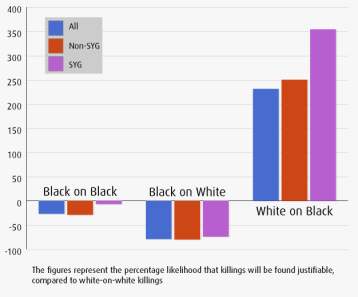
Chart Of The Week

A reader writes:

I’m surprised that you repeatedly posted that chart about the Stand Your Ground results compared to white-on-white incidents without attribution. It’s a great chart, and the difference so stark, that it begs for attribution.

We subsequently updated the posts with a link to the study – by John Roman of the Urban Institute’s Justice Policy Center, via PBS’s Frontline, which followed up with Roman to create the chart. Another reader picked up on Roman’s study:

I was amazed by the graph you’ve posted several times this week regarding percentages 11of justifiable homicides between the races.  It was troubling enough that I decided to track down the source of the study.  In doing so, I found out an even more amazing statistic.  The study looked at all 73,000 homicides between 2005-2009.  It then separated all of the homicides where one stranger killed another stranger, similar to what occurred in the Trayvon case.  Finally, the study separated those instances by race.  Of the 73,000 homicides in that time period, only 23 were one white person killing one black person.  23!  From the media coverage this weekend, I thought the number was probably in the thousands.  The small sample size makes the significant portion of the graphic you posted basically worthless.

I don’t think it makes the chart worthless. But it’s an important piece of perspective. Update from a reader:

The reader is fundamentally confused on the difference between a random sample survey and a census or direct reporting of observed data.  For a survey, you need to reach a certain number of responses/cases randomly selected from the total universe of potential respondents or cases to achieve statistical validity.  But if you’re reporting the actual, total data for a universe of observed people or phenomena, there’s no “sample size” involved – you’re reporting the facts.

Another critique:

Income is absent from this chart. Did it occur to you that perhaps the white people were wealthier and had better lawyers? Maybe the amount paid for lawyers correlates to the efficacy of those lawyers? (It stands to reason that lawyers that can charge more get their way more often; why would anyone pay more for them if that weren’t true?) In fact, nationally, white men earn 150% of what black men earn.

Another builds on that point:

Look at OJ – a rich black guy was able to kill two white people and get away with it, even with what looked like a very good case.  How? MONEY – he had a lot of it and bought the best lawyers he could to buy his freedom.  I suspect many of the white dudes in the chart that beat their case because of their ability to put up a vigorous defense, or at least threaten to do so. So the chart does show that SYG makes it easier to beat a murder charge, but it doesn’t show that whites (or Hispanics) are getting away with murder with a sly wink of a racist society.  I’d also like to see more detail from the chart as well, such as the location and situation of the relative incidents.  It’s possible that there are a lot of other factors involved.

The Tragedy Of Trayvon: Reader Odds And Ends

Some remaining thoughts on the Zimmerman-Martin saga:

Each man likely was scared of the other. Each man likely thought he was fighting for his life.  Martin, because a stranger was following him with a gun.  Zimmerman, because he did not know if Martin was armed. Their mutual panic spiraled first into a fight, and then into a life-and-death struggle fueled only by fear of the other’s intentions.

I’m a gun owner, but this is what scares me most about guns.  If two men are fighting, and one notices the other has a gun, won’t the one without the gun naturally fear for his life?  Won’t this fear lead him to escalate the situation by trying to grab the gun, or disable the other by slamming his head into the concrete?  Won’t the man with the gun, seeing the escalation, choose to use his gun rather than risk serious injury, or the other man taking the gun away and using it against him?  Won’t both men be acting in self-defense?

Another reader:

Imagine that Martin is also armed, legally possessing a handgun, on the night of his killing. Is there a point in his confrontation with Zimmerman where he is legally justified to shoot Zimmerman in self-defense? It seems to me that Stand Your Ground laws give an incentive to use lethal force in confrontations with even potential for physical violence … and also to shoot first.

Another:

I’d like to raise one more point in this conversation which keeps being overlooked both in this specific case and the gun discussion in general: Why does any conversation about self-defense tumblr_mpz9xoYIvJ1qz4e1ro1_1280focus on lethal gun use? Zimmerman could have used mace or pepper spray. He could’ve used a Taser. He could’ve used rubber bullets or a bean bag rifle. He could’ve shot Martin in the thigh or right shoulder.  And on and on.  But his chosen method of self defense was to shoot Martin in the area of the heart using bullets intended to inflict massive internal injuries.

Like you, I’m a small “c” conservative. To me, those are the “conservative” approaches to self-defense.  Shoot to kill first and ask questions later is the opposite. We apparently had a black woman in Jacksonville use a more conservative approach to self-defense by firing warning shots, and she is sentenced to prison for 20 years. What is the message being sent here?

Another:

I think it’s a bit dishonest to proclaim that Zimmerman confronted Trayvon without attempting to address the four-minute delay between the time Zimmerman told the dispatcher he lost sight of Trayvon and the start of the fight between the two.  Keep in mind, Trayvon was about two blocks from his house when Zimmerman lost sight of him, yet, almost four minutes later, a fight occurred closer to Zimmerman’s truck than to Trayvon’s house. This was one of the defense teams main arguments in trial, yet conveniently enough, it goes unmentioned by virtually every serious journalists and commentator.  And while this four-minute gap isn’t dispositive one way or another, it is pretty deceitful to leave it out of all analysis.

Glad to include it. Another:

Something I haven’t seen brought up in the Trayvon Martin case: In 2005 Zimmerman is arrested for “resisting officer with violence” and “battery of law enforcement officer.” But he wrote in his application to the Seminole County Sheriff’s Office Citizens Law Enforcement Academy that “the officer assaulted me first”.

Later that year, his fiance accuses him of domestic violence and takes out a restraining order on him. But he responded by taking out his own restraining order to protect himself against her. Finally we have this case, where Zimmerman claims that a kid who is running away suddenly, for no apparent reason, changes his mind and attacks Zimmerman.

The poor guy can’t catch a break! People keep attacking him, and then they (or the liberal media) claim that he attacked them!

In all seriousness, I think it would have been useful for the prosecution to present witnesses (the cop, the fiance) who could testify that Zimmerman was in the habit of assaulting people and then claiming that they assaulted him.

Another:

Did you know that George Zimmerman’s cousin accused him of molesting her beginning at at age 6, and it allegedly went on for several years? She said that her parents found out and confronted Zimmerman and that he admitted to the molestation. Why was this not admitted at trial, particularly since the defense was trying to admit things (and may actually have) from Trayvon Martin’s past?

One more:

I’ve been biting my tongue out of professional courtesy (I’m a prosecutor), but there is an issue here that isn’t getting enough attention: The prosecutors did a terrible job.

You noted that the juror conceded that one of the most important facts – that Martin was “suspicious” because he was walking in the rain – came from Zimmerman.  True, but he didn’t testify to that. Instead, the prosecutors inexplicably played a video of his self-serving explanation of that night.  They had no obligation to play that video, his explanation wasn’t subject to any cross-examine action, and he exonerated himself.  By playing it, they ensured he would never testify and thus be subjected to the cross-examination the prosecutor now says he was “praying” for.  It was obvious at the time this was a terrible decision.  This was their biggest blunder but there were many others; these folks were grossly incompetent.

Update from a reader regarding the molestation allegations:

Sometimes I forget that not everyone is a trial attorney like I am.  In all likelihood, the reason the prosecution did not attempt to enter this evidence is that it knew it was not admissible.  Evidence of prior bad acts in order to show character or conformity of behavior are almost never admissible.  The basis for this rule of evidence is that defendants are to be judged on what happened in this specific case, not what has the defendant done in the past.  The same logic kept out most of Trayvon’s past transgressions as well, if not all of them.

The same rationale applies to your reader’s suggestion that the evidence of Zimmerman’s prior claims of self defense should have been put into issue.  However, repeated self-defense claims and the self-defense claim in the Trayvon case could have caused this to be either “habit” evidence or permissible character evidence.  I don’t practice in Florida so cannot claim expertise of their rules of evidence.  But here the legal nuances are at least very interesting.  The sexual assault allegations would never be admitted.

Imagine if every trial became a list of horribles against the defendants?  We’d be persecuting people for their character, not prosecuting them for crimes.

And The Greatest American Novel Is …

Tom Ferraro makes the case for Mario Puzo’s The Godfather, “the most read adult novel in history and the most influential single act of American creativity of the second half of the American century”:

The Godfather was written in 1969 and can be read as a dramatic response to a pivotal moment in American history.

Puzo substituted the Corleones’ tactical genius for our stumbling intervention in Vietnam; he traded the family’s homosocial discipline and female complicity for women’s liberation; and he offered the dream of successful immigrant solidarity in place of the misconstrued threat of civil rights and black power.

Yet like any profound myth narrative, The Godfather reads as well now as then. Its fantasy of perfect succession, the son accomplishing on behalf of the father what the father could not bear to do, is timeless. And Puzo’s ability to express love and irony simultaneously is masterful: the mafia is our greatest romance and our greatest fear, for it suspends our ethical judgments and binds us to its lust for power and vengeance. Of course, our immigrant entrepreneurs, violent of family if not of purpose, keep coming. Even Puzo’s out-sized vulgarities illuminate, if you can hear their sardonic wit.

After Puzo, none of America’s epic stories, Ahab’s or Gatsby’s, Hester Prynne’s or Invisible Man’s, reads exactly the same. And that is exactly the criterion of T.S. Eliot’s admission to the “great tradition.” The Godfather teaches us to experience doubly. To enjoy the specter of Sicilian otherness (an old-world counterculture, warm and sexy even in its violence) while suspecting the opposite, that the Corleones are the hidden first family of American capitalism. In Puzo’s omerta, the ferocious greed of the mafia is all our own.

A Long History Of Social Reading

dish_schoolofathens

The shareable commenting features on e-readers may seem like a novelty, but reading has been a “social” activity far longer than it’s been a solo one:

Homeric poetry and other oral genres were recited to crowds for centuries before the notion of reading came around. The most beautiful depiction of learning in Western art may be Raphael’s School of Athens, which shows Socrates speaking as disciples surround him, listening and taking notes.

After writing became more widespread, it was often a prompt for speaking, something one used as an aid in orating, reciting, or declaring to others. When Saint Augustine watched Ambrose read a book without moving his lips or making any sounds, he was shocked: Until about the eighth century, most people read by reading words out loud.

No one was curling up with the large, bulky, vellum-and-wooden books that were kept chained to desks in monasteries. This kind of “social reading” continued throughout most of the Middle Ages, as scribes copying manuscripts assumed readers would enunciate the words they saw on the page. Written texts developed from and aided oral communication, and since there are no commas or capital letters in speech, there were initially no spaces between words, no lower-case letters, and no punctuation in manuscripts, either. THEIRSENTENCESLOOKEDLIKETHIS.

As late as the 19th century, Victorian readers could still often aptly be called “listeners” as they sat in chairs in a circle lit by candlelight, with one person reading out loud the copy of the latest triple-decker installment of, say, a Dickens novel. Even for us moderns, reading can be construed as an inherently social act, not as in “sitting in a room with others” but as in “together, alone.” Reading can be one of the most profound encounters a human can have, revealing the inherently connective tissue that is human consciousness. As David Foster Wallace put it: “Fiction, poetry, music, really deep serious sex, and, in various ways, religion—these are the places (for me) where loneliness is countenanced, stared down, transfigured, treated.”

(Image: The School of Athens by Raffaello Sanzio, 1511, via Wikimedia Commons)

Revisiting Dune

Jon Michaud urges you to read or re-read Frank Herbert’s 1965 sci-fi classic:

With daily reminders of the intensifying effects of global warming, the spectre of a worldwide water shortage, and continued political upheaval in the oil-rich Middle East, it is possible that “Dune” is even more relevant now than when it was first published. If you haven’t read it lately, it’s worth a return visit. If you’ve never read it, you should find time to.

Like the best science-fiction and fantasy novels, “Dune” creates for the reader a complex, fully-realized universe. … This is … a universe of Machiavellian realpolitik, science fiction through the prism of the Cold War. There is little that is cute or cuddly: no furry-footed Hobbits, no teddy-bear-like Ewoks. (In fact, the cutest thing you’ll see in a copy of “Dune” is the author photo: bald, bearded, and smiling, Herbert could pass for one of Tolkien’s dwarves.) Even the hero, young Paul Atreides, stuns his mother with his unsentimental reaction to his father’s death. Instead of grieving, he immediately begins plotting the overthrow of his adversaries. This is terrain that is familiar to readers of George R. R. Martin’s “A Song of Ice and Fire.” Herbert’s scheming, backstabbing villain, the Baron Vladimir Harkonnen, would be perfectly at home among the Lannisters of Westeros.

Michaud guesses why the book lacks obsessive devotees on par with Lord of the Rings or Star Wars:

Perhaps one explanation for “Dune”‘s lack of true fandom among science-fiction fans is the absence from its pages of two staples of the genre: robots and computers. This is not an oversight on Herbert’s part but, rather, a clever authorial decision. Centuries before the events described in the novel, humans revolted and destroyed all thinking machines. “The god of machine-logic was overthrown,” Herbert writes in an appendix, “and a new concept was raised: ‘Man may not be replaced.’ ” This watershed moment, known as the Butlerian Jihad, resulted in a spiritual awakening, which put into place the religious structures that ultimately produce the messiah, Paul Atreides. There is no Internet in Herbert’s universe, no WikiLeaks, no cyber war. This de-emphasis on technology throws the focus back on people. It also allows for the presence of a religious mysticism uncommon in science fiction. It’s a future that some readers may find preferable to our own gadget-obsessed present.

Spellchecking Your Blindspots

Michael Keller ran a bunch of misspelled words through an iPhone simulator to see which topics Apple doesn’t autocorrect:

Our analysis found over 14,000 words that are recognized as words when spelled accurately, but appointment-kathithat won’t be corrected even when they are only slightly misspelled. However, the vast majorityof these words are technical or very rarely used words: “nephrotoxin,” “sempstress,” “sheepshank,” or “Aesopian,” to name a few.

But among this list as well are more frequently used (and sensitive) words such as “abortion,” “abort,” “rape,” “bullet,” “ammo,” “drunken,” “drunkard,” “abduct,” “arouse,” “Aryan,” “murder,” and “virginity.”

We often look to technology to make our lives easier—to suggest restaurants, say, or to improve things as simple as our typing. But as more and more of our speech passes through mobile devices, how often is software coming between us and the words we want to use? Or rather, when does our software quietly choose not to help us? And who draws the line?

A commenter makes an obvious counterpoint:

I’m not the engineer in charge of this, but if I *WERE*, I’d probably have been told that my boss didn’t want to see users complain about spellchecks turning innocent typos into offensive words. The best way to do that would be to mark the word as something that the dictionary wouldn’t complain about, but that would never feature in those “Damn You, Spellcheck!” websites or tweets.

If that’s the case in reality (and it certainly seems likely enough), it’s not censorship and it’s not squeamishness. It’s Apple helping the majority of users from having little mistakes escalate into major embarrassments.

Racism And Richard Cohen’s Reality

Richard Cohen is cutting edge for 1988. In fact, a huge amount of the op-ed crap published by Fred Hiatt appears to be frozen from the time liberals decided it was time to move to the center-right. I think they were as right to do so in the late 1980s as they are wrong to cling to that position as if it is embalmed in aspic today.

So Cohen describes what he calls a “uniform” that young black men wear that legitimately tumblr_mpz9xoYIvJ1qz4e1ro1_1280causes fear among whites (and presumably blacks too). For twenty years, as I wrote earlier, I lived on a crime-charged corner in DC, where the 17th and Euclid gang still operates (and I hope to return). For the first ten years, it was sometimes hard to get people to visit me (not that I did much entertaining). And they weren’t crazy. It was a crime-ridden hood. I lived through several murders on my block, a dead body found in my alley way, and a bullet that came through my upstairs neighbor’s window.

But I honestly never felt any real fear simply being around young black men in the hood. And I still don’t. Yes, if I saw drug deals from my window, I took pictures in case the police needed help. Yes, I could see that most of the miscreants were black men – but that could have been said of my neighbors who played basketball, or hung out on the local stoops. I lived by minding my own business, something Zimmerman could have done as well.

I think it may be the fact that I wasn’t born or raised in America; or obliviousness; or a simple, growing awareness of how many young black men are in no way related to that kind of violence – because I lived among them; or aware that I was a familiar face and so in no way a threat. But I never felt fear. Hoodies were not a “uniform”, either, unless there’s been a fashion craze since I left for New York. What Richard Cohen is describing in his attempt at political incorrectness is a vision in his own head that equates all young black men he may come across with the potential to kill. I can’t think of a word to describe lumping everyone of a certain race, gender and clothing into a category of potential murderers other than, yes, racist. Can you?

There’s no question that young urban black men commit a disproportionate number of crimes, compared, say, with young white men.

If you look at homicide, you’ll see, however, that a white person is far, far more likely to be killed by another white person than by a black one. 83 percent of white murders were committed by whites. In 2011, only 448 black men killed a white person in America. In a country of 300 million, that means that Richard Cohen’s fear of the young black men is as unjustified as Zimmerman’s description of Martin as a punk. The percentage odds of Richard Cohen being killed by a young black man is 0.00015 percent. And yet he’s scared. I guess it’s clarifying to have this fact of human nature expressed in a column. But it doesn’t make it any less repugnant.

Elspeth Reeve covers the rest. This is for me her best point:

“Urban crime” is shorthand for young black people committing crimes in big cities on the verge of collapse. But Martin wasn’t killed in Cabrini-Green. He was killed in Sanford, Florida (population 53,570), inside a gated community called the Retreat at Twin Lakes, which has about 260 townhouses. The alleged crime was a suburban crime. And, just for the record, it was not the black kid who was just acquitted of it.

(Photo-image by from the Tumblr “While Seated” by Michael David Murphy.)

What Would Actual Conservative Foreign Policy Look Like?

Jennifer Rubin says it should strike “a middle ground between unbridled intervention and neo-isolationism”:

Finding a conservative middle ground that incorporates the lessons of the past decade should be the work of elected Republicans, former officials and think-tank gurus. They must present a foreign policy that maintains (or restores, when Obama leaves) American supremacy in the world and is also politically sustainable.

Larison pounces:

Since neo-isolationism doesn’t really exist and even Rubin wouldn’t claim to favor “unbridled intervention,” we can be confident that the “middle ground” Rubin refers to here is not a compromise between her hard-line, aggressive foreign policy and a foreign policy characterized by restraint and respect for the limits of American power. By setting up two extremes that virtually no one favors, Rubin is resorting to the time-honored tactic of presenting her own position as the “middle ground” that will satisfy most conservatives and Republicans.

He describes the conservative foreign policy he’d like to see:

A conservative alternative to Obama’s foreign policy wouldn’t automatically support all or even most U.S. overseas commitments, but would reduce those commitments when regional allies and rising powers have the resources to assume responsibilities for security in their own parts of the world. It wouldn’t treat “American supremacy” as an end in itself, and it would recognize that America’s post-WWII and post-Cold War roles were exceptional ones that needn’t and shouldn’t be emulated forever. Unless a treaty ally is attacked, a conservative foreign policy wouldn’t allow the U.S. to be pulled into conflicts where the country’s security wasn’t at stake for the sake of preserving “credibility” or supposed allied solidarity. It also would oppose waging wars of choice.

Ask Michael Hanna Anything: Next Steps For Egypt

In today’s video, Michael explains why Egypt’s military and political leaders must pursue reconciliation and reform if they want the current transition to be successful:

Meanwhile, last night in Egypt there were more deadly clashes between security services and pro-Morsi protesters. Last week, Ahmad Shokr offered a succinct overview of Egypt’s precarious new order:

Egypt is still ruled by the armature of the old regime. Two and a half years of elite factionalism — the inability to forge a stable alliance — have set off a game of musical chairs. In this period, the momentum has rotated among Islamists, liberals, state bureaucrats, businessmen, military and security officials, and Mubarak-era dregs. They share a fetish for capturing the state but also the lack of a novel vision for dealing with Egypt’s deep structural problems. Attempts by any combination of these figures to restore full-fledged authoritarianism are likely be tempered by some level of public disobedience. At the same time, there is no revolutionary coalition strong enough to begin overturning the undemocratic and inegalitarian legacies of previous regimes. A balance of weakness has set in whereby no side in Egyptian politics is able to claim outright victory.

More distressing, perhaps, is a societal mood that is becoming more inclined toward intolerance and scapegoating.

Egypt’s unsavory climate of chauvinism, intransigence, opportunism and deceit from almost every side has been made worse by Mursi’s ouster and its bloody aftermath. Media outlets are constantly in search of fifth columnists to demonize, whether as “terrorists” or as “infidels.” The Brothers are portrayed as traitors with a penchant for violence who must be forcibly subdued. For their part, the Brothers paint the revolt against their rule as a little more than a conspiracy hatched by the old regime. They insist their resistance to the army is peaceful, but the string of violent acts by Mursi supporters — the killing of protesters in Cairo and Alexandria, the intimidation and mob attacks directed at Christians in Minya and Marsa Matrouh — tells a different story. There were even accusations that the interim president is secretly a Jew.

Thanassis Cambanis remains confident in Egypt’s revolutionary people-power:

Egypt can survive many more waves of revolt, election and coup, and it will, until the political order begins to reflect more of the will of the people. The latest roadmap repeats most of the mistakes of 2011 (for detailed explanations of how, read Nathan Brown and Zaid Al-Ali). The Egyptian public has developed a profound intolerance for arbitrary authoritarian rule; for opaque, paranoid leaders; for governments that ignore the country’s collapsing economy and standard of living.

Revolutionaries might not represent the majority, but they are now a maturing, key constituency. They are unlikely to embrace fascism or fiats from anyone: not the military, not the Brotherhood, not the old political parties. That’s the underlying signal of Egypt’s latest revolt. Until Egypt’s power brokers recognize the core demands of the public and begin to address them, the public isn’t likely to go away.

Michael Wahid Hanna is a Senior Fellow at The Century Foundation, where he works on issues of international security, international law, and US foreign policy in the broader Middle East and South Asia. He appears regularly on NPR, BBC, and al-Jazeera. Additionally, his Twitter feed is a must-read for anyone interested in Egyptian politics. Michael’s previous answers are here. Our full Ask Anything archive is here.