When Will The GOP Remake Itself?

Cassidy wonders:

Could the party really remain in thrall to the God, guns, and anti-government brigade until Ronald Reagan returns to save us all from eternal damnation? That’s doubtful. Clearly, though, the adjustment process is going to take more time. How much more? At this stage, it is looking like at least another four years—time enough for the party to suffer a third straight crushing defeat at the Presidential level. Based on history and common sense, that will probably be enough to give the reformers the upper hand. With today’s G.O.P., though, you never can be sure.

Larison doubts that three defeats will be enough:

[I]nstead of grappling with what Bush did wrong, they have spent a lot of their time inventing a mostly fictional Obama record to run against. Making some changes on foreign policy–even superficial and rhetorical ones–seems an obvious way to address one of the party’s serious weaknesses, but there has been no movement on this except among a handful of members of Congress. The point here isn’t that foreign policy reform would be a panacea for the GOP or that it would remedy that many of the party’s electoral weaknesses, but that it is one of the more glaringly obvious opportunities for reform and a relatively easy way to break with the disasters of the Bush years. Despite that, there seems to be very little interest in it.

Kilgore explains such lack of interest, noting that the Republican coalition includes many people who don’t agree with the conventional wisdom “on how to win elections, don’t care about short-term political implications, or don’t care about anything other than expressing their opinion about the hellwards direction of the Republic and perhaps of the human race”:

Mix in another significant number of people with a large pecuniary interest in reactionary politics, and you have a movement that’s not going to turn from its current trajectory with any great speed. You can stamp your feet or call them crazy people or deplore their impact on the level of discourse all you want, but they just aren’t going away, and we might as well get used to it instead of marveling about it as though it came out of nowhere and will soon disappear.
PTSD In The US vs UK

In American veterans, rates of post-traumatic stress typically range from 10 to 17 percent, but among British veterans, the rate is closer to 4 percent. David J. Morris explains how that discrepancy has little to do with a “stiff upper lip”:

P.T.S.D. cannot be reduced to a simple matter of differing cultural attitudes. Within the field of P.T.S.D. research, there is a concept known as “the dose-response curve.” In simple terms, the more horror and death you are exposed to, the more likely you are to experience post-traumatic stress. (This is not limited to shooting combat; it encapsulates exposure to any life-threatening danger.) And Americans have been exposed to a lot more horror and death than their British counterparts.

When I asked Matt Friedman, the director of the National Center for P.T.S.D., about the differing diagnosis rates and what this might mean for American psychiatry, he seemed to grow irritated. “The Brits were down in Basra. Ain’t nothing happening down in Basra,” he said. In a letter responding to the original Lancet study that compared P.T.S.D. rates of American and British veterans, Charles Hoge and Carl Castro, P.T.S.D. researchers at the Walter Reed Army Institute of Research, made this very point, writing that “only 17% of UK service members reported discharging their weapon, compared with 77-87% of US service members; 32% of UK service members reported coming under small arms fire, compared with more than 90% of US service members.”

Morris zooms out:

The growing criticism of our current understanding of P.T.S.D. suggests that what was once ignored or treated as a failure of character—the soldier’s weakness—has now been medicalized to the exclusion of discussing its moral and spiritual dimensions. “It feels to me as if the U.S. civilian population has pathologized the veteran experience,” Elliott Woods, an Iraq veteran-turned-reporter, told me not long ago. “One well-intentioned person said to me the other day, ‘I can’t see how anyone could go to Iraq and not come back with P.T.S.D.’ ” Yet our social mechanisms for dealing with that problem are weaker than they should be.

Previous Dish on PTSD here, here, and here.

Chart Of The Day

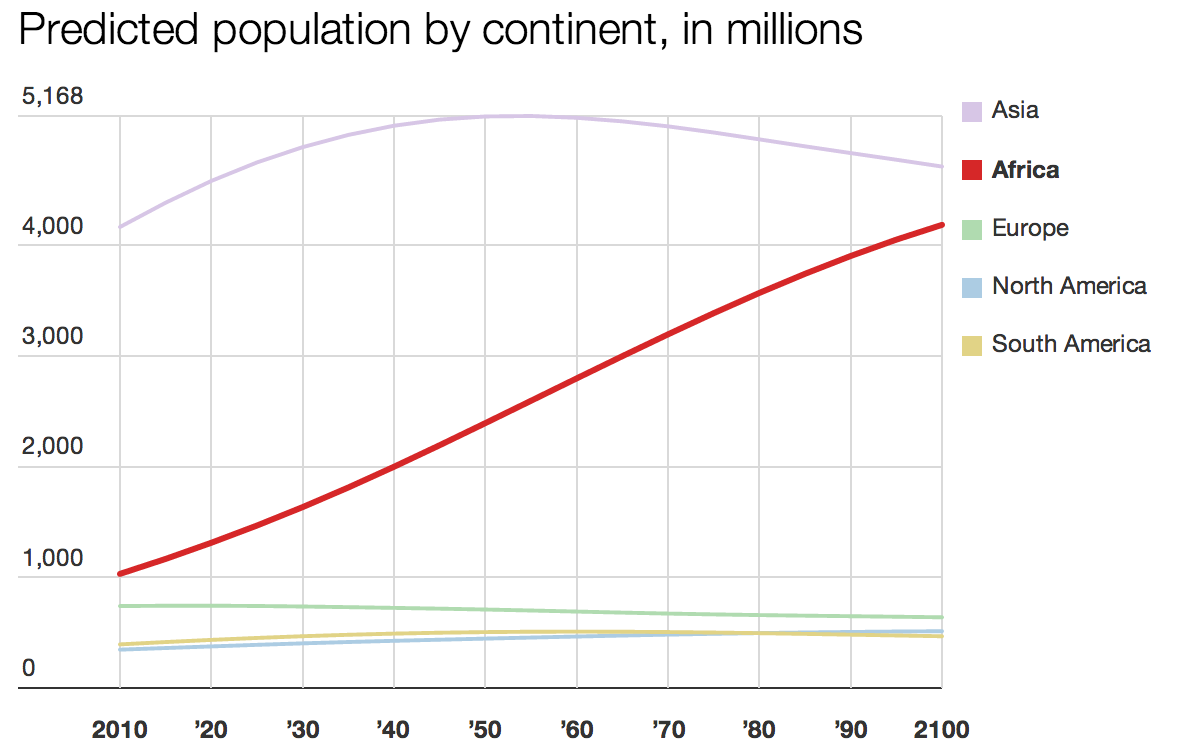
World Population

Africa’s population is projected to skyrocket:

Right now, with a couple of exceptions, Africa’s population density is relatively low; it’s a very big continent more sparsely populated than, say, Europe or East Asia. That’s changing very quickly. The continent’s overall population is expected to more than quadruple over just 90 years, an astonishingly rapid growth that will make Africa more important than ever. And it’s not just that there will four times the workforce, four times the resource burden, four times as many voters. The rapid growth itself will likely transform issues within African countries and thus their relationship with the rest of the world.

Nigeria is expected to become one of the world’s largest countries:

In just 100 years, maybe two or three generations, the population is expected to increase by a mind-boggling factor of eight. The country is already troubled by corruption, poverty and religious conflict. It’s difficult to imagine how a government that can barely serve its population right now will respond when the demand on resources, social services, schools and roads increases by a factor of eight. Still, if they pull it off – the country’s vast oil reserves could certainly help – the rapidly growing workforce could theoretically deliver an African miracle akin to, say, China’s.

The New Newsroom

After watching the first four episodes of The Newsroom’s second season, Marc Tracy concludes that creator Aaron Sorkin has become more self-aware:

[T]he most important change Sorkin has made is to the show’s structure, using its episodes to tell one ongoing story. And so the story—and the season—is told in flashback, as network lawyers interview various staffers at a gigantic conference-room table in preparation for a wrongful termination lawsuit surrounding a blockbuster story that the show-within-the-show, “News Night,” has had to retract. (The device would remind you of The Social Network even if you didn’t know Sorkin had written it.) The result is a cross between one of those six-hour BBC series—an association further suggested by the new, slicker opening credits—and a sitcom. The overarching storyline gradually unfolds, while the episode-specific subplots come fast and furious, and with a discipline that didn’t exist on the one actual sitcom Sorkin did, ABC’s “Sports Night.”

Making the season-long arc about a faked news story solves another of the haters’ complaints. It no longer seems so absurd to watch a show intimately tied to two-year-old current events when the dramatic weight is placed overwhelmingly on a fabrication and the actual news pegs are relegated to comedy or, at least, decidedly minor drama.

Nevertheless, Alyssa thinks the show remains flawed:

The problem with The Newsroom, I think, is that no one comes across as particularly competent, both by design and by accident. Women on the show tend to be dippy, impulsive, prone to attacks on their technology, rants on the street, or attacks of principle that are bad for ratings. But men can be high-handed, obsessive about conspiracy theories, stories without ratings draws, or their ex-girlfirends, or oddly naive, as is the case with Jim’s (or the show’s) lack of awareness that since outlets pay for seats on campaign buses, the Romney staff can’t actually kick him off. What the show identifies as moments of journalistic bravery are significantly driven by the fact that Will McAvoy is based on Keith Olbermann, and so a ranting answer to a question, or a special comment during a broadcast get more points than actual reporting, or driving new subjects into the news stream the way Rachel Maddow did with national security.

Alison Agosti hated the first season but feels compelled to see the show through:

In general, if a show starts to drag or if a character gets amnesia or something, I’m out. Yet Sorkin has created something perfectly infuriating, where I’m not sure that I’m enjoying it, but I am completely engrossed. I want to see what he going to do next, what new inanimate objects Maggie will trip over. Quite frankly, I’m really looking forward to rolling my eyes so hard I’m worried they’ll fall out of my head when Will and Mackenzie inevitably get back together.

Previous Dish coverage of The Newsroom here, here, here and here.

“Even If You’re A 300-Lb Black Kid, You Still Wanna Be Calvin”

Scott Beggs is super-psyched about the upcoming documentary on the creator of Calvin and Hobbes:

To get an idea of how long Dear Mr. Watterson has been in the works, consider that its creator Joel Schroeder posted a teaser trailer for it three years ago. And that was years after he’d started working on it. Fortunately, it was the exact kind of thing that Kickstarter was built for, and after 2,083 backers representing over $120,000 chipped in, the film is finished. Now, according to Variety, the “Calvin & Hobbes” documentary will see theaters and VOD on November 15th.

As you can imagine, it chronicles Bill Watterson’s monumental creation and its influence — specifically by featuring conversations with the likes of Berkeley Breathed (“Bloom County”), Bill Amend (“Foxtrot”), Seth Green and more. … Awesome, awesome, awesome news. Times a million. I don’t even know what else to say.

A reader does:

Calvin & Hobbes is the best comic ever. There is such joy and adventure and heart and just enough mischief.

Bill Watterson’s complaints when he retired were that the newspapers wanted the comic in a set form and he hated when they shrunk the strip down too much. A website where he had complete creative control over how the subscribers saw his work would eliminate all of that. If Watterson ever wanted to create a site where one paid him directly for a weekly or even monthly strip, I’d sign up in an instant.

Is Wikileaks Ready For Its Close-Up?

Garance previews the upcoming Wikileaks movie, The Fifth Estate:

Based on Daniel Domscheit-Berg’s book Inside WikiLeaks: My Time with Julian Assange at the World’s Most Dangerous Website and David Leigh and Luke Harding’s WikiLeaks: Inside Julian Assange’s War on Secrecy, the film covers the heady early days of the site and appears from the trailer, which was just released, to cast Assange as a heroic visionary who takes things too far. “You can’t change change the world without crashing the system,” the movie trailer says. It would seem an apt tagline for Snowden’s activities, too — and a reminder that it’s only a matter of time before he also becomes the ripped from the headlines personality at the center of a major film.

David Haglund considers Julian Assange’s own response to the film’s script:

Julian Assange has called The Fifth Estate, the upcoming movie in which he is played by Benedict Cumberbatch, “a serious propaganda attack on WikiLeaks.” (This was after reading an early version of the script.)

You certainly don’t get that impression from the first trailer, which—though it notes that some people deem Assange a “traitor”—has a decidedly pro-WikiLeaks vibe, presenting its story as one of the people against the powerful. (The title references citizen journalism, the “fourth estate” being a nickname for the professional press.) Then again, Assange is a guy who decided his own (ghostwritten) autobiography was not flattering enough, so perhaps no film would have been hagiographic enough for his taste.

More Dish on leaking on the big screen here.

Super-Sizing Movie Monsters

Wesley Morris was impressed by Pacific Rim‘s scale:

Del Toro is a dreamer. He’s a visionary. If you give him a pile of money to make enormous robots fight enormous monsters at the end of civilization, he will work to make Pacific Rim a movie that makes you feel all the enormousness. He will put you at the feet of the monsters and inside the bellies of the beasts. He will do what a movie about big reptiles and big machines is supposed to do: make you look up, make you feel as if the screen is grossly inadequate to contain what’s on it, even though, if you’re charmed — or strategic — you’re already watching the movie on the biggest screen you possibly can.

Tasha Robinson ponders the meaning of the massive monsters in the movie:

[Del Toro’s] discussions of the film suggest its overriding message is “Japanese monster movies were totally badass.” He seems more interested in enthusiastically paying homage to entertainment he loves—rubber-suit monsters and anime from Voltron to Neon Genesis Evangelion—than in tapping into current cultural or societal anxieties. Certainly returning to the nuclear panic of the 1960s, the heart of the kaiju boom, would feel dated at this point.

If you need a metaphor, though, I think you can dig one up: Pacific Rim’s kaiju are a devastating worldwide threat that can hit anywhere at any time, and dealing with them is expressly beyond the resources of any one country.

As del Toro said in his interview with Slashfilm, he wanted them to feel like “a charging force of nature.” So if there’s a metaphor at work, I’d say it’s global climate change, and the fear that it’s producing increasingly deadly events like the 2004 Indian Ocean tsunami, the 2011 Japanese Pacific-coast tsunami, and the 2010 Haiti earthquake, not to mention disasters like Hurricane Katrina. The kaiju could well be symbols of these huge, unpredictable events, and the need for a unified global response.

Jeff Yang relates the monsters to Japanese culture:

In Shinto belief, all objects have spirits, and all spirits have the ability to become gods — or demons. “Japanese monsters, or yokai, were originally called ‘bakemono’ — literally, ‘transformed thing,’” says [Matt Alt]. In Japan, “robots are an anthropomophization of the power of technology, [and] the organic kaiju are an anthropomorphization of the power of nature, or of the effects of human technology on it.”

As a result, the titanic clashes of the kaiju and mecha genres aren’t just sequences of gleeful destruction for destruction’s sake — they’re metaphysical conflicts; wars of ideas as much as anything else.

Matt Singer focuses on another aspect of the film. He couldn’t stop wincing while listening to Pacific Rim star Charlie Hunnam, who is British, try to pull off an American accent:

[W]e keep getting these uncomfortable performances from hunky international heroes like Hunnam, Worthington, and Butler, who look great but sound terrible. Maybe that’s another manifestation of the rise of international box office as a driving force in Hollywood. Massive special effects travel; regional cultural nuances do not. Movies made for a global audience put spectacle at a premium over everything else. In most foreign markets, the dialogue is going to be subtitled or dubbed anyway, so the spoken word moves even lower on the film’s list of priorities. People come to see Charlie Hunnam fight the monsters, not talk them to death.

Forrest Wickman, on the other hand, thinks the increasing importance of foreign markets isn’t all bad. He notes that they “offer the incentive to make use of more diverse casts, and to tell more stories whose heroes aren’t exclusively American.”

Repeal “Stand Your Ground” Laws

A reader sends a fascinating examination of how the new law has affected Florida. It’s from last month in the Tampa Bay Times but reads even more powerfully today. Money quote:

The number of [SYG] cases is increasing, largely because defense attorneys are using “stand your ground” in ways state legislators never envisioned. The defense has been invoked in dozens of cases with minor or no injuries. It has also been used by a self-described “vampire” in Pinellas County, a Miami man arrested with a single marijuana cigarette, a Fort Myers homeowner who shot a bear and a West Palm Beach jogger who beat a Jack Russell terrier.

People often go free under “stand your ground” in cases that seem to make a mockery of what lawmakers intended. One man killed two unarmed people and walked out of jail. Another shot a man as he lay on the ground. Others went free after shooting their victims in the back. In nearly a third of the cases the Times analyzed, defendants initiated the fight, shot an unarmed person or pursued their victim — and still went free.

No wonder Zimmerman felt able to stalk Martin. What did he have to lose when he could simply kill the dude anyway and get away with it? Worse, the law is subject to huge discrepancies depending on the case, the jury, the prosecutors, etc. It’s enforced with wild inconsistency, as illustrated in the above video.

To my mind, it’s a return to the Wild West, where murderers walk the streets with no fear and plenty of opportunities for gunning down foes, rivals, family members, exes, and on and on. It’s completely out of control:

Drug dealers have successfully invoked “stand your ground” even though they were in the middle of a deal when the shooting started. In Daytona Beach, for example, police Chief Mike Chitwood used the “stand your ground” law as the rationale for not filing charges in two drug deals that ended in deaths. He said he was prevented from going forward because the accused shooters had permits to carry concealed weapons and they claimed they were defending themselves at the time. “We’re seeing a good law that’s being abused,” Chitwood told a local paper.

No, we’re seeing a terrible law having completely predictable consequences. I note that the governor who signed this provision into law was Jeb Bush. Perhaps someone could ask him how he feels about it now?

An Authoritarian Fanatic For Wyoming

Liz Cheney is running for Senate:

Larison wonders what her candidacy is trying to accomplish:

It goes without saying that there is nothing wrong with challenging incumbents, and launching intra-party challenges can be an important means to hold politicians accountable when they ignore their constituents or cease to be effective advocates for the people that put them in office. The obvious flaw in Cheney’s challenge is that Enzi has done nothing to anger voters in Wyoming or conservatives nationally. Other than trying to re-establish the Cheney family in Wyoming politics, her candidacy serves no purpose.

Friedersdorf reviews her record:

Liz Cheney hasn’t just embraced the objectionable actions and positions of neoconservative Republicans. She has also earned an independent reputation as someone who participates in weak, laughable, and even scurrilous attacks on ideological opponents that can only cast doubt on her judgment and moral character. The weak, laughable attacks are often aimed at President Obama, of whom I am often critical. But even people who hold Obama in low esteem can’t help but feel embarrassed on behalf of commentators who discredit themselves by making absurd claims like, “He’s unwilling to go after the terrorists that are threatening the nation.” To deny Obama’s willingness to go after terrorists is to be deeply ignorant, ideologically blinkered, or a liar. None of those qualities is desirable in an aspiring U.S. Senator.

A TPM reader expects her to lose:

I think Liz Cheney just made a fatal career move. Having lived in WY for 35 years, I do not believe that Liz can beat Enzi. I think this is going to cause all kinds of hard feelings in Wyoming because this kind of disrespect to a man who has done nothing to deserve being disrespected in this way will simply not sit well. It’s a very east coast kind of move (think Cory Booker) and will only serve to remind people that Liz Cheney has absolutely no real history in Wyoming.

She also seems to have forgotten a very basic element of the WY electoral process, i.e., we have same day voter registration and Democrats routinely turn into Republicans when they walk into the polling place for the primary and then switch back to Democrat on their way out. Personally, I’ve done this at least 4 or 5 times and I will surely do it again next year. Democrats often do this simply to meddle in the Republican primary, often to vote for the most conservative crazy in the field. But this time, I am sure a lot of Dems will happily switch just for the joy of voting against Liz Cheney.

What a joy it would be to see this pro-torture talk radio pugilist soundly defeated. But she’ll have neocon money. And her Daddy’s rolodex.

Obamacare Saves New Yorkers Money!

This [NYT] is great news – especially for Dish Publishing LLC – and bad news for those conservatives who loathe the market-friendly insurance exchanges solely because president Obama included them in the ACA:

Individuals buying health insurance on their own will see their premiums tumble next year in New York State as changes under the federal health care law take effect, Gov. Andrew M. Cuomo announced on Wednesday. State insurance regulators say they have approved rates for 2014 that are at least 50 percent lower on average than those currently available in New York. Beginning in October, individuals in New York City who now pay $1,000 a month or more for coverage will be able to shop for health insurance for as little as $308 monthly. With federal subsidies, the cost will be even lower.

Again, it’s worth noting that these efficiencies are gained by competition, an idea that was once pioneered by the Heritage Foundation. Now, their hatred of Obama has made them hate their own policies. Jonathan Cohn goes into more detail on how Obamacare is spurring competition:

New York … seems to be reaping the benefits of a more competitive market. Based on the filings, it appears that some insurers are pricing very aggressively, trying to underbid competitors. Some will price too low, and end up losing money, while others may be saving in ways consumers won’t like—say, by offering very limited networks of doctors and hospitals. But the insurers will find a price that works for them. Meanwhile, people can pick and choose the plan they want, which is something many simply can’t do now because they can’t really compare benefits and prices, or because they lack the money to pay for insurance in the first place. As New York officials pointed out today, per capita health care costs in the state are among the highest in the country. But these new premium rates are actually slightly lower than what the Congressional Budget Office had projected for a nationwide average. That’s an encouraging sign.

Sarah Kliff explains why New York is nonetheless an outlier:

A headline about the health care law driving down premiums, by this level of magnitude, is a rarity. But it shouldn’t be shocking: New York has, for two decades now, had the highest individual market premiums in the country.

A lot of it seems to trace back to a law passed in 1993, which required insurance plans to accept all applicants, regardless of how sick or healthy they were. That law did not, however, require everyone to sign up, as the Affordable Care Act does.

New York has, for 20 years now, been a long-running experiment in what happens to universal coverage without an individual mandate. It’s the type of law the country would have if House Republicans succeeded in delaying the individual mandate, as they will vote to do this afternoon. The result: a small insurance market with very high insurance premiums.

Beutler agrees:

The news out of New York vindicates the consensus view that the mandate-subsidize-regulate policy only works if it includes a mandate, subsidies, and regulations. This vindication couldn’t be better-timed, as the House of Representative gears up to vote on legislation to delay the mandate for a year.

Yglesias adds:

The haters are out in force already on Twitter to observe that this is happening due to special state-specific features of New York that won’t impact people elsewhere. That’s true, but this is a big deal anyway.

The first reason is that New York is a really big state. Its almost 20 million residents account for over 6 percent of the American population. In terms of the number of people impacted, a huge improvement in the health insurance market in New York is a bigger deal than a huge improvement in New Mexico, Nebraska, West Virginia, Idaho, Hawaii, Maine, New Hampshire, Rhode Island, Montana, Delaware, South Dakota, Alaska, North Dakota, D.C., Vermont, and Wyoming combined. So it’s true that if you live outside New York state this is not good news for you, personally. But if you’re capable of some human empathy, then it’s good news for an awful lot of people and you might care about that.