If Immigration Reform Dies

In a post urging Republicans to kill immigration reform, Bill Kristol and Rich Lowry claim that, if “Republicans take the Senate and hold the House in 2014, they will be in a much better position to pass a sensible immigration bill.” Wonkblog pushes back:

The odds that Republicans would go anywhere near immigration reform in 2015 after they painfully, anxiously killed it in 2013 are vanishingly low. But let’s say, hypothetically, they did. It’s easy enough to imagine the Democratic — and Hispanic — response: If Democrats win the White House again in 2016 and increase their numbers in the House and Senate, they will be in a much better position to pass a sensible immigration bill.

That’s the thing about “later” The other side has a vision of it, too.

Waldman contrasts GOP opposition to Clinton’s and Obama’s healthcare bills with GOP opposition to immigration reform:

Those two efforts at health care reform were always understood as a conflict between a Democratic administration seeking a longtime Democratic goal, and Republicans in Congress trying to stop them. It was reported like a sporting event: Clinton loses, Republicans win; Obama wins, Republicans lose. Immigration, on the other hand, has been reported largely as a battle within the Republican party. President Obama, knowing full well that anything he advocates immediately becomes toxic for most Republicans, has been using a lighter touch when it comes to public advocacy for comprehensive reform. I’m not saying he hasn’t been pushing for it, but he hasn’t done the all-out, campaign-style barnstorming tour that would help turn it into a purely Democrats-versus-Republicans issue. The story has always been, “What will the Republicans do?” and if reform goes down, the headlines won’t read, “Obama Defeated on Immigration Reform,” they’ll read, “Republicans Kill Immigration Reform,” with subheadings like “Danger ahead for GOP as Latino voters react.”

Those headlines got more likely today. Brian Beutler reports that “John Boehner stated a specific policy preference Tuesday that will alienate the entire Democratic Party if he adheres to it, and thus doom the reform effort”:

“It’s clear from everything that I’ve seen and read over the last couple of weeks that the American people expect that we’ll have strong border security in place before we begin the process of legalizing and fixing our legal immigration system,” Boehner said outside the Capitol Monday afternoon. … [Boehner’s statement] amounts to a de facto endorsement of the conservative view that any steps to legalize existing immigrants should be contingent upon implementation of draconian border policies. As is Boehner’s custom, it also eschews the word “citizenship,” suggesting that even if Democrats agree to a trigger, he won’t guarantee that it would be aimed at a full amnesty program, and, thus, eventual voting rights for immigrants already in the U.S.

Yglesias dismisses complaints about immigration reform’s border security measures:

The more nonsensical argument I’ve been hearing takes the Congressional Budget Office’s conclusion that the Gang of 8 bill would cut unauthorized migration in half and appends the word “only” to it. Get it? Immigration reformers say their reform bill will secure the border, but in fact it will only cut unauthorized migration in half relative to the current policy baseline. But of course not passing the immigration bill just leaves us with the current policy, which (by definition!) doesn’t cut unauthorized migration at all relative to the current policy baseline. So disappointment about the border security potency of the bill can’t actually be the reason for not passing it. The reason for not passing it would have to be what it plainly is—hostility to creating a path to citizenship for current unauthorized residents of the country that’s so intense that it outweighs other possible benefits of the bill.

The Badass Flight Attendants Of Asiana 214

Lisa Wade hails them:

[I’m] surprised to see almost no discussion of the flight attendants’ role in this “miracle.” Consider the top five news stories on Google at the time I’m writing: CNNFoxCBS, the Chicago Tribune, and USA Today.  These articles use passive language to describe the evacuation: “slides had deployed”; all passengers “managed to get off.” When the cabin crew are mentioned, they appear alongside and equivalent to the passengers: the crash forced “dozens of frightened passengers and crew to scamper from the heavily damaged aircraft”; ”passengers and crew were being treated” at local hospitals.

Only one of these five stories, at Fox, acknowledges that the 16 cabin crew members worked through the crash and its aftermath.  The story mentions that, while passengers who could were fleeing the plane, crew remained behind to help people who were trapped, slashing seat belts with knives supplied by police officers on the ground.  The plane was going up in flames; they risked their lives to save others.

At least one of the 12 flight attendants at the scene carried out an injured child on her back, while others freed trapped colleagues with axes:

[Cabin manager Lee Yoon-hye] herself worked to put out fires and usher passengers to safety despite a broken tailbone that kept her standing throughout a news briefing with mostly South Korean reporters at a San Francisco hotel. She said she didn’t know how badly she was hurt until a doctor at a San Francisco hospital later treated her. … Lee said that after the captain ordered an evacuation, she knew what to do. “I wasn’t really thinking, but my body started carrying out the steps needed for an evacuation,” Lee said. “I was only thinking about rescuing the next passenger.”

Passenger Eugene Anthony Rah took the above photo:

One tiny woman, who he said is flight attendant Kim Ji-yeon, stood out to him, because she was helping the injured, “carrying people piggyback” who couldn’t walk. Tears were streaming down her face, he said, as she helped clear the plane only minutes before flames engulfed the passenger cabin. He copied her name off her uniform name tag, he said, because “she was a hero.”

Update from a reader:

I used to work in the building that housed Virgin Airlines’ main office. One day their future flight attendants were training outside. They were training with their “emergency” voices.  Andrew, they had more power and authority in their voices than any movie depiction of a military drill sergeant I have ever seen. They actually scared me! I have never looked at a sweet, polite, gentle airline flight attendant the same after that day, knowing the firm fury that they can unleash should the need arise!

Egypt’s Insta-Democracy

Interim President Adly Mansour has announced that a new constitution will be drafted and voted on within the next five months and that parliamentary elections will follow soon thereafter. Nathan Brown thinks the declaration “will set off more political battles than it will resolve”:

Start with a constitutional declaration written in secret and dropped on a population that, still basking in post-revolutionary goodwill, is not reading the fine print. Then add a considerable measure of vagueness, an extremely rushed timetable, critical gaps and loopholes, and a promise that everyone gets a seat at a table but not much of a guarantee that anybody listens to what is said at that table: The generals are clearly calling the shots for the short term, but there’s just enough opacity, and a dose of influence for civilian officials and politicians, that it’s not clear where the real responsibility lies.

Reward those who cut deals with the military or security apparatus, but also allow those who missed out on cutting a deal to decry the very idea of such deals. Add in measures of repression, xenophobia, media restrictions and harassment, and the postponement of all reform questions. Use state media in a blatantly partisan way. And subject Egyptians to a rapid series of elections so that, as soon as they’re done with one round of balloting, they are called to vote on the next.

Allahpundit wonders if the Brotherhood will eventually play ball:

The timetable doesn’t give the Muslim Brotherhood and its political allies much time to choose whether to participate in electoral politics or sit out and hope that their absence will impact the validity of the results.  They should know, however, that this trick rarely works; usually the sitters end up isolated and delegitimized as everyone else moves on from the past.  If the military can keep a lid on further outbreaks of violence, the Muslim Brotherhood will have little choice but to participate — which means it will be in their interests to see violence flare up and derail the elections.  That’s why the issue of who started the shooting this time will be secondary to whether it starts up again, and who starts the violence in the future.

Meanwhile, Juan Cole unpacks the interim constitution:

The third paragraph says that the economic system is based on social justice and that no one shall be exempt from paying taxes (US corporations wouldn’t like that provision).

Para. 4 says that citizens are equal before the law and shall not be discriminated against on the grounds of gender (al-jins), origin, race (naw`), language, religion or doctrine. The 2012 constitution did not guarantee equality before the law for women.

Para. 5 says that the private lives of citizens are sacrosanct and protected by the law, and that correspondence, whether mail or electronic, and telephone conversations, and other means of communication, are all sacrosanct and their secrecy is guaranteed except by the issuance of a warrant by a judge, for a limited period of time and in accordance with the law. (This one is now in advance of the practice in the United States).

It also guarantees against arbitrary arrest (which is hypocritical since the military is rounding up Muslim Brothers not known to have committed a crime).

A Mini Military-Industrial-Complex, Ctd

In an excerpt from his new book, Rise of the Warrior Cop: The Militarization of America’s Police ForcesBalko warns that law enforcement agencies are increasingly deploying paramilitary units against gamblers, teen drinkers, and other minor-league offenders, such as the alleged cockfighter taken down by Steven Seagal in the above video. And the Fourth Amendment offers little protection:

While the Supreme Court has laid down some avoidable requirements for obtaining a no-knock warrant (or deciding to conduct a no-knock raid at the scene), there are few court decisions, laws, or regulations when it comes to when it is and isn’t appropriate to use a SWAT team and all the bells and whistles of a dynamic entry. The decision is almost always left to the discretion of the police agency–or in the case of the multi-jurisdictional task forces, to the SWAT team itself. The mere fact that there’s actually a split in the federal court system over the appropriateness of using SWAT teams to perform regulatory alcohol inspections at bars shows just how little attention the courts pay to the Fourth Amendment’s reasonableness requirement.

In other words, if the DEA wants to stick it to medical marijuana users because they’re flouting federal law, they can. If Steven Seagal wants to drive a tank into a man’s living room to demonstrate his love of animals, he can.

Previous Dish on the subject here and here.

A Redder And Bluer World

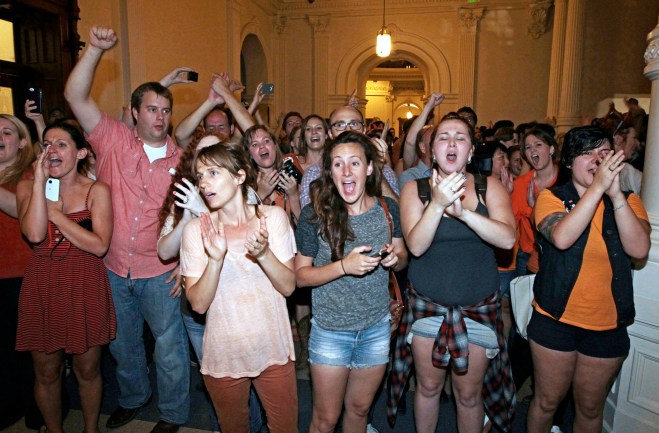
Protesters In Texas Statehouse Block Texas Lawmakers From Passing Abortion Bill

We used to live on a planet defined by collectivism/communism and individualism/market capitalism. It was a crude way to describe the second half of the 20th Century, but it worked relatively well. Vast, stultified masses were toiling under the disproven theories of dead Victorians in Russia, China, and parts of South America; while the West either endured a kind of socialism (in Western Europe/India) or a more robust capitalism. We know how that struggle played out. What we didn’t know was what would replace it, when India, China and Russia – let alone South America – embraced, in varying degrees, the tangible success of the market in making people’s material lives more pleasant than at any point in post-hunter-gatherer human history.

But we know now. Market capitalism could not be restrained merely to the economic realm. It necessarily empowered individualist challenges to tradition and totalist faith – and, empowered also by the information technology revolution – these challenges could not be TURKEY-POLITICS-UNREST-DEMOgeographically contained any longer. And so in the increasingly fundamentalist Pakistan, one of the most popular Google search terms is “gay sex”. In Nigeria, 30 school children are burned alive for the crime of getting educated outside of religious rote indoctrination. In Tehran, ecstasy is easy to find, while in the Iranian hinterlands, young gay men are hanged in public. In Turkey, middle class secularists are in open revolt against creeping Islamization. In Israel, the once largely secular socialist country is becoming more and more dominated by religious fundamentalists who are now shaping its foreign policy in such a way as to provoke religious war rather than prevent it.

In Egypt, we have just witnessed a key precedent for civil war. The secular pragmatists and liberals – having lost to Islamists in the last election by a landslide – have engineered a counter-coup against the incompetence and fundamentalism of the Morsi government, which showed not the faintest clue of how to run a country. What is particularly striking to me is how each side now has a clearly different set of facts than the other. For the secularists, it is a given that the Muslim Brotherhood started the fracas that became yesterday’s massacre. For the Islamists, and anyone with open eyes, the overwhelming evidence is of a premeditated slaughter of unarmed citizens.

In America, violence, mercifully, is held at bay in these struggles, but the political system has effectively ground to a halt under their weight. Despite getting fewer votes than the Democrats for president, House and Senate, the Republicans are using their gerrymandered majority in the House to block even executive branch appointees from approval. They are determined to destroy universal healthcare. Rick Perry Leads "The Response" Prayer Rally In HoustonThey are launching a national campaign to shut down abortion clinics. They deny climate science. They voted against tax cuts – purely because a Democratic president proposed them.
There are relatively easy compromises to be had right now in a sane republic: short-term stimulus accompanied by long-term structural tax and entitlement reform; reform of universal healthcare to empower individuals rather than burden companies; pricing CO2 more aggressively to abate climate change; investing in infrastructure to help accelerate growth in the long run. There are good arguments to be had in all these areas – how best to tackle climate change? what share of the economy should the welfare state take as boomers age? – but the differences, compared with the crises facing many other countries, are relatively minor.

But the cultural gulf has rarely been as deep or as wide. My view on this is that our division is not really about politics or even ideology. Ideology is an often ill-fitting misnomer for something much more powerful – deep cultural alienation between the two parts of America. That alienation, in my view, is at its core the same alienation we are seeing in countries as diverse as Turkey and Egypt and Iran and Israel. It’s about the response to modernity – a choice between fear/rejection and relish/adoption. It’s between a red world and a blue world. Or rather an increasingly blue world in deadly conflict between an increasingly red one.

David Brooks reviewed Charles Taylor’s masterpiece, “The Secular Age”, today. Money quote:

Taylor’s investigation begins with this question: “Why was it virtually impossible not to believe in God in, say 1500, in our Western society, while in 2000 many of us find this not only easy but even inescapable?” That is, how did we move from the all encompassing sacred cosmos, to our current world in which faith is a choice, in which some people believe, others don’t and a lot are in the middle?

The real question, however, is how societies can retain their coherence and unity when they are caught between the reassuring certainties of fundamentalism and the exhilarating disorientation of modernity. The worldviews are from such different places – and are now penetrating cultures which, before the globalization of information, were able to keep them at bay. And so a mutilated woman in Saudi Arabia can see unfathomable sexual pornography with a click of a mouse. And young, hip Tehran youth look on in disbelief as the crudest forms of religious frenzy guide an economy toward the rocks. If you go from the central cities of these countries and venture further and further into the rural heartlands, you will find not only that the blue parts of these countries are getting bluer, but that, in response, many of the red parts are getting redder. Soon, both parties create a different set of facts, as well as beliefs, about their world. Until they are barely able to communicate with each other at all.

The places where these forces are not as strong are in Western Europe and China – where traditionalist religion has either died or was killed by decades of brutalizing communist atheism. But in those countries where fundamentalism has not lost its power, and where ISRAEL-RELIGION-JUDAISM-WOMENmodernity has not lost its seductive appeal, the conflict is deepening. I thought Barack Obama could somehow transcend this, and help move us forward. He has in many ways, but he is not engaging in an argument with his opponents, because in a religious and cultural war, arguments are just less potent than symbolism, resentment, identity and a divine claim to absolute truth. My fear is that these two forces are intensifying the strength of the other. Egyptians now have their own set of facts about yesterday’s massacre – but we in America have FNC and MSNBC. And the more the fundamentalist forces recoil from a multi-racial, multi-cultural, sexually free society, the more secularists are tempted to move from condescension to outright hostility. Before long, we have atheism in its most unadulterated form banishing people of faith from any role in public discourse – and vice-versa (think of climate denialism among those declaring God in control of the weather).

All of this is an epic struggle for meaning – and the possibility of meaning in any communal sense. That’s why it’s so intractable. That’s why it is tearing countries and cultures apart. That’s why reasoned debate, however vital, is so disarmed right now. Because pride, honor and identity are at stake. The ressentiment in the rural heartland is echoed by the bigotry of liberal, urban Americans when they discuss their fellow citizens in the redder, fundamentalist states.

I’m not sure there can be a political resolution to this in the short term. Obama was as good a try as any – and he has made under-EGYPT-POLITICS-UNRESTappreciated pragmatic progress in reforming America, shifting our foreign policy back toward sanity, saving us from a second Great Depression or the fate of much of Europe, and even winning universal healthcare. But there comes a point at which he simply hits a brick wall, just as the Islamists did in Egypt and the Green Movement did in Iran and the secularists have in Turkey and the liberal individualists in Tel Aviv against the settlers on the West Bank.
The only way through this impasse is through religious reform, in my view. This may take more than my lifetime. But proving the ineptness of theocracy, exposing the fallacies of the fundamentalist psyche, while treasuring varieties of religious experience that include within them a toleration of the conscience of others, is surely the only way forward. It will not be easy getting to a more purple world. But if it is not possible, then we face a century of warfare and social dysfunction. The unanswered question, to my mind, is whether this dynamic has so purged religious institutions of free thinkers and writers and theologians and saints that it has sealed its own – and everyone else’s – demise. As a Christian I refuse to believe that. But as a writer and observer of the world, it becomes harder each day.

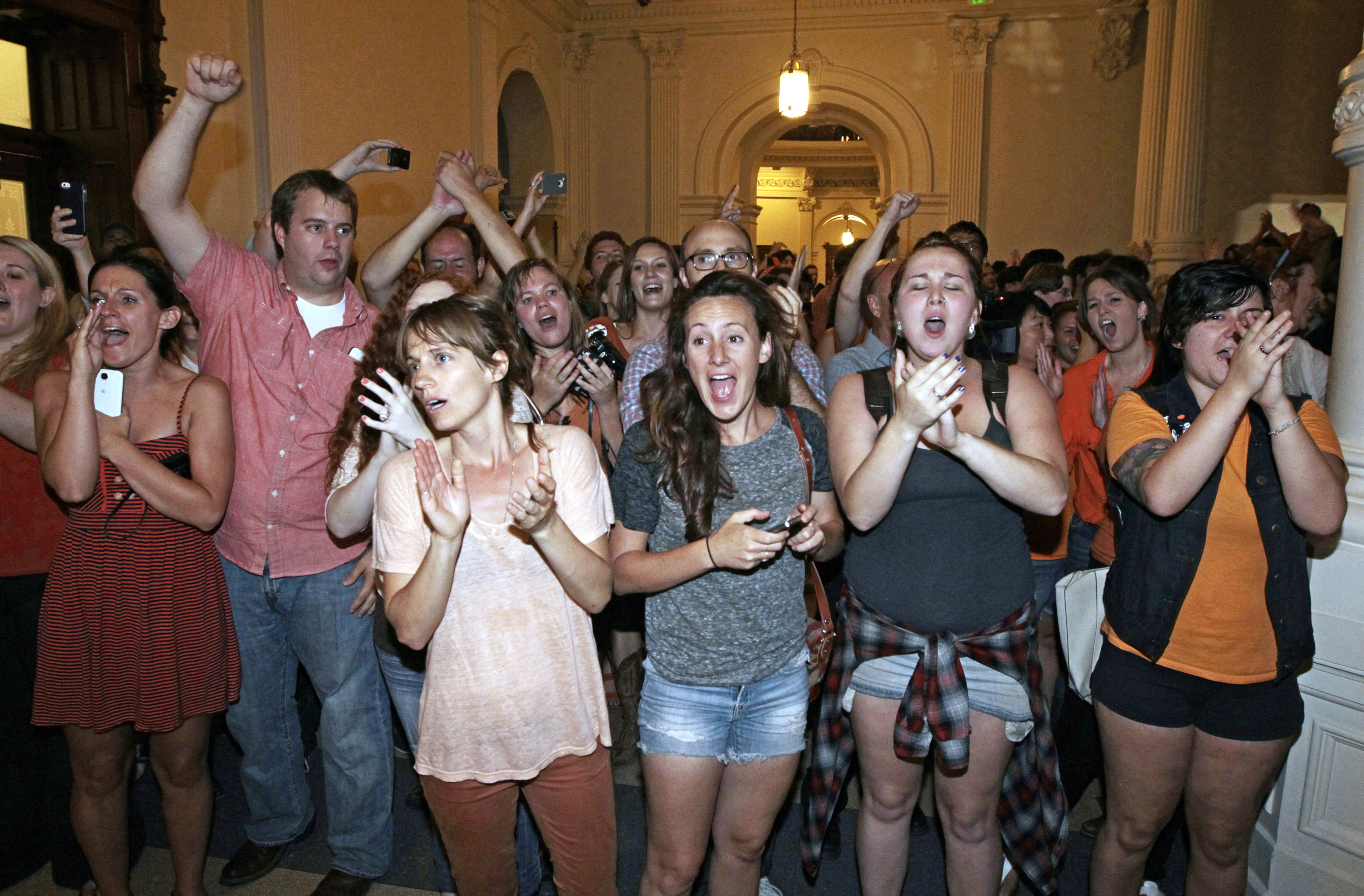
(Photos in descending order: Reproductive rights advocates fill the Texas capitol celebrating the defeat of the controversial anti-abortion bill SB5, which was up for a vote on the last day of the legislative special session June 25, 2013 in Austin, Texas. By Erich Schlegel/Getty Images.

A woman protestor plays with a water gun on Taksim square on July 6, 2013 before clashes on Istiklal Avenue in Istanbul. Riot police fired tear gas and water cannon on July 6 to disperse some 3,000 demonstrators who tried to enter flashpoint protest spot Taksim Square in Istanbul. By Bulent Cilic/AFP/Getty Images.

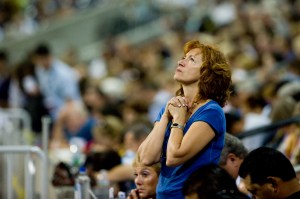
Donna George of Houston, TX, stands and prays during the non-denominational prayer and fasting event, entitled ‘The Response’ at Reliant Stadium August 6, 2011 in Houston, Texas. Thousands attended the event organized by Gov. Rick Perry in order to pray for God to help save ‘a nation in crisis’ referring to America. By Brandon Thibodeaux/Getty Images.

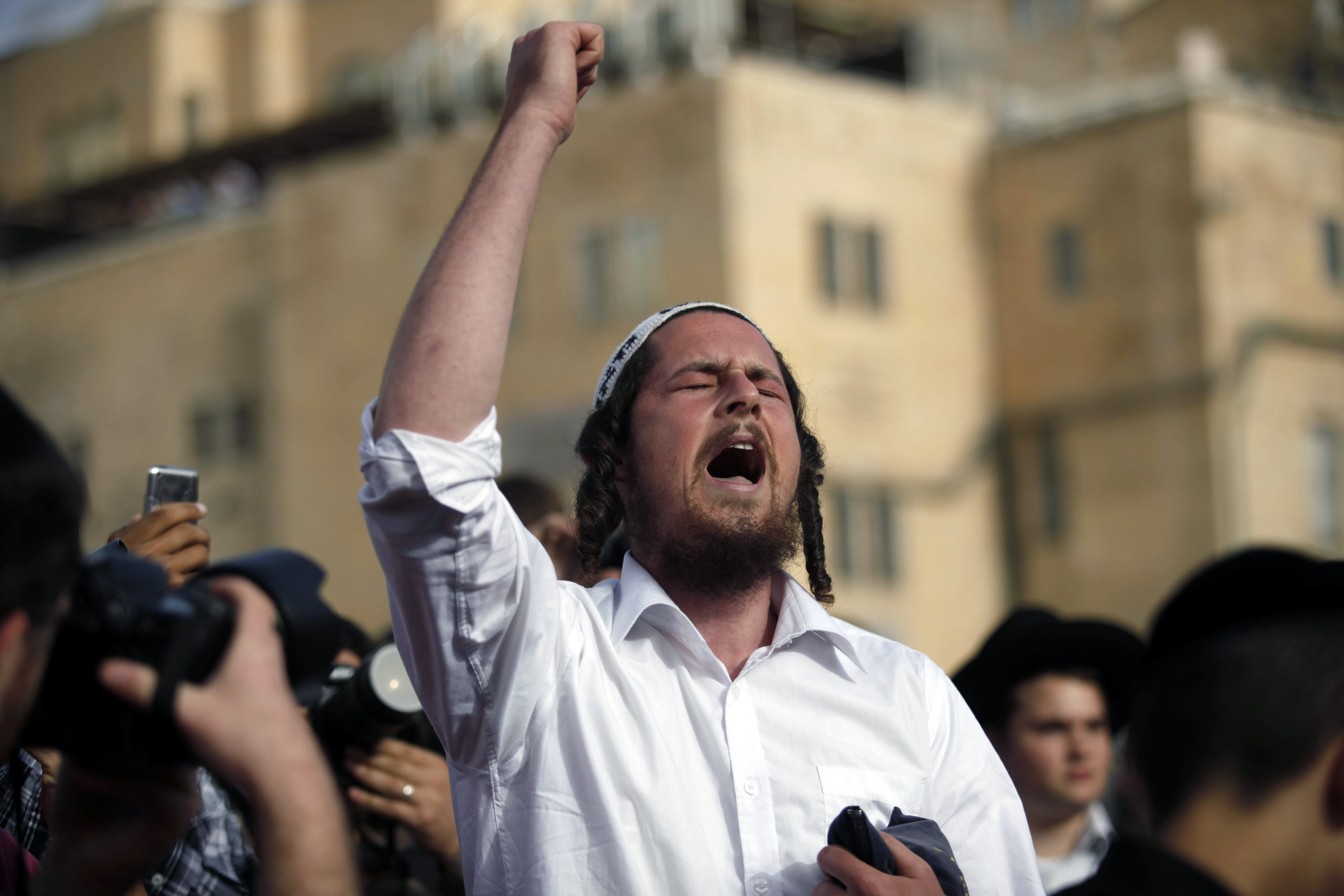
An Orthodox Jewish man chants slogans to protest against members of the liberal Jewish religious group Women of the Wall who pray with traditional Jewish prayer apparel for men on June 9, 2013 at the Western Wall in Jerusalem’s Old City marking the first day of the Jewish month of Tamuz. By Gali Tibbon/AFP/Getty Images.

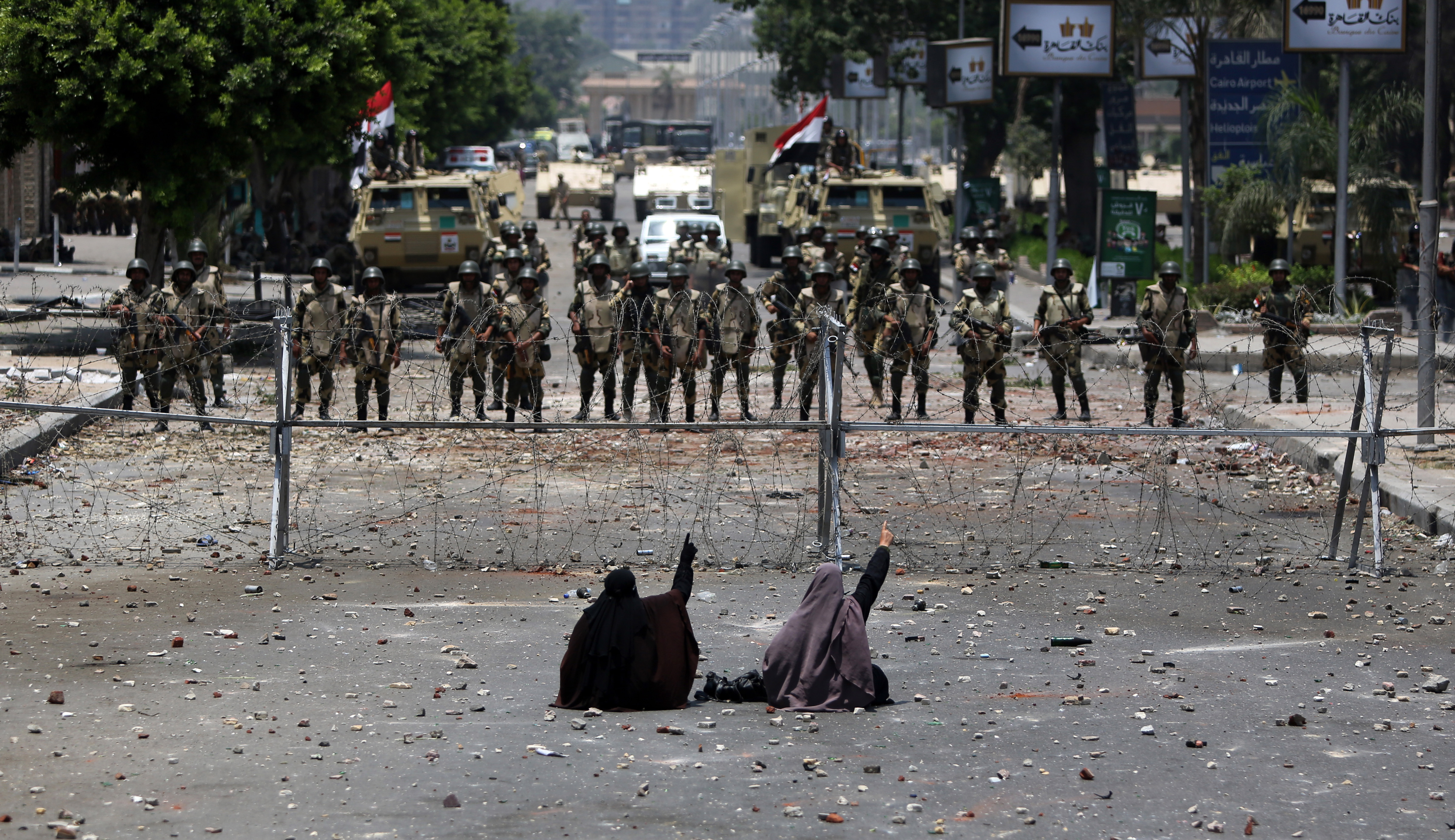
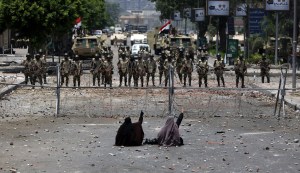
Egyptian supporters of deposed president Mohamed Morsi sit in front of barbed wire fencing that blocks the access to the headquarters of the Republican Guard in Cairo on July 8, 2013.  By Mahmud Hams/AFP/Getty Images.)
The View From Your Window Contest: Winner #161

vfyw_7-6

A reader writes:

Ok, more red-roofed buildings. What is this, like the fourth one in the last two months? I was thinking of the combo of more modern buildings with tin shacks to be China, again, but the area is more a feeling of somewhere else in Southeast Asia. I’m going out on a limb to think it’s in the Philippines, but I can’t find a single visual clue to pinpoint a city, so I’m just going with Manila. (It’s probably Burma, or Thailand, huh?)

Another:

The tropics somewhere, but there is something about the cream-colored walls and the red tin roofs that make me think of San Jose, Costa Rica!

Another:

Pretty sure that’s one of the favelas outside of Sao Paulo. Might be one outside of Rio.

Another gets on the right continent:

Kampala, Uganda? The hills, trees and architecture are consistent. As a guess I’d put the photo on the east side of the city near the Jinja/Kampala road, near Mbuya.

Another:

Kampala? This is an easy one for me simply because I am looking out on a very similar view from my window as I write this. Wonderful place by the way, despite all the negative press it receives back in the states. The weather is about as perfect as you could ask for and the people are very friendly.

Another:

I’d say that this is surely le pays de mille collines. In a big city, so we’ll say Kigali. From there, it’s hard to say.  The Serena Hotel has metal railings on the exterior-facing windows, so it’s a possible match. So: 3rd floor from the Serena Hotel, Kigali, Rwanda. I don’t have any stories from there, never having been, but I have taught English to many Rwandan immigrants here in Brussels.

Another nails the right city:

This picture reminds of the city I grew up in … Addis Ababa, Ethiopia. Although I left the Ethiopia about 10 years ago, my best guess is the picture is taken from the Top View restaurant.

Our grand champion strikes again:

Normally when you find a view, you also find where the picture was taken from, such as a specific hotel or apartment building. But this week’s view is so far off the map that I’m left hoping the viewer will provide us details about their location. In any case, here goes:

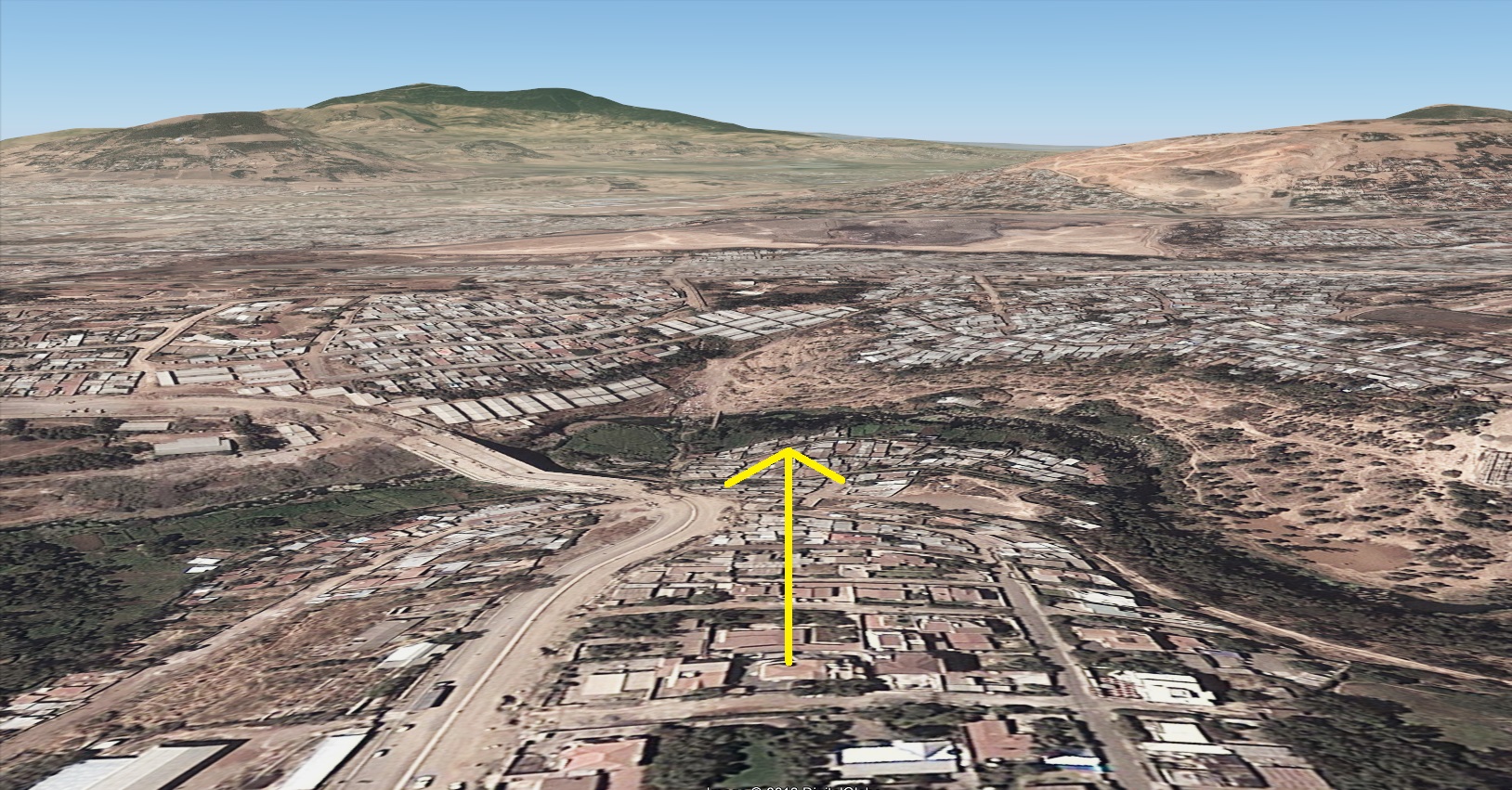
This week’s view comes from Addis Ababa, the capitol of Ethiopia. The view was taken from a modest high rise building and looks south by southwest along a heading of 212 degrees. As I couldn’t find your viewer’s address, the best I can do is provide the approximate coordinates which are 8°59’7.74″N and 38°43’11.87″E. The neighborhood does contain quite a few orphanages, NGOs and Christian groups with links to the U.S., so if I had to guess I’d say your viewer might be involved with one of them. A marked bird’s eye view is attached.

VFYW Addis Ababa Marked - Copy

(When I opened the original file’s metadata [the original file was subsequently swapped out] I saw an “8” for the longitude or latitude before looking away, so this response is partially a cheat, but I figured I’d send it in if you need the copy. Ironically, I thought the 8 was for longitude, which initially led me to exclude Addis Ababa when I found it using clues in the image.)

Thus, only one reader – the native Ethiopian – correctly guessed the window this week without any hidden help. From the reader who submitted the photo:

Here is a view from the top floor of our house in the Old Airport neighborhood as we pack up and leave this beautiful, if exasperating at times, country after three years.

The reader follows up:

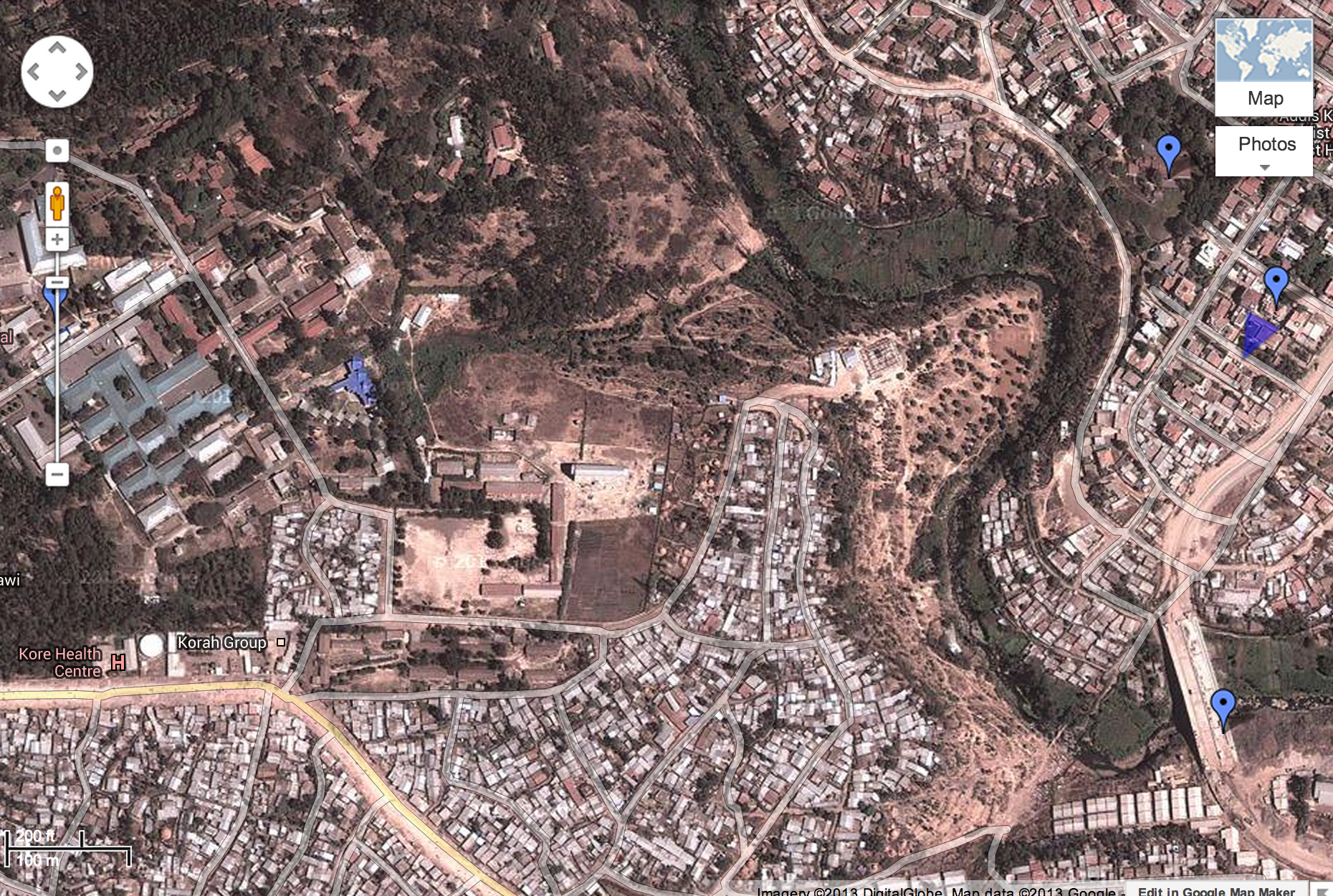
Excited to see my VFYW submission as your contest this week. I’m not particularly tech savvy (and I moved two weeks ago, so I can’t snap any additional angles), but here is a Google Map to pinpoint the location:

Screen Shot 2013-07-09 at 12.54.28 PM

I’m expecting that this will be one of the harder contests, since we lived in one of the outer neighborhoods without any noticeable landmarks looking south. And to be honest, there aren’t a whole lot of landmarks beyond obvious monuments and government buildings in all of Addis, so this should be a stiff test for even the diehards.

One of the interesting characteristics of Addis that sets it apart from other African capitals is the mix of classes in all neighborhoods. Although there are certainly rougher areas to avoid, there is no one place that serves as a rich or privileged enclave. Old Airport (the area where this picture was taken) tends to have a lot of ferenji (foreigners) due to close proximity of the African Union and the largest international school. Even so, there are a lot of simple homes and shanties mixed in as well. Houses tend to be on walled compounds that are a bit of overkill, since Addis has a low crime rate and violent crime is rare. We enjoyed walking to shops and the school although every time I went out for a jog I got a lot of bemused looks and cat calls of “Haile Gebreselassie”.

Ethiopia is a fascinatingly idiosyncratic country with its fair share of problems. Hopefully more of the benefits of its recent economic growth will start to flow down to the masses.

(Archive)

How Barbaric Is Force-Feeding? Ctd

Readers voice skepticism over this disturbing video:

I feel churlish for pointing this out, since I, too, want to see the forcefeeding of Gitmo detainees stopped, but since this undercuts the strength of the argument, it’s worth point out that Mos Def is an actor. Moreover, he’s a very good actor, having been nominated both for an Emmy and a Golden Globe for a powerful performance in this movie.  Which means that he (unlike Hitchens) may not have been the best person to do this. I fear there are going to be no shortage of neo-cons who will say he was exaggerating very convincingly (though you could always challenge one of the doubters by telling them to try it for themselves).

Another:

Call me cynical, but isn’t it strange that Yasiin is literally begging the people doing the procedure to stop? The whole project is voluntary, right? Why wouldn’t they stop when he first asked them to? I’d wager it’s because they knew that having Mos beg for a bit would better persuade the viewer of the horrors of forced feeding. I don’t mind that so much as a cause marketing idea, except that it presents an inaccurate picture.

Undergoing NTF in and of itself, one time, is not actually such a debilitating or psychologically damaging thing. In fact, it’s pretty commonly done in hospitals and at home, even for children, who presumably have a lower tolerance for pain than a grown adult. I agree that subjecting Guantanamo prisoners to this twice a day, against their will, constitutes torture, but I think it’s patently obvious that Yasiin was doing a bit of acting here. Which is a shame, because it cheapens what is otherwise a correct and important message.

Another speaks from experience:

This past January, I began tube-feeding – or “force feeding” – my son, who is just under two years old.

He had become dangerously underweight due to a medical condition, and could not take food by mouth, so this was the safest way to feed him. The tube, called an NG tube, is not dissimilar to the one in the Mos Def video.  It’s just smaller – more appropriate for a child.  To insert it, I hold his head still (I have to use a strong grip) while my husband measures an appropriate length of tube out, and then pushes it through his nostril and into his stomach  My son struggles, cries, and yells, and we have to swaddle him to keep him from using his arms to block us.  He’s usually gagging as it goes down his throat.  Sometimes he vomits while we’re placing the tube, and we have to stop and wait 5-10 minutes before beginning the process again.

The first time we did it was the worst.  He screamed, and, really did look like he was being tortured.  We’ve had to do it 8-10 times since then, and it’s gotten easier. Nowadays, he no longer looks frightened, but is clearly deeply uncomfortable during the insertion. Once it’s in, he’s fine.  Food is pumped into his stomach 2-3 times a day; he’s usually watching television or peacefully sleeping when he’s being fed.  No discomfort whatsoever.

My son is one of many.  Hundreds of children are either born or later develop conditions that make tube-feeding a necessity for some amount of time.  I learned about them at this website.

Like you, I find the situation at Gitmo an abomination.  And I loathe how this practice refuses these men the right to their own bodies (and I agree with Steve Chapman).   Still, every time you or someone else writes that force-feeding is “barbaric” or “grotesquely inhumane” (and especially when they compare it to water-boarding) I cringe, as I’m sure many other parents of NG tube-fed children do.

Another notes:

For what it’s worth, efforts have been made to categorize the pain associated with common medical procedures.  Insertion of a nasogastric (NG) tube is considered among the most painful of common procedures, according to surveys of patients.  This procedure ranks ABOVE reduction (re-alignment) of a fractured bone.  To do this to people against their will, repeatedly, is beyond inhumane.  One of the lessons I take from these studies is that I owe my patients a bit of IV opiate painkiller (fentanyl, morphine) before proceeding to place the tube; I doubt the prisoners at Gitmo are accorded such compassion.

The Last Lesson We Learn From Our Pets, Ctd

Redding(2)-3-29-13

A reader sends the above photo:

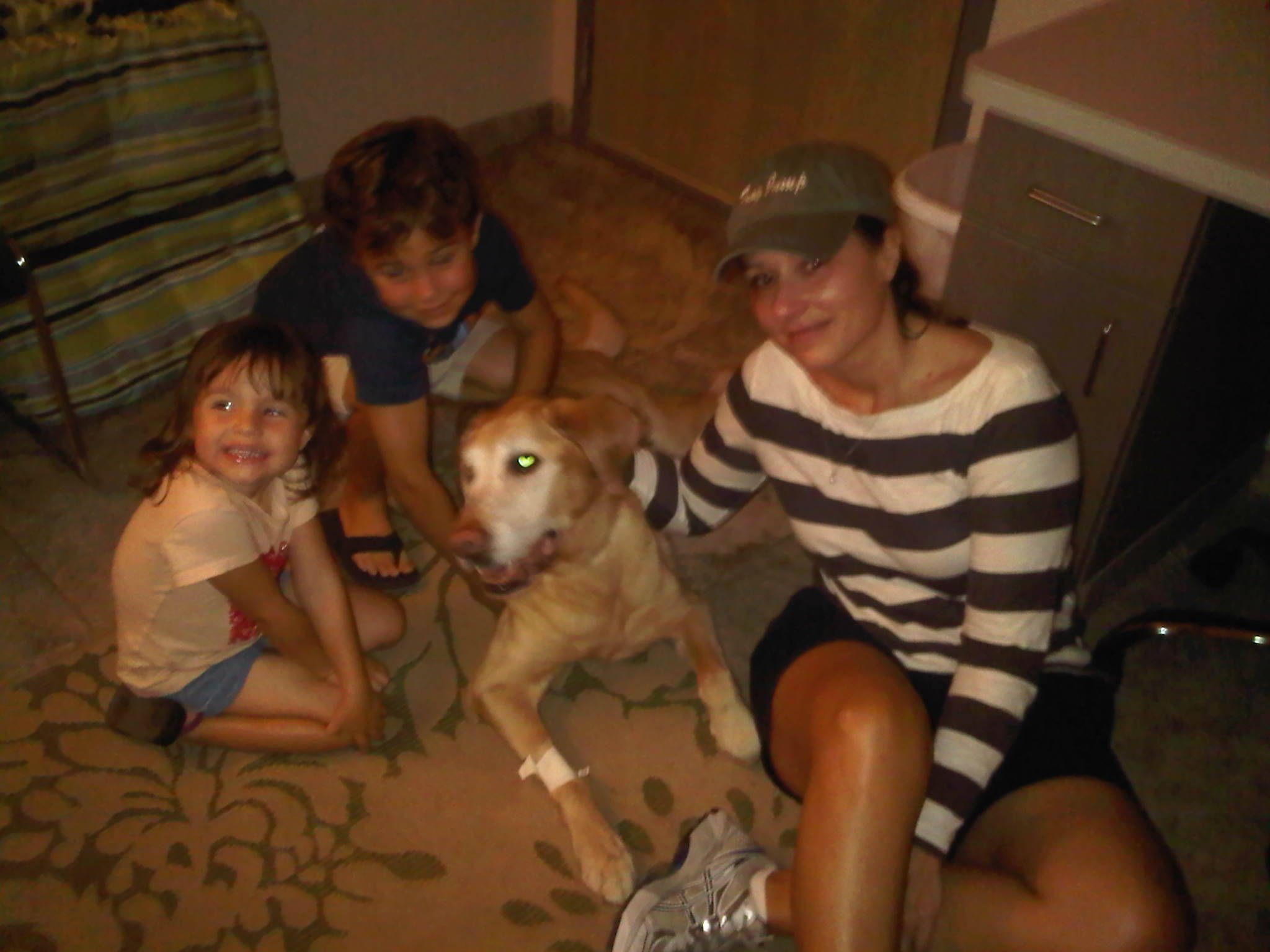
I don’t know you from Adam, but I do subscribe to your blog.  My wife and I just put our dog down yesterday. I attached a picture of him sedated. The vet tech gave him a shot and he went from panting in pain to this peaceful rest.  They gave us 10 or 20 minutes alone with him and then came in and administered the overdose of anesthesia.  We petted him while he passed on.

I often look to your blog to try and find comfort when things happen in the world.  I guess now I am looking for something on a personal level.  Thanks for listening.

Another reader:

I just read your post about Dusty and twice you used the phrase “put down” (the first time without quotes). For the love of God and all that’s holy – I’m an atheist – can we please start a movement to change that horrible phrase? Put down? That’s something you do to a phone or a bottle or a piece of luggage. It’s absolutely NOT what you do with a companion who’s been there through thick and thin; who’s been loved and loved in return. I very recently had to let go of my big Endymion, a gorgeous, amazing, friendly and loving cat of many years and I cry whilst writing this. I most certainly did not “put him down.” I let him go. Let go > put down.

Good luck with Dusty, you have my love and support.

Another:

I’m sure mine will be one hundreds of notes you get on this topic.  It’s one I have been thinking about for many 1044795_10201205134237952_1267167286_nmonths now.  My dog, my very first dog, was diagnosed with incurable cancer last October.  With treatment, we were told he would like have a year.  And so treatment it was. It’s been nine months, and I have fought through an extended grieving process.  Beyond the medical treatments, the dog has suffered longbouts of anxiety that we have struggled to manage.  I have often found myself thinking that if it is this much of a struggle with the dog, what will happen when my now 60-year-old parents start to wind down their lives?  My dog, through his illness and eventual death, is teaching me how to plug ahead, and to love, cherish and find grace in a friend whose time is limited.
At the moment, things have normalized.  And we are loving the hell out of our buddy while we can.  His personality is back for the most part, as you can see in the included photo.

Another was better able to cope with the death of her 92-year-old grandmother after the loss of her pets:

In the last four years, we have had to put three pets to sleep.

Our first was our 12-year-old lab, Max, who suffered from severe hip dysplasia and then got cancer.  We opted not to do chemo because he was already feeble.  We tried some natural remedies that I do believe gave us a few more good months with him.  When we made the decision to put him down, he had stopped eating and could not pick himself up to walk outside.

Our cat got a cancer diagnosis about two years after Max was put down.  He was almost 19 years old and the cancer was in his nasal passage, which caused him to not be able to breathe very well.  We tried some medications to reduce the size of the tumor, but ultimately we had to put him down about a month after diagnosis, when his reduced oxygen intake made him disoriented and very weak.  His kidneys also started failing.

Our second lab, Cooper, who was our first “child” together (Max having come into our marriage from my husband and kitty from me) got a cancer diagnosis about a year after Max was put down, which resulted in us having to amputate one of his hind legs.  He rebounded from that almost immediately and enjoyed life as a tripod until last fall.  I had noticed that it was taking him some extra time to pull himself up to standing position and that he seemed to lose his balance more often.  He was 11, so I did not give it to much thought.  We had not noticed any new tumors in our check-ups.  Cooper always acted like a puppy and was so happy to be around us.  His behavior did not change as he got older; he was always a happy dog and, for some reason, chose me as his favorite person.  I liked to call him my 85-pound lapdog.

When he stopped eating for a few days, I immediately took him to the vet.  It was cancer again, but this time a different, more aggressive form than what led to the earlier amputation.  Hemangiosarcoma.   Cooper had tumors on most of his major organs.  These types of tumors were filled with blood vessels in danger of rupturing at any moment and causing massive internal bleeding.  In fact, it appeared that some of the tumors may have already ruptured, as his abdomen was partially filled with blood (which is why he would not eat). During the time these tumors were growing and spreading, he never act like he was in pain, he just appeared weaker than normal.  I would have to help him into our bed at night (where he normally slept) because he could no longer make the jump.  He needed a little assistance walking up steps.  He never stopped being the most loving dog, furiously wagging his tail anytime one of us was around.

When the vet confirmed the nature of the cancer and the risks of massive internal bleeding if one of the larger tumors ruptured, we made the decision that very day to put Cooper down.  While it had been difficult with Max and the kitty, because they both had seemed so physically and mentally ready to go, the grief in making the choice to end their suffering was somewhat manageable.  With Cooper, his overall personality remained fairly unchanged.  He was still so happy and loving at the time of his last diagnosis.  The staff at the vet hospital even remarked on what a happy tail-wagger he was.  That made it a much more difficult decision because I wanted to take him home and spend more time with him.

Knowing that the tumors on his organs could rupture at any moment and cause him to have a terrible, painful death, however, helped us make our decision.  We could not allow that to happen when we had a chance to ease him into wherever he would next be going.  We brought our kids to the hospital and we spent a good hour just hanging out with Cooper in a room by ourselves and saying our goodbyes.  When it was time, my husband took my kids out, and I laid down next to Cooper and held him and talked to him while the injections were made and for some time thereafter.

I miss him so much, and even though deep down I know we made the right decision for Cooper, I wonder if he could have comfortably lived a few more months.  On the other hand, I also wonder and fear that he had been in pain much longer than we ever knew, and his sweet, loving disposition just masked his pain and discomfort.

All of this is to say that the lives and deaths of Max, kitty, and Cooper have helped me get through other things in my life.  After we had put down Max and kitty, my grandmother was diagnosed with pancreatic cancer at age 92.  She was at home with hospice care for several months.  I think having gone through the passing of Max and kitty helped me through the passing of my grandmother.  I had not previously lost any human member of my family that I was especially close to.  My grandmother’s passing in some ways helped me through Cooper’s death (she died about three months before he did), and his passing likewise helped me with accepting my grandmother’s death.

I wish the best for you and Dusty and just wanted to relay that, based on my experience with the four (or three)-legged loved ones in our lives, it is true that you will know when it is the right time to let them go.

The real reason I wanted to write to you, though, was to share a picture with you.  During our last moments with Cooper, my husband took a picture of the kids and me with him.  I was so torn up after putting him down that it took me two weeks to even look at the picture:

cooper2012

While the photo is a bit fuzzy, I hope you can see the extra-special twinkle in Cooper’s eye.  This was his last gift to me and so typical of who he was.

Previous reader stories here.

Globalized Indifference, Ctd

2007 study in The Quarterly Journal of Economics found that 40,000 people must die in a drought to receive the same amount of US news coverage as a single person who dies in a volcano-related incident. Similarly, a disaster is 5 percent less likely to make American news and 6 percent less likely to receive relief if it occurs during the Olympic Games. Beth McMurtrie highlights new research on how causes break into the public eye:

[N]ongovernmental organizations, government agencies, and others who work in human rights and development—what [political scientist R. Charli] Carpenter refers to as global issue networks—are performing a deliberate calculus when they decide where to spend their energies. What matters isn’t necessarily the urgency of the cause, but whether they think they can sell it to the public and muster the resources to run an effective campaign.

Carpenter used surveys and focus groups to ask leaders of advocacy groups about the factors that come into play in deciding whether to turn problems into causes.

Responses were blunt: There needs to be a victim and a perpetrator. Some issues are “too complex” to advocate for. And if no clear solution is in sight, the problem is that much harder to rally around. “People need to be able to feel like they can make a difference,” said one participant.

The Power Of Maps

dish_bungedetroitmap

Cartographer Denis Wood considers his craft:

I’ve seen maps that I find completing terrifying. Maps of uranium mining and of various illnesses in the Navajo reservations—they’re just insane. They just make you furious. Bill Bunge’s map—which I still think is one of the great maps, the map of where white commuters in Detroit killed black children while going home from work—that’s a terrifying map, and that’s an amazing map.

He knew that. They had to fight to get the data from the city. They had to use political pressure to get the time and the exact location of the accidents that killed these kids. They knew what they were looking for. I didn’t have anything to do with that project, so when I saw the map for the first time, it was like, “Oh my god.” It’s so powerful to see maps like that. That’s the power of maps, or one of the powers of maps: to make graphic—and at some level unarguable—some correlative truth. We all knew that people go to and from work. But to lay the two things together reveals something horrible.

Update from a reader:

The Curbed LA blog posted a map yesterday showing human life expectancy in the different communities in the Los Angeles area. Of note, residents of Watts live an average of 11.9 fewer years than residents of Bel Air.

Recent Dish on maps here, here, and here.